Anthropic Tests "Lobster" Conway: Supports Independent UI, Webhook Activation, and Custom Extension Standards

marsbitPublicado a 2026-04-02Actualizado a 2026-04-02

Resumen

Anthropic is actively developing "Conway," a persistent agent solution designed to provide Claude with an always-on, independently running intelligent environment. It features a standalone UI instance, operating as a traditional chat interface and more of a dedicated workspace. Conway can directly control browsers, connect to external services, and integrate Claude Code for deeper code execution and task handling. It supports Webhook-based invocation, enabling external services or events to trigger automated workflows. Additionally, Conway will support for extensions through the upcoming CNW ZIP standard, allowing developers to build custom tools, UI tabs, and context handlers, similar to an app store ecosystem. This enhancement aims to transform Claude from a reactive conversational tool into a proactive, multi-step task assistant, positioning it as a strong competitor in the AI agent space and advancing the trend toward always-on AI capabilities.

Anthropic is actively developing a persistent agent solution named Conway, aimed at creating an always-on, independently running intelligent environment for Claude.

According to related information, Conway will feature an independent UI instance, moving beyond the traditional chat interface to operate as a standalone agent workspace. It will be capable of directly controlling browsers, connecting external connectors, and integrating Claude Code functionality (potentially involving Epitax-related features), enabling deeper code execution and task handling. Simultaneously, Conway supports invocation via Webhooks, allowing external services or events to trigger agent workflows, thereby boosting automated response capabilities.

Additionally, Conway will support an extension system. Anthropic is set to launch the CNW ZIP standard, which developers can use to easily build custom tools, UI tabs, and context handlers, forming an ecosystem expansion capability similar to an "app store." This will significantly enhance Claude's flexibility and scalability in handling complex tasks.
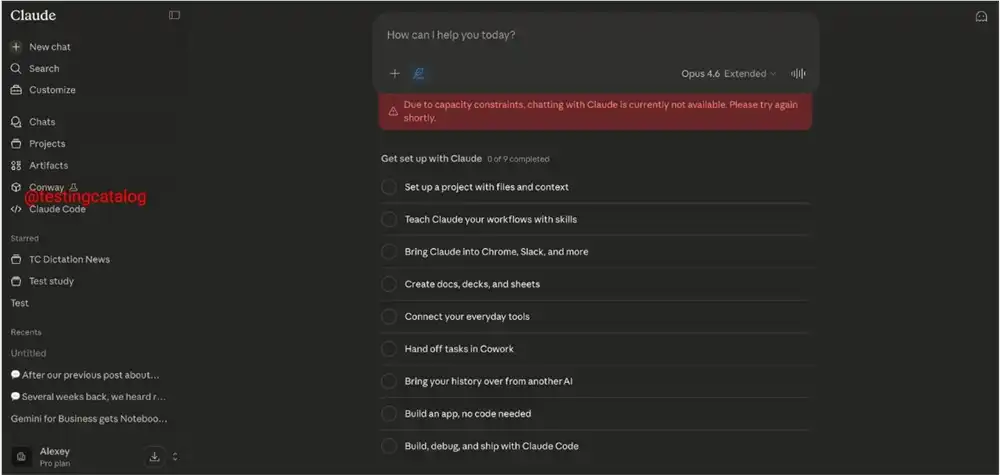
The emergence of Conway is seen as a key strategic move by Anthropic in the AI agent domain, aiming to transform Claude from a passive conversational tool into a persistent assistant capable of continuous operation and autonomous execution of multi-step tasks. It not only supports browser automation and event triggering but also strengthens code generation, execution, and problem-solving capabilities through native integration of Claude Code.

Industry observers believe that Conway has the potential to become a strong competitor to rivals like OpenClaw, driving the advancement of AI agents toward an "always-on" direction. The era where Claude can truly "show its prowess" may be just around the corner.


Preguntas relacionadas

QWhat is the name of the persistent agent solution being developed by Anthropic for Claude?

AThe persistent agent solution being developed by Anthropic for Claude is named Conway.

QHow does Conway differ from a traditional chat interface?

AConway differs by being an independent UI instance that operates as a standalone agent workspace, capable of directly controlling the browser, connecting to external connectors, and integrating Claude Code functionality.

QWhat method does Conway support to allow external services or events to trigger its work?

AConway supports being invoked via Webhook, which allows external services or events to trigger the agent's work and enhance automated response capabilities.

QWhat is the name of the extension standard that will allow developers to build custom tools for Conway?

AThe extension standard that developers can use to build custom tools, UI tabs, and context handlers for Conway is called the CNW ZIP standard.

QHow is Conway expected to transform the role of Claude according to the article?

AConway is expected to transform Claude from a passive conversational tool into a persistent assistant that can run continuously and autonomously execute multi-step tasks, moving towards an 'always-on' AI agent direction.

Lecturas Relacionadas

Can a Hair Dryer Earn $34,000? Deciphering the Reflexivity Paradox in Prediction Markets

An individual manipulated a weather sensor at Paris Charles de Gaulle Airport with a portable heat source, causing a Polymarket weather market to settle at 22°C and earning $34,000. This incident highlights a fundamental issue in prediction markets: when a market aims to reflect reality, it also incentivizes participants to influence that reality. Prediction markets operate on two layers: platform rules (what outcome counts as a win) and data sources (what actually happened). While most focus on rules, the real vulnerability lies in the data source. If reality is recorded through a specific source, influencing that source directly affects market settlement. The article categorizes markets by their vulnerability: 1. **Single-point physical data sources** (e.g., weather stations): Easily manipulated through physical interference. 2. **Insider information markets** (e.g., MrBeast video details): Insiders like team members use non-public information to trade. Kalshi fined a剪辑师 $20,000 for insider trading. 3. **Actor-manipulated markets** (e.g., Andrew Tate’s tweet counts): The subject of the market can control the outcome. Evidence suggests Tate’sociated accounts coordinated to profit. 4. **Individual-action markets** (e.g., WNBA disruptions): A single person can execute an event to profit from their pre-placed bets. Kalshi and Polymarket handle these issues differently. Kalshi enforces strict KYC, publicly penalizes insider trading, and reports to regulators. Polymarket, with its anonymous wallet-based system, has historically been more permissive, arguing that insider information improves market accuracy. However, it cooperated with authorities in the "Van Dyke case," where a user traded on classified government information. The core paradox is reflexivity: prediction markets are designed to discover truth, but their financial incentives can distort reality. The more valuable a prediction becomes, the more likely participants are to influence the event itself. The market ceases to be a mirror of reality and instead shapes it.

marsbitHace 8 min(s)

Can a Hair Dryer Earn $34,000? Deciphering the Reflexivity Paradox in Prediction Markets

marsbitHace 8 min(s)

First Day Review of "Musk's WeChat" XChat: Even Worse Than Expected

Elon Musk's much-anticipated "WeChat-like" app, XChat, has officially launched after multiple delays. The initial review reveals a product that falls short of expectations, offering an experience largely similar to X Platform's (formerly Twitter) direct messages, despite being marketed as an encrypted communication tool. Key observations from the first-day test include: 1. The app's promoted "end-to-end encryption" and its claimed relation to Bitcoin's architecture were criticized by experts as a superficial attempt to capitalize on crypto buzz, with no real technical connection. 2. Musk's vision of an ad-free "secure communication system" is technically met, but only because the app is currently extremely basic, featuring only a single chat interface. 3. A promised anti-screenshot feature appears inconsistent; it works in X Platform group chats but fails within the XChat app itself, where screenshots still capture avatars. 4. The app supports 45 languages and has a 16+ age rating, indicating a broader tolerance for content compared to WeChat's 13+ rating. 5. A puzzling login process requires users to verify the email associated with their X account. 6. The touted encryption" feels minimal in practice, with its presence only indicated by a simple "Encrypted - Yes" label on messages. 7. Disappearing message timers for groups can be set from 5 minutes to 4 weeks, with the timer starting upon being read by a user. 8. Group invite links are shared with X Platform groups. 9. Group size limits are planned to be increased, aiming for 1000 members, a move that has drawn user criticism. 10. The app offers 8 different colored icons, and its chat bubbles are notably similar to WeChat's. Message deletion options mimic Telegram's. Crucially, many pre-announced features like importing X contacts, integrating Grok AI, X Money payments, and Cashtags are not yet available. The initial release is seen as a bare-bones and underwhelming first step.

Odaily星球日报Hace 1 hora(s)

First Day Review of "Musk's WeChat" XChat: Even Worse Than Expected

Odaily星球日报Hace 1 hora(s)

Trading

Spot
Futuros
活动图片




