Ant Digital Tech Proposes New Architecture for Agent Economy, Covering Four Layers: Identity, Payment, Risk Control, and Compliance

marsbitPublicado a 2026-04-20Actualizado a 2026-04-20

Resumen

Ant Digital Technologies (Ant Digital) has introduced a new architectural framework for the agentic economy, named the "4R Full-Stack Architecture," at the Hong Kong Web3 Festival. The framework is designed to address four core challenges in AI agent operations: identity, payment, risk control, and compliance. The four layers include: - **Agentic Runtime**, featuring DTClaw with the CARLI security model to enforce behavioral constraints and ensure controllability and auditability; - **Payment Rails**, which provide on-chain payment channels supporting smart decision-making, verifiable credentials, instant settlement, and cross-chain asset transfers; - **Agent Registry**, leveraging DIDs and the ERC-8004 standard to assign verifiable on-chain identities to agents; - **Root Infrastructure**, built on Jovay Layer2 and ZKVM technology to enable high-speed micro-payments and trusted off-chain computation with on-chain verification. According to CTO Yan Ying, the architecture aims to resolve fundamental gaps in the current agent economy—such as execution vulnerabilities, identity issues, payment barriers, and trust deficits—by redesigning underlying infrastructure rather than applying superficial fixes. The initiative builds on Ant Digital’s extensive experience in financial-grade security, privacy computing, and blockchain.

On April 20, Ant Digital Tech introduced the "4R Full-Stack" architecture concept for the agent economy at the Hong Kong Web3 Festival, encompassing four layers: Agentic Runtime, Payment Rails, Agent Registry, and Root Infrastructure. This framework aims to provide AI agents with a technical infrastructure covering identity, payment, risk control, and compliance.

Ant Digital Tech CTO Yan Ying pointed out in her speech that the current foundation of the agent economy suffers from "four gaps": execution failures due to prompt logic vulnerabilities, responsibility vacuums caused by AI's lack of credible identity, transaction barriers from payment gateways designed for humans, and collaboration risks arising from a lack of trust between unfamiliar agents. "These cannot be resolved by simply patching software; they require a redesign from the underlying infrastructure level," she said.

According to Yan Ying, the core product of the Agentic Runtime layer is DTClaw, which incorporates the CARLI security model to enforce constraints on agent behavior at the execution level. It supports multi-model compatibility and financial-grade compliance standards, aiming to make every AI operation controllable, auditable, and recoverable.

The Payment Rails layer builds native on-chain payment channels, integrating agent intelligent decision-making with verifiable credential chain technology. This ensures precise payment intent recognition and full-link security control while achieving transparency and immutability in the transaction process. For high-frequency micro-transaction scenarios, the platform constructs a native instant settlement network that supports cross-chain, multi-asset seamless flow, and intelligent routing, significantly improving capital turnover efficiency. Additionally, by providing a standardized development toolchain and a seamless wallet integration experience, the solution greatly reduces development barriers and user costs, forming a payment closed-loop that balances financial-grade security and an optimal user experience.
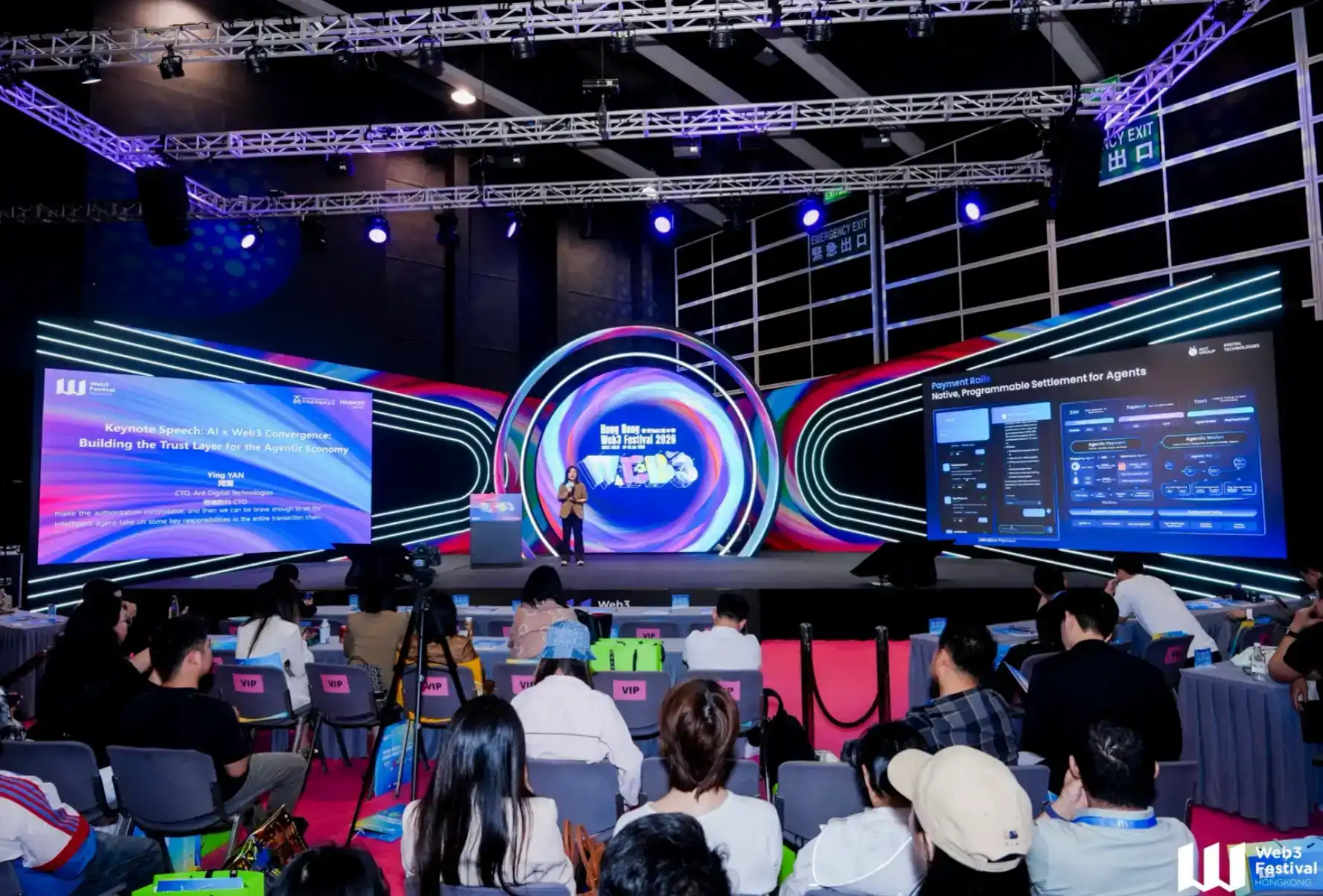
The Agent Registry layer issues on-chain identities for each agent based on DID (Decentralized Identity) and the ERC-8004 standard, ensuring that every collaboration between agents is documented. The Root Infrastructure layer serves as the architectural foundation, utilizing Jovay Layer2 to achieve 120-millisecond confirmation times to support AI micro-payments, and combining ZKVM technology to enable off-chain computation and on-chain verification, addressing the trust issues in AI economy computing power. Yan Ying stated, "The Root Infrastructure uses blockchain and privacy computing technologies to provide agents with an immutable contract execution environment. Even two unfamiliar AIs can establish trust based on code and conduct transactions with confidence."

Currently, AI is evolving from the era of Chat and Action to the era of the agent economy. Yan Ying believes that the qualitative change in the third stage lies not in AI becoming smarter, but in it beginning to possess assets and transaction rights. She noted that over the past decade, Ant Digital Tech has accumulated extensive engineering practices in financial-grade security, privacy computing, blockchain, and compliance systems, and the 4R architecture is built upon this foundation with全新研发和设计 (entirely new research and design).


Preguntas relacionadas

QWhat is the '4R Full-Stack' architecture proposed by Ant Digital Tech, and what are its four layers?

AThe '4R Full-Stack' architecture is a framework for the agentic economy proposed by Ant Digital Tech. Its four layers are: Agentic Runtime, Payment Rails, Agent Registry, and Root Infrastructure.

QAccording to Ant Digital Tech's CTO, what are the 'four fractures' in the current foundation of the agentic economy?

AThe 'four fractures' are: 1) Execution loss of control due to prompt logic vulnerabilities, 2) A responsibility vacuum caused by AI's lack of a trusted identity, 3) Transaction barriers from payment gateways designed for humans, and 4) Collaboration risks from a lack of trust between unfamiliar agents.

QWhat is the core product in the Agentic Runtime layer and what is its primary function?

AThe core product in the Agentic Runtime layer is DTClaw. Its primary function is to enforce mandatory constraints on agent behavior at the execution level, making every AI operation controllable, auditable, and recoverable.

QHow does the Payment Rails layer facilitate transactions for AI agents?

AThe Payment Rails layer builds native on-chain payment channels that integrate agent intelligent decision-making with verifiable credential chain technology. It ensures precise payment intent recognition, full-link security, transparency. It also features an instant settlement network for high-frequency micro-transactions, supporting cross-chain, multi-asset flow and smart routing.

QWhat technologies are used in the Root Infrastructure layer to support the agentic economy?

AThe Root Infrastructure layer utilizes Jovay Layer2 to achieve 120-millisecond confirmation times to support AI micro-payments, and combines ZKVM technology to enable off-chain computation with on-chain verification, solving the trust problem in AI economy computing power.

Lecturas Relacionadas

In Jinjiang, Fujian, a Storage Super Unicorn Lies Quiet

In Fujian's Jinjiang, a city known for sportswear, lies a quiet semiconductor giant: Fujian Jinhua Integrated Circuit Co. (JHICC). Once a promising domestic DRAM manufacturer alongside Yangtze Memory and ChangXin Memory Technologies (CXMT), its journey was derailed in 2018 when the U.S. placed it on an Entity List and filed criminal charges for alleged trade secret theft. This halted production for years. A turning point came in February 2024 when a U.S. federal court found JHICC not guilty. However, it had lost crucial time. While CXMT soared to become a top-valued A-share company in 2024, JHICC, with an estimated valuation of 80 billion RMB, was just restarting. Its current output is primarily customized DDR4 chips, not the advanced DDR5/HBM demanded for AI, but it still benefits from the broader memory chip upcycle. JHICC's story is tied to Chen Zhengkun, a veteran engineer who left Micron to lead the venture. Founded in 2016 with state-backed funding, JHICC partnered with Taiwan's UMC to develop DRAM technology. Rapid progress was cut short by the U.S. actions, which Micron initiated, partly due to its heavy reliance on the Chinese market. Post-sanctions, Chen's team worked to rebuild the production line with reduced reliance on U.S. technology. According to its records, JHICC achieved small-scale production and revenue growth under immense pressure. It now focuses on the stable "niche" DRAM market (e.g., TVs, routers) with a monthly capacity of ~40,000 wafers, aiming for 60,000 by 2026. It holds over 1,000 patents but remains on the Entity List. For Jinjiang, investing in JHICC was a bold industrial leap. The local government provided unwavering financial and logistical support during the crisis, helping the company survive. JHICC has become the anchor for a growing local semiconductor cluster. Though its scale lags behind domestic peers, JHICC's persistence symbolizes a hard-won foothold in a global market long dominated by Samsung, SK Hynix, and Micron. Having missed one boom, it seeks a place in the new AI-driven memory supercycle.

marsbitHace 41 min(s)

In Jinjiang, Fujian, a Storage Super Unicorn Lies Quiet

marsbitHace 41 min(s)

Must-Watch Events Next Week|CLARITY Act Could Face Senate Vote; SpaceX, Circle to Report Earnings (8.3-8.9)

**Summary: Key Events and Developments to Watch (August 3-9)** The upcoming week is marked by significant financial disclosures, key legislative deadlines, and notable product updates. **Major Financial Events:** Several companies are scheduled to release their Q2 2026 earnings. American Bitcoin (ABTC) will report on August 3, followed by SpaceX and Hut 8 Mining Corp. on August 4, and Circle on August 5. Notably, a significant portion of SpaceX shares (up to 12% of total shares) will be unlocked on August 6 following their earnings release. **Key Legislative Deadline:** The U.S. Senate faces an August 7 deadline to secure 60 votes for the CLARITY Act, a bipartisan bill aiming to establish a federal regulatory framework for cryptocurrencies. The Senate may hold a full vote on the bill during the week. **Economic Data:** The U.S. July Non-Farm Payrolls report will be released on August 7, providing crucial labor market data. **Technology & Product Updates:** * **Shutdowns:** DeFi portfolio tracker Zapper and wallet app Ctrl Wallet will cease operations on August 3. * **Upgrades:** LayerZero will deprecate its v1 relayers on August 3. XRP Ledger's new version 3.3.0, featuring five new functions, is expected next week. * **AI:** Elon Musk announced that the advanced Grok 4.6 AI model is set for release around August 7. * **Bitcoin:** The BIP-110 forced signaling for a potential Bitcoin network change is scheduled to begin around August 8. **Other Notable Events:** Chinese robotics firm Unitree Tech has set its preliminary price inquiry for its IPO for August 5. South Korean exchange Upbit will delist AQT and AERGO tokens on August 3.

marsbitHace 2 hora(s)

Must-Watch Events Next Week|CLARITY Act Could Face Senate Vote; SpaceX, Circle to Report Earnings (8.3-8.9)

marsbitHace 2 hora(s)

Trading

Spot
活动图片




