Ant Digital Tech Proposes New Architecture for Agent Economy, Covering Four Layers: Identity, Payment, Risk Control, and Compliance

marsbitPublicado a 2026-04-20Actualizado a 2026-04-20

Resumen

Ant Digital Technologies (Ant Digital) has introduced a new architectural framework for the agentic economy, named the "4R Full-Stack Architecture," at the Hong Kong Web3 Festival. The framework is designed to address four core challenges in AI agent operations: identity, payment, risk control, and compliance. The four layers include: - **Agentic Runtime**, featuring DTClaw with the CARLI security model to enforce behavioral constraints and ensure controllability and auditability; - **Payment Rails**, which provide on-chain payment channels supporting smart decision-making, verifiable credentials, instant settlement, and cross-chain asset transfers; - **Agent Registry**, leveraging DIDs and the ERC-8004 standard to assign verifiable on-chain identities to agents; - **Root Infrastructure**, built on Jovay Layer2 and ZKVM technology to enable high-speed micro-payments and trusted off-chain computation with on-chain verification. According to CTO Yan Ying, the architecture aims to resolve fundamental gaps in the current agent economy—such as execution vulnerabilities, identity issues, payment barriers, and trust deficits—by redesigning underlying infrastructure rather than applying superficial fixes. The initiative builds on Ant Digital’s extensive experience in financial-grade security, privacy computing, and blockchain.

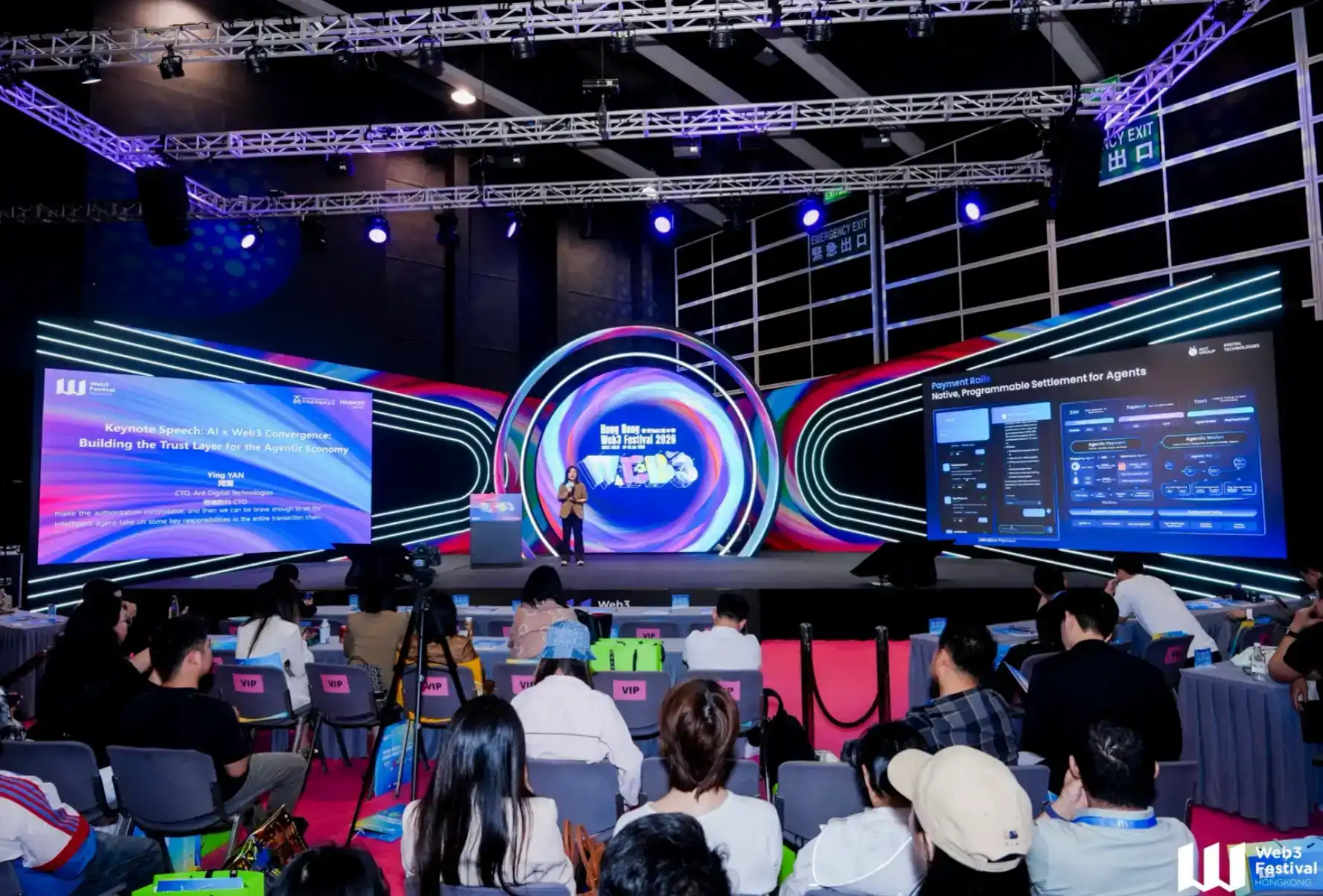
On April 20, Ant Digital Tech introduced the "4R Full-Stack" architecture concept for the agent economy at the Hong Kong Web3 Festival, encompassing four layers: Agentic Runtime, Payment Rails, Agent Registry, and Root Infrastructure. This framework aims to provide AI agents with a technical infrastructure covering identity, payment, risk control, and compliance.

Ant Digital Tech CTO Yan Ying pointed out in her speech that the current foundation of the agent economy suffers from "four gaps": execution failures due to prompt logic vulnerabilities, responsibility vacuums caused by AI's lack of credible identity, transaction barriers from payment gateways designed for humans, and collaboration risks arising from a lack of trust between unfamiliar agents. "These cannot be resolved by simply patching software; they require a redesign from the underlying infrastructure level," she said.

According to Yan Ying, the core product of the Agentic Runtime layer is DTClaw, which incorporates the CARLI security model to enforce constraints on agent behavior at the execution level. It supports multi-model compatibility and financial-grade compliance standards, aiming to make every AI operation controllable, auditable, and recoverable.

The Payment Rails layer builds native on-chain payment channels, integrating agent intelligent decision-making with verifiable credential chain technology. This ensures precise payment intent recognition and full-link security control while achieving transparency and immutability in the transaction process. For high-frequency micro-transaction scenarios, the platform constructs a native instant settlement network that supports cross-chain, multi-asset seamless flow, and intelligent routing, significantly improving capital turnover efficiency. Additionally, by providing a standardized development toolchain and a seamless wallet integration experience, the solution greatly reduces development barriers and user costs, forming a payment closed-loop that balances financial-grade security and an optimal user experience.
The Agent Registry layer issues on-chain identities for each agent based on DID (Decentralized Identity) and the ERC-8004 standard, ensuring that every collaboration between agents is documented. The Root Infrastructure layer serves as the architectural foundation, utilizing Jovay Layer2 to achieve 120-millisecond confirmation times to support AI micro-payments, and combining ZKVM technology to enable off-chain computation and on-chain verification, addressing the trust issues in AI economy computing power. Yan Ying stated, "The Root Infrastructure uses blockchain and privacy computing technologies to provide agents with an immutable contract execution environment. Even two unfamiliar AIs can establish trust based on code and conduct transactions with confidence."

Currently, AI is evolving from the era of Chat and Action to the era of the agent economy. Yan Ying believes that the qualitative change in the third stage lies not in AI becoming smarter, but in it beginning to possess assets and transaction rights. She noted that over the past decade, Ant Digital Tech has accumulated extensive engineering practices in financial-grade security, privacy computing, blockchain, and compliance systems, and the 4R architecture is built upon this foundation with全新研发和设计 (entirely new research and design).


Preguntas relacionadas

QWhat is the '4R Full-Stack' architecture proposed by Ant Digital Tech, and what are its four layers?

AThe '4R Full-Stack' architecture is a framework for the agentic economy proposed by Ant Digital Tech. Its four layers are: Agentic Runtime, Payment Rails, Agent Registry, and Root Infrastructure.

QAccording to Ant Digital Tech's CTO, what are the 'four fractures' in the current foundation of the agentic economy?

AThe 'four fractures' are: 1) Execution loss of control due to prompt logic vulnerabilities, 2) A responsibility vacuum caused by AI's lack of a trusted identity, 3) Transaction barriers from payment gateways designed for humans, and 4) Collaboration risks from a lack of trust between unfamiliar agents.

QWhat is the core product in the Agentic Runtime layer and what is its primary function?

AThe core product in the Agentic Runtime layer is DTClaw. Its primary function is to enforce mandatory constraints on agent behavior at the execution level, making every AI operation controllable, auditable, and recoverable.

QHow does the Payment Rails layer facilitate transactions for AI agents?

AThe Payment Rails layer builds native on-chain payment channels that integrate agent intelligent decision-making with verifiable credential chain technology. It ensures precise payment intent recognition, full-link security, transparency. It also features an instant settlement network for high-frequency micro-transactions, supporting cross-chain, multi-asset flow and smart routing.

QWhat technologies are used in the Root Infrastructure layer to support the agentic economy?

AThe Root Infrastructure layer utilizes Jovay Layer2 to achieve 120-millisecond confirmation times to support AI micro-payments, and combines ZKVM technology to enable off-chain computation with on-chain verification, solving the trust problem in AI economy computing power.

Lecturas Relacionadas

Reddit Crypto Discussion: Tech Stocks Surge for 8 Months, Is the Crypto Community Starting to 'Accept Fate'?

Reddit Crypto Discussion: Has the Community 'Given Up' as Tech Stocks Soar? A recent post on Reddit's r/CryptoMarkets asking if the crypto market feels "dead" compared to surging tech stocks has sparked intense debate. The discussion highlights a community grappling with underperformance: Bitcoin is down ~44% from its October 2025 high and ~20% YTD in 2026, while the S&P 500 and Nasdaq 100 have gained significantly. The debate features classic opposing views. Some users, citing Bitcoin's history, are "cycle believers" who anticipate a return to form, arguing it has "died" many times before. Others counter that crypto's narratives keep shifting without delivering a stable, compelling real-world use case beyond speculation. A prevalent third view pinpoints AI as the core issue: the tech sector's transformative boom is absorbing all attention and capital, while crypto lacks a comparable, impactful utility. Data supports the pessimistic mood. Bitcoin spot ETFs saw their largest monthly net outflow in May 2026 (~$2.3B), indicating institutional de-risking. The Crypto Fear & Greed Index has fallen to "Fear" levels. When asked about the timing of a potential market rotation back to crypto, answers are uncertain. A key practical point raised is the current high-interest-rate environment, which makes stable yields from cash and bonds attractive, reducing incentive to move into volatile assets like crypto. The underlying anxiety, as one user summarized, is "opportunity cost"—the worry about missing gains elsewhere while waiting for a crypto revival.

marsbitHace 43 min(s)

Reddit Crypto Discussion: Tech Stocks Surge for 8 Months, Is the Crypto Community Starting to 'Accept Fate'?

marsbitHace 43 min(s)

Chatbot has been burning money for three years, is it still the 'New Continent' of the AI era?

For years, the AI industry has been guided by a singular "map" — the belief that the AI era's "new continent" would be found in the Chatbot, a super-app akin to the mobile internet's super-apps. This belief was fueled by ChatGPT's explosive 2022 debut. However, three years of heavy investment reveal a different reality: the Chatbot-as-ultimate-entry-point model is struggling. The core issue is economic. Chatbots defy traditional internet economics. Unlike apps with near-zero marginal cost, each AI query consumes significant, expensive compute. More users mean higher costs, not profits. OpenAI, despite ~900M weekly active users, reportedly loses money. The expected network effects and data flywheels that power internet giants are weak in Chatbots, as one user's interactions don't improve another's experience. Monetization is a major hurdle. The subscription model faces low conversion rates, especially in China where users expect AI to be free. The "free + ads" model also struggles. Chatbot interactions often lack commercial intent, and inserting ads compromises the trust essential for an answer engine. Perplexity's minimal ad revenue and subsequent pivot away from ads highlight this difficulty. Switching between Chatbots is easy, making user loyalty low and competition a potential race to the bottom on price. Data suggests the standalone Chatbot's growth is slowing, and user engagement (avg. ~6 mins/day) pales compared to apps like TikTok. The product form itself is limiting; studies show nearly half of interactions are simple Q&A, trapping AI's potential in a passive, single-turn "cage." A contrasting, more successful path is emerging, exemplified by Anthropic. With over 85% of its ~$30B annualized revenue from enterprises, it focuses on AI as a productivity tool, not a companion. The rise of AI Agents (like OpenClaw) and the integration of AI into existing workflows (e.g., Google's AI Overviews, Apple Intelligence in OS) signal a shift. The future may not be a dominant Chatbot app, but AI embedded seamlessly into social apps, operating systems, and hardware — a capability-layer revolution, not a new distribution container. The conclusion is clear: the old "map" centered on a standalone Chatbot super-app is leading to a dead end. To find the true valuable "continent" of the AI era, the industry must update its navigation to prioritize deep integration, practical utility, and sustainable economics over a generic conversation window.

marsbitHace 56 min(s)

Chatbot has been burning money for three years, is it still the 'New Continent' of the AI era?

marsbitHace 56 min(s)

Trading

Spot
Futuros
活动图片




