Analyst Reveals Accumulation Level For Dogecoin Before It Rallies To $2

bitcoinistPublicado a 2026-04-25Actualizado a 2026-04-25

Resumen

A crypto analyst, Crypto Patel, predicts that Dogecoin (DOGE) could rally to $2, despite currently trading below $0.10. The analyst identifies a key accumulation zone between $0.07 and $0.09, where DOGE has repeatedly tested support without breaking down. Based on a bi-weekly chart using Elliott Wave theory, DOGE is in a Wave 4 consolidation phase within a descending channel. A bounce from this support is expected to trigger a Wave 5 rally, projecting a 2,767% surge toward $2. Price targets are set sequentially at $0.50, $1, and $2, with a stop-loss below $0.048. For a bullish trend reversal, DOGE must break above the $0.10 resistance level, which was recently rejected in April. Analysts emphasize that market conditions and a confirmed higher high are critical for the projected uptrend.

A crypto analyst is of the notion that the Dogecoin price will trade at $2, with this view being obvious, and most just can’t see it yet.

The meme coin is still pinned below the $0.10 threshold despite repeated attempts to break higher, but according to crypto analyst Crypto Patel, the chart is screaming for a breakout rally to $2. This prediction is based on a decades-long chart structure with a projection of DOGE bouncing off a strong accumulation zone.

Dogecoin Sitting Inside Accumulation Zone

Crypto Patel pointed to a narrow range between $0.09 and $0.07 as the most important accumulation level for Dogecoin right now. This is based on technical observations showing that the meme coin is already trading within that band and repeatedly testing it as support.

His accompanying bi-weekly chart spanning DOGE’s full price history from 2019 through a projected 2027 peak maps an Elliott Wave structure across two complete market cycles.
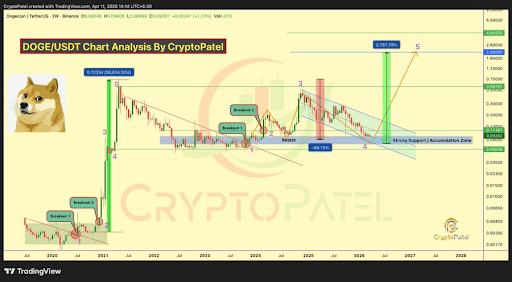
Source: Chart from Crypto Patel on X

The previous cycle topped at $0.72334, representing a 26,834% gain from its base. The current setup shows Dogecoin in what Crypto Patel labels as Wave 4, which is a consolidation phase playing out within a support and accumulation zone.

Wave 4 has been playing out since the DOGE price topped out at $0.48 in December 2024. Since then, the price action has been characterized by lower highs and lower lows, and this has led to the formation of a parallel downward channel on the 2-week candlestick timeframe.

DOGE’s Projected Path To $2

This zone carries added significance because it corresponds with the lower boundary of the descending channel that has been guiding Dogecoin’s price structure for months. Notably, each retest within the $0.08 to $0.09 band has so far failed to produce a breakdown, and this means there are strong buy orders here.

The expected move here is a bounce from the lower trendline, with the green vertical arrow projecting a wave 5 extension that sees the Dogecoin price going on a 2,767% rally. This projected rally will see Dogecoin landing squarely around $2. Crypto Patel set his price targets at $0.50, $1, and $2 in that sequential order, with a stop-loss defined as a higher-timeframe close below $0.048.

Dogecoin is not in its breakout phase yet. Even with the larger bullish structure in place, Dogecoin’s broader outlook is dependent on market conditions.

The most important thing right now is breaking above $0.10. This price level was rejected on April 17, when Dogecoin reached as high as $0.102. A similar analysis from crypto analyst Trader Tardigrade interpreted this rejection as a clean retest after breaking out of a descending triangle on the daily timeframe. All that needs to happen now is the creation of a higher high that flips the downtrend into an uptrend.

DOGE trading at $0.09 on the 1D chart | Source: DOGEUSDT on Tradingview.com

Preguntas relacionadas

QAccording to crypto analyst Crypto Patel, what is the key accumulation level range for Dogecoin before it rallies?

AThe key accumulation level range for Dogecoin is between $0.09 and $0.07.

QWhat is the analyst's projected price target for Dogecoin's potential rally?

AThe analyst's price target for the potential rally is $2.

QWhat specific Elliott Wave phase is Dogecoin currently in, according to the analysis?

ADogecoin is currently in Wave 4, which is a consolidation phase.

QWhat is the significance of the $0.10 price level for Dogecoin's price action?

AThe $0.10 level is a significant resistance point that needs to be broken for the price to establish a new uptrend, as it was rejected on April 17.

QWhat is the stop-loss level defined by Crypto Patel for this bullish setup?

AThe stop-loss is defined as a higher-timeframe close below $0.048.

Lecturas Relacionadas

Can Alibaba Cloud Rewrite Itself?

Over the past five months, Alibaba Cloud's MaaS (Model as a Service) revenue has surged 15x, marking a strategic overhaul where the company is shifting its 17-year-old system designed for "humans using cloud" to a new paradigm centered on "Agents consuming Tokens." At its recent summit, Alibaba Cloud announced a full-stack upgrade encompassing "chip-cloud-model-inference," all optimized for AI Agents. Key launches include the new AI product portal "QianWen Cloud," hyper-node servers powered by the in-house AI chip Zhenwu M890, and the latest flagship model, Qwen3.7-Max. Senior VP Liu Weiguang described this as building "China's largest AI factory," where chips are raw materials, the cloud is the workshop, models are machines, and the inference platform is the assembly line, with Tokens as the final product. The company is now emphasizing its chip strategy, unveiling the Zhenwu M890 and a two-year roadmap for future chips. With over 560,000 chips deployed across 400+ clients, Alibaba Cloud aims to control the marginal cost per Token, mirroring Google's integration of TPU and Gemini for optimal cost-performance. The cloud infrastructure itself is being rewritten. Traditional cloud interfaces are being transformed into standardized, Agent-callable Skills. A new scheduling logic focuses on "task scheduling" over "resource scheduling" to handle the unpredictable, elastic workloads of Agents. Liu noted that AI applications now automatically provision cloud resources, with one customer's daily automated provisioning equaling two weeks of manual work. For models, the focus has shifted from conversational prowess to execution capability. Qwen3.7-Max demonstrated this by autonomously writing and optimizing a production-grade AI compute kernel for the new Zhenwu M890 chip over 35 hours, achieving a 10x performance improvement. The underlying Bailian platform was upgraded for efficiency, and it maintains an open ecosystem, hosting third-party models. This restructuring extends beyond technology to sales, organization, and metrics. Alibaba Cloud has established dedicated MaaS sales teams, separated from traditional IaaS, with new KPIs focusing on high-quality Tokens that solve real problems, the number of core business systems integrated with models, and the efficiency of Agent task completion. The underlying bet is clear: AI represents an opportunity orders of magnitude larger than before. Despite the uncertainty, Alibaba Cloud is aggressively rebuilding its entire system, betting on an AI-driven future where Tokens could become its largest product line.

marsbitHace 47 min(s)

Can Alibaba Cloud Rewrite Itself?

marsbitHace 47 min(s)

Warsh's First Conundrum: Rate Cuts, Inflation, and a Fractured Fed

Walsh's First Dilemma: Rate Cuts, Inflation, and a Divided Fed Kevin Warsh officially assumed the Fed Chairmanship on May 15th, inheriting a central bank deeply divided over inflation. Contrary to market expectations of a dovish stance due to his appointment by President Trump, Warsh's historical record shows early and consistent hawkish concerns about inflation. The Fed he leads is fractured, with three FOMC members recently dissenting against even hinting at future rate cuts. The immediate challenge is surging inflation. While the Iran-related oil shock is a temporary factor, core CPI and services inflation are accelerating, showing signs of becoming entrenched—echoing the Fed's 2022 "transitory" misstep. Warsh faces the task of building consensus within a committee where several members believe policy may not be restrictive enough, especially if the neutral interest rate (r-star) is higher than currently estimated. Politically, Warsh is caught between Trump's desire for rate cuts and the economic reality of persistent price pressures. Any move perceived as bowing to political pressure could undermine Fed independence. Market implications are significant. Long-term Treasury yields (e.g., 30-year at 5.19%) could rise further, especially if the June FOMC statement hints at possible tightening. Tech stocks face continued valuation pressure from higher rates. The key variable is progress in Iran negotiations; a breakthrough before the June meeting could temporarily ease oil-driven inflation, but stubborn services inflation would remain. All eyes are on Warsh's first post-FOMC press conference on June 17th. His wording on inflation and policy will reveal how much the market has mispriced his stance and the Fed's likely path forward.

marsbitHace 1 hora(s)

Warsh's First Conundrum: Rate Cuts, Inflation, and a Fractured Fed

marsbitHace 1 hora(s)

Trading

Spot
Futuros
活动图片





