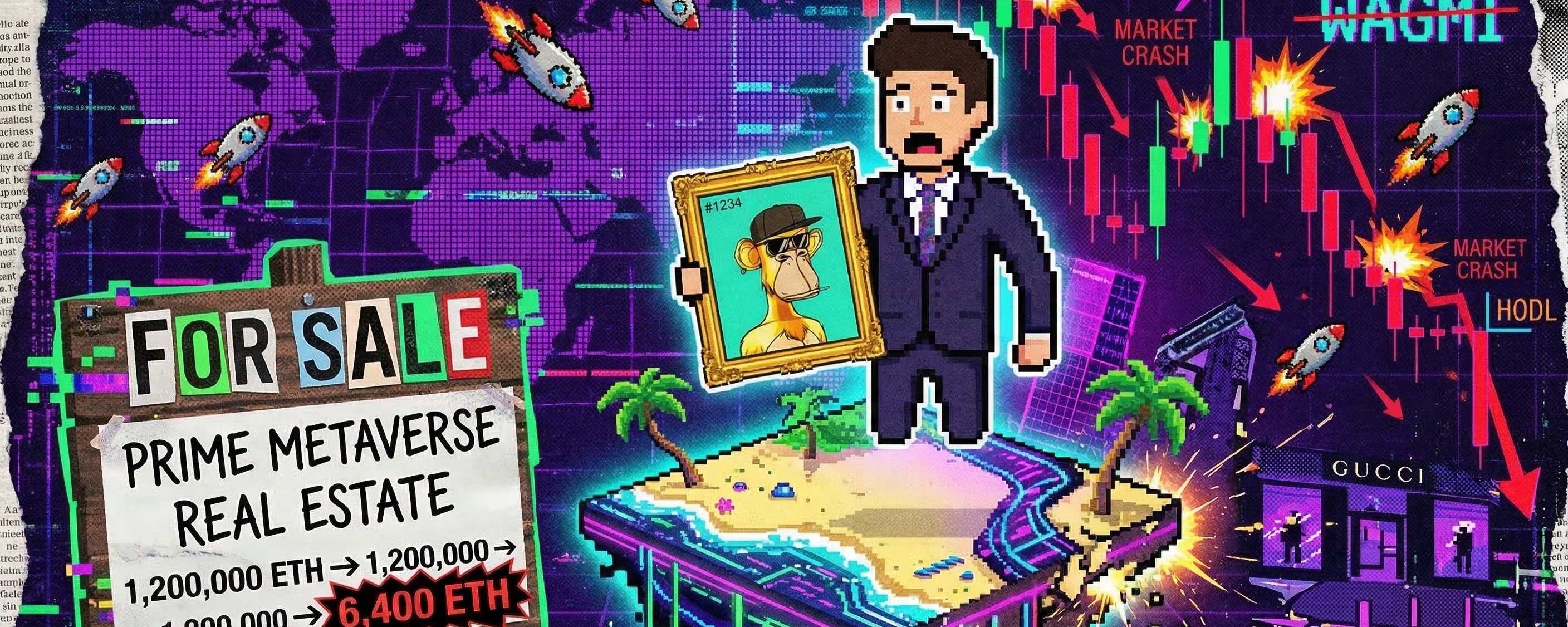
An Expensive Fantasy: The Evaporation of Wealth in Metaverse Real Estate

比推Publicado a 2026-03-20Actualizado a 2026-03-20

Resumen

An investor recounts losing a $1.2 million fortune in the metaverse real estate crash, with their portfolio now valued at just $6,400. They purchased 11 virtual properties across platforms like Decentraland, The Sandbox, and Meta’s Horizon Worlds, driven by hype and promises of a digital frontier. Despite early enthusiasm, low user engagement, corporate pullouts (like Gucci), and platform shutdowns led to catastrophic value declines. The investor reflects on the culture of “diamond hands” (holding assets despite massive losses) and irrational optimism, while also noting losses from NFT investments like a Bored Ape. Meta’s $84 billion loss on its metaverse division underscores the speculative bubble’s collapse. The narrative concludes with a shift to AI-based virtual land investment, repeating the cycle of high-risk speculation.

Author: @gothburz

Compiled by: Big Pliers | PANews Lobster

Original Title: Metaverse Real Estate Victim's Account: My $1.2 Million Is Now Only $6,400


"Diamond hands" means: even if your investment drops by 94%, you never sell. We’ve packaged this financial paralysis as a personality trait.

My net worth peaked at $1.2 million.

But not a single cent of that money was real.

I’m not speaking philosophically. I mean, it existed on some servers—and those servers are now shut down.

I owned eleven properties in the metaverse. Three in Decentraland, four in The Sandbox, two in Voxels, one in Otherside. And a seaside villa in Horizon Worlds—I paid $214,000 for it because Mark Zuckerberg himself said it was the "next frontier."

Last week, that "frontier" closed.

It’s now a mobile app.

Last year, I sent the same message to 340 people: "You have no idea how early we were."

I stopped sending those messages later. Not because I admitted I was wrong, but because most of them had blocked me.

I entered the metaverse real estate market in November 2021. Everyone was buying back then. Someone spent $450,000 just to be Snoop Dogg’s neighbor in a game. In a video game. Where the avatars didn’t even have legs.

Yes, those avatars had no legs.

But I thought that was actually a good sign.

"Legs are coming eventually," I told everyone in the Discord group. "Legs are on the product roadmap." Three hundred people immediately replied with rocket emojis.

I gave myself a title—"Digital Real Estate Tycoon."

I put it in my Twitter bio.

I put it in my LinkedIn job title.

I even went on a podcast to talk about it. That podcast had eleven listeners. Three were bots. The rest were my own alt accounts.

My combined virtual properties were larger than my actual apartment.

But my actual apartment has furniture.

Location, location, location.

My most valuable asset was a plot right next to a virtual Gucci store.

In 2023, Gucci pulled out.

The store is still there. No one goes in. It’s like a shopping mall in Ohio—but with worse graphics and no food court.

I didn’t sell.

Diamond hands.

That’s what we always said—"diamond hands." It means: even if your investment drops by 94%, you never sell. We packaged this financial paralysis as a personality trait.

There was a guy in my Discord group who spent $2.4 million on a manor on a prime 618 plot in Decentraland. Prime location. High foot traffic.

I asked him what "foot traffic" meant on a platform with a daily active user count of 38.

He said I didn’t understand the technology.

He was right, I didn’t.

But I kept buying more.

We had a DAO—a decentralized autonomous organization. Meaning, everyone votes on decisions.

There were nine of us total. Three never showed up. Two voted on everything without reading the proposals. The other four were me and my alt accounts.

We voted to "acquire strategic plots."

Unanimously approved.

I cast four votes myself.

My portfolio peaked at $1.2 million. I told everyone. I made a spreadsheet. I predicted a 40x return by 2025. I made a business plan. One slide said:

"We are building a digital economy."

That slide had a rocket emoji.

That was my entire financial model.

In 2023, I spent $189,000 on a Bored Ape NFT.

Now it’s worth $14,000.

I don’t talk about that ape.

But I still use it as my profile picture. If someone asks, I say "I’m long-term bullish."

"Long-term bullish" means: if I sold, I’d cry in a Panera Bread.

My mom asked me what a Bored Ape was.

I said: "Digital art on the blockchain."

She asked why it was more expensive than her car.

I said: "You don’t understand Web3."

She said: "All I know is you live in a studio apartment."

She’s not in my Discord group.

Justin Bieber spent $1.3 million on one.

Now it’s probably worth around $90,000.

Hearing that made me feel better.

That’s the power of community.

WAGMI. We're All Gonna Make It.

We said it every day. In group chats. As the floor price kept dropping. As trading volume dried up. As 95% of NFT projects went to zero.

We’re all gonna make it.

None of us made it.

But we said it with absolute conviction, paired with laser-eye profile pictures. That has to count for something, right?

It doesn’t.

But we said it did. That’s called decentralized consensus.

Meta spent $84 billion on the metaverse.

Let me say that again.

$84 billion.

More than the GDP of Luxembourg. More than the combined GDPs of Iceland, Luxembourg, and Malta. They poured that money into a platform where avatars had no legs, the graphics looked like a 2006 Wii game, and the concurrent user count was lower than the lunch rush at a Chipotle in Des Moines.

They just removed Horizon Worlds from VR headsets.

It continues to exist as a mobile app.

My seaside villa is now a mobile app.

Location, location, location.

Zuckerberg renamed the entire company for this. Facebook became Meta. A $900 billion company changed its legal name because the CEO watched *Ready Player One* and said, "I want that."

Reality Labs division: lost $10 billion in 2021, $14 billion in 2022, $16 billion in 2023, $18 billion in 2024, $19 billion in 2025.

This isn’t strategy; it’s speedrunning.

This year, they laid off 1,500 employees from Reality Labs. Shut down three VR studios. Canceled Supernatural. Put the entire VR social vision in a coffin and announced: "We’re pivoting to AI and wearables."

This pivot took four years and burned $84 billion.

I pivoted too.

I’m now an AI real estate investor.

I bought a plot in an AI-generated virtual world that doesn’t exist yet. The founder said it’s at the "intersection of spatial computing and large language models."

I have no idea what that means.

I gave him $40,000.

He has a whitepaper, 47 pages. I read the title and the tokenomics section. That section was a pie chart. I love pie charts. They make everything look planned.

This project has a roadmap. Q1: Build community. Q2: Launch beta. Q3: Expand ecosystem. Q4: Blank.

Q4 is always blank.

That’s the slot reserved for the exit.

My accountant asked me to value my metaverse portfolio for tax purposes.

I said: $1.2 million.

He said: Current market value.

I said: $6,400.

He stared at me for eleven seconds.

I know because I counted.

He asked if I had any other investments.

I showed him my NFTs.

He stared longer.

I said these are "cultural artifacts with long-term provenance."

He asked if I had considered buying a 401(k).

I said 401(k)s are "legacy artifacts of traditional finance."

He told me to leave his office.

The metaverse is dead.

I don’t accept that.

I am a digital real estate tycoon. I own eleven properties across four platforms. I have a seaside villa that’s now a mobile app, a plot next to an empty Gucci store, and a cartoon monkey that cost more than my actual car.

Location, location, location.

This location is nothingness.

But I was early.

I’m always early.

It’s the same thing as being wrong—just said with more confidence.


Twitter:https://twitter.com/BitpushNewsCN

Bitpush TG Discussion Group:https://t.me/BitPushCommunity

Bitpush TG Subscription: https://t.me/bitpush

Original article link:https://www.bitpush.news/articles/7621504

Preguntas relacionadas

QWhat was the peak value of the author's metaverse real estate portfolio, and what is its current estimated value?

AThe peak value of the author's metaverse real estate portfolio was $1.2 million. Its current estimated value is $6,400.

QAccording to the author, what does the term 'diamond hands' mean in the context of their investment strategy?

AAccording to the author, 'diamond hands' means refusing to sell an investment even after it has fallen by 94%, a form of financial paralysis that was packaged as a personality trait.

QWhich major company invested heavily in the metaverse, how much did it lose, and what was the consequence for the author's property?

AMeta (formerly Facebook) invested heavily in the metaverse, losing over $100 billion across several years. A consequence for the author was that their $214,000 Horizon Worlds 'ocean-view villa' was moved from VR to a mobile app after the platform was shut down on VR headsets.

QWhat expensive NFT did the author purchase and what is the significant difference between its purchase price and its current value?

AThe author purchased a Bored Ape Yacht Club (BAYC) NFT for $189,000. It is now worth approximately $14,000, representing a significant loss.

QWhat ironic justification does the author use for their continued investment in digital assets despite the massive financial losses?

AThe author ironically justifies their continued investment by claiming they were 'early,' which they state is the same thing as being wrong, but said with more confidence.

Lecturas Relacionadas

In Conversation with Ray Dalio: We Are Currently in an AI Bubble, with 1% of My Portfolio in Bitcoin

Ray Dalio, founder of Bridgewater Associates, warns in an interview that the current AI boom shows classic bubble characteristics, which could lead to significant economic downturns as seen in past cycles like 1929 or 2000. He explains that speculative enthusiasm, fueled by debt and overvaluation, often precedes a crash when rising rates or taxation force asset sales, causing widespread losses and recession. Dalio also outlines his "Big Cycle" theory, describing an approximate 80-year pattern where widening wealth gaps, massive government deficits, and shifting geopolitical power (like China's rise) create internal conflict and global instability. He emphasizes that we are in a late-cycle, transitional phase where traditional powers like the US and UK face decline. For personal wealth protection, Dalio advises diversification beyond cash into assets like stocks, bonds, real estate, and particularly gold, which he prefers over Bitcoin. While he holds about 1% of his portfolio in Bitcoin as a non-printable hard asset, he views gold as more secure from technological or governmental threats. Regarding AI's impact, Dalio believes it will disproportionately benefit capital owners, worsening inequality by replacing both physical and cognitive labor. He suggests that human intuition and emotional intelligence, combined with AI, will be key for future workers. On taxation, Dalio argues that wealth taxes are impractical and risk triggering asset sell-offs, reducing productive investment. He points to the UK as a cautionary example of debt, low productivity, and political strife. Geopolitically, Dalio foresees a more regionalized world, with the US showing weakness in prolonged conflicts like with Iran, akin to past imperial declines. The ideal outcome, he suggests, is coexisting powerful blocs (e.g., Americas, China-Asia Pacific) without major war.

marsbitHace 3 hora(s)

In Conversation with Ray Dalio: We Are Currently in an AI Bubble, with 1% of My Portfolio in Bitcoin

marsbitHace 3 hora(s)

Daily 7.2 Trillion KRW: Foreign Capital's Record Net Buying on Friday! Wall Street Says Headwinds for Korean Stock Fund Flows Have Subsided

South Korean stock market sees a dramatic shift in fund flows. On July 31, foreign investors made a record net purchase of approximately KRW 7.2 trillion in KOSPI stocks, marking a fundamental reversal from the persistent large-scale net outflows seen in previous months. This contributed to a significant narrowing of foreign net selling in July to KRW 9.8 trillion, down sharply from KRW 48.4 trillion in June and KRW 44.5 trillion in May. Simultaneously, domestic institutional pressure eased. South Korean pension funds and asset managers turned to a net buying position in July, purchasing KRW 1.0 trillion worth of KOSPI shares, contrasting with net sales in May and June. Market volatility is expected to be dampened by new financial regulations. Effective July 31, the Financial Services Commission tightened access for retail investors to single-stock leveraged ETFs by raising the minimum cash deposit requirement. Trading volumes for these products subsequently dropped to about 50% of their monthly average. Citigroup Research maintains its year-end KOSPI target of 10,000 points. The firm cites several supportive factors: the substantial easing of headwinds from capital outflows, a robust fundamental outlook for the semiconductor sector, historically low market valuations, strong economic fundamentals, and the potential for policy support from financial authorities if needed.

marsbitHace 3 hora(s)

Daily 7.2 Trillion KRW: Foreign Capital's Record Net Buying on Friday! Wall Street Says Headwinds for Korean Stock Fund Flows Have Subsided

marsbitHace 3 hora(s)

Thanks to Dice Rolls, Bitcoin Keys Are Stored Offline, But Not Everyone Will Do It

The article discusses using dice rolls to generate secure Bitcoin wallet seeds, providing entropy independent of potentially flawed hardware random number generators. It explains that each fair dice roll offers about 2.585 bits of entropy, with around 50 rolls needed for a standard 12-word seed phrase and 99+ recommended for higher security. This method gained attention after a vulnerability was revealed in some Coldcard hardware wallets, where a faulty firmware RNG (dating back to 2021) compromised generated keys. The analysis notes that while a dice-generated main seed was safe from this specific flaw, other Coldcard functions (like creating paper wallets, backup keys, or passwords) could still be vulnerable if they used the defective RNG. The piece argues that while dice-based entropy is technically robust, the manual process is error-prone, tedious, and unrealistic for most new users, who might make mistakes in recording or inputting rolls. It concludes that while manual entropy generation should remain an option for advanced users, the long-term goal is to develop reliable, user-friendly hardware and software that securely generates randomness without requiring specialized knowledge. Coldcard users are advised to check their firmware version and replace any secondary secrets (like paper wallet keys) created with vulnerable devices, while also considering multi-signature setups with devices from different manufacturers for added security.

cryptonews.ruHace 8 hora(s)

Thanks to Dice Rolls, Bitcoin Keys Are Stored Offline, But Not Everyone Will Do It

cryptonews.ruHace 8 hora(s)

Trading

Spot
活动图片





