All about Dogecoin’s ‘muted’ price action and the distribution pressure on it

ambcryptoPublicado a 2026-03-21Actualizado a 2026-03-21

Resumen

Dogecoin's on-chain activity surged with 1.037 billion DOGE transferred, yet the price remained stagnant around $0.094. This divergence suggests the high volume stems from redistribution, exchange movements, or internal transfers rather than genuine buying pressure. Whale activity, including $90 million+ flows into exchanges like Bitget, indicates distribution, increasing sell-side pressure. Although exchange balances dropped 30% since late 2025, intermittent large inflows continue to introduce overhead resistance. With top holders controlling 66% of supply and not accumulating, DOGE remains range-bound, balancing between distribution and absorption forces.

Dogecoin’s [DOGE] on-chain activity has expanded sharply lately. And yet, the price action stayed muted, establishing a clear imbalance between flow and valuation. Transfer volume climbed to 1.037 billion DOGE, roughly $97.8 million, while the price held near $0.094 with gains of only 0.3%.

As this divergence developed, the transaction count increased to 26,627 alongside 32,915 active addresses, reflecting rising network engagement. However, the price failed to respond in tandem, shifting attention towards the composition of these flows.

The high volume is more likely a sign of redistribution, exchange routing, or internal wallet movements than accumulation. As activity intensifies without directional follow-through, the gap between volume and price will only widen.

This pattern also suggested that raw on-chain expansion, when unadjusted for internal transfers, does not quite confirm genuine demand or sustained buying pressure.

Whale flows signal distribution behind Dogecoin’s volume spike

As transaction volume cools down, whale flows can help clarify why the price has been unresponsive. Transfers above $90 million moved into Bitget-linked wallets within 24 hours, signaling distribution into available liquidity.

As these flows hit exchanges, they increased immediate sell pressure, which absorbed incoming demand rather than pushing the price higher.

Meanwhile, top-100 holders still control over 66% of supply, translating to approximately 101.99 billion DOGE, without expanding balances, reinforcing the absence of accumulation. This behavior implied a late-cycle rotation, where large players offload into retail-driven activity. As supply met demand at these levels, the price stabilized near $0.094 instead of breaking out.

However, since holdings have been concentrated, the downside stayed controlled, leaving DOGE range-bound until either accumulation resumes or sell pressure intensifies.

Exchange flows keep Dogecoin range-bound

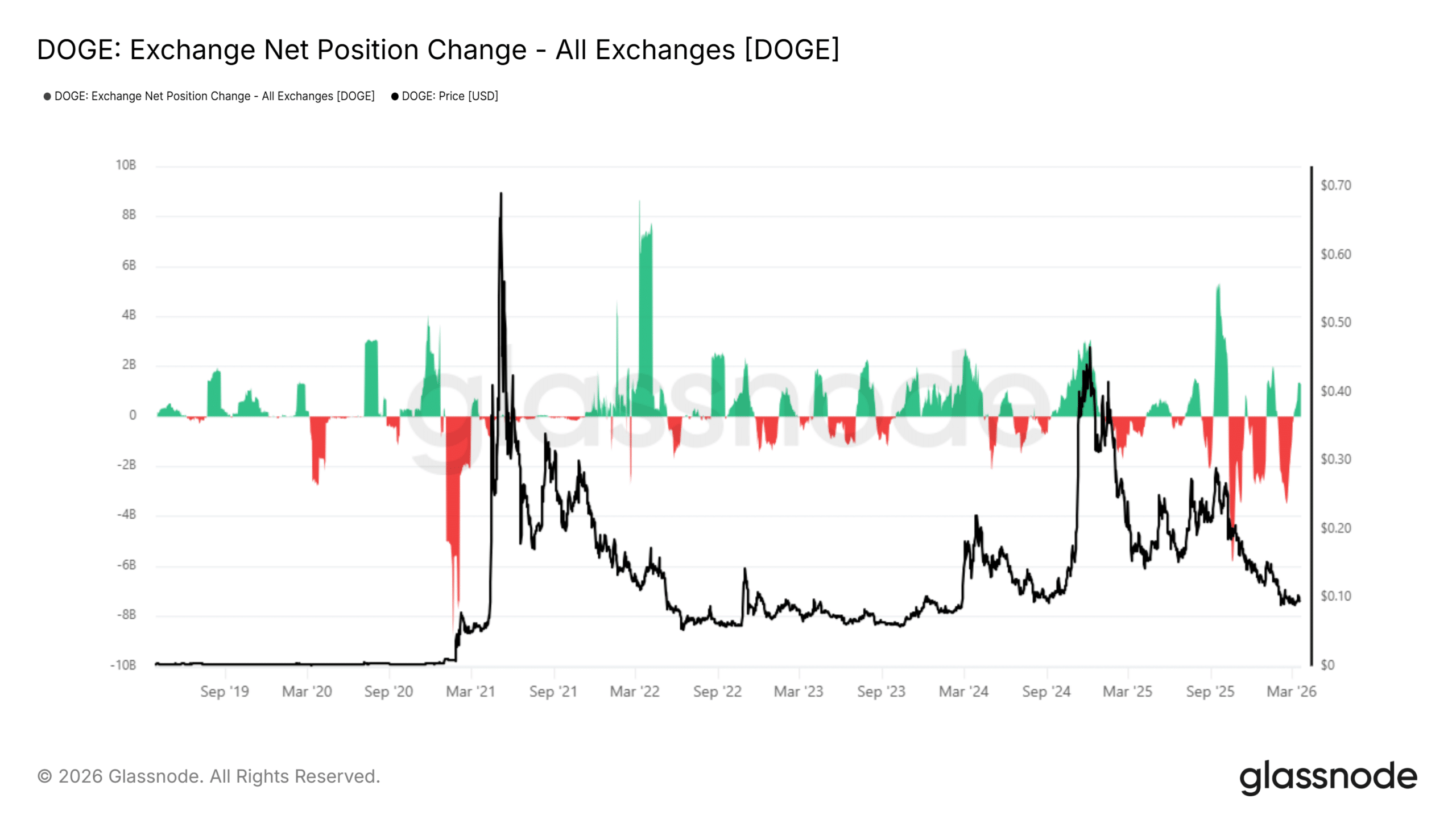
Exchange flows add context to the redistribution narrative. For example – The Net Position change showed repeated spikes above 4 billion DOGE, reflecting strong inflows into exchanges during key periods.
Source: Glassnode

As these inflows rise, the price often stalls or declines, reinforcing sell-side pressure. More recently, persistent negative flows hinted at intermittent outflows – Indicative of periods of absorption or accumulation.

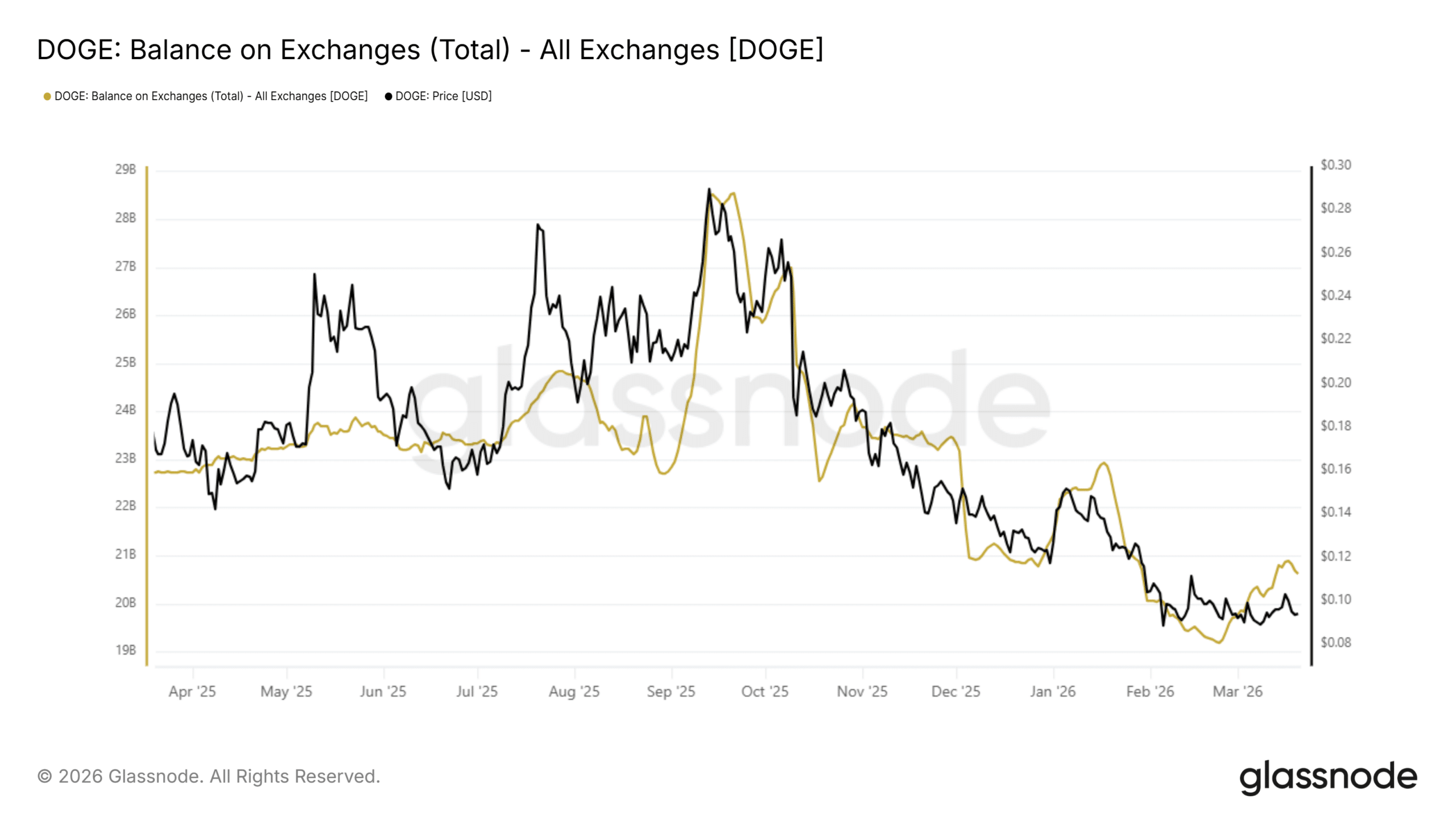
At the same time, total Exchange Balances declined from nearly 29 billion DOGE in late 2025 to around 20 billion DOGE at press time – Marking a roughly 30% drop. This reduction could allude to supply moving off exchanges, which can support price over time.
Source: Glassnode

However, intermittent inflow spikes have still introduced some overhead pressure. This is likely to keep DOGE range-bound as opposing forces balance market direction.


Final Summary

  • Dogecoin’s [DOGE] on-chain volume of 1.037 billion DOGE with the price near $0.094 reflected whale-led redistribution into exchanges.
  • Exchange inflows above 4 billion DOGE, alongside a 30% drop in balances, revealed ongoing absorption, despite intermittent sell pressure keeping price compressed.


Preguntas relacionadas

QWhat was the key divergence observed in Dogecoin's on-chain activity and price action?

ADogecoin's on-chain transfer volume climbed sharply to 1.037 billion DOGE, yet the price remained muted, holding near $0.094 with minimal gains of only 0.3%, establishing a clear imbalance between network flow and valuation.

QAccording to the article, what does the high transaction volume more likely signify rather than accumulation?

AThe high volume is more likely a sign of redistribution, exchange routing, or internal wallet movements, rather than genuine demand or sustained buying pressure from accumulation.

QHow did whale flows contribute to the unresponsive price of Dogecoin?

AWhale transfers above $90 million moved into Bitget-linked wallets, signaling distribution into available liquidity. This increased immediate sell pressure on exchanges, which absorbed incoming demand instead of pushing the price higher.

QWhat does the 30% drop in total exchange balances from late 2025 to the time of the article suggest?

AThe decline from nearly 29 billion DOGE to around 20 billion DOGE suggests that supply is moving off exchanges, which can be a supportive factor for the price over time, indicating periods of absorption.

QWhat are the two opposing forces that the article suggests are keeping DOGE's price range-bound?

AThe two opposing forces are intermittent inflow spikes that introduce overhead sell pressure and the reduction of supply on exchanges from absorption, which balance market direction and keep the price compressed.

Lecturas Relacionadas

Has the 'Digital Gold' Narrative for BTC Failed?

**Title: Has the "Digital Gold" Narrative for Bitcoin Failed?** The article argues that Bitcoin's "digital gold" narrative remains valid despite a recent sharp price decline (from a peak near $126k in Oct 2025 to briefly under $61k in Feb 2026). It presents a long-term investment framework based on three core points: **1. Viewing Bitcoin as an Asset:** Bitcoin is presented as a superior potential store of value compared to gold. Key arguments are its absolute scarcity (21 million cap), superior portability, and transparent auditability via its public ledger. While acknowledging its current use in early, volatile stages (~3-4% global adoption), the author draws parallels to the early, disruptive phases of the internet and e-commerce. **2. Understanding the Recent Downturn:** The current ~50% correction is framed as a predictable, consensus-driven cycle following its post-halving peak (the 2024 halving preceded the Oct 2025 high). A crucial factor is a historic "changing of hands": the influx of new institutional buyers via ETFs allowed early, low-cost holders (miners, OG believers) to take profits. The author notes that while severe, Bitcoin's historical drawdowns (e.g., 93% in 2011, 77% in 2021-22) have been progressively smaller, suggesting maturing holder structure and decreasing volatility over time. **3. The Long-Term Perspective:** The long-term thesis hinges on Bitcoin capturing a portion of gold's market value. With Bitcoin's market cap at ~$1.4 trillion (at $70k) versus gold's ~$20 trillion, significant upside potential exists if the "digital gold" narrative is partially realized. However, the author strongly cautions that short-term risks remain, the bottom is unpredictable, and high volatility is inherent. The real risk is not Bitcoin failing but poor personal position management (over-leverage, wrong capital) and a lack of deep understanding, which can force investors out during severe downturns. The conclusion uses Amazon's 95% crash post-2000 dot-com bubble and subsequent 42x recovery as an analogy. The ultimate question is not if Bitcoin's price will rise, but if an investor's strategy and conviction can withstand the volatility to see the long-term play out. The recent divergence (gold up, Bitcoin down) is posed not as a narrative failure, but as potential evidence of this ongoing, painful transition from a speculative asset to a mainstream allocation.

marsbitHace 6 hora(s)

Has the 'Digital Gold' Narrative for BTC Failed?

marsbitHace 6 hora(s)

Has BTC's 'Digital Gold' Narrative Failed?

The article discusses Bitcoin's "digital gold" narrative, its recent price drop, and long-term outlook through the perspective of "Jason". It argues the narrative is not a failure but that Bitcoin represents a superior, new asset class due to its fixed supply (21 million), portability, and auditability. The piece compares its current ~3-4% global adoption rate to early internet/e-commerce, suggesting significant growth potential. Regarding the 2025-2026 price decline (from ~$126k to briefly under $61k), the author views it as a predictable, consensus-driven sell-off within Bitcoin's ~4-year cycle post-halving, exacerbated by a major "handover" from early, low-cost holders to new institutional buyers via ETFs. A key observation is that historical peak-to-trough drawdowns have lessened over time (e.g., 93% in 2011 to ~50% in 2026), indicating maturing volatility as holder structure changes. For the long term, the author uses a simple framework: Bitcoin's total market cap (~$1.4T at $70k) is only about 7% of gold's (~$20T). Even capturing 30-50% of gold's value would imply substantial upside. However, the article strongly cautions against viewing this as investment advice, emphasizing extreme volatility and the critical importance of risk management, position sizing, and deep fundamental understanding to survive severe drawdowns. It concludes by drawing a parallel to Amazon's 95% crash in 2000 and subsequent 42x recovery, stressing that the key is surviving market cycles to realize long-term potential.

链捕手Hace 6 hora(s)

Has BTC's 'Digital Gold' Narrative Failed?

链捕手Hace 6 hora(s)

From Code to Cognition: A Ten-Thousand-Word Guide to the Evolution of the Robot Brain

"From Code to Cognition: The Evolution of Robot Brains" The journey of robotic intelligence has shifted dramatically from manually coded systems to AI-driven brains. For decades, robots relied on layered software stacks—perception, state estimation, planning, control—each handcrafted. While predictable, they lacked adaptability. The 2010s saw deep learning revolutionize perception (e.g., object detection) and control (via reinforcement learning), but learned skills remained narrow. The arrival of Large Language Models (LLMs) marked a turning point. LLMs acted as high-level planners, interpreting natural language instructions and generating sequences of actions for traditional robotic systems to execute. However, true integration came with Visual-Language-Action (VLA) models, which fused vision, language, and motion prediction into a single network. Pioneered by models like RT-2 and open-source projects like OpenVLA, VLAs enable robots to reason and act directly from visual input and commands. The most advanced humanoid robots now employ a "dual-brain" architecture: a slow-thinking, large VLA (System 2) for reasoning and planning, and a fast-reacting, small network (System 1) for high-frequency motion control, sometimes with an even lower-level System 0 for balance. This split balances cognition with the physics of real-time movement. Computation is split between onboard hardware (e.g., NVIDIA Jetson) for safety-critical control loops and cloud/edge servers for non-critical tasks like learning and interfaces. A crucial driver is the open-source ecosystem—models like GR00T and OpenVLA allow startups to build upon pre-trained brains and fine-tune them with their own data, accelerating development. Despite progress, current systems struggle with recovery from errors, sample inefficiency, and long-horizon tasks. This has spurred the rise of **World Models**—neural networks that predict the consequences of actions. By simulating possible futures before acting (like NVIDIA Cosmos or Meta V-JEPA), robots can plan, recover, and generalize better. This represents the next frontier: shifting intelligence from learned reactions to an internal model of physics and cause-and-effect. The field is rapidly evolving. While not yet at its "ChatGPT moment," the convergence of cheaper hardware, scalable simulation, and world models points toward robots that are increasingly capable, adaptive, and useful. The question is shifting from "what can robots do?" to "what *should* they do?"

marsbitHace 7 hora(s)

From Code to Cognition: A Ten-Thousand-Word Guide to the Evolution of the Robot Brain

marsbitHace 7 hora(s)

Trading

Spot
Futuros
活动图片




