AI Giants Queueing Up for IPOs: Is This the 'Last Dance' for the U.S. Stock Market?

marsbitPublicado a 2026-05-25Actualizado a 2026-05-25

Resumen

A massive wave of IPOs from AI giants like OpenAI, Anthropic, and SpaceX is taking shape, potentially reshaping the U.S. stock market. OpenAI is reportedly preparing for a historic IPO, targeting a valuation over $1 trillion and raising roughly $60 billion, which would dwarf previous records. Anthropic is also advancing its own IPO plans, projecting significant revenue growth and achieving quarterly operating profit. However, their financial profiles starkly differ. While Anthropic is nearing profitability with a focus on enterprise clients, OpenAI continues to report substantial losses, with a negative operating margin and expectations for positive cash flow only by 2029-2030. Analysts warn these listings could trigger a major "passive fund reshuffle," forcing index funds to sell holdings in established tech giants to make room for the new entrants, potentially pressuring the broader market. Some observers view the IPO rush as a "risk transfer," allowing early private investors to cash out at peak valuations while passing future financial uncertainty to public market investors. The divergent paths of Anthropic's near-term profitability versus OpenAI's long-term, high-cost growth narrative present a critical choice for investors. The outcome of these IPOs is seen as a major swing factor for risk assets in 2026, testing whether this surge marks a new cycle or a potential peak.

Author: Dong Jing

Source: Wall Street News

An IPO feast comparable to the peak of the dot-com bubble is taking shape. AI giants OpenAI, Anthropic, and SpaceX are racing towards the public markets, each targeting a trillion-dollar valuation. Their combined scale is enough to reshape the landscape of the U.S. stock market. This unprecedented wave of listings is both the ultimate stress test for AI investment logic and the biggest variable for the direction of risky assets this year.

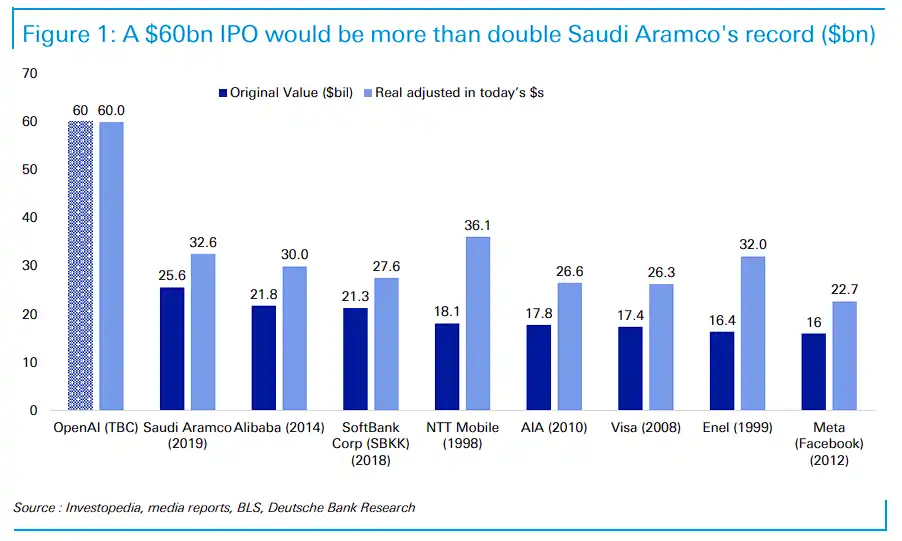
On May 22, according to a Wall Street News article, OpenAI has prepared to confidentially file its IPO application with regulators. The listing could happen as early as September this year, targeting a valuation exceeding $1 trillion and aiming to raise approximately $60 billion. This would more than double the $25.6 billion IPO record set by Saudi Aramco in 2019.

Meanwhile, rival Anthropic is also advancing its own listing plans and disclosed that its Q2 revenue is expected to double sequentially to $10.9 billion, potentially achieving quarterly operating profitability for the first time. Deutsche Bank noted in a research report that the landing of these two IPOs "is likely to become a major swing factor for the direction of risky assets this year," and is a macro theme that must be closely watched.

However, beneath the glossy valuations, the two companies' financial fundamentals are starkly different. OpenAI's Q1 revenue was $5.7 billion, but its adjusted operating profit margin was -122%, meaning it lost $1.22 for every dollar of revenue generated. It is not expected to achieve positive cash flow until 2029 or 2030 at the earliest. Anthropic's revenue was $4.8 billion in the same quarter and is projected to jump to $10.9 billion in Q2, with an expected operating profit of about $559 million, having already touched the threshold of profitability.

Analysis points out that these two companies are competing on the same stage but present vastly different business logics, presenting public market investors with a rare dilemma.

The Largest IPO in History: How Shocking Are the Numbers?

Deutsche Bank noted in a research report that the scale of either OpenAI's or Anthropic's single IPO would exceed twice the fundraising amount of Saudi Aramco's 2019 IPO. Even after inflation adjustment, it would easily become the largest IPO in history.
Deutsche Bank stated in another report that if OpenAI achieves its target valuation of over $1 trillion, it would become the world's 14th largest company by market capitalization, trailing only Berkshire Hathaway and surpassing Eli Lilly.
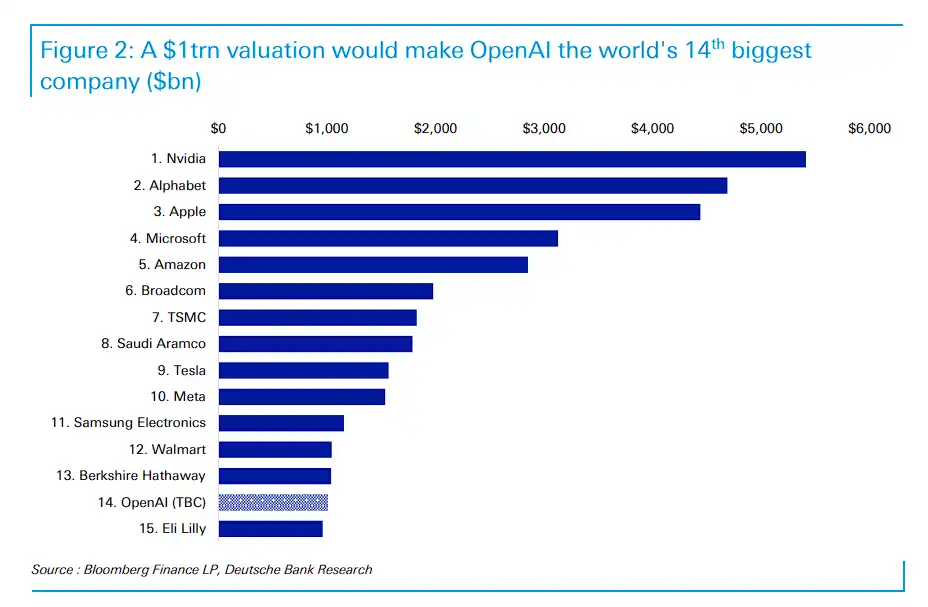
For comparison, Berkshire's revenue last year exceeded $370 billion with a net profit of $67 billion; Eli Lilly's sales exceeded $65 billion with a profit of $21 billion. In contrast, OpenAI is not yet profitable, has an annualized revenue of about $30 billion, and only has thousands of employees.

From a market capacity perspective, Deutsche Bank believes the current total U.S. stock market capitalization is about $70 trillion, five times that of the peak of the dot-com bubble. The market's digestion capacity is far stronger than in the late 1990s.

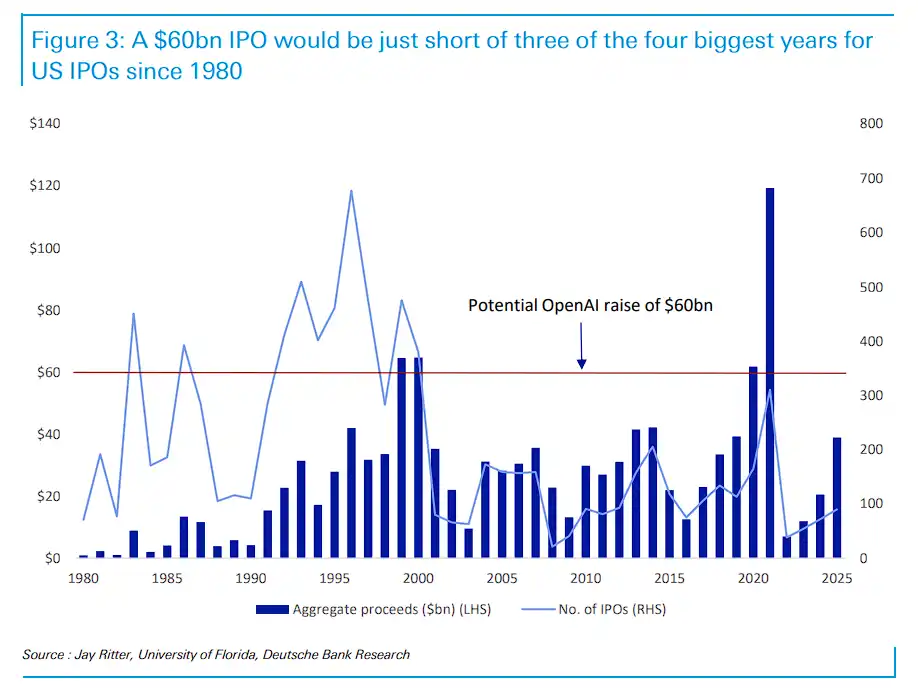
Back then, there were nearly 500 IPOs annually on average, whereas this decade averages only about 120, and today's listed companies are generally more mature.

Furthermore, a single $60 billion IPO is slightly less than the total fundraising for all U.S. IPOs in both 1999 and 2000 (each around $65 billion), equivalent to half of the record $119 billion set in 2021.
The 'Siphoning Effect' of the Behemoths and the Massive Passive Fund Reallocation

As these giants move towards public markets, their potential liquidity drainage effect on the U.S. stock market has already raised high alert on Wall Street.

The clustering of SpaceX, OpenAI, and Anthropic listings, combined with Nasdaq's newly introduced "fast inclusion" mechanism, is brewing an unprecedented massive reallocation of passive funds—the siphoning effect of the AI behemoths.

As mentioned in a Wall Street News article, JPMorgan Chase estimates that if SpaceX targets a $2 trillion valuation and ultimately achieves a 50% free float, passive funds would have to sell approximately $95 billion of their holdings in the current eight major Wall Street tech stocks (Nvidia, Apple, Microsoft, Amazon, Google, Broadcom, Meta, Tesla) to make room for the new entries.

Todd Sohn, Chief ETF Strategist at Strategas, points out that since the initial public float of an IPO is typically only 5%, while ETFs track trillions in assets, this extreme supply-demand imbalance will make the index inclusion process "slightly crazy." Passive investors may have no choice but to buy at high prices.

Valérie Noël, Head of Trading at Syz Group, stated that the market has already begun betting on downward pressure on existing large-cap stocks.

According to information disclosed on March 28 this year, OpenAI's public listing will be a substantial referendum on the entire AI investment logic. That information showed that OpenAI's revenue reached $13.1 billion in 2025, but its net loss in 2026 is projected to be $14 billion.

Simultaneously, OpenAI has committed to investing approximately $1.4 trillion in infrastructure construction before 2033. If S&P Global, FTSE Russell, and Nasdaq adopt fast-inclusion rules, they could force passive funds to buy around $24 billion to $48 billion immediately after the listing.

Faced with such a massive fund restructuring, ordinary investors, whether active or not, will see their portfolios passively reshaped as rules change.

Deutsche Bank noted in its report that the landing method of these IPOs will be a major swing factor for the direction of risky assets this year. PitchBook's analysis is more blunt:

There has been a "systematic quality inversion" in the private market—the companies with the highest valuations score lowest on the business quality metrics that truly matter for pricing in the public market.

For ordinary investors holding index funds or ETFs, it's hard to stay out of this game: whether active or not, their investment portfolios will be passively reshaped as index rules change.

For active investors, once the S-1 filings are public and all financial secrets are laid bare, the market will face a clear choice: to believe in a company that has already found a profitable model, or a giant asking the market for several more years and hundreds of billions of dollars to explore profitability?

The answer will determine whether this frenzy marks the start of a new cycle or the last dance before the party ends.

A Tale of Two Extremes: Anthropic Profits vs. OpenAI's Huge Losses

Despite soaring valuations, the financial conditions of the two AI leaders present starkly different pictures. Anthropic has begun to turn a profit, challenging the traditional notion that massive spending by AI companies would hinder near-term profitability.

According to a Wall Street News article, on Wednesday local time, The Wall Street Journal reported that Anthropic's Q2 revenue is expected to more than double to $10.9 billion and achieve an operating profit of approximately $559 million.

Anthropic's gross margin has jumped from 38% to over 70%. Its CEO, Dario Amodei, once joked that revenue growth had become "too difficult to handle."

The company's success is largely attributed to explosive demand from enterprise clients for its programming tools. About 85% of its revenue comes from enterprise and developer customers, a model with clear willingness to pay and relatively lower service costs.

In contrast, OpenAI is still losing money.

As mentioned in a Wall Street News article, data shows OpenAI's Q1 revenue was $5.7 billion, but its adjusted operating profit margin was -122%, meaning it loses $1.22 for every dollar earned.

Approximately 85% of OpenAI's revenue is related to ChatGPT consumer subscriptions. Despite having 55 million paying users, it supports a vast pool of over 900 million weekly active users, creating a massive cost black hole due to inference expenses for the free users.

OpenAI is not expected to achieve positive cash flow until 2029 or 2030. Its CEO Sam Altman and Head of Applied Business Fidji Simo are trying to shift focus towards commercial clients who can directly generate revenue.

At the IPO narrative level, the two companies are telling entirely different stories. Anthropic, armed with verified quarterly profitability data, tells a story comparable to Salesforce or ServiceNow—the logic of an enterprise software company.

OpenAI needs to convince the market to believe that AI agents, image generation, and even advertising businesses will eventually turn its massive consumer traffic into profit.

In Sam Altman's plan, the ChatGPT advertising business might bring in about $102 billion in revenue by 2030. But this requires time, and time is precisely the most scarce resource for OpenAI as it trades losses for growth.

AI Giants Rushing to IPO: Essentially Passing the 'Hot Potato' to Retail Investors?

According to a Wall Street News article, in the view of Joachim Klement, Managing Director at Panmure Liberum, this wave of AI giant IPOs is essentially a "risk transfer"—a large-scale offloading of early-stage investment risks onto retail investors, pension funds, and other institutions.

He believes that companies like OpenAI and Anthropic are accelerating their listings while investor sentiment is high, aiming to cash in at high valuations before the hype fades. Early institutional investors can exit entirely in the public market, while the retail investors and pension funds that take over will directly face the risk of financial logic eventually returning to reality.

He directly characterized this process as "the action of transferring investment risk on a massive scale from current holders to those willing to pay for the story."

Klement referenced Alan Greenspan's 1996 "irrational exuberance" warning as a benchmark—it was three years before the bubble burst. He judged that the AI hype in 2026 could still persist, and the likelihood of hyperscale cloud providers cutting investments is not high. However, the "impossible math" will eventually return to reality, "perhaps not in 2026, but 2027 or 2028 might see it arrive."


Preguntas relacionadas

QAccording to the article, what is the estimated target valuation for OpenAI's upcoming IPO?

AOpenAI's target valuation for its upcoming IPO is over $1 trillion (more than 1 trillion US dollars).

QWhich AI company is highlighted as achieving operational profitability ahead of OpenAI?

AAnthropic is the AI company highlighted as achieving operational profitability ahead of OpenAI, expecting about $5.59 billion in operating profit for Q2.

QWhat significant financial risk is associated with OpenAI's current business model according to the article?

AA significant financial risk for OpenAI is its negative adjusted operating margin of -122%, meaning it loses $1.22 for every dollar of revenue it generates.

QWhat potential market impact does the article suggest could result from the massive IPOs of AI giants like SpaceX and OpenAI?

AThe article suggests a potential 'siphoning effect' or massive passive fund reallocation, where passive funds might need to sell significant holdings in existing large tech stocks to make room for the new giants, potentially putting downward pressure on those stocks.

QHow does Joachim Klement from Panmure Liberum characterize the wave of AI giant IPOs?

AJoachim Klement characterizes the AI giant IPO wave as essentially a 'risk transfer', a large-scale shifting of early-stage investment risks from current holders to retail investors, pension funds, and other institutions willing to buy into the narrative.

Lecturas Relacionadas

ETH Bull and Bear Views Compilation: Can Ethereum's Value Flow Back to ETH?

Titled "ETH Bull and Bear Views: Can Ethereum's Value Flow Back to ETH?", this article synthesizes the current heated debate around Ethereum's native token, ETH, following Bankless co-founder David Hoffman's decision to sell his entire ETH holdings. The **bullish case**, represented by figures like Tom Lee (BitMine CEO) and Raoul Pal, argues that ETH's core thesis remains intact. They contend Ethereum is the essential, secure, and neutral foundational layer for future finance—encompassing stablecoins, RWA, DeFi, L2s, and Agentic AI. Bulls bet on ETH's long-term revaluation as institutional adoption of on-chain finance grows, with significant buying activity from entities like BitMine and Consensys cited as evidence. Conversely, the **bearish perspective**, led by Hoffman and analysts like Markus Thielen, questions ETH's value capture mechanism. They acknowledge Ethereum's network success but argue that the value created by L2s, DeFi, and applications does not sufficiently accrue to the ETH token itself. Bears point to ETH's prolonged underperformance versus the broader crypto market, lack of traditional cash flows, weakening "ultrasound money" narrative, and apparent institutional retreat (e.g., Harvard Management Company exiting its ETH ETF position) as key concerns. The debate highlights a pivotal shift: ETH is no longer just a community belief asset. The central question is whether ETH can transition from being a "**used infrastructure**" to a "**continuously bought and held core asset**" as more value enters the Ethereum ecosystem. The market is now critically examining the direct link between network growth and ETH's value.

marsbitHace 38 min(s)

ETH Bull and Bear Views Compilation: Can Ethereum's Value Flow Back to ETH?

marsbitHace 38 min(s)

Crypto is dead, Perps are forever

The crypto industry is shifting from a focus on creating native assets (like altcoins and protocol tokens) to becoming a "global asset pipeline." Native cryptocurrencies, except for Bitcoin, are seen as failing in their value storage and utility promises, with demand driven largely by speculation. Attention and liquidity are now moving toward real-world assets (RWAs) like U.S. stocks, bonds, gold, and oil traded on-chain via perpetual contracts (Perps). Stablecoins like USDT and USDC set the precedent, proving blockchain's core strength is efficient global settlement and transfer, not inventing new monetary systems. Meanwhile, assets like Ethereum and many DeFi tokens struggle as their narratives weaken against tangible traditional assets and the rapid real-world progress of AI. Perpetual contracts have emerged as a pivotal innovation. They simplify trading by offering pure price exposure to any asset, bypassing complexities of ownership, custody, and traditional market hours. Projects like Hyperliquid gained traction by combining CEX-like efficiency with on-chain transparency, capitalizing on post-FTX distrust, macroeconomic volatility, and the surge in demand for 24/7 stock trading. In conclusion, while the era of speculative native "crypto assets" may be over, perpetual contracts persist as the industry's most potent financial instrument—transforming all assets into globally accessible, constantly tradable instruments centered on price speculation.

marsbitHace 44 min(s)

Crypto is dead, Perps are forever

marsbitHace 44 min(s)

Tencent, Alibaba, ByteDance in a Battle for the Skill Store

Skill is becoming a key concept in the AI field, essentially serving as a structured "instruction manual" for AI Agents that specifies tool calls, decision logic, and output standards. This allows Agents to execute predefined tasks. As the number of Skills grows, distribution platforms have emerged. Major tech companies are swiftly entering this space. In March, Tencent, Alibaba, and ByteDance launched Skill stores within their respective Agent platforms. Subsequently, players like Zhipu AI, Meituan, and Xiaohongshu joined the fray. This competition for the "Skill store" is fundamentally a battle for the AI-era user entry point; whoever controls distribution controls the users. While ByteDance's Coze has experimented with paid Skills, most platforms offer them for free. The real value lies not in the stores themselves but in using them to attract and retain users within an ecosystem, driving revenue from services like cloud computing, model calls, or advertising. The landscape features three main player types: 1) **Internet giants** (e.g., Alibaba, ByteDance, Tencent, Meituan), leveraging Skills to drive traffic and monetize through their broader ecosystems (cloud services, transactions, ads). 2) **Large model companies** (e.g., Zhipu AI, Moonshot AI), using Skill stores to increase user engagement and monetize model API calls. 3) **Content platforms** (e.g., Xiaohongshu), treating Skills as a new content format to generate traffic and ad revenue. However, transforming Skill stores into a sustainable business faces significant hurdles. Key challenges include: the **difficulty in pricing Skills** due to inconsistent outputs across different models and contexts; **lack of cost transparency** (varying token consumption); **security risks** like Skill poisoning; and the **absence of standardized protocols** for development and evaluation. Unlike standardized mobile apps, Skills are often personalized workflows resistant to uniformity, which hinders the establishment of a reliable review and monetization system akin to the App Store. While there is genuine user demand for paid Skills—particularly in enterprise (e.g., contract review) and certain personal productivity scenarios—current platforms offer developers limited and unpredictable distribution. The future of Skill stores depends on overcoming these standardization, evaluation, and safety challenges to make acquiring a Skill as straightforward as downloading an app. For now, the stores function more as display shelves than robust marketplaces.

marsbitHace 44 min(s)

Tencent, Alibaba, ByteDance in a Battle for the Skill Store

marsbitHace 44 min(s)

The Crypto Scene Is Dead, Perpetual Swaps Are Eternal

The crypto industry is undergoing a fundamental shift. The era defined by minting novel, native digital assets (altcoins) is fading. These assets, lacking real-world cash flows or clear value, are losing relevance as attention and capital flow elsewhere. Two powerful external forces are reshaping the space. First, traditional assets like U.S. stocks, bonds, gold, and oil are being tokenized and traded on-chain. Second, the explosive growth of AI, with its tangible products, has overshadowed crypto's once-dominant "future narrative." This marks a critical pivot: crypto is transitioning from being a "factory for new assets" to becoming a "global conduit for existing assets." Its validated utility is not complex financial reinvention but efficient global settlement, transfer, and trading—the original promise of blockchain. Stablecoins like USDT and USDC exemplify this, offering faster dollar movement rather than replacing it. Consequently, native ecosystems like Ethereum face profound challenges. While still crucial infrastructure, ETH struggles to capture value as users interact with Layer 2s or trade traditional assets without needing to hold it. DeFi's grand narrative of rebuilding finance has narrowed to core needs like cheap transfers and deep liquidity. The true breakout innovation is the perpetual contract (Perp). It brilliantly bypasses the complexities of direct asset ownership (custody, compliance, dividends) by creating pure price exposure. Users can speculate on the price movement of *any* asset—NVIDIA, gold, oil—24/7, globally, and with leverage. This "price casino" model, while risky and ethically fraught, delivers unmatched liquidity and accessibility. Projects like Hyperliquid succeeded not by inventing new mechanics but by perfecting the timing and execution of this model. Key drivers included making on-chain Perps feel like centralized exchanges, post-FTX trust migration towards transparency, and rising demand to trade macro assets and equities round-the-clock. In conclusion, the crypto world's most enduring successes are the dollar (via stablecoins), Bitcoin, and trading. Its new frontier is not creating alternative assets but providing a seamless, perpetual trading layer—a new API—for the world's existing financial system. The age of native altcoins is over; the age of perpetual synthetic exposure has begun.

Odaily星球日报Hace 53 min(s)

The Crypto Scene Is Dead, Perpetual Swaps Are Eternal

Odaily星球日报Hace 53 min(s)

Trading

Spot
Futuros
活动图片




