After Tokenizing Assets, How to Exit?

链捕手Publicado a 2026-06-16Actualizado a 2026-06-16

Resumen

After tokenization, a key unresolved issue is providing holders with a reliable exit mechanism, as underlying asset settlement (taking days to months) lags far behind on-chain token settlement. Three primary models for instant liquidity have emerged, differing in their capital structure and efficiency: 1. **Balance Sheet Model (e.g., Grove Basin):** A single, well-capitalized entity (like Sky) provides immediate liquidity from its own reserves. This offers simplicity and deep initial liquidity but is constrained by that single balance sheet's capacity and risk appetite, limiting scalability. 2. **Dedicated Vault Model (e.g., Upshift Clear):** Independent liquidity providers (LPs) fund separate vaults for each supported asset. This decentralizes capital sources but isolates liquidity and capital, which becomes inefficient as the number of tokenized assets grows. 3. **Shared Liquidity Layer Model (Symbiotic Liquid Lane):** Independent capital providers fund shared vaults that can support multiple tokenized assets simultaneously. Capital remains productive between redemptions (e.g., earning yield in DeFi markets). Exits are settled via a competitive RFQ market where market makers bid. The article argues that the shared layer model offers superior capital efficiency and scalability. It transforms exit liquidity from an asset-specific patch into shared market infrastructure, allowing liquidity capacity to grow with overall market participation rather than being fragmented per...

Author: Symbiotic

Compiled by: Hu Tao, ChainCatcher

 
Summary:
  • All three methods allow holders to exit immediately, so speed is similar. The real difference lies in the capital structure behind the exit.

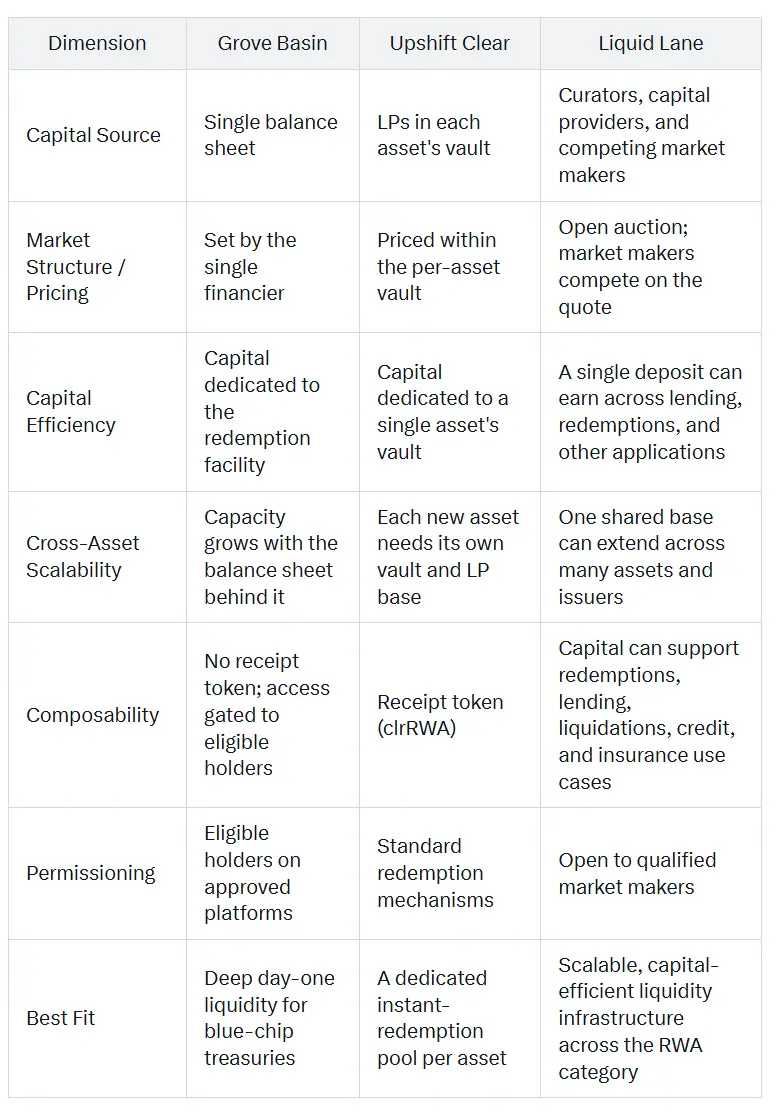
  • The key difference is how each model handles redemption capital: Grove Basin uses a single balance sheet, Upshift Clear establishes dedicated vaults for each asset, while Symbiotic's Liquid Lane settles through a shared liquidity layer in the open market.

  • Grove Basin provides instant liquidity for tokenized vaults, funded from Sky's balance sheet and launched in partnership with institutional partners. Upshift Clear extends this model to independent liquidity provider (LP) capital, with each supported asset equipped with a dedicated vault.

  • Liquid Lane, launched by Symbiotic, is based on shared capital, can support multiple assets simultaneously, continues to earn yields from multiple sources between redemptions, and settles through an open RFQ market where qualified market makers compete.

  • The result is higher capital efficiency per deposit, and the capacity of the liquidity layer grows as market participation increases, which is precisely where providing a reliable exit mechanism is most difficult and most valuable.


Exit is the Unsolved Half of Tokenization

Tokenization addresses how assets come on-chain, but barely addresses how holders redeem them. Tokenized treasuries or private credit funds can be issued, transferred, and distributed on-chain efficiently, while the underlying redemption process takes about T+1 day for treasuries and 60 to 180 days for private credit, real estate, and structured products. The time gap between token settlement in one block and fund settlement over months is this longstanding problem.

This gap is crucial because DeFi markets need confidence that tokenized assets can transform into liquid value when needed. With reliable liquidity infrastructure, RWAs can evolve beyond simple asset representation into efficient financial primitives: they can serve as credit collateral, leverage support, debt coverage, and assets for underwriting risk in on-chain markets.


Emerging Instant Liquidity Architectures

Three models have emerged aiming to provide instant exit pathways for tokenized real-world assets, differing in their funding sources and structure:

  1. Balance Sheet Model. In this model, a well-capitalized single entity provides liquidity immediately from its own reserves when an eligible holder redeems for stablecoins, then waits for the underlying settlement in the background. Grove's Basin project is an example, funded from Sky's balance sheet.

  2. Dedicated Vault Model. Independent liquidity providers supply separate capital pools for each supported asset and earn the redemption spread. Upshift Clear, initially launched in partnership with Superstate, follows this model.

  3. Shared Liquidity Layer Model. Independent capital providers fund a common capital base that supports multiple assets simultaneously, settling through an open, competitive market. Symbiotic's Liquid Lane is built on this model.

The question worth exploring is which architecture is best suited for liquidity that must scale across assets, issuers, and risk profiles while remaining capital-efficient.


How to Evaluate a Liquidity Layer for Tokenized Assets

Exit speed itself is nearly equal and not very telling. What truly matters is comparing everything that happens afterward in the five-dimensional space.

  1. Who funds it and who bears the risk? Where does the liquidity come from? Who bears the duration and credit risk of the underlying asset during redemption settlement?

  2. How redemption is priced. The mechanism that determines the discount a holder pays for early redemption, whether it's a single provider's quote, fixed parameters for a dedicated pool, or bidding among multiple participants.

  3. Capital Efficiency and Cost of Supply. How much committed capital a model needs to support redemptions, and the opportunity cost of using that capital for settlement events. This cost ultimately shows up in the spread holders pay and whether liquidity providers can sustain the model.

  4. How the model scales across asset types. What does extending coverage to new assets and issuers require as the market grows?

  5. Composability. Whether holders' claims and providers' funds can be used elsewhere in on-chain finance, and under what conditions. This determines whether liquidity is confined to a single venue or can support other uses.

These five categories describe how reliable and scalable a liquidity model will be as the tokenization market grows in size and variety. The next sections apply them to each model in turn.


Balance Sheet Liquidity for Tokenized Treasuries and Credit

Grove Basin provides instant stablecoin liquidity for RWAs by prefunding when eligible holders initiate approved redemptions via supported tokenization platforms. Grove Basin acts as a programmable credit facility against pending settlement proceeds.

The design's strengths:

  • Immediate balance sheet depth. Since Basin is funded from an existing reserve base, it can offer substantial liquidity from day one.

  • Simple user experience. Basin operates through supported tokenization platforms, so eligible holders can exit faster while the traditional redemption process continues in the background.

  • The balance sheet bridge is ideal for bonds and money market funds with short settlement cycles. These often settle in T+1 to T+2, so the balance sheet bridge effectively covers the gap.

These trade-offs stem from the same design choices:

  • Capacity depends on a single balance sheet. The liquidity ceiling ultimately depends on the size and risk appetite of the funding balance sheet. This means capacity growth relies on a single reserve base, not a broader capital market forming around the opportunity.

  • Access is restricted. Basin is only open to eligible holders, approved transactions, and supported platforms. This allows the model to control how liquidity expands but limits how accessible and reusable it becomes for the broader market.

  • The first use case is the most liquid part of the market. Tokenized treasury bills and money market funds have relatively short settlement cycles to begin with.

Grove Basin is a powerful vertically integrated solution for improving exits from tokenized treasuries. Its main drawback is that liquidity depth, risk allocation, and economics are tied to a single balance sheet model.


Upshift Clear: Asset-Specific Vaults for Instant Liquidity

Upshift Clear, initially launched with Superstate, applies the instant redemption model to independent USDC liquidity providers through dedicated vaults. LPs deposit USDC into a vault in exchange for backing an RWA and receive a composable receipt token, clrRWA, while earning fees from the redemption spread.

The model's reach:

  • Independent capital. Liquidity comes from LPs who choose to participate, so capacity can grow with the market without depending on any single institution's reserves.

  • General-purpose design. The platform aims to support any RWA with a standard redemption mechanism, offering issuers a repeatable path to instant liquidity.

  • Clear, voluntary risk-taking. Upshift Clear prices the settlement spread as a yield opportunity that LPs knowingly and willingly take on, achieving clear alignment of risk and reward.

  • Composable receipts. The clrRWA token can circulate in DeFi, so LP positions are usable beyond the vault itself.

Where the model is more constrained:

  • Capital is siloed by asset. Each supported asset has its dedicated funding pool, so each new asset must attract its own liquidity. As coverage expands, the number of pools grows with the number of assets, potentially fragmenting market liquidity coordination.

  • Capital serves one asset at a time. Funds in a specific vault are committed to that specific asset, limiting what each dollar can do between redemptions.

  • The launch asset tests a more specific liquidity problem. Superstate's USCC is a ~$267 million crypto arbitrage fund with the advantage of near-instant exits, but its liquidity challenge differs from longer-duration private credit or structured assets. It provides a solid starting point for the model while raising a broader question: how does the same design perform for less liquid, longer-term assets?

Upshift Clear offers a flexible option for issuers wanting dedicated instant redemption pools for specific assets. Its main drawback is that liquidity, risk, and capital efficiency are allocated asset-by-asset.

Liquid Lane: Shared, Efficient, Cross-Asset Liquidity

Symbiotic Liquid Lane is a shared liquidity layer for tokenized assets. Redemption funding comes from Symbiotic vaults that can back multiple tokenized assets simultaneously, not tied to a single balance sheet or isolated in pools dedicated to one asset. Between settlement events, these funds continue earning yields from multiple sources and are available when holders need to exit.

Vault managers decide how the funds are used. They choose which issuers and assets to support, set risk parameters, and design vault strategies for different asset types, redemption patterns, and yield opportunities. This makes the liquidity layer configurable, not one-size-fits-all: different managers can build different strategies on the same shared infrastructure.

When a holder wants to redeem, qualified market makers bid on the redemption discount through a request-for-quote layer. Once an offer is accepted, vault funds settle the redemption on-chain atomically and immediately, while the issuer's redemption proceeds in the background.

The resulting model has four structural advantages:

  • Shared capital across many assets. A single vault can back redemptions for multiple RWA types. New assets can tap the same capital base, so liquidity capacity grows with market participation rather than fragmenting asset-by-asset.

  • Funds earn between redemptions. Collateral doesn't sit idle waiting for redemption demand. It can earn underlying lending yields in whitelisted lending markets like Morpho and Aave, earn redemption spreads when settling redemptions, and back financial obligations in other Symbiotic applications like credit and insurance. Thus, a single deposit can generate yield from multiple sources, maximizing capital efficiency and making it composable with DeFi.

  • Configurable risk and yield strategies. Managers can tailor vault strategies by selecting supported assets, issuers, limits, and risk parameters. This means liquidity can be deployed according to different risk appetites and market views, not forced into a one-size-fits-all pool design.

  • Open competition for settlement. Liquid Lane uses a competitive request-for-quote (RFQ) market where qualified market makers bid to settle exit trades. Redemption discounts are set by market competition, and earnings are split among market makers, capital providers, and managers.

This design aims to serve the part of the market where providing a reliable exit is hardest and thus most valuable: tokenized private credit, structured assets, and other products with long redemption windows. These can have 60- to 180-day windows, and reliable exit infrastructure transforms how the assets are held, financed, and used on-chain.

Liquid Lane's initial integrations include Fasanara (first vault manager) and Midas (first issuer via mGLOBAL and mF-ONE), alongside other vault managers such as Avantgarde Finance, Barter, and Kpk.


Side-by-Side Comparison

Conclusion: From Liquidity Patches to Shared Infrastructure

Tokenized assets need reliable exit mechanisms to reach mass adoption. The question is whether those exits are built as one-off solutions or as infrastructure that scales with the market.

If every asset needs its own separate liquidity pool, every issuer needs its own funding line, or every exit relies on a separate reserve, the market gets faster exits but not truly scalable liquidity. A sustainable liquidity model is different: it's shared, efficient, flexible liquidity that grows with market participation and doesn't fragment capital every time coverage expands.

That's what Symbiotic Liquid Lane aims to provide. It transforms redemption liquidity from single-purpose mechanisms into a shared layer for the tokenized market: a capital base that can back multiple assets, multiple obligations, and multiple sources of yield.

For issuers, this means increased demand, distribution, and AUM because tokenized assets become easier to hold and use as collateral. For market makers, it means participating in RWA settlement without holding idle inventory upfront. For capital providers, it means earning from lending, redemption, and Symbiotic applications with a single deposit.

Liquid Lane is the shared liquidity infrastructure for RWAs: cross-asset, capital-efficient, T+0.


Preguntas relacionadas

QWhat is the core issue regarding tokenized real-world assets (RWA) that the article addresses?

AThe core issue is that while tokenization solves how assets are placed on-chain (the "on-ramp"), it largely fails to solve how holders can redeem or exit their positions (the "off-ramp"). There is a significant time gap between the instantaneous settlement of a token trade and the much slower underlying redemption process for assets like treasuries, private credit, or real estate, which can take days to months. This gap hinders the broader use of RWA in DeFi.

QWhat are the three main models for providing immediate exit liquidity for tokenized assets, as described in the article?

AThe three models are: 1) Balance Sheet Model, where a single, well-capitalized entity provides liquidity from its own reserves (e.g., Grove Basin). 2) Dedicated Vault Model, where independent liquidity providers fund isolated pools for each supported asset (e.g., Upshift Clear). 3) Shared Liquidity Layer Model, where independent capital providers fund a shared base that supports multiple assets and settles through an open, competitive market (e.g., Symbiotic's Liquid Lane).

QAccording to the article, what are the key criteria for evaluating a liquidity layer for tokenized assets?

AThe key evaluation criteria are: 1) Source of capital and risk bearers. 2) Mechanism for pricing redemptions. 3) Capital efficiency and cost of supply. 4) Scalability to different asset types. 5) Composability (whether holder claims and provider funds can be used elsewhere in on-chain finance).

QWhat is the primary structural advantage of the Shared Liquidity Layer model (Symbiotic Liquid Lane) over the other two models?

AIts primary structural advantage is that a single pool of capital can support redemptions for multiple tokenized asset types simultaneously. This shared capital base allows liquidity capacity to grow with overall market participation rather than being fragmented asset-by-asset. Furthermore, this capital can earn yield from multiple sources between redemption events, maximizing capital efficiency.

QWhat specific type of tokenized assets does the Symbiotic Liquid Lane model primarily target, and why?

AIt primarily targets the most challenging and valuable part of the market: tokenized private credit, structured assets, and other products with long redemption windows (e.g., 60 to 180 days). Reliable exit infrastructure is hardest to provide for these assets, but it would fundamentally change how they are held, financed, and used on-chain.

Lecturas Relacionadas

Weekly Editor's Picks (0725-0731)

Weekly Editor's Picks (0725-0731) provides a curated selection of deep analysis, filtering out market noise. Key themes from this week include: **Macro & Policy:** The Federal Reserve's upcoming meeting is marked by high uncertainty, balancing cooling inflation data against persistent price pressures. Meanwhile, the U.S. crypto regulatory Clarity Act faces critical political hurdles, with its 2026 passage probability seen as low. **Investing & Crypto:** Analysis suggests long-term crypto success depends on conviction through volatile cycles, focusing on assets like Bitcoin and core smart contract platforms. A trend noted is the increasing similarity between global equity markets (especially tech) and crypto, driven by narrative and leverage. Several major crypto protocols show strong revenue growth, but this isn't always translating to token price appreciation due to sell pressure and structural factors. **AI & Semiconductors:** Nvidia's rising credit default swap rates signal market concern over AI infrastructure financing risks. The storage sector experienced volatility as markets began pricing in potential 2027 oversupply. Despite a record profitable quarter, SK Hynix's results were deemed "below expectations," reflecting heightened investor demands for future growth visibility. **Markets & DeFi:** TradeXYZ demonstrated remarkable accuracy in pre-market pricing for a major A股 listing. The token ONDO saw gains, linked to its growing role in the on-chain tokenized stock ecosystem. **Ethereum:** Post-Pectra upgrade, a major structural shift is underway as Lido begins migrating millions of ETH to new validator architectures designed for capital efficiency. **Also Highlighted:** Butian's bullish stock market move; OpenAI's Altman promising major advances; Samsung and SK Hynix securing large AI chip deals; Apple reaching a $5T market cap; and ongoing discussions around exchange security following Poolin's bankruptcy case.

marsbitHace 9 min(s)

Weekly Editor's Picks (0725-0731)

marsbitHace 9 min(s)

Low Investment Isn't Apple's Immunity Pass

While Meta and Google face investor scrutiny over ballooning AI capital expenditures, Apple's minimal AI investment has paradoxically become a strength. Its market cap recently reclaimed the global top spot, surpassing $5 trillion. The irony is deep: Apple's own AI efforts have lagged, with "Apple Intelligence" delayed and core talent lost, forcing reliance on partners like Google Gemini and Alibaba's Qianwen. Its Q3 FY2026 (Q2 CY) earnings initially seemed stellar. Revenue hit $109.4B (up 16% YoY), with iPhone and Mac sales, growing 22% and 29% respectively, driving most of the growth. However, the stock fell over 8% post-earnings. The primary concern was a weaker Q4 revenue growth forecast of 9-11%, below expectations, due to looming supply chain constraints. Apple is feeling the indirect cost of the AI boom. Soaring memory and chip prices, fueled by massive data center investments from Microsoft, Amazon, and others, are forcing Apple to raise Mac and iPad prices significantly. The upcoming iPhone launch is also expected to see substantial price hikes. Despite avoiding heavy AI infrastructure spending—its capital expenditures are actually down 28%—Apple cannot escape the industry-wide supply and cost pressures. While Apple's operating cash flow remains robust, its substantial R&D spending (up 32% YoY) has yet to yield major AI breakthroughs. As Tim Cook prepares to step down as CEO, Apple faces a challenging transition: balancing its premium hardware success against the strategic and cost pressures of the AI era it has so far cautiously navigated.

marsbitHace 59 min(s)

Low Investment Isn't Apple's Immunity Pass

marsbitHace 59 min(s)

PA Graphics Explanation | One Chart to Understand the Major Web3 Events in August 2026

**PANews Crypto Calendar: Key Web3 Events in August 2026** PANews introduces its revamped crypto calendar, featuring comprehensive coverage, flexible filtering, and easy export options. The market in August will be shaped by multiple key events across macroeconomics, regulation, tokenomics, and project developments: * **Macro & Policy:** Key US economic data releases (July Non-Farm Payrolls, CPI), the Federal Reserve meeting minutes, and the Jackson Hole Economic Symposium will be in focus. On the regulatory front, the US Senate plans to release a new draft of the *CLARITY Act*, while the EU's expanded crypto ban against Belarus comes into effect. * **Token Unlocks:** Significant token unlocks are scheduled for assets including ENA, AVAX, CONX, ZRO, and KAITO, which may influence market volatility. * **Project Updates & Shutdowns:** Several services, including Exchange Art, Ctrl Wallet, Zapper, NFTfi, and Summer.fi, are set to cease operations or undergo major adjustments. Users are advised to manage their assets accordingly. * **Corporate Activity:** Q2 earnings reports from companies like SpaceX, Circle, and Nvidia are due. Unitree Robotics will initiate its IPO subscription on the STAR Market, and Moonshot AI plans to begin a Pre-IPO financing round. * **Industry Events:** Major conferences such as Bitcoin Asia 2026 and the 2026 Digital Expo will take place. The overarching market narrative for August will revolve around macroeconomic expectations, regulatory developments, token unlock schedules, and ongoing industry consolidation.

marsbitHace 1 hora(s)

PA Graphics Explanation | One Chart to Understand the Major Web3 Events in August 2026

marsbitHace 1 hora(s)

Wall Street's Most Famous 'Cassandra' Now Has His Sights Set on Nvidia

Michael Burry, the famed "Big Short" investor, has once again captured Wall Street's attention with a series of short positions against major tech and semiconductor stocks, most notably Nvidia. In late June and July, through his "Cassandra Unchained" newsletter, Burry disclosed short bets against Nvidia, Tesla, Applied Materials, Caterpillar, the SOXX semiconductor ETF, and later, Micron Technology. His core thesis revolves around potential distortions in the AI infrastructure boom, specifically questioning whether extended depreciation schedules (e.g., 6 years vs. a realistic 2-3 years for AI chips) by cloud giants like Microsoft and Google artificially inflate profits. He also raises concerns about possible "off-balance-sheet circular financing," where chip demand might be propped up by vendor-backed funding to clients. Nvidia's stock experienced volatility following these disclosures, briefly dipping but largely holding near Burry's reported entry points, leaving his positions roughly flat or slightly underwater as of late July. This move is part of a pattern for Burry, whose track record since his legendary 2008 bet is mixed. He has faced notable losses, such as on Tesla in 2021, while scoring on broader market turns like the 2020 pandemic crash. His methodology focuses intensely on free cash flow and scrutinizing original financial documents to spot overvaluation and structural risks, but it often struggles with timing the market. The article contrasts Burry's stance with other prominent investors. Steve Eisman, another "Big Short" figure, is not shorting Nvidia, citing strong fundamentals but expressing nervousness about sustainability. Jim Chanos agrees with the broad "accounting mismatch" concern—comparing it to the dot-com bubble—but targets financial leverage in private equity firms rather than the chip stocks themselves. While Nvidia's short interest remains relatively low at 1.3-1.4% of float, the massive stock size means absolute short losses have been significant, exceeding $5 billion earlier this year. The piece concludes that for ordinary investors, the key takeaway is not replicating specific short bets but learning from the critical frameworks these investors use: questioning rosy accounting, identifying structural vulnerabilities, and maintaining skepticism during market euphoria, even if pinpointing the exact catalyst for a downturn remains elusive.

marsbitHace 1 hora(s)

Wall Street's Most Famous 'Cassandra' Now Has His Sights Set on Nvidia

marsbitHace 1 hora(s)

Weekly Selection丨Epic Stock Market Volatility, Changxin Tech's IPO Reshapes Storage Landscape, Saylor Aims to Re-Anchor STRC Around September 8th

PANews Weekly Digest: Market Turmoil, Tech Breakthroughs, and Crypto Developments. The week saw significant volatility across global markets. South Korea's KOSPI index experienced extreme turbulence, including multiple trading halts, largely driven by sharp declines in AI hardware stocks like SK Hynix. In contrast, China's Changxin Xinqiao (CXC) achieved a landmark IPO with a market cap surpassing 4 trillion yuan, marking a major success for the domestic DRAM industry after a decade of losses. In the crypto and Web3 space, several key narratives emerged. AI is driving demand for new infrastructure, with projects like AI agent wallets and programmable payments gaining traction, attracting interest from firms like Coinbase. The Bitcoin mining sector is pivoting, with companies like MARA focusing on energy management as electricity becomes a core AI-era asset. Meanwhile, the RWA (Real World Assets) sector faces a "utilization puzzle," with hundreds of billions in on-chain assets remaining dormant. Notable market movements included a historic single-day surge of over 17% for the KOSPI index and a significant migration of $16.5 billion in staked ETH within the Lido ecosystem. Michael Saylor announced a target to re-peg the STRC stablecoin around September 8th. Other highlights include discussions on Ethereum's ambitious 2030 roadmap for scaling and privacy, analysis showing high protocol revenues not always translating to token price gains, and warnings from Citi about potential extreme commodity price shocks by late 2026.

marsbitHace 1 hora(s)

Weekly Selection丨Epic Stock Market Volatility, Changxin Tech's IPO Reshapes Storage Landscape, Saylor Aims to Re-Anchor STRC Around September 8th

marsbitHace 1 hora(s)

Trading

Spot
活动图片