After Polymarket and Kalshi, Are There Any Dark Horses Left in the Prediction Market?

marsbitPublicado a 2026-05-21Actualizado a 2026-05-21

Resumen

The prediction market, once a niche crypto experiment, has evolved into a mainstream financial and information market, moving beyond a sole reliance on political events. The 2024 US election showcased platforms like Polymarket and Kalshi, but sustained post-election volume from sports, tech, and economics proved long-term demand. By 2026, a duopoly controls ~97.5% of volume: Polymarket leverages on-chain trading, USDC settlement, and media integrations, while Kalshi uses CFTC compliance to access mainstream finance via partners like Robinhood. New challengers are emerging in specific niches: short-cycle trading (@trylimitless), media-native markets (@MyriadMarkets), social platform integration (@kash_bot), and infrastructure layers (@azuroprotocol, @theclearingco). Key 2026 drivers include AI agents executing over 30% of on-chain trades, media platforms embedding odds as engaging content, and sports becoming the dominant sustained vertical. Core challenges remain: contested volume metrics, state-level regulatory friction classifying markets as gambling, and token airdrop speculation inflating activity. The future lies not with generic clones, but with platforms possessing deep vertical focus, clear distribution advantages, and viable regulatory or on-chain liquidity strategies.

Editor's Note: Prediction markets are evolving from a niche crypto application to a more mainstream financial and information market.

The 2024 US election brought Polymarket and Kalshi into the public eye, but what truly changed the industry narrative was that trading volume did not rapidly disappear after the election. Markets in sports, technology, and economics absorbed the traffic, proving that the long-term demand for prediction markets is not solely driven by political events.

This article outlines the core landscape of prediction markets in 2026: on one side, a duopoly formed by Polymarket and Kalshi, with the former expanding its influence through on-chain trading, USDC settlement, and media distribution, and the latter entering mainstream financial scenarios through CFTC compliance qualifications and channels like Robinhood. On the other side, a group of new platforms are seeking opportunities in short-cycle trading, sports prediction, media embedding, on-chain native metrics, and the infrastructure layer.

What's more noteworthy is that the competition in prediction markets is no longer just about trading volume; it's a comprehensive contest involving liquidity, distribution capabilities, and regulatory pathways. Meanwhile, issues like wash trading, disputes over trading volume statistics, expectations for token airdrops, and state-level regulatory pressure indicate that this sector is still in a highly uncertain stage.

Prediction markets are no longer just DeFi experiments. They are becoming a new asset class where financial trading, media content, and algorithmic strategies intersect. The platforms that truly have a chance to break through in the future may not be generalized replicas, but rather those with clear vertical scenarios and distribution advantages.

The following is the original text:

Two platforms that were barely known in 2022 settled a notional trading volume last year that exceeded New Zealand's GDP.

In 2025, the combined trading volume of Kalshi and Polymarket reached $44 billion. In May 2026, Kalshi raised $1 billion in funding at a valuation of $22 billion. The Intercontinental Exchange (ICE), parent company of the New York Stock Exchange, pledged a $2 billion investment in Polymarket at a $9 billion valuation. AI Agents are already executing over 30% of on-chain trades. Meanwhile, a group of new teams are building vertical-specific platforms on Base, Solana, Hyperliquid, and Arweave—they are all betting on one judgment: these two giants cannot monopolize all categories.

This is likely the most comprehensive overview of the prediction market builder ecosystem available today.

Numbers That Rewrote the Narrative

2024 was the validation moment for prediction markets. The single market of the US Presidential election alone brought $3.3 billion in trading volume to Polymarket. During the campaign, almost all major financial news desks began reporting prediction market odds. Bloomberg, Politico, and FiveThirtyEight cited this data in their analyses.

But what happened after November 5th surprised many: trading volume did not drop back to its previous baseline. Sports markets absorbed that traffic.

By the end of 2025, sports markets accounted for 85% of Kalshi's trading volume and 39% of Polymarket's. Tech & Science markets grew 1,637% year-over-year, and Economic markets grew 905%. Political markets—the vertical once assumed to be the core driver of prediction markets—grew by only 43%.

Prediction markets found their long-term engine, and it wasn't elections.

The Duopoly Landscape
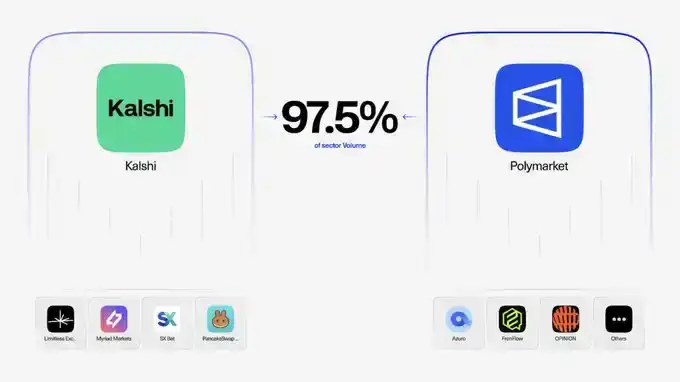
Polymarket runs on Polygon, settles in USDC, and intentionally charges no fees on most markets to prioritize building trading volume. In October 2025, ICE invested $2 billion in a strategic investment at a post-money valuation of approximately $9 billion. In June 2025, X announced Polymarket as its official prediction market partner. In February 2026, Substack natively integrated Polymarket's live odds data; within weeks, one-fifth of the top 250 revenue-generating publications on Substack began using this data. The platform's CMO also confirmed that the POLY token and an airdrop are forthcoming. Upon full functionality launch, its projected annualized fee revenue is expected to exceed $200 million.

Kalshi, on the other hand, obtained a Designated Contract Market designation from the CFTC, becoming the first event contract platform with such credentials, and turned this into a distribution moat. It was this compliant status that enabled Kalshi to enter Robinhood. In 2025 alone, Robinhood facilitated over 4 billion event contract trades. In January 2025, Kalshi launched markets related to the Super Bowl. In less than 12 months, sports markets skyrocketed from roughly 10% to over 85% of its trading volume. In May 2026, Kalshi raised $1 billion at a $22 billion valuation, led by Coatue with participation from Sequoia, a16z, Paradigm, Morgan Stanley, and ARK. At the time of funding, Kalshi had approximately 2 million monthly active users, annualized trading volume of about $178 billion, and annualized revenue of about $1.5 billion.

In 2025, these two companies collectively controlled about 97.5% of the total trading volume in the prediction market industry.

Ecosystem Map
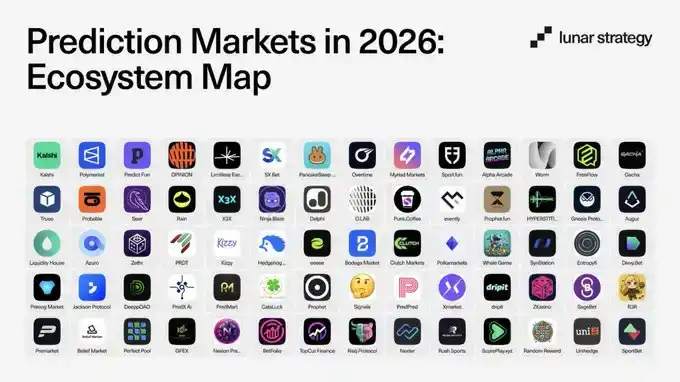
The Challengers
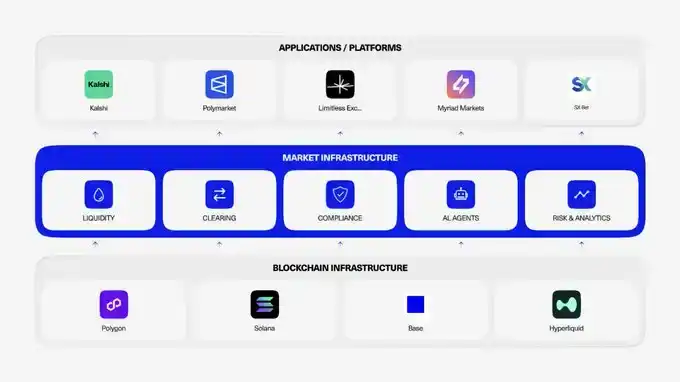
Beyond the duopoly, over a dozen teams are building new prediction market platforms. Each targets a specific gap.

@trylimitless is deployed on Base, focusing on short-cycle markets including 15-minute, hourly, and daily markets, targeting cryptocurrency and stock traders seeking fast settlement. The project raised $10 million from 1confirmation, Coinbase Ventures, F-Prime, DCG, and Arrington, among others. In Q1 2026, its monthly trading volume reached $1.1 billion. The fully diluted valuation of the $LMTS token once reached $800 million after launch.

@MyriadMarkets runs on the Abstract chain and integrates with Linea, Celo, and BNB. It bets on "media-native" prediction markets. Its first distribution partnership occurred in December 2025, embedding prediction features into Trust Wallet. It currently has over 430,000 users who have completed more than 1.7 million predictions. The project was founded by the team behind Decrypt and Rug Radio.

KASH embeds into X via @kash_bot, allowing users to create and trade prediction markets within quote posts. In February 2026, KASH raised $2 million from Big Brain Holdings, Spartan, Coinbase Ventures, Animoca, and the Sui Foundation, among others. Its core belief: whoever can enter the scenarios where users already spend their time via the shortest path will win prediction markets.

@DriftProtocol is built atop Drift Protocol's $500 million Solana liquidity pool. It supports over 30 collateral assets, allows cross-collateral positions, and offers FUEL rewards.

@HedgehogMarket targets on-chain native metrics, such as Base fees, funding rates, validator performance, while also offering general binary options on Solana and Eclipse. The platform supports permissionless market creation, with peak TVL once reaching around $20 million.

@HyperliquidX's HIP-4 went live on May 2, 2026, co-designed by John Wang, Head of Crypto at Kalshi. This mechanism uses USDH exclusively as collateral, employs a CLOB order book model, and charges no opening fees. The first market, deployed officially by Hyperliquid, revolves around BTC outcomes, achieving $6 million in trading volume on its first day. Currently, @Outcomexyz is the primary frontend for HIP-4, contributing 10x the trading volume of any other interface.

@azuroprotocol is more like infrastructure than a frontend product for general users. It provides a sports prediction market layer for other teams, using a Liquidity Tree pool design. The project has raised $11 million from Delphi Digital, Gnosis, and Arrington Capital, among others.

@Overtime_io runs on Optimism, Arbitrum, and Base. All protocol revenue flows to $OVER token buybacks.

@RobinhoodApp is powered by Kalshi's backend, facilitating over 2 billion event contract trades in Q3 2025 alone.

The infrastructure layer is also heating up. In August 2025, @theclearingco raised a $15 million seed round from investors including Union Square Ventures, Haun Ventures, Coinbase Ventures, and Variant. The company was founded by former executives from Polymarket and Kalshi. Capital flowing to the clearinghouse layer usually signals that an asset class is maturing.

Core Drivers in 2026

Regulated platforms are exploring on-chain tracks. Kalshi tokenizing markets and deploying to Solana, Polymarket advancing US CFTC compliance through the acquisition of QCEX, and Hyperliquid's HIP-4 being co-designed by Kalshi—all these moves point in the same direction: a global liquidity layer at the base, overlaid with regulatory shells for different regions.

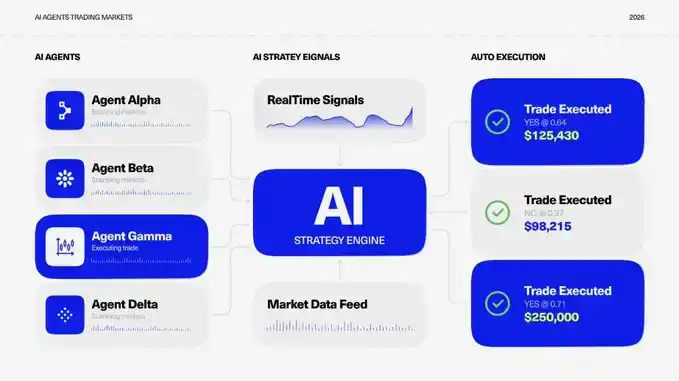
AI Agents have become a non-negligible part of prediction market activity. According to analytics platform LayerHub, over 30% of wallets on Polymarket are running AI Agents. Olas's Polystrat Agent executed over 4,200 trades in its first month, with single-position returns as high as 376%. Elastics also raised $2 million, aiming to build a natural language trading interface.

Whether platform teams initially designed for it or not, prediction markets are becoming algorithmic trading venues.
Media platforms are treating prediction odds as high-engagement content. X's official partnership deal, Substack's native integration, and Google Finance displaying live odds essentially serve the same purpose: turning financial questions into media events that can be discussed collectively, thereby driving organic user acquisition.

Sports is the most sustainable vertical. The 2024 US election brought the first wave of users; sports kept them. Any new platform raising funds in 2026 without a sports strategy is either building deep infrastructure or making a highly concentrated bet on a specific niche.

The Real Challenges

Three risks are worth pointing out directly.

First, trading volume metrics themselves are controversial. An analysis published by Paradigm in December 2025 noted that Polymarket's NegRisk architecture causes most third-party data tracking tools to double-count. CertiK estimated that wash trading accounted for peaks near 60% of some Polymarket trading volume in 2024. Therefore, the $44 billion figure is better used as a directional reference rather than strictly audited, accurate data.

Second, state-level legal friction is real. As of January 2026, there were over 19 related federal lawsuits. In March 2026, Ohio ruled that Kalshi's sports products constituted gambling. Attorneys General in Wisconsin and Arizona have also taken action against both major platforms. Federal tailwinds from the CFTC coexist with strong headwinds at the state level, and this tension won't disappear soon.

Third, token speculation is driving platform activity. A significant portion of trading volume in 2025 and early 2026 was related to market expectations for the POLY airdrop. Any platform touting impressive trading volume numbers without disclosing this context is misleading readers.

Conclusion

In 2024, prediction markets completed the leap from "interesting DeFi experiment" to a financial asset class. By 2025, they began building institutional-grade pipelines: strategic investments from exchange parent companies, CFTC-related settlements, Robinhood integration, and seed funding for clearinghouse layers.

In 2026, the real question for this sector has become: Who else has a chance to win besides Kalshi and Polymarket?

The current answer: Teams that go deep in verticals, possess clear distribution advantages, and can find paths for regulatory protection or on-chain liquidity density.

The opportunity for generalized replicas is over. Other paths, however, remain open.

If you are also building in this space and want to find the right growth architecture for your vertical, let's talk.


Preguntas relacionadas

QWhat are the two dominant platforms in the prediction market as of 2026, and what are their key competitive advantages?

AAs of 2026, the two dominant platforms in the prediction market are Polymarket and Kalshi, forming a duopoly. Polymarket's key advantages include its on-chain infrastructure on Polygon, USDC settlement, zero-fee models for many markets, and strong media partnerships (e.g., with X and Substack) for distribution and visibility. Kalshi's core advantage is its CFTC designation as a Designated Contract Market, which provides regulatory compliance and enabled its integration into mainstream financial platforms like Robinhood, significantly expanding its user base.

QAccording to the article, what has become the most significant long-term driver for prediction markets, replacing political events?

AThe most significant long-term driver for prediction markets, as identified in the article, is sports. While the 2024 US Presidential election brought initial attention and users, sports markets successfully retained and grew that user base. By the end of 2025, sports markets accounted for 85% of Kalshi's trading volume and 39% of Polymarket's. This shift demonstrates that sustainable demand for prediction markets extends far beyond political cycles.

QWhat are some of the key vertical strategies or niches that new prediction market platforms are pursuing to challenge the duopoly?

ANew prediction market platforms are pursuing several vertical niches to challenge the dominant duopoly. These include: platforms focusing on short-cycle markets (like @trylimitless for minute/hour/day trades), media-native integrations (like @MyriadMarkets embedding predictions into content platforms), social-native trading via bots (like KASH on X), on-chain native metrics (like @HedgehogMarket for blockchain data), and dedicated infrastructure layers for sports betting (like @azuroprotocol).

QWhat major risks or challenges does the prediction market industry face according to the article?

AThe article highlights three major risks: 1) Controversy over trading volume metrics, with concerns about double-counting and wash trading potentially inflating reported figures. 2) Persistent legal friction at the state level, with multiple lawsuits and state-level rulings challenging the legality of certain prediction markets as gambling. 3) The influence of token speculation, where a significant portion of trading activity is driven by anticipation of token airdrops (like POLY), which may not represent genuine, sustainable user engagement.

QWhat is the article's conclusion about the future opportunity for new players in the prediction market space?

AThe article concludes that the opportunity for generic copycat platforms is over. Future success for new players lies in building platforms with deep specialization in a specific vertical (e.g., sports, finance), possessing clear distribution advantages (e.g., media integration, social embedding), and finding a viable path through regulatory hurdles or by leveraging on-chain liquidity density. The competition has evolved into a multi-dimensional battle involving liquidity, distribution, and regulatory strategy.

Lecturas Relacionadas

Will the Next Crypto Bull Run Start with On-Chain Trading of SpaceX?

This article presents a scenario-based forecast for the crypto industry from 2026 to 2029, arguing that the next major cycle will be driven not by technological narratives but by legal access to real-world assets. The author predicts that by mid-2026, pre-IPO perpetual contracts for top private companies like SpaceX, OpenAI, and Anthropic on platforms like Hyperliquid will become the primary gateway for accessing quality assets, as most crypto-native tokens fail to capture real value. The much-hyped AI x Crypto intersection largely fails except for prediction markets, which thrive on betting on AI model supremacy. By 2027, public blockchain foundations are forced to choose between catering to retail speculation or building compliant infrastructure for institutions, with many opting for the latter. Growth in stablecoins and tokenized private credit/equity hits a "triple ceiling" due to regulatory and political uncertainty rather than market demand. The pivotal shift is forecast for 2028. A major liquidation event in pre-IPO perpetuals exposes the structural flaw of synthetic markets lacking a real underlying asset anchor. In response, regulatory changes finally allow the public solicitation of private securities resales to verified accredited investors. This creates a legitimate secondary market for real company equity, which then becomes the core asset class of the new bull market, relegating synthetic perps to a niche role. By 2029, the industry becomes "boring" but foundational. Tokens without claims on real cash flows or assets cease trading. Stablecoin growth is steady but politically capped. Crypto infrastructure fades from view as it gets absorbed into traditional finance backends. The article's central thesis is that the key bottleneck for crypto's next phase is legal and regulatory channels for real asset ownership, not technology.

marsbitHace 30 min(s)

Will the Next Crypto Bull Run Start with On-Chain Trading of SpaceX?

marsbitHace 30 min(s)

The Value Distribution of Stablecoins

**Summary: The Value Distribution of Stablecoins** The article argues that stablecoins are evolving from mere trading tools into broader channels for dollar access. It divides the stablecoin ecosystem into four layers to analyze how value is distributed: 1. **Issuance Layer:** Mints stablecoins, holds reserve assets, and captures the spread between reserve yield and user costs (e.g., Tether, Circle). This layer currently earns the largest profit margin. 2. **Infrastructure Layer:** Connects stablecoins to the traditional financial system, handling fiat on/off-ramps, banking integration, compliance (KYC/AML), and asset management (e.g., Bridge, BVNK). This is the "unglamorous" but critical work, building the essential bridges between crypto and real-world finance. 3. **Acquiring/Distribution Layer:** Integrates stablecoins into merchant systems, manages payment flows, and provides enterprise financial software (e.g., Stripe, Coinbase). They act as the access point for businesses. 4. **Application Layer:** The end-users and businesses that ultimately use stablecoins for payments, settlements, or as a store of value. They benefit from convenience but have little pricing power. The core thesis is that while the issuance layer currently dominates profits, the often-overlooked **infrastructure layer holds significant long-term potential**. The real challenge and barrier to mass adoption is not the on-chain transfer of stablecoins (which is simple), but the complex "last mile" integration into existing business workflows, banking systems, and regulatory frameworks across different countries. Companies in this layer are currently in a "land grab" phase, investing heavily to build networks, secure bank partnerships, and establish compliance pathways. While their position is currently pressured by the profitable issuers above and distribution platforms below, the article suggests that if stablecoins become a default financial rail for businesses, the infrastructure providers who have done the hard work of integration will ultimately gain strong pricing power and become entrenched, essential players.

marsbitHace 7 hora(s)

The Value Distribution of Stablecoins

marsbitHace 7 hora(s)

The Value Distribution of Stablecoins

The Value Distribution of Stablecoins The article argues that stablecoins are evolving from a mere trading tool into a broad "dollar channel." It analyzes the industry's value chain through four layers: 1. **Issuance Layer (e.g., Tether, Circle):** The top layer that mints stablecoins, holds reserve assets, and captures the thickest interest rate spread. 2. **Infrastructure Layer (e.g., Bridge, BVNK):** Connects stablecoins to the traditional financial system, handling critical but complex "dirty work" like fiat on/off-ramps, banking integration, compliance (KYC/AML), and cross-border settlement. 3. **Acquiring/Distribution Layer (e.g., Stripe, Coinbase):** Embeds stablecoins into merchant systems, manages payment flows, and integrates with enterprise software. 4. **Application Layer:** End-users and businesses that ultimately use stablecoins for payments, settlement, or storing value. The author posits that while the issuance layer currently captures the most profit, the most overlooked and potentially critical layer is infrastructure. The core challenge for stablecoin adoption isn't the on-chain transfer (which is simple), but bridging the gap between blockchain and the real-world financial system. This involves solving practical problems for businesses: fiat conversion, reconciliation, tax handling, and user onboarding. Infrastructure companies are currently in a difficult "land-grab" phase—building networks, securing banking relationships, and achieving compliance country-by-country. They face pressure from both the profitable issuance layer above and distribution platforms below. However, the author suggests this layer is building a crucial moat. Once stablecoins become a default business rail, the infrastructure players who have done the hard work of integration may gain significant, durable value and pricing power.

链捕手Hace 7 hora(s)

The Value Distribution of Stablecoins

链捕手Hace 7 hora(s)

Trading

Spot
Futuros

Artículos destacados

Cómo comprar T

¡Bienvenido a HTX.com! Hemos hecho que comprar Threshold Network Token (T) sea simple y conveniente. Sigue nuestra guía paso a paso para iniciar tu viaje de criptos.Paso 1: crea tu cuenta HTXUtiliza tu correo electrónico o número de teléfono para registrarte y obtener una cuenta gratuita en HTX. Experimenta un proceso de registro sin complicaciones y desbloquea todas las funciones.Obtener mi cuentaPaso 2: ve a Comprar cripto y elige tu método de pagoTarjeta de crédito/débito: usa tu Visa o Mastercard para comprar Threshold Network Token (T) al instante.Saldo: utiliza fondos del saldo de tu cuenta HTX para tradear sin problemas.Terceros: hemos agregado métodos de pago populares como Google Pay y Apple Pay para mejorar la comodidad.P2P: tradear directamente con otros usuarios en HTX.Over-the-Counter (OTC): ofrecemos servicios personalizados y tipos de cambio competitivos para los traders.Paso 3: guarda tu Threshold Network Token (T)Después de comprar tu Threshold Network Token (T), guárdalo en tu cuenta HTX. Alternativamente, puedes enviarlo a otro lugar mediante transferencia blockchain o utilizarlo para tradear otras criptomonedas.Paso 4: tradear Threshold Network Token (T)Tradear fácilmente con Threshold Network Token (T) en HTX's mercado spot. Simplemente accede a tu cuenta, selecciona tu par de trading, ejecuta tus trades y monitorea en tiempo real. Ofrecemos una experiencia fácil de usar tanto para principiantes como para traders experimentados.

614 Vistas totalesPublicado en 2024.12.10Actualizado en 2026.06.02

Cómo comprar T

Discusiones

Bienvenido a la comunidad de HTX. Aquí puedes mantenerte informado sobre los últimos desarrollos de la plataforma y acceder a análisis profesionales del mercado. A continuación se presentan las opiniones de los usuarios sobre el precio de T (T).

活动图片