Author: Lawyer Liu Honglin
Over the past two days, many friends who have bought Hong Kong and US stocks have been sharing the same piece of news.
On May 22, 2026, the China Securities Regulatory Commission (CSRC) announced that it had filed investigations into Tiger Brokers, Futu Securities, Longbridge Securities, and related domestic and overseas entities for their illegal securities business operations in China, and issued prior notices of administrative penalties. Let's clarify one detail first: this is not the final penalty decision; the parties involved still have the right to make statements, defenses, and request hearings.
On the same day, the CSRC and seven other departments also jointly issued the "Implementation Plan for Comprehensive Rectification of Illegal Cross-border Securities, Futures, and Fund Business Activities." The focus of this plan is not simply to penalize a single internet brokerage, but to centrally rectify the entire chain of business where overseas securities, futures, and fund institutions conduct operations targeting domestic investors without approval. According to the plan, the regulatory authorities aim to address not only marketing, account opening, receiving or processing trading orders, and fund transfers by overseas institutions within China, but also support provided by domestic entities for such businesses, such as website development, trading software development and operation, and customer service. The plan also sets a two-year concentrated rectification period, with existing business generally allowed only for one-way selling and fund withdrawal.
Many ordinary users have previously understood this matter as "which app I choose to buy Hong Kong and US stocks." However, the regulatory focus is not on which trading software is installed on a user's phone, but on whether the entity behind that software is providing securities services within China without approval. As long as domestic customer acquisition, order processing, system operation, customer service support, and fund flows form a de facto closed business loop, it is no longer just a simple internet product issue.
Therefore, after the news broke, people have already come to ask me: since the traditional cross-border brokerage path is becoming narrower, can we trade Hong Kong and US stocks on-chain?
This question does not surprise me.
Last year, I went to Singapore and exchanged ideas with several investment friends. One friend, who previously had little interest in cryptocurrencies, started paying attention to Web3 last year—not because Bitcoin surged again or because some public chain spun a new story, but because of on-chain US stocks. His idea was straightforward: if in the future, assets like Apple, NVIDIA, Tesla, and S&P ETFs could be held, transferred, settled, and even incorporated into DeFi portfolios using on-chain accounts, then blockchain would no longer be just an internal asset game within the crypto circle. Instead, it could become a new interface layer for global financial assets.
This is a very interesting phenomenon.
On-chain US stocks make it easier for traditional investors to understand Web3 because they do not require people to first believe in a completely new, unfamiliar asset. Instead, they place well-known stocks, ETFs, and index products into the context of wallets, stablecoin settlement, and smart contracts. For some investors, this is much more intuitive than listening to a bunch of explanations about public chain performance, consensus mechanisms, and ecosystem incentives.
However, this matter is not as simple as people imagine. For mainland Chinese investors, on-chain US stocks are not a "solution" to bypass regulations. If what someone wants to do is simply replace the account opening, funding, trading, and holding completed in a cross-border brokerage app with wallets, USDT, and on-chain tokens, the risks may not be lower.
A more accurate way to put it is: On-chain US stocks address the problem of "how traditional assets go on-chain and how qualified users can gain exposure to US stocks using on-chain methods"; they do not solve the problem of "whether mainland residents can bypass securities, foreign exchange, and virtual currency regulations to buy US stocks."
For compliant institutions and technology service providers, this is a promising infrastructure direction worth serious consideration. For ordinary investors, if you are just looking for a new loophole, it is advisable to cool down a bit first.
Where Does the Demand for On-Chain US Stocks Come From?
Why have on-chain US stocks emerged? Traditional securities markets are already very mature, but for many non-US investors, buying US stocks is not as simple as opening a page and clicking "buy." Preparing account opening materials, moving funds in, handling tax documents, and knowing who to contact after an account is flagged for risk control—these steps are familiar to professional institutions, but for ordinary users, each step involves dealing with banks, brokers, and compliance processes. When the experience is not smooth enough, the market naturally seeks new entry points.
For crypto users, this gap is even more pronounced. They have grown accustomed to wallet transfers, on-chain settlement, and 24/7 fund flow. Yet, once they want to allocate some funds to stocks or ETFs, they must return to bank accounts, brokerage accounts, and traditional clearing systems. The connection between on-chain assets and traditional assets is not technically impossible, but the user experience is very fragmented.
This is precisely where on-chain US stocks are appealing: they attempt to create on-chain representations of US stock or ETF economic exposure. What users see is a stock token, such as an on-chain version of a US stock or ETF; behind it, there may be issuers, brokers, custodians, market makers, oracles, smart contracts, and distribution platforms. Products with relatively complete disclosure and higher compliance requirements typically emphasize underlying asset backing, segregated custody, qualified investor restrictions, redemption arrangements, and legal documentation.
It can be viewed in two layers: what you see on-chain are accounts, tokens, and trading interfaces; what truly matters off-chain are the underlying assets, custody arrangements, legal documents, user access, and exit paths.
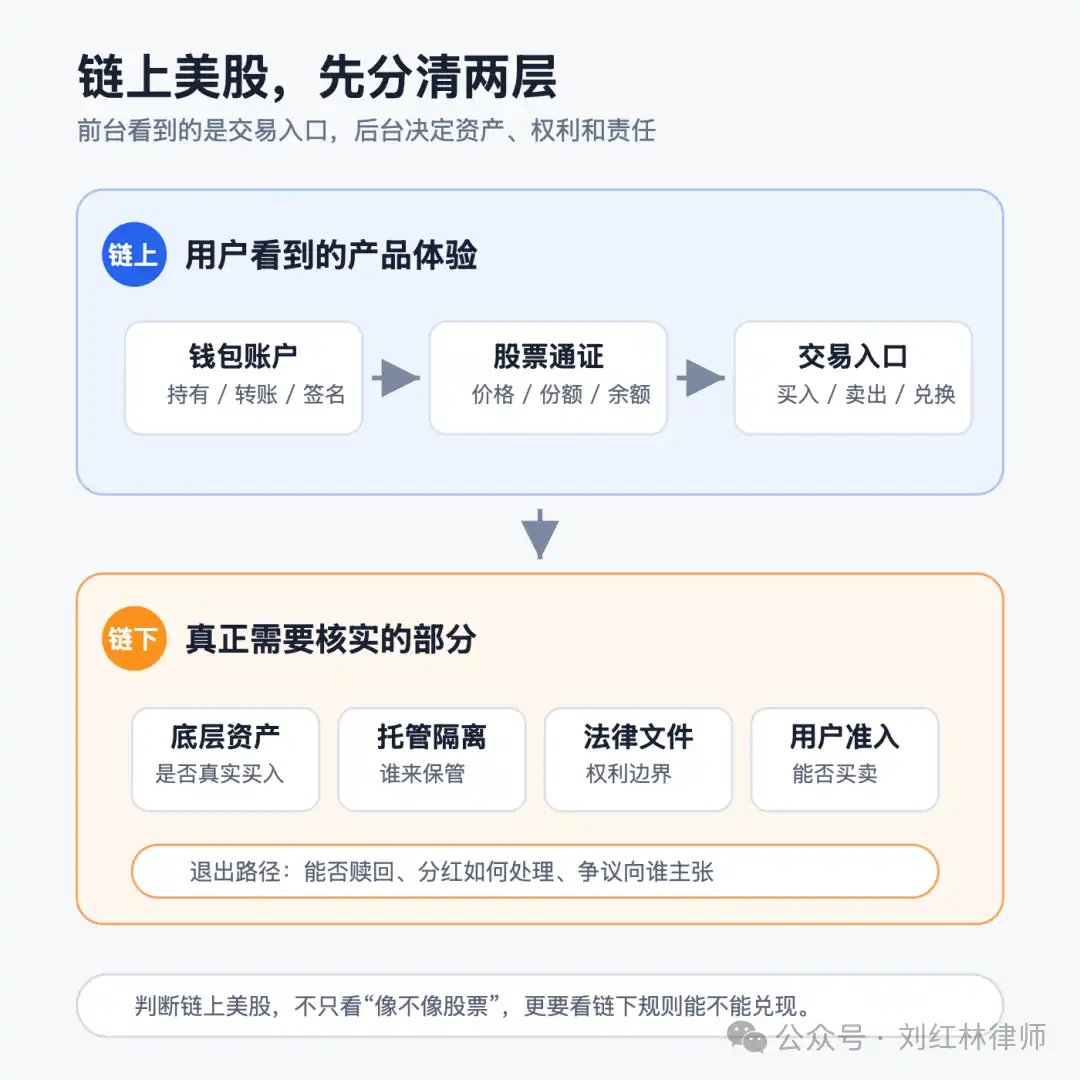
On-Chain US Stock Product Structure: On-Chain Interface and Off-Chain Rules
When evaluating an on-chain stock product, one cannot just look at whether its name contains Apple, NVIDIA, or Tesla. You must look all the way down: whether the underlying assets are actually purchased, who custodies the assets, how the issuance documents are written, whether users have the qualification to purchase, and whether they can redeem, sell, or claim rights later.
This is also the most easily misunderstood aspect of on-chain stocks. It does not necessarily mean you directly own a share of a US-listed company stock.
Currently, the industry roughly follows two paths.
One path involves issuers creating on-chain financial instruments based on underlying stocks or ETFs. For example, xStocks under Backed, whose official legal documents describe it as a type of on-chain transferable security, specifically a "tracking certificate"—a structured product tracking the price of the underlying stock or ETF. It emphasizes that each xStock tracks a publicly listed stock or ETF on a 1:1 basis and is fully collateralized by the corresponding underlying assets. However, it also explicitly states that holders do not thereby obtain voting rights or shareholder rights of the underlying stock. In other words, what you get is a financial instrument backed by underlying assets, not direct ownership as a shareholder of the listed company.
The other path involves large platforms using stock tokens as an investment entry point for users in specific regions. For example, Robinhood launched US stock and ETF tokens for EU users in 2025, focusing on allowing qualified European users to gain exposure to US stocks within the app, supporting dividends and extended trading hours. When Ondo Global Markets launched in 2025, it also promoted moving over 100 US stocks and ETFs on-chain, targeting non-US qualified users. Their commonality is not "anyone can buy," but rather trying to place the products within specific compliant distribution frameworks.
The market size for on-chain stocks is also growing. According to CoinGecko's 2026 RWA report, the market capitalization of on-chain stocks grew from approximately $2.09 million as of June 30, 2025, to about $487 million as of March 31, 2026. The spot trading volume for on-chain stocks in Q1 2026 was approximately $15.1 billion, already exceeding the total trading volume for the second half of 2025.
However, this should not be misinterpreted as "on-chain US stocks have replaced traditional brokers." The same report also reminds us that even though leading on-chain stocks are listed on multiple centralized exchanges, their trading volume is still very small compared to the real US stock market. This direction is growing rapidly, but it is not yet the mainstream securities market itself.
I prefer to see it as an ongoing infrastructure experiment rather than a mature investment shortcut.
What Investors Should Pay Attention To
For individual investors, what needs the most vigilance regarding on-chain US stocks is not the technical terms, but the illusion created by "a page that looks very much like stock trading." Many products display stock tickers, real-time prices, percentage changes, and buy/sell buttons on the front end, making it easy for users to mistake them for US stock trading in a traditional brokerage. However, in terms of legal relationships, what you buy might be a certificate backed by underlying stocks, a structured product, a synthetic asset, or even just price exposure within the platform's internal ledger.
The first thing is to examine rights. Is there a redemption right? How are dividends handled? Are there voting rights? How are underlying assets handled if the issuer goes bankrupt? Who do you contact if the custodian has issues? These questions are not in the token's name but in the legal documents and product structure. If a project only emphasizes "tradable" and "price tracks US stocks" but is unclear about underlying assets, custody, and exit arrangements, investors should be very cautious.
The second thing is to examine identity and geographical restrictions. Currently, relatively transparent on-chain US stock products in the market clearly state which regions can use them, which cannot, and what identity verification or qualified investor checks users need to pass. Many products emphasize targeting non-US users, but "non-US" does not equal "everyone in the world can buy freely," and certainly does not equal "mainland Chinese residents can buy directly via wallets." If users bypass platform restrictions using fake identities, nominee identities, VPNs, foreign phone numbers, or other methods, they might gain access in the short term, but two troubles often follow: the platform may freeze, restrict, or liquidate the account upon discovery; and if disputes arise, users will find it difficult to claim full protection based on a non-compliant access path.
The third thing is to examine the source of funds. For individuals in China, purchasing foreign exchange requires a genuine and lawful transaction basis. The Personal Foreign Exchange Purchase Application Form explicitly states that funds cannot be used for overseas investments like real estate or securities, which are not yet open capital account items. If someone could not compliantly use their personal foreign exchange quota to buy overseas stocks before, switching to first converting to stablecoins and then buying on-chain US stocks will not make the fund usage compliant just by adding an extra layer of wallet transactions.
China's regulation of virtual currencies has arguably been intensifying. On February 6, 2026, the People's Bank of China and seven other departments issued the "Notice on Further Preventing and Addressing Risks Related to Virtual Currency, etc." (Yin Fa [2026] No. 42). It continues to clarify that virtual currencies do not have the same legal status as fiat currency. Conducting business activities within China involving the exchange between fiat and virtual currencies, between virtual currencies, token issuance and financing, and trading of virtual currency-related financial products are illegal financial activities that must be strictly prohibited and取缔 (eliminated according to law). Overseas entities and individuals are also prohibited from providing virtual currency-related services to domestic entities in any form without authorization. It also incorporates real-world asset tokenization into the regulatory framework, clarifying that conducting related activities within China and providing intermediary or information technology services, etc., without specific approval, will also face risks of being considered illegal financial activities. In the context of on-chain US stocks, if a domestic user uses stablecoins to access overseas stock tokens, the risk is not just "buying an overseas asset," but potentially叠加 (overlapping) securities investment, foreign exchange usage, virtual currency trading, anti-money laundering, and cross-border dispute lines.
Besides the issues mentioned above, there are many other aspects of on-chain US stocks that investors need to pay attention to.
First is price and liquidity. Traditional US stocks have opening/closing times, centralized auctions, market makers, regulations, and clearing systems. On-chain tokens can be transferred 24/7, but the underlying stock market is not open 24/7. How are on-chain prices pegged during non-trading hours? Who acts as the market maker? To what degree of price deviation is still acceptable? During extreme market volatility, can the redemption and arbitrage mechanisms function? If these questions are not clarified beforehand, what users buy may not be stable exposure to US stocks, but an on-chain trading instrument that merely looks like US stocks in price.
Stocks involve corporate actions like dividends, stock splits, mergers, delistings, tender offers, tax withholding, etc. Traditional brokers typically handle these for users. If on-chain US stocks are to be sufficiently standardized, they must also address these: How are dividends distributed? How are stock splits adjusted? What happens to tokens after delisting? Who provides tax documents? Do users bear additional reporting obligations? Otherwise, while users superficially gain "US stock exposure," when corporate actions actually occur, they may find their rights boundaries are vague.
There's also dispute resolution. On-chain transfers seem clear, but legal relationships may not be. The issuer is in one jurisdiction, the custodian in another, the distribution platform in a third, and the user might be in mainland China. If problems arise, which country's laws apply? Where to file a lawsuit? Can asset proof be obtained? Can custodial assets be traced? These are not issues a block explorer can solve for you.
Therefore, the on-chain aspect is just the front end; what truly determines safety is the entire set of off-chain rules: underlying assets, custody arrangements, issuance documents, user access, redemption mechanisms, audit disclosures, and dispute resolution. Without this framework, no matter how grand the narrative of putting stocks on-chain, it will be difficult to attract genuine buyers.
What Web3 Entrepreneurs Should Pay Attention To
For entrepreneurs, on-chain US stocks are certainly worth attention, but they should not be understood as "traditional brokers are being squeezed by regulation, so the on-chain opportunity has arrived."
The most important takeaway from this cross-border broker rectification is not just the naming of Futu, Tiger, and Longbridge, but the holistic approach to illegal cross-border operations. Overseas institutions themselves are naturally targets of regulation, but domestic affiliated entities, partners, illegal intermediaries, internet platforms, self-media, account opening tutorials, experience sharing, marketing and traffic referrals, trading software, customer service, and fund transfer support may also fall under regulatory scrutiny.
This serves as a direct reminder for on-chain US stock entrepreneurs: If you promote on-chain US stocks to domestic investors, guide account opening, teach funding methods, offer referral rebates, provide Chinese customer service, organize community investment advisory, help users process trading orders, or provide trading software, website operation, customer service, and marketing support for overseas platforms, even if the entry point changes from a brokerage app to a wallet and the settlement currency changes from USD to stablecoins, the nature of the risk does not automatically change.
A more realistic entrepreneurial position is not to become a "new channel for retail investors to buy US stocks," but to position oneself closer to the B2B side, more偏向 (biased towards) infrastructure, and more偏向 compliance services.
Issuers need underlying asset custody and proof of assets, independent audits and reserve disclosures, user identity verification, anti-money laundering, sanctions list screening, on-chain address risk scoring, oracles, transaction monitoring, abnormal price alerts, corporate action processing systems, tax reporting, and user reconciliation tools. Trading platforms and wallets also need compliant distribution capabilities, such as how to display products in different regions, how to perform access judgments for different users, which assets require additional risk disclosures, which operations trigger suspicious transaction monitoring, and which on-chain addresses should not be interacted with.
These tasks may not sound as exciting as "buying US stocks on-chain," but they are closer to a sustainable business.
If an overseas licensed broker, asset management institution, custodian, or fund platform wants to explore security tokenization business, it might not understand on-chain wallets, smart contracts, security audits, on-chain data, cross-chain bridges, asset proofs, and stablecoin settlement itself. If a startup team can provide clear technical modules and avoids handling user funds, trade matching, marketing to the domestic public, and profit promises, the compliance space would be much larger than directly operating a C2C trading channel.
On-Chain Is Not a Universal Solution
Returning to the opening question: Are on-chain stocks a new solution?
If the so-called solution is to find a new path for mainland investors to circumvent cross-border securities regulations, foreign exchange regulations, and virtual currency regulations, then the answer is clear: No. Not only is it not a solution, it may turn what was originally a securities account issue into a problem叠加 (overlapping) securities, foreign exchange, virtual currency, anti-money laundering, and cross-border disputes.
However, looking from another perspective, will on-chain US stocks become an important gateway for global financial assets going on-chain? I think yes.
Market demand is real. Global users want lower-friction access to US assets; crypto users want stablecoins to be used beyond just trading and payments; traditional financial institutions are also seeking more efficient issuance, clearing, and distribution methods. US stocks and ETFs are already among the most globally recognized assets. Making them into on-chain interfaces is easier for ordinary investors to understand than creating a new token from scratch.
The watershed moment is not about "going on-chain or not," but "what is the purpose of going on-chain?" If going on-chain is to bypass identity verification, foreign exchange controls, securities licenses, and investor suitability requirements, this path will not go far. If going on-chain is to make the issuance, custody, transfer, auditing, settlement, and risk control of compliant assets more transparent, automated, and globalized, then it is infrastructure worth building in the long term.
For ordinary investors, the most important thing is not to mistake "looks like a stock" for "is a stock," and not to mistake "on-chain" for "no regulation." For entrepreneurs, the opportunity lies not in "helping retail investors find detours to buy US stocks," but in the business services around compliant funds, qualified users, compliant issuance, clear custody, verifiable reserves, restricted distribution, risk disclosures, transaction monitoring, corporate action processing, taxes, and more.
Market demand will not disappear because of regulatory documents, but demand also does not automatically translate into compliant business.
On-chain US stocks have value, but they are not a new outlet for old problems. What they truly test is whether technological innovation can reconnect with financial regulation when real-world financial assets enter the on-chain realm.
If handled steadily, it could be an important stop for financial assets going on-chain; if used as a detour tool, it will become the next risk hotspot.

![Will Bittensor [TAO] hold $193 or sink to $186? Watch out for 2 signs!](https://d1x7dwosqaosdj.cloudfront.net/images/2026-07/41f6627611d24a5f96cbc0fe7b981e2b.jpg)