After a Valuation of $1 Billion and Five Years of Exploration, Why Did It 'Admit Defeat'?

深潮Publicado a 2025-12-09Actualizado a 2025-12-09

Resumen

After five years of development and raising $180 million at a near $1 billion valuation, Farcaster has officially conceded that its Web3 social strategy did not succeed. The platform, initially designed as a decentralized alternative to Twitter, aimed to address issues like platform monopoly, user data ownership, and creator monetization through an on-chain, protocol-based approach. Despite a brief surge in early 2024—when monthly active users (MAU) peaked at around 80,000—growth quickly stalled. MAU has since declined to under 20,000 by late 2025. Farcaster’s user base remained heavily concentrated within the crypto-native community, failing to attract mainstream users due to high barriers to entry, niche content, and inferior user experience compared to established platforms like X or Instagram. Co-founder Dan Romero announced a strategic pivot from social-first to a wallet-focused product, acknowledging that social alone wasn’t driving sustainable growth. Internal data showed that wallet features—used for transactions, trading, and interacting with dApps—consistently outperformed social modules in user retention and frequency. The shift reflects a broader realization: It’s easier to add social features to a wallet than to build a social product around crypto. While the move has sparked some community discontent, Farcaster is betting that deeper integration with on-chain utilities represents a more viable path to product-market fit.

Written by: Bootly

After five years of operation, raising approximately $180 million in total funding, and reaching a valuation once nearing $1 billion, Farcaster has officially admitted: the path of Web3 social has not succeeded.
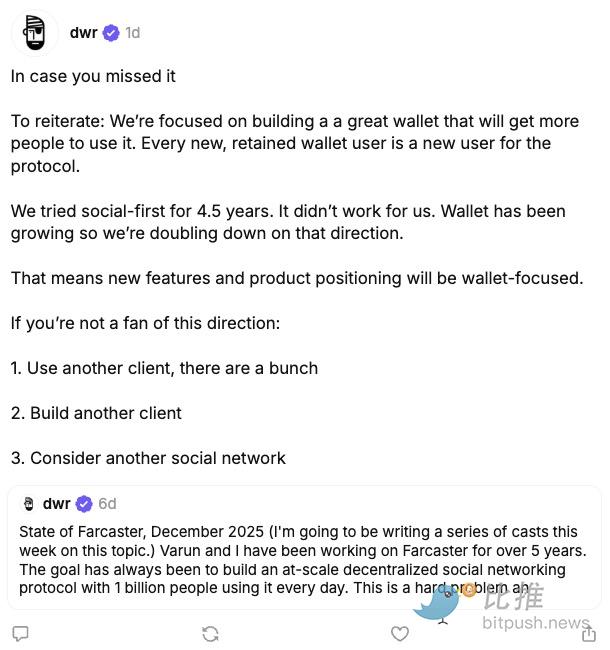
Recently, Farcaster co-founder Dan Romero posted a series of messages on the platform, announcing that the team will abandon the "social-first" product strategy and instead fully focus on the wallet direction. In his words, this is not an active upgrade but a choice forced by reality after a long period of attempts.

"We tried social-first for 4.5 years, and it didn't work."

This judgment not only signifies Farcaster's transformation but also once again highlights the structural challenges of Web3 social.

The Gap Between Ideal and Reality: Why Farcaster Failed to Become the 'Decentralized Twitter'

Farcaster was born in 2020, during the rise of the Web3 narrative. It attempted to solve three core problems of Web2 social platforms:

  • Platform monopoly and censorship

  • User data not belonging to users themselves

  • Creators unable to monetize directly

Its design approach was highly idealistic:

  • Decentralized protocol layer

  • Freedom to build clients

  • Social relationships on-chain and migratable

Among the various "decentralized social" projects, Farcaster was once considered the product closest to PMF. Especially after Warpcast gained traction in 2023, many KOLs from Crypto Twitter joined, making it seem like the prototype of the next-generation social network.

But problems soon emerged.

According to Farcaster's monthly active user (MAU) statistics on Dune Analytics, Farcaster's user growth trajectory shows a very clear but not optimistic pattern:
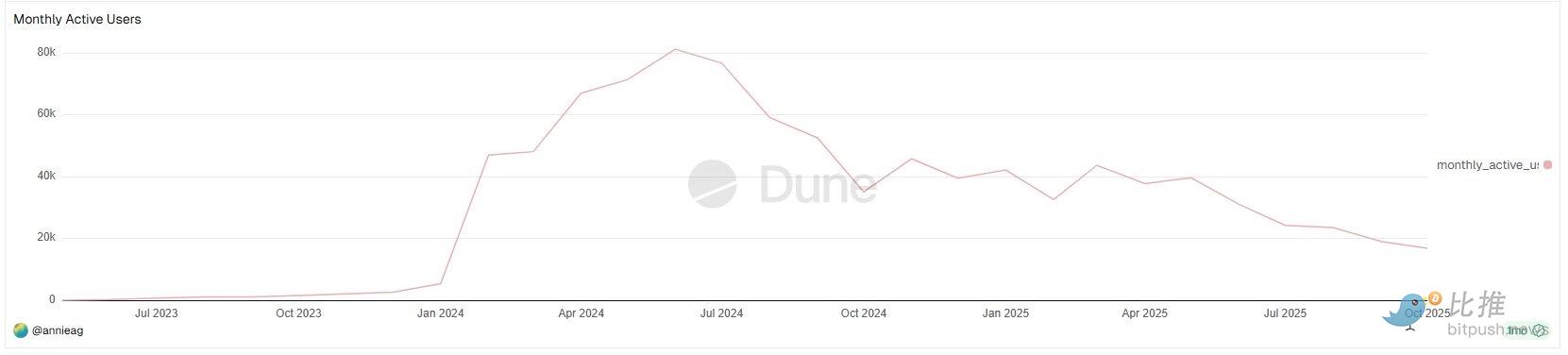
For most of 2023, Farcaster's monthly active users were almost negligible;

The real growth inflection point occurred in early 2024, with MAU rapidly increasing from a few thousand to about 40,000–50,000 in a short time, and even approaching 80,000 by mid-2024.

This was Farcaster's only truly scalable growth window since its inception. It is particularly noteworthy that this growth did not occur during a bear market but during a period of high activity in the Base ecosystem and the emergence of dense SocialFi narratives.

However, this window did not last long.

Starting in the second half of 2024, monthly active data showed a clear decline, and over the following year, it exhibited a volatile downward trend:

  • MAU rebounded multiple times, but the peaks continued to lower

  • By the second half of 2025, monthly active users had fallen to less than 20,000

In fact, Farcaster's growth has always been unable to "break through," with its user structure highly homogeneous:

  • Crypto practitioners

  • VCs

  • Builders

  • Crypto-native users

For ordinary users:

  • High registration barrier

  • Social content is heavily "insider-focused"

  • User experience not better than X / Instagram

This prevented Farcaster from ever forming true network effects.

DeFi KOL Ignas (@DeFiIgnas) on X bluntly stated that Farcaster "just admitted what everyone has felt for a long time":

The strength of X's (formerly Twitter) network effects is almost impossible to break head-on.

This is not a problem with the crypto narrative but a structural barrier of social products. From a product perspective, the issues with Farcaster's social side are very typical:

  • User growth has always been locked into the crypto-native crowd

  • Content is highly insular and difficult to spill over

  • Creator monetization and user retention did not form a positive feedback loop

This is why Ignas succinctly summarized Farcaster's new strategy in one sentence:

"It's easier to add social to a wallet than to add a wallet to a social product."

This judgment essentially admits that "social is not the first-order need of Web3."

"The Bubble Is Comfortable, but the Numbers Are Cold"

If MAU data answers "how Farcaster performed," then another question is: How big is this market itself?

Crypto creator Wiimee provided a set of striking comparative data on X.
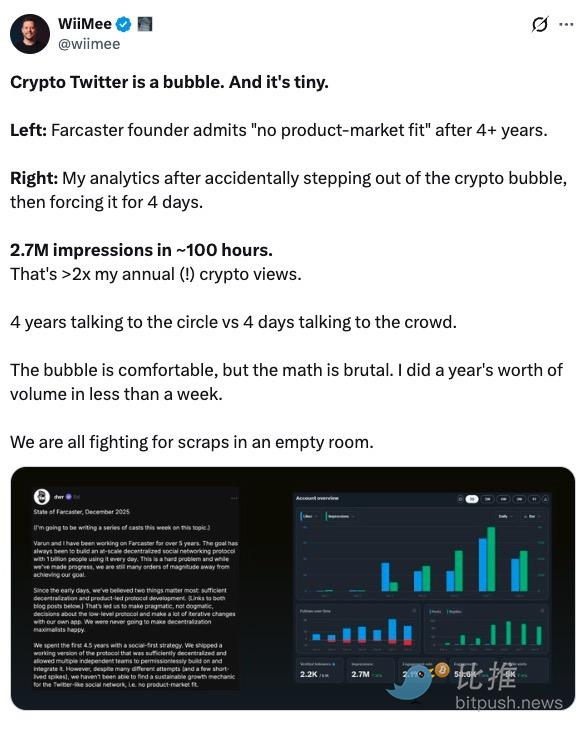
After "accidentally stepping out of the crypto content circle," Wiimee created content for a general audience for four consecutive days. His analysis data showed that in about 100 hours, he received 2.7 million impressions, more than double the total views of all his crypto content over a year.

He stated:

"Crypto Twitter is a bubble, and it's small. Four years of speaking to insiders is less effective than four days of speaking to the masses."

This is not a direct criticism of Farcaster but reveals a more fundamental problem:

Crypto social itself is a highly self-referential ecosystem with weak spillover capabilities. When content, relationships, and attention are all confined to the same batch of users, even the most refined protocol design cannot break through the upper limit of market scale.

This means Farcaster faced not "the product isn't good enough" but "there aren't enough people in the field."

Wallet, on the Other Hand, Achieved PMF

What truly changed Farcaster's internal judgment was not a reflection on social but the unexpected validation of the wallet.

Earlier in 2024, Farcaster introduced a built-in wallet in its application, initially intended only as a supplement to the social experience. But from usage data, the wallet's growth slope, frequency of use, and retention performance were significantly different from the social module.

Dan Romero emphasized in a public response:

"Every new and retained wallet user is a new user for the protocol."

This statement itself reveals the logical core of the strategic shift. The wallet addresses not "the desire to express" but real, rigid on-chain behavioral needs: transfers, transactions, signatures, and interactions with new applications.

In October, Farcaster acquired Clanker, an AI Agent-driven token issuance tool, and gradually integrated it into the wallet system. This move was also seen as the team's clear bet on the "wallet-first" path.

From a business perspective, this direction has clear advantages:

  • Higher frequency of use

  • Clearer monetization path

  • Tighter integration with the on-chain ecosystem

In contrast, social seems more like a nice-to-have rather than an engine for growth.

Although the wallet strategy is justified by the data, community controversy has also followed.

Several long-term users explicitly stated that they are not opposed to the wallet itself but are uncomfortable with the cultural shift that comes with it: from "users" being redefined as "traders," from "co-builders" being labeled as "old guard."

This exposes a practical problem: when a product direction changes, community sentiment is often harder to migrate than the roadmap. Farcaster's protocol layer remains decentralized, but the choice of product direction is still concentrated in the hands of the team. This tension is amplified during transformation.

Romero later admitted that there were communication issues but made it clear that the team had made its choice.
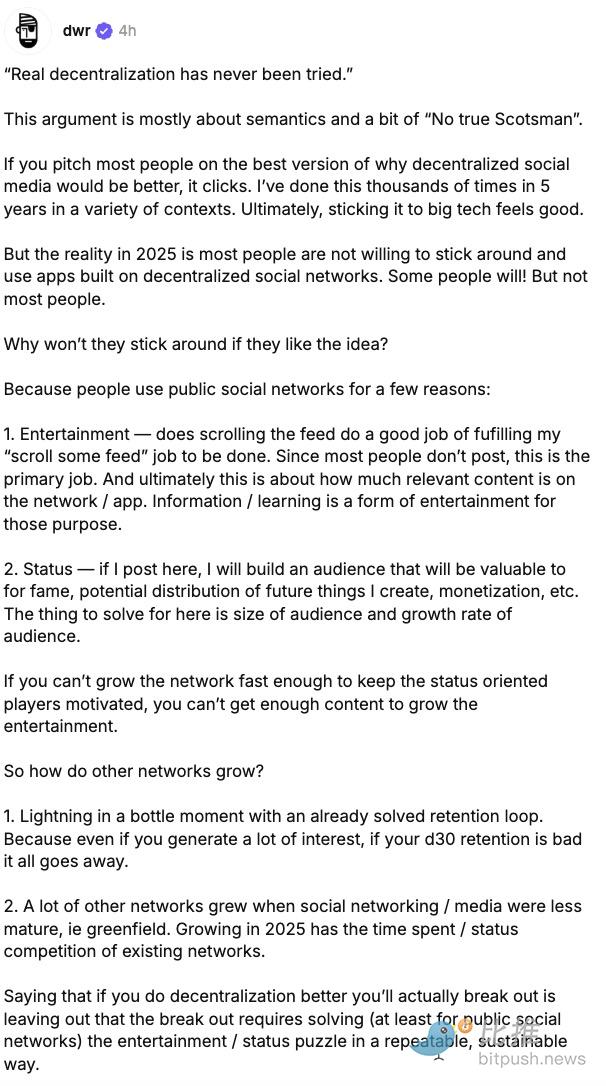
This is not arrogance but a common decisive reality for startup projects in the later stages of their lifecycle. In this sense, Farcaster did not abandon the social ideal but gave up the illusion of its scalability.

As one observer perhaps put it best:

"First, let users stay for the tools; then there is space for social to exist."

Farcaster's choice may not be the most romantic, but it might be the one closest to reality. Deeply integrating native financial tools (wallets, transactions, issuance) is the practical path to converting into sustainable commercial value.

Preguntas relacionadas

QWhy did Farcaster decide to pivot from a social-first strategy to a wallet-focused approach?

AFarcaster shifted its strategy because after 4.5 years of focusing on social, it did not achieve product-market fit. The social approach failed to scale beyond the crypto-native user base, while the wallet feature demonstrated stronger growth, retention, and clearer monetization paths.

QWhat were the main challenges Farcaster faced in trying to build a decentralized social platform?

AFarcaster struggled with high user onboarding barriers, highly insular crypto-focused content, inability to break out of the crypto echo chamber, and failure to form genuine network effects competitive with platforms like X (Twitter) or Instagram.

QHow did Farcaster's user growth trend reflect its struggles in social?

AFarcaster's monthly active users (MAU) saw a brief surge to around 80,000 in mid-2024 but quickly declined, falling to under 20,000 by late 2025. Growth was confined to crypto insiders and never achieved broad adoption.

QWhat key insight did the comparison between crypto content and mainstream content exposure reveal?

AA creator's experiment showed that four days of creating content for a general audience generated 2.7 million impressions—more than double the exposure of a year's worth of crypto content—highlighting the small size and limited reach of the crypto social bubble.

QWhy is the wallet considered a more promising direction for Farcaster than social?

AThe wallet addresses core, frequent on-chain needs like transactions, transfers, and signing, leading to higher usage and retention. It integrates more effectively with the crypto economy and offers clearer monetization compared to social features, which are harder to scale and monetize.

Lecturas Relacionadas

Gensyn AI: Don't Let AI Repeat the Mistakes of the Internet

In recent months, the rapid growth of the AI industry has attracted significant talent from the crypto sector. A persistent question among researchers intersecting both fields is whether blockchain can become a foundational part of AI infrastructure. While many previous AI and Crypto projects focused on application layers (like AI Agents, on-chain reasoning, data markets, and compute rentals), few achieved viable commercial models. Gensyn differentiates itself by targeting the most critical and expensive layer of AI: model training. Gensyn aims to organize globally distributed GPU resources into an open AI training network. Developers can submit training tasks, nodes provide computational power, and the network verifies results while distributing incentives. The core issue addressed is not decentralization for its own sake, but the increasing centralization of compute power among tech giants. In the era of large models, access to GPUs (like the H100) has become a decisive bottleneck, dictating the pace of AI development. Major AI companies are heavily dependent on large cloud providers for compute resources. Gensyn's approach is significant for several reasons: 1) It operates at the core infrastructure layer (model training), the most resource-intensive and technically demanding part of the AI value chain. 2) It proposes a more open, collaborative model for compute, potentially increasing resource utilization by dynamically pooling idle GPUs, similar to early cloud computing logic. 3) Its technical moat lies in solving complex challenges like verifying training results, ensuring node honesty, and maintaining reliability in a distributed environment—making it more of a deep-tech infrastructure company. 4) It targets a validated, high-growth market with genuine demand, rather than pursuing blockchain integration without purpose. Ultimately, the boundaries between Crypto and AI are blurring. AI requires global resource coordination, incentive mechanisms, and collaborative systems—areas where crypto-native solutions excel. Gensyn represents a step toward making advanced training capabilities more accessible and collaborative, moving beyond a niche controlled by a few giants. If successful, it could evolve into a fundamental piece of AI infrastructure, where the most enduring value in the AI era is often created.

marsbitHace 6 hora(s)

Gensyn AI: Don't Let AI Repeat the Mistakes of the Internet

marsbitHace 6 hora(s)

Why is China's AI Developing So Fast? The Answer Lies Inside the Labs

A US researcher's visit to China's top AI labs reveals distinct cultural and organizational factors driving China's rapid AI development. While talent, data, and compute are similar to the West, Chinese labs excel through a pragmatic, execution-focused culture: less emphasis on individual stardom and conceptual debate, and more on teamwork, engineering optimization, and mastering the full tech stack. A key advantage is the integration of young students and researchers who approach model-building with fresh perspectives and low ego, prioritizing collective progress over personal credit. This contrasts with the US culture of self-promotion and "star scientist" narratives. Chinese labs also exhibit a strong "build, don't buy" mentality, preferring to develop core capabilities—like data pipelines and environments—in-house rather than relying on external services. The ecosystem feels more collaborative than tribal, with mutual respect among labs. While government support exists, its scale is unclear, and technical decisions appear driven by labs, not state mandates. Chinese companies across sectors, from platforms to consumer tech, are building their own foundational models to control their tech destiny, reflecting a broader cultural drive for technological sovereignty. Demand for AI is emerging, with spending patterns potentially mirroring cloud infrastructure more than traditional SaaS. Despite challenges like a less mature data industry and GPU shortages, Chinese labs are propelled by vast talent, rapid iteration, and deep integration with the open-source community. The competition is evolving beyond a pure model race into a contest of organizational execution, developer ecosystems, and industrial pragmatism.

marsbitHace 8 hora(s)

Why is China's AI Developing So Fast? The Answer Lies Inside the Labs

marsbitHace 8 hora(s)

3 Years, 5 Times: The Rebirth of a Century-Old Glass Factory

Corning, a 175-year-old glass company, is experiencing a dramatic revival as a key player in AI infrastructure, driven by surging demand for high-performance optical fiber in data centers. AI data centers require vastly more fiber than traditional ones—5 to 10 times as much per rack—to handle high-speed data transmission between GPUs. This structural demand shift, coupled with supply constraints from the lengthy expansion cycle for fiber preforms, has created a significant supply-demand gap. Nvidia has invested in Corning, along with Lumentum and Coherent, in a $4.5 billion total commitment to secure the optical supply chain for AI. Corning's competitive edge lies in its expertise in producing ultra-low-loss, high-density, and bend-resistant specialty fiber, which is critical for 800G+ and future 1.6T data rates. Its deep involvement in co-packaged optics (CPO) with partners like Nvidia further solidifies its position. While not the largest fiber manufacturer globally, Corning's revenue from enterprise/data center clients now exceeds 40% of its optical communications sales, and it has secured multi-year supply agreements with major hyperscalers including Meta and Nvidia. Financially, Corning's optical communications revenue has surged, doubling from $1.3 billion in 2023 to over $3 billion in 2025. Its stock price has risen nearly 6-fold since late 2023. Key future catalysts include the rollout of Nvidia's CPO products and the scale of undisclosed customer agreements. However, risks include high current valuations and potential disruption from next-generation technologies like hollow-core fiber. The company's long-term bet on light over electricity, maintained even through the telecom bubble crash, is now being validated by the AI boom.

marsbitHace 8 hora(s)

3 Years, 5 Times: The Rebirth of a Century-Old Glass Factory

marsbitHace 8 hora(s)

Trading

Spot
Futuros

Artículos destacados

Cómo comprar CC

¡Bienvenido a HTX.com! Hemos hecho que comprar CC(Canton) (CC) sea simple y conveniente. Sigue nuestra guía paso a paso para iniciar tu viaje de criptos.Paso 1: crea tu cuenta HTXUtiliza tu correo electrónico o número de teléfono para registrarte y obtener una cuenta gratuita en HTX. Experimenta un proceso de registro sin complicaciones y desbloquea todas las funciones.Obtener mi cuentaPaso 2: ve a Comprar cripto y elige tu método de pagoTarjeta de crédito/débito: usa tu Visa o Mastercard para comprar CC(Canton) (CC) al instante.Saldo: utiliza fondos del saldo de tu cuenta HTX para tradear sin problemas.Terceros: hemos agregado métodos de pago populares como Google Pay y Apple Pay para mejorar la comodidad.P2P: tradear directamente con otros usuarios en HTX.Over-the-Counter (OTC): ofrecemos servicios personalizados y tipos de cambio competitivos para los traders.Paso 3: guarda tu CC(Canton) (CC)Después de comprar tu CC(Canton) (CC), guárdalo en tu cuenta HTX. Alternativamente, puedes enviarlo a otro lugar mediante transferencia blockchain o utilizarlo para tradear otras criptomonedas.Paso 4: tradear CC(Canton) (CC)Tradear fácilmente con CC(Canton) (CC) en HTX's mercado spot. Simplemente accede a tu cuenta, selecciona tu par de trading, ejecuta tus trades y monitorea en tiempo real. Ofrecemos una experiencia fácil de usar tanto para principiantes como para traders experimentados.

157 Vistas totalesPublicado en 2026.04.21Actualizado en 2026.04.21

Cómo comprar CC

Cómo comprar BLEND

¡Bienvenido a HTX.com! Hemos hecho que comprar Fluent (BLEND) sea simple y conveniente. Sigue nuestra guía paso a paso para iniciar tu viaje de criptos.Paso 1: crea tu cuenta HTXUtiliza tu correo electrónico o número de teléfono para registrarte y obtener una cuenta gratuita en HTX. Experimenta un proceso de registro sin complicaciones y desbloquea todas las funciones.Obtener mi cuentaPaso 2: ve a Comprar cripto y elige tu método de pagoTarjeta de crédito/débito: usa tu Visa o Mastercard para comprar Fluent (BLEND) al instante.Saldo: utiliza fondos del saldo de tu cuenta HTX para tradear sin problemas.Terceros: hemos agregado métodos de pago populares como Google Pay y Apple Pay para mejorar la comodidad.P2P: tradear directamente con otros usuarios en HTX.Over-the-Counter (OTC): ofrecemos servicios personalizados y tipos de cambio competitivos para los traders.Paso 3: guarda tu Fluent (BLEND)Después de comprar tu Fluent (BLEND), guárdalo en tu cuenta HTX. Alternativamente, puedes enviarlo a otro lugar mediante transferencia blockchain o utilizarlo para tradear otras criptomonedas.Paso 4: tradear Fluent (BLEND)Tradear fácilmente con Fluent (BLEND) en HTX's mercado spot. Simplemente accede a tu cuenta, selecciona tu par de trading, ejecuta tus trades y monitorea en tiempo real. Ofrecemos una experiencia fácil de usar tanto para principiantes como para traders experimentados.

161 Vistas totalesPublicado en 2026.04.24Actualizado en 2026.04.24

Cómo comprar BLEND

Cómo comprar ACN

¡Bienvenido a HTX.com! Hemos hecho que comprar AITECH CLOUD NETWORK (ACN) sea simple y conveniente. Sigue nuestra guía paso a paso para iniciar tu viaje de criptos.Paso 1: crea tu cuenta HTXUtiliza tu correo electrónico o número de teléfono para registrarte y obtener una cuenta gratuita en HTX. Experimenta un proceso de registro sin complicaciones y desbloquea todas las funciones.Obtener mi cuentaPaso 2: ve a Comprar cripto y elige tu método de pagoTarjeta de crédito/débito: usa tu Visa o Mastercard para comprar AITECH CLOUD NETWORK (ACN) al instante.Saldo: utiliza fondos del saldo de tu cuenta HTX para tradear sin problemas.Terceros: hemos agregado métodos de pago populares como Google Pay y Apple Pay para mejorar la comodidad.P2P: tradear directamente con otros usuarios en HTX.Over-the-Counter (OTC): ofrecemos servicios personalizados y tipos de cambio competitivos para los traders.Paso 3: guarda tu AITECH CLOUD NETWORK (ACN)Después de comprar tu AITECH CLOUD NETWORK (ACN), guárdalo en tu cuenta HTX. Alternativamente, puedes enviarlo a otro lugar mediante transferencia blockchain o utilizarlo para tradear otras criptomonedas.Paso 4: tradear AITECH CLOUD NETWORK (ACN)Tradear fácilmente con AITECH CLOUD NETWORK (ACN) en HTX's mercado spot. Simplemente accede a tu cuenta, selecciona tu par de trading, ejecuta tus trades y monitorea en tiempo real. Ofrecemos una experiencia fácil de usar tanto para principiantes como para traders experimentados.

91 Vistas totalesPublicado en 2026.04.28Actualizado en 2026.04.28

Cómo comprar ACN

Discusiones

Bienvenido a la comunidad de HTX. Aquí puedes mantenerte informado sobre los últimos desarrollos de la plataforma y acceder a análisis profesionales del mercado. A continuación se presentan las opiniones de los usuarios sobre el precio de A (A).

活动图片