Aerodrome Finance: Can AERO target $0.65 after a 22% weekly rally?

ambcryptoPublicado a 2026-07-05Actualizado a 2026-07-05

Resumen

Aerodrome Finance (AERO) has rallied strongly, gaining 22% in the past week. After holding support at $0.45, the altcoin reached $0.60 for the first time since January and was trading at $0.58 at the time of writing. Technical indicators show bullish momentum, with the RSI at 67 and the DMI Modified indicator rising sharply, suggesting a strengthening uptrend. This price movement is supported by significant market demand. Open Interest in derivatives surged 10% to $56 million in a day, and spot trading has shown a positive buy-sell delta over recent days, with net exchange flow turning negative, indicating accumulation. Analysts suggest that if bullish pressure continues, AERO could target $0.65. However, a failure to sustain above $0.60 could weaken the trend, potentially leading to a retest of the $0.46-$0.50 support zone.

Aerodrome Finance [AERO] is on a strong upward run. Since holding $0.45 support four days ago, the altcoin has closed at higher highs.

As a result, the altcoin touched a high of $0.60 for the first time since January, then slightly retraced. At the time of writing, AERO was trading at $0.58, up 4.85% on the daily charts, adding to its 22% weekly surge.

What do Aerodrome’s charts suggest?

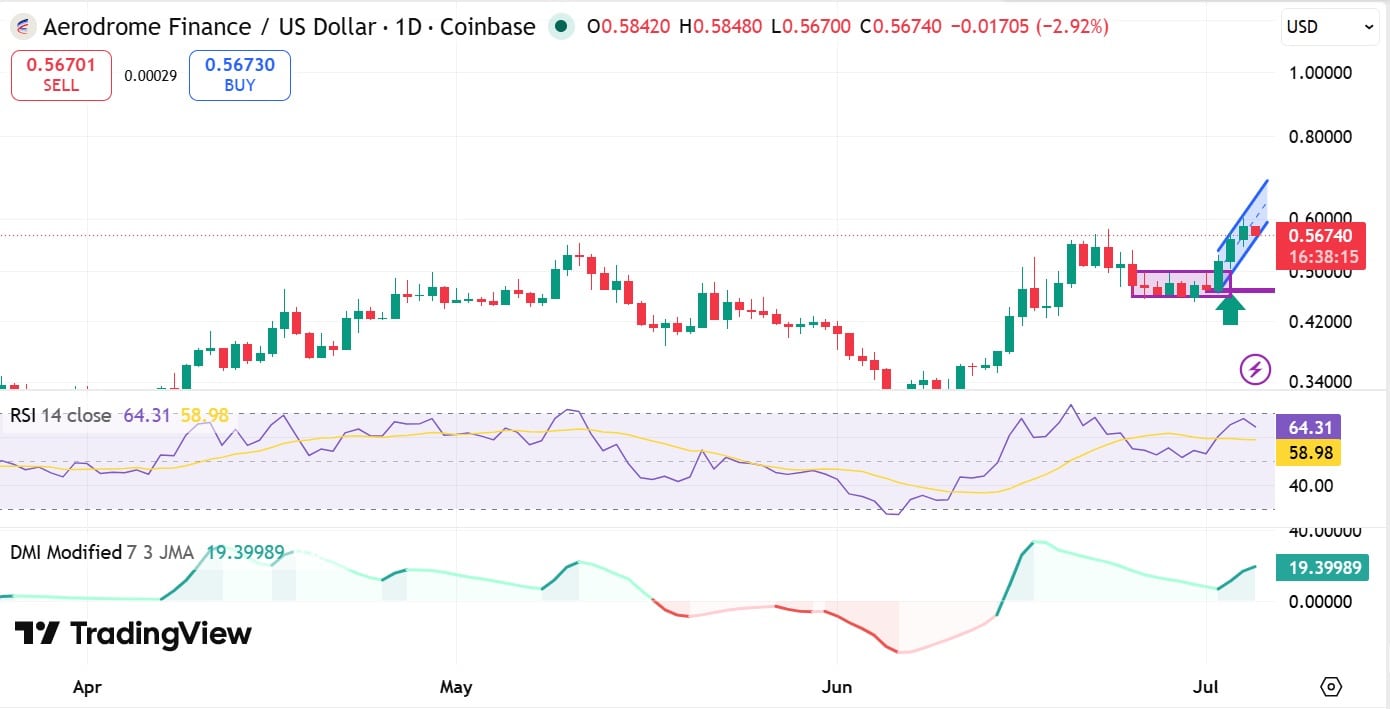
AERO charts continued to show relative strength, with the uptrend holding strong. In fact, the altcoin held the $0.45 level as buyers returned with strength.

As a result, the altcoin’s Relative Strength Index (RSI) formed a bullish crossover and rose to 67 as of writing, indicating that buyers have a commanding control of the market. Often, buyer dominance has preceded extended upward movement.
Source: TradingView

Even more so, the DMI Modified indicator further confirmed the strength of this trend. The DMI Modified jumped from 6 to 19, indicating the market started to develop a meaningful directional move.

Taken together, these two momentum indicators suggest that the altcoin uptrend is strengthening and the prevailing trend could continue.

What’s driving AERO’s ?

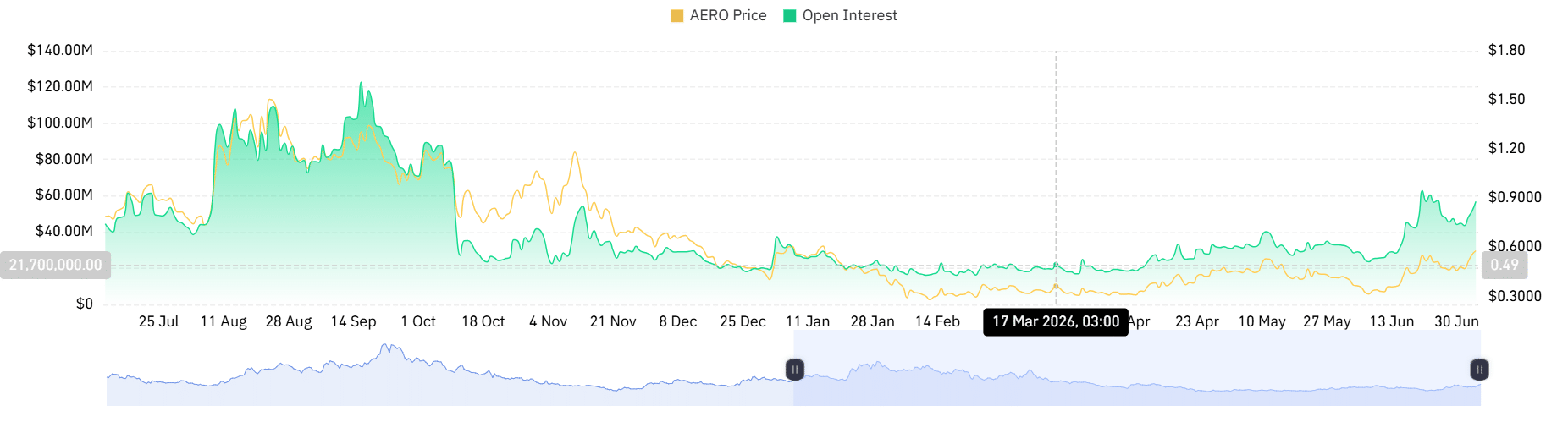
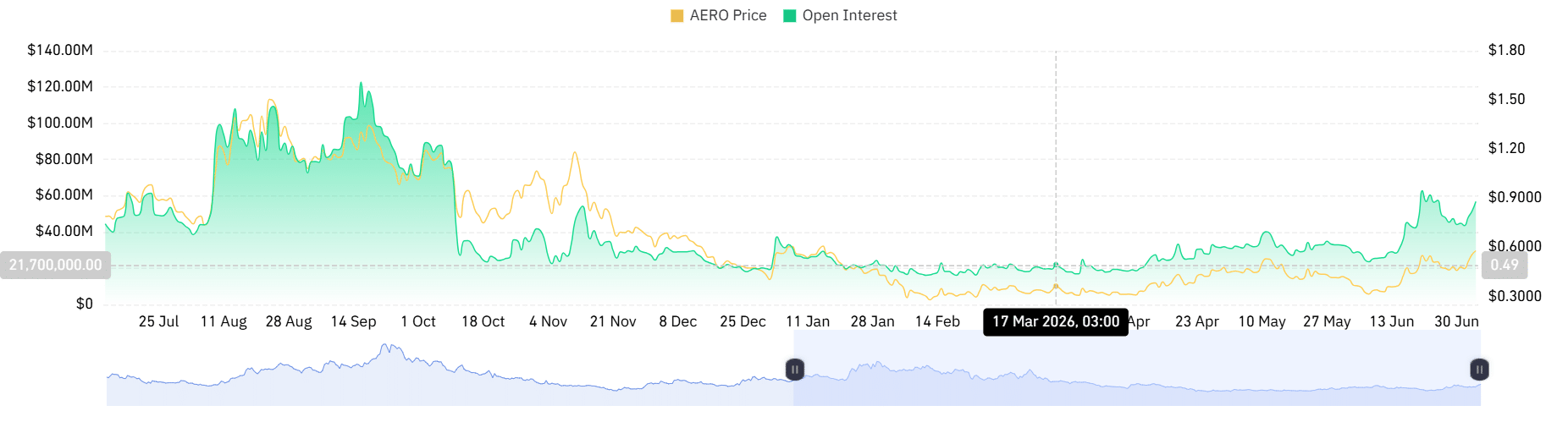
The altcoin has shown relative strength, supported by broad market demand. In derivatives trading, for instance, AERO’s Open Interest (OI) surged 10% to $56 million over the past day.
Source: CoinGlass

In July, the altcoin’s OI increased by over $13 million, suggesting significant capital has flowed into opening new positions

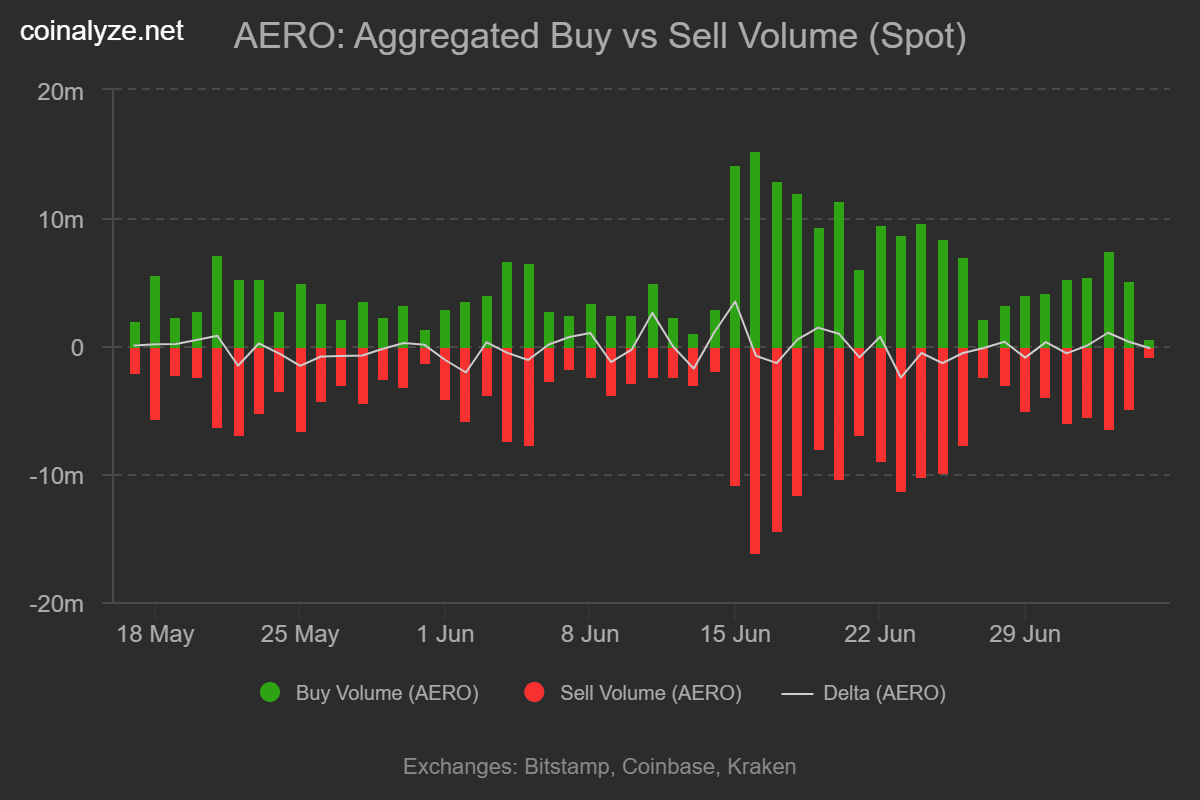
On the spot side, a similar pattern emerged, with buyers having displaced sellers since the 2nd of July. According to Coinalyze data, AERO has closed with a positive buy-sell delta over the past three days.
Source: Coinalyze

Over this period, the altcoin recorded 18.6 million in buy volume compared to 15.8 million in Sell volume.

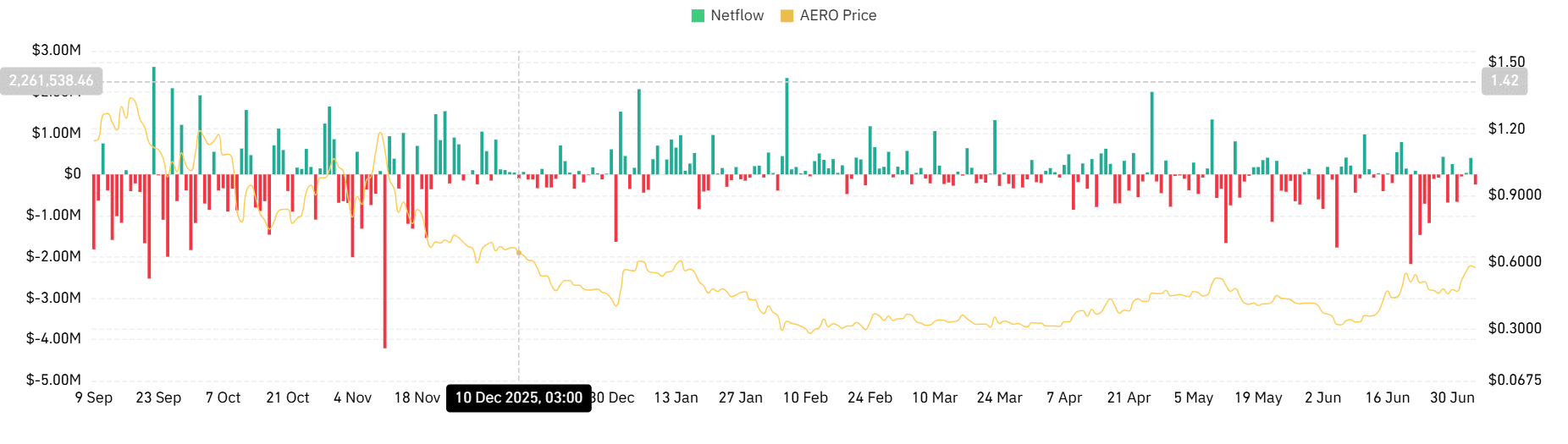
Exchange flow further confirms this market trend. According to CoinGlass, the Spot Netflow dropped to -$254k, down from $400k the previous day, a clear sign of buyers taking over.
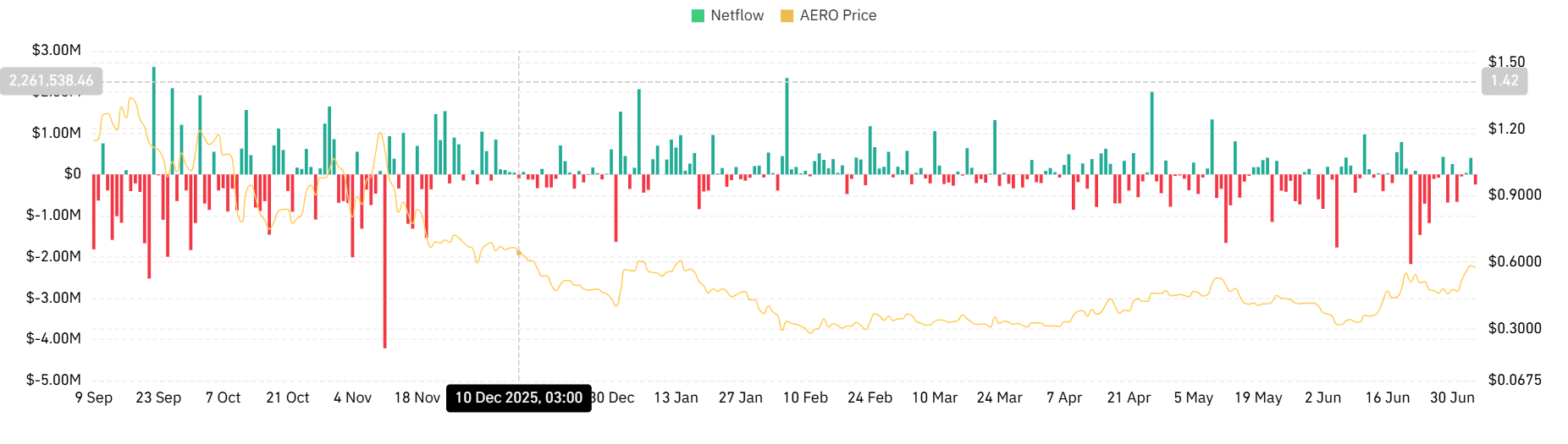
Source: Coinglass

Historically, strong demand on both derivatives and spot has preceded extended market rallies. Therefore, recovering market demand positions the altcoin for further gains on price charts.

Thus, if the prevailing bullish pressure holds, AERO will hold $0.6 and target $0.65 in the short- to medium-term. On the other side, if the altcoin fails to close above $0.6, the uptrend will weaken significantly. In doing so, the altcoin could lose $0.5 support and drop towards $0.46, where the current uptrend started.


Final Summary

  • Aerodrome Finance extended its uptrend, hiking 4.85% to $0.6 for the first time since January before retracing to $0.58.
  • AERO experienced strong demand across the spot and derivatives market, as bulls eye more gains.

Preguntas relacionadas

QWhat is the current price of Aerodrome Finance (AERO) and how much has it surged in the past week?

AAt the time of writing, AERO was trading at $0.58, marking a 22% weekly surge.

QWhat key technical indicator shows strong buyer dominance for AERO, and what is its value?

AThe Relative Strength Index (RSI) indicates strong buyer dominance, with a value of 67 at the time of writing.

QHow has the Open Interest (OI) for AERO in derivatives trading changed recently?

AAERO's Open Interest surged 10% to $56 million over the past day and increased by over $13 million in July, indicating significant capital inflow.

QWhat does the article suggest as the short- to medium-term price target for AERO if bullish pressure holds?

AIf the prevailing bullish pressure holds, the article suggests AERO could target $0.65 in the short- to medium-term.

QAccording to the article, what is a potential bearish scenario and price level for AERO if it fails to hold $0.6?

AIf AERO fails to close above $0.6, the uptrend could weaken, causing it to potentially lose the $0.5 support and drop towards $0.46.

Lecturas Relacionadas

Li Fei-Fei's Latest Long-Form Article: When Video Generation, Robotics, and NVIDIA All Call Themselves World Models, We Need a Taxonomy

In a new article, Dr. Fei-Fei Li addresses the widespread and often inconsistent use of the term "world model" in AI. She proposes a clear, functional taxonomy rooted in the classic Partially Observable Markov Decision Process (POMDP) loop (agent → action → state → observation → agent). According to this framework, current systems called "world models" are different projections of this loop, categorized by their primary output: 1. **Renderers**: Output observations (pixels). Their goal is visual fidelity for human consumption (e.g., video generation models like Sora). They are the most commercially mature but are limited by a focus on appearance over physical accuracy. 2. **Simulators**: Output states (geometric, physical, dynamic representations). They provide a structurally accurate world for both human professionals (e.g., architects) and computational agents (e.g., robots for training). Li argues simulators are the crucial, underappreciated bridge, as they can underpin both rendering and planning. 3. **Planners**: Output actions. Given an observation and a goal, they decide what an agent should do next (e.g., robotic action models). This area is highly promising but remains the least mature for real-world deployment. Li highlights a key trend: the boundaries between these three categories are beginning to blur, as they all rely on a shared underlying understanding of geometry, physics, and dynamics. The logical endpoint is a unified world foundation model capable of switching between rendering, simulation, and planning based on downstream needs. This convergence, she concludes, is central to advancing spatial intelligence—enabling machines not just to talk about the world, but to truly understand, imagine, and interact with it.

marsbitHace 3 hora(s)

Li Fei-Fei's Latest Long-Form Article: When Video Generation, Robotics, and NVIDIA All Call Themselves World Models, We Need a Taxonomy

marsbitHace 3 hora(s)

Forbes Feature: Stablecoin Cross-Border Payments Are Faster, But Not Yet Cheaper

A Forbes feature delves into the state of stablecoin-based cross-border payments, noting rapid growth but a key shortfall: while faster and more accessible, they are not yet cheaper. At a recent industry conference in Mexico City, optimism about technology, regulation, and volume was tempered by discussions with practitioners. The core issue is liquidity. Traditional FX brokers charge 60-70 basis points, and stablecoins promise to slash this to 2-5 basis points. However, this theoretical cost advantage cannot be realized until deep liquidity pools are established at scale, requiring significant institutional capital inflow. A major adoption barrier is trust. Businesses often rely on long-standing relationships with traditional brokers, valuing reliability over marginal cost savings. This shift will be gradual. Furthermore, successful companies in the space are not positioning themselves as replacements for legacy systems like SWIFT, but as complements. They leverage stablecoins for speed while using traditional rails for their standardization and reliability in ensuring accurate payment details—a critical factor for supplier payments to avoid customs issues. Companies like Caliza, experiencing high monthly growth, exemplify this hybrid approach. The industry anticipates consolidation, as long-term viability will depend on securing the essential trifecta: proper licensing, robust fiat on/off-ramps, and deep liquidity. Without these, firms risk being mere intermediaries rather than building sustainable businesses.

marsbitHace 3 hora(s)

Forbes Feature: Stablecoin Cross-Border Payments Are Faster, But Not Yet Cheaper

marsbitHace 3 hora(s)

Trading

Spot
活动图片