Advancing MM 1: Market Maker Inventory Quoting System

深潮Publicado a 2025-12-28Actualizado a 2025-12-28

Resumen

"Attack of the MM 1: Market Maker Inventory Quoting System" by Dave explores why altcoin prices often move against retail traders immediately after their purchases, debunking the myth of intentional manipulation by "market manipulators." The article explains that this phenomenon is not due to malicious intent but is a result of automated market maker (MM) systems using the Avellaneda-Stoikov model for inventory-based pricing and protection against toxic order flow. When retail traders execute large buy orders, MMs sell, leading to a short inventory exposure. To mitigate risk, MMs adjust their strategies in two ways: 1. **Quote Skew**: They lower prices to attract sellers and discourage further buys, aiming to replenish inventory and protect their short position. 2. **Spread Widening**: They widen bid-ask spreads to reduce transaction probability and earn more spread profit to offset potential losses. The core mechanism involves the "Reservation Price," calculated as Mid Price − γ⋅q (where q is inventory and γ is risk aversion). Large retail orders disrupt inventory balance, causing MMs to adjust prices dynamically. Retail traders often face this due to their concentrated, unconcealed, and unhedged orders, especially in low-liquidity altcoins where their trades significantly impact pricing. The article concludes with a practical tip: instead of executing large orders at once, retail traders can break them into smaller, staggered orders to exploit MM pricing adjustments,...

Author: Dave

Have you ever experienced a situation where, after buying some altcoins, the price keeps moving in the opposite direction in a short time, as if the "market manipulators" are targeting you? Why does this happen? Is it really a conspiracy by the manipulators?

This post will introduce the market maker's quoting system and unveil the mystery behind the "manipulator" conspiracy. The conclusion is: prices often move against us not due to subjective manipulation, but rather due to Inventory-based pricing quote skew under the Avellaneda–Stoikov model and the protective mechanism for handling toxic flow. How exactly? Once upon a time...

First, let's understand the concept of inventory. As we all know, market makers are not directional investors. Under strict hedging, spot price changes should not affect the total P&L. At this point, holding inventory is a "passive" behavior. Changes in inventory lead to an expansion of positions, and the more positions you hold, the greater your risk exposure to adverse price movements. At this time, retail traders' buy and sell orders cause changes, and market makers react to the risks brought by these inventory changes.

In a nutshell, you break their balance, and the MM has to protect themselves and try to return to balance. The means of protection is the quoting system.

1. Quote Skew

When the MM is heavily bought by you, it is equivalent to: the MM has sold heavily, and the inventory becomes a short exposure. What does the MM hope to do at this time: (1) Replenish the inventory as soon as possible. (2) Protect the exposed short position.

So the MM's reaction is: lower the price to attract selling, prevent further buying, and ensure that their net short position remains temporarily non-loss-making, giving time to hedge.

2. Spread Widening

When the inventory continues to deteriorate, the MM not only skews the price but also widens the spread to reduce the probability of execution.

Their goal is to reduce the execution risk per unit time and, through spread profits, earn more to protect against price losses.

While writing this article, each additional mathematical formula reduces the number of readers by 10%, but in case some小伙伴们 want to see something substantial, I will briefly introduce the formation of quotes (which is also the mathematical mechanism behind the above quote changes).

The price at which we trade with the market maker is called the Reservation Price, which comes from the Inventory-based pricing model:

Reservation Price = Mid price − γ⋅q

q: current inventory

gamma γ: risk aversion coefficient

Actually, the Reservation Price looks like the following, but I don't want to disgust everyone, so just take a glance:

When retail traders buy or sell heavily, q changes significantly, causing the quoted Reservation Price to change significantly. The specific amount of change comes from the Avellaneda–Stoikov model. As you might guess, since buying and selling cause small changes in inventory, this model is a partial differential equation. Guess what? I'm not interested in deriving this equation either, so we only need to know the core conclusion:

The optimal quote is symmetrically spread around the Reservation Price. Inventory must mean-revert to 0. The optimal spread widens with risk.

If you don't understand the above, it's okay. Just roughly understand that after retail buying, prices often move against the bullish direction, essentially because our flow changes the market's risk pricing. The reasons why retail traders often encounter this situation are:

• Retail traders almost always use aggressive orders

• Concentrated size, non-stealthy timing

• No hedging

• Not timing the market, not splitting orders

In small altcoins, this situation is even more severe because altcoin liquidity is poor. Often, your order is one of the few aggressive orders within 5 minutes. In large品种, natural hedging might occur, but in small coins, you are the counterparty to the manipulator.

So professional MMs are not trying to crush you; their objective is maxE[Spread Capture]−Inventory Risk−Adverse Selection. Actually, their objective function looks like this, with inventory risk being exponentially penalized.
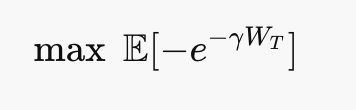
Readers who have made it this far must be韭菜 with dreams of becoming market manipulators. So to激励 the brave, I'll share a small trick to utilize the quoting mechanism. We said retail traders often have concentrated size and non-stealthy timing, so just do the opposite. Suppose Dave wants to go long 1000U. Instead of going all in at once, using the manipulator's method, first buy 100U. The quoting system will lower the price, allowing me to build a position at a cheaper level. Then I buy another 100U, and the price will continue to fall. Thus, my average entry cost will be much cheaper than going all in at once.

The story of retail's bad luck is only half told here. Besides inventory management quoting factors, the MM's handling of order flow is another element causing price divergence, namely the toxic order flow mentioned at the beginning. In the next part, I will introduce the market maker's order book and order flow, and I will also speculate on the micro-market reasons behind the 1011惨案.

To know what happens next, stay tuned for the next episode.

Preguntas relacionadas

QWhat is the main reason why altcoin prices often move against retail traders after they buy, according to the article?

AIt is not due to subjective manipulation, but rather the result of the Avellaneda-Stoikov model's Inventory-based pricing quote skew and a protection mechanism against toxic order flow.

QHow does a market maker (MM) react when its inventory becomes short due to a large buy order from a retail trader?

AThe MM will lower its prices to attract sell orders and discourage further buying, while also widening the bid-ask spread to reduce the probability of execution and protect its exposed short position.

QWhat is the 'Reservation Price' in the context of the market maker's pricing model?

AThe Reservation Price is the price at which traders transact with the market maker. It is derived from the Inventory-based pricing model and is calculated as: Reservation Price = Mid price - γ * q, where q is the current inventory and γ is the risk aversion coefficient.

QWhat are the characteristics of retail trader orders that make them particularly vulnerable to price movements against them?

ARetail orders are often aggressive (taking liquidity), concentrated in size, not stealthy in timing, unhedged, and not split or timed strategically.

QWhat practical tip does the article suggest for a retail trader who wants to buy a large position to get a better average entry price?

AInstead of buying the entire position at once, the trader should split the order into smaller chunks. Buying a small amount first causes the MM's pricing system to lower the price, allowing subsequent buys to be executed at cheaper levels, resulting in a lower average cost.

Lecturas Relacionadas

From Return to Resignation: Chen Hang's 437 Days at DingTalk

The 437-Day Return and Departure of Chen Hang at DingTalk This article chronicles the 437-day period from March 31, 2025, to June 11, 2026, when Chen Hang (also known as "No Move") returned as CEO of DingTalk, the enterprise communication platform he originally founded, only to later step down. Chen Hang, the creator of DingTalk in 2015, was brought back by Alibaba in 2025 after the company acquired his subsequent startup, HHO. His return was driven by Alibaba's renewed focus on AI and DingTalk's strategic role as its key to-B AI application. However, his aggressive management style, marked by strict work policies like mandatory clock-ins and extended hours, quickly caused internal friction and was criticized as being at odds with Alibaba's culture. Despite the internal turmoil, Chen Hang drove significant product launches. In August 2025, he unveiled "AI DingTalk 1.0," featuring new products like the AI-native entry point "DingTalk ONE." By March 2026, he announced "Wukong," touted as the world's first enterprise-grade AI-native work platform, representing a fundamental rebuild of DingTalk's architecture. The turning point came in early June 2026. A detailed internal post criticizing DingTalk's work culture went viral, followed by a public critique from a former executive. This prompted an unprecedented public rebuke from the Alibaba Partners Committee, which stated such management was not aligned with company values. One day later, on June 11, Alibaba announced Chen Hang's departure. He was succeeded by Chen Yusen, a 32-year-old technical expert known for founding cybersecurity firm Changting Technology. While Chen Hang's tenure laid the technical foundation for DingTalk's AI transformation with "Wukong," his leadership style ultimately led to his replacement as the company seeks a new direction under younger leadership.

marsbitHace 6 min(s)

From Return to Resignation: Chen Hang's 437 Days at DingTalk

marsbitHace 6 min(s)

The 2026 Landscape of Decentralized AI: Why Blockchain is the Inevitable 'Antidote' for AI?

Decentralized AI 2026 Landscape: Why Blockchain is AI's Essential "Antidote" Centralized AI faces structural bottlenecks—expensive compute, concentrated control, unverifiable outputs, and difficult data access—that cannot be solved by capital or code alone. Blockchain offers a path to make intelligence open, verifiable, and economically accessible. The decentralized AI stack comprises: * **Infrastructure:** The foundation with compute, verifiable inference, distributed training, data/storage, and privacy/verification layers. Projects like Akash, Render, and Filecoin provide cheaper, decentralized alternatives for raw resources. * **Middleware:** The coordination layer for agent discovery, identity, and commerce. Key players include Bittensor (a network of specialized AI subnets), Virtuals (an agent economy OS), and frameworks providing agent identity and tooling. * **Applications & Services:** Dominated by Agentic Finance (AI agents executing on-chain actions based on natural language) and Agentic Payments (machine-to-machine transactions using blockchain as a settlement layer). Projects like Giza, Infinit Labs, and x402 are enabling these use cases. Key trends for 2026-2027 show AI demand outgrowing infrastructure, compute becoming an asset class, and tokenomics emerging as a structural advantage for coordinating capital, compute, and data. While still early—with adoption uneven and revenue often trailing token incentives—projects like Bittensor, NEAR, and Venice demonstrate decentralized AI is evolving from a narrative into a new model for coordinating intelligence.

Foresight NewsHace 26 min(s)

The 2026 Landscape of Decentralized AI: Why Blockchain is the Inevitable 'Antidote' for AI?

Foresight NewsHace 26 min(s)

Trading

Spot
Futuros

Artículos destacados

Cómo comprar BILL

¡Bienvenido a HTX.com! Hemos hecho que comprar Billions Network (BILL) sea simple y conveniente. Sigue nuestra guía paso a paso para iniciar tu viaje de criptos.Paso 1: crea tu cuenta HTXUtiliza tu correo electrónico o número de teléfono para registrarte y obtener una cuenta gratuita en HTX. Experimenta un proceso de registro sin complicaciones y desbloquea todas las funciones.Obtener mi cuentaPaso 2: ve a Comprar cripto y elige tu método de pagoTarjeta de crédito/débito: usa tu Visa o Mastercard para comprar Billions Network (BILL) al instante.Saldo: utiliza fondos del saldo de tu cuenta HTX para tradear sin problemas.Terceros: hemos agregado métodos de pago populares como Google Pay y Apple Pay para mejorar la comodidad.P2P: tradear directamente con otros usuarios en HTX.Over-the-Counter (OTC): ofrecemos servicios personalizados y tipos de cambio competitivos para los traders.Paso 3: guarda tu Billions Network (BILL)Después de comprar tu Billions Network (BILL), guárdalo en tu cuenta HTX. Alternativamente, puedes enviarlo a otro lugar mediante transferencia blockchain o utilizarlo para tradear otras criptomonedas.Paso 4: tradear Billions Network (BILL)Tradear fácilmente con Billions Network (BILL) en HTX's mercado spot. Simplemente accede a tu cuenta, selecciona tu par de trading, ejecuta tus trades y monitorea en tiempo real. Ofrecemos una experiencia fácil de usar tanto para principiantes como para traders experimentados.

262 Vistas totalesPublicado en 2026.05.07Actualizado en 2026.06.02

Cómo comprar BILL

Qué es ATWO

I. Introducción al ProyectoArena Two es una plataforma interactiva descentralizada que permite a los fanáticos jugar un papel activo y tokenizado en los resultados de eventos en tiempo real. A diferencia de los modelos de transmisión tradicionales que reducen a los fanáticos a espectadores pasivos, Arena Two aprovecha la tecnología blockchain para permitir que los fanáticos voten directamente en tiempo real e influyan en los resultados en el campo.II. Información del TokenNombre del token: ATWO (Arena Two)III. Enlaces RelacionadosSitio web: https://arenatwo.com/Exploradores: https://basescan.org/token/0x499D35eBE6cEe9B2Ac35Fd003fcBbeeB9CFc7B32Twitter: https://x.com/arenatwoXNota: La introducción del proyecto proviene de los materiales publicados o proporcionados por el equipo oficial del proyecto, que es solo para referencia y no constituye asesoramiento de inversión. HTX no se hace responsable de ninguna pérdida directa o indirecta resultante.

161 Vistas totalesPublicado en 2026.05.18Actualizado en 2026.06.02

Qué es ATWO

Cómo comprar ATWO

¡Bienvenido a HTX.com! Hemos hecho que comprar Arena Two (ATWO) sea simple y conveniente. Sigue nuestra guía paso a paso para iniciar tu viaje de criptos.Paso 1: crea tu cuenta HTXUtiliza tu correo electrónico o número de teléfono para registrarte y obtener una cuenta gratuita en HTX. Experimenta un proceso de registro sin complicaciones y desbloquea todas las funciones.Obtener mi cuentaPaso 2: ve a Comprar cripto y elige tu método de pagoTarjeta de crédito/débito: usa tu Visa o Mastercard para comprar Arena Two (ATWO) al instante.Saldo: utiliza fondos del saldo de tu cuenta HTX para tradear sin problemas.Terceros: hemos agregado métodos de pago populares como Google Pay y Apple Pay para mejorar la comodidad.P2P: tradear directamente con otros usuarios en HTX.Over-the-Counter (OTC): ofrecemos servicios personalizados y tipos de cambio competitivos para los traders.Paso 3: guarda tu Arena Two (ATWO)Después de comprar tu Arena Two (ATWO), guárdalo en tu cuenta HTX. Alternativamente, puedes enviarlo a otro lugar mediante transferencia blockchain o utilizarlo para tradear otras criptomonedas.Paso 4: tradear Arena Two (ATWO)Tradear fácilmente con Arena Two (ATWO) en HTX's mercado spot. Simplemente accede a tu cuenta, selecciona tu par de trading, ejecuta tus trades y monitorea en tiempo real. Ofrecemos una experiencia fácil de usar tanto para principiantes como para traders experimentados.

193 Vistas totalesPublicado en 2026.05.18Actualizado en 2026.06.02

Cómo comprar ATWO

Discusiones

Bienvenido a la comunidad de HTX. Aquí puedes mantenerte informado sobre los últimos desarrollos de la plataforma y acceder a análisis profesionales del mercado. A continuación se presentan las opiniones de los usuarios sobre el precio de A (A).

活动图片














