Activity Rivals Base, Robinhood Chain Competes for Financial Super App

Foresight NewsPublicado a 2026-07-27Actualizado a 2026-07-27

Resumen

Robinhood Chain, a new Ethereum Layer 2 network built on Arbitrum Orbit, has launched as Robinhood enters the "super app" competition to bridge traditional finance and crypto. The network has rapidly gained traction, attracting over $200M in bridged ETH and generating $1.94M in transaction fees in its first month. Activity is primarily driven by memecoin trading, $430M in stablecoin liquidity (including its native USDG), and tokenized stock offerings. The network's economic model is highly profitable for Robinhood. Of the total fees collected, approximately 89% ($1.73M) is retained by Robinhood, with about 10% ($193k) paid to Arbitrum and less than 1% ($12k) to Ethereum for data availability and settlement. This mirrors the trend seen on other major L2s like Base, where the app-chain captures the vast majority of value generated by user activity. While initial momentum is strong, the key question is whether this activity can evolve into sustainable demand for Robinhood Chain's core focus areas: tokenized real-world assets (RWA) and round-the-clock on-chain financial services.


Author: Tanay Ved, Coin Metrics Analyst

Compiled by: Chopper, Foresight News


With the official launch of Robinhood Chain, a leading global retail brokerage has officially entered the race to become a financial "super app," aiming to bridge traditional financial markets, crypto assets, and tokenized real-world assets (RWA). A core element of this strategy is the on-chain settlement layer built upon Robinhood's global user network. At Robinhood's "The World is Flat" conference, the company unveiled multiple products, including its self-developed Layer 2 blockchain, Robinhood Chain. With Coinbase launching Base and Kraken introducing Ink, exchanges developing their own Layer 2 chains have become a mainstream industry choice.


Early user behavior and on-chain data indicate that Robinhood Chain's popularity is rapidly rising. As of July 20th, over $200 million worth of ETH has been bridged into Robinhood Chain, with a total transaction count of approximately 130 million, generating nearly $1.9 million in transaction fee revenue. As Robinhood retains the vast majority of the network's revenue, the launch of this public chain has reignited industry discussions on how Ethereum Layer 2 economic models distribute profits and how much value the underlying L1 can ultimately capture.


This article will outline the full picture of Robinhood Chain, compare its early on-chain data with other Layer 2 networks, and analyze the economic relationship between Robinhood Chain and Ethereum.


Overview of Robinhood Chain


Robinhood Chain is an Ethereum Layer 2 network built using the Arbitrum Orbit technology stack and operated by Robinhood. Its focus is on tokenized real-world assets (stock tokens, ETFs, etc.) and on-chain financial services, supporting 24/7 trading and lending, with a block time of about 100 milliseconds, approaching sub-second confirmation. The network is compatible with EVM tools and various applications, relying on Ethereum for data availability and security. Its native Gas token is ETH.
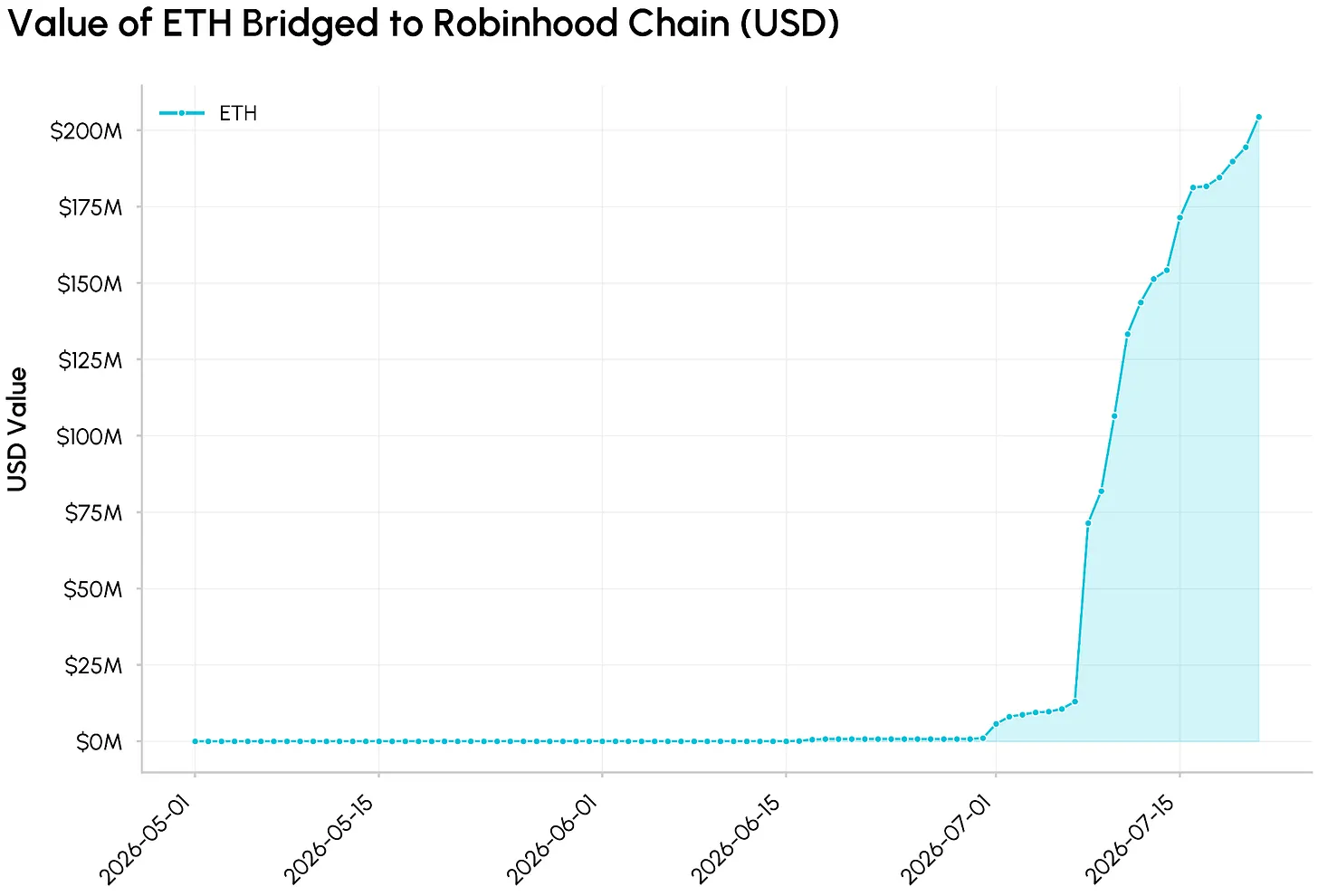


Since its mainnet launch on July 1st, Robinhood Chain has quickly attracted liquidity and achieved early user adoption. Over $200 million in ETH has been transferred via bridges (assets are custodied on the Ethereum mainnet, with corresponding wrapped assets issued on Layer 2) for trading, paying Gas, or serving as collateral. The continuous capital inflow and rising market demand for ETH as a Gas and collateral asset validate the network's early appeal.


Meme Coins, Stablecoins, and Tokenized Stocks


The overall liquidity on Robinhood Chain is approximately $700 million, with ETH accounting for 28% ($205 million). However, the initial buzz was primarily driven by speculative trading of the natively issued Meme coin Cash Cat, whose market cap once surpassed $200 million, providing the network with initial liquidity and user cold start.


On-chain stablecoin holdings amount to $430 million, including the natively issued Global Dollar (USDG) and externally bridged assets like Ethena USDe. These stablecoins form the basis for the Robinhood Earn product, built upon Morpho vaults managed by Steakhouse Financial, with total deposits already reaching $163 million.


USDG is a consortium-type stablecoin initiated by Paxos, where interest generated from reserves is proportionally distributed among partners within the Global Dollar network, with an incentive mechanism similar to OpenUSD (OUSD). This model not only provides on-chain liquidity but also allows distribution partners like Robinhood to gain sustained revenue by scaling stablecoin operations, opening up new income streams.
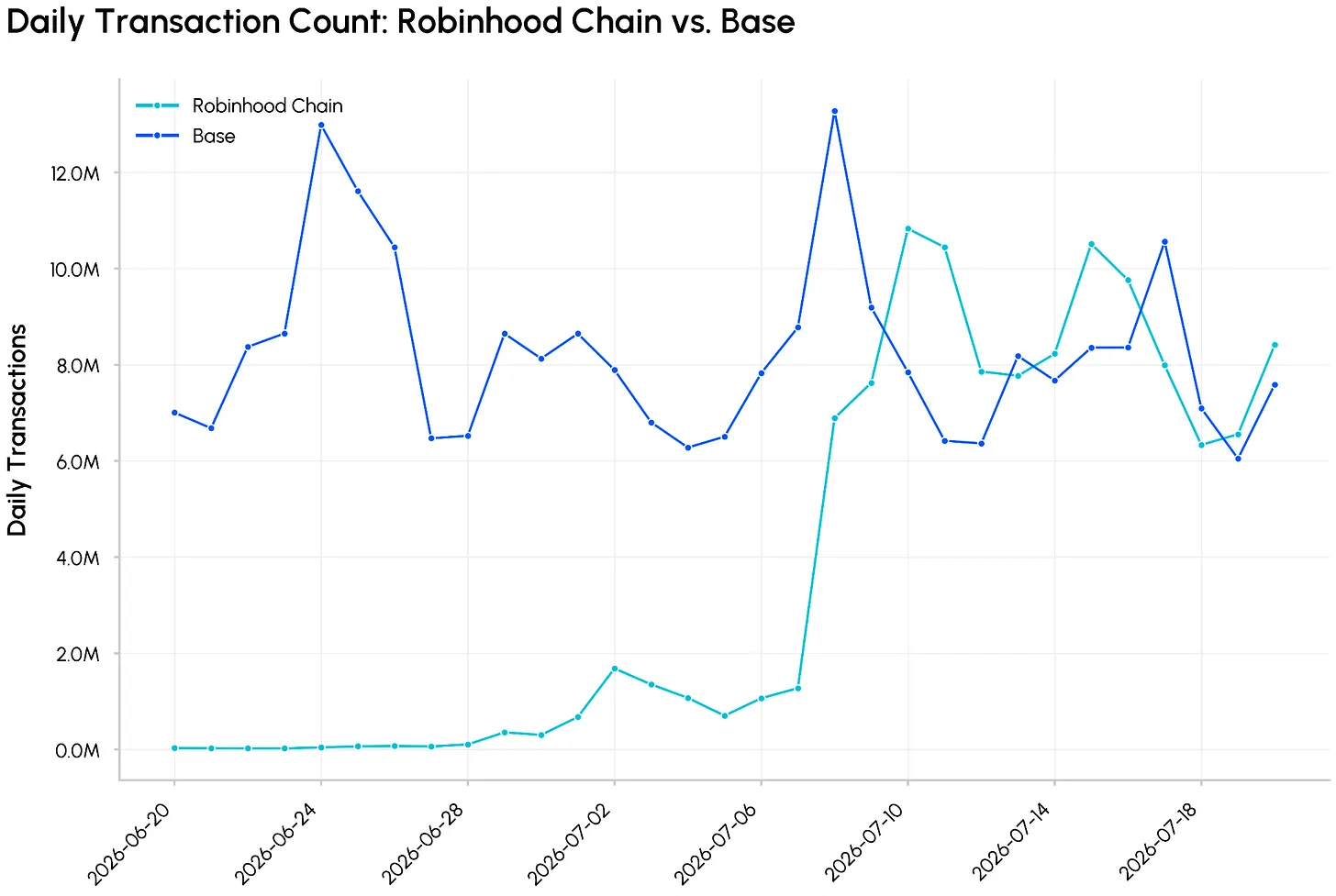


This liquidity has translated into robust on-chain activity. Robinhood Chain's daily transaction volume already rivals Coinbase's Layer 2 network Base, with approximately 270,000 unique active addresses and a cumulative total of about 3.4 million addresses.


Current on-chain transaction activity is primarily driven by: users trading Meme coins on spot and perpetual DEXs like Uniswap and Lighter, Morpho lending vault operations, and steady growth in tokenized equity driven by Robinhood's stock tokens. Robinhood's tokenized stocks are ERC-20 standard tokens, similar in model to Backed xStocks, representing tokenized debt securities where investors gain economic benefits corresponding to the underlying custodied assets.


A core question that remains under market scrutiny is whether short-term hype can transform into long-term, stable demand, especially in the officially planned key areas like RWA and various on-chain financial products.


Robinhood Chain Economic Model: Fee Revenue and Operating Costs


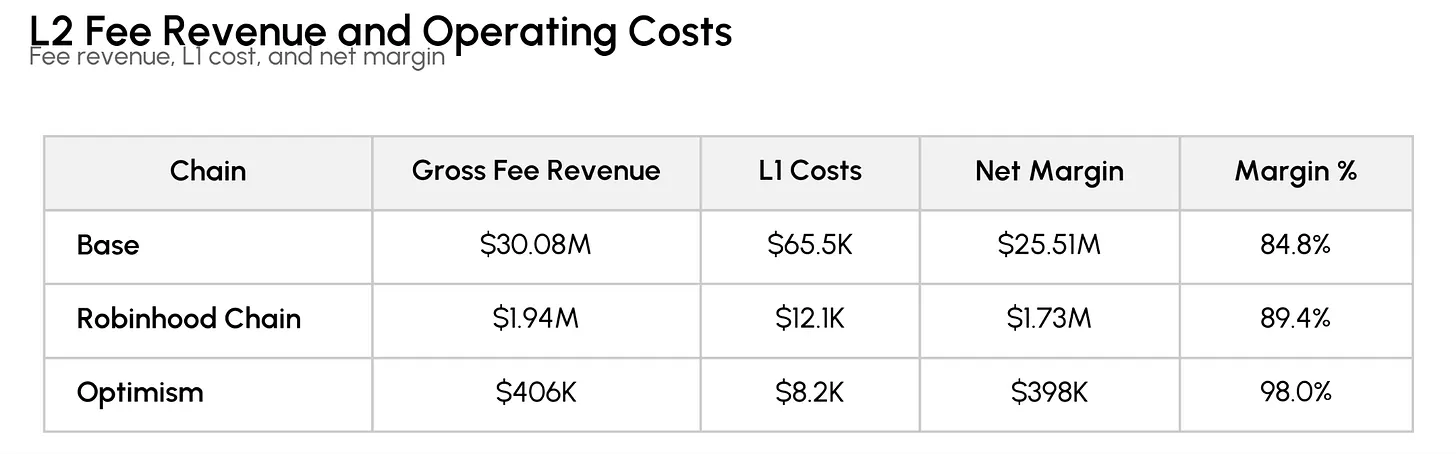
Revenue generated from on-chain transactions is distributed among different participants across the technology stack. Since launch, Robinhood Chain's total transaction fee revenue is approximately $1.94 million (all Gas fees paid by users on Layer 2). About 10% of this (around $193,000) is paid to Arbitrum for Rollup infrastructure and execution environment; less than 1% (about $12,000) goes to Ethereum to cover data availability and security settlement costs; and the remaining approximately 89% ($1.73 million) is retained by Robinhood. This clearly illustrates that Layer 2 network operators capture the vast majority of the value generated by application activity.


Robinhood Chain currently employs a first-come, first-served transaction ordering mechanism, where order is determined by arrival time, not through auction-based sequencing. Therefore, the network cannot extract additional MEV revenue from transaction ordering priority like some Layer 2 sequencers.
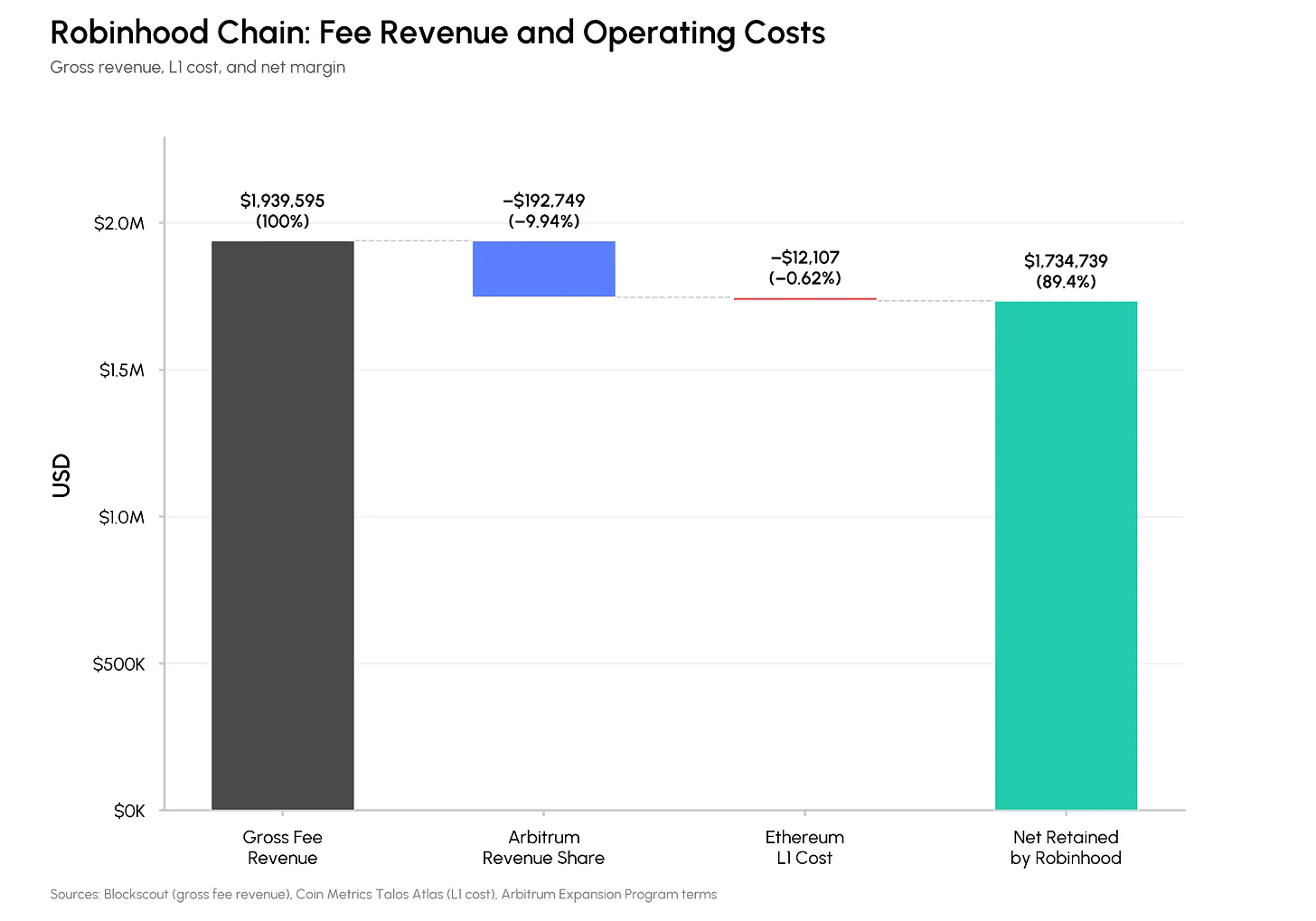


This distribution structure is not unique to Robinhood. Among major mainstream Layer 2 networks, the cost paid to Ethereum L1 for data availability and settlement constitutes a very small percentage of the total fees. Even during demand surges, the fee revenue generated by Layer 2 networks continues to significantly outpace the costs paid to Ethereum.
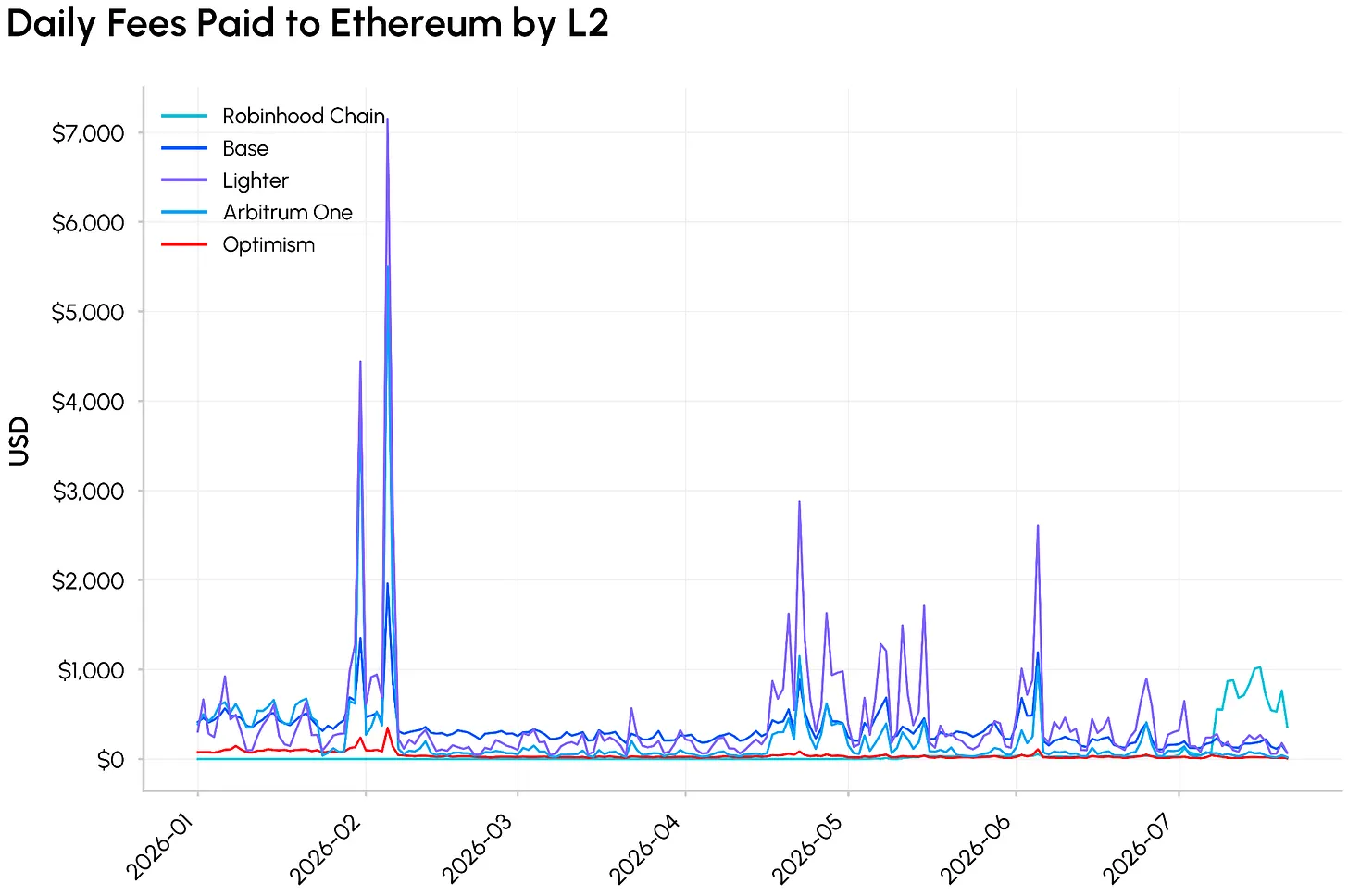


From the beginning of 2026 to date, Base's total fee revenue is $30.08 million, with $655,000 paid to Ethereum and approximately $4.5 million shared with the Optimism Foundation, resulting in a net retention of about $25.5 million and a profit margin of around 85%. Robinhood Chain, operational for less than a month, has total fee revenue of $1.94 million, retaining $1.73 million (an 89% share); it paid only $12,000 to Ethereum and, according to the sharing agreement, allocated 10% ($193,000) to Arbitrum.


This landscape once again highlights a long-standing dilemma for Ethereum: Layer 2 networks and their technology stacks capture the vast majority of direct fee revenue. However, the expansion of the Layer 2 ecosystem creates network effects, driving up demand for ETH as a Gas asset. Ethereum, as a neutral settlement layer, continues to provide the security foundation for these high-revenue application chains.


Conclusion


Leveraging Meme coins, stablecoin liquidity, and growing tokenized equity assets, Robinhood Chain has rapidly evolved into a high-activity, high-profit-margin Layer 2 network. Its economic model underscores how Robinhood relies on Ethereum for security and settlement while capturing the vast majority of fees generated by user activity.


As the integration of traditional finance and crypto markets continues to accelerate, future focus will be on whether the current short-term hype can transform into sustainable business demand, especially in the RWA sector, which the network prioritizes, and in various on-chain financial infrastructure built upon 24/7 trading markets and Robinhood's global distribution network.


Preguntas relacionadas

QWhat is the strategic goal behind Robinhood launching its own layer-2 blockchain, Robinhood Chain?

ARobinhood Chain aims to compete in the 'super app' race by bridging traditional financial markets, crypto assets, and tokenized real-world assets (RWA). Its goal is to leverage Robinhood's global user network to build an on-chain settlement layer for integrated, round-the-clock trading and financial services.

QAccording to the early data cited in the article, how does Robinhood Chain's user activity compare to Coinbase's Base network?

AAccording to the article, Robinhood Chain's daily trading volume is already on par with Coinbase's layer-2 network Base. It has approximately 270,000 unique active addresses and a cumulative total of around 3.4 million addresses.

QWhat are the three main drivers of transaction activity on Robinhood Chain mentioned in the article?

AThe three main drivers are: 1) Trading of meme coins (like Cash Cat) and other assets on DEXs such as Uniswap and Lighter. 2) Lending activities via Morpho vaults. 3) Growth in tokenized stock offerings, which are ERC-20 tokens representing economic rights to underlying equities.

QHow is the revenue from transaction fees distributed among the parties in the Robinhood Chain ecosystem?

AApproximately 89% of the total transaction fee revenue (about $1.73 million) is retained by Robinhood. About 10% (about $193,000) is paid to Arbitrum for the rollup infrastructure and execution environment. Less than 1% (about $12,000) is paid to Ethereum for data availability and security settlement costs.

QWhat key challenge or contradiction for Ethereum is highlighted by the economic model of layer-2 networks like Robinhood Chain?

AThe economic model highlights the contradiction that while layer-2 networks and their tech stacks capture the vast majority of direct fee revenue, Ethereum as the underlying settlement layer captures only a small fraction. However, the expansion of the L2 ecosystem increases demand for ETH as a gas asset, and Ethereum continues to provide the foundational security for these high-revenue application chains.

Lecturas Relacionadas

The Turning Point of the AI Bull Market: Leverage Blow-ups, Overcapacity in Compute, Why This Macro Analyst is Fully Bearish

AI Bull Market Reaches Inflection Point: Analyst Turns Bearish Due to Leverage, Chinese Competition, and Overcapacity Fidenza Macro analyst Geo Chen explains his decision to sell all AI semiconductor and infrastructure holdings in June, offering a comprehensive bearish thesis. He argues the AI-driven bull market has peaked, citing several key factors. First, unsustainable buying pressure: a massive influx of "low-quality" capital from Korean retail investors using highly leveraged ETFs on stocks like SK Hynix created a parabolic, fragile rally. Recent liquidations have wiped out billions and impacted over a million accounts, removing a key market driver. Second, a competitive threat: the rapid rise of powerful, cost-effective open-source AI models from China, such as MoonShot AI's Kimi K3 and Alibaba's Qwen 3.8, is commoditizing intelligence. This undermines the pricing power and high-valuation financing prospects of closed-source leaders like OpenAI and Anthropic, potentially creating a "single point of failure" for the ecosystem. Third, an impending capacity glut: while AI compute and components are currently in shortage, Chen warns this is typical of a cycle top. Massive, committed capex from cloud providers will likely lead to a supply overhang within 1-2 years. Data shows token spending has already peaked and declined since June, while bond spreads for data center companies are widening, signaling rising credit risk. Chen also highlights broader macro headwinds: the protracted Iran conflict acts as a persistent stagflationary force, and the Federal Reserve under Chair Kevin Warsh is losing credibility in its inflation fight. Long-term Treasury yields breaking above 5.2% present a new challenge for equities. In summary, Chen believes the convergence of speculative excesses, competitive disruption, looming overcapacity, and adverse macroeconomic conditions marks a significant turning point for the AI investment theme.

marsbitHace 15 min(s)

The Turning Point of the AI Bull Market: Leverage Blow-ups, Overcapacity in Compute, Why This Macro Analyst is Fully Bearish

marsbitHace 15 min(s)

Saeed Al-Marri: How Tokenization Unlocks New Opportunities for Shipping Funds

Said Al-Marri: How Tokenization Opens New Opportunities for Shipping Funds For centuries, commercial shipping has been a capital-intensive asset class limited to institutional funds and shipping dynasties. Said bin Saleh Al-Marri, CEO of Ethra Invest and Ethra Ship, aims to break down these barriers by combining Real World Asset (RWA) tokenization with conservative private equity principles. This bridges decentralized finance (DeFi) with the physical realities of global trade. Tokenization allows fractional ownership of ships on a blockchain, giving smaller investors access to previously inaccessible markets. However, Al-Marri warns it is not a regulatory loophole or a cure for asset illiquidity. The core physical risks are isolated in Special Purpose Vehicles (SPVs) for qualified investors. While tokenization enhances transparency and ownership record-keeping, Al-Marri stresses that a liquid secondary market depends on transparent asset valuation and must not interfere with ship operations managed by professionals. Regarding legal enforcement, smart contracts cannot physically seize a ship. Legal recourse still relies on traditional maritime courts, ship mortgages, and flag state laws, with blockchain records needing to mirror legal ownership in the SPV perfectly. Beyond ownership, the industry faces administrative hurdles like paper-based bills of lading. Al-Marri argues the bottleneck is legal and operational standardization, not technology. He advocates for a hybrid model combining digital trade documents and programmable settlements with support from regulated financial institutions, rather than a full crypto replacement for tools like Letters of Credit. A major challenge is decarbonizing the global fleet by 2050. Transitioning to green fuels requires massive upfront investment. Al-Marri emphasizes a conservative, holistic approach to underwriting these projects, evaluating technology, fuel availability, safety, and resale value. Investments must be justified under conservative forecasts, not just optimistic ones. By combining pragmatic risk management with digital infrastructure, leaders like Al-Marri show that the evolution of maritime finance is about mobilizing capital to build a modernized and sustainable global fleet, not just putting ships on a blockchain.

cryptonews.ruHace 30 min(s)

Saeed Al-Marri: How Tokenization Unlocks New Opportunities for Shipping Funds

cryptonews.ruHace 30 min(s)

Trading

Spot
活动图片