Above the Seats: A Covert Power Struggle Deciding the Fate of Encryption

marsbitPublicado a 2026-03-19Actualizado a 2026-03-19

Resumen

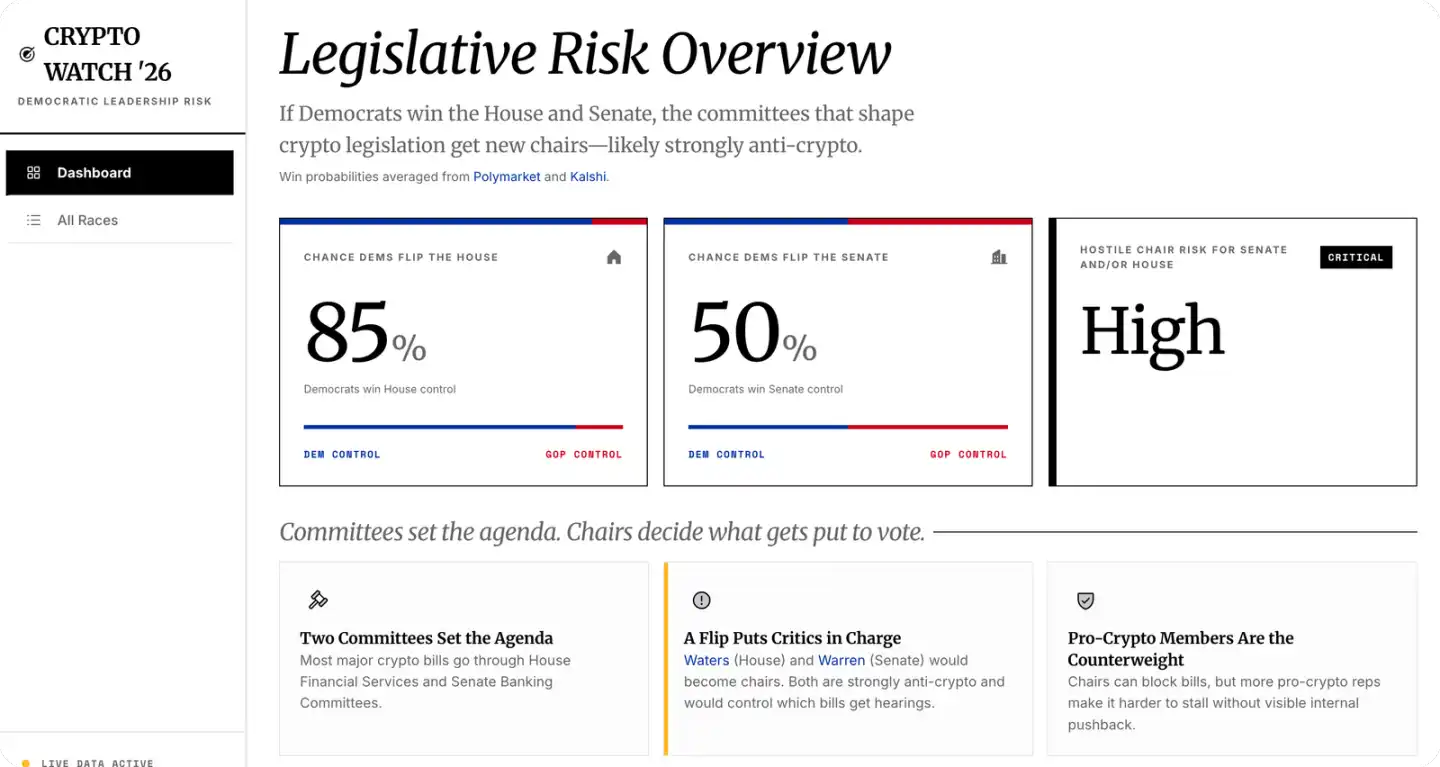
The 2026 US midterm elections pose significant risks to the crypto industry, with Democrats having an 85% chance of taking the House. This would place Maxine Waters, a vocal crypto critic, as Chair of the House Financial Services Committee (HFSC), giving her absolute power to block crypto legislation by controlling the agenda. In the Senate, Elizabeth Warren, another staunch opponent, would likely chair the Banking Committee. While nearly half of Democratic lawmakers voted for the pro-crypto GENIUS Act, this support is superficial. Bills never go to a full floor vote without first passing through committee, where chairs hold unilateral power to kill them. The current pro-crypto Republican chairs, who advanced bills like FIT21 and CLARITY, would be replaced. The analysis highlights that even though pro-crypto Democrats exist, they lack influence in the powerful committees that control legislative progress. Key elections that could shift committee dynamics are limited. The conclusion is that a Democratic sweep would create a severe structural headwind, stalling major crypto legislation in Congress despite bipartisan voter support.

Written by: David Christopher

Compiled by: Saoirse, Foresight News

What level of risk does this midterm election truly conceal for the encryption industry? As the possibility of a Democratic sweep of both the Senate and the House of Representatives in the midterm elections continues to rise, I aim to conduct an in-depth analysis of its potential impact on the future trajectory of the encryption industry, based on current polls.

To this end, I have consulted prediction markets on one hand, and resources like Stand with Crypto (SWC) on the other—a platform that records the policy stances of various candidates towards the encryption industry. I have integrated this information and built an analytical dashboard accordingly.

Although the data is still being supplemented and refined, I have established a core database tracking key districts where Democratic candidates are leading, and correlating their encryption policy positions with potential influence in Congressional committees. This analysis preliminarily reveals the policy landscape for the coming months: superficially, there appears to be room for cooperation, but a deeper look uncovers profound structural issues.
A Surprising Reality

First, it must be clarified that Democratic support for the encryption industry is actually higher than commonly perceived—at least on certain bills.

In the House of Representatives, 101 Democratic lawmakers (approximately 48% of the caucus) voted in favor of the GENIUS Act; in the Senate, 18 Democrats (40%) voted to advance the bill to a floor vote. This seems to form a tangible bipartisan support coalition. However, this support is confined to that specific bill. Once it enters the core stage that truly determines legislative direction—the committee process—this support vanishes entirely.

This is precisely the crux of the issue.

The Core Source of Influence

Encryption-related legislation is never brought directly to a full floor vote.

Whether it's stablecoin regulation, market structure rules, or defining the authority of the U.S. Securities and Exchange Commission (SEC), all issues must first undergo committee review. The House Financial Services Committee (HFSC) and the Senate Banking Committee are the two core bodies that determine the life or death of encryption bills (market structure bills also require input from the Agriculture Committee regarding the relevant authority of the Commodity Futures Trading Commission (CFTC)).

Committee chairs hold absolute agenda control: they decide which bills get hearings, which move to the deliberation stage, and which die quietly in procedural deadlock. A chair opposed to a bill does not need to vote it down; they can simply kill it by refusing to schedule it.

Republican chairs in recent years have fully demonstrated the influence of this power:

  • Senate Banking Committee Chair Tim Scott pushed the GENIUS Act through committee review and helped it pass the Senate vote;
  • Former House Financial Services Committee Chair Patrick McHenry strongly advocated for the FIT21 Act, making it the first major encryption market structure bill to pass the House;
  • Current House Financial Services Committee Chair French Hill has continued this momentum, pushing related bills like the CLARITY Act through the House (although this bill remains stalled in the Senate), and consistently holding hearings on digital assets and capital markets modernization.

So, what changes if Democrats achieve a full victory?

The majority party will control all committee chair positions in Congress, without exception. If Democrats recapture the House, they will chair all House committees; if they take the Senate, they will fully control all Senate committees. The selection of chairs within the majority party is typically based on seniority.

  • House Financial Services Committee: The most senior Democrat is Maxine Waters;
  • Senate Banking Committee: The highest-ranking Democrat is Elizabeth Warren.

It is well-known that both have voted against all major encryption bills. Warren led the opposition during the GENIUS Act deliberations, calling it "a threat to national security"; Waters directly condemned the bill as "a complete and total crypto scam."

The key point of contention in the House is this—once party control changes, the subcommittees will be completely reorganized. The majority party will dictate the allocation and proportional adjustment of seats for new members. Waters will have significant influence over personnel arrangements within the House Financial Services Committee and its subcommittees, including deciding who will oversee "digital asset" related matters. Admittedly, she cannot unilaterally decide all members (the party leadership and caucus have a say), but it is enough to steer the committee towards her preferred anti-encryption stance.

The Democratic contingent in the current House Financial Services Committee is already clearly leaning anti-encryption: Brad Sherman, Stephen Lynch, Emanuel Cleaver, and Sylvia Garcia all hold strong opposing views. Even with pro-encryption members like Jim Himes, Bill Foster, Ritchie Torres, Josh Gottheimer, and Vicente Gonzalez, they cannot control the agenda under Waters' chairmanship.
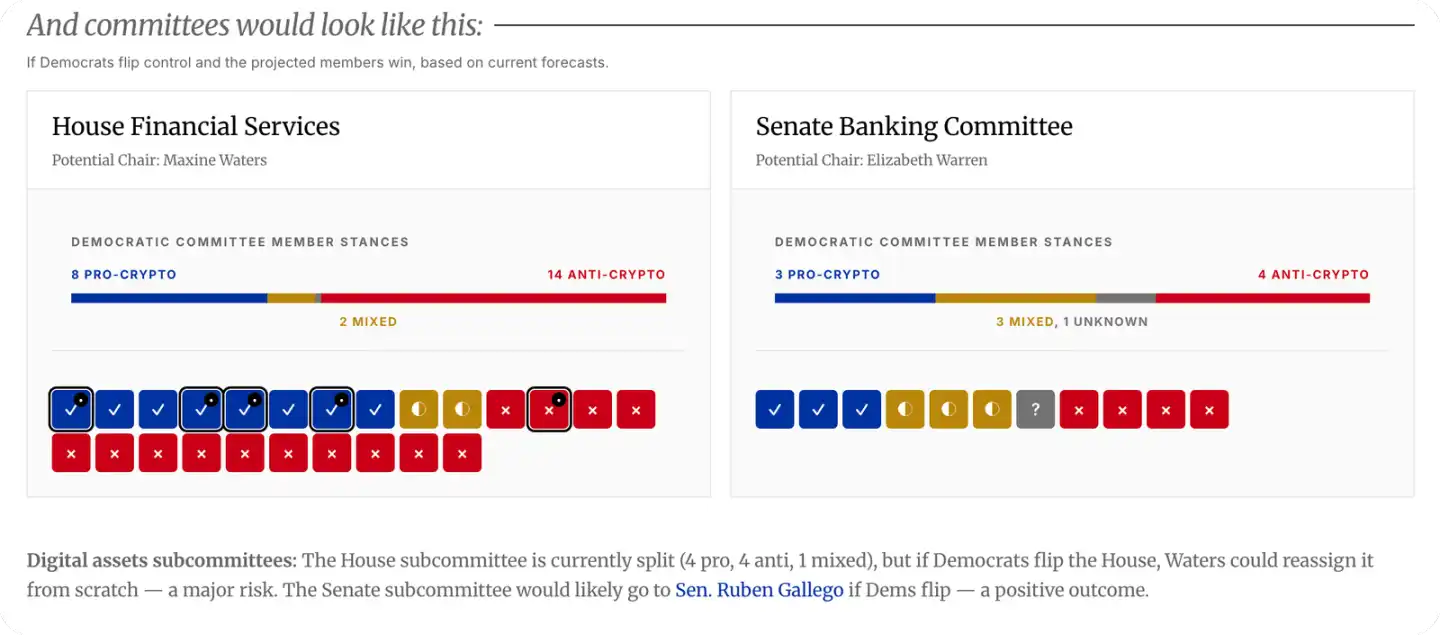
This chart shows the distribution of encryption stances in the two core committees if Democrats regain control of Congress in the 2026 midterm elections, visually reflecting the regulatory landscape the encryption industry will face.

The situation in the Senate Banking Committee is slightly better. Although Warren would become chair, the committee's composition is more diverse: it includes pro-encryption senators (e.g., Mark Warner, Ruben Gallego, Angela Alsobrooks), opponents (e.g., Tina Smith), and swing-vote moderates. A slight positive is that if Democrats control the Senate, Senator Gallego, rated favorably on the SWC platform, is highly likely to chair the digital assets subcommittee. Although Warren would still control the full committee's agenda, Gallego could potentially carve out some space for pro-encryption voices at the subcommittee level.

The Key Elections That Truly Impact the Landscape

Most existing pro-encryption Democratic lawmakers are not on the House Financial Services Committee or the Senate Banking Committee. They can certainly vote in favor of relevant bills in full floor votes, and they can pressure party leadership (though, given the high degree of partisanship on this issue, most are reluctant to speak out for the encryption industry), but they cannot force committee chairs to advance legislation.

Only a handful of elections can truly change the power composition within these committees.
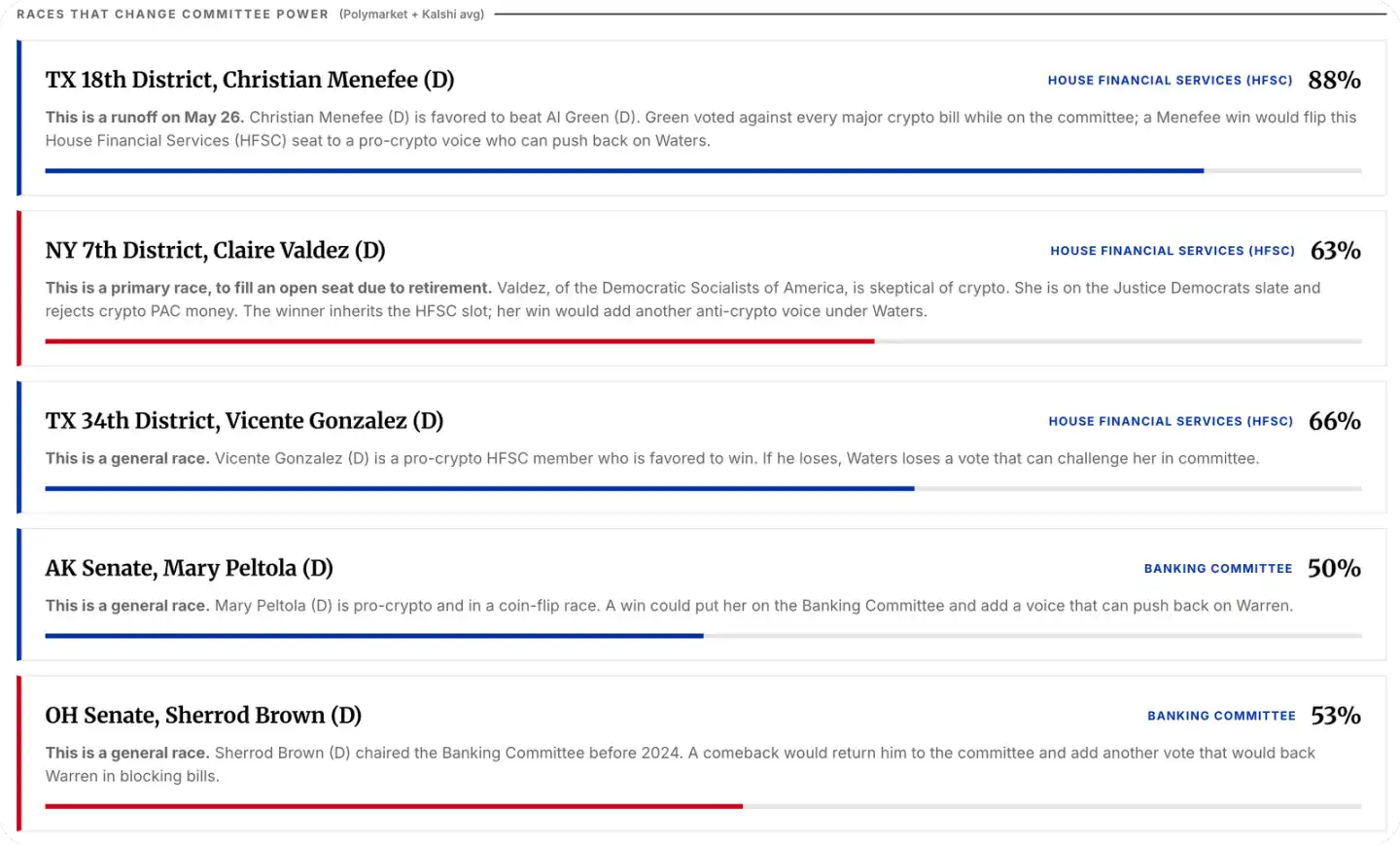
This chart is an analysis of key district races affecting U.S. Congressional encryption legislative power. Data is averaged from Polymarket and Kalshi prediction markets. It corely shows which election results would directly change the encryption stance of the House Financial Services Committee (HFSC) and the Senate Banking Committee.

The Final Conclusion of the Midterm Elections

The prospects in the House are extremely grim.

The probability of Democrats retaking the House is as high as 85%, meaning Waters is highly likely to chair the House Financial Services Committee, wielding absolute power to reorganize subcommittees and control the legislative agenda. The remaining bright spots are extremely limited: Menefee has a chance to defeat Green for a seat, and Gonzalez is highly likely to retain his current seat. These scenarios might create some checks and balances, but they cannot change the core of power—the ownership of the chairmanship.

The Senate is the encryption industry's last remaining stronghold, and the situation worsened last night: Juliana Stratton defeated Raja Krishnamoorthi in the Illinois primary. Based on SWC platform records, combined with the fact that Fairshake (a U.S. Super PAC with ties to the encryption industry, and currently one of the most influential political lobbying organizations in the crypto space) spent $7 million opposing her, it is clear that Stratton is a staunch anti-encryption politician.

Even more frustrating is the overall picture: approximately 47% of Democratic lawmakers in both chambers supported the GENIUS Act, and 37% of House Democrats supported the CLARITY Act—pro-encryption Democrats do exist. But the life or death of bills is never decided by full floor votes; it depends on the committees. Committee votes on market structure bills strictly follow party lines. The existing support base simply cannot transmit to the core环节 that truly determines legislative direction.

The encryption industry should not have become so partisan. Pro-encryption Democrats do exist; they just happen not to be in the key positions that hold real legislative power.


Preguntas relacionadas

QWhat is the main concern for the crypto industry regarding the upcoming midterm elections according to the article?

AThe main concern is that if Democrats sweep both the House and Senate, key congressional committees like the House Financial Services Committee (HFSC) and Senate Banking Committee will be chaired by strong crypto opponents like Maxine Waters and Elizabeth Warren, who can block crypto-related bills by controlling the agenda and refusing to advance them to a full vote.

QWhich two congressional committees are identified as the most critical for the fate of crypto legislation?

AThe House Financial Services Committee (HFSC) and the Senate Banking Committee are the two core committees that determine the survival or death of crypto bills, as all related legislation must pass through them first before reaching a full floor vote.

QWho are the likely Democratic chairs of the HFSC and Senate Banking Committee if their party gains control, and what are their stances on crypto?

AMaxine Waters would likely chair the House Financial Services Committee (HFSC), and Elizabeth Warren would likely chair the Senate Banking Committee. Both are strong opponents of crypto; Warren called the GENIUS Act a 'threat to national security,' and Waters denounced it as a 'total crypto scam.'

QWhat specific power does a committee chair hold over crypto legislation, as explained in the article?

AA committee chair has absolute agenda control: they decide which bills get hearings, which move to markup, and which die in procedural gridlock. They can kill a bill they oppose simply by refusing to schedule it for consideration, without needing to vote it down.

QDespite significant Democratic support for some crypto bills in full votes, why does the article argue this support is ineffective?

AThe support is ineffective because crypto bills never go directly to a full vote; they must first pass through committees. The chairs of these key committees, who are staunch crypto opponents, can block the bills from ever reaching a full vote, rendering the broader support meaningless.

Lecturas Relacionadas

In Conversation with Ray Dalio: We Are Currently in an AI Bubble, with 1% of My Portfolio in Bitcoin

Ray Dalio, founder of Bridgewater Associates, warns in an interview that the current AI boom shows classic bubble characteristics, which could lead to significant economic downturns as seen in past cycles like 1929 or 2000. He explains that speculative enthusiasm, fueled by debt and overvaluation, often precedes a crash when rising rates or taxation force asset sales, causing widespread losses and recession. Dalio also outlines his "Big Cycle" theory, describing an approximate 80-year pattern where widening wealth gaps, massive government deficits, and shifting geopolitical power (like China's rise) create internal conflict and global instability. He emphasizes that we are in a late-cycle, transitional phase where traditional powers like the US and UK face decline. For personal wealth protection, Dalio advises diversification beyond cash into assets like stocks, bonds, real estate, and particularly gold, which he prefers over Bitcoin. While he holds about 1% of his portfolio in Bitcoin as a non-printable hard asset, he views gold as more secure from technological or governmental threats. Regarding AI's impact, Dalio believes it will disproportionately benefit capital owners, worsening inequality by replacing both physical and cognitive labor. He suggests that human intuition and emotional intelligence, combined with AI, will be key for future workers. On taxation, Dalio argues that wealth taxes are impractical and risk triggering asset sell-offs, reducing productive investment. He points to the UK as a cautionary example of debt, low productivity, and political strife. Geopolitically, Dalio foresees a more regionalized world, with the US showing weakness in prolonged conflicts like with Iran, akin to past imperial declines. The ideal outcome, he suggests, is coexisting powerful blocs (e.g., Americas, China-Asia Pacific) without major war.

marsbitHace 2 hora(s)

In Conversation with Ray Dalio: We Are Currently in an AI Bubble, with 1% of My Portfolio in Bitcoin

marsbitHace 2 hora(s)

Daily 7.2 Trillion KRW: Foreign Capital's Record Net Buying on Friday! Wall Street Says Headwinds for Korean Stock Fund Flows Have Subsided

South Korean stock market sees a dramatic shift in fund flows. On July 31, foreign investors made a record net purchase of approximately KRW 7.2 trillion in KOSPI stocks, marking a fundamental reversal from the persistent large-scale net outflows seen in previous months. This contributed to a significant narrowing of foreign net selling in July to KRW 9.8 trillion, down sharply from KRW 48.4 trillion in June and KRW 44.5 trillion in May. Simultaneously, domestic institutional pressure eased. South Korean pension funds and asset managers turned to a net buying position in July, purchasing KRW 1.0 trillion worth of KOSPI shares, contrasting with net sales in May and June. Market volatility is expected to be dampened by new financial regulations. Effective July 31, the Financial Services Commission tightened access for retail investors to single-stock leveraged ETFs by raising the minimum cash deposit requirement. Trading volumes for these products subsequently dropped to about 50% of their monthly average. Citigroup Research maintains its year-end KOSPI target of 10,000 points. The firm cites several supportive factors: the substantial easing of headwinds from capital outflows, a robust fundamental outlook for the semiconductor sector, historically low market valuations, strong economic fundamentals, and the potential for policy support from financial authorities if needed.

marsbitHace 2 hora(s)

Daily 7.2 Trillion KRW: Foreign Capital's Record Net Buying on Friday! Wall Street Says Headwinds for Korean Stock Fund Flows Have Subsided

marsbitHace 2 hora(s)

Thanks to Dice Rolls, Bitcoin Keys Are Stored Offline, But Not Everyone Will Do It

The article discusses using dice rolls to generate secure Bitcoin wallet seeds, providing entropy independent of potentially flawed hardware random number generators. It explains that each fair dice roll offers about 2.585 bits of entropy, with around 50 rolls needed for a standard 12-word seed phrase and 99+ recommended for higher security. This method gained attention after a vulnerability was revealed in some Coldcard hardware wallets, where a faulty firmware RNG (dating back to 2021) compromised generated keys. The analysis notes that while a dice-generated main seed was safe from this specific flaw, other Coldcard functions (like creating paper wallets, backup keys, or passwords) could still be vulnerable if they used the defective RNG. The piece argues that while dice-based entropy is technically robust, the manual process is error-prone, tedious, and unrealistic for most new users, who might make mistakes in recording or inputting rolls. It concludes that while manual entropy generation should remain an option for advanced users, the long-term goal is to develop reliable, user-friendly hardware and software that securely generates randomness without requiring specialized knowledge. Coldcard users are advised to check their firmware version and replace any secondary secrets (like paper wallet keys) created with vulnerable devices, while also considering multi-signature setups with devices from different manufacturers for added security.

cryptonews.ruHace 7 hora(s)

Thanks to Dice Rolls, Bitcoin Keys Are Stored Offline, But Not Everyone Will Do It

cryptonews.ruHace 7 hora(s)

Trading

Spot
活动图片




