Aave governance vote sparks backlash over rushed escalation

cointelegraphPublicado a 2025-12-22Actualizado a 2025-12-22

Resumen

A governance vote at Aave has sparked significant backlash after a proposal regarding control of the protocol's brand assets was escalated to a snapshot vote, despite unresolved community discussions. The proposal seeks to transfer ownership of domains, social handles, and other intellectual property to AAVE token holders via a DAO-controlled legal structure. Aave founder Stani Kulechov defended the move, stating the community was ready for a decision after five days of discussion. However, critics, including former Aave Labs CTO Ernesto Boado and Aave Chan Initiative lead Marc Zeller, accused the team of rushing the vote without proper consent or dialogue. Zeller described the action as a "hostile takeover attempt," criticizing the timing during the holiday period, which limited participation and mobilization. The controversy highlights ongoing governance challenges within the DeFi protocol concerning control over proposal escalation and decision-making processes.

A governance vote at decentralized finance (DeFi) lending protocol Aave sparked a backlash from key stakeholders after a proposal on ownership of Aave's brand assets was escalated to a snapshot vote amid unresolved discussion.

The proposal asks the community whether Aave (AAVE) token holders should regain control over the protocol’s brand assets, including domains, social handles, naming rights and other intellectual property through a DAO-controlled legal vehicle.

Aave founder Stani Kulechov said the community was interested in a decision, announcing that the proposal had been moved to a vote.

“We realize the community is very interested in a path forward and is ready to make a decision,” Kulechov wrote.

While Kulechov said it was time for tokenholders to vote, other community members argued that the proposal was pushed to a vote prematurely, bypassing governance norms.
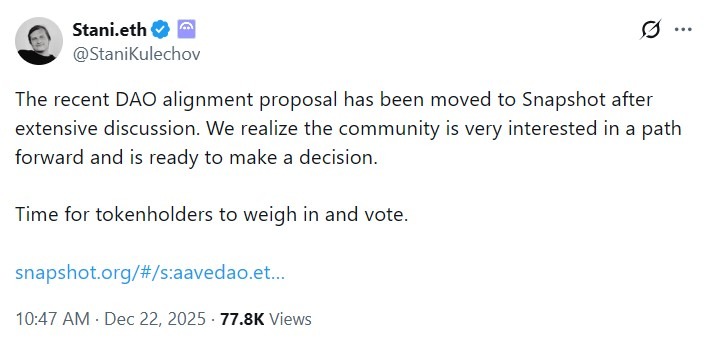
Source: Stani Kulechov

Related: SEC ends probe into Aave after four years, CEO Kulechov says

Aave Labs faces “hostile takeover” accusations

Former Aave Labs chief technology officer Ernesto Boado, whose name appears as the proposal’s author, said the vote was escalated without his consent or knowledge.

“This is not, in ethos, my proposal,” Boado wrote on X, saying that he would not have approved the submission for a vote while community discussion was still ongoing. He said the escalation breaks the code of trust in the community.

Marc Zeller, who leads the Aave Chan Initiative (ACI), said the proposal was “unilaterally escalated” despite unresolved questions from delegates and token holders.

In a public statement, Zeller said that the timing and process choices materially reduced community participation, adding that the ability of late-informed participants to mobilize or redelegate was being limited.

“What started as a push for clarity and a more fair relationship between token holders and the current stewards,” Zeller said, “is now turning into a hostile takeover attempt by Labs.”

Zeller criticized the decision of pushing the vote during the holiday period, which large stakeholders, investors and institutions have flagged as one of the “worst windows” for high-stakes governance votes.

Responding to the criticisms, Kulechov said that the discussion has been going on for five days, with many comments, and claimed that the vote complies with all the requirements.

“People are tired of this discussion and getting into a vote is the best way to resolve, this is governance end of the day,” he wrote.

The dispute highlighted deeper governance questions for Aave, one of the biggest DeFi protocols in the space.

While the proposal focuses on “soft” asset ownership, the backlash underscores how much influence can stem from control over escalation, timing and information flow.

Magazine: Bitcoin whale Metaplanet ‘underwater’ but eyeing more BTC: Asia Express

Criptos en tendencia

Preguntas relacionadas

QWhat is the main reason for the backlash in the Aave governance vote?

AThe backlash occurred because a proposal on ownership of Aave's brand assets was escalated to a snapshot vote prematurely, bypassing governance norms and without resolving ongoing community discussions.

QWho is the author of the controversial proposal, and what was his reaction?

AThe proposal's author is former Aave Labs chief technology officer Ernesto Boado, who stated the vote was escalated without his consent or knowledge, breaking the community's code of trust.

QWhat did Marc Zeller of the Aave Chan Initiative accuse Aave Labs of attempting?

AMarc Zeller accused Aave Labs of attempting a 'hostile takeover' by unilaterally escalating the vote despite unresolved questions and limiting community participation during the holiday period.

QHow did Aave founder Stani Kulechov justify moving the proposal to a vote?

AStani Kulechov claimed the community was tired of the five-day discussion and that moving to a vote was the best way to resolve the issue, asserting it complied with all governance requirements.

QWhat broader governance issue did the dispute highlight for Aave?

AThe dispute highlighted how control over escalation timing and information flow can significantly influence governance outcomes, even for proposals focused on 'soft' asset ownership.

Lecturas Relacionadas

The Verdict in Choi Tae-won's Divorce Case: Revealing the Inheritance Undercurrent Behind SK Hynix's Trillion-Won Empire

SK Group Chairman Chey Tae-won's high-profile divorce case, involving a record 1.38 trillion won settlement, has drawn attention to the succession plans for Korea's second-largest conglomerate, especially its crown jewel, SK hynix. Unlike traditional chaebol scripts centered on the eldest son, Chey's three children from his marriage to former President Roh Tae-woo's daughter, Roh Soh-yeong, are carving distinct, non-traditional paths. Eldest daughter Chey Yun-jung (b. 1989) is seen as the most evident successor. With a scientific and consulting background, she holds executive roles at SK bioscience and SK Inc.'s growth support department, focusing on future strategy and biopharma. Her marriage is to an AI infrastructure entrepreneur, not a traditional business alliance. Second daughter Chey Min-jung (b. 1991) took a unique route, voluntarily serving as a South Korean naval officer, including an anti-piracy deployment. She later worked on policy and strategy for SK hynix in Washington D.C. before co-founding an AI-driven healthcare startup. She married a former U.S. Marine Corps officer, connecting her to U.S. defense and policy circles—networks crucial for a global semiconductor giant. The only son, Chey In-geun (b. 1995), who studied physics like his father, worked briefly at SK E&S before joining McKinsey. Despite fitting the traditional "heir" profile as the eldest son, he remains silent and holds no public position or shares in SK, suggesting the old succession playbook is obsolete. As SK hynix's valuation soars, becoming a geopolitical asset in the AI era, the heirs' legitimacy is no longer automatic. They must prove themselves in fields like AI biotech, global policy, and strategic consulting. Their marriages also reflect new elite networks in tech and defense, not old political alliances. Their inheritance is the complex challenge of navigating a globalized, tech-driven world, not just a corporate throne.

marsbitAyer 09:06

The Verdict in Choi Tae-won's Divorce Case: Revealing the Inheritance Undercurrent Behind SK Hynix's Trillion-Won Empire

marsbitAyer 09:06

From OpenSea to OpenRouter: Is Alex Atallah Repeating His 'Exit at the Peak' Playbook?

From OpenSea to OpenRouter: Is Alex Atallah Repeating His "Exit at the Peak" Playbook? According to the Wall Street Journal, payments giant Stripe is in talks to acquire the AI model aggregation platform OpenRouter in a potential deal valuing the company near $100 billion. This would mark founder Alex Atallah's second creation of a company reaching a $100 billion valuation, following his co-founding of NFT marketplace OpenSea. OpenRouter, founded just over three years ago, has grown rapidly by acting as a unified gateway for developers to access over 400 AI models. It currently has about 10 million users and processes over 200 trillion tokens monthly. While the platform's annualized revenue is around $50 million, its valuation has skyrocketed from $1.3 billion in March 2026. The potential acquisition by Stripe, a company OpenRouter's founder once likened it to, represents a major expansion into AI infrastructure for the payments leader. This move echoes Atallah's previous timing with OpenSea, where he departed before the NFT market's significant downturn. For OpenRouter, selling now may be strategic. Despite its scale, its business model—charging a 5-5.5% fee on AI inference calls—faces pressure from competition, open-source models, and potential price wars among model providers, limiting its profitability narrative for an IPO. A key asset for potential acquirers like Stripe is OpenRouter's vast repository of real-world AI usage data, which offers unique insights into model performance and developer preferences that are difficult to replicate. Whether this potential deal signifies a new valuation benchmark for AI infrastructure or another market peak signal remains to be seen.

链捕手Ayer 08:42

From OpenSea to OpenRouter: Is Alex Atallah Repeating His 'Exit at the Peak' Playbook?

链捕手Ayer 08:42

Trading

Spot

Artículos destacados

Cómo comprar AAVE

¡Bienvenido a HTX.com! Hemos hecho que comprar Aave Protocol (AAVE) sea simple y conveniente. Sigue nuestra guía paso a paso para iniciar tu viaje de criptos.Paso 1: crea tu cuenta HTXUtiliza tu correo electrónico o número de teléfono para registrarte y obtener una cuenta gratuita en HTX. Experimenta un proceso de registro sin complicaciones y desbloquea todas las funciones.Obtener mi cuentaPaso 2: ve a Comprar cripto y elige tu método de pagoTarjeta de crédito/débito: usa tu Visa o Mastercard para comprar Aave Protocol (AAVE) al instante.Saldo: utiliza fondos del saldo de tu cuenta HTX para tradear sin problemas.Terceros: hemos agregado métodos de pago populares como Google Pay y Apple Pay para mejorar la comodidad.P2P: tradear directamente con otros usuarios en HTX.Over-the-Counter (OTC): ofrecemos servicios personalizados y tipos de cambio competitivos para los traders.Paso 3: guarda tu Aave Protocol (AAVE)Después de comprar tu Aave Protocol (AAVE), guárdalo en tu cuenta HTX. Alternativamente, puedes enviarlo a otro lugar mediante transferencia blockchain o utilizarlo para tradear otras criptomonedas.Paso 4: tradear Aave Protocol (AAVE)Tradear fácilmente con Aave Protocol (AAVE) en HTX's mercado spot. Simplemente accede a tu cuenta, selecciona tu par de trading, ejecuta tus trades y monitorea en tiempo real. Ofrecemos una experiencia fácil de usar tanto para principiantes como para traders experimentados.

358 Vistas totalesPublicado en 2024.12.11Actualizado en 2026.06.02

Cómo comprar AAVE

Discusiones

Bienvenido a la comunidad de HTX. Aquí puedes mantenerte informado sobre los últimos desarrollos de la plataforma y acceder a análisis profesionales del mercado. A continuación se presentan las opiniones de los usuarios sobre el precio de AAVE (AAVE).

活动图片













