Author: Thought Circle
Have you ever thought that the software industry might be undergoing a transformation more dramatic than the shift from command line to graphical interface? Recently, I listened to a16z's David George's in-depth analysis of the AI market, and I was stunned by one set of data: the fastest-growing AI companies are expanding at an annual growth rate of 693%, while their spending on sales and marketing is significantly lower than that of traditional software companies. This is not an isolated case; the entire group of AI companies is growing more than 2.5 times faster than non-AI companies. What I find even more incredible is that these companies' ARR per FTE (Annual Recurring Revenue per Full-Time Employee) reaches $500,000 to $1 million, while the standard for the previous generation of software companies was $400,000.
What does this mean? It means we are witnessing the birth of a completely new business model, an era of creating greater value with fewer people and lower costs. D
avid George mentioned in his talk that this is not a minor adjustment, but a complete paradigm shift. Those core concepts—version control, templates, documentation, even the concept of a user—are being redefined by AI agent-driven workflows. I firmly believe that within the next five years, companies that cannot adapt to this change will be completely eliminated.
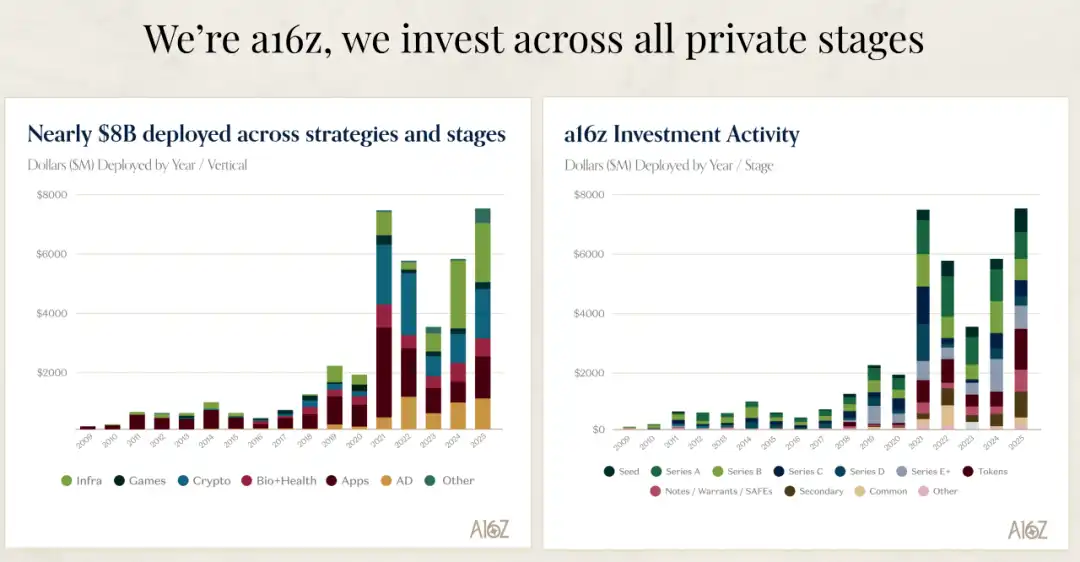
The Astonishing Truth About AI Company Growth
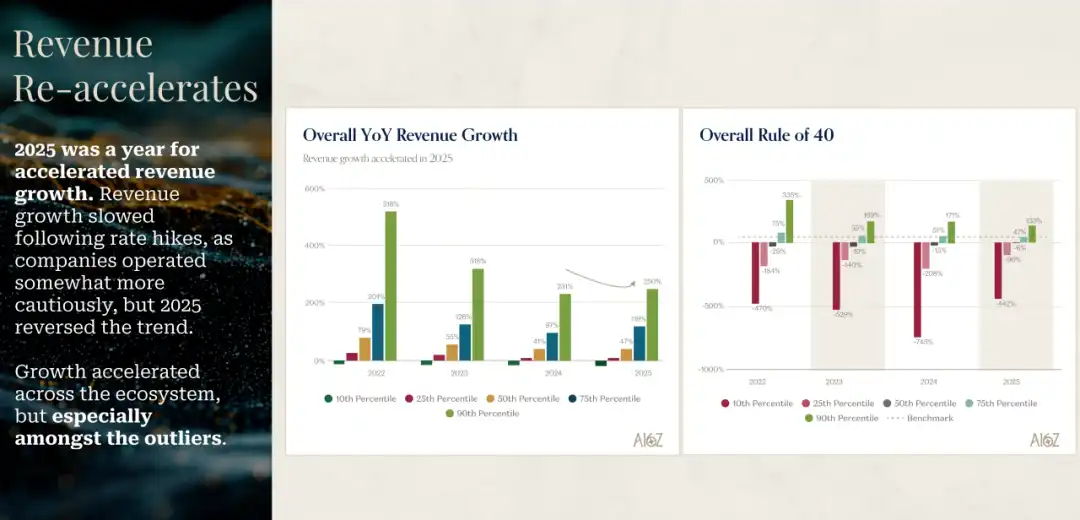
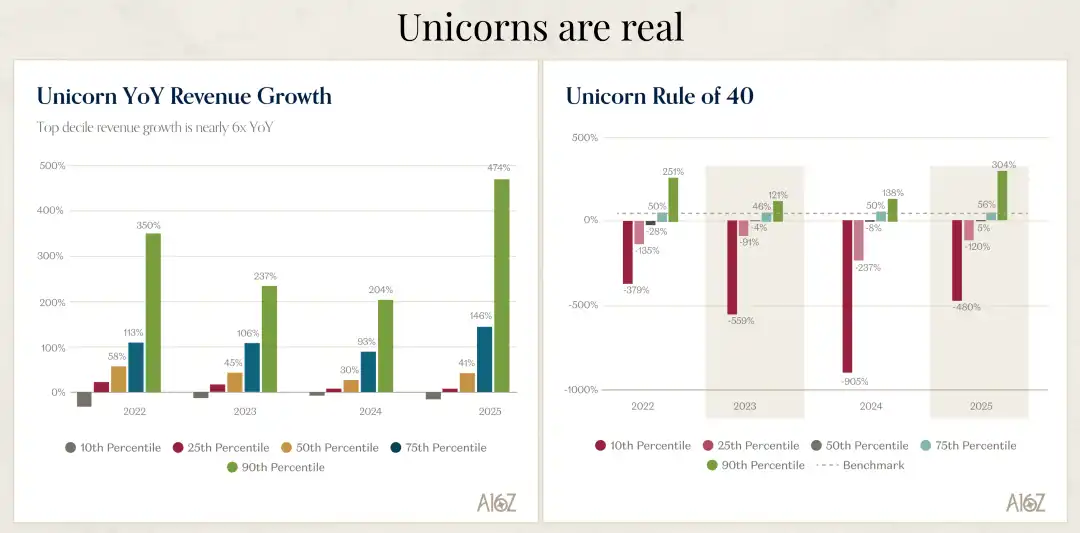
The data David George presented made me rethink what true growth really is. 2025 has been a year of accelerated growth for AI companies. After the growth deceleration in 2022, 2023, and 2024 due to rising interest rates and tech sector contraction, 2025 completely reversed this trend. Most astonishingly, among companies ranked by different tiers, the true outlier companies are growing at an almost unbelievable pace.
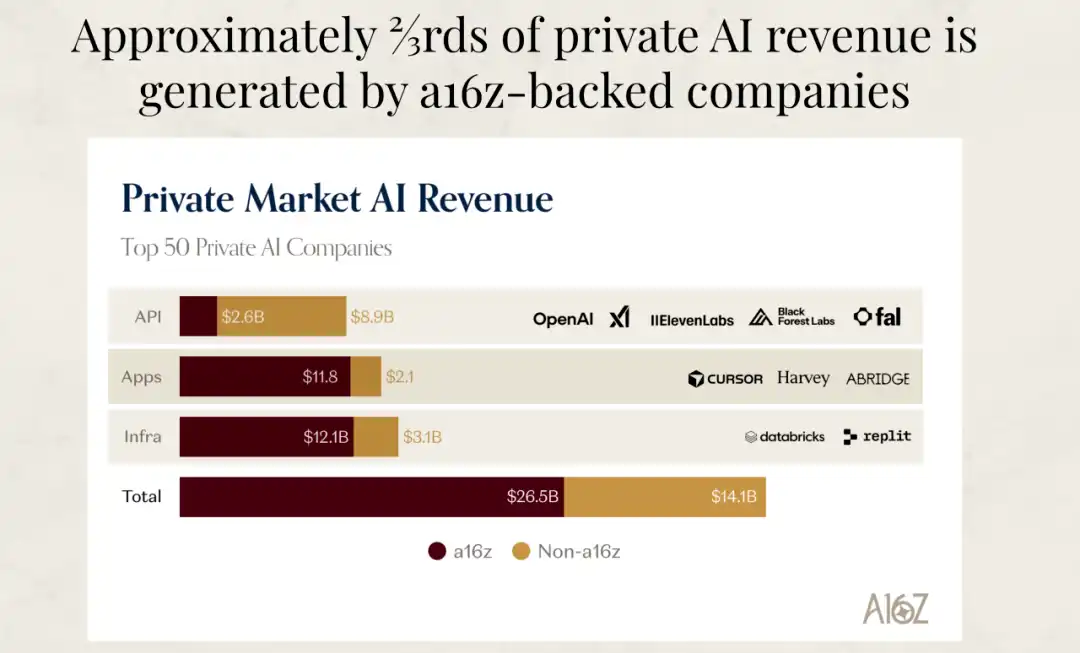
My first reaction upon seeing this data was: are these numbers correct? The top-performing group of AI companies is growing at 693% year-over-year. David said their team also triple-checked before believing this number. But it completely aligns with the actual situations and cases they see from their portfolio companies. This is not an isolated phenomenon, but a systemic change happening across the entire AI field.
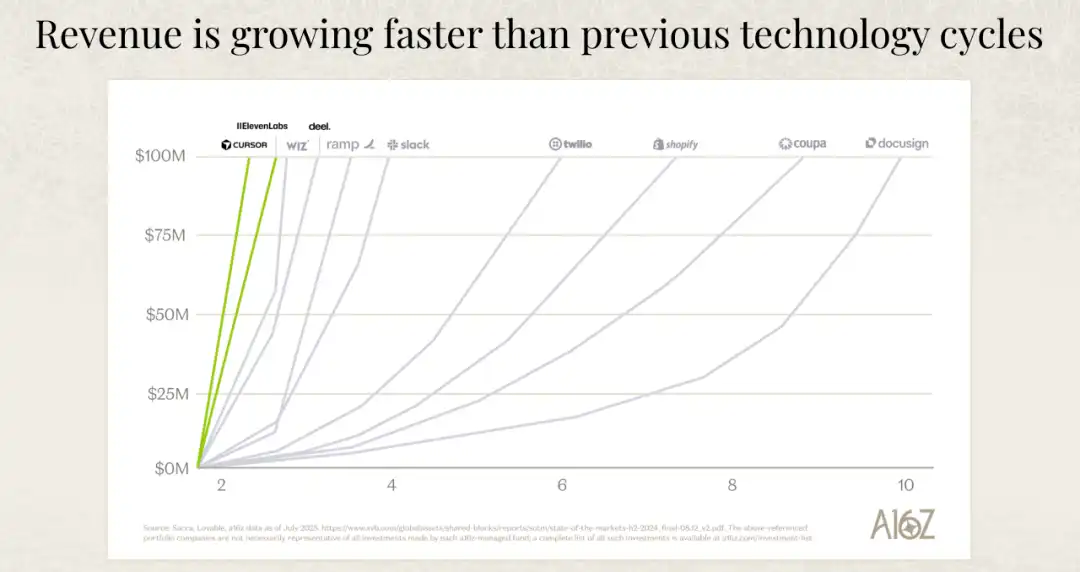
More importantly is the quality of growth. Traditional software companies usually take a long time to reach $100 million in annual revenue, while the fastest-growing AI companies reach this milestone much quicker. David emphasized a very important point: this is not because they are spending more on sales and marketing; on the contrary, the fastest-growing AI companies actually spend less on sales and marketing than traditional SaaS (Software as a Service) companies. They are growing faster while spending less. What's the reason? It's because end-customer demand is extremely strong, and the products themselves are highly compelling.
I think this reveals a profound shift in business logic. In the past era of software, growth often relied on strong sales teams and huge marketing budgets. You needed to educate the market, persuade customers, and overcome adoption barriers. But in the AI era, truly excellent products can speak for themselves. When a product can immediately create value for users, allowing them to feel an efficiency boost the first time they use it, market demand automatically arises. This product-driven growth model is much healthier and more sustainable than the traditional sales-driven model.
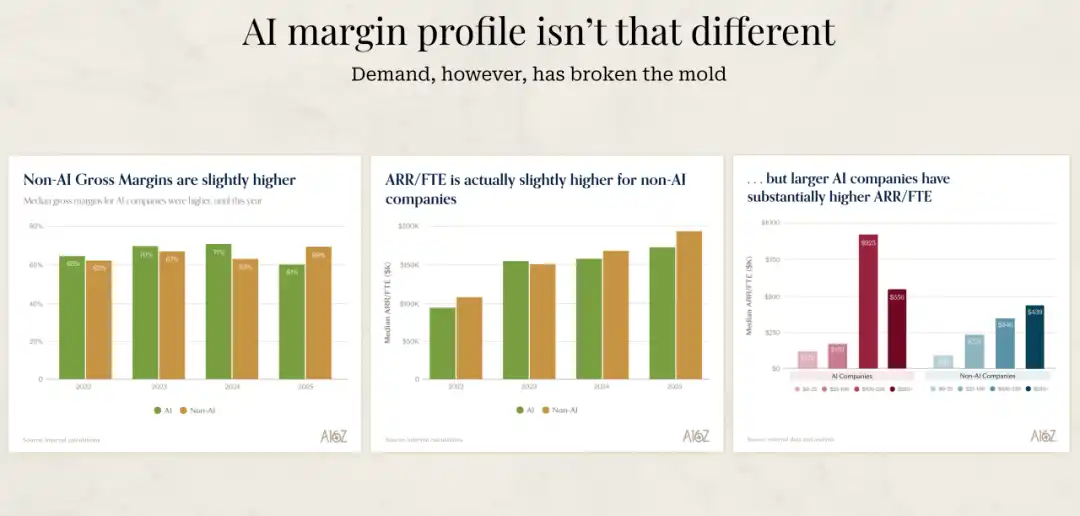
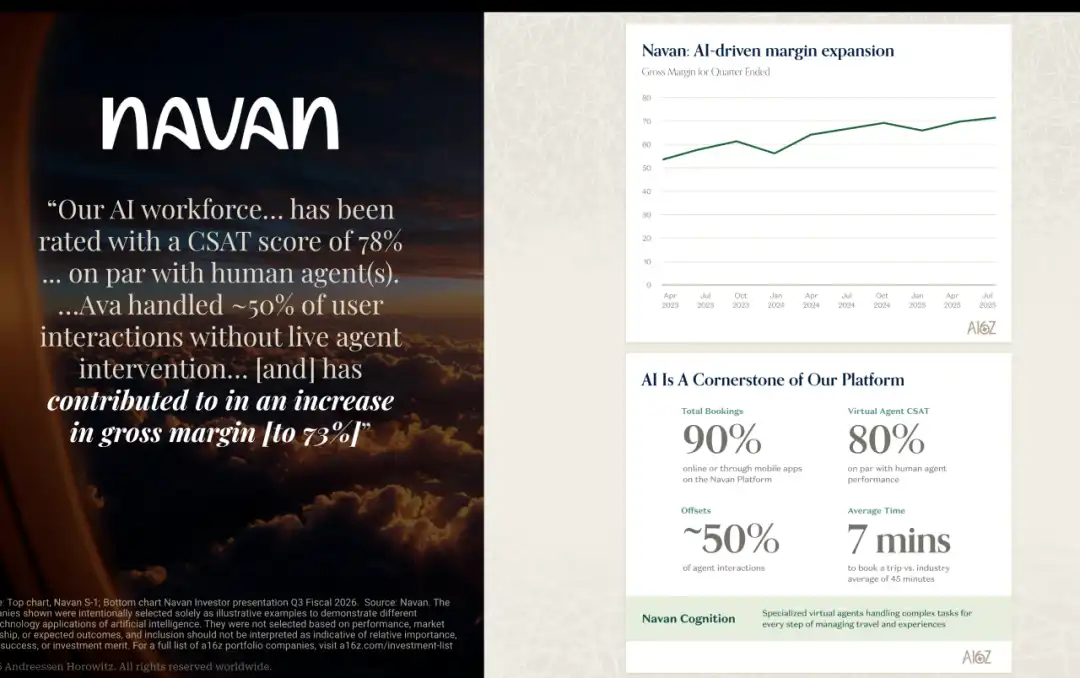
Another set of data David showed is also interesting. The gross margins of AI companies are actually slightly lower than those of traditional software companies. Their team has a unique perspective: for AI companies, low gross margin is somewhat a badge of honor. Because if the low gross margin is caused by high inference costs, it indicates two things: First, people are really using the AI features; Second, over time, these inference costs will decrease. So, in a way, if they see an AI company with particularly high gross margins, they might be a bit suspicious, as it could mean the AI features are not what customers are actually buying or using.
Why AI Companies Can Be More Efficient
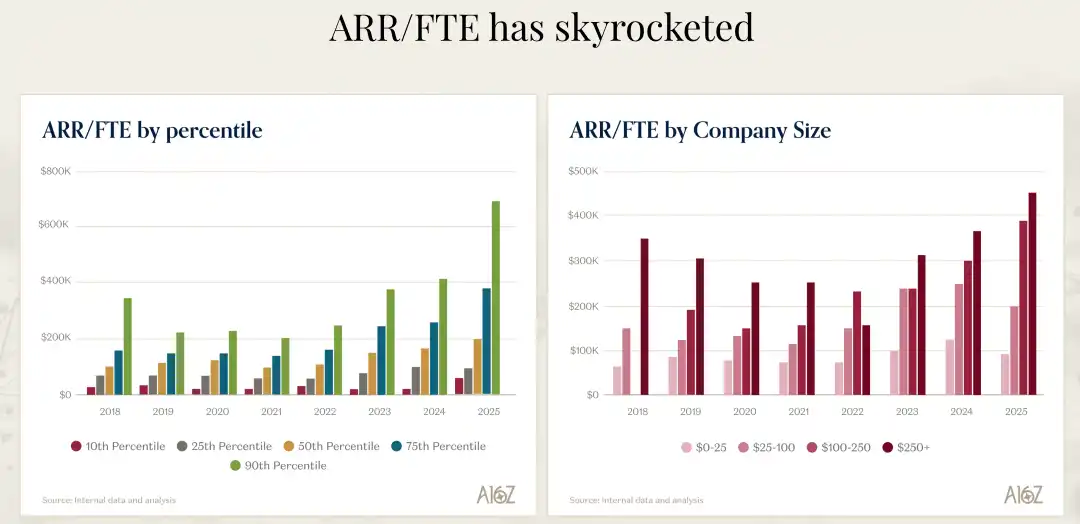
I've been thinking about a question: Why can AI companies, also being software companies, create more revenue with fewer people? David focused on the ARR per FTE metric in his talk, which is the Annual Recurring Revenue per Full-Time Employee. This metric is actually a comprehensive indicator of a company's overall operational efficiency, encompassing not only sales and marketing efficiency but also management costs and R&D costs.
The ARR per FTE of the best AI companies reaches $500,000 to $1 million, while the standard for the previous generation of software companies was about $400,000. This might seem like just a numerical difference, but it reflects completely different business models and operational methods. David believes the main reason for this difference is that the market demand for these products is very strong, so they need fewer resources to bring the product to market.
But I think this is only the surface reason. The deeper reason is that AI companies are forced from the start to think differently about how to operate. They have no choice but to use AI to redesign their internal processes, product development methods, and customer support systems. This forced innovation反而 allows them to find a more efficient business model.
David shared a particularly vivid example. He said he recently chatted with a founder of a company who was dissatisfied with the progress of one of their products. So, he directly assigned two engineers who were deeply involved in AI to rebuild this product from scratch using the latest programming tools like Claude Code and Cursor, and gave them an unlimited budget for programming tools. The result? The founder said he believed the progress was 10 to 20 times faster than before. And the bills generated by these tools were so high that it made him start rethinking what the entire organization should look like.
What impressed me about this example is that this is not an incremental improvement, but an order-of-magnitude leap. What does a 10 to 20 times speed increase mean? It means a project that originally took a year might now be completed in one or two months. This speed difference will have a decisive impact in competition. This founder's conclusion was: I need the entire product and engineering team to work in this way, and I think this will happen within the next 12 months. But this also means the team's organizational structure will undergo fundamental changes. Where are the boundaries between product, engineering, and design? These questions all need to be redefined.
I believe December 2024 was a turning point in the field of programming. David feels the same. He said it felt like at that point in time, programming tools made a qualitative leap. In the next 12 months, this change will either truly take root in companies, or those that don't adopt it will be much slower than their peers. This is not alarmist; it's reality.
Adapt to AI or Be Eliminated
David mentioned a very stark view in his talk: For companies founded before the AI era, it's either adapt to the AI era or die. This sounds extreme, but I completely agree. And this adaptation needs to happen simultaneously on two fronts: the front end and the back end.
On the front end, companies need to think about how to natively integrate AI into the product, not just add a chatbot to existing workflows. This requires reimagining what the product can do with AI and being radically disruptive to themselves, making changes. David shared several interesting examples. There is a pre-AI era software company whose CEO has been completely converted by the AI concept, saying: We are going to become an AI product. We want the product to be able to say, your employees are now your AI agents. How many agents do you have? These are the topics he discusses now.
There is an even more extreme example. A CEO said, for every task we need to complete now, I ask one question: Can I do this with electricity, or must I do it with blood? This is an extreme mindset shift. Using electricity refers to using AI and automation; using blood refers to using human labor. This shift in thinking is very profound; it forces you to re-examine every process and every task in the company.
On the back end, companies need to fully adopt the latest programming models and tools. All developers should use the latest programming assistance tools, and every functional department should use the latest tools. So far, adoption rates are highest in the programming field, which is also where the biggest leaps are seen. But this change is spreading to other functional areas.
David mentioned that for those pre-AI companies, the good news is that the evolution of the business model is still in its early stages. The most disruptive scenario is when both technology/product and business model shift. Right now, technology and product are indeed undergoing dramatic changes, but the business model shift hasn't fully unfolded yet.
He sees the business model as a spectrum. On the far left is the license model (licenses), the pre-SaaS era license and maintenance model. Then comes SaaS and subscription models, usually based on seat pricing, which was a major innovation and very disruptive. You can look at what happened to Adobe during this transition. Then comes the consumption-based model, which is usage-based pricing, the way cloud services charge. Many usage-based businesses have moved from seat-based to consumption-based.
The next stage will be the outcome-based model. When you complete a task, ideally successfully complete a task, you charge based on the successful completion of the task. Currently, the only area where this might be truly feasible is customer support and customer success, because you can objectively measure problem resolution. But as model capabilities improve, if other functions beyond customer support can also measure such outcomes, that will be hugely disruptive to existing companies.
I find this evolution path very insightful. From license to subscription, from subscription to consumption, from consumption to outcome—each transition is a disruption of the previous generation's business model. And we are now on the eve of the transition from consumption to outcome. Once AI agents can reliably complete tasks and be objectively evaluated, outcome-based pricing will become mainstream. By then, companies still charging by seat will find themselves completely uncompetitive.
The AI Adoption Dilemma of Large Companies
Regarding Fortune 500 companies adopting AI, David's observations are very interesting. He said there is a huge gap between what he hears from the CEOs of these large companies and what is actually happening. The CEOs are all saying: We must adapt, we are desperate to understand what AI tools we need, we are ready to change, our business will roll out these tools across the board, we are going to be AI companies.
But the reality is completely different. The biggest disconnect between this mindset and actual business change is: change management is too difficult. Even just getting people to use AI assistants to help them do their jobs better is hard enough. As for actual business management, changing business processes, change management—these are extremely difficult.
David said he isn't surprised by market chatter that things are moving slower than expected. But for the best companies that are truly fully embracing AI and know what to do, there has been a huge business impact. He gave a few specific examples: Chime said they reduced support costs by 60%; Rocket Mortgage said they saved 1.1 million hours in underwriting, a 6x year-over-year increase, equivalent to $40 million in annual operational savings.
I think this reveals a key problem: the gap between intention and capability. Large company CEOs have the intention to embrace AI, but whether they have the ability to implement it is another matter. The difficulty of change management is often underestimated. This is not just about buying some tools or hiring some AI engineers; it requires fundamentally changing the company's processes, culture, and organizational structure.

And many large companies need to first adjust their own business to make it ready for AI. Using a chatbot is one thing; how much productivity gain you might get is probably not much. But if you have to completely overhaul your systems, information, and backend to accommodate AI, a lot of work is potentially in the works, accumulating, and we haven't seen the related results yet.
David predicts the next 12 months will be very interesting. He thinks we will see more case studies, but there will be companies that figure it out and companies that don't. Those that figure it out will gain massive productivity advantages, and those that don't will be at a huge disadvantage. I believe this divergence will come faster and more sharply than people imagine.
Model Busters and the Future of the Market
David mentioned a concept I find particularly insightful: Model Busters. These are companies whose growth speed and duration far exceed anything anyone could predict in any scenario. The iPhone is the classic case of this concept. If you look at the consensus forecast before the iPhone launch and the actual performance 4-5 years later, the consensus forecast was off by 3x. And this is the most watched company in the world.
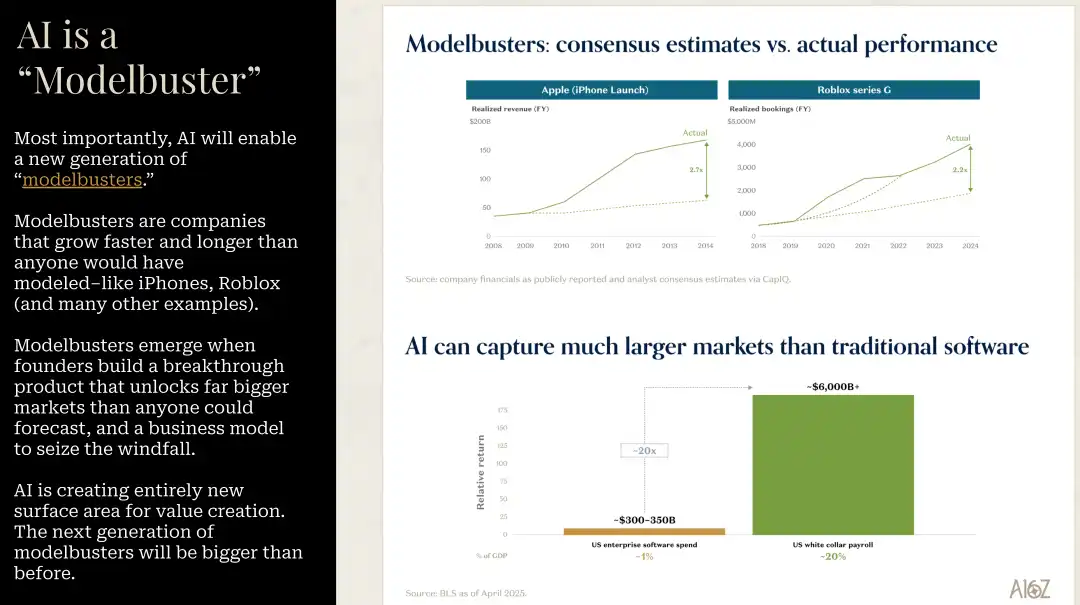
David believes AI will be the biggest Model Buster he has seen in his career. The performance of many companies in the AI space will significantly exceed any expectations in any spreadsheet. I strongly agree with this view. When a technology platform brings not incremental improvement but order-of-magnitude leaps, traditional prediction models fail.
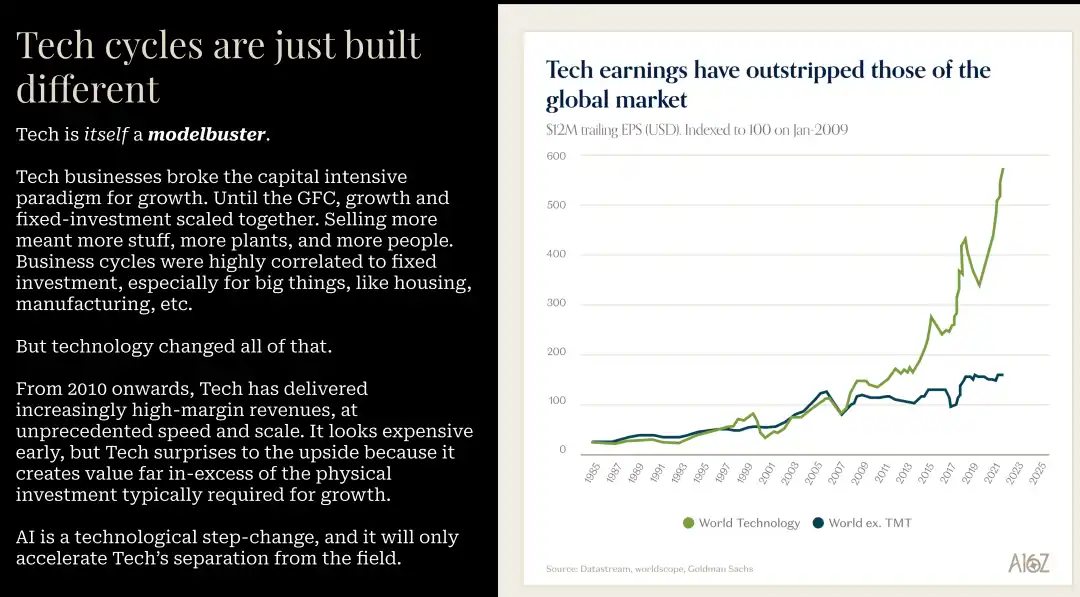
He mentioned that technology itself is a Model Buster. But since 2010, tech has delivered high-margin revenue at unprecedented speed and scale. So it always looks expensive early on, but it repeatedly outperforms expectations, creating value far in excess of the capital required. He sees no reason why this time should be any different.
In terms of capital expenditure (capex), the data David showed is also interesting. Compared to the dot-com bubble era, current capex is actually supported by cash flow, and capex as a percentage of revenue is much lower. The hyperscale cloud providers bear the brunt of the capex burden, and these are some of the best business companies ever.
David specifically mentioned that, as a portfolio company, they very much welcome this capex. He said: Building as much capacity as possible, providing as much supply for training and inference as possible, is a very good thing. And the ones bearing most of the burden are some of the best business companies ever.
A phenomenon they are starting to watch is debt entering the equation. You can't fund all the forecasted future capex with just cash flow, and the market is starting to see some debt. But overall, they feel comfortable with companies funding with cash flow, continuing to generate cash flow, and using debt, as long as the counterparties are companies like Meta, Microsoft, AWS, Nvidia.

David mentioned a case worth watching: Oracle. Oracle has always been profitable, always buying back stock, but the scale of capex they've committed to is massive; it's a huge bet. They will have negative cash flow for many years to come. The market has started to notice this; Oracle's credit default swap (CDS) costs have risen to about 2% over the past three months. This is a signal to watch.
I think this capital-intensive building phase is necessary but not without risk. The key is to ensure these investments ultimately generate corresponding returns. Currently, demand far exceeds supply. All hyperscale cloud providers report demand far outstripping supply. Gavin Baker, whom David interviewed, had a great analogy: In the internet era, a lot of fiber was laid, and then that fiber sat idle, unused; this was called dark fiber. But in the AI era, there is no such thing as a dark GPU. If you install a GPU in a data center, it will be immediately fully utilized.
The Astonishing Speed of Revenue Growth
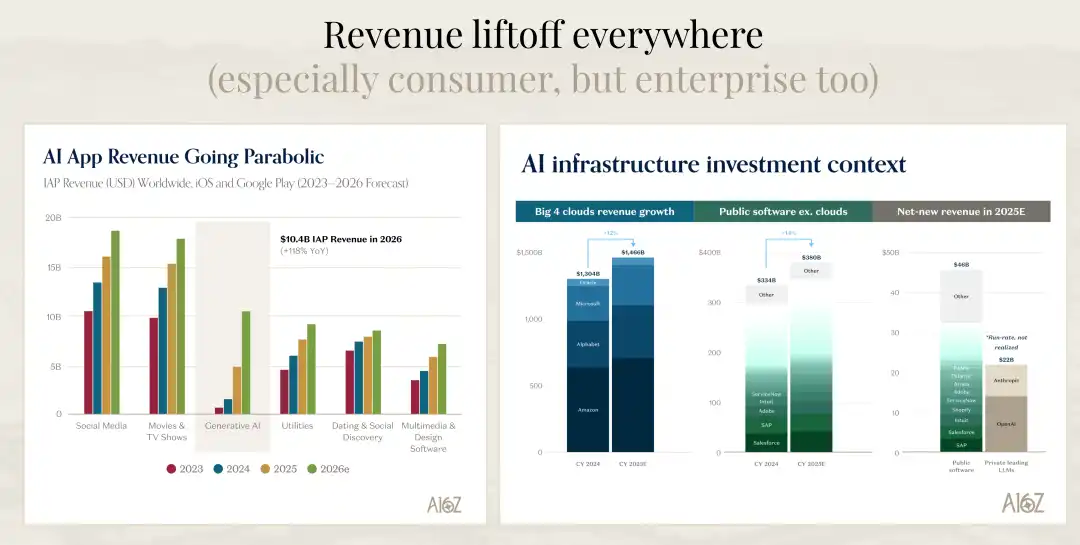
One set of data David showed was particularly震撼. He compared cloud services, public software companies, and the net new revenue added in 2025. Public software companies added a total of $46 billion in new revenue in 2025. If you look just at OpenAI and Anthropic, on an operating revenue basis, the new revenue they added is almost half of that number.
And David believes that if you do the same comparison for 2026, the new revenue added by AI companies (model companies) could reach 75% to 80% of the entire public software industry (including SAP and legacy software companies, not just SaaS). This speed is simply unbelievable. This means that within just a few years, the new value created by AI companies will surpass that of the entire traditional software industry.
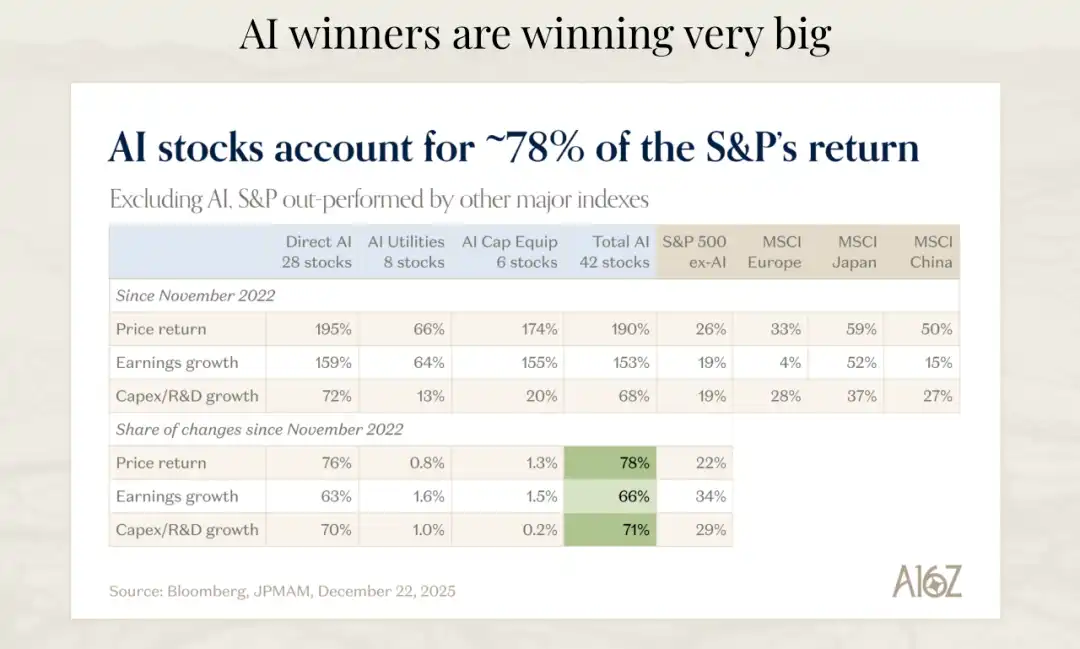
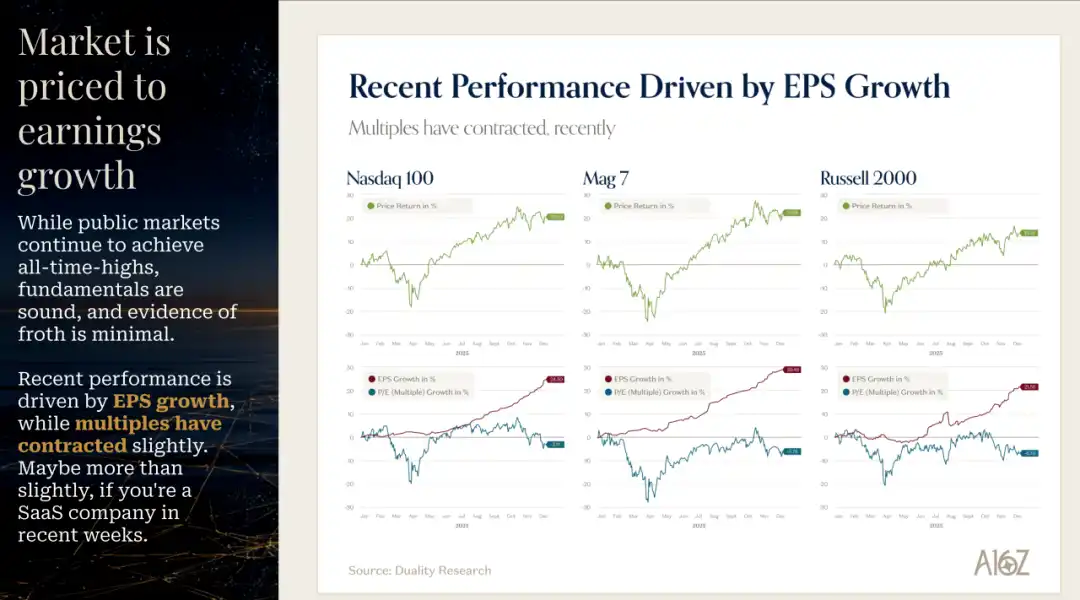
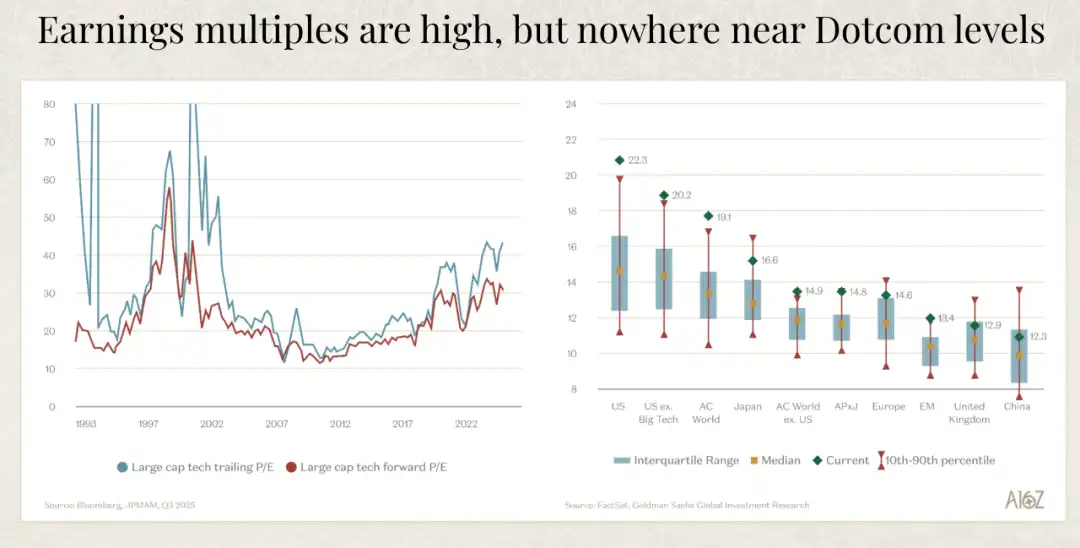
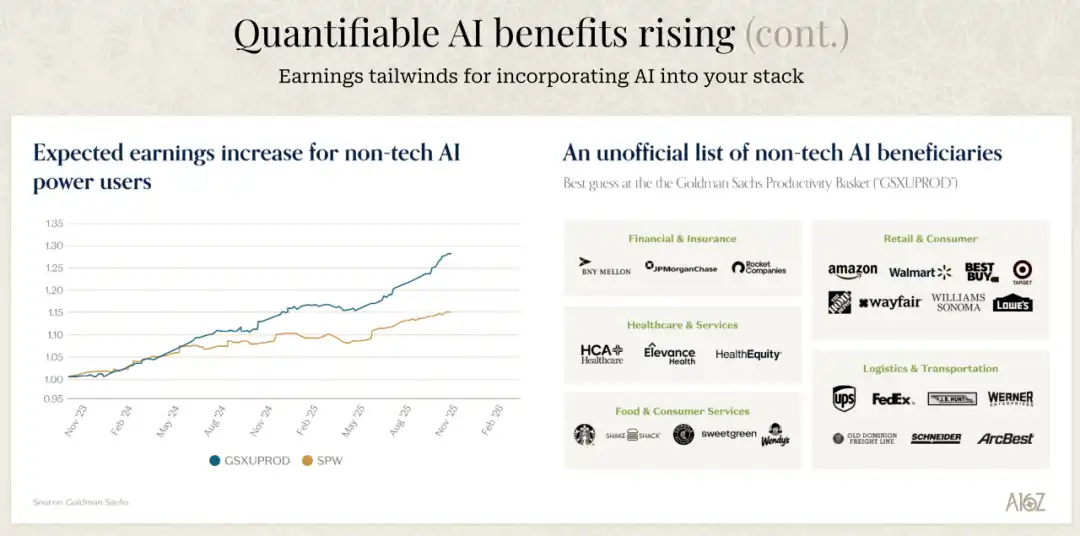
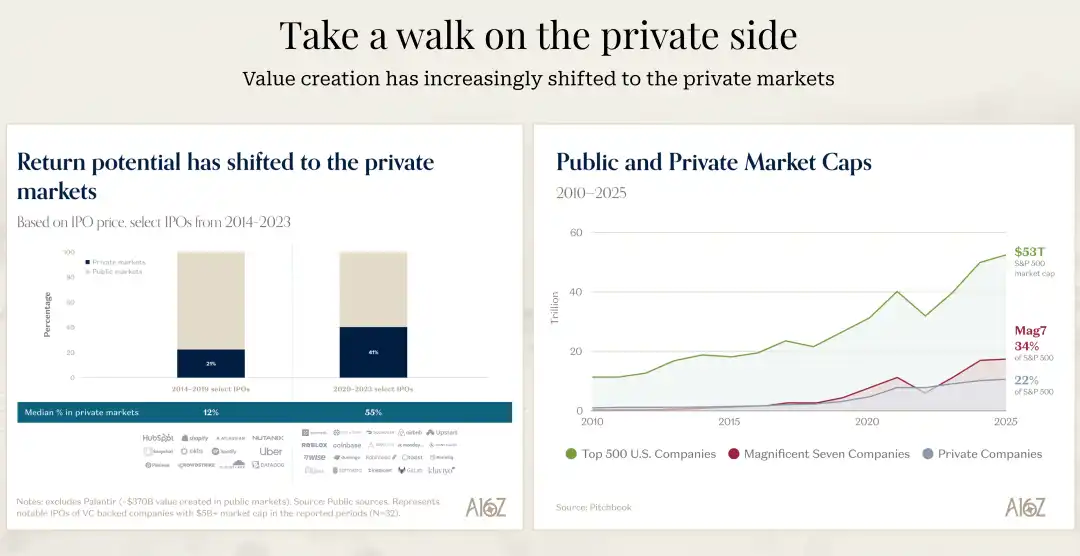
Goldman Sachs estimates that AI build-out will generate $9 trillion in revenue. Assuming a 20% profit margin and a 22x P/E ratio, this would translate into $35 trillion in new market capitalization. About $24 trillion has already been提前 priced in. While we can argue whether this is all due to AI or large tech performance, there is still a lot of market cap up for grabs, and significant upside potential if these assumptions are correct.
David also did some simple arithmetic. Based on current estimates, by 2030, the cumulative capex of hyperscale cloud providers will be just under $5 trillion. To achieve a 10% hurdle rate on this $4.8 trillion or nearly $5 trillion investment, AI annual revenue needs to reach about $1 trillion by 2030. To put that number in context, $1 trillion is roughly 1% of global GDP, just to generate a 10% return.
Is this achievable? It might also fall slightly short. But David thinks looking仅仅 at 2030 is limiting. The returns on these investments will likely materialize over a longer period, say between 2030 and 2040. And if we are at roughly $50 billion in AI revenue now (his rough estimate), and this has mainly been generated in the past year and a half or so, then the path from $50 billion to $1 trillion is not unimaginable.
My Thoughts on the Future
After listening to David's talk, my biggest feeling is: we are at the beginning of a historic inflection point, not the middle or the end. This is a product cycle that could last 10 to 15 years, and we are just getting started. This makes me both excited and anxious.
Excited because the opportunities brought by this transformation are enormous. For companies that can adapt quickly and fully embrace AI, they will not only gain competitive advantages but are more likely to become the companies that define the next era. We will see new unicorns born, new business models emerge, and completely different ways of organizing companies.
Anxious because the speed of this change may be much faster than most people expect. The data David mentioned is particularly telling: the average time a S&P 500 company stays in the index has decreased by 40% over the past 50 years. This means the speed at which companies are being disrupted is accelerating. In the AI era, this speed is likely to accelerate further.
I believe a clear divergence will emerge next. Some companies will truly understand the potential of AI and fundamentally rethink their products, processes, and organizational structures. These companies will gain order-of-magnitude efficiency improvements and competitive advantages. Other companies, even if they have the intention to change, will progress slowly due to the difficulties of change management, organizational inertia, and technical debt. This divergence will become increasingly apparent in the coming years.
For entrepreneurs, now might be the best of times. Market demand is extremely strong, technological capabilities are advancing rapidly, and capital markets are still willing to support truly promising companies. And compared to the previous generation of software companies, it's now possible to reach the same scale with fewer resources and faster speed. This lowers the barrier to entry but also increases the requirements for product quality and market fit.
For investors, the key is to identify the true Model Busters. The growth speed and duration of these companies will far exceed any predictions from traditional models. But this also requires investors to have sufficient vision and patience, willing to believe growth curves that seem unreasonable.
For practitioners, whether you are an engineer, product manager, designer, or any other role, you need to quickly learn and adapt to new tools and ways of working. The example David mentioned—two engineers using the latest programming tools being 10 to 20 times faster than before—is not an isolated case but a trend. Those who can master these new tools and methods will gain huge career advantages.
Finally, I want to say that this transformation is not just technical, but also a shift in mindset. From "how should we do it" to "what outcome do we want to achieve", from "adding more people" to "how to solve this problem with AI", from "following established processes" to "reimagining possibilities". That question of "electricity or blood", although it sounds extreme, captures the essence of this shift.
We are witnessing the software world being rewritten. This is not an incremental upgrade, but a complete重构. Those who can understand this, embrace this, will define the next era.
Criptos en tendencia












Preguntas relacionadas
QWhat is the key difference in growth and efficiency between the fastest-growing AI companies and traditional software companies according to the a16z analysis?
AThe fastest-growing AI companies are expanding at an annual growth rate of 693%, which is 2.5 times faster than non-AI companies. They achieve this with significantly lower sales and marketing expenditures. Additionally, their ARR per FTE (Annual Recurring Revenue per Full-Time Employee) is $500,000 to $1 million, compared to the previous standard of $400,000 for traditional software companies, indicating a more efficient and scalable business model driven by strong product-market fit rather than heavy sales investment.
QHow does the article explain the lower gross margins of AI companies compared to traditional software firms?
AThe article suggests that lower gross margins for AI companies can be a 'badge of honor' because they are often caused by high inference costs. This indicates two things: first, that customers are actually using the AI features extensively, and second, that these inference costs are expected to decrease over time. A very high gross margin might conversely raise suspicions that the AI functionality is not a core part of the product that customers value and use.
QWhat fundamental shift in business model evolution does the article predict is on the horizon due to AI?
AThe article predicts a shift towards an 'outcome-based' business model. This model moves beyond current consumption-based pricing (paying for usage) to charging customers based on the successful completion of a specific task or the achievement of a desired result. This is seen as a potentially massive disruption, as it aligns pricing directly with the value delivered, unlike traditional seat-based SaaS subscriptions or even usage-based cloud models.
QWhat major challenge do large Fortune 500 companies face in adopting AI, despite their CEOs' enthusiasm?
AThe primary challenge is the 'change management gap.' There is a significant disconnect between the CEOs' strategic desire to adopt AI and the practical difficulty of implementing it. Transforming business processes, retraining or restructuring teams, and integrating AI natively into complex existing systems is extremely difficult. This often leads to much slower actual implementation and business transformation than the initial ambitious statements from leadership would suggest.
QWhat is the concept of a 'Model Buster' as described in the article, and why is AI considered one?
AA 'Model Buster' is a company whose growth speed and duration far exceed any reasonable consensus prediction made by traditional financial or business models. The iPhone is given as a classic example. AI is considered the ultimate Model Buster of this era because the technology delivers not just incremental improvements but order-of-magnitude leaps in capability and efficiency. This fundamental shift makes historical data and conventional forecasting models largely ineffective for predicting the growth and impact of leading AI companies.
Lecturas Relacionadas





Trading
Artículos destacados
Qué es $S$
Entendiendo SPERO: Una Visión General Completa Introducción a SPERO A medida que el panorama de la innovación continúa evolucionando, la aparición de tecnologías web3 y proyectos de criptomonedas juega un papel fundamental en la configuración del futuro digital. Un proyecto que ha atraído la atención en este campo dinámico es SPERO, denotado como SPERO,$$s$. Este artículo tiene como objetivo reunir y presentar información detallada sobre SPERO, para ayudar a entusiastas e inversores a comprender sus fundamentos, objetivos e innovaciones dentro de los dominios web3 y cripto. ¿Qué es SPERO,$$s$? SPERO,$$s$ es un proyecto único dentro del espacio cripto que busca aprovechar los principios de descentralización y tecnología blockchain para crear un ecosistema que promueva la participación, la utilidad y la inclusión financiera. El proyecto está diseñado para facilitar interacciones de igual a igual de nuevas maneras, proporcionando a los usuarios soluciones y servicios financieros innovadores. En su esencia, SPERO,$$s$ tiene como objetivo empoderar a los individuos al proporcionar herramientas y plataformas que mejoren la experiencia del usuario en el espacio de las criptomonedas. Esto incluye habilitar métodos de transacción más flexibles, fomentar iniciativas impulsadas por la comunidad y crear caminos para oportunidades financieras a través de aplicaciones descentralizadas (dApps). La visión subyacente de SPERO,$$s$ gira en torno a la inclusividad, buscando cerrar brechas dentro de las finanzas tradicionales mientras aprovecha los beneficios de la tecnología blockchain. ¿Quién es el Creador de SPERO,$$s$? La identidad del creador de SPERO,$$s$ sigue siendo algo oscura, ya que hay recursos públicos limitados que proporcionan información de fondo detallada sobre su(s) fundador(es). Esta falta de transparencia puede derivarse del compromiso del proyecto con la descentralización, una ética que muchos proyectos web3 comparten, priorizando las contribuciones colectivas sobre el reconocimiento individual. Al centrar las discusiones en torno a la comunidad y sus objetivos colectivos, SPERO,$$s$ encarna la esencia del empoderamiento sin señalar a individuos específicos. Como tal, comprender la ética y la misión de SPERO sigue siendo más importante que identificar a un creador singular. ¿Quiénes son los Inversores de SPERO,$$s$? SPERO,$$s$ cuenta con el apoyo de una diversa gama de inversores que van desde capitalistas de riesgo hasta inversores ángeles dedicados a fomentar la innovación en el sector cripto. El enfoque de estos inversores generalmente se alinea con la misión de SPERO, priorizando proyectos que prometen avances tecnológicos sociales, inclusión financiera y gobernanza descentralizada. Estas fundaciones de inversores suelen estar interesadas en proyectos que no solo ofrecen productos innovadores, sino que también contribuyen positivamente a la comunidad blockchain y sus ecosistemas. El respaldo de estos inversores refuerza a SPERO,$$s$ como un contendiente notable en el dominio de proyectos cripto que evoluciona rápidamente. ¿Cómo Funciona SPERO,$$s$? SPERO,$$s$ emplea un marco multifacético que lo distingue de los proyectos de criptomonedas convencionales. Aquí hay algunas de las características clave que subrayan su singularidad e innovación: Gobernanza Descentralizada: SPERO,$$s$ integra modelos de gobernanza descentralizada, empoderando a los usuarios para participar activamente en los procesos de toma de decisiones sobre el futuro del proyecto. Este enfoque fomenta un sentido de propiedad y responsabilidad entre los miembros de la comunidad. Utilidad del Token: SPERO,$$s$ utiliza su propio token de criptomoneda, diseñado para servir diversas funciones dentro del ecosistema. Estos tokens permiten transacciones, recompensas y la facilitación de servicios ofrecidos en la plataforma, mejorando la participación y la utilidad general. Arquitectura en Capas: La arquitectura técnica de SPERO,$$s$ apoya la modularidad y escalabilidad, permitiendo la integración fluida de características y aplicaciones adicionales a medida que el proyecto evoluciona. Esta adaptabilidad es fundamental para mantener la relevancia en el cambiante paisaje cripto. Participación de la Comunidad: El proyecto enfatiza iniciativas impulsadas por la comunidad, empleando mecanismos que incentivan la colaboración y la retroalimentación. Al nutrir una comunidad sólida, SPERO,$$s$ puede abordar mejor las necesidades de los usuarios y adaptarse a las tendencias del mercado. Enfoque en la Inclusión: Al ofrecer tarifas de transacción bajas e interfaces amigables para el usuario, SPERO,$$s$ busca atraer a una base de usuarios diversa, incluyendo a individuos que anteriormente pueden no haber participado en el espacio cripto. Este compromiso con la inclusión se alinea con su misión general de empoderamiento a través de la accesibilidad. Cronología de SPERO,$$s$ Entender la historia de un proyecto proporciona información crucial sobre su trayectoria de desarrollo y hitos. A continuación se presenta una cronología sugerida que mapea eventos significativos en la evolución de SPERO,$$s$: Fase de Conceptualización e Ideación: Las ideas iniciales que forman la base de SPERO,$$s$ fueron concebidas, alineándose estrechamente con los principios de descentralización y enfoque comunitario dentro de la industria blockchain. Lanzamiento del Whitepaper del Proyecto: Tras la fase conceptual, se lanzó un whitepaper completo que detalla la visión, los objetivos y la infraestructura tecnológica de SPERO,$$s$ para generar interés y retroalimentación de la comunidad. Construcción de Comunidad y Primeras Interacciones: Se realizaron esfuerzos de divulgación activa para construir una comunidad de primeros adoptantes y posibles inversores, facilitando discusiones en torno a los objetivos del proyecto y obteniendo apoyo. Evento de Generación de Tokens: SPERO,$$s$ llevó a cabo un evento de generación de tokens (TGE) para distribuir sus tokens nativos a los primeros seguidores y establecer liquidez inicial dentro del ecosistema. Lanzamiento de la dApp Inicial: La primera aplicación descentralizada (dApp) asociada con SPERO,$$s$ se puso en marcha, permitiendo a los usuarios interactuar con las funcionalidades centrales de la plataforma. Desarrollo Continuo y Alianzas: Actualizaciones y mejoras continuas a las ofertas del proyecto, incluyendo alianzas estratégicas con otros actores en el espacio blockchain, han moldeado a SPERO,$$s$ en un jugador competitivo y en evolución en el mercado cripto. Conclusión SPERO,$$s$ se erige como un testimonio del potencial de web3 y las criptomonedas para revolucionar los sistemas financieros y empoderar a los individuos. Con un compromiso con la gobernanza descentralizada, la participación comunitaria y funcionalidades diseñadas de manera innovadora, allana el camino hacia un paisaje financiero más inclusivo. Como con cualquier inversión en el espacio cripto que evoluciona rápidamente, se anima a los posibles inversores y usuarios a investigar a fondo y participar de manera reflexiva con los desarrollos en curso dentro de SPERO,$$s$. El proyecto muestra el espíritu innovador de la industria cripto, invitando a una mayor exploración de sus innumerables posibilidades. Mientras el viaje de SPERO,$$s$ aún se desarrolla, sus principios fundamentales pueden, de hecho, influir en el futuro de cómo interactuamos con la tecnología, las finanzas y entre nosotros en ecosistemas digitales interconectados.
229 Vistas totalesPublicado en 2024.12.17Actualizado en 2024.12.17

Qué es AGENT S
Agent S: El Futuro de la Interacción Autónoma en Web3 Introducción En el paisaje en constante evolución de Web3 y las criptomonedas, las innovaciones están redefiniendo constantemente cómo los individuos interactúan con las plataformas digitales. Uno de estos proyectos pioneros, Agent S, promete revolucionar la interacción humano-computadora a través de su marco agente abierto. Al allanar el camino para interacciones autónomas, Agent S busca simplificar tareas complejas, ofreciendo aplicaciones transformadoras en inteligencia artificial (IA). Esta exploración detallada profundizará en las complejidades del proyecto, sus características únicas y las implicaciones para el dominio de las criptomonedas. ¿Qué es Agent S? Agent S se presenta como un marco agente abierto innovador, diseñado específicamente para abordar tres desafíos fundamentales en la automatización de tareas informáticas: Adquisición de Conocimiento Específico del Dominio: El marco aprende inteligentemente de diversas fuentes de conocimiento externas y experiencias internas. Este enfoque dual le permite construir un rico repositorio de conocimiento específico del dominio, mejorando su rendimiento en la ejecución de tareas. Planificación a Largo Plazo de Tareas: Agent S emplea planificación jerárquica aumentada por la experiencia, un enfoque estratégico que facilita la descomposición y ejecución eficiente de tareas complejas. Esta característica mejora significativamente su capacidad para gestionar múltiples subtareas de manera eficiente y efectiva. Manejo de Interfaces Dinámicas y No Uniformes: El proyecto introduce la Interfaz Agente-Computadora (ACI), una solución innovadora que mejora la interacción entre agentes y usuarios. Utilizando Modelos de Lenguaje Multimodal de Gran Escala (MLLMs), Agent S puede navegar y manipular diversas interfaces gráficas de usuario sin problemas. A través de estas características pioneras, Agent S proporciona un marco robusto que aborda las complejidades involucradas en la automatización de la interacción humana con las máquinas, preparando el terreno para una multitud de aplicaciones en IA y más allá. ¿Quién es el Creador de Agent S? Si bien el concepto de Agent S es fundamentalmente innovador, la información específica sobre su creador sigue siendo elusiva. El creador es actualmente desconocido, lo que resalta ya sea la etapa incipiente del proyecto o la elección estratégica de mantener a los miembros fundadores en el anonimato. Independientemente de la anonimidad, el enfoque sigue siendo en las capacidades y el potencial del marco. ¿Quiénes son los Inversores de Agent S? Dado que Agent S es relativamente nuevo en el ecosistema criptográfico, la información detallada sobre sus inversores y patrocinadores financieros no está documentada explícitamente. La falta de información disponible públicamente sobre las bases de inversión u organizaciones que apoyan el proyecto plantea preguntas sobre su estructura de financiamiento y hoja de ruta de desarrollo. Comprender el respaldo es crucial para evaluar la sostenibilidad del proyecto y su posible impacto en el mercado. ¿Cómo Funciona Agent S? En el núcleo de Agent S se encuentra una tecnología de vanguardia que le permite funcionar de manera efectiva en diversos entornos. Su modelo operativo se basa en varias características clave: Interacción Humano-Computadora Similar a la Humana: El marco ofrece planificación avanzada de IA, esforzándose por hacer que las interacciones con las computadoras sean más intuitivas. Al imitar el comportamiento humano en la ejecución de tareas, promete elevar las experiencias de los usuarios. Memoria Narrativa: Empleada para aprovechar experiencias de alto nivel, Agent S utiliza memoria narrativa para hacer un seguimiento de las historias de tareas, mejorando así sus procesos de toma de decisiones. Memoria Episódica: Esta característica proporciona a los usuarios una guía paso a paso, permitiendo que el marco ofrezca apoyo contextual a medida que se desarrollan las tareas. Soporte para OpenACI: Con la capacidad de ejecutarse localmente, Agent S permite a los usuarios mantener el control sobre sus interacciones y flujos de trabajo, alineándose con la ética descentralizada de Web3. Fácil Integración con APIs Externas: Su versatilidad y compatibilidad con varias plataformas de IA aseguran que Agent S pueda encajar sin problemas en ecosistemas tecnológicos existentes, convirtiéndolo en una opción atractiva para desarrolladores y organizaciones. Estas funcionalidades contribuyen colectivamente a la posición única de Agent S dentro del espacio cripto, ya que automatiza tareas complejas y de múltiples pasos con una intervención humana mínima. A medida que el proyecto evoluciona, sus posibles aplicaciones en Web3 podrían redefinir cómo se desarrollan las interacciones digitales. Cronología de Agent S El desarrollo y los hitos de Agent S pueden encapsularse en una cronología que resalta sus eventos significativos: 27 de septiembre de 2024: El concepto de Agent S fue lanzado en un documento de investigación integral titulado “Un Marco Agente Abierto que Usa Computadoras Como un Humano”, mostrando las bases del proyecto. 10 de octubre de 2024: El documento de investigación fue puesto a disposición del público en arXiv, ofreciendo una exploración profunda del marco y su evaluación de rendimiento basada en el benchmark OSWorld. 12 de octubre de 2024: Se lanzó una presentación en video, proporcionando una visión visual de las capacidades y características de Agent S, involucrando aún más a posibles usuarios e inversores. Estos marcadores en la cronología no solo ilustran el progreso de Agent S, sino que también indican su compromiso con la transparencia y la participación comunitaria. Puntos Clave Sobre Agent S A medida que el marco Agent S continúa evolucionando, varios atributos clave destacan, subrayando su naturaleza innovadora y potencial: Marco Innovador: Diseñado para proporcionar un uso intuitivo de las computadoras similar a la interacción humana, Agent S aporta un enfoque novedoso a la automatización de tareas. Interacción Autónoma: La capacidad de interactuar de manera autónoma con las computadoras a través de GUI significa un salto hacia soluciones informáticas más inteligentes y eficientes. Automatización de Tareas Complejas: Con su metodología robusta, puede automatizar tareas complejas y de múltiples pasos, haciendo que los procesos sean más rápidos y menos propensos a errores. Mejora Continua: Los mecanismos de aprendizaje permiten a Agent S mejorar a partir de experiencias pasadas, mejorando continuamente su rendimiento y eficacia. Versatilidad: Su adaptabilidad en diferentes entornos operativos como OSWorld y WindowsAgentArena asegura que pueda servir a una amplia gama de aplicaciones. A medida que Agent S se posiciona en el paisaje de Web3 y criptomonedas, su potencial para mejorar las capacidades de interacción y automatizar procesos significa un avance significativo en las tecnologías de IA. A través de su marco innovador, Agent S ejemplifica el futuro de las interacciones digitales, prometiendo una experiencia más fluida y eficiente para los usuarios en diversas industrias. Conclusión Agent S representa un audaz avance en la unión de la IA y Web3, con la capacidad de redefinir cómo interactuamos con la tecnología. Aunque aún se encuentra en sus primeras etapas, las posibilidades para su aplicación son vastas y atractivas. A través de su marco integral que aborda desafíos críticos, Agent S busca llevar las interacciones autónomas al primer plano de la experiencia digital. A medida que nos adentramos más en los reinos de las criptomonedas y la descentralización, proyectos como Agent S sin duda desempeñarán un papel crucial en la configuración del futuro de la tecnología y la colaboración humano-computadora.
636 Vistas totalesPublicado en 2025.01.14Actualizado en 2025.01.14
Cómo comprar S
¡Bienvenido a HTX.com! Hemos hecho que comprar Sonic (S) sea simple y conveniente. Sigue nuestra guía paso a paso para iniciar tu viaje de criptos.Paso 1: crea tu cuenta HTXUtiliza tu correo electrónico o número de teléfono para registrarte y obtener una cuenta gratuita en HTX. Experimenta un proceso de registro sin complicaciones y desbloquea todas las funciones.Obtener mi cuentaPaso 2: ve a Comprar cripto y elige tu método de pagoTarjeta de crédito/débito: usa tu Visa o Mastercard para comprar Sonic (S) al instante.Saldo: utiliza fondos del saldo de tu cuenta HTX para tradear sin problemas.Terceros: hemos agregado métodos de pago populares como Google Pay y Apple Pay para mejorar la comodidad.P2P: tradear directamente con otros usuarios en HTX.Over-the-Counter (OTC): ofrecemos servicios personalizados y tipos de cambio competitivos para los traders.Paso 3: guarda tu Sonic (S)Después de comprar tu Sonic (S), guárdalo en tu cuenta HTX. Alternativamente, puedes enviarlo a otro lugar mediante transferencia blockchain o utilizarlo para tradear otras criptomonedas.Paso 4: tradear Sonic (S)Tradear fácilmente con Sonic (S) en HTX's mercado spot. Simplemente accede a tu cuenta, selecciona tu par de trading, ejecuta tus trades y monitorea en tiempo real. Ofrecemos una experiencia fácil de usar tanto para principiantes como para traders experimentados.
1.2k Vistas totalesPublicado en 2025.01.15Actualizado en 2026.06.02

