A Transformative Era for DeFi Collateral: Exploring RWA as the New Composable Infrastructure for DeFi

marsbitPublicado a 2026-04-20Actualizado a 2026-04-20

Resumen

DeFi Collateral Transformation: RWA Emerges as Composable Infrastructure The tokenized Real-World Asset (RWA) market has reached $27 billion, yet only about $2.7 billion is actively used as collateral in DeFi lending markets. This growth was accelerated by key 2025-2026 regulatory milestones in the U.S., including the GENIUS Act for stablecoins and the classification of major blockchain tokens as digital commodities. The composition of tokenized assets differs significantly from those actively used in DeFi. U.S. Treasuries dominate tokenized AUM (48.5%) but represent only 2% of DeFi deposits. Conversely, credit assets (17% of AUM) constitute 80% of deposits, driven by yield differentials that enable profitable leverage strategies. Reinsurance is emerging as a new composable asset class, with over 80% of its tokenized supply active in DeFi. The market is evolving in real-time. As yield spreads compress, collateral diversification is increasing, evidenced by Aave Horizon's shifting composition. Permissionless access is a critical driver for distribution, as demonstrated by Maple Finance's 'syrup' tokens, which have been composably deployed across multiple chains and protocols without requiring permissions. In conclusion, while the absolute value of RWA in DeFi is still small, its rapid growth rate, the divergence between tokenized and utilized assets, and the power of permissionless composability are the key trends shaping this new infrastructure layer.

Author: Dune

Compiled by: Felix, PANews

This article is an expanded analysis based on the speech by Fredrik Haga, co-founder and CEO of Dune, at EthCC 2026. Details below.

The scale of tokenized RWAs has reached $27 billion. However, only about $2.7 billion is actively deposited in decentralized lending markets: as collateral, in vaults, or for yield strategies. This article explores the distribution of these funds, the driving forces behind them, and what this portends for the future.

From Regulatory Clarity to Composable Capital

Three regulatory milestones in late 2025 and early 2026 accelerated the tokenization process. In July 2025, the GENIUS Act established the first comprehensive framework for payment stablecoins in the United States, requiring 1:1 asset backing and clear regulation. In March 2026, the U.S. SEC and CFTC jointly classified major blockchain tokens as digital commodities rather than securities. Days later, the SEC approved Nasdaq to trade and settle tokenized stocks and ETFs on its main market.

These milestones further propelled the tokenization process. The total supply of stablecoins, serving as the settlement layer for tokenized assets, surpassed $330 billion, growing 12-fold since 2020. During the same period, the number of active stablecoins increased from 31 to 215. Tokenized RWAs showed a similar trajectory, with their Assets Under Management (AUM) growing 27-fold in two years to approximately $27 billion, expanding from a few initial categories to the seven categories tracked in the dashboard (including reinsurance and stocks).

Beyond the impressive AUM figures, a more meaningful question is: how much of this capital is actually being used in the DeFi space. Currently, about $2.7 billion worth of RWA tokens are actively deposited in DeFi lending markets, accounting for roughly 10% of the $27 billion tokenized AUM. A year ago, this 10% share was almost non-existent. Composability is arguably the most promising advantage of tokenization. That is, the ability for tokenized assets to serve as collateral, be used for lending, and be utilized in various yield strategies across different protocols and chains.
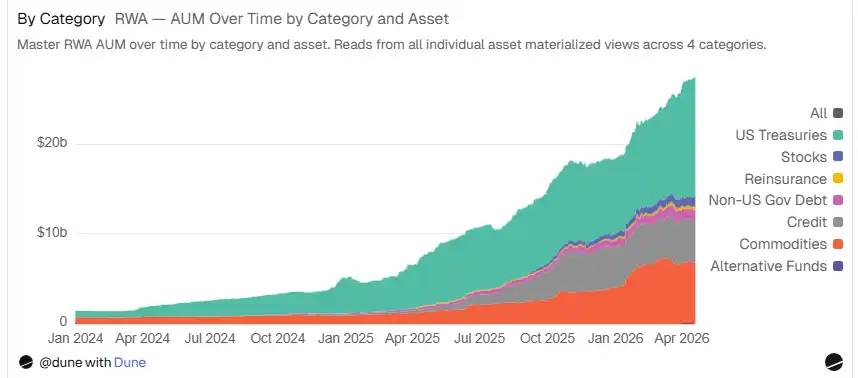
Note: The RWA tokens counted are limited to collateral and vault supplies. Data as of April 16, 2026.

Where is the ~$2.7 Billion Deposited?

The funds are distributed across four main platforms on Ethereum, Solana, and multiple L2s:
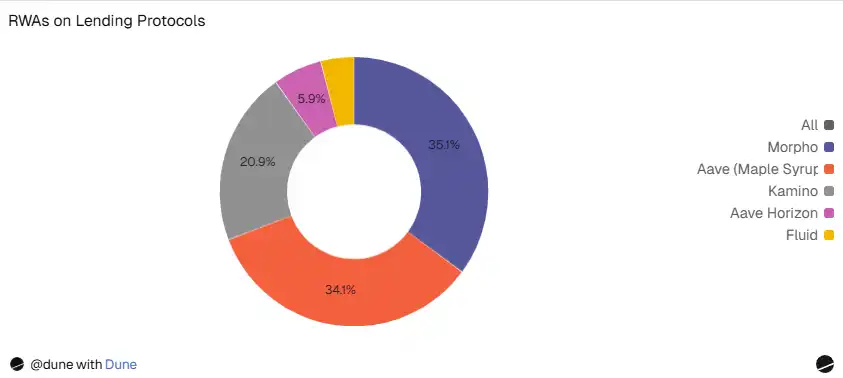
  • Morpho ($957 million): Permissionless, listing 41 RWA assets across 10 chains. Professional curators like Gauntlet and Steakhouse manage vaults, allocating funds to these markets and building structured leverage strategies on top of tokenized RWAs.
  • Aave ($929 million): Maple's syrup tokens are deposited on Plasma, Base, and Ethereum. Institutional credit flows permissionlessly to where the economics of borrowing are best.
  • Kamino ($587 million): The largest lending protocol and RWA platform on Solana. This includes $315 million for PRIME (HELOC lending yield), $161 million for syrupUSDC, $71 million for ONyc (reinsurance), $18 million for USCC, plus xStocks markets (covering seven tokenized stocks totaling $21 million).
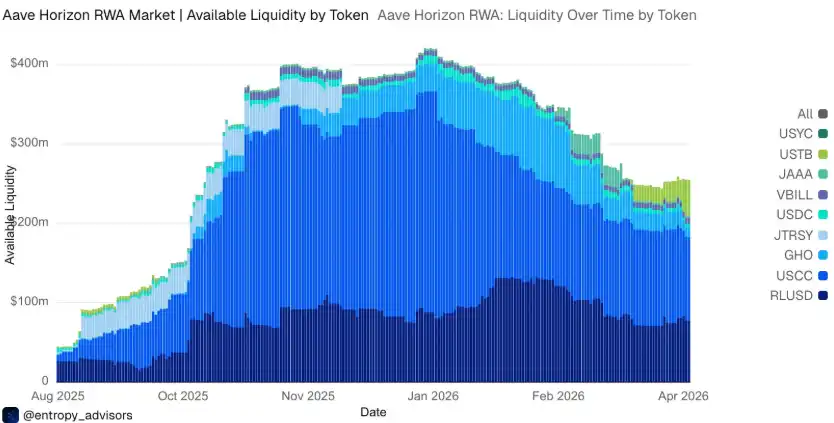
  • Aave Horizon ($161 million): Aave's permissioned, institutionally-oriented RWA market. There are 256 addresses with an average holding of $1.5 million. This includes $105 million in USCC, $46 million in USTB, $7 million in VBILL, and $3 million in JAAA. The total active borrowing in stablecoins is $124 million, with a utilization rate of 77%.
  • Fluid ($109 million): $94 million in reUSD (reinsurance), $12 million in gold, $2 million in syrup. Notably, it supports using Re Protocol's reUSD as collateral, which is not offered by other platforms.

Tokenized Assets vs. Actively Used Assets Are Not Aligned

There is a significant discrepancy between the assets dominating tokenized AUM and those actually deposited as collateral in lending protocols. These two leaderboards are almost completely inverted.
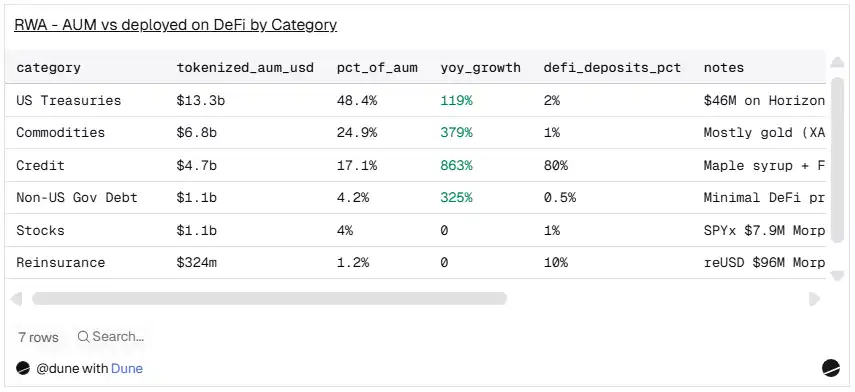
Source: Dune

U.S. Treasuries account for 48.5% of tokenized AUM ($13.2 billion) but only 2% of DeFi deposits. Credit assets account for 17% of AUM but dominate deposits at around 80%. Commodities account for 25.2% of AUM but constitute almost less than 1% of DeFi deposits.

Credit assets dominate due to their profit model. Maple's syrupUSDC yields about 6%, while Treasury Bills (T-Bills) yield about 3.5%. When your collateral earns 6% and you can borrow stablecoins at 3%, you achieve positive carry. Curators like Gauntlet build explicit looping strategies on top of this: deposit RWA as collateral, borrow against it, and buy more. This is designed and risk-controlled leverage. This also explains why credit assets appear on every major lending platform: $957 million on Morpho, $929 million on Aave, $476 million on Kamino.
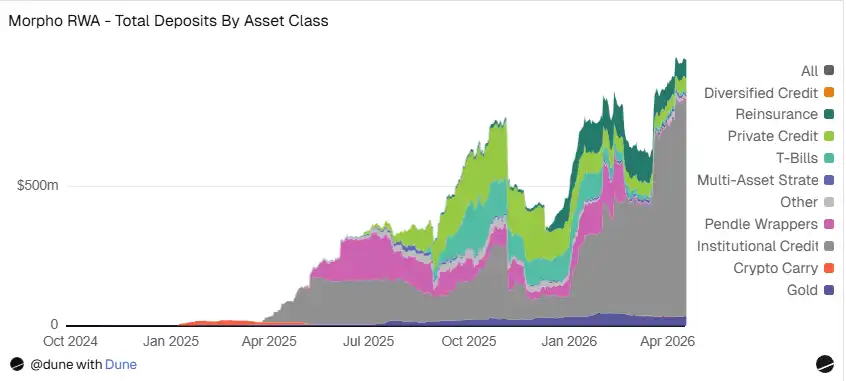
Source: Dune

Reinsurance is emerging as a genuinely new, composable asset class. Re Protocol's reUSD appears on multiple platforms: $96 million on Morpho (including $50 million in Pendle PT-reUSD), $94 million on Fluid, while OnRe's ONyc occupies $71 million on Kamino. Overall, tokenized reinsurance AUM is $324 million (1.2% of total), with DeFi deposits around $261 million (10% of total), meaning about 80% of tokenized reinsurance capital is active in lending protocols, a much higher deposit ratio than any other asset class.
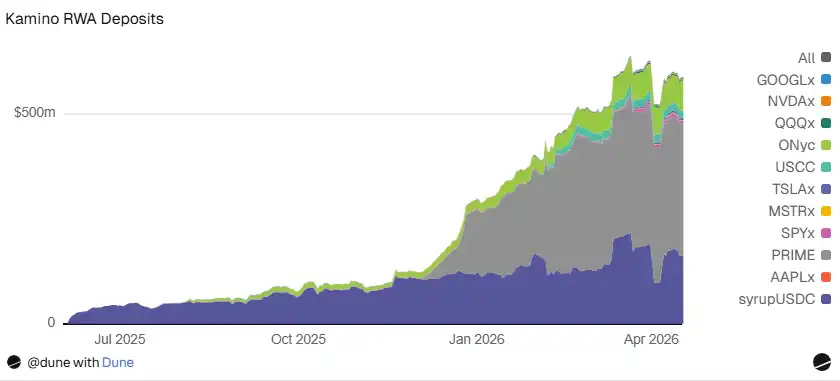
Tokenized stocks are also appearing in DeFi: SPYx ($7.9 million on Morpho), xStocks on Kamino (covering SPYx, TSLAx, QQQx, NVDAx, GOOGLx, MSTRx, AAPLx totaling $21 million), and deSPXA ($3.6 million). While the amounts are smaller, the infrastructure is live, and borrowing activity against stock collateral is happening.

This discrepancy is instructive. Tokenization prioritizes safety and familiarity. U.S. Treasuries are easy to understand, regulate, offer transparency (frequent NAV updates and easy oracle pricing), and are highly attractive to institutional balance sheets. Composability, however, values different things: yield differentials and leverage economics.

Collateral Composition is Evolving in Real-Time

The dominance of high-yield credit might be partly a function of timing. Aave Horizon provides the clearest evidence.

When Horizon launched in August 2025, Superstate's USCC, a crypto arbitrage fund, offered ~15% APY through basis trading on crypto futures. This yield led it to constitute 93% of all RWA collateral. Treasury products were also listed but saw no uptake.

Since then, as the basis narrowed, USCC's yield compressed to ~4%, converging with the 3-4% yield of Treasuries. The result: USCC's collateral share dropped from 93% to about 67%, while USTB surged 570% in 30 days from under $1 million to $45.6 million. As yield differentials narrow, the market is diversifying.
Source: Dune

This is significant not just for Horizon. If credit yields compress across the market (as often happens in mature markets), the collateral composition across all platforms could become more diverse. The assets that dominated the first wave (high-yield credit) might not dominate the next. Risk appetite, regulatory environment, and settlement mechanics will start to matter more.

Pendle adds another dimension to this evolution. Its Principal Tokens (PTs) account for $58 million in deposits on Morpho (allowing users to lock in fixed yields from RWA products). Pendle also directly offers RWA markets for thBILL and mTBILL, bringing yield curve trading into the composability stack. As more RWA products list on Pendle, fixed-rate strategies will become another channel for RWA distribution.

Permissionless Access Drives Distribution

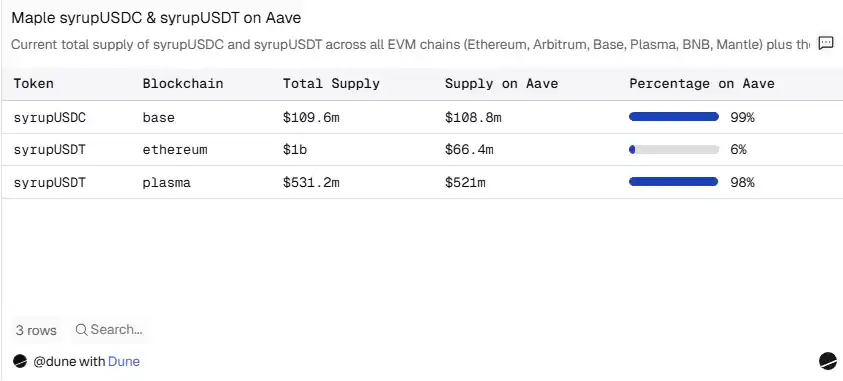
Maple Syrup is the clearest case. syrupUSDC and syrupUSDT are permissionless ERC-20 tokens. Technically, they are hybrids between stablecoins and RWAs, as they are pegged 1:1 to USDC/USDT but earn yield from institutional credit. They are classified as RWAs because the underlying exposure is real-world lending. Anyone can mint, trade, or deposit them into any lending protocol. No KYC, no whitelists, no partnership required.

The result: 98% of syrupUSDT on Plasma and 99% of syrupUSDC on Base are actively deployed on Aave. Curators like Gauntlet on Morpho independently built leveraged vaults around Syrup without coordinating with Maple. syrupUSDC also reached $161 million on Kamino (Solana).
Source: Dune

Each integration adds utility, utility attracts capital, and capital drives more integrations. It is this flywheel effect that has led to $929 million being organically distributed across three chains.

This is crucial because distribution is recognized as the industry's biggest challenge. Centrifuge's "Tokenization Outlook 2026" report noted that 86% of operators said scaling distribution for existing products is more important than launching new ones. The Maple case on Aave shows that permissionless composability is itself a distribution channel.

$1.85 Billion Tokenized, Only $13 Million Composable

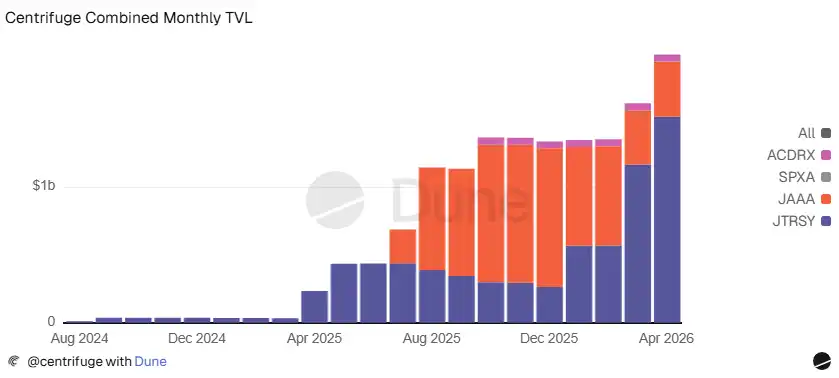
Centrifuge's report highlights both the opportunity and the gap for RWAs. It is one of the largest tokenization platforms, with institutional product AUM exceeding $1.85 billion: JTRSY (US Treasury tokenized fund) at $1.52 billion, JAAA (AAA-rated CLO tokenized fund) at $403 million, ACRDX (Apollo Diversified Credit Fund) at $52 million, and the recently launched SPXA (first S&P 500 index tokenized fund) at $3.7 million. However, only about $13 million of this is composable in DeFi: primarily through deRWA wrapper tokens and JAAA on Horizon.
Source: Dune

This gap ultimately comes down to timing and design. The deRWA wrappers only launched in September 2025. The permissioned design slowed integration, and liquidity was thin.

But integration is accelerating. Resolv committed $100 million to JAAA on Horizon. Falcon Finance added JAAA and JTRSY as collateral for USDf. Grove is deploying $250 million on Avalanche. LayerZero enables distribution across 165+ networks. And deSPXA (the DeFi wrapper version of Centrifuge's S&P 500 fund) has reached a total TVL of $3.6 million and DEX trading volume of $7.9 million, showing early organic activity and the potential of the deRWA model: permissionless wrapper tokens operating in parallel with permissioned institutional products.

Three Key Takeaways

Growth rate is more important than current size. There is $2.7 billion in RWA deposits across major DeFi lending markets, about 10% of the $27 billion tokenized AUM. But this $2.7 billion barely existed a year ago. The absolute numbers are still small, but the growth rate is what truly matters.

Tokenized assets are not the same as actively used assets. Treasuries account for 48.5% of tokenized AUM but only 2% of DeFi deposits. Credit accounts for 17% of AUM but 80% of deposits. Higher yields enable positive carry, which supports leverage loops. Credit yields above 6% work; Treasury yields at 3.5% do not. But as the macro environment changes and yield differentials shift across asset classes, collateral composition will adjust, accommodating different assets and emerging categories like reinsurance.

Permissionless access drives distribution. Maple's syrup tokens (hybrids between RWAs and stablecoins) reached over $1 billion across Aave and Kamino on four chains. The token was designed to be composable, so the market composited it. Assets that are easy to onboard get adopted more easily. Assets requiring whitelists are catching up but are moving much slower.

Related reading: On-chain is not liquidity: RWA still needs the final leap

Preguntas relacionadas

QWhat is the total value of tokenized RWA currently being actively used as collateral in DeFi lending markets, and what percentage of the total tokenized RWA AUM does this represent?

AApproximately $2.7 billion of tokenized RWA is actively used as collateral in DeFi lending markets, which represents about 10% of the total $27 billion tokenized RWA AUM.

QWhich three regulatory milestones in late 2025 and early 2026 are credited with accelerating the tokenization process?

AThe three regulatory milestones are: 1) The GENIUS Act in July 2025, which established a comprehensive U.S. framework for payment stablecoins. 2) The joint classification of major blockchain tokens as digital commodities, not securities, by the U.S. SEC and CFTC in March 2026. 3) The SEC's approval for Nasdaq to trade and settle tokenized stocks and ETFs on its main market, also in March 2026.

QWhy do credit assets dominate the DeFi collateral deposits despite U.S. Treasuries making up a larger portion of the total tokenized AUM?

ACredit assets dominate DeFi deposits because of their profit-generating model. They offer higher yields (e.g., ~6% from Maple's syrupUSDC) compared to U.S. Treasuries (~3.5%). This yield spread allows for positive carry trades, where users can borrow stablecoins at a lower rate than the yield their collateral generates, enabling leveraged strategies that are not feasible with lower-yielding assets like Treasuries.

QHow does permissionless access, as exemplified by Maple's syrup tokens, facilitate the use of RWA in DeFi?

APermissionless access facilitates RWA use in DeFi by allowing assets to be easily minted, traded, and deposited into any lending protocol without requiring KYC, whitelisting, or formal partnerships. This design enables organic distribution and integration across multiple platforms and chains, creating a flywheel effect where utility attracts capital, which in turn drives further integration. For example, Maple's syrup tokens reached over $1 billion across Aave and Kamino on four different chains.

QWhat significant discrepancy does the case of Centrifuge highlight regarding tokenized AUM and its composability in DeFi?

AThe case of Centrifuge highlights a significant gap between the total tokenized AUM and its active use in DeFi. While Centrifuge has over $1.85 billion in institutional product AUM, only about $13 million of it is composable in DeFi. This discrepancy is attributed to factors like the recent launch of its deRWA wrapper tokens and a permissioned design that initially slowed down integration and limited its composability compared to permissionless models.

Lecturas Relacionadas

It Took Me a Year to See the Hard Truth About Agent Payments

**Title: It Took Me a Year to See the Hard Truth About Agent Payments** Over the past year, I've worked on infrastructure for the Agent economy, engaging with major players like Stripe, Visa, Coinbase, and numerous startups. The findings reveal a stark reality: genuine, widespread demand for Agent-based payments does not yet exist. **Key Observations:** * **Agent-to-Merchant (Shopping):** The user experience for AI shopping often falls short, especially for visual product discovery. While AI excels at understanding needs, conversational interfaces can't yet replace browsing and comparing multiple products visually. Current merchant interest is largely defensive ("Agent Engine Optimization") for a future that hasn't arrived. High-frequency, low-friction purchases (like food delivery) are potential fits, but lack open APIs and face high AI inference costs. Simpler, more affordable, or cross-language interactions for complex UIs are a niche opportunity but require massive consumer distribution to scale. * **Agent-to-API (Developer Tools):** Developer payment needs for APIs (computing, data, models) are already met through subscriptions and prepaid credits. The core challenge is not payment friction but supplier economics: most large SaaS providers prefer enterprise contracts over micropayments for API calls. Protocols like MPP and x402 suit the long-tail of smaller services but cater to a developer market historically reluctant to pay for these tools. Major infrastructure needs at the top of the stack are already being addressed. * **Agent-to-Agent (Machine Commerce):** This is a long-term vision with almost no current transaction volume. While a future with high-speed, high-frequency, multi-party machine-to-machine transactions would require novel infrastructure, it remains theoretical. The market is not here yet. * **Agent-to-Finance:** This is the only category with clear, present demand. Financial professionals and DeFi users already pay for tools, and AI augmentation is a natural evolution. Autonomous AI agents can enable entirely new financial strategies. However, competition is fierce from established, regulated incumbents who can more easily layer AI onto their existing products. **The Core Insight:** Companies, especially giants with long time horizons, are building defensively for a potential future of mass machine commerce. For them, early investment is a low-cost hedge. For startups, the current market reality is different. The primary challenge isn't just moving money between agents (payments). The larger, unsolved problem is **orchestration** – coordinating work between agents and humans, verifying outcomes, and then settling. Payment is just a part of settlement, which is just a part of orchestration. Companies that solve the orchestration problem will subsume payments, not the other way around. After a year of building, we see the real, growing, and underserved market opportunity lies in this broader domain of orchestration.

链捕手Hace 13 min(s)

It Took Me a Year to See the Hard Truth About Agent Payments

链捕手Hace 13 min(s)

Claude Opus 4.8 Finds a $4.5 Billion Bug: The AI Era is Mass-Producing Hackers

A researcher discovered a critical "infinite mint" vulnerability in the Zcash cryptocurrency's Orchard protocol using Claude Opus 4.8, leading to a swift fix but also a 50% market drop, erasing billions in value. This incident highlights a new era where powerful, accessible AI models are dramatically lowering the barrier to finding software vulnerabilities. Previously, the security community feared specialized models like Claude Mythos Preview, capable of finding decades-old zero-day exploits. The Zcash case, however, involved a publicly available, general-purpose model. This shift makes advanced security auditing—and attack capabilities—accessible to far more people, not just experts. The mass democratization of vulnerability discovery brings a dual challenge: a flood of low-quality, AI-generated false reports that overwhelm maintainers, and the real, rapid uncovering of deep, dangerous bugs. Open-source projects, often understaffed and unfunded, are particularly vulnerable to this "attention DDoS." The article cites examples like curl shutting down its bug bounty program due to the unsustainable workload. Our perceived digital safety has often been luck, relying on the high cost and effort required to find deeply hidden flaws in complex systems, as seen with historical vulnerabilities like Heartbleed or Baron Samedit. AI changes this cost structure, effectively "mass-producing flashlights" to illuminate every corner of our codebase. While large companies operate extensive security chains involving external white-hat hackers and massive defensive operations, the global cybersecurity workforce faces a severe shortage, especially of experienced personnel capable of analyzing complex threats and coordinating fixes. The core dilemma emerges: AI makes *finding* bugs cheap and scalable, but *fixing* them remains a slow, expensive, and human-intensive process. The article concludes that AI won't destroy the internet but acts as a bright light, revealing that our digital existence is not inherently secure but is precariously maintained by ongoing human effort. The true cost in the AI era may not be discovery, but whether there will be enough people left willing and able to do the hard work of repair.

marsbitHace 46 min(s)

Claude Opus 4.8 Finds a $4.5 Billion Bug: The AI Era is Mass-Producing Hackers

marsbitHace 46 min(s)

Codex Goal Mode Usage Guide: How to Make AI Continuously Pursue a Specific Objective

"Codex Goal Mode: How to Make AI Work Continuously Toward a Specific Goal" OpenAI's Codex "goal mode" (/goal) transforms the AI from a reactive code assistant into a proactive execution agent capable of working autonomously for hours or even days to achieve a defined objective. To maximize its effectiveness, follow these key principles: 1. **Define Clear, Verifiable Exit Criteria:** The goal prompt should be a concise, measurable success condition, not a lengthy specification. Use quantifiable metrics like "reduce build time by 30%" or "achieve 100% test parity." 2. **Provide Initial Guidance and Tools:** Direct Codex toward likely problem areas and specify available tools (e.g., browsers, testing environments) to prevent it from exploring unproductive paths. 3. **Enable Progress Measurement:** Equip Codex with ways to track advancement, such as creating comparison tools for visual tasks or evaluation sets, ensuring it can gauge its own progress. 4. **Use a Realistic Execution Environment:** For tasks like performance optimization, provide access to environments that closely mimic production (e.g., similar configs, databases) to yield valid results. 5. **Be Cautious with Visual Goals:** Avoid vague "pixel-perfect" instructions. Instead, supplement visual references with functional checklists or design system specifications to prevent Codex from obsessing over minor details. 6. **Implement Progress Tracking:** For long-running tasks, have Codex commit code to draft PRs, update progress documents, or send Slack updates to maintain visibility into its work. 7. **Review and Consolidate Results:** Once the goal is met, instruct Codex to review its work, clean up ineffective experimental code, and reflect on what strategies succeeded or failed. Ultimately, using goal mode shifts the developer's role from writing prompts to managing a persistent engineering agent—defining objectives, establishing metrics, configuring environments, and conducting final reviews.

marsbitHace 1 hora(s)

Codex Goal Mode Usage Guide: How to Make AI Continuously Pursue a Specific Objective

marsbitHace 1 hora(s)

From Ethereum to AI's 'CROPS': What Exactly Is This 'Slow Variable' That Vitalik Has Repeatedly Emphasized?

Recently, Vitalik Buterin has frequently emphasized the concept of "CROPS," first outlined in the Ethereum Foundation's March mandate as core principles guiding its focus: Censorship Resistance, Capture Resistance, Open Source, Privacy, and Security. CROPS represents Ethereum's commitment to providing foundational capabilities for user sovereignty—enabling asset ownership, identity expression, and coordination without reliance on centralized platforms or surrendering ultimate control. This framework is gaining new urgency with the rise of AI, particularly AI agents managing digital assets and automating transactions. While AI offers convenience, it risks centralizing user data, intent, and control if dependent on opaque, centralized services. Vitalik argues for "CROPS AI"—AI that is open, privacy-preserving, secure, and capable of local execution to maintain user agency. He highlights convergence between "CROPS Ethereum access layers" and "CROPS AI," such as using zero-knowledge proofs for private remote LLM calls and Ethereum RPC reads, ensuring users can access services without exposing sensitive information. Ultimately, CROPS is not just an abstract ideal but a practical guide for Ethereum's development and AI integration. It addresses the critical long-term question: as digital systems grow more powerful, how can users retain control over their privacy, assets, and autonomy? In an AI-driven era, these principles may define Ethereum's enduring value—prioritizing verifiable, secure, and user-centric design over short-term optimizations like speed and cost alone.

marsbitHace 2 hora(s)

From Ethereum to AI's 'CROPS': What Exactly Is This 'Slow Variable' That Vitalik Has Repeatedly Emphasized?

marsbitHace 2 hora(s)

Trading

Spot
Futuros

Artículos destacados

Cómo comprar ERA

¡Bienvenido a HTX.com! Hemos hecho que comprar Caldera (ERA) sea simple y conveniente. Sigue nuestra guía paso a paso para iniciar tu viaje de criptos.Paso 1: crea tu cuenta HTXUtiliza tu correo electrónico o número de teléfono para registrarte y obtener una cuenta gratuita en HTX. Experimenta un proceso de registro sin complicaciones y desbloquea todas las funciones.Obtener mi cuentaPaso 2: ve a Comprar cripto y elige tu método de pagoTarjeta de crédito/débito: usa tu Visa o Mastercard para comprar Caldera (ERA) al instante.Saldo: utiliza fondos del saldo de tu cuenta HTX para tradear sin problemas.Terceros: hemos agregado métodos de pago populares como Google Pay y Apple Pay para mejorar la comodidad.P2P: tradear directamente con otros usuarios en HTX.Over-the-Counter (OTC): ofrecemos servicios personalizados y tipos de cambio competitivos para los traders.Paso 3: guarda tu Caldera (ERA)Después de comprar tu Caldera (ERA), guárdalo en tu cuenta HTX. Alternativamente, puedes enviarlo a otro lugar mediante transferencia blockchain o utilizarlo para tradear otras criptomonedas.Paso 4: tradear Caldera (ERA)Tradear fácilmente con Caldera (ERA) en HTX's mercado spot. Simplemente accede a tu cuenta, selecciona tu par de trading, ejecuta tus trades y monitorea en tiempo real. Ofrecemos una experiencia fácil de usar tanto para principiantes como para traders experimentados.

373 Vistas totalesPublicado en 2025.07.17Actualizado en 2026.06.02

Cómo comprar ERA

Discusiones

Bienvenido a la comunidad de HTX. Aquí puedes mantenerte informado sobre los últimos desarrollos de la plataforma y acceder a análisis profesionales del mercado. A continuación se presentan las opiniones de los usuarios sobre el precio de ERA (ERA).

活动图片













