A New Paradigm in Tokenomics? When Backpack Makes VCs 'Delay Gratification'

marsbitPublicado a 2026-02-10Actualizado a 2026-02-10

Resumen

The article discusses Backpack's innovative tokenomics model, which challenges conventional practices in the cryptocurrency industry. Unlike typical projects where teams and venture capitalists (VCs) receive immediate token allocations, Backpack allocates 100% of liquid tokens to users at TGE. The remaining 37.5% of tokens, traditionally reserved for teams and investors, are locked in a corporate vault and tied to the company’s eventual IPO. This structure ensures that internal stakeholders can only benefit after a successful IPO, with an additional one-year lock-up period post-IPO to prevent early sell-offs. Backpack’s approach emphasizes long-term alignment with user interests and project sustainability. The token distribution prioritizes community incentives, with 25% of tokens released at TGE to reward users and NFT holders. Future unlocks are tied to product milestones, ensuring that new token releases contribute more value to the ecosystem than they dilute the token’s price. Additionally, Backpack prioritizes regulatory compliance, currently serving only 48% of global regions to adhere to legal standards. Its goal is to build a hybrid platform integrating crypto and traditional financial services. Market reactions are mixed: Backpack is reportedly seeking funding at a $1 billion valuation, but predictions about its token FDV reflect uncertainty. Ultimately, Backpack’s model represents a shift toward transparency, long-term value, and user-centric growth in Web3.

In the "Wild West" of cryptocurrency, "founders cashing out and exiting" and "project teams rug-pulling retail investors" have become blatant acts of profit plunder, turning into chronic maladies that shackle the development of Web3. Consequently, "tokenomics" is often seen as an accelerator for team wealth and a touchstone for user confidence.

However, when we turn our attention to Backpack, we see a completely different design: Backpack has chosen a thorny path that directly addresses the industry's pain points: at TGE, all liquid tokens are given to users, while the returns for the team and investors are entirely tied to the company's IPO process.

This move by Backpack abandons the rugged design of "VCs setting up the game, retail investors footing the bill." Whether it ultimately succeeds or not, this is a respectable attempt in the history of cryptocurrency.

Delayed Gratification: The Long-Term Game Between Team and Capital

In Backpack's token economic system, the most attention-grabbing aspect is the strict constraints on returns for the team and investors—no founders, executives, employees, or venture capitalists directly receive token allocations.

As Backpack founder and CEO Armani Ferrante put it, the "escape velocity" Backpack seeks is never about reaching a market cap of billions of dollars or hitting some short-term milestone in user numbers, but about the company successfully completing an IPO in the United States.

All tokens originally intended for "team incentives" and "investor returns" (37.5% of the total supply) are deposited into the company's "corporate treasury," i.e., on Backpack's balance sheet. Even after a successful IPO, these tokens are subject to a fully locked period of at least one year, further eliminating the possibility of "cashing out immediately upon listing."

This design of "delayed gratification" is the best protection for the project's long-term value. In the crypto industry, too many projects collapse due to the "short-sightedness" of teams and investors—selling tokens too early to cash out, causing token prices to crash, losing user trust, and ultimately leading to demise. Backpack's approach completely severs the path for insiders to "cash out short-term," forcing the team and investors to "sink or swim" with the project.

Of course, an IPO is no easy path. Backpack's founders admit that going public could be imminent, could be far off, or might never happen. But regardless of the outcome, they will give it their all. This "break or break through" determination makes Backpack stand out among the myriad of short-sighted crypto projects, yet it has won the trust of users who truly value long-term value.

User-First Token Distribution: Igniting the Growth Engine with Incentives

In Backpack's tokenomics, all liquid tokens are entirely allocated to users. In Backpack's view, users are the core driving force behind project growth, so tokens should serve as fuel to incentivize user participation and drive product development.
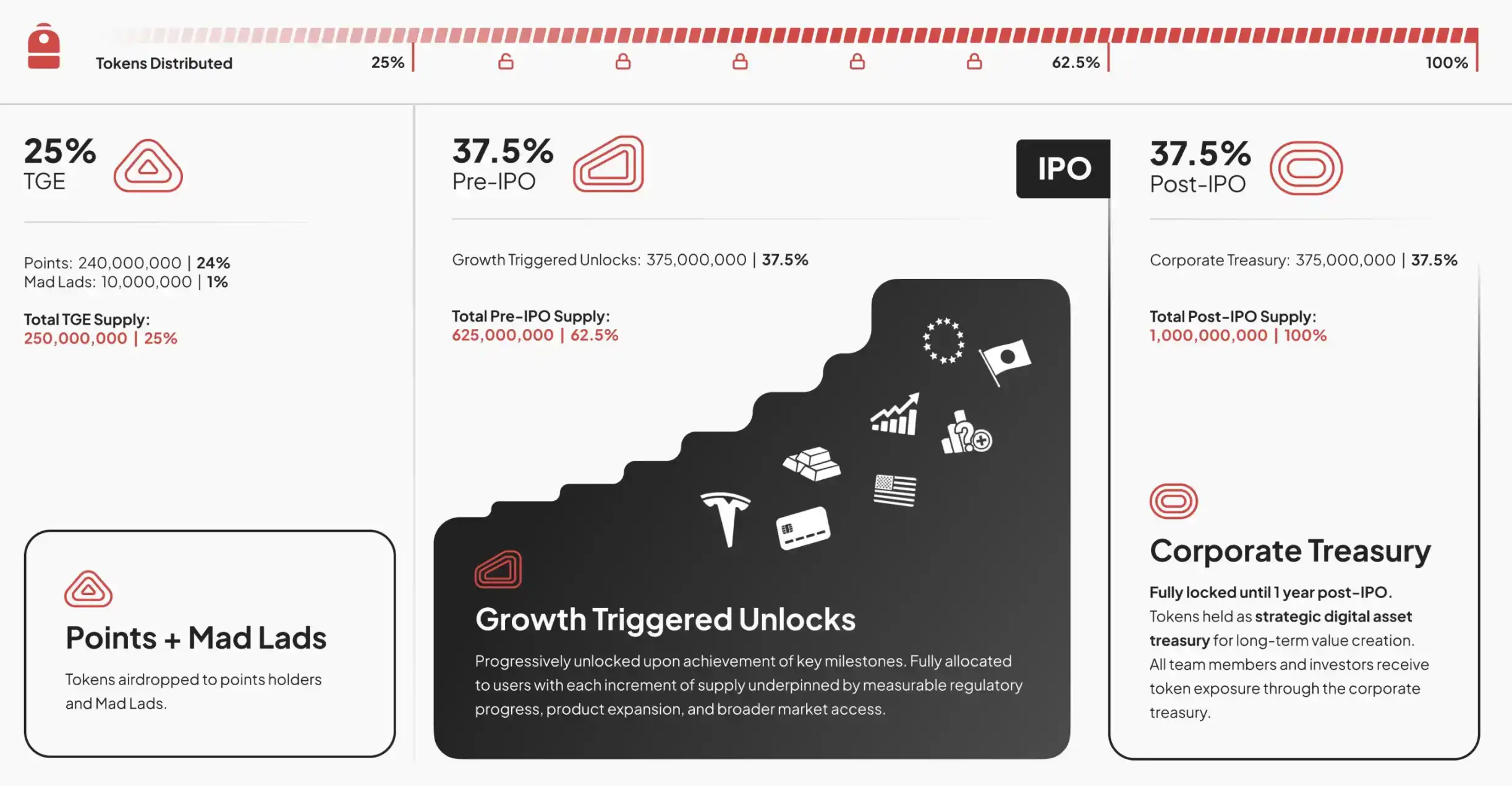
· Total supply of 1 billion tokens, 25% directly released to the community at TGE: Among these, points holders account for 24%, and Mad Lads holders account for 1%.

· Unlocked (37.5%) triggered by key product milestones before IPO. Every market expansion, every new product launch, is an opportunity to incentivize users with tokens, each triggering corresponding token unlocks. This design, through a predictable token unlock model, continuously attracts new users and expands the community scale.

More importantly, according to Armani Ferrante, Backpack has set strict constraints for token unlocks: the new ecological value brought by token unlocks must always be greater than its dilutive effect on the token price.

This design protects the core interests of users while ensuring the project's long-term value is not diluted by short-term unlocking behavior, making token incentives a true catalyst for platform growth, achieving a triple win of "user benefit, ecological value addition, and project growth."

Under Compliance: Slow is Fast

Beyond the innovation in token distribution, another distinctive feature of Backpack is its pursuit of compliance. This stands in stark contrast to the common logic in the industry of "expand first, comply later" and "prioritize scale over compliance."

As Armani Ferrante revealed, "Backpack currently serves only about 48% of regions globally. Behind this seemingly slow expansion lies a pursuit of compliance."

This strategic choice might mean missing market opportunities in the short term, but from a long-term development perspective, it is key to building a trust barrier.

Currently, Backpack's positioning is a compliant crypto exchange, offering cryptocurrency spot, derivatives, and lending services. But it is not content with being a pure cryptocurrency trading platform; it aims to build a compliant platform integrating crypto assets and traditional financial (TradFi) services. To achieve this goal, the team is laying banking rails globally and also plans to gradually launch diversified services like securities products in the future. In January, Backpack also launched a unified margin and cross-collateralization prediction product.

Market Perspective: How to View Backpack's FDV?

The market's attitude towards Backpack also reflects the controversy and potential of its model from the side.

According to Axios citing informed sources, Backpack is negotiating terms for new financing, with a pre-money valuation already reaching $1 billion.

On the prediction market Polymarket, market expectations for Backpack's token show significant volatility: the probability of Backpack's token FDV exceeding $1 billion within one day of listing is 21%, while in November 2025, this probability once reached over 80%. Of course, this volatility largely stems from the inherent uncertainty of the crypto market and also reflects the market's cautious attitude towards the "IPO-bound returns" model.

Summary

When tokens become tools for project teams to cash out, and users become targets to be harvested, the crypto industry loses its original ideals. Backpack's token distribution essentially creates a physical separation between Web2 equity incentives and Web3 token utility.

· For the team: The only way out is to make the product stronger and more compliant until the IPO. If the company fails midway or cannot go public, the equity in the team's hands will be worthless, with no possibility of cashing out.

· For the community: They are no longer the liquidity exit for VCs. Tokens are purely user rewards and ecological tools, not the team's ATM.

Backpack's choice is to redefine the value logic of crypto projects with compliance, transparency, and long-termism, showing us another possibility for the Web3 industry.

As Armani Ferrante said: "We either go big, or we go home." This statement is not only the manifesto of the Backpack team but also a mandatory question for the entire Web3 industry: Do we continue to revel in the speculative bubble,透支行业的信任与未来透支行业的信任与未来 (overdrawing the industry's trust and future原文此处为中文); or do we, like Backpack, choose the harder, slower, but more hopeful path, using long-termism to reconstruct the industry ecosystem?

Of course, an IPO is not easy, and the road is long and arduous, especially in the crypto industry, facing multiple challenges like regulation, market, and competition. Accidents and uncertainties are everywhere.


Preguntas relacionadas

QWhat is the core innovation in Backpack's token economics model?

ABackpack's token economics model allocates all liquid tokens to users at TGE, while team and investor rewards are entirely tied to the company's IPO process, preventing early insider sales and aligning long-term incentives.

QHow does Backpack ensure that token unlocks benefit the ecosystem without diluting value?

ABackpack sets strict constraints for token unlocks: the new ecological value generated from unlocks must always exceed the dilutive effect on the token price, ensuring user benefits and sustainable growth.

QWhat percentage of the total token supply is allocated to the community at TGE, and how is it distributed?

AAt TGE, 25% of the total 1 billion token supply is allocated to the community: 24% to points holders and 1% to Mad Lads holders.

QWhy does Backpack prioritize compliance in its expansion strategy, and what regions does it currently serve?

ABackpack prioritizes compliance to build long-term trust and regulatory security, currently serving only about 48% of global regions to ensure adherence to local laws before expanding.

QWhat is the significance of tying team and investor rewards to Backpack's IPO instead of token sales?

ALinking rewards to the IPO ensures that team and investors are fully committed to the project's long-term success, as they cannot cash out until after a successful IPO, which may take years or never happen, aligning their interests with sustainable growth.

Lecturas Relacionadas

How Difficult is Chip Making? A Division Error Costs 475 Million Dollars

How Hard Is It to Make a Chip? A Division Error Cost $475 Million Chip expert Shi Kan, a researcher at the Chinese Academy of Sciences and a popular tech creator, explains the immense challenges of chip development. Chips are foundational to modern technology, but their creation is extraordinarily difficult. The journey from sand to a functional chip involves complex design and manufacturing, but a critical bottleneck is verification—ensuring the design works flawlessly before costly production. A single, undetected bug can have catastrophic consequences, as illustrated by the infamous 1994 Intel Pentium FDIV bug. A flaw in the floating-point division unit forced a recall costing $475 million. Unlike software, chips cannot be easily patched after manufacture, making "first-time success" paramount. However, industry surveys show only 24% of chip projects achieve this; over three-quarters require at least one costly re-spin due to design flaws. Verification has thus become the dominant phase, consuming up to 70% of the design cycle. The core challenge is a "verification impossible triangle" between high performance, good debuggability, and low cost. Exhaustively verifying a modern CPU core could take 15,000 years with software simulation, or 30 years with advanced hardware emulation—timeframes utterly impractical for development. Despite being essential, verification is often seen as unglamorous "dirty work," receiving less academic attention than fields like AI. Shi and his team are tackling this by developing an agile verification research framework called ENCORE, based on FPGA technology, to improve verification efficiency and debug capability. Beyond research, Shi engages in public science communication through long-form video content, aiming to demystify chip technology, AI, and computer science. He argues for the value of pursuing "hard and long-term" endeavors, whether in the meticulous world of chip verification or in creating substantive educational content, believing such sustained effort is likely the right path forward.

marsbitHace 9 min(s)

How Difficult is Chip Making? A Division Error Costs 475 Million Dollars

marsbitHace 9 min(s)

Blockchain Has Finally Started to Sail into the Mainstream After 18 Years

Blockchain Finds Its True Path After 18 Years: Becoming the Financial Backbone for AI Agents and Autonomy This analysis explores a pivotal shift in the blockchain and crypto investment landscape, driven by the dominance of AI. Major venture capital firms, including Variant, Paradigm, Haun Ventures, and YZi Labs, are moving beyond pure "crypto" investment theses. They are expanding their focus to AI, robotics, and frontier tech, signaling that blockchain is no longer seen as a standalone sector but as an underlying infrastructure layer. The core argument is that blockchain's killer application may not be user-facing apps, but rather providing the economic rails for the coming wave of AI agents, autonomous robots, and automated systems. Key capabilities like self-custody wallets, programmable stablecoins for micropayments, on-chain identity, and verifiable smart contracts are positioned as essential for a future where machines conduct economic activity. The recent $1.4 billion investment by Tether (via its venture arm) in German robotics company NEURA Robotics exemplifies this, aiming to embed Tether's wallet tools directly into robots for autonomous transactions. While many "AI + Crypto" projects remain superficial, the article concludes that true value lies where crypto is a necessary component—enabling machine-to-machine payments, agent autonomy, verifiable data provenance, and open financial settlement for the AI era. For crypto venture capital, this convergence with AI represents both an adaptation to shifting capital flows and a potential path to unlocking the large-scale, non-speculative utility the industry has long sought.

marsbitHace 29 min(s)

Blockchain Has Finally Started to Sail into the Mainstream After 18 Years

marsbitHace 29 min(s)

Blockchain has finally begun sailing toward the main channel after 18 years

After 18 years of development, blockchain technology is beginning to move from a specialized niche into mainstream adoption, according to a recent industry analysis. The shift is reflected in the changing strategies of major crypto venture capital firms, which are expanding their focus beyond pure "digital ownership" towards broader themes like "autonomy." The report highlights that leading VC firms like Variant, Paradigm, Haun Ventures, and YZi Labs are broadening their investment mandates to include not only crypto but also artificial intelligence (AI), robotics, biotech, and other frontier technologies. This reflects a recognition that the isolated "crypto investment" narrative is losing appeal to limited partners (LPs) as capital and attention increasingly flow toward AI and other high-growth tech sectors. A key emerging thesis is that blockchain's most significant future application may not be as a consumer-facing product, but as the underlying economic and settlement infrastructure for the AI era. As AI agents and autonomous systems become more prevalent, they will require programmable, global, and low-cost payment networks (like stablecoins), verifiable digital identities, and secure wallets to manage transactions and assets on behalf of users. The investment by stablecoin issuer Tether into robotics company NEURA, with plans to integrate its wallet technology, is cited as a prime example of this convergence. However, the article cautions that simply labeling projects as "AI + Crypto" is insufficient. True value lies in integrations where blockchain technology is essential—such as enabling machine-to-machine micropayments, verifiable data provenance for AI, or transparent governance for autonomous organizations—rather than being a superficial marketing add-on. In conclusion, while AI currently dominates the tech narrative and capital flows, it may ultimately create the real-world, high-frequency demand that the crypto industry has long sought. For crypto VCs and projects, the path forward is to position blockchain not as a competing sector, but as a critical foundational layer powering autonomy and economic activity in an AI-driven future.

链捕手Hace 36 min(s)

Blockchain has finally begun sailing toward the main channel after 18 years

链捕手Hace 36 min(s)

Y Combinator Co-founder: How to Make a Billion Dollars?

The Y Combinator co-founder argues that becoming a billionaire by founding a successful startup is not only possible but demonstrably achievable without unfair or unethical practices. He disputes a politician's claim to the contrary, using the example of a founder whose company grew at 93% monthly solely through creating a product users loved and recommended. The core mechanism is exponential growth. A conservative 15% monthly growth rate compounds to a 4384x increase over five years, which can easily lead to billion-dollar valuations and founder wealth. The process depends on two key variables: the growth rate and the duration it can be sustained. A high growth rate stems from a great product that users naturally promote, while a long duration requires a large enough market. For aspiring founders, especially young ones, the simplest path is to build something they and their friends genuinely need. Young people's current needs often predict future mass-market trends. He advises against actively "searching" for ideas, as this tends to filter out unconventional but promising ones. Instead, inspiration should come from working on interesting projects with friends, as many iconic companies (e.g., Apple, Facebook) started this way. Ultimately, building a massively valuable startup is not about exploitation but empathy: deeply understanding a user group and building a product that significantly improves their lives. This, powered by exponential growth in a large market, is the legitimate path to immense wealth creation.

Foresight NewsHace 38 min(s)

Y Combinator Co-founder: How to Make a Billion Dollars?

Foresight NewsHace 38 min(s)

Trading

Spot
Futuros
活动图片