A Less 'Hawkish' 'Hawkish Rate Cut' and Balance Sheet Expansion Buying Bonds That 'Is Not QE'

深潮Publicado a 2025-12-11Actualizado a 2025-12-11

Resumen

The Federal Reserve cut interest rates by 25 basis points for the third consecutive time in 2024, lowering the target range to 3.50%-3.75%. The decision revealed the largest internal dissent in six years, with three officials opposing the move. The updated dot plot continues to project only one more rate cut in 2025, signaling a significant slowdown in the pace of easing. Chair Jerome Powell emphasized that the current policy stance allows the Fed to be patient and data-dependent, noting that no one is assuming the next move will be a hike. Simultaneously, the Fed announced it would begin purchasing short-term Treasury bills to maintain ample reserves in the banking system, with an initial $40 billion in purchases planned for the next month. Powell stressed that these operations are for reserve management purposes and do not represent a change in monetary policy stance. The economic projections were slightly revised, with upgrades to GDP growth and minor downgrades to inflation expectations. The labor market is showing signs of cooling, with the unemployment rate rising and job growth slowing.

Source: Wall Street Journal

The Federal Reserve cut interest rates again at the conventional pace as the market expected, but it exposed the largest divergence among voting policymakers in six years, signaling a slowdown in the pace of action next year and a potential pause in the near term. The Fed also, as expected by Wall Street, initiated reserve management operations, deciding to buy short-term Treasury bonds by year-end to address pressures in the money markets.

On Wednesday, December 10, Eastern Time, the Federal Reserve announced after its FOMC monetary policy meeting that the target range for the federal funds rate was lowered from 3.75%-4.00% to 3.50%-3.75%. This marks the third 25-basis-point rate cut this year, bringing the total reduction for the year to 75 basis points. Since September of last year, this easing cycle has cumulatively cut rates by 175 basis points.

It is worth noting that the Fed's interest rate decision faced three dissenting votes for the first time since 2019. Governor Milan, appointed by Trump, continued to advocate for a 50-basis-point cut, while two regional Fed presidents and four non-voting members supported holding rates steady. In effect, seven officials opposed the decision, reportedly the largest divergence in 37 years.

The dot plot released after the meeting showed that the interest rate path forecast by Fed policymakers remained consistent with the one published three months ago, still projecting one 25-basis-point rate cut next year. This implies that the pace of rate cuts next year will slow significantly compared to this year.

As of Tuesday's close, CME Group's FedWatch Tool showed that the futures market priced in an approximately 88% probability of a 25-basis-point cut this week, while the probability of at least another 25-basis-point cut did not reach 71% until next June. The probabilities for such a cut at the January, March, and April meetings next year all remained below 50%.

The predictions reflected by the CME tool can be summarized by the recently popular term "hawkish cut." It refers to the Fed cutting rates this time while simultaneously signaling a potential pause in action, with no further cuts in the near term.

Nick Timiraos, a veteran Fed reporter known as the "new Fed whisperer," stated bluntly after the meeting that the Fed "signaled it may pause on rate cuts for now" due to "rare" internal disagreements over whether to worry more about inflation or the job market.

Timiraos pointed out that three officials dissented from the 25-basis-point cut at this meeting, and the stalled decline in inflation and cooling labor market made this meeting the most divisive in recent years.

Powell emphasized at the post-meeting press conference that he did not believe "a rate hike at the next meeting" was anyone's base case. The current level of rates allows the Fed to be patient and observe how the economy evolves. He also stated that the available data so far does not indicate a change in the economic outlook, and the scale of Treasury purchases may remain high in the coming months.

01 Fed Cuts Rates by 25 Basis Points as Expected, Still Projects One Cut Next Year, Initiates RMP Buying $40B in Short-Term Bonds

On Wednesday, December 10, Eastern Time, the Federal Reserve announced after its FOMC monetary policy meeting that the target range for the federal funds rate was lowered from 3.75%-4.00% to 3.50%-3.75%. This marks the third consecutive FOMC meeting with a rate cut, each by 25 basis points, bringing the total reduction for the year to 75 basis points. Since September last year, this easing cycle has cumulatively cut rates by 175 basis points.

It is worth noting that the Fed's interest rate decision faced three dissenting votes for the first time since 2019. Trump-appointed Governor Milan continued to advocate for a 50-basis-point cut, while two regional Fed presidents and four non-voting members supported holding rates steady. In effect, seven officials opposed the decision, reportedly the largest divergence in 37 years.

A key change in this meeting's statement compared to the previous one was in the interest rate guidance. Although the decision was to cut rates, the statement no longer broadly said that, when considering further rate cuts, the FOMC would assess incoming data, the evolving outlook, and the balance of risks. Instead, it more explicitly referred to considering the "extent and timing" of future adjustments. The statement now reads:

"In considering the extent and timing of any adjustments to the target range for the federal funds rate, the Committee will carefully assess incoming data, the evolving outlook, and the balance of risks."

The meeting statement reiterated that inflation remains somewhat elevated and that the downside risks to employment have increased in recent months. It removed the phrase "remains low" regarding the unemployment rate, noting it had risen slightly to 4.4% as of September.

The addition of "extent and timing" regarding further rate cuts is seen as signaling a higher bar for future cuts.

Another important change in this meeting's statement compared to the last was the addition of a new paragraph specifically noting the intention to purchase short-term bonds to maintain ample reserve balances in the banking system. The statement wrote:

"The Committee views reserve balances as having declined to ample levels and will begin purchases of Treasury bills, as needed, to maintain ample reserve balances over time."

This amounts to announcing the start of so-called reserve management operations, rebuilding liquidity buffers in the money markets. Year-end often sees market disruptions as banks typically reduce activity in the repo market to support their balance sheets for regulatory and tax settlements.

The statement said reserves have declined to ample levels and, to maintain ample reserves, will begin buying short-term bills this Friday. The New York Fed plans to buy $40 billion in short-term bills over the next 30 days and expects Reserve Management Purchases (RMP) of short-term bills to remain high in the first quarter of next year.

The median projection of Fed officials' interest rate forecasts released after Wednesday's meeting showed that their expectations this time were exactly the same as the previous ones published in September.

Fed officials currently also project that, after three rate cuts this year, there will likely be one 25-basis-point cut each in the next two years.
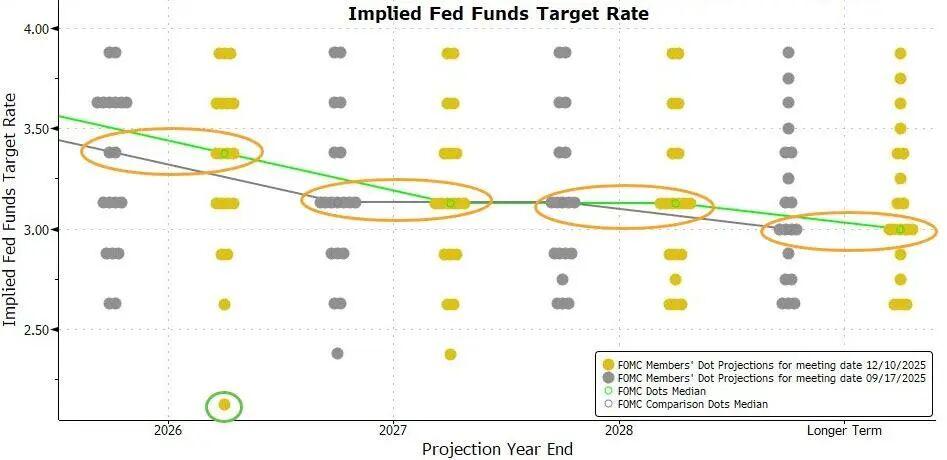
Many had expected that the dot plot reflecting future interest rate movements would show Fed policymakers leaning more hawkish. This dot plot did not show such a tendency; instead, it was slightly more dovish compared to the previous one.

Among the 19 Fed officials providing forecasts, seven now project the interest rate next year to be between 3.5% and 4.0%, compared to eight who projected this last time. This means that the number of officials expecting no rate cuts next year decreased by one.

The economic projections released after the meeting showed that Fed officials raised their GDP growth forecasts for this year and the subsequent three years, and slightly lowered the unemployment rate forecast for 2027, i.e., the year after next, by 0.1 percentage point, while leaving the forecasts for other years unchanged. This adjustment indicates that the Fed views the labor market as more resilient.

Simultaneously, Fed officials slightly lowered their forecasts for PCE inflation and core PCE inflation for this year and next year by 0.1 percentage point each. This reflects a slightly stronger confidence in inflation slowing over the coming period.

02 Powell: Current Rates Allow for Patience, Does Not Believe 'Next Move is a Hike' is Anyone's Base Case

With today's cut, the Fed has lowered the policy rate by a total of 75 basis points over the past three meetings. Powell said this will help gradually return inflation to 2% after the effects of tariffs fade.

He said the adjustments made to the policy stance since September have brought the policy rate into the range of various estimates of "neutral interest rates." The median projection of FOMC members shows the appropriate level for the federal funds rate at the end of 2026 is 3.4% and 3.1% at the end of 2027, unchanged from September.

Powell stated that currently, inflation risks are tilted to the upside, while employment risks are tilted to the downside, presenting a challenging situation.

A reasonable baseline is that the impact of tariffs on inflation will be relatively short-lived, essentially a one-time shift in the price level. Our job is to ensure this one-time price increase does not evolve into a persistent inflation problem. But at the same time, downside risks to employment have increased in recent months, and the overall balance of risks has changed. Our policy framework requires balance between the two aspects of our dual mandate. Therefore, we believe a 25-basis-point cut at this meeting was appropriate.

Given the stalled progress in bringing inflation down, Fed officials had hinted before this week's decision that further cuts might require evidence of labor market weakness. Powell said at the press conference:

"Where we are right now allows us to be patient and watch how the economy evolves."

In the Q&A session, regarding the question of whether the next policy adjustment is necessarily downward now that rates are closer to neutral, or if policy risks have truly turned two-way, Powell responded that no one has rate hikes as their base case currently, and he hasn't heard such views. There are differing views within the Committee: some members believe the current policy stance is appropriate and advocate maintaining the status quo for further observation; others believe another cut may be needed this year or next, perhaps even more than one.

When members write down their judgments on the policy path and appropriate interest rate levels, expectations are mainly concentrated on a few scenarios: either maintaining the current level, implementing a small cut, or a slightly larger cut. Powell emphasized that the current mainstream expectations do not include a rate hike scenario.

Powell stated that as a separate decision, the Fed also decided to initiate purchases of short-term U.S. Treasury bills, with the sole purpose of maintaining ample reserve supplies over time, thereby ensuring the Fed can control the policy rate effectively. He stressed that these issues are separate from the monetary policy stance itself and do not represent a change in policy orientation.

He said the scale of short-term bill purchases may remain high in the coming months, and the Fed isn't strictly "worried" about money market tensions, just that this situation came a bit sooner than expected.

Powell also stated that, according to the New York Fed's announcement, the initial scale of asset purchases will reach $40 billion in the first month and may remain high in the following months to alleviate anticipated short-term money market pressures. Afterwards, the scale of purchases is expected to decline, with the specific pace depending on market conditions.

Regarding the labor market, Powell said that although official October and November employment data are not yet available, existing evidence suggests that both layoffs and hiring remain at low levels. Simultaneously, households' perceptions of job availability and businesses' sense of hiring difficulty continue to decline. The unemployment rate continues to rise slightly, reaching 4.4%, and employment growth has slowed noticeably compared to earlier this year. The Fed also removed the phrase "the unemployment rate has remained low" from the statement.

Powell said in the subsequent Q&A that after adjusting for overestimation in the employment data, job growth may have turned slightly negative since April.


Criptos en tendencia

Preguntas relacionadas

QWhat was the outcome of the December 10th FOMC meeting regarding the federal funds rate?

AThe Federal Reserve lowered the target range for the federal funds rate from 3.75%-4.00% to 3.50%-3.75%, marking the third 25 basis point cut of the year.

QWhat does the term 'hawkish cut' refer to in the context of this article?

AA 'hawkish cut' refers to the Fed's decision to cut interest rates while simultaneously signaling that it may pause and not cut rates again in the near future.

QWhat new policy did the Fed announce alongside the rate cut to address money market pressures?

AThe Fed announced it would begin purchasing short-term Treasury bills to maintain an ample supply of reserves in the banking system, starting with a plan to buy $40 billion over the next 30 days.

QAccording to the dot plot, how many rate cuts do Fed officials project for the year 2025?

AFed officials' median projection, as shown in the dot plot, indicates one 25 basis point rate cut for the year 2025.

QWhat was Chairman Powell's stance on the possibility of the next policy move being a rate increase?

AChairman Powell stated that he does not believe a rate hike is anyone's base case assumption for the next policy move and that the mainstream expectations were for either holding rates steady or for small cuts.

Lecturas Relacionadas

Micron Shuts Up the Bears, Makes India's 'Buffett' Regret: Sold Too Early, Missed Out on $2 Billion

Indian value investor Mohnish Pabrai, a disciple of Warren Buffett, revealed his costly mistake of selling shares in Micron Technology too early. He initially invested in 2017, holding it for six years and building a position as large as 77% of his portfolio, based on a thesis that the memory chip industry would consolidate into a stable oligopoly of Samsung, SK Hynix, and Micron. However, he sold his entire stake in September 2023, fearing oversupply after Samsung announced production expansion. Shortly after his exit, demand for high-bandwidth memory (HBM) surged with the rise of AI, and Micron's stock price skyrocketed over 15 times in two years. Pabrai estimates this premature sale cost him roughly $20 billion in potential gains. He expressed similar regret over selling his investment in SK Hynix too soon, stating he violated his own principle of holding companies forever. Reflecting on these errors, Pabrai emphasized his core investment checklist principles: avoiding leverage, focusing on the durability of a company's competitive moat, and assessing management's character. Despite these personal trading missteps, his long-term view on the remaining memory chip leaders remains bullish, advising current holders not to sell as "the party is just getting started." He concluded by sharing his philosophical outlook, prioritizing character over wealth, and his goal to donate his entire fortune before his passing.

marsbitHace 21 min(s)

Micron Shuts Up the Bears, Makes India's 'Buffett' Regret: Sold Too Early, Missed Out on $2 Billion

marsbitHace 21 min(s)

Mihoyo's Next Protagonist Is Her, Who Plays the Piano

Mihoyo, widely recognized for its hit game Genshin Impact, has long harbored a grander ambition: creating a virtual world where one billion people would want to live. While its character design is unparalleled, the company recognizes a fundamental limitation—these beloved virtual characters are not truly "alive." Their dialogue and actions are pre-scripted. This drive for authentic "living" characters has guided Mihoyo's strategic investments in cutting-edge fields like brain-computer interfaces, AI (including an early investment in MiniMax), and nuclear fusion. Following the release of ChatGPT in late 2022, co-founder Cai Haoyu stepped down from management to lead a new overseas AI venture, Anuttacon, focused on creating AI-driven virtual beings. Mihoyo's path has involved experimentation and iteration. Anuttacon's early project, *Whisper of the Stars*, showcased real-time AI conversation but revealed limitations in underlying language models. The team subsequently focused its resources on developing a sophisticated "emotional" large language model, distinct from purely utilitarian AI. Co-founder Liu Wei (Dawei) announced plans to invest up to 100 billion RMB in this AI pursuit. The first tangible product of this vision is *BSide: Olivia Lin*, a free Steam application featuring a piano-playing virtual companion. Unlike typical AI chatbots demanding constant interaction, Olivia Lin operates on a slower, more deliberate rhythm—responding to letters, playing user-submitted melodies, and serving as a desktop presence. This design emphasizes "lifelikeness" over exhaustive conversation, strategically working around current technological constraints while building a sense of authentic connection. The company's journey traces back to its name, "miHoYo," where "mi" pays homage to the virtual singer Hatsune Miku. For nearly two decades, fans have loved Miku, a character unaware of their devotion. Mihoyo's ultimate goal, now backed by massive investment and AI research, is to bridge that gap—to create virtual beings that can truly know they are loved.

marsbitHace 40 min(s)

Mihoyo's Next Protagonist Is Her, Who Plays the Piano

marsbitHace 40 min(s)

Citrini Research: Taking Stock of 5 Major Investment Themes Overshadowed by the AI Trade

Citrini Research identifies five under-the-radar investment themes potentially overshadowed by the dominant AI trade. With capital and analyst attention overwhelmingly focused on AI infrastructure, these overlooked areas present alpha opportunities as market dynamics shift. **Theme 1: Airlines** – Despite strong fundamentals, stocks like Delta and United have been penalized for 18 months due to macro concerns (tariff-inflation, oil prices), not profitability. A rebound is expected as these headwinds fade, aided by trends like premiumization and the 2026 World Cup. **Theme 2: Senior Housing** – A pure demographic play. The U.S. population over 80 is projected to grow 56% in the next decade, drastically outpacing supply. This creates a compelling need for facilities, benefiting REITs like Welltower and operators like Brookdale. **Theme 3: Live Events & Entertainment** – "Being there" is becoming a luxury. This sector has outperformed even tech over the past decade. Companies like TKO Group (WWE/UFC), Cinemark, and IMAX are capitalizing on demand for premium, in-person experiences. **Theme 4: Exchange Competition** – CME Group's ~98% monopoly in U.S. interest rate derivatives faces its first real challenge from FMX Futures Exchange. Backed by major Wall Street banks, FMX offers lower fees and margin savings. While CME's deep liquidity remains an advantage, FMX provides a competitive alternative. **Theme 5: Fintech Recovery** – Heavily sold off in 2026, fintech stocks like SoFi, Robinhood, and Upstart are showing signs of a rebound based on improving fundamentals—SoFi's stablecoin launch, Robinhood's transformation into a "financial super app," and Upstart's renewed AI lending narrative—rather than a change in sector outlook. The report advises maintaining some AI exposure but diversifying into these neglected "small themes" where mispricing exists due to a simple shortage of investor attention.

marsbitHace 1 hora(s)

Citrini Research: Taking Stock of 5 Major Investment Themes Overshadowed by the AI Trade

marsbitHace 1 hora(s)

21Shares Mid-Year Key Report: Bitcoin's Four-Year Cycle Remains Intact, Stablecoins and Tokenization Emerge as New Growth Engines

21Shares Mid-Year Report 2026: Bitcoin Cycle Intact, Stablecoins & Tokenization Emerge as New Engines This mid-year review assesses progress against 21Shares' ten predictions for 2026. While the overarching shift from narrative to fundamentals holds, performance varies. Key findings show Bitcoin's four-year cycle remains evident despite market maturation. Global crypto ETP AUM has declined to ~$140B, lagging the $400B target, though product innovation continues. Stablecoin supply surpassed $320B, demonstrating non-cyclical demand but falling short of the $1T forecast due to slower regulatory clarity. DeFi TVL, stalled at ~$140B, was hindered by major security incidents. Corporate crypto treasuries hold ~1.28M BTC ($100B), with consolidation pressuring weaker players. Prediction markets are on track, with $57.5B volume already surpassing half the $100B annual target. AI agent infrastructure is ready, but adoption is early. Ethereum L2 consolidation is underway, with the top 5 capturing nearly 90% of activity. Compliant token launches have a platform but lack mainstream volume. Tokenized RWAs total ~$31B on public chains, but institutional pipeline growth is strong. In summary, fundamentals like stablecoins, tokenization, and prediction markets are advancing, but targets require faster adoption or price appreciation. The market is maturing, yet cyclical patterns persist.

marsbitHace 1 hora(s)

21Shares Mid-Year Key Report: Bitcoin's Four-Year Cycle Remains Intact, Stablecoins and Tokenization Emerge as New Growth Engines

marsbitHace 1 hora(s)

Trading

Spot
Futuros

Artículos destacados

Qué es NASDAQ100

El Índice Nasdaq-100 incluye 100 de las empresas no financieras más grandes que cotizan en el Mercado de Valores Nasdaq y se utiliza ampliamente como un referente para las acciones de crecimiento y tecnología de gran capitalización en EE. UU.

7 Vistas totalesPublicado en 2026.06.18Actualizado en 2026.06.18

Qué es NASDAQ100

Cómo comprar NASDAQ100

¡Bienvenido a HTX.com! Hemos hecho que comprar Nasdaq-100 Index (NASDAQ100) sea simple y conveniente. Sigue nuestra guía paso a paso para iniciar tu viaje de criptos.Paso 1: crea tu cuenta HTXUtiliza tu correo electrónico o número de teléfono para registrarte y obtener una cuenta gratuita en HTX. Experimenta un proceso de registro sin complicaciones y desbloquea todas las funciones.Obtener mi cuentaPaso 2: ve a Comprar cripto y elige tu método de pagoTarjeta de crédito/débito: usa tu Visa o Mastercard para comprar Nasdaq-100 Index (NASDAQ100) al instante.Saldo: utiliza fondos del saldo de tu cuenta HTX para tradear sin problemas.Terceros: hemos agregado métodos de pago populares como Google Pay y Apple Pay para mejorar la comodidad.P2P: tradear directamente con otros usuarios en HTX.Over-the-Counter (OTC): ofrecemos servicios personalizados y tipos de cambio competitivos para los traders.Paso 3: guarda tu Nasdaq-100 Index (NASDAQ100)Después de comprar tu Nasdaq-100 Index (NASDAQ100), guárdalo en tu cuenta HTX. Alternativamente, puedes enviarlo a otro lugar mediante transferencia blockchain o utilizarlo para tradear otras criptomonedas.Paso 4: tradear Nasdaq-100 Index (NASDAQ100)Tradear fácilmente con Nasdaq-100 Index (NASDAQ100) en HTX's mercado spot. Simplemente accede a tu cuenta, selecciona tu par de trading, ejecuta tus trades y monitorea en tiempo real. Ofrecemos una experiencia fácil de usar tanto para principiantes como para traders experimentados.

9 Vistas totalesPublicado en 2026.06.18Actualizado en 2026.06.18

Cómo comprar NASDAQ100

Qué es RE

I. Introducción al Proyecto Re Protocol es un mercado de capital en cadena que conecta capital de stablecoin con reaseguro totalmente colateralizado y regulado. El reaseguro permite a las compañías de seguros transferir porciones de su riesgo a otros aseguradores especializados, ayudándoles a absorber grandes pérdidas y continuar proporcionando cobertura. II. Información del Token Nombre del token: RE(Re) III. Enlaces Relacionados Sitio web:https://re.xyz/ Exploradores:https://bscscan.com/token/0xd41fdb03ba84762dd66a0af1a6c8540ff1ba5dfb https://etherscan.io/token/0x526526528f35ac738177003b8773b402b8df8143 Twitter:https://twitter.com/re Nota: La introducción al proyecto proviene de los materiales publicados o proporcionados por el equipo oficial del proyecto, que es solo para referencia y no constituye asesoramiento de inversión. HTX no se hace responsable de ninguna pérdida directa o indirecta resultante.

108 Vistas totalesPublicado en 2026.06.18Actualizado en 2026.06.18

Qué es RE

Discusiones

Bienvenido a la comunidad de HTX. Aquí puedes mantenerte informado sobre los últimos desarrollos de la plataforma y acceder a análisis profesionales del mercado. A continuación se presentan las opiniones de los usuarios sobre el precio de A (A).

活动图片