A History of Technological Evolution Powered by Electricity: Aluminum, Bitcoin, and AI

marsbitPublicado a 2026-05-26Actualizado a 2026-05-26

Resumen

The journey from the Rockdale aluminum smelter in Texas to space-based data centers illustrates a core economic principle: whoever controls the cheapest electricity dictates the use of computing power. The evolution is clear. Old industrial sites with pre-existing, high-capacity power grids are being repurposed. In Rockdale, a former Alcoa plant now houses vast Bitcoin mining rigs, which are increasingly being replaced by AMD chips for AI training. The logic is purely financial: while smelting aluminum yields $0.17–0.27 per kWh and Bitcoin mining $0.05–0.11, AI inference on H100 GPUs generates $1.27–3.67 per kWh. Recent deals confirm the rush for power infrastructure. Riot Platforms leases space to AMD; TeraWulf bought an old Kentucky aluminum plant for its grid; NYDIG secured a New York site for its cheap hydropower to mine Bitcoin. As AI giants like Anthropic, Microsoft, Google, and Amazon aggressively expand, they now directly compete with crypto miners for the same industrial power resources, often outbidding them. This has led to a decline in Bitcoin's global hash rate and a wave of miner conversions to AI data centers. This "digital resource curse" extends globally. Gulf nations, long offering subsidized power to attract heavy industry like aluminum, are now pivoting to become AI and cloud computing hubs—exporting computational power instead of physical commodities. Similarly, Bhutan halted its sovereign Bitcoin mining to sell hydropower directly to India for a stead...

Written by: Thejaswini M A

Compiled by: Luffy, Foresight News

Drive about an hour northeast from Austin, Texas, past barbecue joints and barren scrubland, and you'll arrive in Rockdale, Texas. If you roll down the window before the town's outline comes into view, you'll hear a steady roar, like the rumble of a jet engine idling on the tarmac.

Rockdale, built around an old aluminum smelter, now hosts North America's largest concentration of Bitcoin mining operations, with industry leaders like Riot Platforms and Bitdeer having set up shop there. Investigations by The New York Times and Al Jazeera have long documented this soundscape: tens of thousands of mining rigs paired with industrial fans running at full throttle to prevent equipment from overheating and shutting down in the Texas heat.

Follow the roar into the former plant of Alcoa, a symbol of 20th-century heavy industry. No trace of aluminum production remains in the vast industrial yard. Inside a massive metal warehouse, countless thick copper cables and industrial server racks are arranged in grids. Computer equipment is fully submerged in churning synthetic coolant.

Originally used for Bitcoin mining, the equipment here is now being gradually replaced with AMD chips, transitioning to handle artificial intelligence model training workloads.

Forget debating whether AI is a bubble or Bitcoin is in terminal decline. This industrial succession is just a surface manifestation. The companies securing leases for these sites see it clearly: the true core asset is the electrical infrastructure. This is now an industry-wide consensus.

If you're still wondering why, the underlying logic stems from the disparity in revenue per kilowatt-hour of electricity (calculated at real-time London Metal Exchange prices):

  • Aluminum Smelting: Each kWh can generate $0.17–$0.27 in gross revenue.
  • Bitcoin Mining: At current rates, each kWh yields only $0.05–$0.11.
  • Running AI Inference Tasks on H100 GPUs: Each kWh yields a whopping $1.27–$3.67.
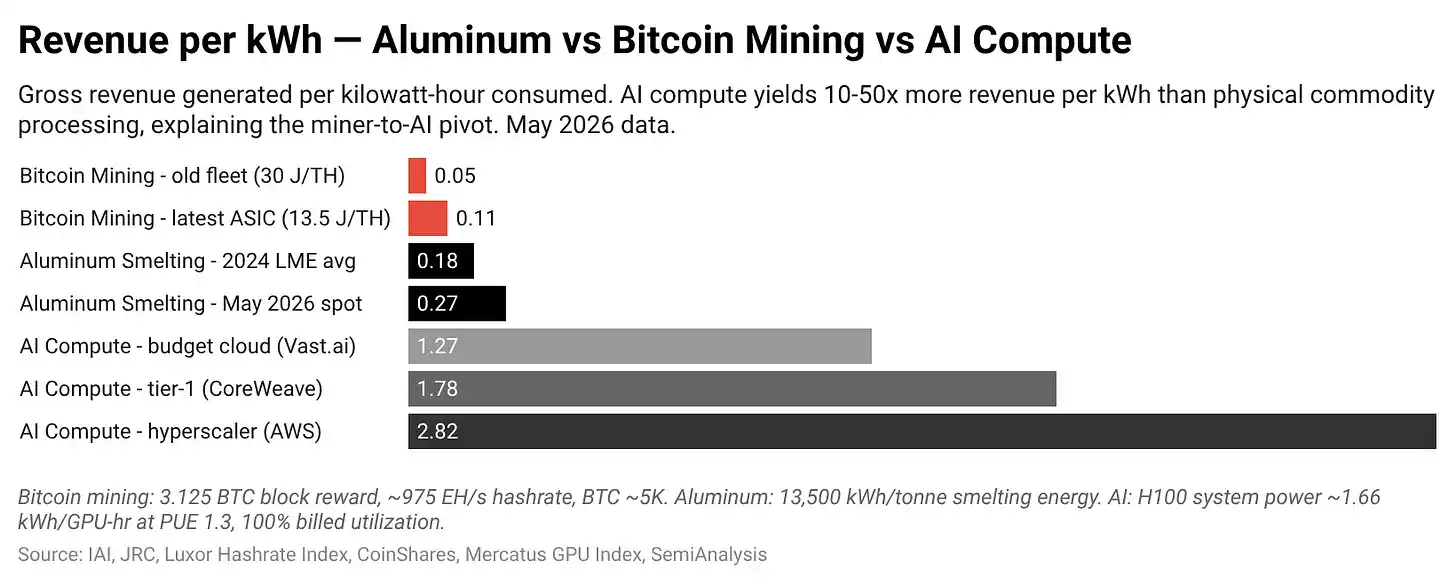
When electricity was cheap, producing aluminum made sense. As margins in the aluminum industry were squeezed, Bitcoin mining became the new use case for low-cost power. By 2026, with Bitcoin prices depressed, AI workloads have become the unequivocally better choice.

Three recent transactions vividly illustrate the industry-wide scramble for power resources, whether for cryptocurrency mining or AI compute.

Riot, with its large site in Rockdale, hasn't limited itself to Bitcoin mining. It has leased part of its space and power to chip giant AMD for building an AI data center. Simply by subleasing electricity and space, the company stands to earn hundreds of millions of dollars.

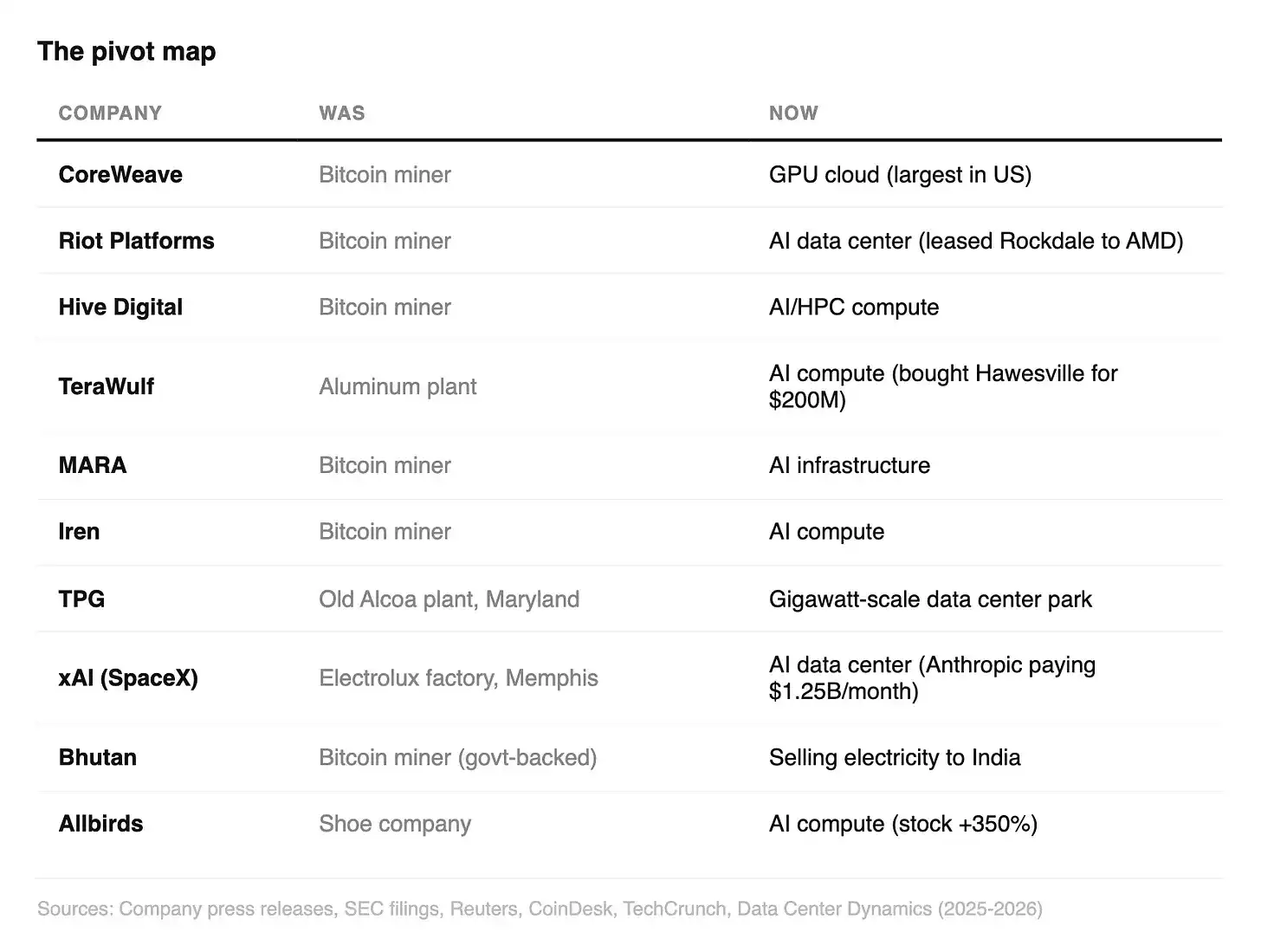
TeraWulf has embarked on a major expansion, spending $200 million to acquire the century-old Century Aluminum plant in Hawesville, Kentucky. The core reason for choosing this location is the plant's existing, robust high-capacity electrical infrastructure. The company plans to dismantle the old production equipment and build a large-scale data center campus leveraging the ready-made power grid.

NYDIG set its sights on the former Massena East industrial site in New York State. The site had been idle for years but offers direct access to 435 megawatts of cheap hydroelectric power from the St. Lawrence River. While peers pivot to AI, NYDIG secured this location solely to lock in low-cost hydropower to continue its Bitcoin mining operations. The industry has long since stopped building sites from scratch; it now competes for existing power hubs.

Over the past two decades, Bitcoin miners have roamed the globe in search of cheap power: at remote hydroelectric dams in Washington state, at flare gas sites in North Dakota's oil fields, in clusters of old industrial grids in upstate New York. The industry has honed a mature set of supporting capabilities: 24/7 high-load power management, industrial-grade cooling solutions, long-term, low-cost power contracts.

The rising AI firms happen to need these ready-made resources and have deeper pockets.
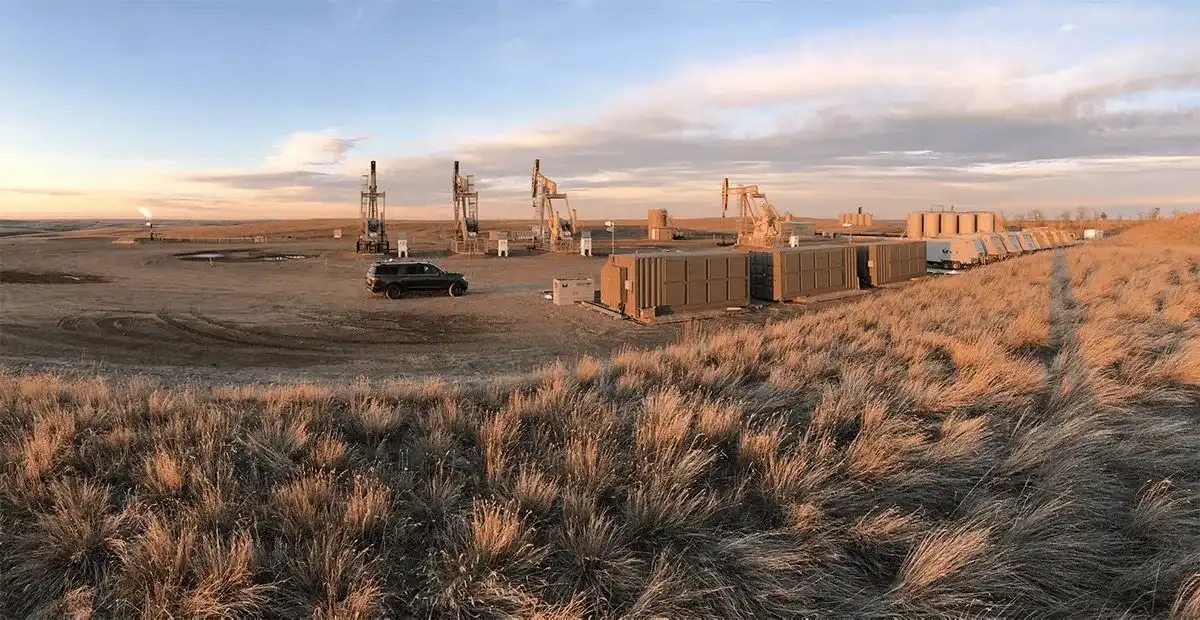
Anthropic is aggressively locking down power resources. Microsoft, Google, and Amazon are also on a data center construction spree, with power infrastructure buildout struggling to keep pace with new facility deployment. The three tech giants are now directly competing with Bitcoin miners for the same pool of industrial power resources. Where miners once competed against each other for power, they now find themselves at a disadvantage against the tech titans.

Data from early 2026 confirms the industry's predicament. Bitcoin's global network hash rate declined for the first time in six years. While the current cost to mine a single Bitcoin is around $88,000, for most of May this year, the price has hovered around $77,000. Miners operating at standard electricity rates are losing money on every coin they produce.

A collective pivot has followed. Companies like Hive, Hut 8, TeraWulf, and Iren are dismantling mining rigs and converting facilities into AI server rooms. CoreWeave has completely exited crypto mining, fully transitioning to AI cloud services. MARA acquired a French tech company to shift its business focus. Those positioned as "power operators," holding valuable electricity resources, are surviving. Miners solely focused on the crypto space are in crisis.
Energy analysts have dubbed this phenomenon the "digital resource curse": nations and companies are increasingly realizing that simply controlling cheap electricity yields higher returns than developing new technologies themselves.

The Gulf States grasped this logic early. For the past six decades, they have maintained ultra-low electricity tariffs: Kuwait has kept residential rates stable at $0.007 per kWh since 1966; in Abu Dhabi, the combined cost of production and delivery is about $0.087 per kWh, but it's sold to residents for just $0.014. Low-cost power was originally a tool for industrial policy, attracting energy-intensive industries like aluminum smelting, petrochemicals, and steel to the desert.
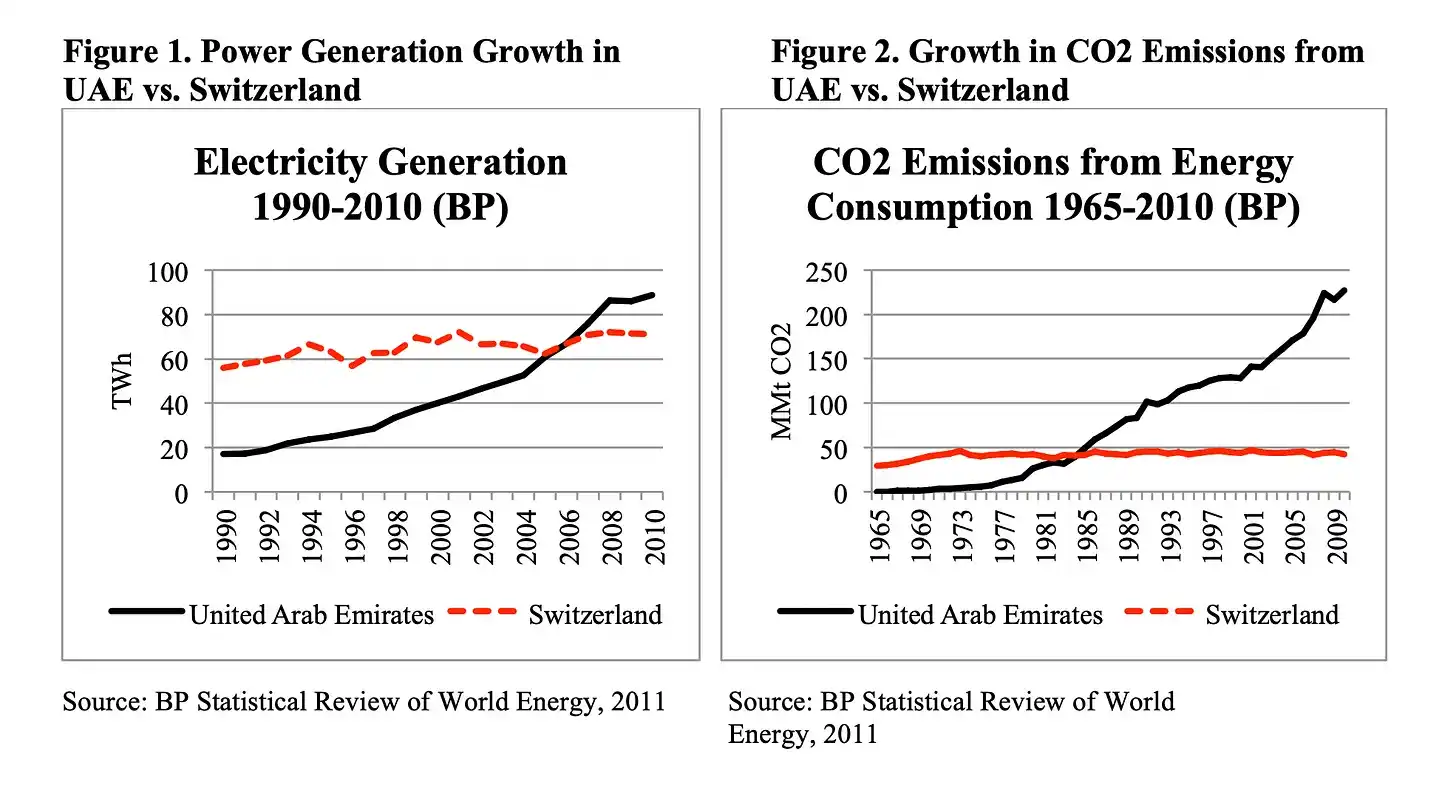
Today, that same cheap power that once supported heavy industry has found a new user: the data center. Saudi Arabia has established a sovereign AI investment agency, HUMAIN, investing tens of billions in tech infrastructure. The UAE is building a 5-gigawatt AI park, attracting companies like OpenAI, Oracle, and Nvidia. The grid that once powered aluminum smelters now powers AI compute. The planned NEOM Oxagon, originally conceived as a floating industrial city, has been repurposed into a $5 billion AI data center cluster powered by wind and solar.

The Carnegie Endowment for International Peace noted: Cloud computing has become the Gulf's "new aluminum." Instead of exporting physical commodities, the region is now converting fossil fuels and solar energy into compute power and exporting it via the internet.

It's not just the Middle East. Bhutan's case is equally telling.

Bhutan once possessed some of the world's cheapest hydropower. Its state-backed Bitcoin mining project was once hailed as a model of sovereign mining, holding a peak of 13,000 BTC. That has now dwindled to 3,100 BTC, and mining operations ceased over a year ago. The country's hydropower is now sold directly to the Indian grid.

The calculus mirrors that of the old American aluminum plant: Is Bitcoin mining still the best use of our electricity? When the answer was yes, Bhutan mined. When selling power to India offered a more stable return without the volatility risk of cryptocurrency, the power flowed to its neighbor.

Similarly, Starcloud raised $200 million to plan an orbital solar-powered data center. They recently trained the first AI model in space using H100 GPUs and are seeking approval to launch 88,000 satellites. While the project retains a Bitcoin mining operation, it is only a secondary component: the in-orbit solar panels generate continuous power, and when the AI compute queue is idle, the surplus electricity is used for crypto mining.

Low Earth orbit offers unique advantages for power generation: constant sunlight, no land use, and the cold of space negates the need for extensive cooling equipment. Over the past two decades, launch costs have fallen by 95%.

SpaceX is also deeply involved in the power-and-compute calculus. According to its latest IPO filing, the company's Colossus 1 data center in Memphis, Tennessee, has its entire compute capacity exclusively leased by Anthropic under a contract running until May 2029, valued at over $40 billion. This single deal alone brings SpaceX $1.25 billion in monthly revenue. This data center was also converted from an old appliance factory, mirroring the transformation model seen in Rockdale's aluminum plant.

Amidst all this industrial churn, perhaps the most unexpected pivot is that of Allbirds. The sustainable shoe brand, once valued at $4 billion, saw its stock price plummet 98% as the consumer brand bubble burst. With its core business struggling, the company, armed with cash and a public listing, decisively pivoted entirely to operating AI compute infrastructure. Its stock price subsequently surged 350%. The market voted: operating servers and trading in power/compute is far more profitable today than the traditional consumer sector.

Meanwhile, crypto projects like Bittensor, Render, and Akash are charting a different path: not building large, centralized facilities, but aggregating the world's distributed, idle compute.

Bittensor has built a compute marketplace where, underpinned by a fixed-supply token system, various AI models compete to provide answers; the project also halved its daily token issuance in December 2025. Render incentivizes users to share idle GPU resources for AI tasks. Akash rents out cloud compute, claiming prices up to 85% lower than Amazon Web Services.

This distributed compute model is gaining attention. At Nvidia's GTC conference in 2026, CEO Jensen Huang compared Bittensor to the classic internet project Folding@home. The latter was born from the idea of leveraging idle home computers worldwide, making dormant devices productive; Bittensor uses crypto tokens as an incentive to aggregate the compute of idle gaming PCs and old mining rigs.

Looking at the big picture, from the roar of industrial fans in Rockdale to sun-chasing satellites in orbit, a massive reconfiguration around physical assets is underway. For the companies involved, the only rule is to chase profit margins. I predict that a decade from now, these compute facilities may once again be emptied and repurposed for the next generation of emerging industries. The underground electrical transmission lines, however, will remain unchanged from beginning to end.

Whoever controls the cheapest electricity decides what the compute is used for. This logic has already played out in Texas, Bhutan, and Abu Dhabi. And 250 miles above the Earth's surface, it will hold true as well.


Preguntas relacionadas

QWhat is the core reason behind the industrial transformation from aluminum smelting to Bitcoin mining and then to AI data centers at sites like the one in Rockdale, Texas?

AThe core reason is the pursuit of maximizing revenue per kilowatt-hour of electricity consumed. The decision is driven by comparing the gross revenue each activity generates from the same unit of power: aluminum smelting ($0.17–0.27/kWh), Bitcoin mining ($0.05–0.11/kWh), and AI inference tasks using H100 GPUs ($1.27–3.67/kWh). As profitability shifts, businesses repurpose infrastructure to host the most lucrative power-consuming operation.

QHow are Bitcoin miners being outcompeted in the race for cheap electricity resources according to the article?

ABitcoin miners are being outcompeted by well-funded AI companies and tech giants like Microsoft, Google, and Amazon. These AI-focused firms have stronger capital and are aggressively securing the same industrial-scale, low-cost power resources and data center sites that miners previously relied on. This competition has contributed to a decline in Bitcoin's global hash rate as miners struggle with profitability against higher electricity bidders.

QWhat is the 'digital resource curse' mentioned in the article, and how is it exemplified by Gulf states?

AThe 'digital resource curse' refers to the phenomenon where countries or companies find that simply controlling cheap electricity resources yields higher returns than developing new technologies. Gulf states like Kuwait and Abu Dhabi exemplify this by using long-standing, heavily subsidized low electricity prices—initially to attract energy-intensive industries like aluminum and chemicals—to now pivot and attract massive AI data center investments, effectively exporting compute power instead of physical commodities.

QWhat alternative, decentralized model for providing AI compute is highlighted in the article, and which projects represent it?

AThe article highlights a decentralized model that aggregates globally distributed, idle computing power instead of building large centralized data centers. This model is represented by crypto projects like Bittensor (which creates a marketplace for AI models to compete), Render (which shares idle GPU resources for AI tasks), and Akash (which offers decentralized cloud computing at lower costs). Nvidia's CEO compared Bittensor to the classic distributed computing project Folding@home.

QWhat broader principle does the article conclude governs the evolution of power-intensive industries from aluminum to AI?

AThe article concludes that the fundamental principle is that whoever controls the cheapest electricity determines the use of compute power. Industries—whether aluminum smelting, Bitcoin mining, or AI training—will continuously migrate to and repurpose infrastructure based on where they can achieve the highest profit per unit of electricity. The physical power grid remains constant, while the operations it supports evolve to follow the highest monetary return.

Lecturas Relacionadas

TechFlow Intelligence Report: Xiaomi Announces 200 Billion HKD Stock Buyback Plan, Spot Gold Falls Nearly 1%

TechFlow Report: Xiaomi announced a HK$200 billion stock buyback plan, while spot gold fell nearly 1%. A wider range of tech headlines includes Google unveiling its powerful video editing model Gemini Omni and the original "Attention is All You Need" authors advocating for a move beyond Transformer architecture. In other AI news, IBM reported its first successful use of a quantum computer to train an AI model, and Qwen3.5 released uncensored local model versions. The crypto/Web3 sector saw discussions on opaque stablecoin products and DEX fee changes. Major tech companies are under scrutiny: Uber's COO publicly questioned the ROI of AI investments, Motorola was accused of hijacking Amazon app links for affiliate codes, and Google faced criticism for using web data to fuel its AI. U.S. markets are focused on high S&P 500 valuations (31.8x P/E) and an intense concentration of capital in semiconductor stocks, with warnings about the sustainability of the AI data center boom. Geopolitical tensions, featuring simultaneous U.S. airstrikes on Iran and peace talks, caused significant oil price volatility. Other notable developments include Ferrari's first pure EV priced at 4.35 million yuan and Boston Dynamics' Atlas robot learning soccer from videos. The underlying theme suggests the AI narrative is shifting from boundless potential to requiring tangible results, while traditional geopolitical risks remain a powerful force in markets.

marsbitHace 5 min(s)

TechFlow Intelligence Report: Xiaomi Announces 200 Billion HKD Stock Buyback Plan, Spot Gold Falls Nearly 1%

marsbitHace 5 min(s)

Coin & Stock Barometer: Bitcoin Miner MARA Holdings Spends Over $860,000 on Bulletproof Vehicle Services for Executives; Bitmine Included in Preliminary List for FTSE Russell 1000 Index (May 19)

Crypto Market Wrap & Key Corporate Updates (May 19) The crypto market saw a decline followed by a minor rebound, while U.S. crypto-related stocks fell broadly. In corporate news: **MARA Holdings**, a Bitcoin miner, disclosed spending over $869,000 on vehicle ballistic armor services for its CEO and CFO under its security program. The board cited higher risks associated with the company's public disclosure of holding substantial Bitcoin assets. According to BitcoinTreasuries.NET, Elon Musk's **SpaceX and Tesla** collectively hold 30,221 BTC ($2.3B), which would rank them as the fifth-largest public company holder if combined. **DDC Enterprise Limited** increased its Bitcoin holdings by 200 BTC, bringing its total to 2,583 BTC. The firm stated it plans to continue accumulating BTC based on liquidity, not short-term price movements. Bitcoin treasury company **Nakamoto** announced a 1-for-40 reverse stock split to regain compliance with Nasdaq's minimum bid price requirement. The company reported a Q1 2026 net loss of $238.8M, partly due to a $102.5M unrealized loss on its Bitcoin holdings. **Tether** acquired SoftBank's stake in **Twenty One Capital (XXI)**, increasing its control. Tether's CEO expressed strengthened confidence in XXI's long-term Bitcoin strategy. Fundstrat's **Tom Lee** stated that **Bitmine (BMNR)** has been included in the preliminary list for the FTSE Russell 1000 Index. Concurrently, two new wallets suspected to be linked to Bitmine withdrew 60,000 ETH ($126M) from Bitgo and Kraken. Solana treasury company **Solmate Infrastructure** announced a registered direct offering of shares to raise approximately $11.4 million. **AI Financial**, a WLFI treasury company, reported a Q1 2026 net loss of $271.5M and raised substantial doubt about its ability to continue as a going concern, partly due to unrealized losses on its WLFI token holdings. **SUI Group** disclosed it holds over 108.7 million SUI tokens (~$115M), with its market cap to net asset value ratio at 0.91x. *Disclaimer: This summary is for informational purposes only and does not constitute investment advice.*

marsbitHace 21 min(s)

Coin & Stock Barometer: Bitcoin Miner MARA Holdings Spends Over $860,000 on Bulletproof Vehicle Services for Executives; Bitmine Included in Preliminary List for FTSE Russell 1000 Index (May 19)

marsbitHace 21 min(s)

China's AI Fronts: From Yan'an to Midway

This article analyzes the competitive landscape of China's AI industry through a dual-front war analogy: the "Eastern Front" of business model competition and the "Western Front" of global strategic positioning. **The Eastern Front: The Scramble for Supply Lines and Monetization** The "Eastern Front" examines the contrasting strategies of three Chinese tech giants—Tencent, Alibaba, and ByteDance—in the face of AI's high marginal costs. Tencent integrates AI as a catalyst within its existing ecosystems (advertising, gaming, cloud) for monetization, prioritizing high-value scenarios over user growth. Alibaba bets on a full-stack, self-developed approach from chips to applications, aiming to control costs and ecosystem, though this requires immense patience and resources. ByteDance, with Doubao as its flagship, pursues a traditional traffic-driven, "super app" strategy but faces severe monetization challenges as its massive user base incurs unsustainable operational costs. The central challenge for all is building a reliable "supply line" (sustainable funding/profit) and achieving efficient monetization, moving beyond being mere "token factories." **The Western Front: "Preserving Land" vs. "Preserving People"** The "Western Front" frames a global strategic divergence. The U.S. model ("preserving land") focuses on closed-source, high-premium models (e.g., Anthropic) targeting lucrative enterprise markets. China's strategy ("preserving people") leverages open-source models (e.g., Alibaba's Qwen, DeepSeek) and extremely low pricing to attract global developers and capture long-tail markets, akin to a "surround the cities from the countryside" approach. The goal is to make Chinese models the default infrastructure, locking in future ecosystem value. However, the critical test is whether this open-source ecosystem can achieve a commercial闭环, converting developer adoption into tangible revenue (e.g., via cloud services), and bridging the monetization gap with Western models that charge for value, not just tokens. **Conclusion: The Long March from Factory to Brand** The article concludes that China's AI industry possesses technology, users, and scenarios but must integrate them to create and capture value. Its ultimate success depends on navigating both fronts: companies must establish sustainable monetization on the Eastern Front, while the industry's Western strategy must evolve from simply "preserving people" (developer adoption) to truly "preserving both people and land" — transforming open-source ecosystem dominance into commercial success and premium brand value. This journey from being a "token factory" to a "value highland" will require strategic patience and the ability to outlast competitors in a prolonged contest.

marsbitHace 52 min(s)

China's AI Fronts: From Yan'an to Midway

marsbitHace 52 min(s)

Conquering is easy, governing is hard: Polymarket must bow to regulations to plant its flag globally

Polymarket, a decentralized prediction market platform, faces significant regulatory hurdles in its global expansion. Its "permissionless" model, which bypasses traditional identity and financial controls, has led to widespread crackdowns. India recently blocked the site, categorizing it as illegal online gambling under new 2025 laws. Brazil also banned it and similar platforms, though it simultaneously authorized a regulated, investor-only version on its national exchange. Across Europe, countries like France, Portugal, and the Netherlands are enforcing bans based on existing gambling and financial regulations. To enter key markets, Polymarket is adopting a pragmatic, compliant approach. In the U.S., it paid a $1.12 million fine, acquired a CFTC-licensed exchange, and now operates a regulated, KYC-mandatory platform for American users. It also secured a major investment from Intercontinental Exchange (ICE), which will distribute its prediction data to institutional investors. In Japan, where gambling laws are strict, Polymarket has begun a long-term lobbying effort, aiming for legalization by 2030 through building institutional partnerships and community presence. Despite these challenges, the prediction market industry is booming, with global volume projected to surge from $51 billion to potentially $1 trillion by 2030. Polymarket's core dilemma remains: adapting its decentralized, anonymous model to fit within sovereign regulatory frameworks focused on licensing, consumer protection, and anti-money laundering rules. Its survival in each market depends on navigating this complex political and legal landscape.

marsbitHace 1 hora(s)

Conquering is easy, governing is hard: Polymarket must bow to regulations to plant its flag globally

marsbitHace 1 hora(s)

It's Easier to Conquer than to Govern: Polymarket Must Bend to Every Rule to Plant Its Flag Globally

Polymarket, a decentralized prediction market platform, is facing significant regulatory hurdles as it expands globally, illustrating the tension between permissionless, crypto-native platforms and national legal frameworks. The platform, which allows users to bet on event outcomes, was recently blocked in India under new online gambling laws and faces similar outright bans in Brazil and Ukraine, the latter citing moral objections to wagering on active war events. In Europe, countries like France, the Netherlands, and the UK are restricting access by enforcing existing gambling and financial derivatives regulations, forcing Polymarket to geo-block users or operate in view-only modes. To navigate this complex landscape, Polymarket is adopting a market-by-market, compliant strategy. In the U.S., it paid a $1.4 million CFTC fine, acquired a licensed exchange (QCEX) for $112 million, and now operates a regulated U.S. entity with strict KYC, abandoning anonymity. It also secured a major investment from Intercontinental Exchange (ICE), which will distribute its prediction data to institutional investors. In Japan, a high-potential market, it has begun a long-term lobbying effort aiming for legalization by 2030, acknowledging the country's strict anti-gambling laws and slow regulatory processes. The article concludes that while the global prediction market is growing rapidly—projected to reach $2.4 trillion by 2030—Polymarket's core challenge is transforming its decentralized model to fit sovereign regulatory systems built on licensing, consumer protection, and anti-money laundering rules. Its survival depends on proving its legitimacy in each jurisdiction.

链捕手Hace 1 hora(s)

It's Easier to Conquer than to Govern: Polymarket Must Bend to Every Rule to Plant Its Flag Globally

链捕手Hace 1 hora(s)

Trading

Spot
Futuros

Artículos destacados

Qué es BITCOIN

Entendiendo HarryPotterObamaSonic10Inu (ERC-20) y Su Posición en el Espacio Cripto En los últimos años, el mercado de criptomonedas ha sido testigo de un aumento en la popularidad de las monedas meme, capturando el interés no solo de los comerciantes, sino también de aquellos que buscan compromiso comunitario y valor de entretenimiento. Entre estos tokens únicos se encuentra HarryPotterObamaSonic10Inu (ERC-20), un proyecto intrigante que mezcla referencias culturales en el tejido de las criptomonedas. Este artículo profundiza en los aspectos clave de HarryPotterObamaSonic10Inu, explorando sus mecanismos, ethos impulsado por la comunidad y su relación con el paisaje cripto más amplio. ¿Qué es HarryPotterObamaSonic10Inu (ERC-20)? Como su nombre sugiere, HarryPotterObamaSonic10Inu es una moneda meme construida sobre la blockchain de Ethereum, clasificada bajo el estándar ERC-20. A diferencia de las criptomonedas tradicionales que pueden enfatizar la utilidad práctica o el potencial de inversión, este token prospera en el valor de entretenimiento y la fuerza de su comunidad. El proyecto tiene como objetivo fomentar un entorno donde los usuarios comprometidos puedan reunirse, compartir ideas y participar en actividades inspiradas por diversos fenómenos culturales. Una característica notable de HarryPotterObamaSonic10Inu es su cero impuestos en las transacciones. Este atractivo elemento tiene como objetivo incentivar el comercio y la participación comunitaria, sin cargos adicionales que puedan disuadir a los comerciantes de pequeña escala. El suministro total de la moneda está establecido en mil millones de tokens, una cifra que marca su intención de mantener una circulación sustancial dentro de la comunidad. Creador de HarryPotterObamaSonic10Inu (ERC-20) Los orígenes de HarryPotterObamaSonic10Inu están algo envueltos en misterio; los detalles sobre el creador siguen siendo desconocidos. El desarrollo de este token carece de un equipo identificable o de un plan explícito, lo cual no es inusual dentro del sector de monedas meme. En cambio, el proyecto ha surgido de manera orgánica, con su progreso muy dependiente del entusiasmo y la participación de su comunidad. Inversores de HarryPotterObamaSonic10Inu (ERC-20) En cuanto a inversiones externas y respaldo, HarryPotterObamaSonic10Inu también sigue siendo ambiguo. El token no lista ninguna fundación de inversión conocida o apoyo organizacional significativo. En cambio, la savia del proyecto es su comunidad de base, que informa su crecimiento y sostenibilidad a través de la acción colectiva y el compromiso en el espacio cripto. ¿Cómo Funciona HarryPotterObamaSonic10Inu (ERC-20)? Como una moneda meme, HarryPotterObamaSonic10Inu opera principalmente fuera de los marcos tradicionales que a menudo rigen el valor de los activos. Hay varios aspectos distintivos que definen cómo funciona el proyecto: Transacciones Sin Impuestos: Sin tarifas impositivas en las transacciones, los usuarios pueden comprar y vender el token libremente sin preocuparse por costos ocultos. Compromiso Comunitario: El proyecto prospera en la interacción comunitaria, aprovechando plataformas de redes sociales para crear entusiasmo y facilitar la participación. Las discusiones, el intercambio de contenido y el compromiso son elementos cruciales que ayudan a expandir su alcance y fomentar la lealtad entre los seguidores. Sin Utilidad Práctica: Cabe señalar que HarryPotterObamaSonic10Inu no ofrece utilidad concreta dentro del ecosistema financiero. Más bien, se clasifica como un token principalmente para actividades de entretenimiento y comunitarias. Referencia Cultural: El token incorpora astutamente elementos de la cultura popular para atraer interés, conectando con entusiastas de los memes y seguidores de las criptomonedas por igual. HarryPotterObamaSonic10Inu ejemplifica cómo las monedas meme operan de manera diferente a los proyectos de criptomonedas más tradicionales, ingresando al mercado como construcciones sociales innovadoras en lugar de activos utilitarios. Cronología de HarryPotterObamaSonic10Inu (ERC-20) La historia de HarryPotterObamaSonic10Inu está marcada por varios hitos notables: Creación: El token surgió de un meme viral, capturando la imaginación de muchos entusiastas de las criptomonedas. Las fechas específicas de creación no están disponibles, subrayando su ascenso orgánico. Listado en Exchanges: HarryPotterObamaSonic10Inu ha llegado a varios exchanges, permitiendo un acceso y comercio más fácil por parte de la comunidad. Iniciativas de Compromiso Comunitario: Actividades continuas destinadas a mejorar la interacción comunitaria, incluyendo concursos, campañas en redes sociales y generación de contenido por parte de fanáticos y defensores. Planes de Expansión Futuros: La hoja de ruta del proyecto incluye el lanzamiento de una colección de NFT, mercancía y un sitio de comercio electrónico relacionado con sus temas culturales, involucrando aún más a la comunidad e intentando añadir más dimensiones a su ecosistema. Puntos Clave Sobre HarryPotterObamaSonic10Inu (ERC-20) Naturaleza Impulsada por la Comunidad: El proyecto prioriza la participación colectiva y la creatividad, asegurando que la involucración de los usuarios esté a la vanguardia de su desarrollo. Clasificación como Moneda Meme: Representa la epítome de las criptomonedas basadas en el entretenimiento, diferenciándose de los vehículos de inversión tradicionales. Sin Afiliación Directa con Bitcoin: A pesar de la similitud en el nombre del ticker, HarryPotterObamaSonic10Inu es distinto y no tiene relación con Bitcoin u otras criptomonedas establecidas. Enfoque en la Colaboración: HarryPotterObamaSonic10Inu está diseñado para crear un espacio para la colaboración y el intercambio de historias entre sus poseedores, proporcionando una vía para la creatividad y el vínculo comunitario. Perspectivas Futuras: La ambición de expandirse más allá de su premisa inicial hacia NFTs y mercancías describe un camino para que el proyecto potencialmente ingrese a avenidas más tradicionales dentro de la cultura digital. A medida que las monedas meme continúan capturando la imaginación de la comunidad de criptomonedas, HarryPotterObamaSonic10Inu (ERC-20) se destaca debido a sus lazos culturales y su enfoque centrado en la comunidad. Si bien puede no encajar en el molde típico de un token impulsado por la utilidad, su esencia radica en la alegría y la camaradería fomentadas entre sus seguidores, destacando la naturaleza en evolución de las criptomonedas en una era cada vez más digital. A medida que el proyecto continúa desarrollándose, será importante observar cómo las dinámicas comunitarias influyen en su trayectoria en el cambiante paisaje de la tecnología blockchain.

1.5k Vistas totalesPublicado en 2024.04.01Actualizado en 2024.12.03

Qué es BITCOIN

Cómo comprar BTC

¡Bienvenido a HTX.com! Hemos hecho que comprar Bitcoin (BTC) sea simple y conveniente. Sigue nuestra guía paso a paso para iniciar tu viaje de criptos.Paso 1: crea tu cuenta HTXUtiliza tu correo electrónico o número de teléfono para registrarte y obtener una cuenta gratuita en HTX. Experimenta un proceso de registro sin complicaciones y desbloquea todas las funciones.Obtener mi cuentaPaso 2: ve a Comprar cripto y elige tu método de pagoTarjeta de crédito/débito: usa tu Visa o Mastercard para comprar Bitcoin (BTC) al instante.Saldo: utiliza fondos del saldo de tu cuenta HTX para tradear sin problemas.Terceros: hemos agregado métodos de pago populares como Google Pay y Apple Pay para mejorar la comodidad.P2P: tradear directamente con otros usuarios en HTX.Over-the-Counter (OTC): ofrecemos servicios personalizados y tipos de cambio competitivos para los traders.Paso 3: guarda tu Bitcoin (BTC)Después de comprar tu Bitcoin (BTC), guárdalo en tu cuenta HTX. Alternativamente, puedes enviarlo a otro lugar mediante transferencia blockchain o utilizarlo para tradear otras criptomonedas.Paso 4: tradear Bitcoin (BTC)Tradear fácilmente con Bitcoin (BTC) en HTX's mercado spot. Simplemente accede a tu cuenta, selecciona tu par de trading, ejecuta tus trades y monitorea en tiempo real. Ofrecemos una experiencia fácil de usar tanto para principiantes como para traders experimentados.

4.9k Vistas totalesPublicado en 2024.12.12Actualizado en 2025.03.21

Cómo comprar BTC

Qué es $BITCOIN

ORO DIGITAL ($BITCOIN): Un Análisis Integral Introducción al ORO DIGITAL ($BITCOIN) ORO DIGITAL ($BITCOIN) es un proyecto basado en blockchain que opera en la red Solana, cuyo objetivo es combinar las características de los metales preciosos tradicionales con la innovación de las tecnologías descentralizadas. Aunque comparte un nombre con Bitcoin, a menudo referido como “oro digital” debido a su percepción como un refugio de valor, ORO DIGITAL es un token separado diseñado para crear un ecosistema único dentro del paisaje Web3. Su meta es posicionarse como un activo digital alternativo viable, aunque los detalles sobre sus aplicaciones y funcionalidades aún están en desarrollo. ¿Qué es ORO DIGITAL ($BITCOIN)? ORO DIGITAL ($BITCOIN) es un token de criptomoneda diseñado explícitamente para su uso en la blockchain de Solana. A diferencia de Bitcoin, que proporciona un papel de almacenamiento de valor ampliamente reconocido, este token parece centrarse en aplicaciones y características más amplias. Aspectos notables incluyen: Infraestructura Blockchain: El token está construido sobre la blockchain de Solana, conocida por su capacidad para manejar transacciones de alta velocidad y bajo costo. Dinámicas de Suministro: ORO DIGITAL tiene un suministro máximo limitado a 100 cuatrillones de tokens (100P $BITCOIN), aunque los detalles sobre su suministro circulante no se han divulgado actualmente. Utilidad: Si bien las funcionalidades precisas no están delineadas explícitamente, hay indicios de que el token podría ser utilizado para diversas aplicaciones, potencialmente involucrando aplicaciones descentralizadas (dApps) o estrategias de tokenización de activos. ¿Quién es el Creador de ORO DIGITAL ($BITCOIN)? En la actualidad, la identidad de los creadores y el equipo de desarrollo detrás de ORO DIGITAL ($BITCOIN) sigue siendo desconocida. Esta situación es típica entre muchos proyectos innovadores dentro del espacio blockchain, particularmente aquellos alineados con las finanzas descentralizadas y fenómenos de monedas meme. Si bien tal anonimato puede fomentar una cultura impulsada por la comunidad, intensifica las preocupaciones sobre la gobernanza y la responsabilidad. ¿Quiénes son los Inversores de ORO DIGITAL ($BITCOIN)? La información disponible indica que ORO DIGITAL ($BITCOIN) no tiene patrocinadores institucionales conocidos ni inversiones destacadas de capital de riesgo. El proyecto parece operar en un modelo de peer-to-peer centrado en el apoyo y la adopción de la comunidad en lugar de rutas de financiamiento tradicionales. Su actividad y liquidez se sitúan principalmente en intercambios descentralizados (DEX), como PumpSwap, en lugar de plataformas de trading centralizadas establecidas, lo que resalta aún más su enfoque de base. Cómo Funciona ORO DIGITAL ($BITCOIN) Los mecanismos operativos de ORO DIGITAL ($BITCOIN) pueden elaborarse en función de su diseño blockchain y atributos de red: Mecanismo de Consenso: Al aprovechar el único proof-of-history (PoH) de Solana combinado con un modelo de proof-of-stake (PoS), el proyecto asegura una validación de transacciones eficiente que contribuye al alto rendimiento de la red. Tokenómica: Si bien los mecanismos deflacionarios específicos no se han detallado extensamente, el vasto suministro máximo de tokens implica que podría atender microtransacciones o casos de uso nicho que aún están por definirse. Interoperabilidad: Existe el potencial de integración con el ecosistema más amplio de Solana, incluyendo varias plataformas de finanzas descentralizadas (DeFi). Sin embargo, los detalles sobre integraciones específicas permanecen no especificados. Cronología de Eventos Clave Aquí hay una cronología que destaca hitos significativos relacionados con ORO DIGITAL ($BITCOIN): 2023: El despliegue inicial del token ocurre en la blockchain de Solana, marcado por su dirección de contrato. 2024: ORO DIGITAL gana visibilidad al estar disponible para trading en intercambios descentralizados como PumpSwap, permitiendo a los usuarios comerciar contra SOL. 2025: El proyecto presencia actividad de trading esporádica y potencial interés en compromisos liderados por la comunidad, aunque no se han documentado asociaciones notables o avances técnicos hasta el momento. Análisis Crítico Fortalezas Escalabilidad: La infraestructura subyacente de Solana soporta altos volúmenes de transacciones, lo que podría mejorar la utilidad de $BITCOIN en varios escenarios de transacción. Accesibilidad: El potencial bajo precio de trading por token podría atraer a inversores minoristas, facilitando una participación más amplia debido a oportunidades de propiedad fraccionada. Riesgos Falta de Transparencia: La ausencia de patrocinadores, desarrolladores o un proceso de auditoría conocidos públicamente puede generar escepticismo sobre la sostenibilidad y confiabilidad del proyecto. Volatilidad del Mercado: La actividad de trading depende en gran medida del comportamiento especulativo, lo que puede resultar en una volatilidad de precios significativa y en incertidumbre para los inversores. Conclusión ORO DIGITAL ($BITCOIN) surge como un proyecto intrigante pero ambiguo dentro del ecosistema de Solana en rápida evolución. Si bien intenta aprovechar la narrativa del “oro digital”, su alejamiento del papel establecido de Bitcoin como refugio de valor subraya la necesidad de una diferenciación más clara de su utilidad y estructura de gobernanza previstas. La aceptación y adopción futura dependerán probablemente de abordar la actual opacidad y de definir sus estrategias operativas y económicas de manera más explícita. Nota: Este informe abarca información sintetizada disponible hasta octubre de 2023, y pueden haber ocurrido desarrollos más allá del período de investigación.

83 Vistas totalesPublicado en 2025.05.13Actualizado en 2025.05.13

Qué es $BITCOIN

Discusiones

Bienvenido a la comunidad de HTX. Aquí puedes mantenerte informado sobre los últimos desarrollos de la plataforma y acceder a análisis profesionales del mercado. A continuación se presentan las opiniones de los usuarios sobre el precio de BTC (BTC).

活动图片