A Critical Review of Base Co-founder's "Letter of Self-Criticism"

marsbitPublicado a 2026-07-17Actualizado a 2026-07-17

Resumen

Yesterday, Base co-founder Jesse Pollak published a self-critical post on X, reflecting on Base's successes and failures over the past two years. While his candor is commendable, the author argues his analysis still misses key points. Jesse admitted his primary mistake was heavily betting that onchain social platforms (like Farcaster) and creator tokens would drive mainstream crypto adoption. The author harshly criticizes this strategy, giving it a "0/100" score. They argue onchain social offers no superior user experience, and creator tokens, like Jesse's own $JESSE, fail to solve fundamental issues about value and creator adoption, unlike successful memecoins on other chains. The author is more forgiving regarding Base lagging in areas like perpetual DEXs and prediction markets, giving this an "80/100". They note strong competitors like Hyperliquid had unique advantages, and Base has found significant success in other narratives like AI and RWA. The author gives Jesse's overall reflection a "60/100" or passing grade. While Jesse now correctly sees multiple paths to adoption (stablecoins, payments, AI Agents) beyond just social, he, along with other industry leaders like Toly and Vitalik, still underestimates the powerful role of memecoins in driving mainstream awareness and adoption. The critique concludes that leaders often leverage memes for user acquisition but fail to genuinely embrace or thoughtfully develop the space, revealing a retreat from idealism and a disconn...

Early yesterday morning, Base co-founder Jesse Pollak posted a long thread on X, reviewing what Base's development strategy had done well and poorly over the past two years.

It was a rather candid post, both to himself and the public. It's not easy for anyone to admit they've made mistakes. Jesse believes it was a mistake for him and the Base team to place their bet on the social field, expecting on-chain native social experiences to drive mass adoption of Base and even cryptocurrency as a whole. However, the other bet—that application developers on Base would also drive mass adoption by producing great applications—was correct.

Now, he has handed over Base App (Base's super app, not the Base chain) to Cobie and has returned to focus on developing the Base chain. From the perspective of an on-chain player, looking back at some of Jesse's actions over the past two years, while I highly commend the candor of this "letter of self-criticism," I also feel there are debatable points in his reflections.

Betting on Social: 0 points

Native on-chain social does not enhance the social experience for the masses at all; it even makes social interactions more complicated. In fact, I wish Jesse had thoroughly analyzed in his "letter of self-criticism" what exactly users could gain from building a brand-new social app like Farcaster—what new social enjoyment they could experience, what new forms of social content they could access, or what novel paths for social network formation the app itself provides—that led him and the entire Base team to think this thing could drive Base's mass adoption by challenging the traditional social media market...

If it were for the ideal of decentralized social, this move might score some points. But thinking this could drive mass adoption? That's a pure 0.

Let's continue. On the social front, Jesse also mentioned creator tokens, referencing the recently popular $ANSEM on Solana. He indicated he wasn't entirely sure whether he promoted Zora at the wrong time or whether the idea of creator tokens was wrong from the start.

This understanding also gets 0 points. First, pushing the concept of "creator tokens" is itself strange. From the debate between Jesse and Toly back then, it was clear: Jesse believes "content" has value, and creators as personal brands have value. Therefore, unlike meme coins, this has fundamentals, so he wanted to promote something with fundamentals.

But who could this logic convince? In any case, Jesse himself led by example and issued $JESSE. Nearly 240 days later, the situation is as follows:
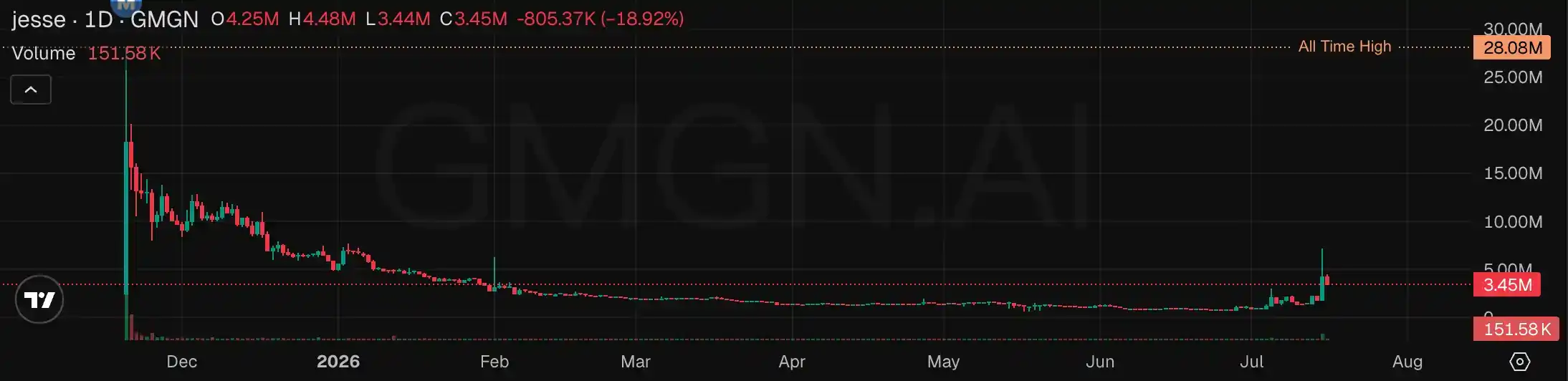
Content and personal IP do have value, but is issuing a token some uniquely effective monetization channel? What caliber of creators can you attract? How do you ensure the value you emphasize has a logical chain of reasoning? There are too many problems to solve in between. But Base gave people the feeling of, "The stage is set, and people will naturally perform."

In this regard, Jesse's understanding is completely defeated by Toly's. At least Toly could say something like, "Meme coins have no value, but mobile game items and skins also have no value, yet people worldwide are still willing to spend hundreds of billions of dollars a year on worthless things."

$ANSEM isn't the kind of "creator token" Jesse was pushing at all. First, it wasn't issued by Ansem himself, nor was it created to monetize his personal IP. It's a mismatch in every way.

In short, Jesse, regarding the social bet, you were really wrong, but you haven't fully figured it out yet. In fact, the best reference case in Crypto + social so far should be the social trading app FOMO.

Lagging Behind in Perp DEX and Other Areas: 80 points

The score could actually be even higher. Looking horizontally, Solana hasn't shown much stronger competitiveness in the Perp DEX and prediction market fields compared to Hyperliquid and Polymarket either, not significantly better than Base.

The reason Jesse feels quite regretful is, "Because we over-invested in social, we didn't keep up in these two areas." This is setting the bar a bit too high for oneself. After all, this is hindsight from a god's perspective. Hyperliquid is a competitor that completely figured out this sector. Without its emergence, Perp DEX would likely have remained at the level of GMX, dYdX. As for prediction markets, Polymarket has first-mover advantage; it's not a major competitive failure.

Moreover, Base has been quite successful in AI. It not only has a presentable but also a leading on-chain narrative sector in the entire market. In terms of specific tokens, there are major ones like $vvv that attracted market-wide attention, and launchpads like Virtuals. The x402 protocol is leading in Agent payments and has also made USDC the dominant stablecoin for inter-agent payments.

Base's success in the AI narrative has also spilled over into some tech narratives related to AI. For example, among the tokens performing well in the robotics sector, quite a few have appeared on Base. In RWA, before Solana dominated on-chain U.S. stock token spot trading with $SPCX, on-chain players would also think of Base more often, such as $LFI, which previously worked on on-chain real estate tax lien trading.

If Jesse did anything less than ideal in this regard, I think it goes back to the beginning of the article, where he mentioned "betting that Base's application developers would also drive mass adoption by producing great applications." In fact, Base's support for its on-chain developers isn't as good as he suggests. From the perspective of an on-chain player, when selecting tokens on Base, checking whether project founders have some connection with the Base team is crucial—you have to play within the "circle." The scenario where a developer has a flash of inspiration, creates a hot project outside Base's prioritized sectors, and quickly receives Base's support is really rare.

Developers complained about this earlier this year, "the three years a developer wasted on Base." I believe that not being sufficiently engaged with the developer community and the market, perhaps as much as overemphasizing the social sector, is a reason for the relative weakness in innovation competition within new narrative sectors.

Jesse's Reflection: 60 points

Does cryptocurrency need social to drive mass adoption on the scale of a billion people? Jesse previously thought it definitely did and was the only path. Now he believes stablecoins, prediction markets, Perp DEX, and RWA can all drive adoption; social isn't the only path to mass adoption.

Therefore, he stated that Base will now focus on winning the competition in three areas: trading, payments, and AI Agents. Base aims to become an indispensable part of the global on-chain financial system.

Jesse has realized one thing—exhausting oneself to pull in users directly and spending heavily to be the vanguard of cryptocurrency evangelism is less effective than overnight policy friendliness or even support for sectors like stablecoins, RWA, and prediction markets. No matter how much you promote Bitcoin/stablecoins for real-world payments, perhaps only users with real inflation-hedging needs, like those in Venezuela or Africa, are easily won over. This is a matter of national-level direction, not something easily done by companies.

But I only give a passing grade because, whether it's Jesse, Solana's Toly, Ethereum's Vitalik, or others, none have realized that for many years, meme coins have been an important path to driving mass adoption.

They have regressed from "I have a mission to actively promote cryptocurrency's conquest of the world" to "National-level forces have already become friendly, we just need to go with the flow." Jesse says he now thinks social is no longer the only path to mass adoption. He still doesn't understand—of course, cryptocurrency still needs word-of-mouth and active discussion among billions of people worldwide. But this isn't something you can achieve by providing an on-chain social platform.

People using Polymarket to bet on World Cup match outcomes won't discuss what stablecoins are. Similarly, people using Agent payments or trading U.S. stocks on-chain also won't care about stablecoins or blockchain. After all these years, the extent to which concepts like NFTs and the metaverse became mainstream topics is now only matched by the most disliked pump.fun, which persists in promoting lottery-like meme coin get-rich-quick stories to once again capture the public's mind.

Whether it's Jesse, Toly, or Robinhood's Vlad recently, everyone knows meme coins are a great user acquisition tool, but they are basically used and discarded. Everyone says nice things about liking memes, but no one steps up to guide the meme coin industry toward becoming more standardized.

Very smart and rational business cognition and choices, but the retreat in idealism and the insufficiently down-to-earth thinking about mass adoption lead me, from the perspective of a small on-chain shrimp, to ultimately give Jesse's reflection on the past two years only a passing grade.


Criptos en tendencia

Preguntas relacionadas

QWhat was Jesse Pollak's main admission regarding Base's past strategy, and which specific bet did he acknowledge as a mistake?

AJesse Pollak's main admission was that Base's past strategic focus was flawed. He specifically acknowledged that betting on on-chain native social experiences (like Farcaster) to drive mainstream adoption of Base and crypto was a mistake. He gave this bet a score of 0.

QAccording to the article, why did the author give Jesse's reflection on 'creator tokens' a score of 0?

AThe author gave a score of 0 because they found the logic behind promoting 'creator tokens' flawed. The idea that a creator's personal brand or content inherently provides fundamental value to a token was unconvincing. The poor performance of Jesse's own $JESSE token was cited as evidence. Furthermore, the author argued that successful examples like $ANSEM on Solana were not true 'creator tokens' in the sense Jesse promoted, making his understanding incorrect.

QIn which areas did the article state that Base has been successful, partially offsetting its failures in social and perp DEXes?

AThe article stated that Base has been particularly successful in the AI narrative. It has leading projects like $vvv and launchpads like Virtuals. The x402 protocol is leading in Agent payments and helped make USDC the dominant stablecoin for such transactions. Success in AI also spilled over into related tech narratives like robotics. Base was also previously strong in RWA (Real World Assets) narratives before Solana gained dominance in that area.

QWhat criticism did the article level against Base's support for its on-chain developers?

AThe article criticized that Base's support for its on-chain developers was not as good as Jesse claimed. From a user's perspective, it was crucial for a project to have some connection to the 'inner circle' of the Base team to receive support. The ecosystem lacked the agility to quickly support promising projects from developers outside its predefined focus areas, as evidenced by a developer's complaint about 'wasting three years on Base.' This lack of grassroots developer engagement was seen as a weakness.

QWhy did the author only give Jesse's overall reflection a passing score of 60, despite praising its honesty?

AThe author gave a score of 60 because while Jesse correctly realized that crypto adoption doesn't rely solely on social apps and can be driven by stablecoins, DeFi, and RWA, he missed a key point. The author argues that Jesse, along with other leaders like Toly and Vitalik, fails to recognize meme coins as a crucial, grassroots-driven path to mainstream adoption. They have retreated from idealistic, proactive mission-driven promotion to a more passive, policy-following stance. The author believes true mass adoption requires organic, word-of-mouth discussion, which an on-chain social platform cannot engineer, but meme culture potentially can.

Lecturas Relacionadas

Understanding the Stablecoin Industry Chain in One Article: The Real Profits Are Not in the Issuance

Understanding the Stablecoin Industry Value Chain: The Real Profits Are Not in Issuance The article argues that while industry discussion focuses on stablecoin issuers like Tether and Circle, the real profit opportunities lie further down the value chain. It breaks the stablecoin ecosystem into five key segments: issuance, on/off-ramps, on-chain transfers, payments, and yield generation/asset growth. Issuance is dominated by a few giants with massive scale and trust advantages, making direct competition difficult. New entrants are advised to focus on specialized infrastructure roles within this segment instead. The on/off-ramp sector faces intense competition and margin pressure on basic transaction fees, pushing service providers to expand into adjacent services for recurring revenue. The on-chain transfer segment, particularly for cross-border payments and payroll, offers significant cost advantages over traditional systems. Profits are not in the transfer itself but in the surrounding compliance, FX services, and leveraging idle funds. In payments, the core profitability lies not in consumer-facing card brands but in the backend infrastructure for issuing, clearing, and settlement. This allows players to capture reserve interest and improve capital efficiency through real-time, on-chain clearing. Finally, the asset growth/yield segment has evolved into a full-fledged on-chain asset management industry. It features layered models with specialized risk managers and offers products ranging from tokenized treasuries (RWA) to yield-bearing synthetic dollars. The future direction points towards integrating stablecoin advantages (24/7 clearing, low-cost transfers, programmable yield) into existing traditional financial infrastructure, as seen in recent acquisitions. Value is shifting downstream to the clearing/payments layer and towards compliant integration with traditional finance, including the rise of regional non-USD stablecoins.

Foresight NewsHace 8 min(s)

Understanding the Stablecoin Industry Chain in One Article: The Real Profits Are Not in the Issuance

Foresight NewsHace 8 min(s)

Stock Price Falls Below IPO Price, First Launch After IPO Hits a Snag, Where Will SpaceX Go From Here?

SpaceX Faces Post-IPO Pressure as Starship Launch Aborted, Stock Slumps SpaceX's highly anticipated 13th test flight of its Starship rocket was aborted during the final ignition sequence on July 17th due to issues with some Raptor engines failing to start as expected. CEO Elon Musk stated the company will replace two engines and aims for another launch attempt early next week. This setback comes at a critical time for SpaceX. Following its historic IPO last month, the company's stock (SPCX) has recently fallen below its offering price, down nearly 40% from its peak. The market had hoped a successful test would bolster the declining share price, but the abort triggered further after-hours selling. The article highlights a shift in investor perspective post-IPO. While previous Starship test failures were often viewed within SpaceX's "fail fast, iterate" Silicon Valley engineering culture as valuable data points, public market investors are now more focused on timelines, commercialization prospects, and their impact on valuation and future cash flows. Each delay or issue is now quickly factored into the stock price. While public listing provides crucial capital for ambitious projects like Starlink and Starship, it also brings increased scrutiny and pressure for predictable progress. The upcoming launch attempt is now seen as more than a technical milestone; its success or failure is likely to significantly influence market sentiment and the stock's near-term trajectory as SpaceX navigates the new realities of being a publicly traded company.

Odaily星球日报Hace 41 min(s)

Stock Price Falls Below IPO Price, First Launch After IPO Hits a Snag, Where Will SpaceX Go From Here?

Odaily星球日报Hace 41 min(s)

When Traditional Finance Fails People in Crisis, Bitcoin Succeeds

When traditional finance fails to reach people in crisis, Bitcoin succeeds. This article highlights how fundraising platforms like GoFundMe face severe limitations in delivering aid to conflict zones like Gaza due to banking regulations, sanctions, and compliance rules. For instance, Sami Jamal Al-Shannat raised over £55,000 for his family but couldn't receive the funds directly; instead, money had to be routed through a beneficiary in another country, leading to disputes and loss of access. The piece explores how compliance requirements often force reliance on intermediaries, shifting risk and responsibility away from platforms and onto individuals. In contrast, Bitcoin and blockchain-based platforms like Geyser and Agora enable direct, peer-to-peer transactions, bypassing traditional financial bottlenecks. These platforms shift trust from centralized institutions to verifiers—local partners or trusted organizations—who validate projects, allowing donors to send funds directly to recipients' wallets. While not a panacea, Bitcoin offers a way to circumvent "transnational financial repression," where sanctions and AML rules inadvertently harm legitimate aid recipients, activists, and dissidents. The conclusion emphasizes that open payment networks and decentralized trust models represent a systemic shift, empowering beneficiaries and providing more resilient humanitarian fundraising in crisis situations. However, challenges around verification, accountability, and fraud prevention remain.

marsbitHace 1 hora(s)

When Traditional Finance Fails People in Crisis, Bitcoin Succeeds

marsbitHace 1 hora(s)

Trading

Spot

Artículos destacados

Qué es $S$

Entendiendo SPERO: Una Visión General Completa Introducción a SPERO A medida que el panorama de la innovación continúa evolucionando, la aparición de tecnologías web3 y proyectos de criptomonedas juega un papel fundamental en la configuración del futuro digital. Un proyecto que ha atraído la atención en este campo dinámico es SPERO, denotado como SPERO,$$s$. Este artículo tiene como objetivo reunir y presentar información detallada sobre SPERO, para ayudar a entusiastas e inversores a comprender sus fundamentos, objetivos e innovaciones dentro de los dominios web3 y cripto. ¿Qué es SPERO,$$s$? SPERO,$$s$ es un proyecto único dentro del espacio cripto que busca aprovechar los principios de descentralización y tecnología blockchain para crear un ecosistema que promueva la participación, la utilidad y la inclusión financiera. El proyecto está diseñado para facilitar interacciones de igual a igual de nuevas maneras, proporcionando a los usuarios soluciones y servicios financieros innovadores. En su esencia, SPERO,$$s$ tiene como objetivo empoderar a los individuos al proporcionar herramientas y plataformas que mejoren la experiencia del usuario en el espacio de las criptomonedas. Esto incluye habilitar métodos de transacción más flexibles, fomentar iniciativas impulsadas por la comunidad y crear caminos para oportunidades financieras a través de aplicaciones descentralizadas (dApps). La visión subyacente de SPERO,$$s$ gira en torno a la inclusividad, buscando cerrar brechas dentro de las finanzas tradicionales mientras aprovecha los beneficios de la tecnología blockchain. ¿Quién es el Creador de SPERO,$$s$? La identidad del creador de SPERO,$$s$ sigue siendo algo oscura, ya que hay recursos públicos limitados que proporcionan información de fondo detallada sobre su(s) fundador(es). Esta falta de transparencia puede derivarse del compromiso del proyecto con la descentralización, una ética que muchos proyectos web3 comparten, priorizando las contribuciones colectivas sobre el reconocimiento individual. Al centrar las discusiones en torno a la comunidad y sus objetivos colectivos, SPERO,$$s$ encarna la esencia del empoderamiento sin señalar a individuos específicos. Como tal, comprender la ética y la misión de SPERO sigue siendo más importante que identificar a un creador singular. ¿Quiénes son los Inversores de SPERO,$$s$? SPERO,$$s$ cuenta con el apoyo de una diversa gama de inversores que van desde capitalistas de riesgo hasta inversores ángeles dedicados a fomentar la innovación en el sector cripto. El enfoque de estos inversores generalmente se alinea con la misión de SPERO, priorizando proyectos que prometen avances tecnológicos sociales, inclusión financiera y gobernanza descentralizada. Estas fundaciones de inversores suelen estar interesadas en proyectos que no solo ofrecen productos innovadores, sino que también contribuyen positivamente a la comunidad blockchain y sus ecosistemas. El respaldo de estos inversores refuerza a SPERO,$$s$ como un contendiente notable en el dominio de proyectos cripto que evoluciona rápidamente. ¿Cómo Funciona SPERO,$$s$? SPERO,$$s$ emplea un marco multifacético que lo distingue de los proyectos de criptomonedas convencionales. Aquí hay algunas de las características clave que subrayan su singularidad e innovación: Gobernanza Descentralizada: SPERO,$$s$ integra modelos de gobernanza descentralizada, empoderando a los usuarios para participar activamente en los procesos de toma de decisiones sobre el futuro del proyecto. Este enfoque fomenta un sentido de propiedad y responsabilidad entre los miembros de la comunidad. Utilidad del Token: SPERO,$$s$ utiliza su propio token de criptomoneda, diseñado para servir diversas funciones dentro del ecosistema. Estos tokens permiten transacciones, recompensas y la facilitación de servicios ofrecidos en la plataforma, mejorando la participación y la utilidad general. Arquitectura en Capas: La arquitectura técnica de SPERO,$$s$ apoya la modularidad y escalabilidad, permitiendo la integración fluida de características y aplicaciones adicionales a medida que el proyecto evoluciona. Esta adaptabilidad es fundamental para mantener la relevancia en el cambiante paisaje cripto. Participación de la Comunidad: El proyecto enfatiza iniciativas impulsadas por la comunidad, empleando mecanismos que incentivan la colaboración y la retroalimentación. Al nutrir una comunidad sólida, SPERO,$$s$ puede abordar mejor las necesidades de los usuarios y adaptarse a las tendencias del mercado. Enfoque en la Inclusión: Al ofrecer tarifas de transacción bajas e interfaces amigables para el usuario, SPERO,$$s$ busca atraer a una base de usuarios diversa, incluyendo a individuos que anteriormente pueden no haber participado en el espacio cripto. Este compromiso con la inclusión se alinea con su misión general de empoderamiento a través de la accesibilidad. Cronología de SPERO,$$s$ Entender la historia de un proyecto proporciona información crucial sobre su trayectoria de desarrollo y hitos. A continuación se presenta una cronología sugerida que mapea eventos significativos en la evolución de SPERO,$$s$: Fase de Conceptualización e Ideación: Las ideas iniciales que forman la base de SPERO,$$s$ fueron concebidas, alineándose estrechamente con los principios de descentralización y enfoque comunitario dentro de la industria blockchain. Lanzamiento del Whitepaper del Proyecto: Tras la fase conceptual, se lanzó un whitepaper completo que detalla la visión, los objetivos y la infraestructura tecnológica de SPERO,$$s$ para generar interés y retroalimentación de la comunidad. Construcción de Comunidad y Primeras Interacciones: Se realizaron esfuerzos de divulgación activa para construir una comunidad de primeros adoptantes y posibles inversores, facilitando discusiones en torno a los objetivos del proyecto y obteniendo apoyo. Evento de Generación de Tokens: SPERO,$$s$ llevó a cabo un evento de generación de tokens (TGE) para distribuir sus tokens nativos a los primeros seguidores y establecer liquidez inicial dentro del ecosistema. Lanzamiento de la dApp Inicial: La primera aplicación descentralizada (dApp) asociada con SPERO,$$s$ se puso en marcha, permitiendo a los usuarios interactuar con las funcionalidades centrales de la plataforma. Desarrollo Continuo y Alianzas: Actualizaciones y mejoras continuas a las ofertas del proyecto, incluyendo alianzas estratégicas con otros actores en el espacio blockchain, han moldeado a SPERO,$$s$ en un jugador competitivo y en evolución en el mercado cripto. Conclusión SPERO,$$s$ se erige como un testimonio del potencial de web3 y las criptomonedas para revolucionar los sistemas financieros y empoderar a los individuos. Con un compromiso con la gobernanza descentralizada, la participación comunitaria y funcionalidades diseñadas de manera innovadora, allana el camino hacia un paisaje financiero más inclusivo. Como con cualquier inversión en el espacio cripto que evoluciona rápidamente, se anima a los posibles inversores y usuarios a investigar a fondo y participar de manera reflexiva con los desarrollos en curso dentro de SPERO,$$s$. El proyecto muestra el espíritu innovador de la industria cripto, invitando a una mayor exploración de sus innumerables posibilidades. Mientras el viaje de SPERO,$$s$ aún se desarrolla, sus principios fundamentales pueden, de hecho, influir en el futuro de cómo interactuamos con la tecnología, las finanzas y entre nosotros en ecosistemas digitales interconectados.

123 Vistas totalesPublicado en 2024.12.17Actualizado en 2024.12.17

Qué es $S$

Qué es AGENT S

Agent S: El Futuro de la Interacción Autónoma en Web3 Introducción En el paisaje en constante evolución de Web3 y las criptomonedas, las innovaciones están redefiniendo constantemente cómo los individuos interactúan con las plataformas digitales. Uno de estos proyectos pioneros, Agent S, promete revolucionar la interacción humano-computadora a través de su marco agente abierto. Al allanar el camino para interacciones autónomas, Agent S busca simplificar tareas complejas, ofreciendo aplicaciones transformadoras en inteligencia artificial (IA). Esta exploración detallada profundizará en las complejidades del proyecto, sus características únicas y las implicaciones para el dominio de las criptomonedas. ¿Qué es Agent S? Agent S se presenta como un marco agente abierto innovador, diseñado específicamente para abordar tres desafíos fundamentales en la automatización de tareas informáticas: Adquisición de Conocimiento Específico del Dominio: El marco aprende inteligentemente de diversas fuentes de conocimiento externas y experiencias internas. Este enfoque dual le permite construir un rico repositorio de conocimiento específico del dominio, mejorando su rendimiento en la ejecución de tareas. Planificación a Largo Plazo de Tareas: Agent S emplea planificación jerárquica aumentada por la experiencia, un enfoque estratégico que facilita la descomposición y ejecución eficiente de tareas complejas. Esta característica mejora significativamente su capacidad para gestionar múltiples subtareas de manera eficiente y efectiva. Manejo de Interfaces Dinámicas y No Uniformes: El proyecto introduce la Interfaz Agente-Computadora (ACI), una solución innovadora que mejora la interacción entre agentes y usuarios. Utilizando Modelos de Lenguaje Multimodal de Gran Escala (MLLMs), Agent S puede navegar y manipular diversas interfaces gráficas de usuario sin problemas. A través de estas características pioneras, Agent S proporciona un marco robusto que aborda las complejidades involucradas en la automatización de la interacción humana con las máquinas, preparando el terreno para una multitud de aplicaciones en IA y más allá. ¿Quién es el Creador de Agent S? Si bien el concepto de Agent S es fundamentalmente innovador, la información específica sobre su creador sigue siendo elusiva. El creador es actualmente desconocido, lo que resalta ya sea la etapa incipiente del proyecto o la elección estratégica de mantener a los miembros fundadores en el anonimato. Independientemente de la anonimidad, el enfoque sigue siendo en las capacidades y el potencial del marco. ¿Quiénes son los Inversores de Agent S? Dado que Agent S es relativamente nuevo en el ecosistema criptográfico, la información detallada sobre sus inversores y patrocinadores financieros no está documentada explícitamente. La falta de información disponible públicamente sobre las bases de inversión u organizaciones que apoyan el proyecto plantea preguntas sobre su estructura de financiamiento y hoja de ruta de desarrollo. Comprender el respaldo es crucial para evaluar la sostenibilidad del proyecto y su posible impacto en el mercado. ¿Cómo Funciona Agent S? En el núcleo de Agent S se encuentra una tecnología de vanguardia que le permite funcionar de manera efectiva en diversos entornos. Su modelo operativo se basa en varias características clave: Interacción Humano-Computadora Similar a la Humana: El marco ofrece planificación avanzada de IA, esforzándose por hacer que las interacciones con las computadoras sean más intuitivas. Al imitar el comportamiento humano en la ejecución de tareas, promete elevar las experiencias de los usuarios. Memoria Narrativa: Empleada para aprovechar experiencias de alto nivel, Agent S utiliza memoria narrativa para hacer un seguimiento de las historias de tareas, mejorando así sus procesos de toma de decisiones. Memoria Episódica: Esta característica proporciona a los usuarios una guía paso a paso, permitiendo que el marco ofrezca apoyo contextual a medida que se desarrollan las tareas. Soporte para OpenACI: Con la capacidad de ejecutarse localmente, Agent S permite a los usuarios mantener el control sobre sus interacciones y flujos de trabajo, alineándose con la ética descentralizada de Web3. Fácil Integración con APIs Externas: Su versatilidad y compatibilidad con varias plataformas de IA aseguran que Agent S pueda encajar sin problemas en ecosistemas tecnológicos existentes, convirtiéndolo en una opción atractiva para desarrolladores y organizaciones. Estas funcionalidades contribuyen colectivamente a la posición única de Agent S dentro del espacio cripto, ya que automatiza tareas complejas y de múltiples pasos con una intervención humana mínima. A medida que el proyecto evoluciona, sus posibles aplicaciones en Web3 podrían redefinir cómo se desarrollan las interacciones digitales. Cronología de Agent S El desarrollo y los hitos de Agent S pueden encapsularse en una cronología que resalta sus eventos significativos: 27 de septiembre de 2024: El concepto de Agent S fue lanzado en un documento de investigación integral titulado “Un Marco Agente Abierto que Usa Computadoras Como un Humano”, mostrando las bases del proyecto. 10 de octubre de 2024: El documento de investigación fue puesto a disposición del público en arXiv, ofreciendo una exploración profunda del marco y su evaluación de rendimiento basada en el benchmark OSWorld. 12 de octubre de 2024: Se lanzó una presentación en video, proporcionando una visión visual de las capacidades y características de Agent S, involucrando aún más a posibles usuarios e inversores. Estos marcadores en la cronología no solo ilustran el progreso de Agent S, sino que también indican su compromiso con la transparencia y la participación comunitaria. Puntos Clave Sobre Agent S A medida que el marco Agent S continúa evolucionando, varios atributos clave destacan, subrayando su naturaleza innovadora y potencial: Marco Innovador: Diseñado para proporcionar un uso intuitivo de las computadoras similar a la interacción humana, Agent S aporta un enfoque novedoso a la automatización de tareas. Interacción Autónoma: La capacidad de interactuar de manera autónoma con las computadoras a través de GUI significa un salto hacia soluciones informáticas más inteligentes y eficientes. Automatización de Tareas Complejas: Con su metodología robusta, puede automatizar tareas complejas y de múltiples pasos, haciendo que los procesos sean más rápidos y menos propensos a errores. Mejora Continua: Los mecanismos de aprendizaje permiten a Agent S mejorar a partir de experiencias pasadas, mejorando continuamente su rendimiento y eficacia. Versatilidad: Su adaptabilidad en diferentes entornos operativos como OSWorld y WindowsAgentArena asegura que pueda servir a una amplia gama de aplicaciones. A medida que Agent S se posiciona en el paisaje de Web3 y criptomonedas, su potencial para mejorar las capacidades de interacción y automatizar procesos significa un avance significativo en las tecnologías de IA. A través de su marco innovador, Agent S ejemplifica el futuro de las interacciones digitales, prometiendo una experiencia más fluida y eficiente para los usuarios en diversas industrias. Conclusión Agent S representa un audaz avance en la unión de la IA y Web3, con la capacidad de redefinir cómo interactuamos con la tecnología. Aunque aún se encuentra en sus primeras etapas, las posibilidades para su aplicación son vastas y atractivas. A través de su marco integral que aborda desafíos críticos, Agent S busca llevar las interacciones autónomas al primer plano de la experiencia digital. A medida que nos adentramos más en los reinos de las criptomonedas y la descentralización, proyectos como Agent S sin duda desempeñarán un papel crucial en la configuración del futuro de la tecnología y la colaboración humano-computadora.

534 Vistas totalesPublicado en 2025.01.14Actualizado en 2025.01.14

Qué es AGENT S

Cómo comprar S

¡Bienvenido a HTX.com! Hemos hecho que comprar Sonic (S) sea simple y conveniente. Sigue nuestra guía paso a paso para iniciar tu viaje de criptos.Paso 1: crea tu cuenta HTXUtiliza tu correo electrónico o número de teléfono para registrarte y obtener una cuenta gratuita en HTX. Experimenta un proceso de registro sin complicaciones y desbloquea todas las funciones.Obtener mi cuentaPaso 2: ve a Comprar cripto y elige tu método de pagoTarjeta de crédito/débito: usa tu Visa o Mastercard para comprar Sonic (S) al instante.Saldo: utiliza fondos del saldo de tu cuenta HTX para tradear sin problemas.Terceros: hemos agregado métodos de pago populares como Google Pay y Apple Pay para mejorar la comodidad.P2P: tradear directamente con otros usuarios en HTX.Over-the-Counter (OTC): ofrecemos servicios personalizados y tipos de cambio competitivos para los traders.Paso 3: guarda tu Sonic (S)Después de comprar tu Sonic (S), guárdalo en tu cuenta HTX. Alternativamente, puedes enviarlo a otro lugar mediante transferencia blockchain o utilizarlo para tradear otras criptomonedas.Paso 4: tradear Sonic (S)Tradear fácilmente con Sonic (S) en HTX's mercado spot. Simplemente accede a tu cuenta, selecciona tu par de trading, ejecuta tus trades y monitorea en tiempo real. Ofrecemos una experiencia fácil de usar tanto para principiantes como para traders experimentados.

1.1k Vistas totalesPublicado en 2025.01.15Actualizado en 2026.06.02

Cómo comprar S

Discusiones

Bienvenido a la comunidad de HTX. Aquí puedes mantenerte informado sobre los últimos desarrollos de la plataforma y acceder a análisis profesionales del mercado. A continuación se presentan las opiniones de los usuarios sobre el precio de S (S).

活动图片