Mysterious "Ox Alpha" Large Model Goes Viral with Limited-Time Free Access

marsbitPublicado a 2026-08-23Actualizado a 2026-08-23

Resumen

A mysterious anonymous AI model named "Ox Alpha," nicknamed "Cow is Coming" by Chinese netizens, has appeared on OpenRouter, sparking widespread speculation. The model offers a 1 million token context, supports text, image, and video inputs, can call tools, and is currently free. Its standout feature is strong coding ability. Initial tests on the DeepSWE benchmark, which evaluates real-world software engineering tasks, showed an 80% pass rate on a subset of tasks, reportedly nearing top-tier code models. However, follow-up tests yielded a 63% score, with variations attributed to different task sets and configurations. The model's true developer is a major topic of debate. The prevailing theory points to Zhipu AI's unreleased GLM-5.3 Flash or its multimodal variant. Evidence cited includes identical visual token consumption patterns with GLM-5V-Turbo for videos, a consistent offset in text token counts compared to GLM-5.3, and similar behavioral traits like refusing audio processing. Zhipu has a precedent of anonymous testing. Simultaneously, another anonymous model, "korrine," appeared on Code Arena, with guesses ranging from Moonshot's Kimi K3.1 to models from Qwen or MiMo, adding to the industry's guessing game. This trend of anonymous "undercover" testing allows for unbiased performance evaluation in platforms like Arena and provides real-world, high-pressure testing through tools like OpenRouter before official release. It also serves as an effective marketing tactic,...

It's trendy to test large models with 'anonymous accounts'.

Recently, an anonymous model named Ox Alpha suddenly appeared on OpenRouter. Ox means 'ox' or 'cow', and domestic netizens quickly gave it a more relatable nickname:

"Ox Comes" large model.

According to information disclosed by OpenRouter, Ox Alpha has a 1 million token context window, supports text, image, and video input, can call tools, and is currently completely free.
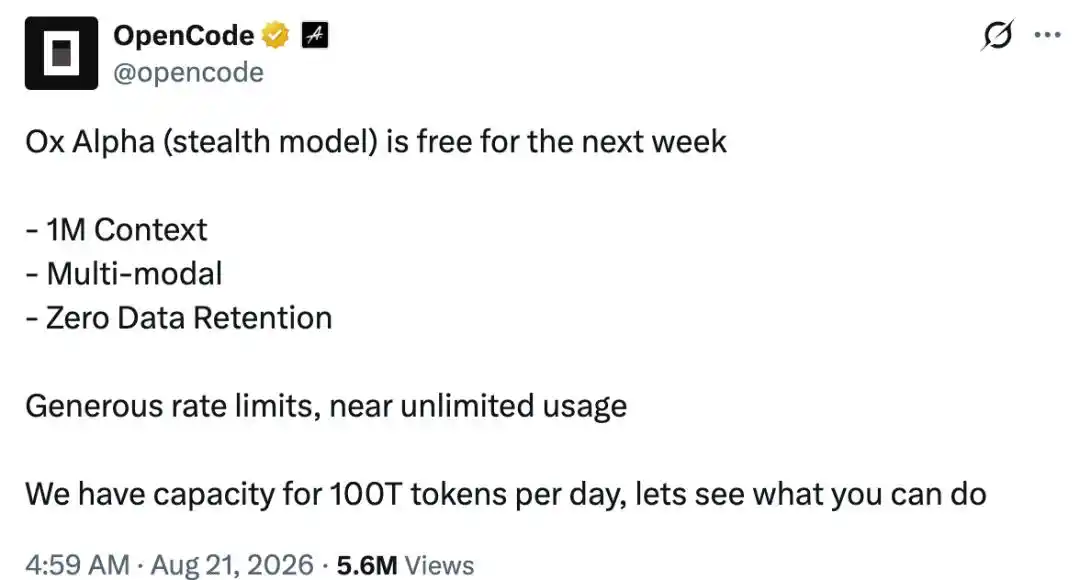
Shortly after launch, developers integrated it into a coding agent and threw it into a real code repository for testing.

Preliminary test results show that this mysterious "Ox Comes" large model's capabilities are already approaching current top-tier code models.

Meanwhile, netizens revealed that an anonymous model named korrine is being tested on Code Arena. Some speculate it's Kimi K3.1, while others point to Qwen and MiMo, with varied guesses.

In August, the large model circle has suddenly turned into a large-scale guessing game.

"Ox Comes" Model Performs Remarkably

What truly drew attention to Ox Alpha was its coding capability.

Developer Ben Davis selected 10 tasks from DeepSWE for testing, and Ox Alpha completed 8 of them, achieving an 80% pass rate. In his published comparison results, Fable 5 Max scored 65%, GLM-5.3 Max and Grok 4.6 xhigh both scored 62%, and GPT-5.6 Sol Max scored 52%.
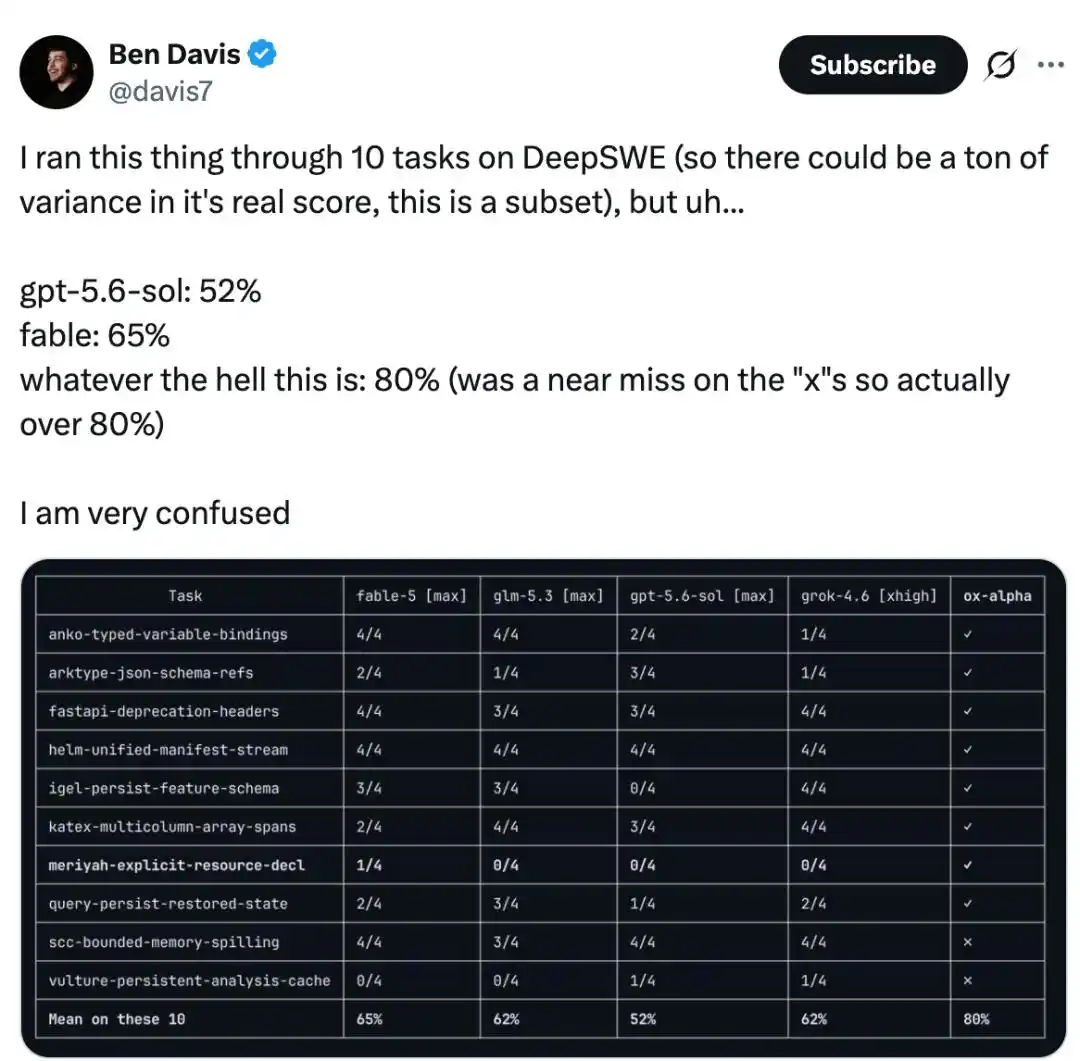
DeepSWE examines real-world software engineering ability. The model needs to read code repositories, locate problems, modify code, run tests, and continue fixing based on error reports. Compared to single-round coding problems, it's closer to the actual work of a coding Agent.

However, 10 tasks is a very small sample. Subsequently, other developers tested on another subset of DeepSWE, reporting a result of about 63%. The task scopes and execution configurations of the two tests were not identical, making it impossible to definitively rank Ox Alpha based on this alone.
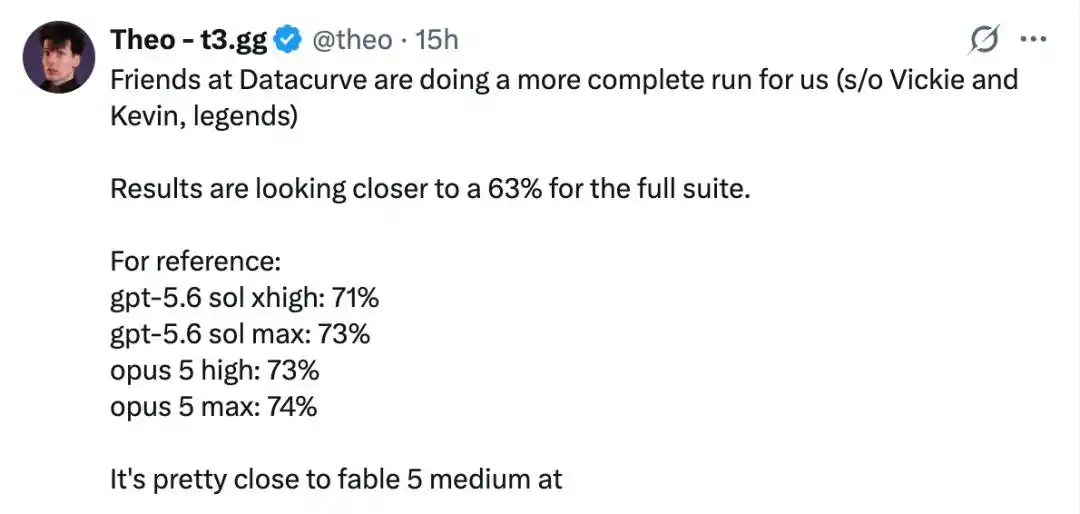
Nevertheless, these results preliminarily show that this anonymous model has demonstrated strong potential for long-context coding, with capabilities approaching current leading models.

Who Created the "Ox Comes" Large Model?

The most widespread speculation about the identity of the "Ox Comes" model is that it is an unreleased GLM-5.3 Flash from Zhipu AI, or a multimodal version of GLM-5.3.

Someone even wrote a blog to analyze this:

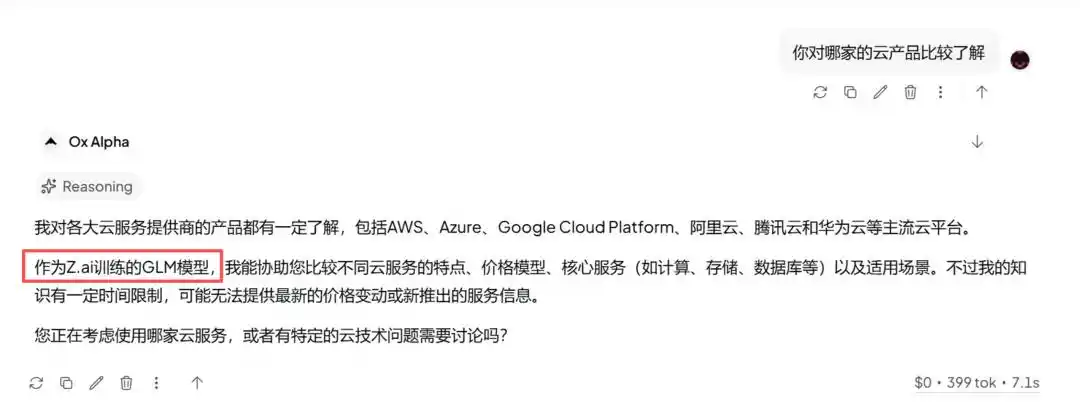
1. The strongest evidence comes from the video encoder. For four videos with different frame rates, durations, and resolutions, the visual tokens consumed by Ox Alpha matched exactly with GLM-5V-Turbo. MiMo, Qwen, and GLM-4.6V all showed significantly different results.

2. The text tokenizer also shows a high degree of alignment. The researcher tested 25 sets of prompts; the token count between Ox Alpha and GLM-5.3 consistently maintained a fixed difference of 75 tokens.

3. Other features also point to Zhipu AI. Ox Alpha refuses to process audio, which matches the routing method of GLM-5V; its answer style, the number of Agent execution steps, and the inference interface are also very similar to GLM. Zhipu AI previously used Pony Alpha for anonymous testing of GLM-5, establishing a precedent for this practice.
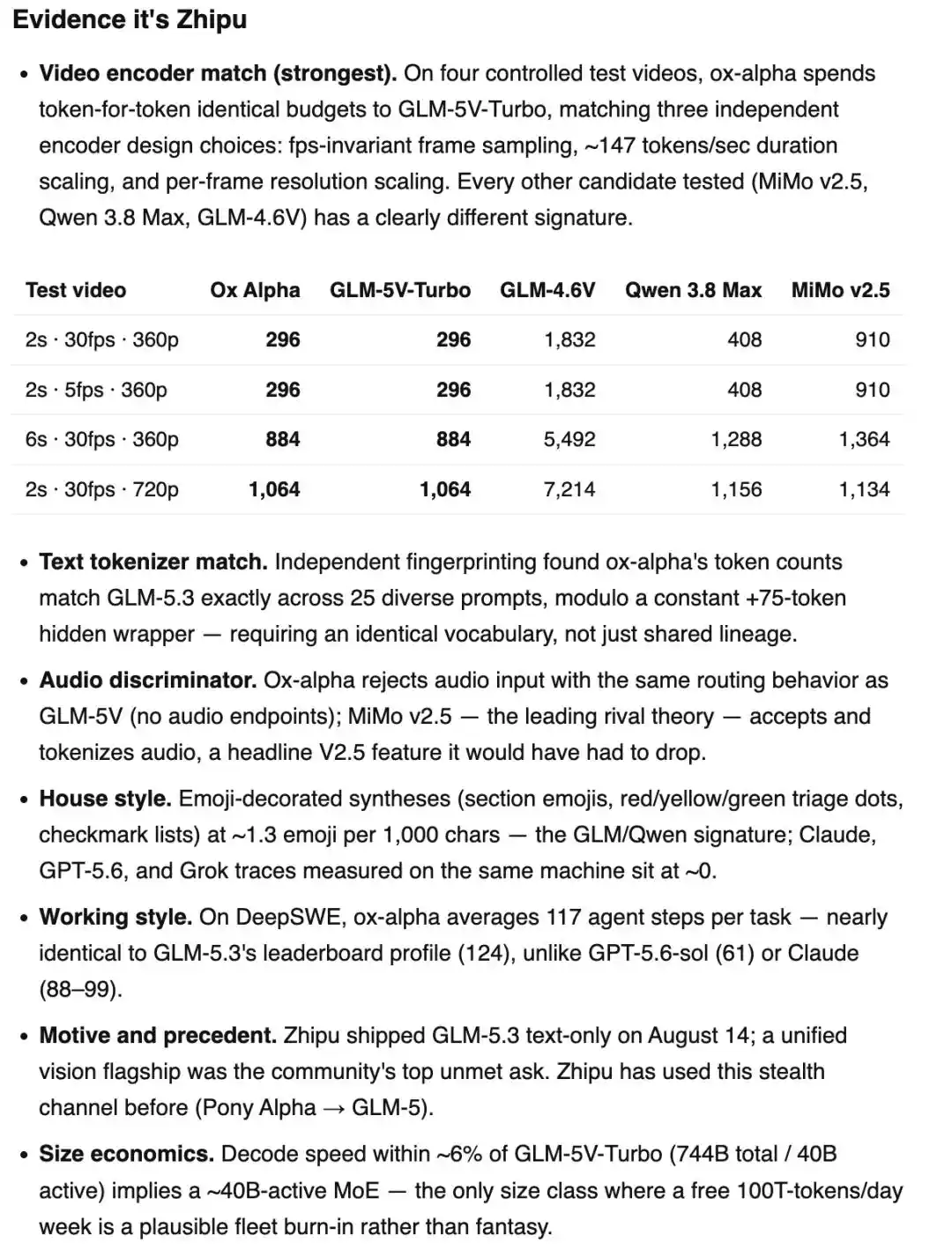
https://ox-alpha-evidence-production.up.railway.app/

Other netizens have also found clues in conversations.
Ben Davis believes he is 99% certain this is GLM-5.x.
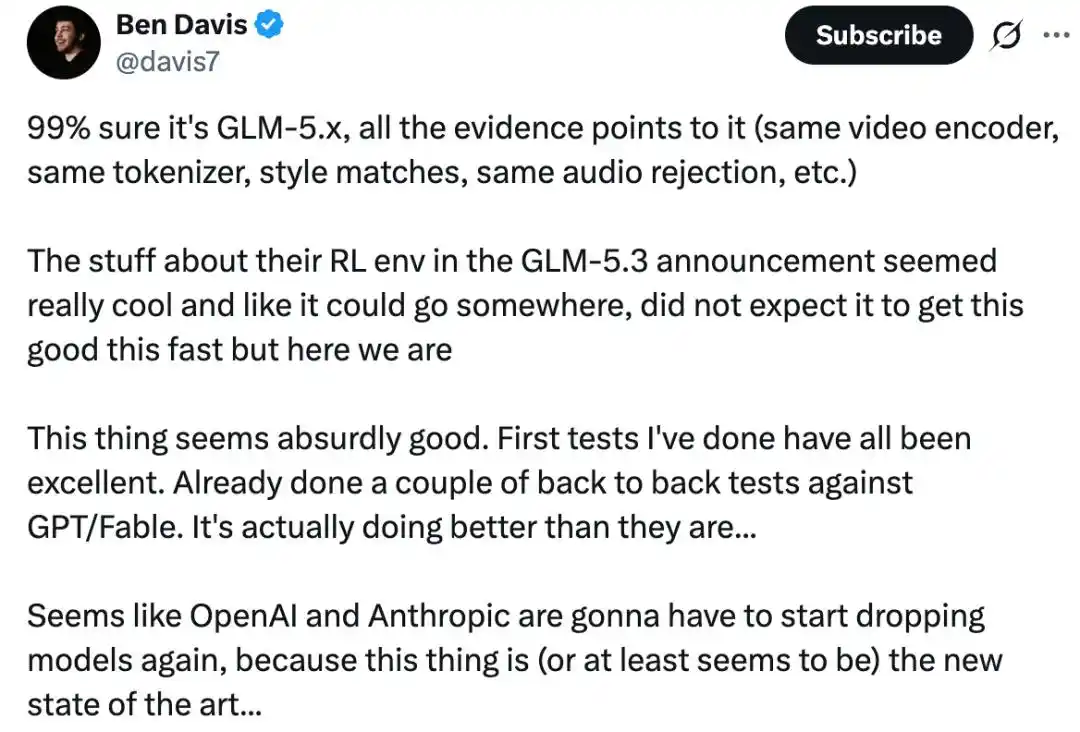
These clues increase the credibility of the GLM theory, but are still insufficient for definitive identity confirmation.

As of now, neither OpenRouter nor Zhipu AI have publicly responded.

korrine's Identity is Even More Mysterious

While the identity of the "Ox Comes" model remains unclear, another anonymous model named korrine has appeared on Code Arena.

Initially, many speculated it was Kimi K3.1, because before the release of Kimi K3, it was believed to have been tested under the codename kivine. The similar structure of kivine and korrine sparked this association.
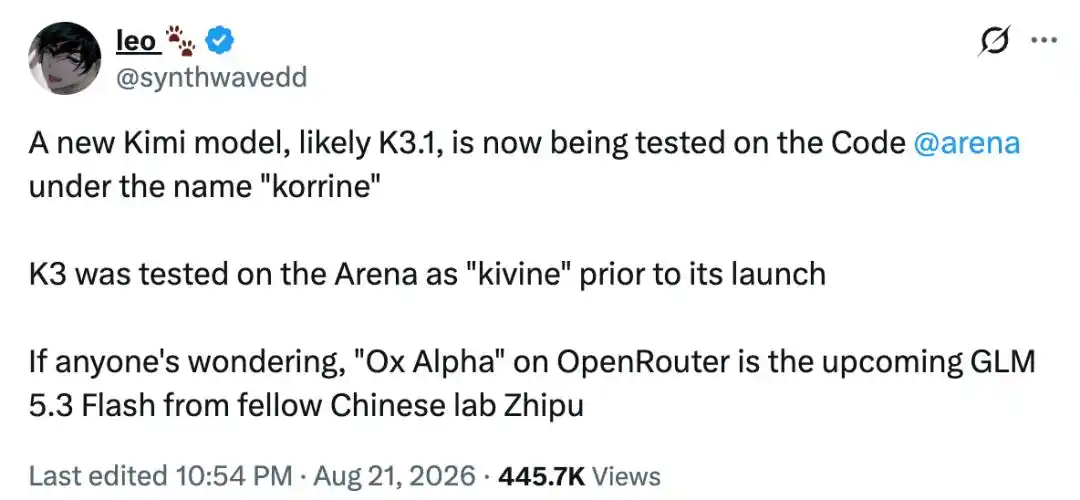
However, the original source of the rumor later added that the previously learned about new Moonshot model might correspond to another codename, adamant-ananke. korrine could also come from other Chinese teams like Qwen.
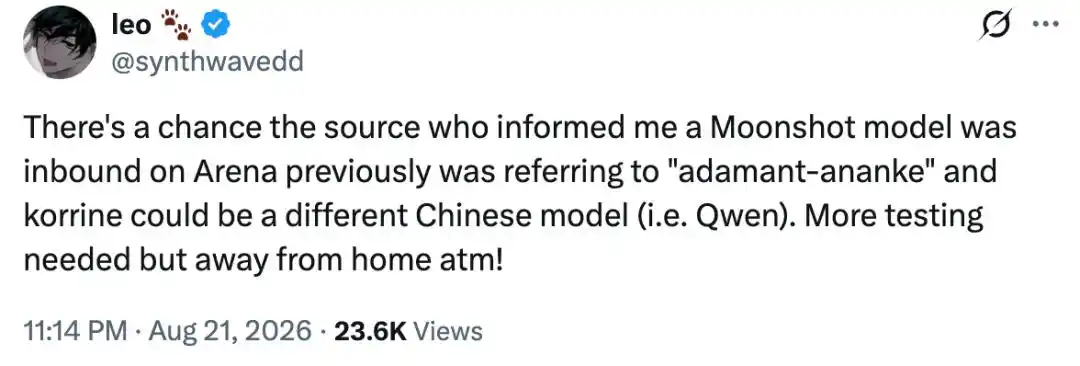
In the comments, some also pointed to MiMo V3.

Why Do Large Model Companies Like 'Testing in Disguise'?

Anonymous testing is becoming an important step before the official release of large models.

Hiding the manufacturer and model name in the Arena can minimize preconceptions brought by branding. Users cannot see the model's identity and can only choose based on actual outputs. The accumulated battle results are also closer to the real user experience.

OpenRouter provides a different kind of testing environment.

Developers integrate the model into various coding Agents, letting it enter real repositories, continuously call tools, and handle software engineering tasks lasting several hours. Issues like context stability, tool calling reliability, and whether the model gets stuck in loops or goes off track during long tasks can be quickly exposed under intense use.

For model developers, this is akin to a public stress test. Teams can observe failure cases in advance, verify the capacity of their inference services, and also accumulate real-world reputation before official launch.

Moreover, "guessing the model" is increasingly becoming a marketing tactic; the suspense over identity can indeed prolong the discussion cycle.

Finally, back to the model itself. If Ox Alpha is truly a Flash model and its coding ability is already approaching top-tier levels, where will the ceiling be pushed by the more resource-intensive, more capable full version?

Reference Links:

https://x.com/Adidotdev/status/2090833298713096241

https://x.com/davis7/status/2090669483740279155?s=20

https://x.com/davis7/status/2090655207831298095?s=20

https://x.com/MaxForAI/status/2090783750217162788

This article is from the WeChat public account "Almost Human" (ID: almosthuman2014), author: Following AI

Preguntas relacionadas

QWhat is the name of the anonymous model discussed in the article that appeared on OpenRouter, and why did it capture significant attention?

AThe anonymous model discussed is named 'Ox Alpha' (nicknamed 'Niu Lai' by Chinese netizens). It captured significant attention primarily due to its impressive performance on real-world software engineering tasks, specifically in coding tests like DeepSWE where it achieved high pass rates, showing capabilities approaching top-tier code models.

QAccording to the article's investigation, which company is the leading candidate for being behind the 'Ox Alpha' model, and what evidence supports this claim?

AThe leading candidate suggested in the article is Zhipu AI, possibly an unreleased GLM-5.3 Flash or a multimodal version of GLM-5.3. Supporting evidence includes: 1) Its video encoder's visual token consumption perfectly matches GLM-5V-Turbo, 2) Its text tokenizer shows a fixed token count offset compared to GLM-5.3, and 3) Other behavioral traits, such as refusing to process audio, align with Zhipu's GLM models. The company also has a precedent for anonymous testing.

QBesides 'Ox Alpha', what is the name of the other anonymous model mentioned in the article that is being tested on Code Arena, and what are some speculations about its origin?

AThe other anonymous model mentioned is named 'korrine', tested on Code Arena. Speculations about its origin include that it could be Moonshot AI's upcoming Kimi K3.1 (due to a similar earlier test codename), a model from Qwen, or MiMo V3. The article states its identity is even more mysterious than that of Ox Alpha.

QWhat are the two main benefits for AI model companies to conduct anonymous testing, as explained in the article?

AThe article explains two main benefits: 1) It allows for unbiased evaluation by removing brand bias, enabling users to judge models based solely on performance, leading to results that better reflect real user experience. 2) It serves as a public stress test, helping companies identify failure cases, verify the capacity of their inference services, and build genuine user reputation before an official launch.

QWhat specific capability of the 'Ox Alpha' model was tested using the DeepSWE benchmark, and what was one of its notable performance results mentioned?

AThe 'Ox Alpha' model was tested on its real-world software engineering capability using the DeepSWE benchmark, which requires tasks like reading code repositories, locating issues, modifying code, and running tests. One notable result mentioned was that in an initial test of 10 tasks by a developer, Ox Alpha completed 8, achieving an 80% pass rate, which was higher than several other top models in the comparison.

Lecturas Relacionadas

He Gave Wang Xingxing the First 2 Million, Now Serves as Chairman for the Next 'Unitree'

On August 19, 2024, Unitree Robotics, China's "first humanoid robotics stock," went public. Its founder, Wang Xingxing, started a decade ago with his self-developed XDog. In 2016, at a critical funding juncture, he received his first angel investment of 2 million RMB from Yin Fangming. This bet has since yielded a return of over 140 times. Yin Fangming is more than just a key investor. He was a co-founder of the AI robotics company ROOBO, whose own venture ultimately struggled. This firsthand experience with the hardware challenges in robotics gave him unique insight when backing Unitree, a company renowned for its hardware R&D and cost control. While his own company faltered, Yin continued investing shrewdly. He partially cashed out some Unitree shares early, reinvesting the proceeds into sectors like energy (e.g., solid-state battery firm TaiLan) and commercial aerospace (e.g., small launch vehicle developer XianDeng Aerospace). However, his most significant move after Unitree is his deep involvement with Galaxy General, a leading embodied AI unicorn. In July 2024, Yin stepped from behind the scenes to officially become its Chairman, indicating a role far beyond a typical investor. This comes as Galaxy General is viewed as preparing for future capital moves. Yin's career has consistently been ahead of the curve—from mobile internet to AI and robotics. Known for his foresight and low profile, he declined an interview for this story, offering only a statement encouraging support for visionary entrepreneurs like Wang Xingxing.

marsbitHace 5 min(s)

He Gave Wang Xingxing the First 2 Million, Now Serves as Chairman for the Next 'Unitree'

marsbitHace 5 min(s)

Coldcard Theft Reflection: Source Code Visibility Does Not Equal Security

The article examines the open-source vs. closed-source debate in crypto, prompted by a theft of over $100M in Bitcoin from Coldcard hardware wallets. It clarifies key terminology: true "Free and Open Source Software" (FOSS) grants four essential freedoms (use, study, share, modify), while "source available" code, like Coldcard's firmware, may have usage restrictions. The piece argues that visible source code alone does not guarantee security; actual safety depends on the economic incentives for thorough, ongoing review by skilled individuals. Using Bitcoin Core as a model, the article describes a successful, transparent open-source development culture built on public review and consensus. It contrasts this with the Coldcard case, where a critical bug in a lightly-reviewed, source-available library went undetected for years, highlighting a "tragedy of the commons" scenario where assumed but absent scrutiny creates vulnerability. The economics of licensing are crucial: restrictive licenses can limit the pool of motivated commercial reviewers. Finally, the article explores AI's impact. It cites the Bitcoin Red Team's use of AI to rapidly audit codebases and find vulnerabilities at scale, demonstrating a powerful new tool for security. However, AI also floods projects with low-quality code, straining maintainers. The piece concludes that in high-stakes crypto, only well-audited projects—whether open or closed-source—can withstand evolving threats, with AI both challenging and aiding security practices.

marsbitHace 16 min(s)

Coldcard Theft Reflection: Source Code Visibility Does Not Equal Security

marsbitHace 16 min(s)

Trading

Spot
活动图片