Q2 Crypto Market Review: Did Bitcoin Rise for 'Nothing'? Did Money Flow to AI and On-Chain?

Foresight NewsPublicado a 2026-07-01Actualizado a 2026-07-01

Resumen

Q2 2026 Crypto Market Recap: Bitcoin's Gains Erased Amid Shift to AI and On-Chain Activity The second quarter of 2026 saw a significant reversal for the cryptocurrency market. Bitcoin gave back all its April gains, ending Q2 down approximately 11%, while major stock indices posted strong gains. This divergence was driven by a hawkish shift in Fed rate expectations, capital rotation into AI stocks, and weakening liquidity channels into crypto. Key demand pillars deteriorated simultaneously. Spot Bitcoin ETFs recorded net outflows of $4.08 billion for the quarter, with outflows dominating June. Crypto treasury entity Strategy's bitcoin accumulation slowed markedly, and the total stablecoin market cap contracted by ~$4.2 billion. This created a tighter liquidity environment. Exchange data reflected the downturn. Spot trading volumes fell 28% quarter-over-quarter. The market underwent significant deleveraging, with $8.35 billion in long liquidations for BTC and ETH, primarily in late May/early June. Open interest and order book liquidity also declined. Despite the bearish price action, structural developments point to an expanding on-chain ecosystem. These include the rise of tokenized stocks with full legal rights, the growth of RWA (real-world asset) perpetual contracts for trading stocks and commodities 24/7, and the use of crypto markets for price discovery ahead of major events like the SpaceX IPO. On-chain vaults are also emerging as a core layer for institutional capit...


Author: Tanay Ved, Coin Metrics

Compiled by: Luffy, Foresight News


TL;DR:


  • Bitcoin gave back all of its April gains, falling approximately 11% in Q2 against a backdrop of shifting interest rate expectations, ETF outflows, and capital rotation into AI stocks.
  • Three major liquidity channels—ETFs, Treasury companies like Strategy, and stablecoins—all weakened in Q2, with spot Bitcoin ETFs alone seeing net outflows of $4.08 billion.
  • Total long liquidations for BTC and ETH reached $8.35 billion, leading to significant deleveraging in Q2, but the market entered Q3 in a more stable condition.


Market Overview


The crypto market entered Q2 2026 with strong momentum. After a difficult Q1, Bitcoin rebounded alongside equities in April, as geopolitical tensions eased briefly and institutional demand improved, climbing to around $82,000. However, this recovery did not last.


This reversal was driven by three forces: Brent crude prices hitting a high of $126.41 amid volatility from geopolitical negotiations, a hawkish shift in the Federal Reserve's interest rate outlook, and capital rotation into the AI trade.
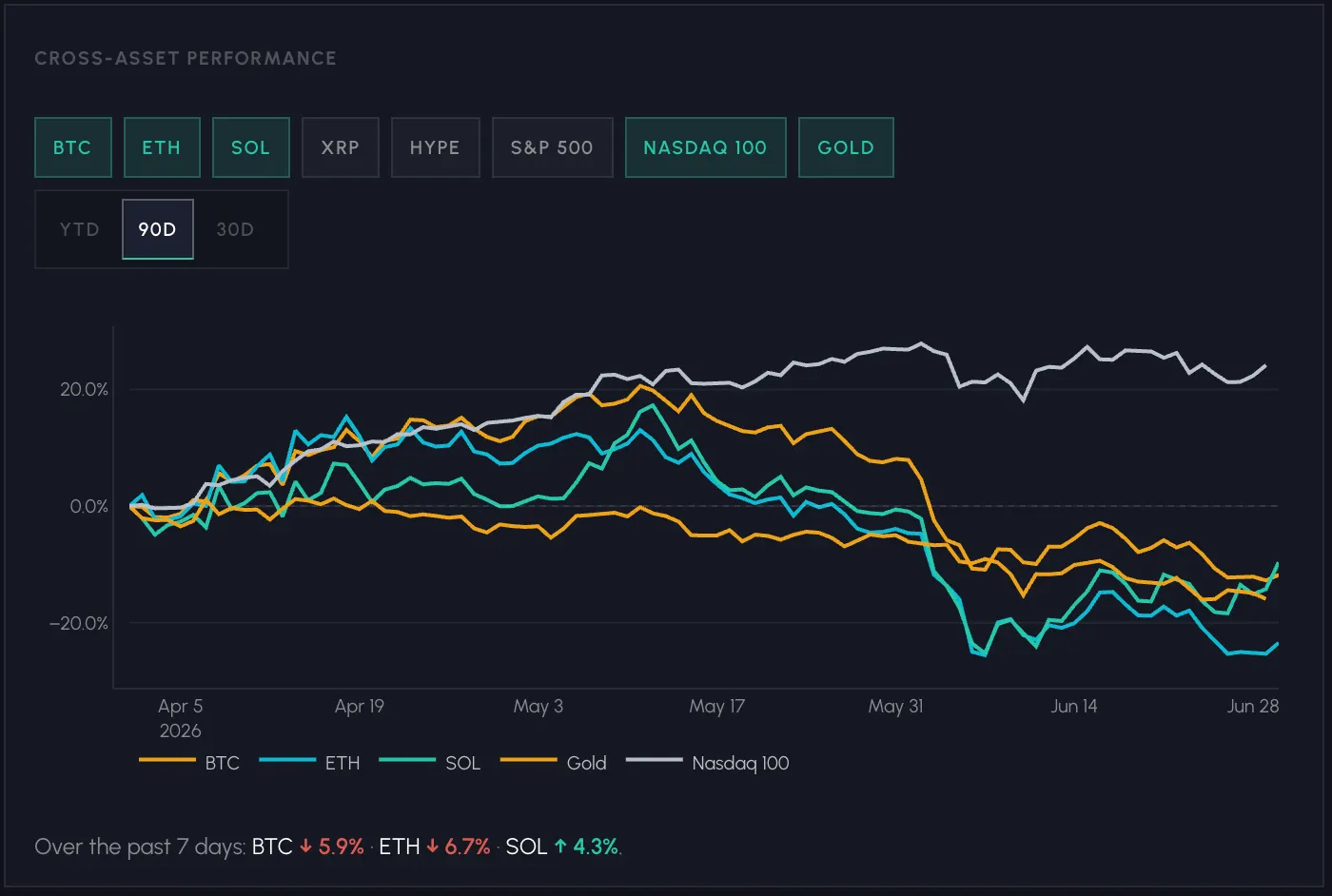


Until mid-May, cryptocurrencies and equities largely moved in sync, with both BTC and ETH rising about 20% from their early-April lows. The divergence came in late May when cryptocurrencies pulled back while equities held firm. Ultimately, the S&P 500 and Nasdaq 100 rose approximately 16% and 28% for the quarter, respectively, while BTC fell about 10%, ETH about 20%, and SOL about 13%.
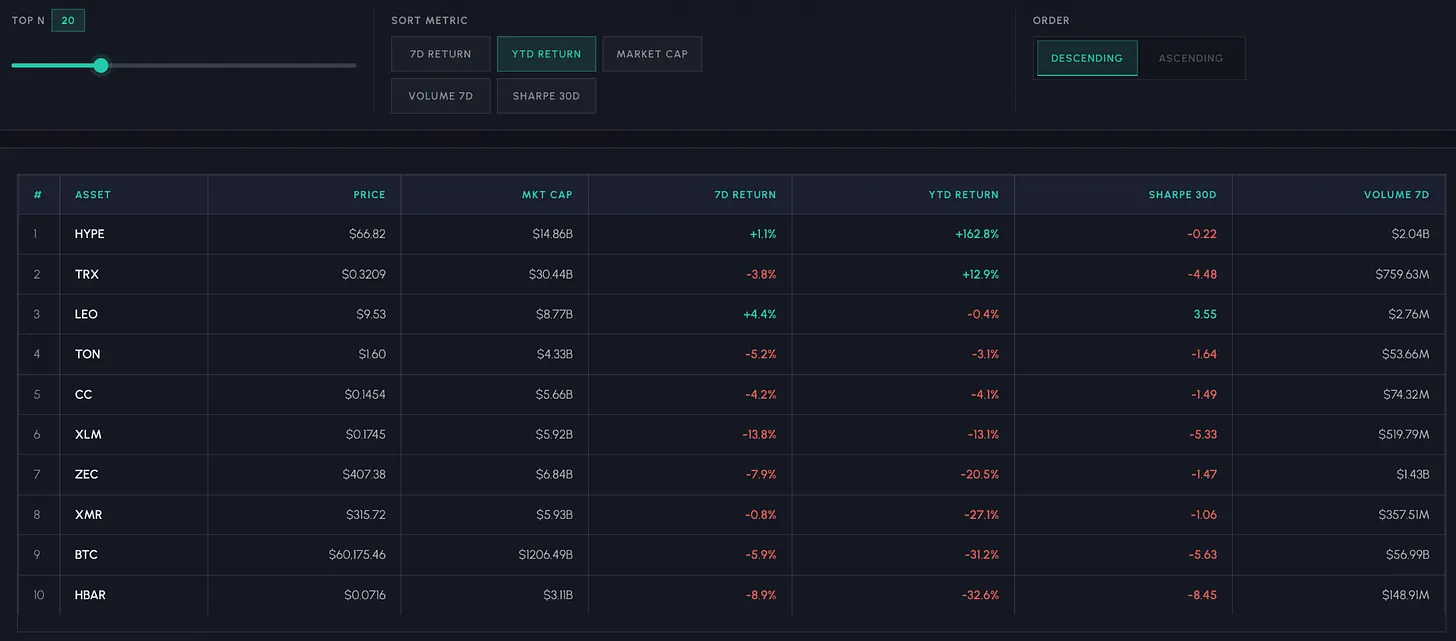


Bitcoin is currently trading around $60,000, down about 52% from its all-time high of $126,000 set in late 2025. Altcoin performance has been similar, with few gainers. Year-to-date, among the top 20 crypto assets by market cap, Hyperliquid (HYPE) remains the sole bright spot (up 142%), driven by strong demand for its on-chain trading of perpetual contracts for stocks and commodities.


Fund Flows


The weakness in Q2 was exacerbated by the deterioration of three key demand channels: spot ETFs, crypto asset treasuries like Strategy, and stablecoin supply.


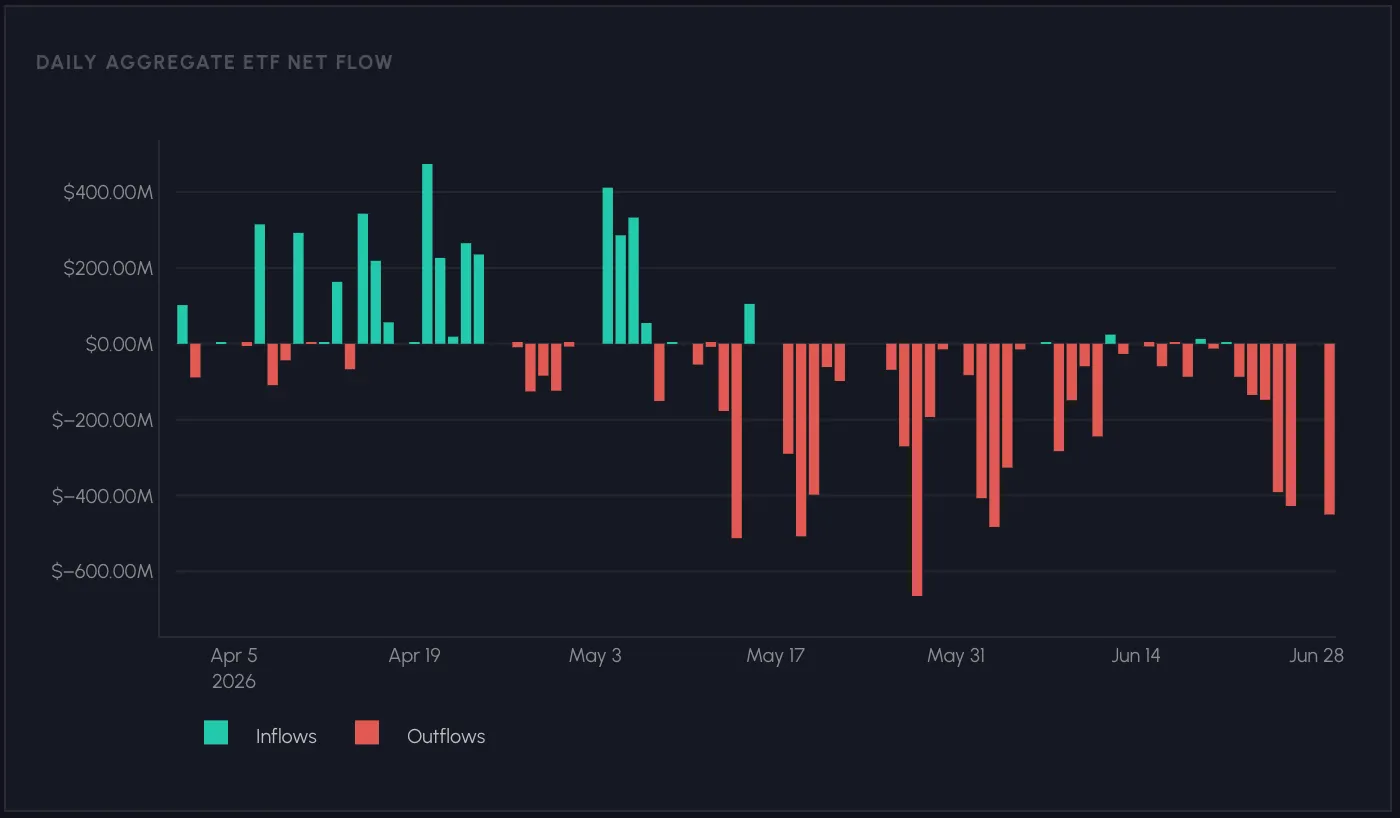
Spot Bitcoin ETFs: April started strong for spot Bitcoin ETFs, dominated by inflows. The peak single-day inflow of $474 million occurred on April 20th, after which flows reversed. Outflows dominated for the rest of the quarter, with 53 days of outflows compared to 30 days of inflows in Q2. June was the primary culprit, with net outflows reaching $3.84 billion for the month among tracked ETF issuers, accounting for the majority of the quarter's total net outflow of $4.08 billion.


Crypto Asset Treasuries (Strategy Companies): This quarter, Bitcoin accumulation by Strategy companies slowed significantly. Their preferred shares (STRC), designed to stabilize around $100, fell to a historic low of $74, while Strategy's market-to-net-asset-value ratio (mNAV) compressed close to 1.0, impacting the funding channels behind their accumulation. A surprise sale of 32 BTC in early June unsettled the market and broke the "never sell" sentiment. In response, Strategy established a new Digital Credit Capital framework, raising STRC dividends to 12%, authorizing the sale of up to $1.25 billion worth of BTC, and setting up a $2.55 billion USD reserve to cover approximately 17 months of debt.


Stablecoins: The total stablecoin market cap contracted by approximately $4.2 billion in Q2, reducing the funds underpinning on-chain activity and liquidity. USDT saw a modest increase of $1.8 billion, while USDC decreased by $3.4 billion. Ethena's USDe fell by $1.4 billion as risk-off sentiment dampened interest in yield-bearing stablecoin strategies.


With the three major demand channels weakening simultaneously, the liquidity environment heading into Q3 is markedly tighter than at the start of Q2. Whether this demand will return to crypto assets or continue flowing into AI stocks remains a dynamic to watch.


Exchange Activity & Derivatives


Total spot trading volume on exchanges fell 28% quarter-over-quarter to $2.32 trillion, continuing a downtrend that began in January. Futures volume fared slightly better at $12.32 trillion, down 11.6% QoQ, but the spot/futures ratio compressed from 0.23x to 0.19x, indicating an increase in derivative positioning rather than spot demand.


Hyperliquid stood out, with its futures trading volume market share growing to around 4.5%, as on-chain perpetuals continued to take market share from centralized exchanges.
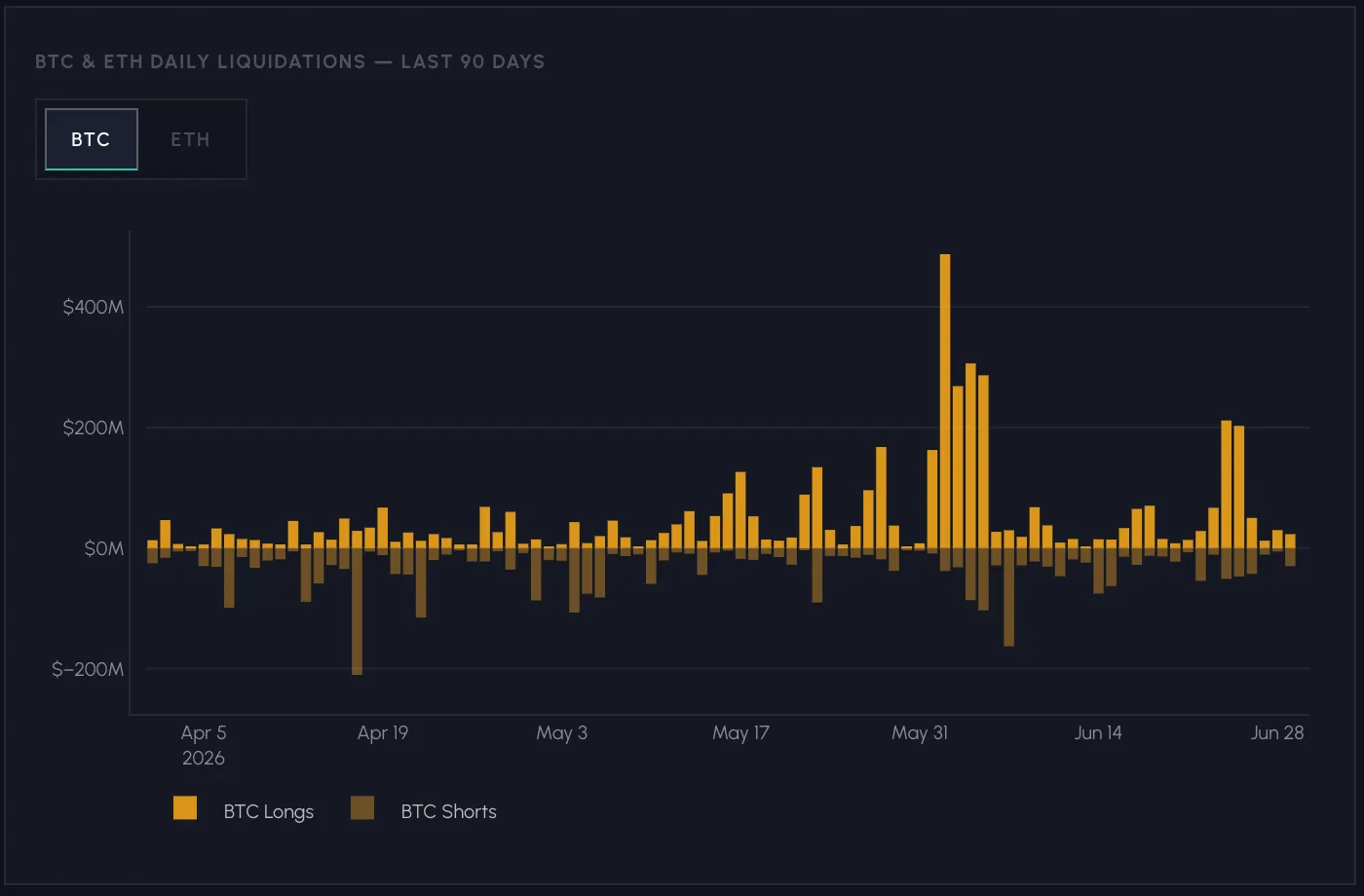


Open interest peaked before the May sell-off, reaching $49.2 billion for BTC and $27.2 billion for ETH. Currently, these figures have dropped to $33.5 billion (BTC) and $16.2 billion (ETH), down 32% and 40% from their peaks, respectively. Throughout Q2, total long liquidations for BTC and ETH reached $8.35 billion. More than half of these liquidations occurred between May 25th and June 7th, as over-leveraged long positions were wiped out. The market entered Q3 in a more deleveraged state.


Funding rates were volatile during Q2, swinging from deeply negative (annualized -16%) in mid-April to strongly positive (annualized +10%) in May as long positions increased. The subsequent sell-off pulled rates back to neutral levels, fluctuating around zero at quarter-end, reflecting cautious sentiment.


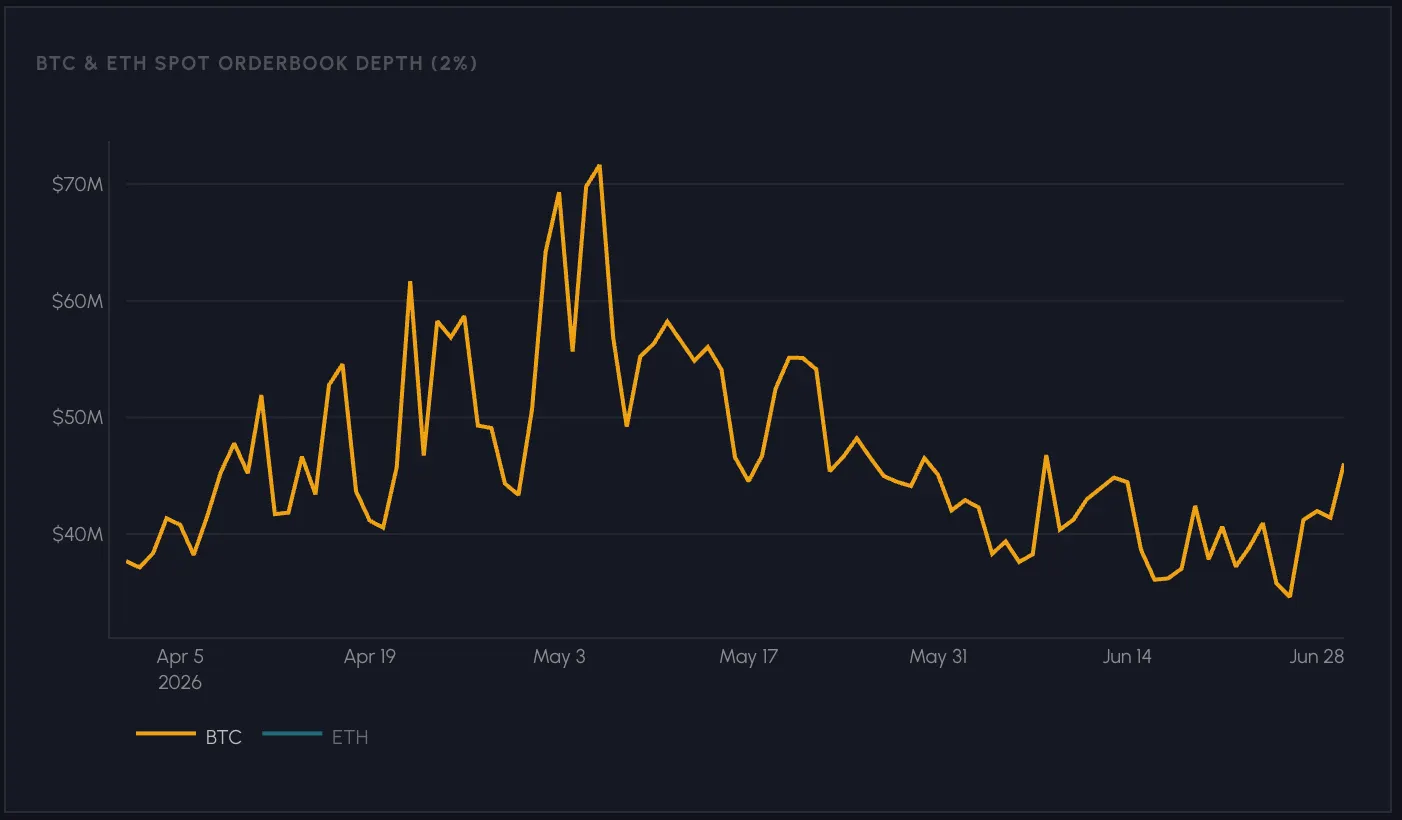
Liquidity also deteriorated in sync. The 2% order book depth for Bitcoin fell from a peak of around $70 million in early May to about $35-40 million by late June, indicating reduced market liquidity and a diminished ability to absorb selling pressure.


Key Themes to Watch Going Forward


Beyond Q2's price action, several structural developments point to the market's future direction, from new asset classes emerging on-chain to the infrastructure supporting them.


  • Tokenized Stocks: Coinbase announced the launch of 1:1 pegged, fully legally entitled tokenized stocks.
  • The Rise of RWA Perpetuals: On-chain trading and price discovery have moved beyond crypto, extending to stocks, indices, and commodities via Hyperliquid HIP-3 perpetuals and centralized exchanges offering 24/7 RWA perpetuals.
  • SpaceX IPO Priced On-Chain: The $1.7 trillion SpaceX IPO was priced on crypto rails ahead of its public listing, providing early price discovery signals for private companies.
  • Vaults & Lending Markets: On-chain vaults are becoming a core allocation layer for institutional capital, pooling deposits into curated lending strategies on protocols like Morpho and Aave. Infrastructure is maturing rapidly as traditional asset managers like Bitwise enter the vault management space.


Criptos en tendencia

Preguntas relacionadas

QAccording to the article, what were the three main forces that drove the reversal in the cryptocurrency market's recovery in Q2 2026?

AAccording to the article, the three main forces were: 1) Brent crude oil prices hitting a high of $126.41 due to geopolitical negotiation volatility, 2) A shift towards a more hawkish Federal Reserve interest rate outlook, and 3) Capital rotation into the AI stock trading sector.

QWhat was the trend in net flows for spot Bitcoin ETFs during Q2 2026, and which month saw the largest net outflow?

AIn Q2 2026, net flows for spot Bitcoin ETFs reversed from initial strong inflows in April to consistent outflows for the rest of the quarter. The largest net outflow occurred in June, with a net outflow of $38.4 billion, accounting for most of the quarter's total net outflow of $40.8 billion.

QHow did the total stablecoin market capitalization change in Q2 2026, and what were the specific trends for USDT and USDC?

AIn Q2 2026, the total stablecoin market capitalization contracted by approximately $4.2 billion. Specifically, USDT saw a moderate increase of $1.8 billion, while USDC experienced a decrease of $3.4 billion.

QWhat does the article state about the performance of Hyperliquid (HYPE) and the reason behind it?

AThe article states that Hyperliquid (HYPE) was the only standout performer among the top 20 crypto assets by market capitalization year-to-date, with a gain of 142%. This performance was attributed to robust demand for its on-chain trading of stock and commodity perpetual contracts.

QWhat are some of the key structural developments mentioned in the article that signal the future direction of the market?

AKey structural developments mentioned include: 1) Tokenized stocks with full legal rights announced by Coinbase, 2) The rise of RWA perpetual contracts extending to stocks, indices, and commodities, 3) The SpaceX IPO being priced on-chain before public listing, and 4) The maturation of on-chain vaults as a core allocation layer for institutional capital, attracting traditional asset managers like Bitwise.

Lecturas Relacionadas

The Largest Upgrade Since The Merge? How Glamsterdam Will Affect Ethereum and Regular Users?

The upcoming Glamsterdam upgrade, scheduled for late 2026, is considered Ethereum's most significant change since The Merge. It focuses on fundamentally restructuring Ethereum's block production, transaction execution, and gas pricing to enable major scalability improvements while preserving decentralization. The upgrade centers on three key innovations: * **Enshrined PBS (ePBS)**: Moves the Proposer-Builder Separation mechanism into the protocol's core, eliminating reliance on external relays. This reorganizes the block pipeline, extending the time window for processing execution payloads, which is crucial for safely increasing block capacity. * **Block-Level Access Lists (BALs)**: Attaches a "map" to each block, declaring in advance which state data its transactions will access. This enables potential parallel transaction processing and faster node synchronization, breaking a key performance bottleneck. * **Gas Repricing**: Introduces a more accurate resource pricing model by separating computation costs from state storage costs. This discourages uncontrolled state growth by making operations that create permanent data (like new accounts) more accurately reflect their long-term network burden. Together, these changes aim to solve the core challenges of increasing Ethereum's throughput (e.g., raising the Gas Limit) without overburdening node hardware or increasing centralization risks. They prepare the infrastructure for higher capacity, targeting a credible post-upgrade capacity of up to 200 million Gas. For users, the impact will be nuanced: * General transaction fees may become lower and more stable as block space increases. * Simple transfers could see cost reductions, while state-intensive operations (like contract deployment) may become relatively more expensive due to the new gas model. * Gas fee estimations by wallets will become more accurate. * L2 networks could benefit long-term from increased data blob capacity. * Standardized logs for all ETH transfers (EIP-7708) will improve tracking for wallets and exchanges. Ultimately, Glamsterdam represents a foundational shift, not a simple block size increase. It seeks to expand Ethereum's capacity by re-engineering its underlying mechanics, maintaining its commitment to decentralization while enabling significant performance gains.

marsbitHace 2 hora(s)

The Largest Upgrade Since The Merge? How Glamsterdam Will Affect Ethereum and Regular Users?

marsbitHace 2 hora(s)

Circle CEO Responds to the OUSD Challenge: Stablecoin is a Winner-Takes-All Business, and We Won't Slow Down

In response to questions about the OUSD stablecoin initiative, Circle CEO Jeremy Allaire argues that the stablecoin market is a "winner-take-most" platform business driven by powerful network effects, and Circle has no plans to slow down. He outlines three key drivers behind USDC's dominant position: 1. **Protocol/Software Layer Network Effects**: The value of a stablecoin network grows as more developers and services integrate it, creating compounding utility and user preference. Circle has spent nearly a decade building this ecosystem with USDC, now accelerated by mainstream adoption and enhanced by software stacks like CCTP and Gateway for interoperability. 2. **Liquidity Network Effects**: Liquidity begets more liquidity. USDC has achieved top-tier global liquidity—ranking among the top three digital assets alongside BTC and USDT—through nearly a decade of building deep primary and secondary market access across regions and venues. 3. **Regulatory and Policy Integration**: Establishing a global stablecoin requires deep regulatory engagement, licensing, and compliance across key markets—a significant, long-term investment where Circle is a leader. Allaire cites Artemis data showing USDC facilitated 80% of all dollar stablecoin on-chain transaction volume in Q1 2026, with USDT at 20% and all others negligible. He addresses OUSD's purported advantages: "free" minting/burning is often not sustainable in practice; redistributing all revenue can starve essential infrastructure investment; and large consortium models historically struggle with inefficiency and slow execution, unlike focused strategic partnerships. He reaffirms Circle's strong ongoing partnership with Coinbase on USDC and notes Circle collaborates with dozens of other stablecoin issuers through its expanding platform (Arc, CCTP, CPN, etc.). While welcoming OUSD to the ecosystem, Allaire asserts that Circle's vast, trusted network and continued investment make USDC the foundational digital dollar infrastructure for the world.

链捕手Hace 2 hora(s)

Circle CEO Responds to the OUSD Challenge: Stablecoin is a Winner-Takes-All Business, and We Won't Slow Down

链捕手Hace 2 hora(s)

Trading

Spot

Artículos destacados

Cómo comprar FLOW

¡Bienvenido a HTX.com! Hemos hecho que comprar Flow (FLOW) sea simple y conveniente. Sigue nuestra guía paso a paso para iniciar tu viaje de criptos.Paso 1: crea tu cuenta HTXUtiliza tu correo electrónico o número de teléfono para registrarte y obtener una cuenta gratuita en HTX. Experimenta un proceso de registro sin complicaciones y desbloquea todas las funciones.Obtener mi cuentaPaso 2: ve a Comprar cripto y elige tu método de pagoTarjeta de crédito/débito: usa tu Visa o Mastercard para comprar Flow (FLOW) al instante.Saldo: utiliza fondos del saldo de tu cuenta HTX para tradear sin problemas.Terceros: hemos agregado métodos de pago populares como Google Pay y Apple Pay para mejorar la comodidad.P2P: tradear directamente con otros usuarios en HTX.Over-the-Counter (OTC): ofrecemos servicios personalizados y tipos de cambio competitivos para los traders.Paso 3: guarda tu Flow (FLOW)Después de comprar tu Flow (FLOW), guárdalo en tu cuenta HTX. Alternativamente, puedes enviarlo a otro lugar mediante transferencia blockchain o utilizarlo para tradear otras criptomonedas.Paso 4: tradear Flow (FLOW)Tradear fácilmente con Flow (FLOW) en HTX's mercado spot. Simplemente accede a tu cuenta, selecciona tu par de trading, ejecuta tus trades y monitorea en tiempo real. Ofrecemos una experiencia fácil de usar tanto para principiantes como para traders experimentados.

258 Vistas totalesPublicado en 2024.12.10Actualizado en 2026.06.02

Cómo comprar FLOW

Discusiones

Bienvenido a la comunidad de HTX. Aquí puedes mantenerte informado sobre los últimos desarrollos de la plataforma y acceder a análisis profesionales del mercado. A continuación se presentan las opiniones de los usuarios sobre el precio de FLOW (FLOW).

活动图片