On August 24, Morgan Stanley analyst Stephen Byrd offered a counterintuitive judgment: Governors across multiple U.S. states are slowing down or even halting data center construction, and the biggest beneficiaries of this development are Bitcoin mining companies—because their facilities are already connected to the power grid.
He named Cipher, Hut 8, Galaxy Digital, MARA Holdings, and Riot Platforms. This reasoning sounds convoluted but is actually straightforward: When new electricity cannot be connected, the existing electricity becomes more valuable.
What's Really Happening Across the U.S.?
Over the past month, opposition to data centers has evolved from scattered NIMBY incidents into an organized political movement.
A Gallup survey in August showed that 71% of Americans oppose building data centers in their local areas. More than 500 towns across the U.S. have imposed restrictions on data center construction. Some local officials have received death threats or even been shot due to approval issues, and some councils have directly closed public comment sessions.
State-level actions are more decisive. New York Governor Kathy Hochul proposed a one-year moratorium on data center construction. Pennsylvania Governor Josh Shapiro signed an executive order imposing strict restrictions on new data center builds.
Texas Governor Greg Abbott shifted from a warm welcome to a suspension of approvals within three months. His reasoning was almost a direct jab at these companies: Data center firms failed to win community support and dug their own graves; this backlash is what they deserve.
Virginia became the first state in the U.S. to tax data centers based on electricity consumption, expecting to collect $6 billion next year; Loudoun County within the state already has over 250 data centers and has now begun restricting new construction.
The cost is quantifiable. In the first quarter of this year, at least 75 data center projects were shelved or delayed due to local opposition, involving approximately $130 billion.
On this issue, the White House and the governors are moving in opposite directions. In an interview on August 23, Trump said communities rejecting data centers are making a mistake because data centers bring substantial employment and wealth. But the approval authority is not in his hands.
Why Has "Already Being Grid-Connected" Suddenly Become Valuable?
To understand Morgan Stanley's judgment, one must first grasp what is truly difficult about building a data center.
The difficulty is not in constructing the building, but in getting power. A large AI data center often requires hundreds of megawatts of electricity, necessitating that the utility company specifically run lines, expand capacity, and queue for approvals—a process taking several years. This link is now politically blocked. The Texas Public Utility Commission has even scheduled a timeline to re-review all grid connection applications for data centers and crypto mining farms by December 10, with a report due on December 17.
And what do Bitcoin mining companies have? What they have been doing for the past decade is searching the world for cheap electricity and then connecting their facilities to it. These power connection contracts, substation facilities, and grid interconnection permits are all ready-made, already approved, and no longer subject to public vote or veto.
In an era when data centers could be built anywhere, this was nothing special. In an era when they cannot be built, this is one of the scarcest resources in the entire United States.
Miners Have Been Pivoting for a While
This is not a new story; it has just been accelerated by politics.
Over the past three quarters, listed mining companies have collectively reduced their hash rate by 21%—not by quitting, but by freeing up electricity for AI use. On August 11, Anthropic signed a $91 billion computing power agreement with Riot Platforms.
The market has long priced in this pivot.
According to CoinShares' statistics, mining companies undertaking AI and high-performance computing contracts have an enterprise value multiple of 12.3x; those purely mining Bitcoin have only 5.9x. The same electricity, the same facilities, the same operations team—connecting to AI contracts more than doubles the valuation.
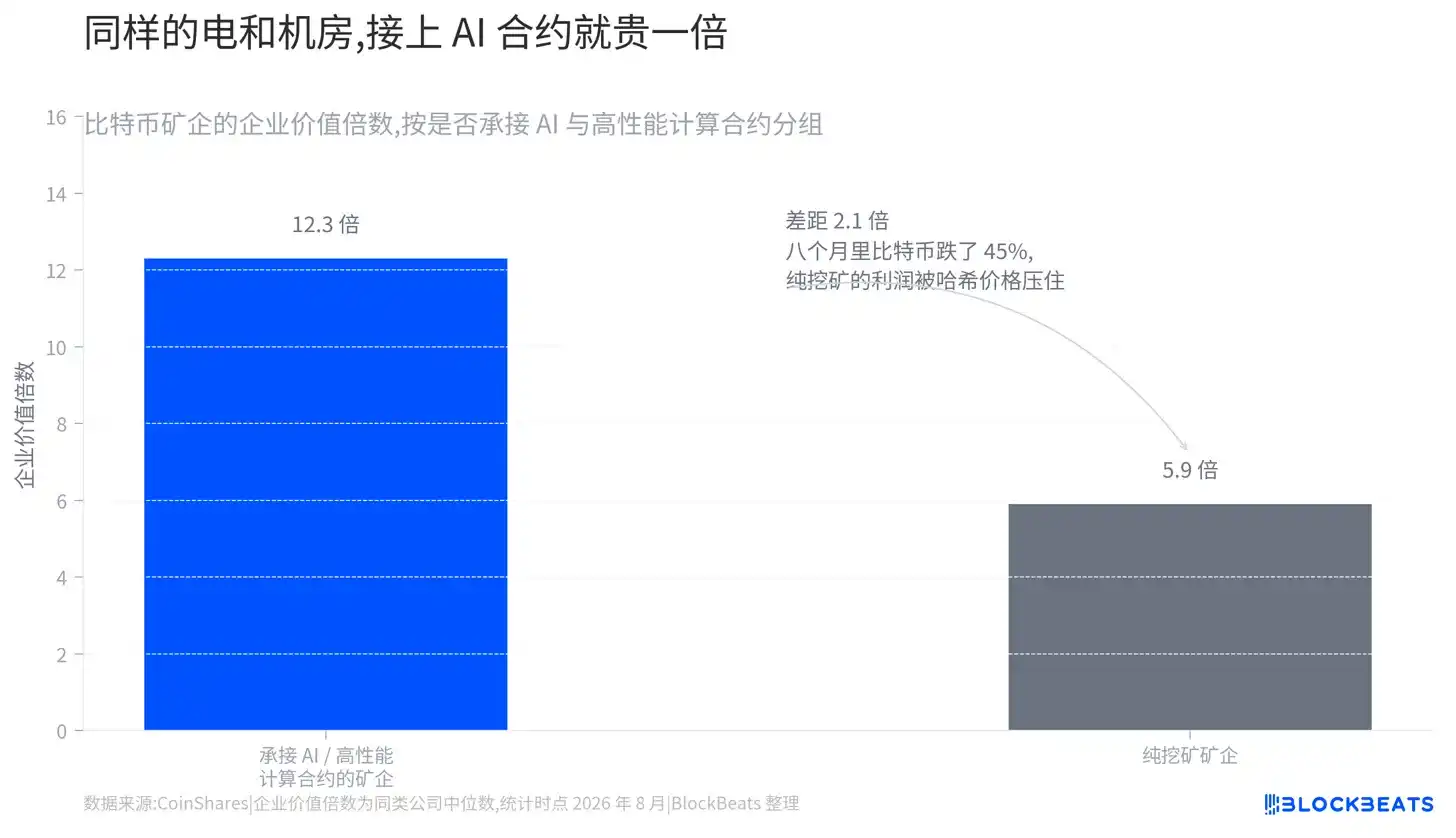
The underlying reason is that the pure mining business is indeed struggling. When CoinShares released that report, Bitcoin had fallen 45% in eight months, and the hash price (the revenue miners earn per unit of computing power) was depressed.
To survive, listed mining companies have sold approximately 28,000 Bitcoins this year, equivalent to $1.78 billion; MARA Holdings mortgaged 18,750 Bitcoins to secure two loans totaling $600 million.
This Calculation Has Two Issues
First, the list for re-review in Texas includes both "data centers and crypto mining farms." Mining farms are not exempted. Whether the grid interconnection permits that mining companies pride themselves on are completely untouchable depends on the report due on December 17.
The backlash targets "large, power-hungry facilities," not specifically "the ones called data centers"—this scenario has already played out in Alabama: Local residents failed to block a large Bitcoin mining data center by exploiting a loophole in the state's zoning laws, not because it was any less disliked.
Second, Bitcoin has just rallied. On August 24, it approached $80,000, hitting a multi-year high and rising 21% in a week. CoinShares calculated that if Bitcoin returns to its historical high of $126,000, the hash price could recover to about $59 per PH/s, making mining economically viable again.
Looking back then, whether freeing up electricity for AI was a pivot or a sell-off might have a different answer.