"These days, the words I hear most often from these people are, 'It seems you really can't make money in stocks' and 'Why does it always drop as soon as I buy?'" Manager Kim from South Korea told Zhiwei.
This past summer, the South Korean stock market staged a dramatic storyline.
It started with the epic bull run in the semiconductor sector. SK Hynix's stock price soared consecutively, Samsung Electronics followed closely, and the entire South Korean stock index, KOSPI, kept hitting new all-time highs.
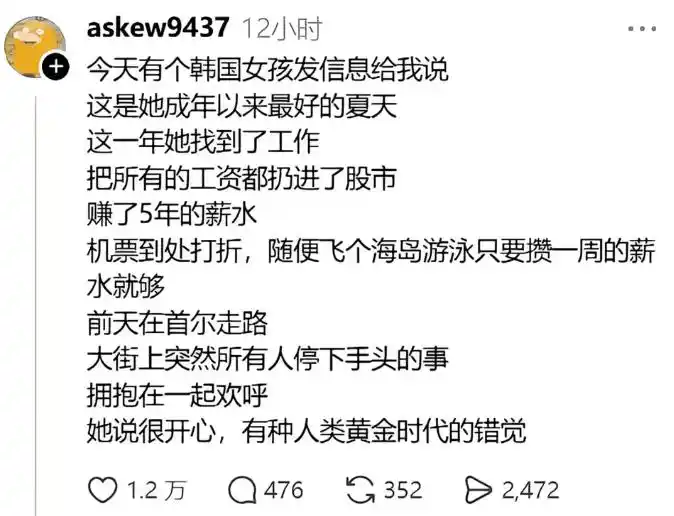
The "Korean girls" meme also became popular in the Chinese internet world, giving rise to the much-envied "golden age of Korean retail investors."
But soon, the plot of falling to circuit breakers followed by violent rallies began to repeat in alternation.
Amid this volatility, Zhiwei found Mr. Park, a Section Chief in Samsung Electronics' DS Division (Semiconductor Business), and Manager Kim, the owner of a South Korean medical aesthetics clinic, to try and understand how the mindsets of South Koreans within this epic market situation were changing.
"'People on the streets of Seoul suddenly stopped, hugging and cheering for each other.' Honestly, I laughed when I saw this. Such a description is almost impossible in South Korean society. I think it's too dramatic and doesn't really fit the Korean personality and social culture. Koreans actually are not the type to openly share how much money they've made with everyone in society." Manager Kim felt the "golden age" short essays were a bit exaggerated, even though his own stock investments had once doubled.
"If I had to say what truly changed in Korean society, I think it's more of an emotional shift. When the stock market rises, stock holders overall appear more optimistic and positive. However, they usually don't intentionally show it. Most of the time, it's just occasional talk about investments among a few friends, rarely becoming a topic of common discussion across the whole society. Especially among the current younger generation in Korea (the MZ generation), many don't even proactively discuss their private lives with superiors at work, let alone openly talk about their investment returns."
As for why Korean investors seem so crazy about stocks now, Manager Kim believes social media and news played a big role.
"When people keep seeing news about so-and-so making a lot of money, the stock market continuing to rise, plus occasionally hearing about people around them making money from investments, many naturally develop the thought, 'Should I start investing too?' Therefore, Koreans' enthusiasm for the stock market in recent years is real. But I think this is more reflected in phenomena like increasing account openings and continuous capital inflow into the stock market, rather than the entire society being immersed in a collective carnival atmosphere of hugging and celebrating as described in those short essays. There's still a big difference between the two."
Manager Kim said that when the market falls, the overall societal mood does dip slightly. However, this change is still relatively restrained. Most of the time, Koreans don't show their anxiety, losses, or stress too overtly.
The gap between the exceptional cases showcased on social media and the widespread reality isn't limited to the stock market.
From the initial widespread rumor "SK Hynix employee badge becomes a hot commodity in the dating market" to "Samsung employee union goes on strike demanding pay raises," these widely circulated messages often don't represent the situation of ordinary company employees.
Mr. Park, the Section Chief from Samsung Electronics' DS Division, explained to Zhiwei, "First, the union does not represent all employees. Generally, in Korean corporate culture, benefits often preferentially favor a minority of union members. Therefore, all employees may not necessarily agree with the labor-management negotiations. This is because sharing the majority of the company's profits with employees doesn't necessarily guarantee the company's development."
Yes, you read that right. South Korea's "unions" are not the type of "unions" imagined by netizens in the Chinese-speaking world. Korean union members are often a kind of "privileged minority class," not truly representing the worker masses, more like some sort of "interest group." The Korean public opinion sphere even has a term criticizing this phenomenon called "noble unions" (귀족노조).
"Additionally, overall salary increases have not yet occurred. Moreover, the salary competition between SK and Samsung actually only targets core employees, such as researchers or management, and generally doesn't reach ordinary employee levels. I'm not too sure about SK Hynix's situation. At Samsung, this year's annual salary negotiations haven't happened yet, and bonuses haven't been paid yet, so there's really no tangible feeling [of change]."
Although the outside world labels the 2024-2026 semiconductor boom cycle as an "AI-driven structural recovery." In Mr. Park's view, the South Korean semiconductor industry has actually been maintaining a growth momentum all along, so having a growth period isn't really seen as a "change."
He told us the company is indeed experiencing performance growth, but this merely means the number of employees is increasing, not distributing two people's salaries to one person. Therefore, apart from gradually improving welfare and raising wages, there's almost no other substantial impact. So, other than stock prices, few people discuss other things; everyone just does their own job.
According to Manager Kim, looking at the overall picture, for a long time in the past, the life trajectory of ordinary Korean office workers has been quite similar.
Many people gradually saved their salaries step by step, then purchased housing through bank loans. As housing prices kept rising, property values increased, personal assets accumulated naturally, thus preparing for retirement.
This lifestyle was once very common in South Korea.
The reason such a model could form was also because the Korean real estate market maintained a long-term upward trend, and housing loans were relatively easy to obtain.
Therefore, for quite a long time in the past, real estate was considered the most important investment method for Koreans.
In contrast, the stock market wasn't as popular as real estate.
It's only in recent years that this situation started to change. As the Korean government continuously strengthened real estate market regulations, increased taxes for multiple property owners, and tightened real estate transaction policies, the real estate market gradually cooled down.
At the same time, the Korean government also kept introducing policies to support capital market development, hoping to attract more funds to stay in the Korean stock market, even encouraging some funds invested in overseas stocks to flow back into the Korean market.
Against this backdrop, starting around 2025, the Korean stock market entered a very active development phase.
More and more Koreans began to feel that stock investment might have become one of the important opportunities for ordinary people to change their wealth situation, even their social class.
Especially after various "wealth myths" kept appearing online, this idea was further amplified.
Manager Kim said many investors, in pursuit of higher returns, invested in hot stocks like Samsung Electronics and SK Hynix through margin loans or leveraged products.
"What surprised me a bit was that those cases in the news were actually happening around me. One friend was like that. He always felt his salary wasn't rising fast enough to catch up with price increases, always thinking about seizing a 'get rich quick' opportunity. So, he took out a loan to invest in leveraged products, hoping to quickly amplify his returns. However, after this market adjustment, he lost almost most of his capital. Recently, many friends around me have started noticeably cutting back on spending. During the bull market, they often treated friends to meals, bought more expensive goods, and some even directly bought new cars. Now, some have sold their cars, and others have started bringing homemade lunch boxes to work every day, hoping to save on living expenses as much as possible."
"I think he wasn't someone who truly loved investing in the first place. It was more because he saw the Korean stock market rising rapidly, leading to an anxious mentality of 'if I don't get on board now, I'll be the only one left poor later.' It was under the influence of this emotion that he kept increasing his investments, ultimately taking on risks far beyond his capacity to bear."
A few days after Manager Kim finished consulting with Zhiwei, the Korean stock market experienced another circuit breaker, followed by repeated successive circuit breakers, causing protesting investors to place wreaths all over the front of the National Assembly building.

"From the end of July, the reactions of people around me started getting bigger. Especially my uncle, he even specifically called me asking, what should I do? The stocks that had clearly made a lot of money before have now turned into losses." Manager Kim said many people around him were a bit panicked. Some even couldn't eat properly because of this, under tremendous pressure, especially those who invested through loans or used leverage.
"The words I hear most often from these people lately are, 'It seems you really can't make money in stocks' and 'Why does it always drop as soon as I buy?'" he said.
Although Manager Kim is also experiencing significant drawdowns in his returns, he feels this is a process a mature stock market needs to go through.
"Actually, for a long time, the fact that the Korea Composite Stock Price Index (KOSPI) could break through 3000 points was, in the eyes of many Korean investors, something nearly miraculous."
Why say that? Because for a long time, many Koreans believed Korean companies weren't receiving market valuations commensurate with their actual strength.
For many leading US semiconductor companies, the market is willing to give them price-to-earnings (P/E) ratios of over a hundred times, so their market capitalizations keep hitting new highs.
But at the same time, some Korean semiconductor companies, whose operating revenues are even higher than some US companies, long had P/E ratios of only around ten times.
"Apart from low valuations, the Korean market had another problem in the past. Due to the large number of small and mid-cap stocks, some individual stocks were often speculated on by market funds, even experiencing so-called 'pump and dump' phenomena. Many people felt Korean stocks had little investment value, many stocks were just fund speculation, and truly excellent companies didn't get the valuations they deserved."
Manager Kim said this view has existed in Korea for many years. It's only in recent years, as the real estate market cooled and capital market-related policies continuously advanced, that more and more funds originally in the real estate market began flowing to the stock market.
Overseas funds also started paying attention to the Korean market, further accelerating the market's rise.
As more and more people with almost no prior investment experience also entered the stock market due to the continuous rise, risk actually started accumulating slowly.
Some overseas funds and institutional investors with substantial profits began taking profits and exiting the market, and the market entered an adjustment phase.
But many ordinary individual investors, due to limited capital and using methods like loans and leverage for investment, couldn't withstand the pressure of continuous decline.
Ultimately, some had to stop losses and exit, while others faced forced liquidation. Chasing the rise and killing the fall, turning off the lights and eating instant noodles.
"The aforementioned multi-faceted factors are important reasons for the recent severe market adjustments. However, even so, I remain optimistic about the future of the Korean stock market. Right now, I'm still continuing to buy in batches. Because whether it's Samsung Electronics, SK Hynix, or many excellent companies in the Korean and US markets, I believe there are still many companies with long-term investment value. I also hope more Chinese friends can understand South Korea better." Manager Kim said.
Actually, looking at it comprehensively, the changes brought by this wave of the semiconductor boom in South Korea are not fundamentally different from those in China. It's just that due to a lack of cultural understanding, people have added an imagined, dreamy filter to many things.
After all, people always think others are living happier lives than themselves.
This article is from the WeChat public account "Zhiwei," author: Hebi, editor: Daping