Bull Arrives: Four Catalysts Behind the Overnight Surge Across the Crypto Market

Odaily星球日报Publicado a 2026-08-20Actualizado a 2026-08-20

Resumen

Crypto Market Surges Overnight: Four Key Drivers Behind the Rally The cryptocurrency market experienced a sudden and broad rally. Bitcoin reclaimed the $69,000 level with a 7.4% gain, while Ethereum led major assets with a surge of nearly 19%. The surge triggered significant liquidations, with short positions bearing the brunt. Four main factors drove the move: 1. **Macro Liquidity Boost**: The U.S. Treasury unexpectedly doubled the size of its long-term bond repurchase operations, a move seen as injecting liquidity and lowering long-term yields, which boosted overall risk appetite. 2. **Regulatory Sentiment Shift**: The White House hosted a crypto summit with industry leaders, and the SEC proposed a new draft rule offering certain financing exemptions for crypto projects. These signals alleviated some regulatory uncertainty. 3. **Institutional Flow Reversal**: After a period of outflows, Bitcoin spot ETFs like BlackRock's IBIT saw renewed net inflows, indicating returning institutional interest. On-chain data also showed large holders accumulating again. 4. **Short Squeeze Amplification**: A high concentration of leveraged short positions was liquidated as prices rose, creating a classic "short squeeze." Data shows over 93% of recent liquidations were short positions, accelerating the upward price movement in a feedback loop.

Original | Odaily Planet Daily (@OdailyChina)

Author | jk

The long-silent crypto market suddenly saw "the bull arrive" today, with major cryptocurrencies collectively surging. Bitcoin reclaimed the $69,000 level, Ethereum's single-day gains approached 20%, and Hyperliquid soared over 22%. The sharp price increase was accompanied by a large-scale liquidation of short positions.

Major Cryptocurrencies Rally Across the Board

  • Bitcoin: According to Coingecko data, currently trading at $69,165, up 7.4% in 24 hours, with a 24-hour range between $64,123.86–$69,892.23. Total market cap stands at $1.393 trillion, with 24-hour volume of $41.587 billion. The price maintained narrow fluctuations in the morning before launching a rapid ascent during the European trading session.
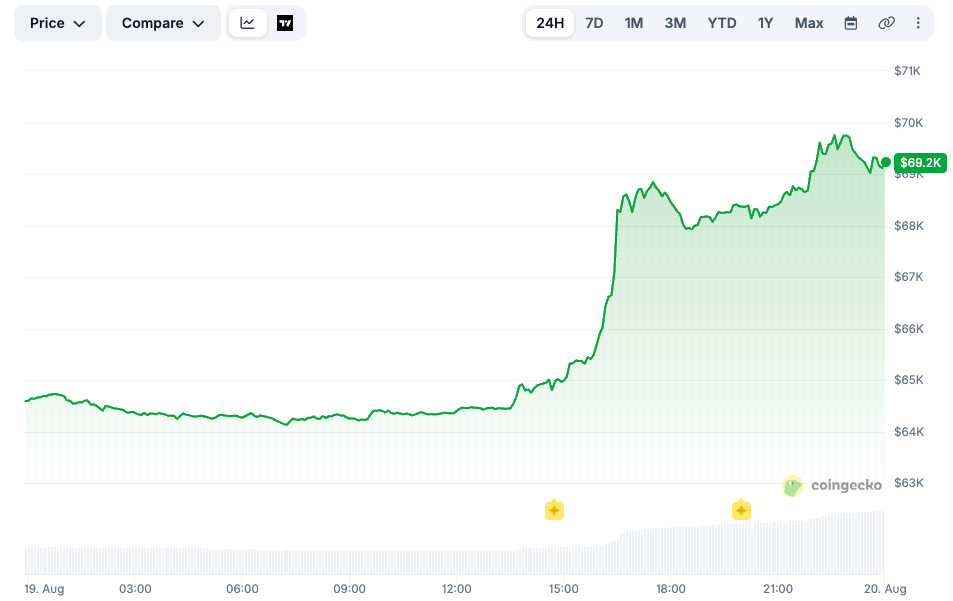
Bitcoin Price Chart, Source: Coingecko

  • Ethereum: Currently trading at $2,269.04, surging 18.6% in 24 hours, with a range between $1,905.44–$2,318.66. Market cap reached $274.047 billion. Ethereum's gains in this round significantly outperformed Bitcoin, and its exchange rate against BTC also strengthened, indicating accelerated capital inflow back into the Ethereum ecosystem.
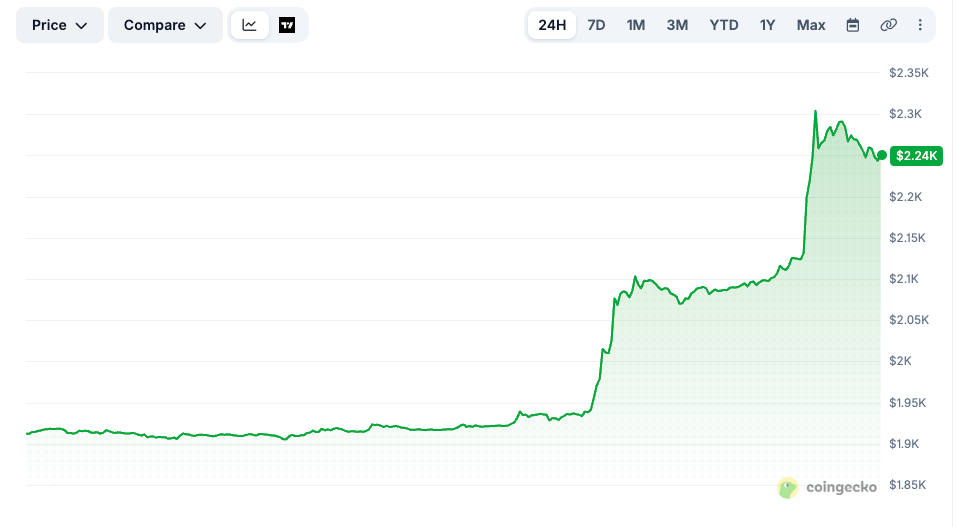
Ethereum Price Chart, Source: Coingecko

  • BNB: Currently trading at $631.92, up 4.9% in 24 hours, showing relatively modest gains among major market leaders. Range was $600.92–$635.85.
  • Solana: Currently trading at $85.65, up 11.2% in 24 hours, range $76.59–$86.96. Market cap is $49.952 billion, with charts showing the price accelerating to break previous highs.
  • Hyperliquid (HYPE): The most explosive gainer in this round, currently trading at $71.41, skyrocketing 22.2% in 24 hours, with a range of $58.04–$72.28.

Cause Analysis: Macro Catalysts Spark Rally, Leverage Structure Amplifies Gains

Considering recent market dynamics and derivatives data, this rally was not driven by a single factor but rather a combination of positive macro liquidity developments, warmer regulatory signals, and the concentrated unwinding of leveraged short positions.

Cause One: U.S. Treasury's Surprise "Liquidity Injection," Lowering Long-Term Rates and Boosting Risk Appetite. On August 19th local time, the U.S. Treasury announced it would at least double the size of its long-term Treasury buyback operations, increasing from $2 billion to over $4 billion per operation, covering the period from September 9th to November 4th, primarily targeting 10- to 30-year Treasury bonds. This move was seen as a direct response to the recent surge in the 30-year Treasury yield to its highest level since 2007 (reaching 5.34% at one point). Following the announcement, yields on 10-year and 30-year Treasuries fell, and U.S. stock futures rose simultaneously. The overall improvement in risk sentiment provided a tailwind for the crypto market. The Treasury's operation was interpreted by the market as a form of quasi-liquidity easing, and its timing closely aligned with the start of the crypto market rally.

Cause Two: White House Crypto Summit Combined with SEC Regulatory Easing, Policy Sentiment Turns Positive. On the same day, Trump met with crypto industry executives from Coinbase, Ripple, Gemini, and others, along with heads of the SEC and CFTC regulatory agencies at the White House, reiterating his push for the swift passage of the CLARITY Act in the Senate to provide a clearer regulatory framework for the industry. The day before the summit, the SEC formally proposed a new rule draft titled "Regulation Crypto Assets," intending to offer crypto project teams a funding exemption channel of up to $75 million per year. The concentrated release of friendly signals from regulators and the White House within the same week has somewhat alleviated the market's previous concerns about policy uncertainty, providing a narrative basis for capital to flow back into crypto assets.
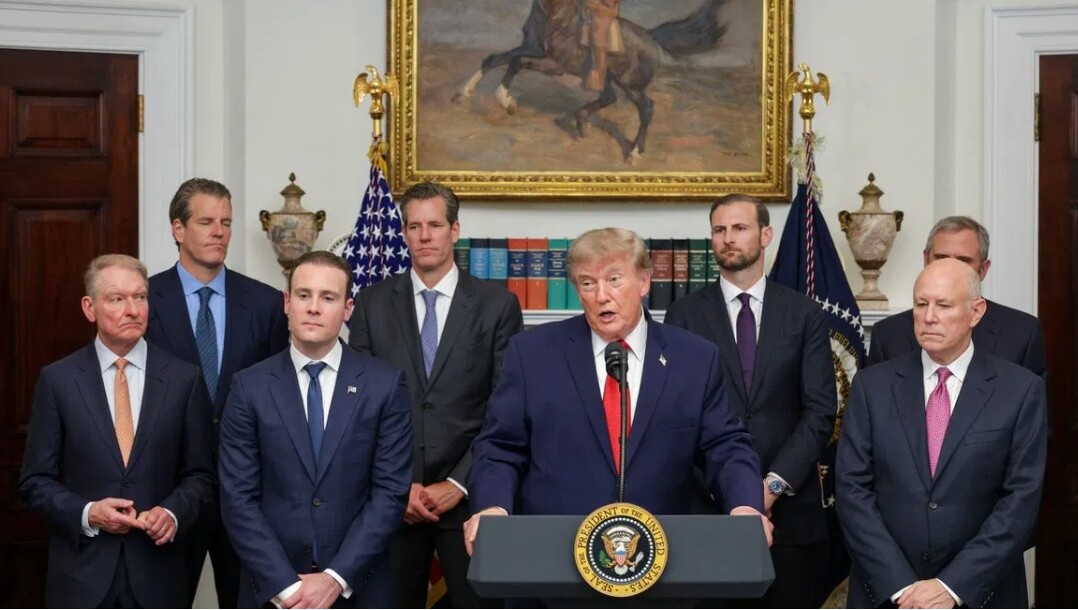
Trump Meets with Industry Leaders, Source: ABCNews

Cause Three: Bitcoin Spot ETF Outflow Trend Reverses, Whales Accumulate on Dips. Bitcoin spot ETFs had previously experienced consecutive days of net outflows, but this rebound was accompanied by signs of improved capital flows. Major products like BlackRock's IBIT and Fidelity's FBTC recorded net inflows again, indicating institutional capital is replenishing. Meanwhile, on-chain data shows that large wallet addresses, after about 60 days of continuous selling, have begun accumulating again. This provided support for price stabilization from the spot side and created conditions for the subsequent squeeze on leveraged shorts.

Cause Four: Concentrated Liquidation of Leveraged Shorts, Creating a Classic "Short Squeeze" Scenario. According to derivatives data, short liquidations far exceeded long liquidations during this rally. Based on Coinglass data, as of press time, 24-hour total liquidation volume across all exchanges has expanded to $2.98 billion, with over 170,000 traders liquidated, predominantly shorts. Within a 4-hour window, short liquidations once accounted for as high as 93.3%. The largest single liquidation order across all networks occurred on Hyperliquid's BTC-USD contract, amounting to $48.8 million. The forced liquidation of large short positions often creates an instantaneous buying vacuum on the order book, pushing prices to accelerate away from the previous range, which in turn triggers more stop-loss orders, forming a positive feedback loop of "longs squeezing shorts."


Preguntas relacionadas

QWhat are the four main reasons mentioned in the article for the sudden, market-wide surge in the cryptocurrency market?

A1) The U.S. Treasury's surprise 'liquidity injection' by doubling its long-term bond repurchase operations, which lowered long-term interest rates and boosted risk appetite. 2) Positive policy signals including the White House crypto summit and the SEC proposing a new regulation draft offering exemptions, easing regulatory uncertainty. 3) A reversal of the outflow trend from Bitcoin spot ETFs and large 'whale' wallets beginning to accumulate again. 4) A large-scale liquidation of leveraged short positions, creating a typical 'short squeeze' scenario.

QWhich cryptocurrency experienced the highest 24-hour price increase, and what was its performance according to the article?

AHyperliquid (HYPE) experienced the highest 24-hour price increase, surging 22.2% to $71.41, with its trading range being $58.04–$72.28.

QHow did Ethereum's price performance compare to Bitcoin's during the rally, and what does this indicate according to the article?

AEthereum's price significantly outperformed Bitcoin's, with a 24-hour surge of 18.6% compared to Bitcoin's 7.4%. The article states that this indicates funds are accelerating their flow back into the Ethereum ecosystem, as shown by Ethereum's strengthening exchange rate against Bitcoin.

QWhat specific action did the U.S. Treasury take, and how did it immediately affect the markets?

AOn August 19, the U.S. Treasury announced it would at least double the size of its long-term bond repurchase operations, from $2 billion to over $4 billion per operation, targeting 10- to 30-year bonds. This news caused the yields on 10-year and 30-year U.S. Treasury bonds to drop immediately, and U.S. stock futures rose, reflecting an overall increase in risk appetite.

QWhat data point is provided to illustrate the intensity of the 'short squeeze', particularly regarding short liquidations?

AAccording to Coinglass data cited in the article, within a 4-hour window, short liquidations accounted for up to 93.3% of all liquidations. The total 24-hour liquidation amount reached $29.8 billion, with over 170,000 traders liquidated, the majority being short positions.

Lecturas Relacionadas

Is Venture Capital Dead? An 'Exit Letter' to All Soon-to-Be-Obsolete Fund Managers

This open letter, addressed to outdated fund managers, delivers a sharp, satirical critique of the modern venture capital landscape. It argues that the game is fundamentally over for small and midsize funds. The core issue is the downward expansion of massive multi-billion dollar funds into seed-stage investing. These giants, with their powerful brands and resources, consistently outcompete smaller funds for deals, even for stakes in two-person startups. Founders naturally gravitate toward established names. The letter states that relevance now hinges entirely on investing in the handful of "globally important" companies each year, like leading AI labs. If a fund misses these, it is irrelevant. It mockingly suggests that struggling funds should simply advise their portfolio companies to seek acquisition by these winners and invest through SPVs instead. The proposed "solution" of moving up to growth-stage investing is presented with equal irony. While seemingly simpler than seed investing, it means paying the same high prices once complained about. Furthermore, competition at this level involves extravagant perks (high-production podcasts, media companies, political connections) that smaller funds cannot match. The author cynically prescribes that the only remaining path is to go "all-in" on AI, as any other sector will be obliterated by imminent Artificial General Intelligence (AGI). The letter concludes by reversing its own nihilism, ironically pointing out that the tech industry's real lesson is that innovation and competition, however difficult, are essential. The final signature, "A soon-to-be-obsolete fund manager," underscores the piece's satirical warning about consolidation, herd mentality, and the existential threat facing traditional VC models.

marsbitHace 41 min(s)

Is Venture Capital Dead? An 'Exit Letter' to All Soon-to-Be-Obsolete Fund Managers

marsbitHace 41 min(s)

Trading

Spot
活动图片