Oil Trading Reminder: Oil Rebound Fails to Gain Momentum, Remaining in a Slight Consolidation in the Short Term

Publicado a 2026-08-20Actualizado a 2026-08-20

Resumen

WTI crude oil hovered around $84.50 in early Asian trading on Thursday, as the market repriced the risk of supply disruptions in the Middle East. Negotiations between the United States and Iran showed limited progress, drawing attention to the security of shipping through the Strait of Hormuz and pushing regional risk premiums higher. Meanwhile, an increase of approximately 4.4 million barrels in U.S. crude oil inventories exerted some downward pressure on prices. However, a decline of 1.5 million barrels in distillate stocks to a one-month low indicated some resilience in the refined products market. In the short term, oil prices will continue to seek direction between geopolitical risks and inventory pressures.

WTI crude oil maintained slight consolidation during the early Asian session on Thursday, trading around $84.50/barrel, after experiencing a minor pullback in the previous trading session. Oil prices have regained support, mainly due to the ongoing escalation of tensions in the Middle East, limited progress in relevant negotiations between the United States and Iran, and increasing market concerns about further disruptions to the crude oil supply chain. Against a backdrop of relatively complex inventory and demand factors, geopolitical risk has once again become a crucial variable determining short-term oil price direction.

Recent market focus has been particularly on the shipping situation in the Strait of Hormuz. As a vital global energy transit chokepoint, any sustained disruption in this region could rapidly elevate the supply risk premium in the international crude oil market. US President Trump stated that crude oil transportation continues to pass through this strait, while leaving the possibility for future negotiations open. This suggests the market currently does not see certainty of a complete supply disruption, but the risk persists.

For the crude oil market, what truly influences prices is not just the number of vessels currently able to pass normally, but the market's expectation regarding future transportation security. If related risks persist, costs for shipping, insurance, and transit times may all increase. Even before actual supply shows a significant decline, traders might preemptively raise risk premiums, thereby keeping crude oil prices at relatively elevated levels.

The further complication of the regional situation also adds to market uncertainty. The UAE announced a suspension of some financial and economic transactions related to Iran, reinforcing market concerns about regional economic exchanges. Meanwhile, Gulf oil-producing nations are maintaining relatively high export volumes through alternative shipping routes and more discreet maritime methods, which somewhat alleviates actual supply-side impacts.

Therefore, the crude oil market currently exhibits a relatively distinct characteristic: risk premiums have clearly risen, but actual supply has not yet shown a disruption fully matching the risk sentiment. If major Gulf producers can continue to maintain stable exports, the upside for oil prices may be limited. Conversely, if transportation facilities, tankers, or key energy infrastructure face further impacts, the market could swiftly shift from "risk trading" to "supply shortage trading."

TD Securities believes the crude oil market environment remains fragile. Risks to transportation security, escalating tensions, and stalled negotiations could all keep energy markets in a high-risk state. For Brent crude and refined products, supply disruption risks may continue to sustain elevated risk premiums. This implies that even if there is no immediate obvious imbalance in actual crude supply and demand, prices may remain highly volatile due to risk expectations.

US inventory data, however, presents another constraint on oil price gains. The latest data from the US Energy Information Administration showed that US crude oil inventories increased by approximately 4.4 million barrels last week. The unexpected rise in inventories indicates relatively ample short-term supply and may also reflect changes in refinery demand or import patterns. Inventory builds typically imply increased pressure on spot market supply and demand, making it a key bearish factor to watch during WTI's current upward move.

Nevertheless, US refined product inventory performance is not entirely pessimistic. Distillate inventories fell by about 1.5 million barrels over the same period, dropping to a one-month low, suggesting there is still some destocking pressure in the refined product market. If refinery run rates remain high in the future and product demand continues to improve, crude oil processing demand may increase, partially offsetting the bearish impact of rising crude inventories.

From a global market perspective, the core contradiction for current oil prices remains the tug-of-war between "escalating geopolitical risk" and "relatively ample inventory and supply." If Middle Eastern risks escalate further, the market may further raise supply disruption premiums, giving WTI the chance to challenge higher price zones. If related risks are contained and US crude inventories continue to build, oil prices may revert to a correction mode dominated by fundamentals.

Going forward, close attention needs to be paid to whether Strait of Hormuz transportation remains stable, changes in US crude and product inventories, export situations from Gulf producers, and progress in US-Iran related negotiations. Particularly, if there is a sustained disruption in crude oil transportation, even before actual inventories rapidly decline, the market might preemptively trade the future supply gap, thereby amplifying oil price gains.

From a daily chart structure perspective, WTI has returned above $84, with the overall trend remaining relatively strong. The price regaining upward momentum after a period of consolidation indicates bulls still hold some initiative. The market currently needs to focus on short-term resistance around $86.00. If oil prices can effectively break through and stabilize above this area, the likelihood of a further run towards $88.00 or even the $90.00 threshold will increase significantly. Initial support below is seen around $84.00. If the price finds support upon retreating to this area, the bullish structure remains intact. A further drop below $84 might expand correction pressure towards the $82.50 vicinity, with more crucial medium-term support around the $80 integer level. Overall, geopolitical risks provide fundamental support for the technical bullish structure, but a swift price rise still warrants caution against profit-taking.

From a 4-hour chart perspective, WTI maintains a consolidation-strong pattern in the short term, with some recovery in bullish momentum after reclaiming $85. The area around $84.50 currently serves as an important observation zone. If the price can break above and hold above $86, the short-term uptrend may strengthen further. If consecutive attempts to break $86 fail, a technical correction may occur. During a correction, $84 is the key level for judging short-term bullish strength. Holding above this area suggests the market may still be gathering strength for an attack, while breaking below $84 would indicate weakening short-term momentum. In summary, the 4-hour chart still leans bullish, but whether oil prices can advance further will highly depend on whether geopolitical risks continue to drive an expansion in the risk premium.
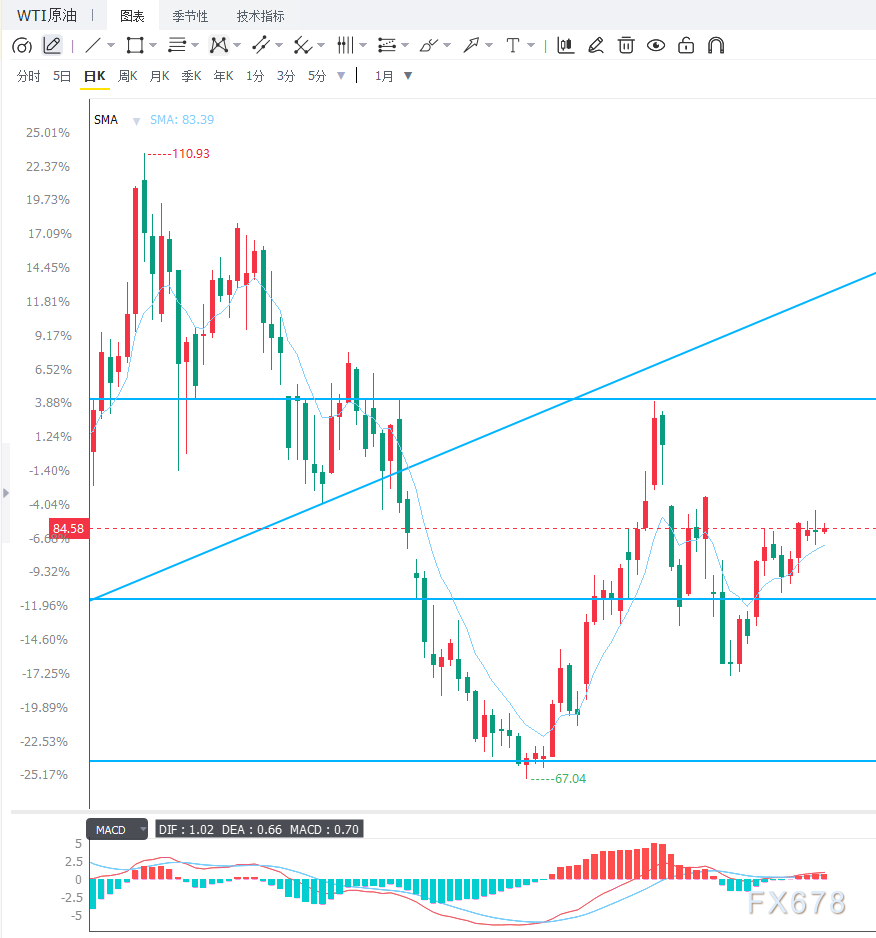
The core driving force behind the current WTI crude oil rally stems from escalating Middle East tensions and the risk to Strait of Hormuz transportation, while rising US crude inventories pose a clear fundamental constraint. As long as the key transit corridor remains basically open, oil price gains reflect more of an expansion in risk premium rather than an actual supply gap. Therefore, WTI may still maintain a consolidation-strong pattern at elevated levels in the short term, but sustained gains would require confirmation from new supply-side shocks. If geopolitical tensions worsen further, the area above $86 could become the next breakout zone. If tensions ease and US inventories continue to rise, oil prices may retreat back towards the $82.50-$84 range. The current market presents both opportunity and risk, and focus should be on whether the supply chain shifts from a "state of risk" to "actual disruption."


Lecturas Relacionadas

Websea Global RWA Summit Successfully Held: Focusing on New Opportunities in China-Kazakhstan Digital Economy, Releasing Signals of Cross-border Collaboration

Websea Global RWA Summit Successfully Held: Focusing on China-Kazakhstan Digital Economy Opportunities, Releasing Signals for Cross-Border Synergy When traditional industries seek new channels for globalization and digital technologies reshape capital, assets, and collaboration methods, an industrial dialogue connecting China, Kazakhstan, and global markets took place in Almaty. On August 18, 2026, the "2026 Global RWA Real-World Asset Tokenization Enterprise Globalization Resource Matching & China-Kazakhstan Industrial Investment Conference," co-hosted by Websea, concluded successfully in Almaty, Kazakhstan. Centered on RWA digitization, cross-border industrial synergy, and investment promotion, the summit gathered industry representatives, investors, digital economy practitioners, creators, and media from China and Kazakhstan to explore the future of a digital economy community. The event shifted focus from mere "project showcases" to fostering deeper "industrial synergy." It featured project roadshows and panel discussions on topics like "Mining Future·Digital Empowerment," "Real Estate Renewal·Urban Evolution," "Green Energy·RWA Opportunities," and "The Globalization Logic of Real Economy." Mr. Yerbol Kharbayev, Chairman of the Kazakhstan Association of Special Economic Zones, emphasized that RWA's significance lies not only in technology but in enhancing asset transparency, collaboration efficiency, and cross-border connectivity through digitization. The discussions highlighted a move towards a deeper "Digital Economy Community" between China and Kazakhstan. Key points included the need for an open, transparent, and stable business environment to attract long-term investment and the crucial role of synergy between governments, enterprises, platforms, and communities. The summit facilitated strategic cooperation signings and targeted B2G/B2B matching, providing a direct channel for Chinese enterprises exploring the Central Asian market. As an invited digital asset platform, Websea participated in brand presentations and the launch of initiatives like a Creator Alliance and a Web3 MCN agency. Herbert Sim, Global CMO of Websea, stated that platform development is fundamentally rooted in user trust and real experience. He expressed gratitude for user and partner trust, underscoring Websea's commitment to asset security, transaction experience, risk awareness, and user rights protection. Websea aims to contribute to the global digital economy through optimized services and open collaboration. The summit also launched the Web3 Beauty Alliance - Central Asia Chapter, a China-Kazakhstan Quality Creator Alliance, and Web3 MCN agencies, expanding the dialogue beyond industry and capital to include technology, content, community, and brand building. The event concluded by signaling that the future of the digital economy will be co-created by a broad range of participants. It requires institutional and infrastructural support, long-term commitment from enterprises, and the sustained trust of users, partners, and communities. With the summit's conclusion, a new chapter in China-Kazakhstan industrial synergy and digital economy cooperation has begun. Websea will use this as a starting point to continue exploring a secure, open, and sustainable digital future alongside global users and partners.

marsbitHace 9 min(s)

Websea Global RWA Summit Successfully Held: Focusing on New Opportunities in China-Kazakhstan Digital Economy, Releasing Signals of Cross-border Collaboration

marsbitHace 9 min(s)

Russia's Banking Bleed and the Crypto Hunt: Citizens Have Withdrawn 24 Billion Euros from Banks This Year; Bill Limiting Total Crypto Purchases Set to Take Effect

**Title: Russia's Banking System Bleeds Cash as Citizens Turn to Crypto, But New Law Imposes Strict Limits** **Summary:** Russia is witnessing a significant outflow of cash from its banking system, with citizens withdrawing approximately €24.4 billion in the first seven months of 2026. This trend accelerated in July, marking the highest monthly increase for the year. Major banks like Gazprombank and Sberbank have reported substantial deposit losses. Simultaneously, cryptocurrency transaction volumes have surged, with an estimated daily trading volume of around $650 million. Officials note that annual crypto transactions exceed 10 trillion rubles, largely occurring outside regulated channels. Citizens are increasingly using crypto as a tool to hedge against currency depreciation and financial uncertainty. In response, President Putin signed the "Digital Currency and Digital Rights Law," with key provisions taking effect on September 1, 2026. This law severely restricts access for ordinary citizens. Non-qualified retail investors will be limited to purchasing only about $3,600 worth of cryptocurrency (initially Bitcoin, Ethereum, and USDT) per year through any single licensed intermediary. Qualified investors and businesses face no such limits for cross-border settlements. Official explanations for the cash exodus cite technical factors like tax changes and digital payment disruptions. However, analysts and media point to deeper public concerns over potential asset freezes, economic instability related to the war, and a lack of trust in the financial system. Notably, September 1 also marks the public launch of the Digital Ruble, Russia's central bank digital currency (CBDC). This creates a dual dynamic: tightening control over decentralized crypto assets while introducing a state-controlled digital currency for payments. For ordinary Russians, traditional banking is losing appeal, crypto access is being capped, and the new Digital Ruble offers a third, fully state-managed pathway.

marsbitHace 33 min(s)

Russia's Banking Bleed and the Crypto Hunt: Citizens Have Withdrawn 24 Billion Euros from Banks This Year; Bill Limiting Total Crypto Purchases Set to Take Effect

marsbitHace 33 min(s)

Household & Personal Care Giant Quietly Becomes the Champion in 'Chip Cleaning'

Kao, the renowned Japanese consumer goods giant known for laundry detergent and facial cleansers, has quietly become a leader in the semiconductor precision cleaning agent market, as revealed in its recent financial report. The company's chemical business, which includes semiconductor precision cleaning agents, achieved net sales of 2472 billion yen (approx. RMB 104.4 billion) in the first half of fiscal 2026, growing 9.4% year-on-year and becoming its fastest-growing segment. Notably, Kao holds about a 60% market share in cleaning agents for package substrates and is also a leader in specific chemicals for NAND flash manufacturing processes. Its products have entered the supply chains of major chipmakers like TSMC, Samsung, and Kioxia. Kao's journey into semiconductors began with its core expertise in surface science, developed from its origins in soap and detergent manufacturing. The 1987 Montreal Protocol, which phased out ozone-depleting solvents like Freon, created a demand for alternative cleaning solutions. Leveraging its deep knowledge of surfactants and purification, Kao launched its "CLEANTHROUGH" aqueous cleaning agent in 1991, entering the precision cleaning market. Over the past three decades, Kao has expanded its product line to cover both front-end (wafer fabrication) and back-end (packaging) semiconductor processes. Its "precision interface control technology" addresses key challenges like particle removal, photoresist stripping, and cleaning complex structures in advanced packaging without damaging delicate materials. Beyond cleaning, Kao's portfolio extends to adjacent processes like dry film photoresist stripping. A key to Kao's success is its customer-centric business model. The company operates "Fine Cleaning Centers" in Japan and Taiwan, where it collaborates directly with clients on process development. This deep integration, coupled with the high cost and risk of switching validated materials in semiconductor production, creates strong customer loyalty. As the AI boom drives demand for complex chip packaging like CoWoS, which requires more numerous and difficult cleaning steps, Kao is strategically positioned. The company plans to defend its back-end dominance while expanding into DRAM and logic semiconductor markets. Kao's story mirrors that of other Japanese firms like Ajinomoto (ABF film) and TOTO (electrostatic chucks), which leveraged deep-rooted core technologies from seemingly unrelated industries to achieve leadership in critical, niche segments of the semiconductor supply chain.

marsbitHace 34 min(s)

Household & Personal Care Giant Quietly Becomes the Champion in 'Chip Cleaning'

marsbitHace 34 min(s)

Trading

Spot
活动图片