LIT Reaches New Highs Constantly, What Has Lighter Done Right?

marsbitPublicado a 2026-08-27Actualizado a 2026-08-27

Resumen

Lighter (LIT) token prices have surged nearly 5x since March, driven by multiple factors. Key contributors include its low circulating supply (approx. 25% of total), significant token buyback/burns (1.73% of supply), and strong staking incentives. Technically, Lighter is a specialized ZK-Rollup for perpetual DEX, solving the traditional "impossible triangle" for on-chain derivatives. Unlike general-purpose L2s or independent L1s (like dYdX v4, Hyperliquid), Lighter encodes exchange rules—including price-time priority order matching, funding rate caps, and liquidation formulas—directly into its zk-SNARK circuits. This provides cryptographic proof of correct execution. It achieves high performance (<5ms matching latency) while inheriting Ethereum's security, including a robust escape hatch for user withdrawals. Its architecture separates the core trading engine (custom ZK circuits) from a parallel zkEVM for general contracts. Recent optimizations have reduced average block verification time to ~1 minute. As an Ethereum L2, it benefits from the ecosystem's liquidity and composability without relying heavily on bridges. This combination of verifiable on-chain mechanics and Ethereum-grade security is a core value proposition, differentiating Lighter in the competitive perp DEX market and underpinning strategic partnerships like the one with Robinhood.

Original Author: Eric, Foresight News

Starting from August 20th, LIT, the token of perp DEX Lighter which boasts a former Citadel quant team background, has been continuously reaching new all-time highs. By August 26th, LIT had touched a high of $3.8, a nearly 5x increase from its low of around $0.78 recorded on March 30th of this year.
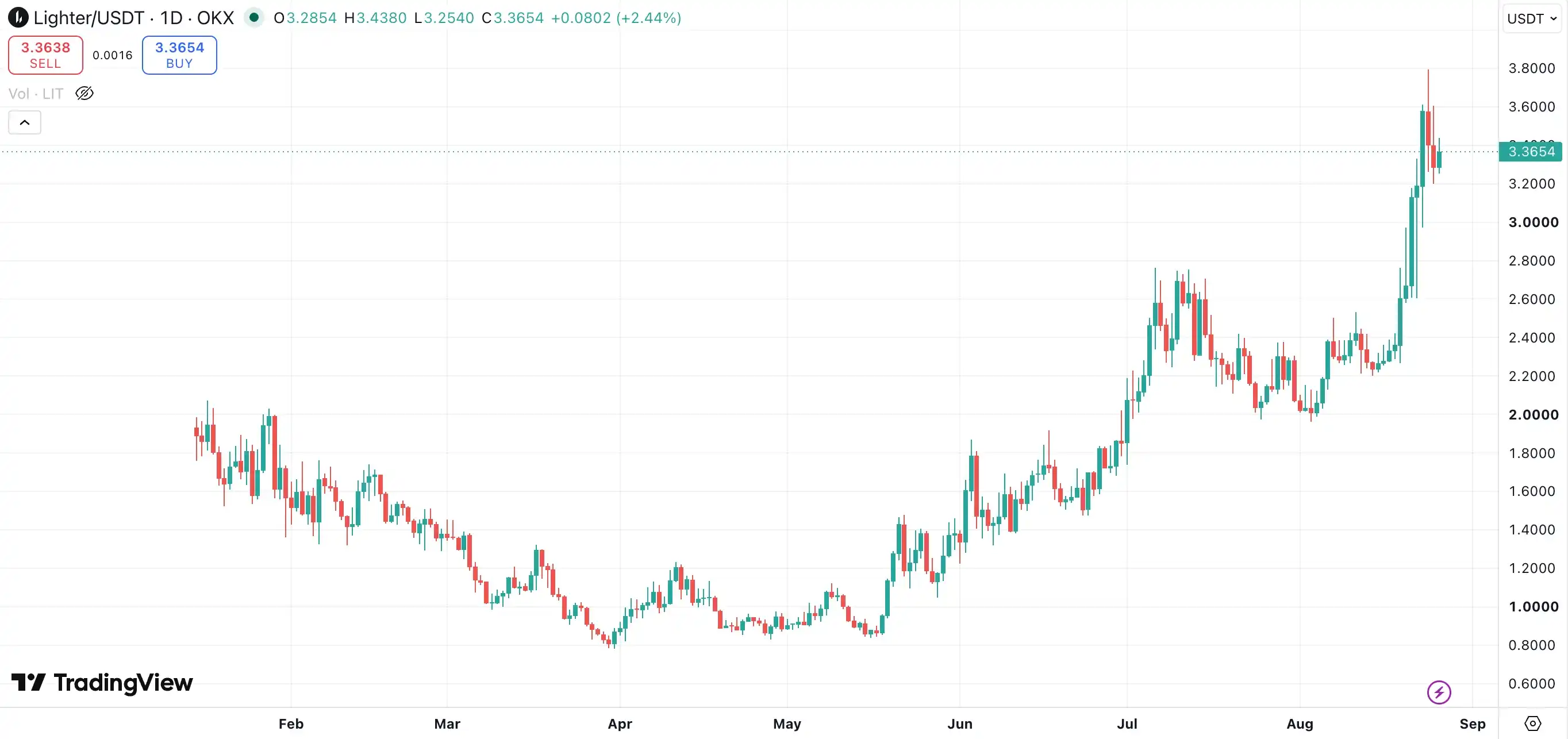
First, it's important to note that the current circulating supply of LIT is only about 25% of the total. Portions allocated to the team and investors are locked until December 30, 2026. The current selling pressure on LIT comes only from staking rewards, which are not substantial. During price increase phases, users have a stronger incentive to stake and are more inclined to hold.
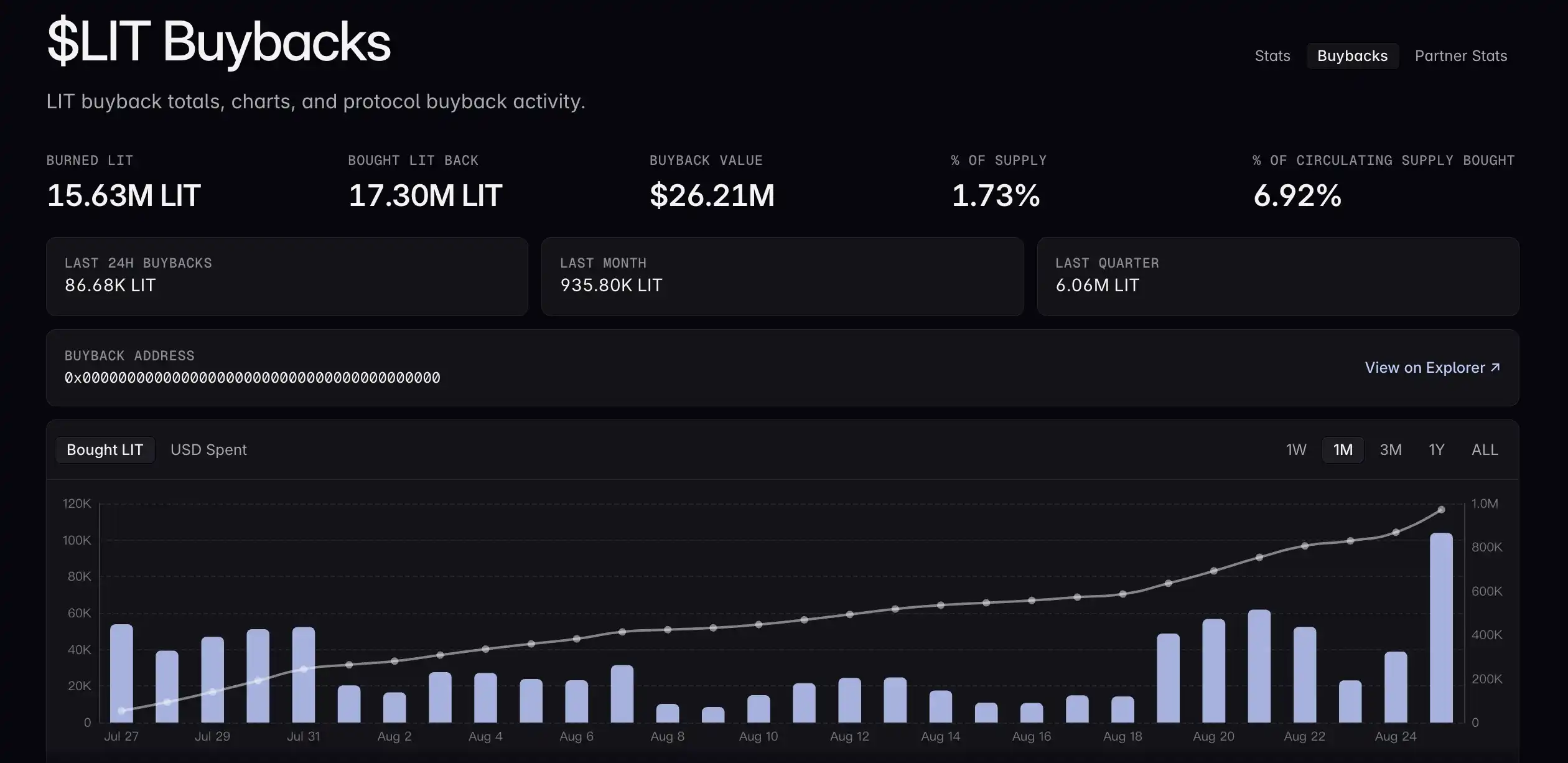
Given the limited circulating supply, the buyback and burn intensity of LIT is also significant. According to the official dashboard, the current amount of LIT bought back has reached 17.3 million, accounting for 1.73% of the total supply and 6.92% of the circulating supply.

In July, in our article "Joining Robinhood in the Race for Market Share, Is Lighter Playing a Big Chess Game?" (https://foresightnews.pro/article/detail/98462), we analyzed the reasons behind LIT's sustained rise, combining factors including the buyback-and-burn mechanism and the collaboration with Robinhood. In addition to these operational stimuli, Lighter has also introduced unique innovations at the chain level.

Before Lighter, on-chain derivatives essentially faced an impossible triangle. General-purpose L2s like Arbitrum have transaction fees and latency unsuitable for high-frequency order placement. Independent chains like dYdX v4 and Hyperliquid somewhat sacrifice security. Hybrid order books in the style of StarkEx rely on centralized matching engines, carrying risks of censorship and MEV.

Hyperliquid's self-built L1 uses HyperBFT consensus to run the matching engine directly within the validator set, achieving sub-second finality and over 200k TPS. The trade-off is a security model that relies entirely on itself, with a few dozen validator nodes supporting the entire chain, and cross-chain asset transfers dependent on bridges.

Lighter chose a different direction. It is a ZK Rollup dedicated solely to trading. Matching, liquidation, and risk control are all encapsulated within its proprietary Lighter Core, using a customized proof engine to generate zk-SNARK proofs, then submitting compressed state to the Ethereum mainnet. Compared to general-purpose zkVMs, this approach sacrifices generality in exchange for proof speed, latency stability, and execution efficiency for high-frequency order books. Official metrics show matching latency below 5 milliseconds, with a single block capable of packing 20,000 orders and cancellations.

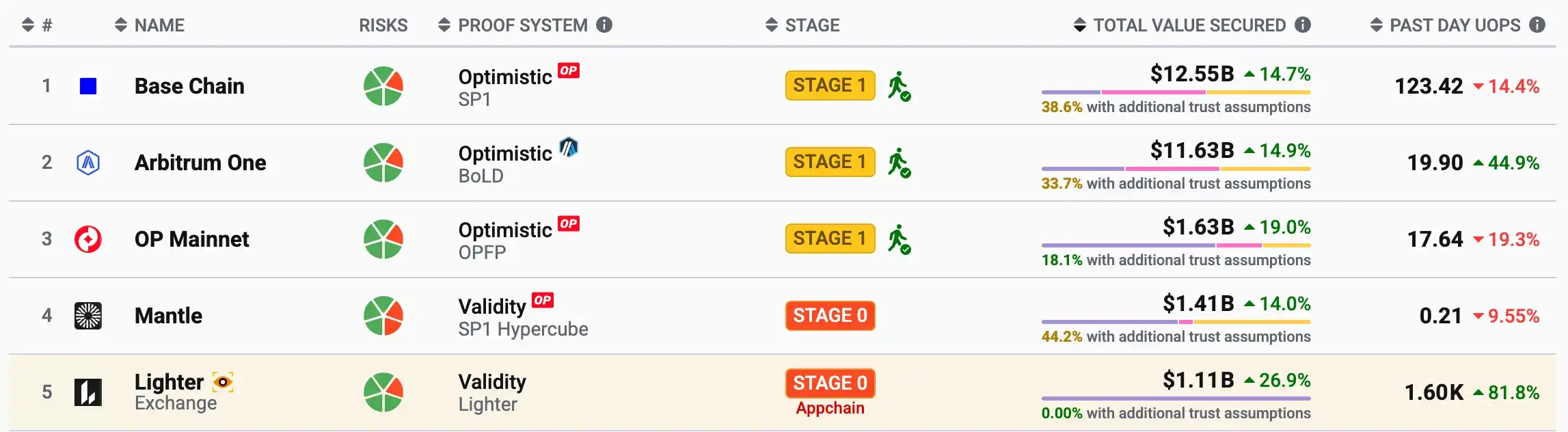
According to L2BEAT data, as an independently developed L2 that doesn't use existing ZK Rollup stacks, Lighter's TVL exceeds $1.1 billion, ranking fifth, just behind Base, Arbitrum, OP Mainnet, and Mantle.
Lighter's system consists of three roles. The sequencer orders transactions first-in-first-out and provides soft finality. The prover generates a proof for each block. Smart contracts on Ethereum host user funds, store state roots, and verify each proof.

The real differentiation lies in what the circuit proves. Most Rollups only prove that state transitions are valid. Lighter's circuits encode the exchange rules themselves as zk constraints. Using a structure called Order Book Tree, a binary prefix tree, it encodes the price-time priority rule into leaf indices, resulting in a proof complexity of only logarithmic order. This means the protocol can cryptographically prove that the highest priority order was filled first, that funding rate caps were correctly enforced, and that liquidations used the correct formulas.

This is particularly crucial for perpetual contracts. Leveraged positions are margin-based, and liquidations are automatic and mechanical. If you cannot verify whether a liquidation was executed correctly, you are choosing to trust the platform at the moment it has the least incentive to be honest with you. Verifiable liquidation is not marketing jargon; it is the core significance of this architecture.

As an Ethereum L2, Lighter inherits two things that independent L1s cannot offer.

The first is exit guarantees. If the sequencer persistently censors transactions, users can directly force-submit transactions on L1. If not processed for over 14 days, the system freezes and enters Desert Mode, allowing users to reconstruct state using on-chain data and submit balance proofs to withdraw funds. This entire process requires no cooperation from the operator. L2BEAT has even practically reproduced this process, reconstructing the state root from L1 blob data and verifying the chain head. All state data required to build proofs is published on-chain, which is the prerequisite for this escape hatch to function.

The second is liquidity network effects. Lighter's funds are custodied in Ethereum contracts. Users can deposit directly from multiple chains like Ethereum, Arbitrum, Base, Solana, etc., and can also reuse assets from ecosystems like Aave, Uniswap, and Ethereum stablecoins, without needing complex cross-chain bridges. In contrast, Hyperliquid's composability is confined within HyperEVM and cannot directly access the hundreds of billions of dollars in TVL on Ethereum.

Another notable feature is LighterEVM's horizontal architecture. The core trading engine runs on custom ZK circuits, while general-purpose smart contracts run in a parallel zkVM environment. The two are logically separated but can atomically share state. Even if on-chain lending protocols become congested, the core order book's matching speed is unaffected. Developers can also build structured products on the EVM side that directly read the order book.

Just yesterday, Lighter published an article introducing its latest progress in the verification system. Over the past month, Lighter's average block verification time has decreased from about 5.3 minutes to about 1 minute, primarily achieved through two independent improvements: first, "heavy/light decomposition," which splits the verification circuit based on transaction complexity, allowing over 98% of simple transactions to pay lower verification costs, cutting verification time in half; second, the results of a prover optimization competition co-hosted with Eigen Labs, focusing on pure infrastructure-level optimizations for the Plonky2 prover, with the first batch of results deployed on August 23rd, halving verification time once again.

Here's a lesser-known fact: when tokenized RWA was just beginning to gain traction, the chain with the most on-chain RWA assets was ZKsync.

There was only one reason: security.

Even today, ZKsync can still rank in the top ten, higher than chains like Arbitrum, Polygon, Base, which may seem stronger on paper. The advantage of ZK proofs lies in the fact that while finality strictly speaking still requires confirmation on the Ethereum mainnet, the validation of transaction credibility is already completed on the L2. For institutions, even if it's a bit slower than other L2s or self-built L1s, or slightly more expensive, it's entirely acceptable.

Compared to general-purpose ZK Rollups like ZKsync and Starknet, or even dedicated L2s developed based on these general-purpose ZK Rollup stacks, Lighter's biggest advantage is that it encodes trading, liquidation, and other logic directly into its circuits, coupled with Ethereum mainnet-level security. This mechanism, potentially even more secure than traditional clearing institutions, gives it the full capability to stand firm in the fiercely competitive perp DEX market.

The collaboration with Robinhood is a case in point. Beyond shared traits like Payment for Order Flow usage and a strong team background, the mechanisms Lighter provides give it unique advantages in security and compliance. The market's willingness to give this architecture a premium is logically clear. For projects aiming to sell perpetual contracts to Robinhood users or traditional financial institutions, "matching rules written in circuits, fund security backed by Ethereum" is a story that can be told to compliance departments and auditing institutions.

Hyperliquid proved that performance can come from consensus. Lighter is proving that trust can come from proofs. While other perp DEXs rack their brains over operations and business, Lighter is carving out a new "path."

Criptos en tendencia

Preguntas relacionadas

QWhat is the main reason behind LIT's continuous price surge according to the article?

AThe main reasons include limited circulating supply, strong buyback and burn mechanism, and unique technological innovations in its L2 architecture, which enhance trust and security.

QHow does Lighter's ZK Rollup architecture differ from other perp DEX solutions like Hyperliquid?

ALighter is a purpose-built ZK Rollup for trading, encoding exchange rules directly into zk-SNARK circuits for verifiable execution, while inheriting Ethereum's security. Hyperliquid uses a self-built L1 with its own consensus, prioritizing performance but relying on its own security model and bridges.

QWhat two key benefits does Lighter gain by being an Ethereum L2?

ALighter gains exit guarantee (users can force transactions or withdraw via L1 if the sequencer misbehaves) and liquidity network effects (direct access to Ethereum's multi-chain asset ecosystem without complex bridges).

QWhat recent improvement has Lighter made to its block verification time, and how was it achieved?

ALighter reduced its average block verification time from about 5.3 minutes to about 1 minute. This was achieved through two improvements: 'Heavy/Light Decomposition' (splitting verification circuits by transaction complexity) and optimizations from a proof system competition with Eigen Labs targeting the Plonky2 prover.

QWhy does the article suggest Lighter's architecture is particularly compelling for partnerships with traditional finance institutions like Robinhood?

ABecause Lighter's architecture offers verifiable trading and liquidation rules encoded in zk-circuits combined with Ethereum's security, providing a strong, auditable narrative for compliance departments and auditors in traditional finance.

Lecturas Relacionadas

Can Entropy Become the Second Trade? The Pre-IPO Competition War Has Begun

The article examines whether Entropy can become a second major player like Trade in the emerging pre-IPO prediction market space. Entropy’s recent launch of its Anthropic market gained significant attention and trading volume, but also drew comparisons to the earlier, less successful platform Ventuals. The author argues that dismissing Entropy as "just another Ventuals" overlooks the importance of nuanced design differences, similar to how Hyperliquid succeeded by innovating with its HLP and Hypercore infrastructure where previous DEXs failed. Ventuals struggled due to extremely long time horizons for pre-IPO events (e.g., launching an Anthropic market over a year before the IPO), which led to wild price dislocations and unsustainable funding rates, causing a loss of market share to Trade. In contrast, Entropy launched its Anthropic market much closer to the expected IPO date. The piece draws a parallel to Hyperliquid’s successful "pre-market wars," where gaining early liquidity was key to capturing future trading volume. Trade achieved dominance in HIP-3 markets for traditional assets by partnering with market makers and ensuring its markets reflected true economic value. Entropy’s core thesis is that providing more direct, sustainable liquidity (akin to an HLP model) and forging strong distribution partnerships will lead to more stable and accurate markets. Its success hinges on building trust in its model, possibly by pioneering a new, large-scale liquidity mechanism for HIP-3, potentially setting up a competitive landscape with Trade.

marsbitHace 3 min(s)

Can Entropy Become the Second Trade? The Pre-IPO Competition War Has Begun

marsbitHace 3 min(s)

Wall Street Morning Post: Nvidia Revives AI Faith, Inflation Dashes Rate Cut Dreams, Food Crisis Darkens

Wall Street Morning Report: NVIDIA Revives AI Faith, Inflation Dashes Rate Cut Hopes, Food Crisis Concerns Intensify Markets lacked direction with the three major U.S. indices closing slightly lower, pressured by hotter-than-expected July PCE inflation data. The core PCE remained well above target, pushing market expectations for a September Fed rate hike higher and boosting Treasury yields. The dollar strengthened, while gold initially fell before stabilizing. Oil prices remained volatile amid ongoing geopolitical tensions in the Middle East. A significant and underappreciated inflation risk emerged from the food sector. Attacks on Black Sea ports, disrupted fertilizer supply chains, and extreme weather are severely impacting global grain supplies. HSBC warns the 2026/27 season could see the largest global grain deficit since 2006/07, with food prices accelerating. The main event was NVIDIA's stellar earnings after the bell, which reignited AI sector optimism. The company reported Q2 revenue that more than doubled year-over-year and, crucially, provided strong forward guidance, with the CFO stating real demand is nearly double current supply-constrained projections. CEO Jensen Huang declared AI has reached an "inflection point." This performance also countered the recent bearish narrative that AI would cannibalize traditional software. Companies like Salesforce and Okta posted strong results and saw shares surge, demonstrating that software firms effectively integrating AI into workflows are thriving. AI security firms like CrowdStrike also gained on heightened demand. In other movers, Meta rose after a major lawsuit settlement, while Apple gained ahead of its key product event. HP fell on weak PC shipment data. Key events to watch include the Jackson Hole symposium and earnings from companies like Marvell and Workday. The planned open-sourcing of China's GLM-5.3 model could further impact AI-related sectors.

marsbitHace 3 min(s)

Wall Street Morning Post: Nvidia Revives AI Faith, Inflation Dashes Rate Cut Dreams, Food Crisis Darkens

marsbitHace 3 min(s)

Trading

Spot

Artículos destacados

Cómo comprar LIT

¡Bienvenido a HTX.com! Hemos hecho que comprar Lighter (LIT) sea simple y conveniente. Sigue nuestra guía paso a paso para iniciar tu viaje de criptos.Paso 1: crea tu cuenta HTXUtiliza tu correo electrónico o número de teléfono para registrarte y obtener una cuenta gratuita en HTX. Experimenta un proceso de registro sin complicaciones y desbloquea todas las funciones.Obtener mi cuentaPaso 2: ve a Comprar cripto y elige tu método de pagoTarjeta de crédito/débito: usa tu Visa o Mastercard para comprar Lighter (LIT) al instante.Saldo: utiliza fondos del saldo de tu cuenta HTX para tradear sin problemas.Terceros: hemos agregado métodos de pago populares como Google Pay y Apple Pay para mejorar la comodidad.P2P: tradear directamente con otros usuarios en HTX.Over-the-Counter (OTC): ofrecemos servicios personalizados y tipos de cambio competitivos para los traders.Paso 3: guarda tu Lighter (LIT)Después de comprar tu Lighter (LIT), guárdalo en tu cuenta HTX. Alternativamente, puedes enviarlo a otro lugar mediante transferencia blockchain o utilizarlo para tradear otras criptomonedas.Paso 4: tradear Lighter (LIT)Tradear fácilmente con Lighter (LIT) en HTX's mercado spot. Simplemente accede a tu cuenta, selecciona tu par de trading, ejecuta tus trades y monitorea en tiempo real. Ofrecemos una experiencia fácil de usar tanto para principiantes como para traders experimentados.

571 Vistas totalesPublicado en 2026.01.15Actualizado en 2026.06.02

Cómo comprar LIT

Discusiones

Bienvenido a la comunidad de HTX. Aquí puedes mantenerte informado sobre los últimos desarrollos de la plataforma y acceder a análisis profesionales del mercado. A continuación se presentan las opiniones de los usuarios sobre el precio de LIT (LIT).

活动图片