China's AI Computing Counterattack

marsbitPublicado a 2026-03-04Actualizado a 2026-03-04

Resumen

Eight years after the ZTE crisis, China's AI industry is fighting back against U.S. chip restrictions. In 2018, ZTE nearly collapsed under U.S. sanctions but survived with heavy fines and oversight. Today, Chinese AI firms like DeepSeek are pivoting away from NVIDIA by developing domestic alternatives and optimizing algorithms to reduce reliance on foreign technology. DeepSeek’s V4 model will use entirely domestic chips, signaling a strategic shift toward computational independence. The real challenge isn’t just hardware—it’s NVIDIA’s CUDA ecosystem, which dominates global AI development with over 4.5 million developers. U.S. export controls have tightened since 2022, banning high-end chips like the A100, H100, and their downgraded versions. In response, Chinese companies are adopting technical workarounds like Mixture-of-Experts models, which activate only parts of the network during inference, slashing costs. DeepSeek’s API is up to 75x cheaper than competitors, driving rapid global adoption. By early 2026, Chinese models accounted for nearly 60% of API calls on OpenRouter. Domestic chips, such as Huawei’s Ascend series, are now capable of full-scale training, not just inference. Production lines in cities like Xinghua manufacture servers with homegrown processors, supporting major AI training projects. Meanwhile, the U.S. faces an electricity shortage as data centers consume growing power, while China benefits from greater energy capacity and lower costs. Chinese AI is...

Eight years ago, ZTE suffered a cardiac arrest.

On April 16, 2018, a ban issued by the U.S. Department of Commerce's Bureau of Industry and Security brought ZTE Corporation, the world's fourth-largest telecommunications equipment manufacturer with 80,000 employees and annual revenue exceeding 100 billion yuan, to a standstill overnight. The content of the ban was simple: for the next seven years, any American company was prohibited from selling components, goods, software, and technology to ZTE.

Without Qualcomm's chips, base station production halted. Without Google's Android authorization, there was no usable system for its phones. Twenty-three days later, ZTE issued an announcement stating that its main business activities could no longer continue.

However, ZTE ultimately survived, but at a cost of $1.4 billion.

A $1 billion fine, paid in one lump sum; a $400 million deposit, placed in an escrow account at a U.S. bank. Additionally, all senior executives were replaced, and a U.S. compliance supervision team was stationed within the company. For the full year of 2018, ZTE reported a net loss of 7 billion yuan, with revenue plummeting 21.4% year-on-year.

Yin Yimin, then chairman of ZTE, wrote in an internal letter: "We are in a complex industry that is highly dependent on the global supply chain." At the time, these words sounded like both reflection and helplessness.

Eight years later, on February 26, 2026, Chinese AI unicorn DeepSeek announced that its upcoming V4 multimodal large model would prioritize deep cooperation with domestic chip manufacturers, achieving for the first time a full-process non-NVIDIA solution from pre-training to fine-tuning.

In other words: We are not using NVIDIA anymore.

The market's first reaction to the news was skepticism. NVIDIA holds over 90% of the global AI training chip market share. Abandoning it—does that make commercial sense?

But behind DeepSeek's choice lies a question larger than commercial logic: What kind of computing independence does Chinese AI truly need?

What Exactly Is Being Strangled

Many people think the chip ban is about hardware. But what truly suffocates Chinese AI companies is something called CUDA.

CUDA, short for Compute Unified Device Architecture, is a parallel computing platform and programming model launched by NVIDIA in 2006. It allows developers to directly utilize the computing power of NVIDIA GPUs to accelerate various complex computational tasks.

Before the AI era arrived, this was just a tool for a few geeks. But when the wave of deep learning hit, CUDA became the foundation of the entire AI industry.

The training of AI large models is essentially massive matrix operations. And this is precisely what GPUs excel at.

Thanks to planning over a decade in advance, NVIDIA used CUDA to build a complete toolchain for global AI developers, spanning from underlying hardware to upper-layer applications. Today, all mainstream AI frameworks worldwide, from Google's TensorFlow to Meta's PyTorch, are deeply tied to CUDA at their core.

A PhD student in AI, from their first day of enrollment, learns, programs, and experiments in the CUDA environment. Every line of code they write reinforces NVIDIA's moat.
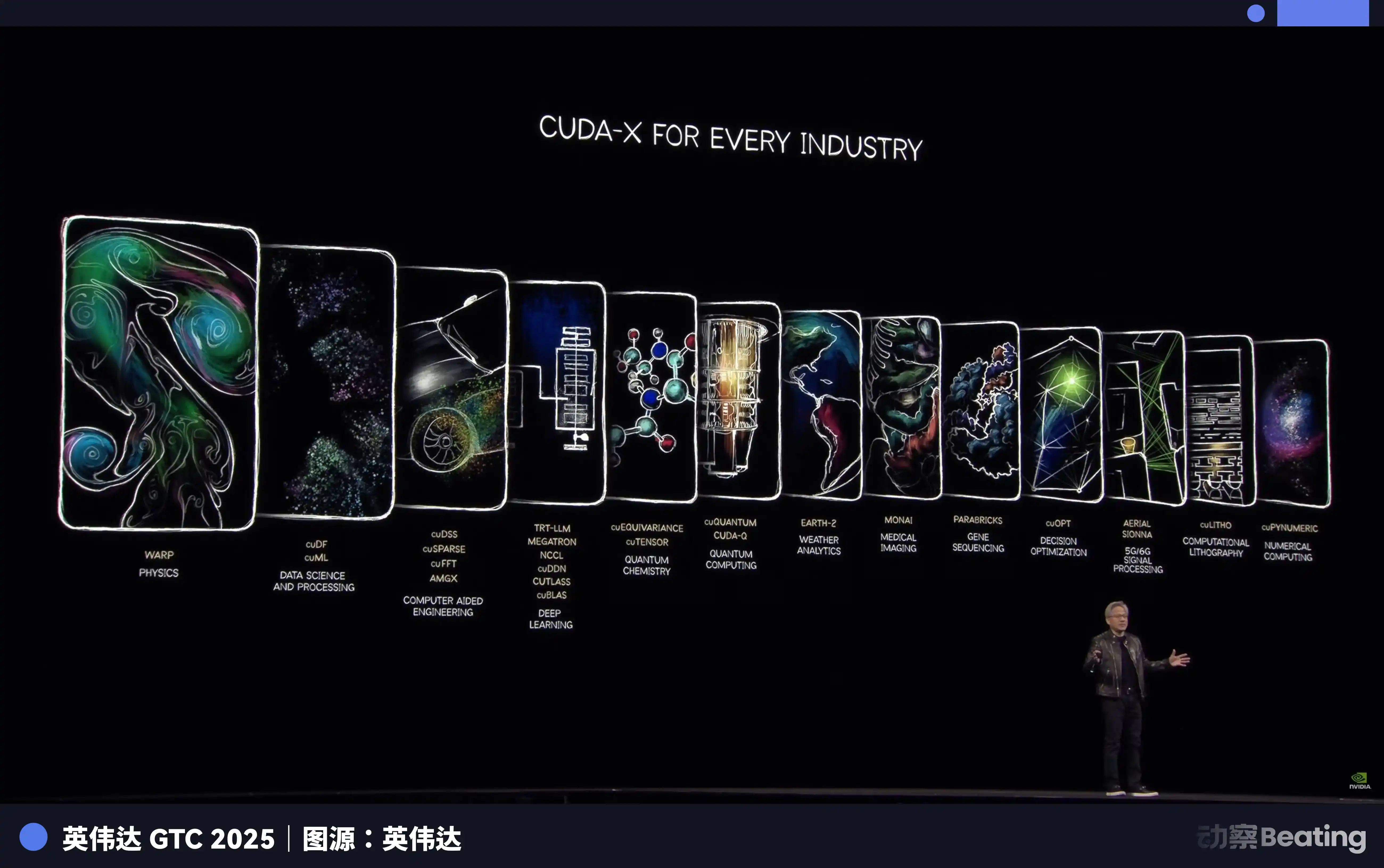
As of 2025, the CUDA ecosystem already boasts over 4.5 million developers, covers more than 3,000 GPU-accelerated applications, and is used by over 40,000 companies globally. This number means that over 90% of the world's AI developers are locked into NVIDIA's ecosystem.

The terrifying thing about CUDA is that it's a flywheel. The more developers use it, the more tools, libraries, and code are generated, making the ecosystem more prosperous; the more prosperous the ecosystem, the more it attracts additional developers. Once this flywheel starts spinning, it becomes almost impossible to stop.

The result is that NVIDIA sells you the most expensive shovel and also defines the only way to dig. Want to change shovels? Fine. But you'll have to rewrite all the experience, tools, and code accumulated over the past decade by hundreds of thousands of the smartest brains worldwide using that specific method.

Who pays for that cost?

So, when the first round of controls landed on October 7, 2022, with BIS restricting exports of NVIDIA's A100 and H100 to China, Chinese AI companies collectively felt a ZTE-like suffocation for the first time. NVIDIA subsequently launched "China-specific" A800 and H800 chips, reducing the inter-chip interconnect speed, barely maintaining supply.

But just a year later, on October 17, 2023, a second round of controls tightened further, banning A800 and H800 as well, and adding 13 Chinese companies to the Entity List. NVIDIA had to launch a further neutered version, the H20. By December 2024, the final round of controls during the Biden administration landed, strictly limiting even H20 exports.

Three rounds of controls, escalating step by step.

But this time, the story's direction is completely different from that of ZTE back then.

An Asymmetric Breakout

Under the ban, everyone thought the dream of Chinese AI large models would end there.

They were wrong. Faced with the blockade, Chinese companies did not choose a head-on confrontation but began a breakout. The first battlefield of this breakout was not in chips, but in algorithms.

From late 2024 to 2025, Chinese AI companies collectively turned to a technical direction: Mixture of Experts (MoE) models.

Simply put, this means splitting a huge model into many small experts, activating only the most relevant few when processing a task, rather than engaging the entire model.

DeepSeek's V3 is a typical example of this approach. It has 671 billion parameters, but only activates 37 billion of them during each inference, just 5.5% of the total. In terms of training cost, it used 2048 NVIDIA H800 GPUs, trained for 58 days, with a total cost of $5.576 million. In comparison, external estimates for GPT-4's training cost are around $78 million. A difference of an order of magnitude.

Extreme optimization in algorithms directly reflected in pricing. DeepSeek's API price is $0.028 to $0.28 per million input tokens, and $0.42 for output. GPT-4o's input price is $5, output $15. Claude Opus is even more expensive, $15 input, $75 output. Converted, DeepSeek is 25 to 75 times cheaper than Claude.

This price difference had a huge impact on the global developer market. In February 2026, on OpenRouter, the world's largest AI model API aggregation platform, the weekly call volume for Chinese AI models surged 127% in three weeks, surpassing the U.S. for the first time. A year earlier, Chinese models had less than 2% share on OpenRouter. A year later, it grew 421%, approaching 60%.
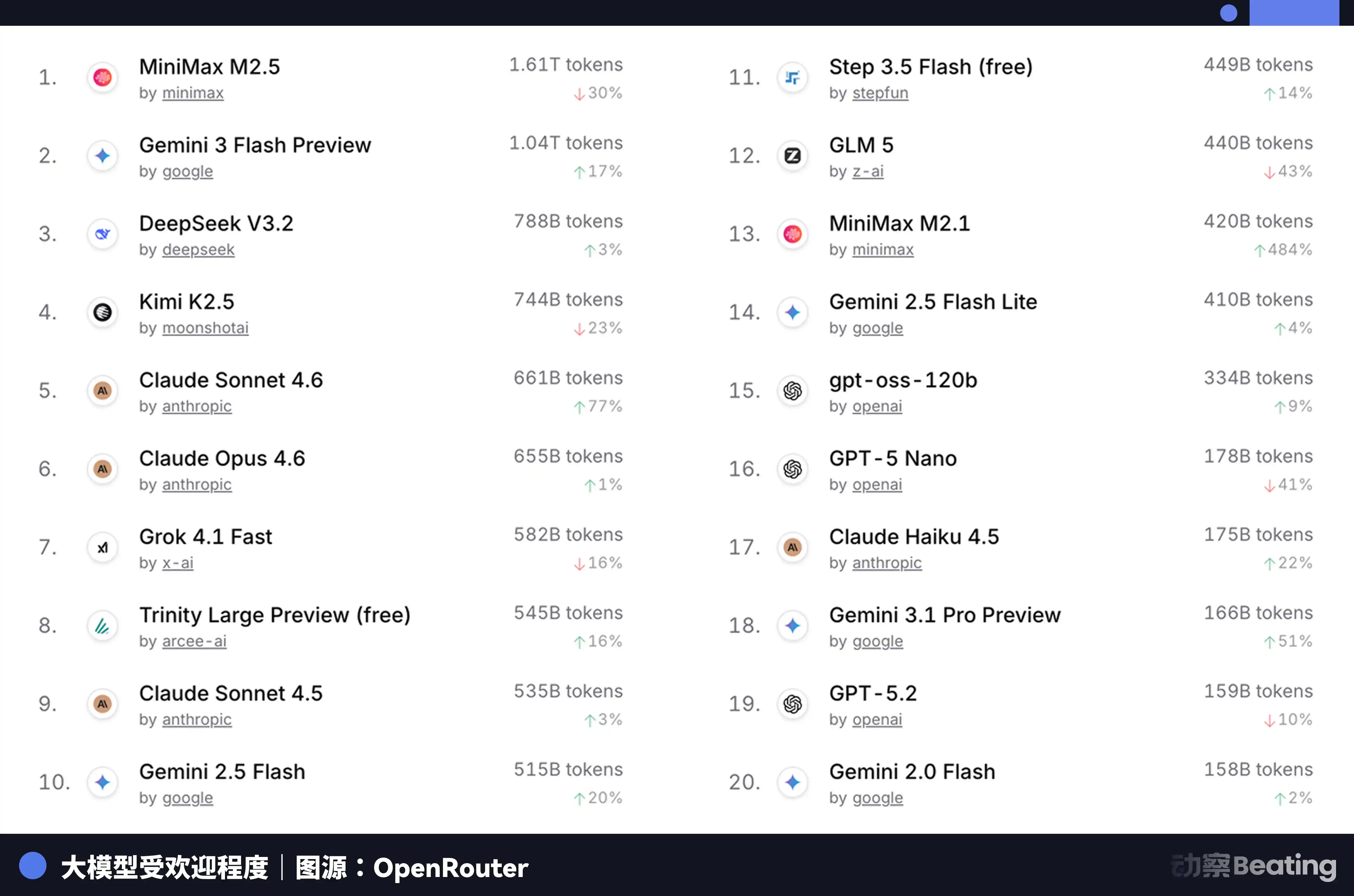
Behind this data lies a structural change that is easy to overlook. Starting in the second half of 2025, the mainstream scenario for AI applications shifted from chat to Agent. In Agent scenarios, the token consumption for a single task is 10 to 100 times that of simple chat. When token consumption grows exponentially, price becomes the decisive factor. The extreme cost-effectiveness of Chinese models恰好踩中了这个窗口 (happened to hit this window perfectly).

But the problem is, reducing inference cost does not solve the fundamental problem of training. A large model that cannot be continuously trained and iterated on new data will see its capabilities degrade rapidly. And training remains that unavoidable computing black hole.

So, where do the "shovels" for training come from?

The Backup Plan Goes Mainstream

Xinghua, Jiangsu, a small city in central Jiangsu, known for stainless steel and health food, previously had no relation to AI. But in 2025, a 148-meter-long production line for domestic computing servers was built and put into operation here, taking only 180 days from signing to production.

The core of this production line is two fully domestic chips: the Loongson 3C6000 processor and the Taichu Yuanqi T100 AI accelerator card. The Loongson 3C6000 is entirely self-developed, from instruction set to microarchitecture. Taichu Yuanqi emerged from the National Supercomputing Center in Wuxi and a Tsinghua University team, adopting a heterogeneous many-core architecture.

At full capacity, this line produces one server every 5 minutes. The total investment for this production line is 1.1 billion yuan, with an expected annual output of 100,000 units.

More importantly, clusters based on these domestic chips, comprising tens of thousands of cards, have begun undertaking real large model training tasks.

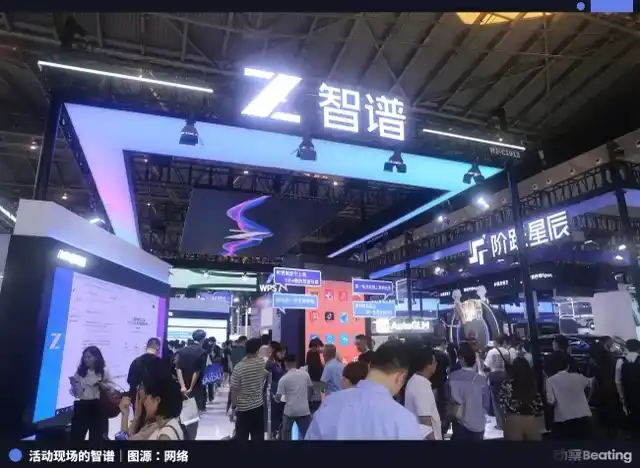
In January 2026, Zhipu AI, in collaboration with Huawei, released GLM-Image, the first SOTA image generation model fully trained from start to finish relying on domestic chips. In February, China Telecom's billion-parameter "Star" large model completed its full training process on a domestic 10,000-card computing pool in Shanghai's Lingang.
The significance of these cases is that they prove one thing: domestic chips have transitioned from "usable for inference" to "usable for training." This is a qualitative change. Inference only requires running a pre-trained model, which places relatively lower demands on the chip; training requires processing massive data, performing complex gradient calculations and parameter updates, demanding an order of magnitude higher requirements for chip computing power, interconnect bandwidth, and software ecosystem.

The core force承担这些任务 (undertaking these tasks) is Huawei's Ascend series chips. As of the end of 2025, the Ascend ecosystem had surpassed 4 million developers, with over 3,000 partners; 43 mainstream large models completed pre-training based on Ascend, and over 200 open-source models were adapted. At the MWC conference on March 2, 2026, Huawei also launched its new computing base, SuperPoD, for overseas markets.

Ascend 910B's FP16 computing power is already comparable to NVIDIA's A100. Although the gap still exists, it has gone from unusable to usable, and from usable to becoming good. Ecosystem building cannot wait until the chips are perfect; it must be rolled out on a large scale at the usable stage, using real business needs to force the iteration of chips and software. ByteDance, Tencent, and Baidu's targets for importing domestic computing servers普遍较上一年翻倍增长 (generally doubled compared to the previous year) in 2026. Data from the Ministry of Industry and Information Technology shows China's intelligent computing scale has reached 1590 EFLOPS. 2026 is becoming the first year of large-scale deployment for domestic computing.

U.S. Power Shortages and China's Overseas Expansion

In early 2026, Virginia, which carries a large amount of data center traffic globally, suspended approval for new data center construction projects. Georgia followed suit, extending the suspension until 2027. Illinois and Michigan also introduced restrictions.

According to data from the International Energy Agency, U.S. data center electricity consumption reached 183 TWh in 2024, accounting for about 4% of the nation's total electricity consumption. By 2030, this number is expected to double to 426 TWh, potentially exceeding 12%. Arm's CEO predicted that by 2030, AI data centers would consume 20% to 25% of U.S. electricity.

The U.S. power grid is already overwhelmed. The PJM grid, covering 13 eastern U.S. states, faces a 6GW capacity shortfall. By 2033, the U.S. overall faces a 175GW power capacity gap, equivalent to the electricity consumption of 130 million households. Wholesale electricity costs in data center concentrated areas are 267% higher than five years ago.

The end of computing power is energy. And on the energy dimension, the gap between China and the U.S. is even larger than in chips, just in the opposite direction.

China's annual electricity generation is 10.4 trillion kWh, while the U.S. is 4.2 trillion kWh; China's is 2.5 times that of the U.S. More crucially, residential electricity consumption in China accounts for only 15% of total electricity usage, while in the U.S. this proportion is 36%. This means China has far more industrial electricity surplus available for computing construction than the U.S.
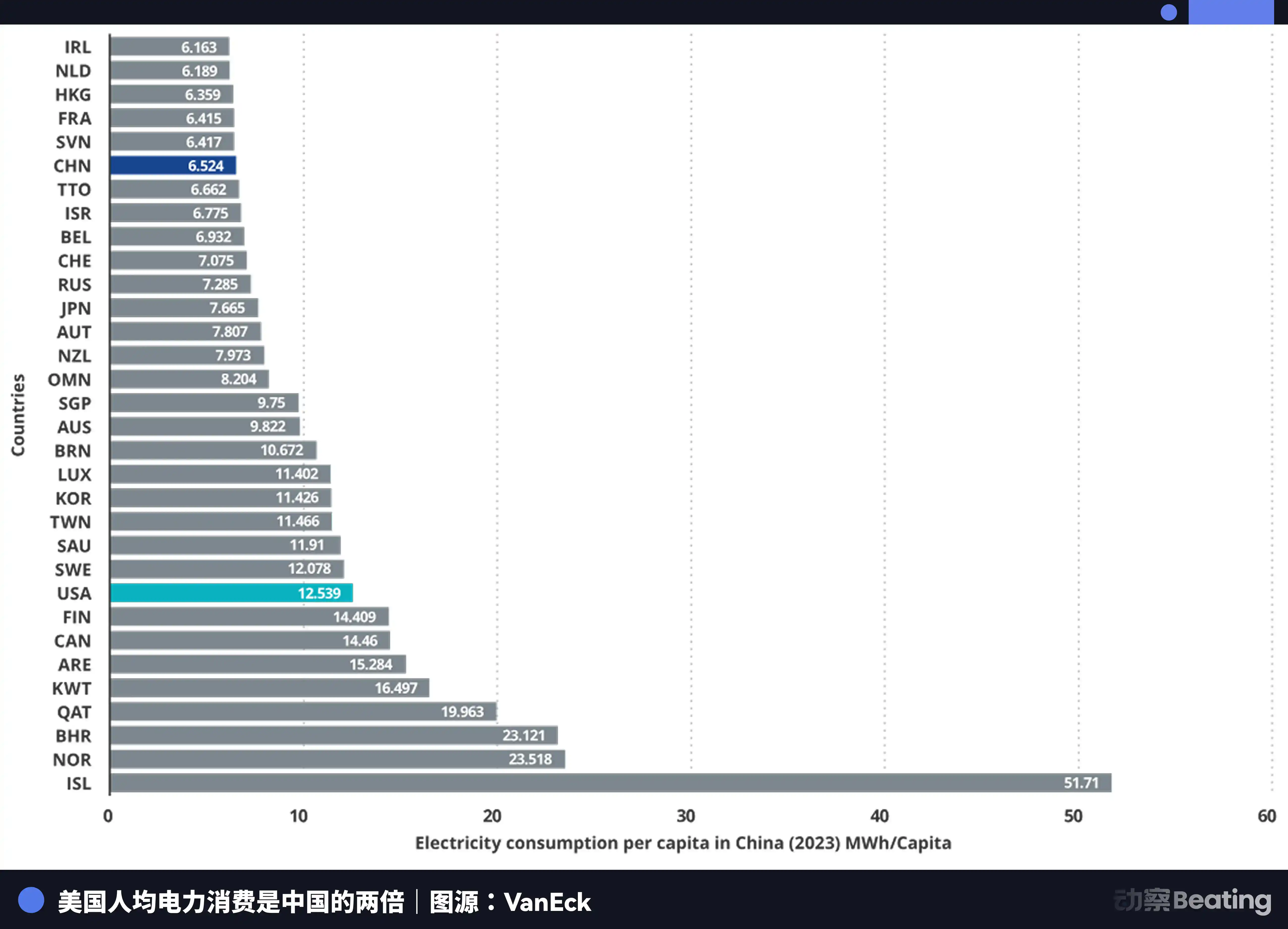
In terms of electricity prices, the price in U.S. AI company hubs is $0.12 to $0.15 per kWh, while industrial electricity prices in western China are about $0.03, only a quarter to a fifth of the U.S. price.

China's power generation growth is already 7 times that of the U.S.

Just as the U.S. worries about electricity, Chinese AI is quietly going global. But this time, what's going overseas is not products, not factories, but Tokens.

Tokens, the smallest unit of information processed by AI models, are becoming a new digital commodity. They are produced in Chinese computing factories and transmitted globally via submarine cables.

DeepSeek's user distribution data is telling: 30.7% in mainland China, 13.6% in India, 6.9% in Indonesia, 4.3% in the U.S., 3.2% in France. It supports 37 languages and is widely popular in emerging markets like Brazil. Globally, 26,000 enterprises have opened accounts, and 3,200 institutions have deployed the enterprise version.

In 2025, 58% of new AI startups included DeepSeek in their tech stack. In China, DeepSeek captured 89% market share. In other sanctioned countries, market share ranged from 40% to 60%.

This scene is reminiscent of another war about industrial autonomy forty years ago.

In Tokyo, 1986, under strong pressure from the U.S., the Japanese government signed the U.S.-Japan Semiconductor Agreement. The core clauses of the agreement were three: requiring Japan to open its semiconductor market, with U.S. chip market share in Japan必须达到 20% 以上 (must reach over 20%); strictly prohibiting Japanese semiconductors from being exported below cost; and imposing 100% punitive tariffs on $300 million worth of chips exported from Japan. Simultaneously, the U.S. vetoed Fujitsu's acquisition of Fairchild Semiconductor.

That year, the Japanese semiconductor industry was at its peak. In 1988, Japan controlled 51% of the global semiconductor market share, while the U.S. had only 36.8%. Six of the world's top ten semiconductor companies were Japanese: NEC ranked second, Toshiba third, Hitachi fifth, Fujitsu seventh, Mitsubishi eighth, and Panasonic ninth. In 1985, Intel lost $173 million in the U.S.-Japan semiconductor war,濒临破产 (on the verge of bankruptcy).

But after the agreement was signed, everything changed.

The U.S., through means like Section 301 investigations, launched a comprehensive suppression of Japanese semiconductor companies. Simultaneously, it扶持 (supported) South Korea's Samsung and Hynix to impact Japan's market with lower prices. Japan's DRAM share fell from 80% to 10%. By 2017, Japan's IC market share was only 7%. Once-invincible giants were either split up, acquired, or left the scene黯然离场 (dimly) amidst endless losses.
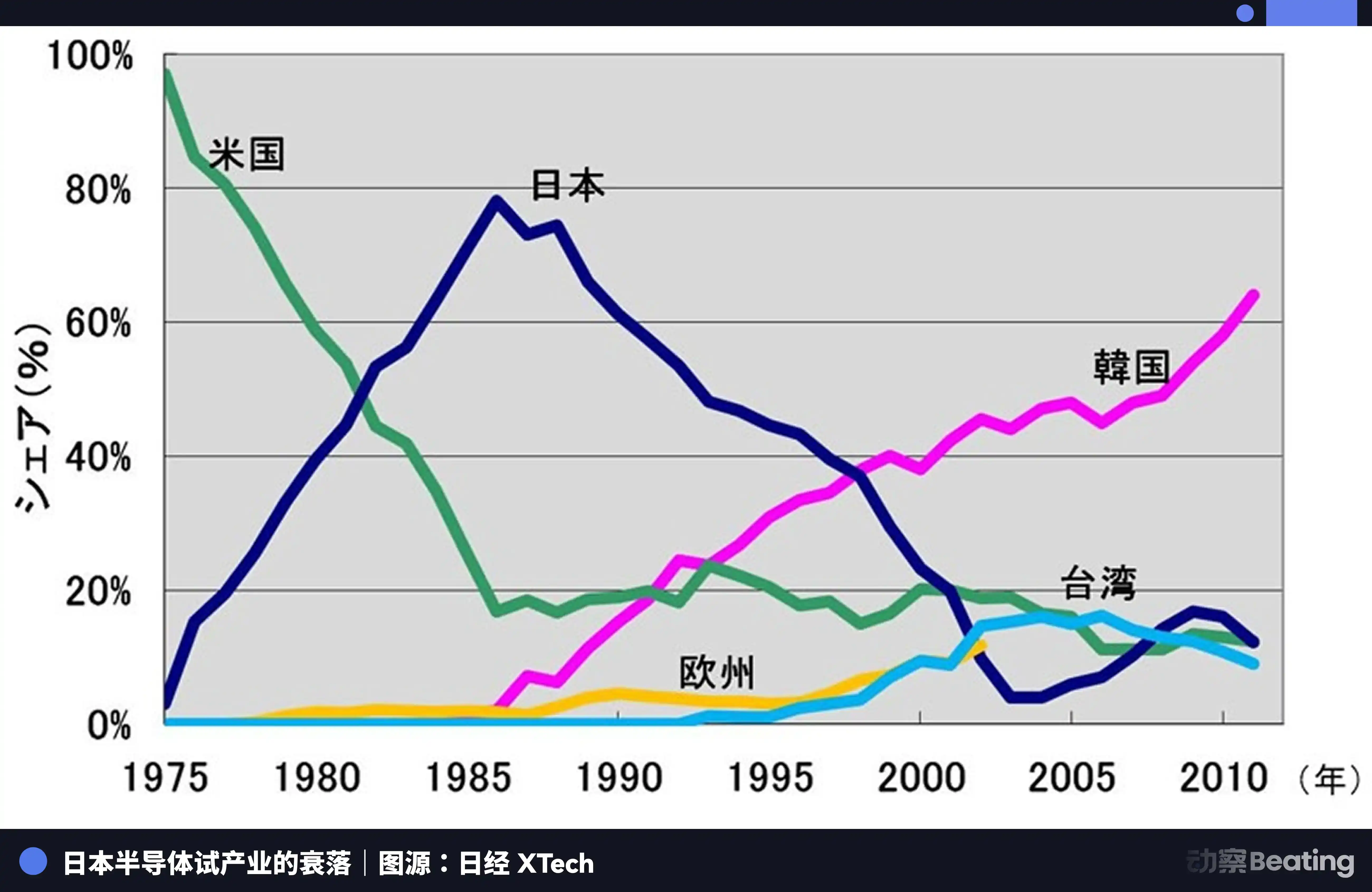
The tragedy of Japanese semiconductors was that they were content being the most excellent producer within a global division of labor system dominated by a single external force, but never thought to build an independent ecosystem of their own. When the tide went out, they found they had nothing but production itself.

Today, China's AI industry stands at a similar yet completely different crossroads.

Similar in that we同样面临着来自外部的巨大压力 (also face huge external pressure). Three rounds of chip controls, escalating step by step, the barrier of the CUDA ecosystem依然高耸 (still stands tall).

Different in that this time, we have chosen a more difficult path. From extreme optimization at the algorithm level, to the leap of domestic chips from inference to training, to the accumulation of 4 million developers in the Ascend ecosystem, to the penetration of global markets through Token exports. Every step on this path is building an independent industrial ecosystem that Japan never possessed back then.

Epilogue

On February 27, 2026, performance reports from three local AI chip companies were released on the same day.

Cambricon, revenue surged 453%, achieving full-year profitability for the first time. Moore Threads, revenue grew 243%, but with a net loss of 1 billion yuan. MetaX, revenue grew 121%, with a net loss of nearly 800 million yuan.

Half flame, half seawater.

The flame is the market's extreme hunger. The 95% void left by Jensen Huang is being filled, inch by inch, by the revenue figures of these local companies. Regardless of performance, regardless of the ecosystem, the market needs a second choice besides NVIDIA. This is a once-in-a-lifetime structural opportunity torn open by geopolitics.

The seawater is the huge cost of ecosystem building. Every cent of loss is real money paid to catch up with the CUDA ecosystem. It's R&D investment, software subsidies, the人力成本 (human cost) of engineers stationed at customer sites solving compilation issues one by one. These losses are not operational failures but the war tax that must be paid to build an independent ecosystem.

These three financial reports, more honestly than any industry report, record the true face of this computing war. It is not a triumphant victory march but a brutal battle of attrition, charging forward while bleeding.

But the form of the war has indeed changed. Eight years ago, we discussed the question of "whether we can survive." Today, we discuss the question of "what price must be paid to survive."

The price itself is progress.

Preguntas relacionadas

QWhat was the core reason behind the 'choking' feeling for Chinese AI companies during the chip ban, beyond just hardware restrictions?

AThe core reason was CUDA (Compute Unified Device Architecture), NVIDIA's parallel computing platform and programming model. It formed the foundational ecosystem for AI development, binding over 90% of global AI developers. Losing access to this deeply entrenched software and toolchain ecosystem, not just the hardware, was what caused severe disruption.

QHow did Chinese AI companies like DeepSeek initially respond to the compute restrictions in a 'non-confrontational' way?

AThey focused on algorithmic breakthroughs, specifically by adopting Mixture-of-Experts (MoE) models. This approach, as seen with DeepSeek V3, used a massive number of parameters (671B) but only activated a small fraction (5.5%) for each task, drastically reducing training and inference expenses, which gave them a significant price advantage.

QWhat key milestone demonstrated that domestic Chinese chips had achieved a qualitative leap in capability?

AThe key milestone was domestic chips transitioning from being 'usable for inference' to 'capable of training' large models. This was proven by instances like Zhipu AI's GLM-Image and China Telecom's 'Xingchen' model, which were fully trained on domestic万卡 (10,000-card) clusters using chips like Huawei's Ascend.

QWhat new advantage is emerging for China's AI industry, related to a fundamental resource constraint facing the US?

AA new advantage is emerging in energy capacity and cost. The US is facing a severe electricity shortage and high costs for powering data centers, while China has 2.5 times the total electricity generation, a larger industrial power allocation, and electricity costs that are only a quarter to a fifth of those in US AI hubs.

QHow is the current Chinese AI industry's situation both similar to and different from Japan's semiconductor industry in the 1980s?

AIt is similar in facing immense external pressure and sanctions from the US. However, it is different because instead of just being a superior manufacturer within a US-led ecosystem (like Japan), China is pursuing a more difficult path of building an independent, full-stack ecosystem—from algorithms and domestic chips to software and a global developer community—which Japan never achieved.

Lecturas Relacionadas

Trading

Spot
Futuros

Artículos destacados

Qué es $S$

Entendiendo SPERO: Una Visión General Completa Introducción a SPERO A medida que el panorama de la innovación continúa evolucionando, la aparición de tecnologías web3 y proyectos de criptomonedas juega un papel fundamental en la configuración del futuro digital. Un proyecto que ha atraído la atención en este campo dinámico es SPERO, denotado como SPERO,$$s$. Este artículo tiene como objetivo reunir y presentar información detallada sobre SPERO, para ayudar a entusiastas e inversores a comprender sus fundamentos, objetivos e innovaciones dentro de los dominios web3 y cripto. ¿Qué es SPERO,$$s$? SPERO,$$s$ es un proyecto único dentro del espacio cripto que busca aprovechar los principios de descentralización y tecnología blockchain para crear un ecosistema que promueva la participación, la utilidad y la inclusión financiera. El proyecto está diseñado para facilitar interacciones de igual a igual de nuevas maneras, proporcionando a los usuarios soluciones y servicios financieros innovadores. En su esencia, SPERO,$$s$ tiene como objetivo empoderar a los individuos al proporcionar herramientas y plataformas que mejoren la experiencia del usuario en el espacio de las criptomonedas. Esto incluye habilitar métodos de transacción más flexibles, fomentar iniciativas impulsadas por la comunidad y crear caminos para oportunidades financieras a través de aplicaciones descentralizadas (dApps). La visión subyacente de SPERO,$$s$ gira en torno a la inclusividad, buscando cerrar brechas dentro de las finanzas tradicionales mientras aprovecha los beneficios de la tecnología blockchain. ¿Quién es el Creador de SPERO,$$s$? La identidad del creador de SPERO,$$s$ sigue siendo algo oscura, ya que hay recursos públicos limitados que proporcionan información de fondo detallada sobre su(s) fundador(es). Esta falta de transparencia puede derivarse del compromiso del proyecto con la descentralización, una ética que muchos proyectos web3 comparten, priorizando las contribuciones colectivas sobre el reconocimiento individual. Al centrar las discusiones en torno a la comunidad y sus objetivos colectivos, SPERO,$$s$ encarna la esencia del empoderamiento sin señalar a individuos específicos. Como tal, comprender la ética y la misión de SPERO sigue siendo más importante que identificar a un creador singular. ¿Quiénes son los Inversores de SPERO,$$s$? SPERO,$$s$ cuenta con el apoyo de una diversa gama de inversores que van desde capitalistas de riesgo hasta inversores ángeles dedicados a fomentar la innovación en el sector cripto. El enfoque de estos inversores generalmente se alinea con la misión de SPERO, priorizando proyectos que prometen avances tecnológicos sociales, inclusión financiera y gobernanza descentralizada. Estas fundaciones de inversores suelen estar interesadas en proyectos que no solo ofrecen productos innovadores, sino que también contribuyen positivamente a la comunidad blockchain y sus ecosistemas. El respaldo de estos inversores refuerza a SPERO,$$s$ como un contendiente notable en el dominio de proyectos cripto que evoluciona rápidamente. ¿Cómo Funciona SPERO,$$s$? SPERO,$$s$ emplea un marco multifacético que lo distingue de los proyectos de criptomonedas convencionales. Aquí hay algunas de las características clave que subrayan su singularidad e innovación: Gobernanza Descentralizada: SPERO,$$s$ integra modelos de gobernanza descentralizada, empoderando a los usuarios para participar activamente en los procesos de toma de decisiones sobre el futuro del proyecto. Este enfoque fomenta un sentido de propiedad y responsabilidad entre los miembros de la comunidad. Utilidad del Token: SPERO,$$s$ utiliza su propio token de criptomoneda, diseñado para servir diversas funciones dentro del ecosistema. Estos tokens permiten transacciones, recompensas y la facilitación de servicios ofrecidos en la plataforma, mejorando la participación y la utilidad general. Arquitectura en Capas: La arquitectura técnica de SPERO,$$s$ apoya la modularidad y escalabilidad, permitiendo la integración fluida de características y aplicaciones adicionales a medida que el proyecto evoluciona. Esta adaptabilidad es fundamental para mantener la relevancia en el cambiante paisaje cripto. Participación de la Comunidad: El proyecto enfatiza iniciativas impulsadas por la comunidad, empleando mecanismos que incentivan la colaboración y la retroalimentación. Al nutrir una comunidad sólida, SPERO,$$s$ puede abordar mejor las necesidades de los usuarios y adaptarse a las tendencias del mercado. Enfoque en la Inclusión: Al ofrecer tarifas de transacción bajas e interfaces amigables para el usuario, SPERO,$$s$ busca atraer a una base de usuarios diversa, incluyendo a individuos que anteriormente pueden no haber participado en el espacio cripto. Este compromiso con la inclusión se alinea con su misión general de empoderamiento a través de la accesibilidad. Cronología de SPERO,$$s$ Entender la historia de un proyecto proporciona información crucial sobre su trayectoria de desarrollo y hitos. A continuación se presenta una cronología sugerida que mapea eventos significativos en la evolución de SPERO,$$s$: Fase de Conceptualización e Ideación: Las ideas iniciales que forman la base de SPERO,$$s$ fueron concebidas, alineándose estrechamente con los principios de descentralización y enfoque comunitario dentro de la industria blockchain. Lanzamiento del Whitepaper del Proyecto: Tras la fase conceptual, se lanzó un whitepaper completo que detalla la visión, los objetivos y la infraestructura tecnológica de SPERO,$$s$ para generar interés y retroalimentación de la comunidad. Construcción de Comunidad y Primeras Interacciones: Se realizaron esfuerzos de divulgación activa para construir una comunidad de primeros adoptantes y posibles inversores, facilitando discusiones en torno a los objetivos del proyecto y obteniendo apoyo. Evento de Generación de Tokens: SPERO,$$s$ llevó a cabo un evento de generación de tokens (TGE) para distribuir sus tokens nativos a los primeros seguidores y establecer liquidez inicial dentro del ecosistema. Lanzamiento de la dApp Inicial: La primera aplicación descentralizada (dApp) asociada con SPERO,$$s$ se puso en marcha, permitiendo a los usuarios interactuar con las funcionalidades centrales de la plataforma. Desarrollo Continuo y Alianzas: Actualizaciones y mejoras continuas a las ofertas del proyecto, incluyendo alianzas estratégicas con otros actores en el espacio blockchain, han moldeado a SPERO,$$s$ en un jugador competitivo y en evolución en el mercado cripto. Conclusión SPERO,$$s$ se erige como un testimonio del potencial de web3 y las criptomonedas para revolucionar los sistemas financieros y empoderar a los individuos. Con un compromiso con la gobernanza descentralizada, la participación comunitaria y funcionalidades diseñadas de manera innovadora, allana el camino hacia un paisaje financiero más inclusivo. Como con cualquier inversión en el espacio cripto que evoluciona rápidamente, se anima a los posibles inversores y usuarios a investigar a fondo y participar de manera reflexiva con los desarrollos en curso dentro de SPERO,$$s$. El proyecto muestra el espíritu innovador de la industria cripto, invitando a una mayor exploración de sus innumerables posibilidades. Mientras el viaje de SPERO,$$s$ aún se desarrolla, sus principios fundamentales pueden, de hecho, influir en el futuro de cómo interactuamos con la tecnología, las finanzas y entre nosotros en ecosistemas digitales interconectados.

72 Vistas totalesPublicado en 2024.12.17Actualizado en 2024.12.17

Qué es $S$

Qué es AGENT S

Agent S: El Futuro de la Interacción Autónoma en Web3 Introducción En el paisaje en constante evolución de Web3 y las criptomonedas, las innovaciones están redefiniendo constantemente cómo los individuos interactúan con las plataformas digitales. Uno de estos proyectos pioneros, Agent S, promete revolucionar la interacción humano-computadora a través de su marco agente abierto. Al allanar el camino para interacciones autónomas, Agent S busca simplificar tareas complejas, ofreciendo aplicaciones transformadoras en inteligencia artificial (IA). Esta exploración detallada profundizará en las complejidades del proyecto, sus características únicas y las implicaciones para el dominio de las criptomonedas. ¿Qué es Agent S? Agent S se presenta como un marco agente abierto innovador, diseñado específicamente para abordar tres desafíos fundamentales en la automatización de tareas informáticas: Adquisición de Conocimiento Específico del Dominio: El marco aprende inteligentemente de diversas fuentes de conocimiento externas y experiencias internas. Este enfoque dual le permite construir un rico repositorio de conocimiento específico del dominio, mejorando su rendimiento en la ejecución de tareas. Planificación a Largo Plazo de Tareas: Agent S emplea planificación jerárquica aumentada por la experiencia, un enfoque estratégico que facilita la descomposición y ejecución eficiente de tareas complejas. Esta característica mejora significativamente su capacidad para gestionar múltiples subtareas de manera eficiente y efectiva. Manejo de Interfaces Dinámicas y No Uniformes: El proyecto introduce la Interfaz Agente-Computadora (ACI), una solución innovadora que mejora la interacción entre agentes y usuarios. Utilizando Modelos de Lenguaje Multimodal de Gran Escala (MLLMs), Agent S puede navegar y manipular diversas interfaces gráficas de usuario sin problemas. A través de estas características pioneras, Agent S proporciona un marco robusto que aborda las complejidades involucradas en la automatización de la interacción humana con las máquinas, preparando el terreno para una multitud de aplicaciones en IA y más allá. ¿Quién es el Creador de Agent S? Si bien el concepto de Agent S es fundamentalmente innovador, la información específica sobre su creador sigue siendo elusiva. El creador es actualmente desconocido, lo que resalta ya sea la etapa incipiente del proyecto o la elección estratégica de mantener a los miembros fundadores en el anonimato. Independientemente de la anonimidad, el enfoque sigue siendo en las capacidades y el potencial del marco. ¿Quiénes son los Inversores de Agent S? Dado que Agent S es relativamente nuevo en el ecosistema criptográfico, la información detallada sobre sus inversores y patrocinadores financieros no está documentada explícitamente. La falta de información disponible públicamente sobre las bases de inversión u organizaciones que apoyan el proyecto plantea preguntas sobre su estructura de financiamiento y hoja de ruta de desarrollo. Comprender el respaldo es crucial para evaluar la sostenibilidad del proyecto y su posible impacto en el mercado. ¿Cómo Funciona Agent S? En el núcleo de Agent S se encuentra una tecnología de vanguardia que le permite funcionar de manera efectiva en diversos entornos. Su modelo operativo se basa en varias características clave: Interacción Humano-Computadora Similar a la Humana: El marco ofrece planificación avanzada de IA, esforzándose por hacer que las interacciones con las computadoras sean más intuitivas. Al imitar el comportamiento humano en la ejecución de tareas, promete elevar las experiencias de los usuarios. Memoria Narrativa: Empleada para aprovechar experiencias de alto nivel, Agent S utiliza memoria narrativa para hacer un seguimiento de las historias de tareas, mejorando así sus procesos de toma de decisiones. Memoria Episódica: Esta característica proporciona a los usuarios una guía paso a paso, permitiendo que el marco ofrezca apoyo contextual a medida que se desarrollan las tareas. Soporte para OpenACI: Con la capacidad de ejecutarse localmente, Agent S permite a los usuarios mantener el control sobre sus interacciones y flujos de trabajo, alineándose con la ética descentralizada de Web3. Fácil Integración con APIs Externas: Su versatilidad y compatibilidad con varias plataformas de IA aseguran que Agent S pueda encajar sin problemas en ecosistemas tecnológicos existentes, convirtiéndolo en una opción atractiva para desarrolladores y organizaciones. Estas funcionalidades contribuyen colectivamente a la posición única de Agent S dentro del espacio cripto, ya que automatiza tareas complejas y de múltiples pasos con una intervención humana mínima. A medida que el proyecto evoluciona, sus posibles aplicaciones en Web3 podrían redefinir cómo se desarrollan las interacciones digitales. Cronología de Agent S El desarrollo y los hitos de Agent S pueden encapsularse en una cronología que resalta sus eventos significativos: 27 de septiembre de 2024: El concepto de Agent S fue lanzado en un documento de investigación integral titulado “Un Marco Agente Abierto que Usa Computadoras Como un Humano”, mostrando las bases del proyecto. 10 de octubre de 2024: El documento de investigación fue puesto a disposición del público en arXiv, ofreciendo una exploración profunda del marco y su evaluación de rendimiento basada en el benchmark OSWorld. 12 de octubre de 2024: Se lanzó una presentación en video, proporcionando una visión visual de las capacidades y características de Agent S, involucrando aún más a posibles usuarios e inversores. Estos marcadores en la cronología no solo ilustran el progreso de Agent S, sino que también indican su compromiso con la transparencia y la participación comunitaria. Puntos Clave Sobre Agent S A medida que el marco Agent S continúa evolucionando, varios atributos clave destacan, subrayando su naturaleza innovadora y potencial: Marco Innovador: Diseñado para proporcionar un uso intuitivo de las computadoras similar a la interacción humana, Agent S aporta un enfoque novedoso a la automatización de tareas. Interacción Autónoma: La capacidad de interactuar de manera autónoma con las computadoras a través de GUI significa un salto hacia soluciones informáticas más inteligentes y eficientes. Automatización de Tareas Complejas: Con su metodología robusta, puede automatizar tareas complejas y de múltiples pasos, haciendo que los procesos sean más rápidos y menos propensos a errores. Mejora Continua: Los mecanismos de aprendizaje permiten a Agent S mejorar a partir de experiencias pasadas, mejorando continuamente su rendimiento y eficacia. Versatilidad: Su adaptabilidad en diferentes entornos operativos como OSWorld y WindowsAgentArena asegura que pueda servir a una amplia gama de aplicaciones. A medida que Agent S se posiciona en el paisaje de Web3 y criptomonedas, su potencial para mejorar las capacidades de interacción y automatizar procesos significa un avance significativo en las tecnologías de IA. A través de su marco innovador, Agent S ejemplifica el futuro de las interacciones digitales, prometiendo una experiencia más fluida y eficiente para los usuarios en diversas industrias. Conclusión Agent S representa un audaz avance en la unión de la IA y Web3, con la capacidad de redefinir cómo interactuamos con la tecnología. Aunque aún se encuentra en sus primeras etapas, las posibilidades para su aplicación son vastas y atractivas. A través de su marco integral que aborda desafíos críticos, Agent S busca llevar las interacciones autónomas al primer plano de la experiencia digital. A medida que nos adentramos más en los reinos de las criptomonedas y la descentralización, proyectos como Agent S sin duda desempeñarán un papel crucial en la configuración del futuro de la tecnología y la colaboración humano-computadora.

248 Vistas totalesPublicado en 2025.01.14Actualizado en 2025.01.14

Qué es AGENT S

Cómo comprar S

¡Bienvenido a HTX.com! Hemos hecho que comprar Sonic (S) sea simple y conveniente. Sigue nuestra guía paso a paso para iniciar tu viaje de criptos.Paso 1: crea tu cuenta HTXUtiliza tu correo electrónico o número de teléfono para registrarte y obtener una cuenta gratuita en HTX. Experimenta un proceso de registro sin complicaciones y desbloquea todas las funciones.Obtener mi cuentaPaso 2: ve a Comprar cripto y elige tu método de pagoTarjeta de crédito/débito: usa tu Visa o Mastercard para comprar Sonic (S) al instante.Saldo: utiliza fondos del saldo de tu cuenta HTX para tradear sin problemas.Terceros: hemos agregado métodos de pago populares como Google Pay y Apple Pay para mejorar la comodidad.P2P: tradear directamente con otros usuarios en HTX.Over-the-Counter (OTC): ofrecemos servicios personalizados y tipos de cambio competitivos para los traders.Paso 3: guarda tu Sonic (S)Después de comprar tu Sonic (S), guárdalo en tu cuenta HTX. Alternativamente, puedes enviarlo a otro lugar mediante transferencia blockchain o utilizarlo para tradear otras criptomonedas.Paso 4: tradear Sonic (S)Tradear fácilmente con Sonic (S) en HTX's mercado spot. Simplemente accede a tu cuenta, selecciona tu par de trading, ejecuta tus trades y monitorea en tiempo real. Ofrecemos una experiencia fácil de usar tanto para principiantes como para traders experimentados.

286 Vistas totalesPublicado en 2025.01.15Actualizado en 2025.03.21

Cómo comprar S

Discusiones

Bienvenido a la comunidad de HTX. Aquí puedes mantenerte informado sobre los últimos desarrollos de la plataforma y acceder a análisis profesionales del mercado. A continuación se presentan las opiniones de los usuarios sobre el precio de S (S).

活动图片