Crypto Should Be Judged By Economic Role, Not Tech Design: ASIC Fintech Chief

bitcoinistPublicado a 2026-03-11Actualizado a 2026-03-11

Resumen

According to Rhys Bollen, head of fintech at the Australian Securities and Investments Commission (ASIC), consumer harm in crypto primarily stems from intermediaries—exchanges, custodians, lenders—rather than the tokens themselves. In a paper presented at the Melbourne Money and Finance Conference, Bollen argued that Australia should regulate digital assets based on their economic function, not their technological design. Tokens that act like securities should be treated as such, stablecoins moving money should fall under payments law, and consumer protection rules should cover the rest. This approach contrasts with jurisdictions like the U.S. and EU, which are creating crypto-specific laws. Australia is already implementing this through its Digital Asset Framework bill, which integrates digital assets into existing financial regulations rather than building a separate legal structure.

Most harm done to consumers in the crypto space has come not from the tokens themselves, but from the platforms handling them — the exchanges, custodians, lenders, and yield services.

That finding sits at the center of a new paper delivered this week by Rhys Bollen, the head of fintech at the Australian Securities and Investments Commission, who argues Australia should stop treating digital assets as something categorically new and start applying the financial laws already on the books.

Regulating What It Does, Not What It’s Called

Bollen made the case at the Melbourne Money and Finance Conference, where he argued that crypto tokens should be judged by their economic function. A token that acts like a security should be treated as one. A stablecoin that moves money should fall under payments law.

Consumer protection rules should pick up whatever else remains. His argument strips away the technological wrapping and asks a simpler question: what does this thing actually do?
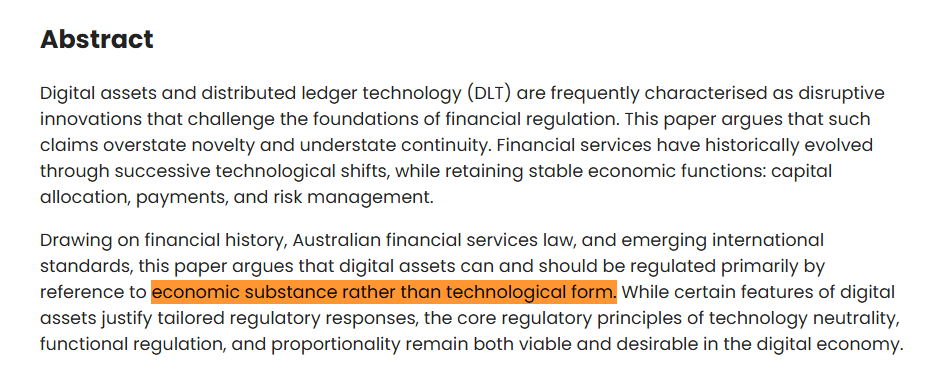
Paper presented at the Melbourne Money & Finance Conference, University of Melbourne by Dr. Rhys Bollen, Senior Executive Leader, FinTech

Crypto-Specific Law

That framing puts Australia at odds with how other countries have gone about it. The US is pushing the CLARITY Act, a purpose-built crypto framework. The European Union has rolled out its Markets in Crypto-Assets rules, known as MiCA. Both create dedicated regulatory structures for digital assets.

Bollen’s position, by contrast, is that building a separate system from scratch misses the point — and leaves gaps that bad actors will find.

“Opportunities for regulatory arbitrage” is how Bollen describes those gaps. Build a crypto-specific law, and someone will structure a product to fall outside it. Attach crypto to existing law based on what the product does, and that exit shrinks.

BTCUSD trading at $69,615 on the 24-hour chart: TradingView

Australia Already Writing It Into Law

Australia isn’t waiting on theory. The country’s Digital Asset Framework bill, currently moving through parliament, doesn’t attempt to replace the Corporations Act.

Reports indicate the bill amends it — slotting digital asset platforms into the existing regulatory structure rather than building a lane beside it.

ASIC’s own guidance document, Information Sheet 225, has already confirmed that existing definitions of financial products and services under the Corporations Act can apply to crypto, depending on how a given asset functions.

Bollen was direct about what that means in practice. Regulators, he said, should be focused on intermediaries — the companies sitting between users and their crypto — rather than on the tokens themselves. That’s where the consumer harm has actually shown up.

Featured image from Cyber Security News, chart from TradingView

Preguntas relacionadas

QAccording to Rhys Bollen, where has most consumer harm in the crypto space originated from?

AMost consumer harm has come not from the tokens themselves, but from the platforms handling them, such as exchanges, custodians, lenders, and yield services.

QWhat is the core argument made by the ASIC FinTech chief regarding how crypto should be regulated?

ACrypto tokens should be judged by their economic function rather than their technological design, meaning a token that acts like a security should be treated as one, and existing financial laws should be applied based on what the product actually does.

QHow does Australia's proposed regulatory approach for digital assets differ from that of the US and EU?

AAustralia is amending its existing Corporations Act to slot digital assets into the current regulatory structure, whereas the US is pushing the purpose-built CLARITY Act and the EU has created a dedicated framework called MiCA.

QWhat does the term 'regulatory arbitrage' refer to in the context of crypto regulation, as mentioned by Bollen?

A'Regulatory arbitrage' refers to the opportunities for bad actors to structure crypto products in a way that falls outside the scope of a purpose-built, crypto-specific regulatory framework, thereby creating gaps in consumer protection.

QWhat is the practical focus for regulators that Bollen suggests to prevent consumer harm in the crypto space?

ARegulators should focus on the intermediaries—the companies that sit between users and their crypto, such as platforms and service providers—rather than on the tokens themselves, as that is where the actual consumer harm has occurred.

Lecturas Relacionadas

Huang Renxun Dramatically 'Saves' South Korean Stock Market

In early June, South Korea's stock market experienced a sharp decline, with the KOSPI index dropping over 5% and triggering a trading halt. Amid this volatility, NVIDIA CEO Jensen Huang's visit to Seoul provided a dramatic boost to market sentiment. During his trip, Huang held a dinner meeting with SK Group Chairman Chey Tae-won and SK Hynix CEO Kwak Noh-Jung. He announced that NVIDIA's new Vera CPU would utilize SK Hynix DRAM and confirmed a multi-year technical collaboration between the two companies. This partnership aims to co-develop next-generation memory for NVIDIA's AI infrastructure roadmap, covering products from data center supercomputers to personal AI devices. Huang also publicly commented that AI company stocks were attractively priced. A key announcement was that NVIDIA's upcoming Vera Rubin AI supercomputer systems will use HBM4 memory, with supply qualifications granted to all three major suppliers: SK Hynix, Samsung Electronics, and Micron Technology. Despite this multi-sourcing strategy, Huang warned that the industry-wide chip shortage, affecting everything from wafers to packaging, is expected to persist for several years due to relentless demand from global AI factory construction. The collaboration extends beyond memory supply. SK Hynix will employ NVIDIA's AI platforms and Omniverse digital twin technology to enhance its own semiconductor design, simulation, and manufacturing processes, aiming for more autonomous factory operations. This visit builds upon a prior October 2025 agreement for SK Group to build a large-scale AI data center using over 50,000 NVIDIA GPUs. Huang's itinerary also included meetings with other Korean giants like Hyundai, LG, and Samsung, indicating NVIDIA's broader strategy to deepen ties with South Korea's tech industry.

链捕手Hace 2 hora(s)

Huang Renxun Dramatically 'Saves' South Korean Stock Market

链捕手Hace 2 hora(s)

When Inference Becomes a Scarce Resource, Who Captures the Value?

When Inference Becomes the Scarce Resource, Who Captures the Value? The core AI bottleneck has shifted from model training to inference (runtime execution). While concerns persisted about an "AI compute gap"—initially a $200B, now a $600B problem—the market is now recognizing that the solution and value lie in the inference layer. Nvidia's financial restructuring around "serving tokens" and Cerebras's successful IPO highlight this shift. Inference is a recurring, usage-based cost, estimated to be 10-50x larger than the one-time training market, especially with the rise of agentic AI. The inference stack spans six layers: silicon (e.g., Nvidia), bare metal (e.g., CoreWeave), GPU rental/aggregation, deployment/optimization, model APIs, and end applications. Most companies operate in one layer. However, Hyperbolic uniquely spans three layers (GPU rental, deployment, and model APIs) without owning any hardware. It aggregates fragmented GPU supply from multiple cloud providers into a standardized pool, offering developers the cheapest available compute through intelligent routing. Its multi-cloud aggregation creates a data moat and a flywheel: more supply leads to better pricing data and liquidity, attracting more developers and providers. In contrast, applications like Venice operate at the top of the stack, reselling privacy-wrapped inference but remaining dependent on and constrained by the underlying compute costs they purchase. As inference demand explodes, value accrues not just to consumer applications but increasingly to the aggregation and routing layer that captures their cost of revenue. The coming potential GPU oversupply reinforces this dynamic. While hardware owners may suffer from depreciation, asset-light aggregators like Hyperbolic benefit from price arbitrage, routing workloads to the cheapest available capacity. The ultimate winner in the inference economy may not be the entity with the most GPUs, but the one that can most efficiently discover, aggregate, and route the world's fragmented compute.

链捕手Hace 2 hora(s)

When Inference Becomes a Scarce Resource, Who Captures the Value?

链捕手Hace 2 hora(s)

Trading

Spot
Futuros
活动图片





