By Sleepy
Most people know Mihoyo because of Genshin Impact.
A second-generation open-world game that topped the application charts in many countries worldwide in its first year. Third-party data shows its mobile revenue has exceeded sixty billion dollars.
Before it was the Honkai series; after it came Honkai: Star Rail and Zenless Zone Zero. Mihoyo has long been one of China's highest-grossing game companies overseas.
Mihoyo's three founders started from Dormitory D32 at Shanghai Jiao Tong University's Minhang campus, pooling 100,000 yuan in interest-free loans, eating Lanzhou ramen and Shaxian snacks downstairs, and writing their first lines of code in a 50-square-meter office.
Fifteen years later, the company is still not listed, has only ever received 1 million yuan in angel investment, and is valued at hundreds of billions of RMB.
This is the Mihoyo most people know. A gaming company, the really successful kind.
Those Invisible Things
What you might not know is that this company is also investing, and in directions you probably wouldn't expect.
In 2021, they invested in brain-computer interfaces, co-establishing a brain disease lab with Ruijin Hospital. The same year, they invested in MiniMax, an AI company few had heard of at the time, which later became one of China's 'Six Giants' in large language models and went public on the Hong Kong Stock Exchange in 2026. They have also invested in controlled nuclear fusion.
Brain-computer, fusion, large models — these words feel a bit mismatched, even a bit cringey, when placed next to anime games.

Mihoyo's homepage still features a line: 'By 2030, create a virtual world that one billion people are willing to inhabit.'
This line has been up for years. Most see it as a slogan, glance at it, and scroll past. But if you take it seriously, all those investments make perfect sense. To build a virtual world one billion people want to live in, visuals aren't enough, story isn't enough, characters aren't enough.
The people in that world have to be 'alive'.
Mihoyo's character design capability has few rivals across the industry. Characters in Genshin Impact have led global players to spend money, create fan art, write fan fiction, and argue over their fates on social media. Someone cried online for three days over the 'death' of a virtual character. These characters are loved, treated seriously, regarded as real in some sense.
But they aren't human. Every line of dialogue is pre-written, every smile is painstakingly animated frame-by-frame, every 'personality' is a set of preset parameters. You fall in love with them, but they don't know. You feel real emotions on this side of the screen, but nothing happens on the other side.
This is a problem all virtual characters face. The better you make them, the more players believe. The more players believe, the quicker the disappointment comes. The anime game industry has made money off this one-way affection for over a decade, and no one saw a problem. Players know the characters aren't real, but knowing is knowing, spending is spending, feeling is feeling.
Except, the person creating the characters, if they truly care, will eventually feel this isn't right.
Six Days
On November 24, 2022, Mihoyo's internal project codenamed Project SH was halted. This project later became City of Rain, but at the time it lacked direction. According to industry reports, co-founder Cai Haoyu tried taking the team overseas to brainstorm, struggled for a while, didn't find a way forward, and pulled back.
Six days later, on November 30, 2022, OpenAI released ChatGPT.
Cai Haoyu graduated from the Computer Science department of Shanghai Jiao Tong University. His master's research was deeply related to intelligent human-computer interaction and brain-computer interfaces. According to people close to him, after returning from his trip, he decided to focus on AI.
He had taken a long detour, from AI to anime games, scaling the company to a value of hundreds of billions with Genshin Impact, then turning back to where he started.
In September 2023, Cai Haoyu stepped down from all management positions at Mihoyo, moving to the overseas AI project Anuttacon. On LinkedIn, his new title is AI Soulcaster.
Another founder, Liu Wei (Da Weige), later explained at Shanghai Jiao Tong University why they let Cai Haoyu go. He said Mihoyo had grown to six or seven thousand people, organizational inertia was too heavy, unsuitable for starting AI from scratch. So the three founders discussed it and split one off. Liu Wei stayed to manage the large company of six or seven thousand, Cai Haoyu took dozens of people to work on cutting-edge technological breakthroughs.
Two-pronged approach.
Hitting Walls and Turning Corners
According to industry reports, Cai Haoyu led forty people overseas, initially wanting to pursue three lines simultaneously: making AI that could talk, act, and see the world. But dividing resources three ways left each strand insufficient.
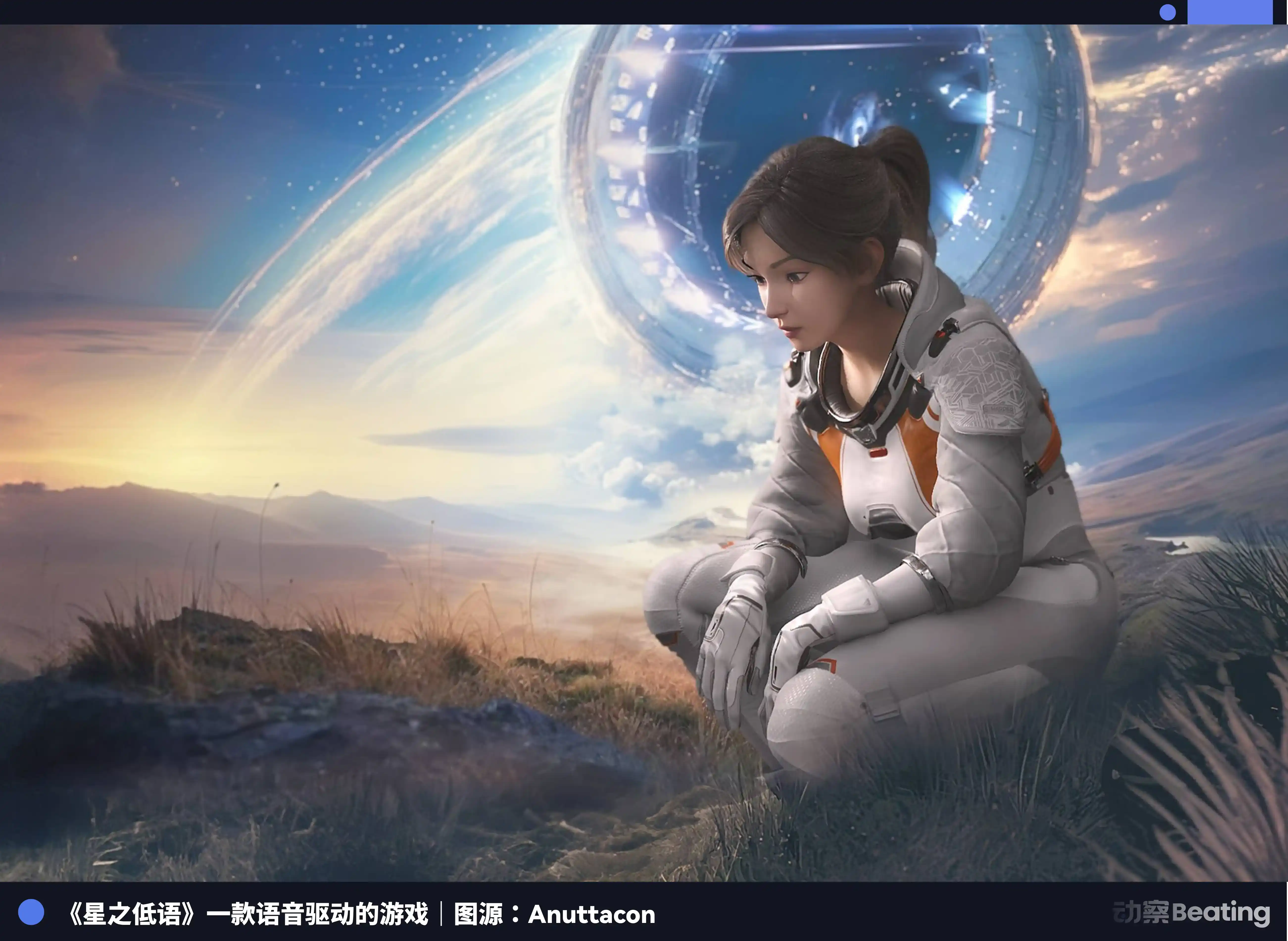
In August 2025, they released their first product on Steam: Whisper of the Stars, an AI-driven interactive game. You converse in real-time with a virtual girl named Stella, helping her survive on an alien planet. No script, no preset options, the AI generates every word she says in real-time. Priced under 30 yuan, it received 'Very Positive' overall reviews on Steam after launch.
But one review said it felt more like a tech demo than a game. Another commented that Stella was oddly relaxed during a wilderness survival scenario; you frantically plan her escape route, and she asks if you've ever felt lost in life. She repeats questions you've already answered, as if suffering from intermittent amnesia.
The reasons for these problems were an underlying language model that wasn't smart enough. The character's performance could be good, the voice realistic, but the character's 'brain' couldn't keep up.
Reportedly, since late last year, Anuttacon cut the other two lines, concentrating almost all resources on language models and agents, with core R&D largely moving back to China.
Then there's Liu Wei's side.
In May 2026, he told a room of PhD students in Beijing that they planned to invest up to 100 billion yuan in AI over the next three years. If it didn't work out, so be it, consider it a grand fireworks display.
When he said this, Mihoyo had already conducted many internal AI experiments. According to insiders, a colleague once set up dozens of AI agents collaborating for a project, burning through 2 million RMB in compute overnight. The company didn't stop it, using this tuition fee to improve their internal platform.
Besides the 100-billion figure, Liu Wei immediately said something else. He said they weren't aiming to build a general-purpose large model; they wanted to build 'a large language model with emotion'. Not just intelligent, but capable of understanding human emotional needs.
You chat with an AI, it gives correct answers, you find it useful, but you don't feel there's a person on the other side. 'Having emotion' requires things that can't be written into benchmark leaderboards, and that's precisely the craft Mihoyo has honed over fifteen years.
They might understand better than any other AI company on Earth how to make a non-existent person feel vitally important to a user.
A Girl Who Plays the Piano
On June 18th, just before the Dragon Boat Festival holiday, Mihoyo opened a pre-release page for an application called BSide: Olivia Lin on Steam.
Note, it's an 'application', not a 'game'. Its classification tag on Steam is Application, not Game.
The protagonist is Li Lin, a Shanghai girl majoring in piano and minoring in psychology. You can listen to her play, upload melodies you've written for her to perform, write her letters (she'll reply), and set her as a dynamic desktop wallpaper. That's it. Free, no gacha, almost none of the familiar trappings of an anime game.
The first dish served after the hundred-billion AI gamble is a piano-playing desktop wallpaper.
Its logic runs completely counter to those AI companion products. Li Lin is not an AI girlfriend. Companies making AI companions, from Replika to Character.AI, operate on a core logic of increasing interaction frequency, always online, responding in seconds, the more chatting the better.
But the more you chat, the more flaws the AI reveals.
Li Lin is not on-call. She replies to your letters after a while, plays melodies you upload, and sits quietly on your desktop if you put her there. This rhythm is almost pre-digital. Letters are inherently delayed, playing music requires no extra dialogue, and quiet presence on the desktop is also a form of companionship.
Ironically, the more realistic the companionship, the lower the AI requirements become. Face-to-face chat is hardest because dialogue is infinite, unpredictable, every reply could expose its non-human nature. Reducing interaction frequency uses product design to compensate for technical gaps. When AI can't yet support a 24/7 'living person', first make an existence you only open occasionally, but feels real every time you do.
In 2020, Mihoyo made a small tool called 'Artificial Desktop', placing their virtual idol Lumi on users' screens. You click, she moves, like a coin-operated merry-go-round. Six years later, Li Lin can play the tunes you write, read your letters, reply with measured phrasing.
Mihoyo calls this path 'sense of being alive'. They've walked it for six years, slowly, but the direction hasn't changed.
In 2010, while a grad student at Jiao Tong University, Cai Haoyu and two others wrote a 2.5D game engine in Flash called Misato. That was Mihoyo's first line of code. Sixteen years later, he's building engines again, only this time the engine isn't for rendering visuals, but for bringing virtual characters to life.
Language model is the brain, letting the character know what to say. Performance model is the body, making the character look alive. Agent framework is memory and personality, letting the character remember experiences and maintain a coherent self. Layer them together, and you have a complete system for turning virtual characters from marionettes into autonomous beings.
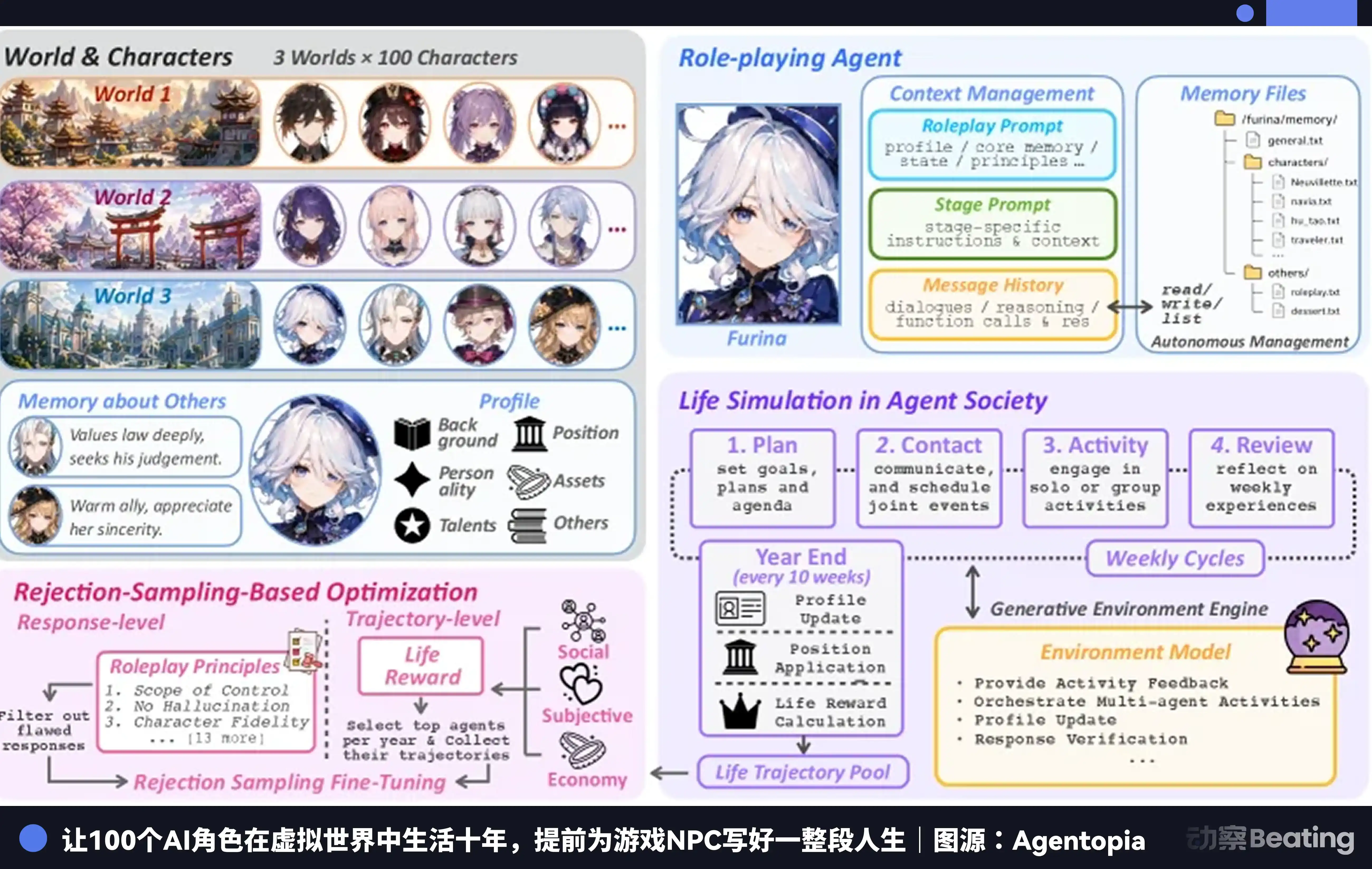
In early June this year, researchers from Fudan University and others published an Agentopia paper, placing one hundred AI characters into three fictional worlds, letting them live autonomously, simulating ten years. The hundred characters each had personalities, memories, social relationships; they quarreled, reconciled, changed opinions of each other over small incidents. The entire experiment consumed 13.7 billion tokens.
One hundred virtual people, in a virtual world, lived ten virtual years.
This system currently has no public benchmark scores, Anuttacon's foundational model is still in closed-door training, with no third-party verification. The only product they've shown the outside world is a girl quietly sitting on your desktop, playing the piano.
Hatsune Miku
Few remember how the name miHoYo came about.
HoYo comes from the first letters of Cai Haoyu and another founder Luo Yuhao's names. The letter o is because they felt big tech companies like Facebook, Google had an o in their names, hoping for a bit of that tech aura.
And mi, from Hatsune Miku. The mi from Hatsune Miku.
Hatsune Miku is a virtual singer. No consciousness, no emotion, no autonomy; technically just a set of vocal synthesis parameters. But thousands of people worldwide write songs for her, draw her, attend her hologram concerts.
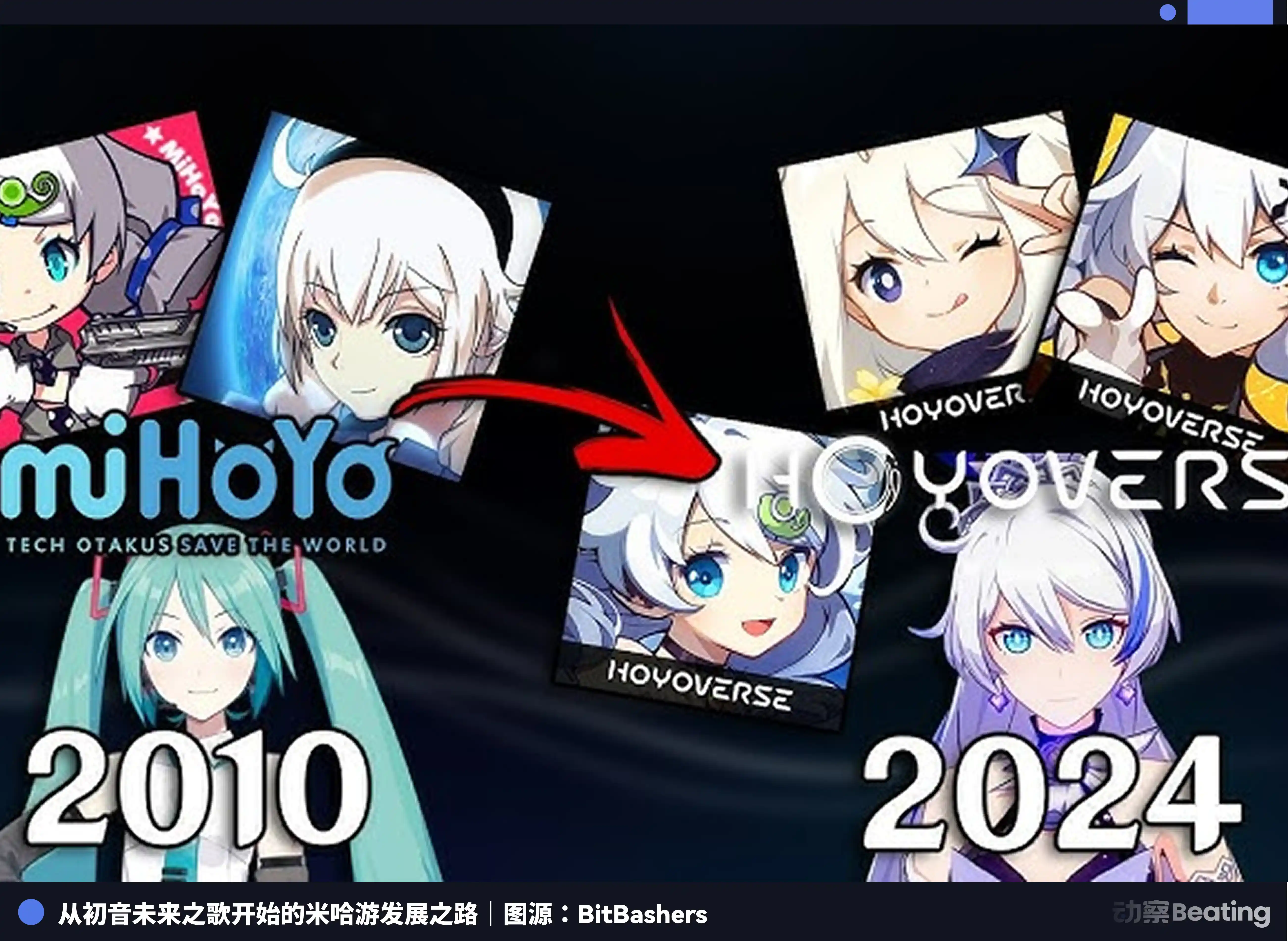
Three young men from a Jiao Tong dormitory named their company after a virtual idol. That was 2012, they had only 100,000 yuan in their pockets. Fourteen years later, this company named after a virtual idol is putting up one hundred billion yuan to solve a problem that was, in fact, written into the company name from day one.
Hatsune Miku has been loved for nearly twenty years. People worldwide have written hundreds of thousands of songs for her, waved glow sticks at a beam of holographic light at concerts, cried, shouted her name. But she doesn't know. She never has.
What if, one day, she did?