Sonnet 5.5 Major Leak, Pitted Against DeepSeek, The New Generation King of Cost-Effectiveness

marsbitPublicado a 2026-08-10Actualizado a 2026-08-10

Resumen

Anthropic's upcoming Sonnet 5.5 model, internally codenamed "Fennec" and potentially launching next month, is reportedly set to challenge DeepSeek V4 Flash as the new value leader. Key leaks suggest a 200万 token context window, faster推理, improved long-context reasoning and multi-step planning, and significantly enhanced agent capabilities like browser and terminal use. While its综合 performance is said to approach the flagship Claude Fable 5, it will remain priced at the Sonnet tier. This positions Sonnet 5.5 as a potentially highly competitive option in the mid-to-high-end AI model market, offering接近Fable-level ability at a more accessible price point. The update also signals a strategic shift, with Sonnet potentially taking over the value segment from the long-unupdated Haiku series.

The competition between Anthropic and OpenAI is heating up.

Ever since DeepSeek V4 Flash entered the arena with its super cost-effective identity, it seems no overseas tech giant can sit still.

Anthropic's latest Sonnet 5.5 model has been leaked and is reportedly ready for launch, with the internal codename "Fennec" (a type of desert fox). Leaks suggest it is highly likely to be released next month.
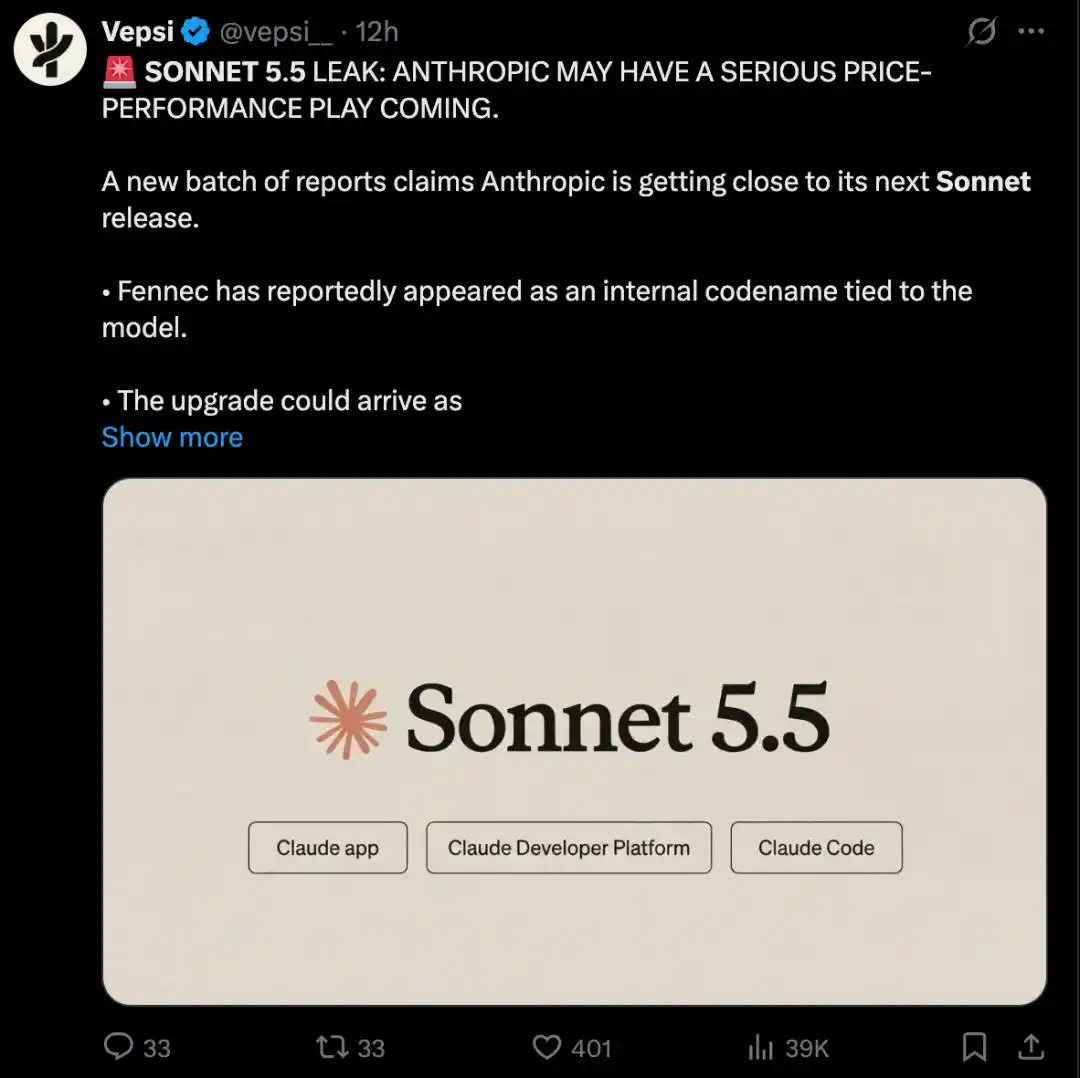
To summarize the leaked information briefly: 200K token context window, faster reasoning speed and lower latency, enhanced long-context reasoning and multi-step planning capabilities, and significant improvements in tool usage such as browsers and terminals. Its capabilities approach Fable 5, while its pricing remains at the Sonnet tier.

According to the currently circulating information:

  • Release Date: Possibly as early as next month
  • Development Progress: Reportedly in the final stages
  • Internal Codename: Previously associated with "Fennec"
  • Context Window: Up to 200K Tokens
  • Reasoning Speed: Expected to be faster with lower latency
  • Reasoning Capability: Long-context reasoning and multi-step planning will be further improved
  • Agent Capabilities: Stronger usage abilities for browsers, terminals, and various tools
  • Performance: Overall capabilities may approach Claude Fable 5
  • Pricing: Will remain at the Sonnet tier

If these rumors are ultimately confirmed, Sonnet 5.5 could become one of the most noteworthy products in the increasingly competitive mid-to-high-end AI model market.

The current context window for Sonnet 5 is 100K tokens, and the official documentation clearly states that 1M is both the default and maximum value, with no smaller variants offered. Doubling to 200K would directly benefit developers working with large code repositories and extensive document collections.

Sonnet 5 itself is Anthropic's model primarily focused on agentic capabilities, described in official introductions as "capable of making plans, using tools like browsers and terminals, and running autonomously." If 5.5 takes a further step in browser and terminal interactions, it means productivity will advance even more.

Regardless, Fable 5 remains the absolute performance king.
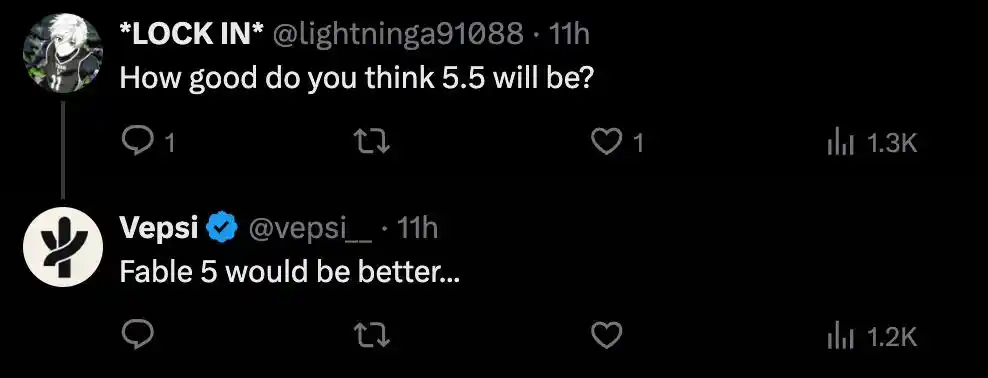
Will It Become the New King of Cost-Effectiveness?

We have reason to believe that the new Sonnet 5.5 is positioned to compete with DeepSeek V4 Flash.

As competition in the AI market intensifies, the contest between large models is no longer confined to benchmark scores but is shifting toward a more practical dimension: how much intelligence users actually get for every dollar spent.

If the currently leaked information is largely accurate, Sonnet 5.5 is poised to occupy an extremely attractive position between mainstream AI models and high-priced cutting-edge systems.

Netizens have also expressed high expectations for its cost-effectiveness.

However, Anthropic's most cost-effective series of models is Haiku, which hasn't been updated for about a year. It seems everyone has almost forgotten about it.
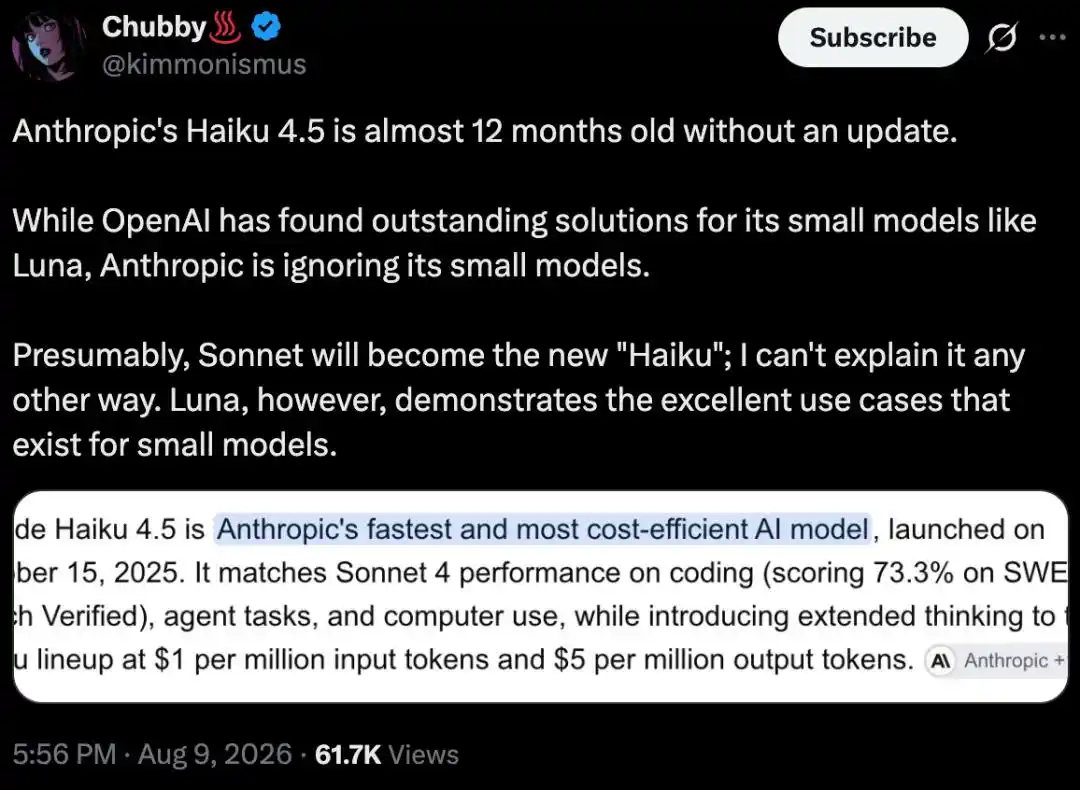
Considering that OpenAI has presented quite impressive solutions with smaller models like Luna, we can draw an inference: Anthropic intends to let Sonnet directly take over the position originally held by Haiku.

If Anthropic can provide reasoning capabilities close to Fable's level at a lower cost, Claude Sonnet 5.5 could very well become one of the most cost-effective AI models on the market.

This article is from the WeChat public account "机器之心" (The Heart of Machines), author: The Heart of Machines (Focused on Large Models), Editor: Cold Cat

Preguntas relacionadas

QWhat are the key leaked specifications of Anthropic's upcoming Sonnet 5.5 model?

AThe leaked specifications include a 2 million token context window, faster inference speed with lower latency, enhanced long-context reasoning and multi-step planning abilities, significantly improved tool use (e.g., browser, terminal), performance approaching Claude Fable 5, and pricing maintained at the Sonnet tier.

QAccording to the article, which model is the Sonnet 5.5 specifically positioned to compete against?

AThe article states that the new Sonnet 5.5 is positioned to compete directly against DeepSeek V4 Flash.

QWhat potential impact could Sonnet 5.5 have on the AI model market, as suggested in the article?

AIf the leaked information is accurate, Sonnet 5.5 could occupy an attractive position between mainstream AI models and high-priced frontier systems, potentially becoming one of the most cost-effective AI models on the market.

QWhat does the article imply about the role of Anthropic's Haiku model series in the company's strategy?

AThe article suggests that with Haiku not being updated for about a year and the focus on Sonnet's advancements, Anthropic might be positioning the Sonnet line to take over the market segment previously targeted by the more cost-effective Haiku series.

QWhat is the reported internal code name for the Sonnet 5.5 model during its development?

AThe reported internal code name for Sonnet 5.5 during its development is 'Fennec', which is a type of desert fox.

Lecturas Relacionadas

Everyone Is Eyeing EUV Lithography Machines

The article "Everyone Has Their Eyes on EUV Lithography Machines" explores the ongoing expansion of EUV (Extreme Ultraviolet) lithography in semiconductor manufacturing. While EUV was once exclusive to giants like TSMC, Samsung, Intel, SK Hynix, and Micron, it's now appearing on the roadmaps of second-tier foundries like Nanya Technology and Winbond Electronics. This shift is driven by the diffusion of EUV into DRAM production, the economic boost from the AI boom making such investments viable, and the maturation of Low-NA EUV as a standard tool. Meanwhile, the "five-member club" of primary EUV users is seeing new entrants like Japan's Rapidus, a state-backed startup aiming for 2nm production. Concurrently, a wave of startups is challenging the traditional EUV model with alternative technologies. These challengers are categorized into four groups: those seeking to replace the light source (e.g., xLight's Free Electron Laser), those aiming to shorten the wavelength (e.g., Inversion Semiconductor, Substrate with BEUV/X-ray approaches), those promoting Nanoimprint Lithography (e.g., Canon), and those exploring maskless particle-based methods (e.g., Multibeam's multi-column e-beam, Lace's helium atom lithography). While these alternatives struggle with the throughput and stability required for high-volume manufacturing, they collectively signal a potential diversification of the future lithography landscape. The conclusion is that while EUV's technical and economic barriers remain high, its user base is broadening. The future may see a more competitive ecosystem, with Low-NA EUV serving mainstream needs, High-NA EUV for cutting-edge nodes, and novel technologies finding niches in specific applications.

marsbitHace 6 min(s)

Everyone Is Eyeing EUV Lithography Machines

marsbitHace 6 min(s)

Chip Stocks 'Hit a Wall,' But the Market Has Not

Chip stocks face volatility, driven by the blowup of an AI hedge fund (Situational Awareness), which briefly dragged the Philadelphia Semiconductor Index down 29%. However, the market has defied concerns, treating the sell-off as a buying signal. Investors injected over $11 billion into semiconductor ETFs in two days, fueling strong rallies in leveraged and non-leveraged funds. This dynamic is part of a broader surge in risk appetite: the S&P 500 hit a record high, high-yield bond funds saw their largest weekly inflow in two years, and Bitcoin ETFs attracted significant capital. Bank of America's Bull & Bear Index has risen to its highest level since 2021. Market strategists note the momentum-driven "tsunami" in buying, though concentration remains in mega-cap tech stocks. Despite the optimism, a key risk persists: elevated Treasury yields, with the 30-year yield near two-decade highs, pose a headwind. A weak July jobs report, however, eased near-term Fed hike fears and supported markets. Analysts suggest the economic backdrop remains solid, with AI infrastructure demand underpinning growth, though potential bottlenecks like power supply could emerge. The prevailing investor psychology is that recent pullbacks have been brief, reinforcing confidence to buy dips, as evidenced by a sharp drop in semiconductor volatility. The overarching narrative is one of resilient money flows toward risk assets despite a lengthening list of worries.

marsbitHace 7 min(s)

Chip Stocks 'Hit a Wall,' But the Market Has Not

marsbitHace 7 min(s)

Divergence in Regulated Token Protocol Standards: Issuance, Compliance, and Integration Each Assume Their Roles

Regulated token standards on EVM chains are diverging not towards a single unified standard, but into a modular, complementary architecture by function. Key examples include ERC-1450 (centered on a Registered Transfer Agent), ERC-3643 (a modular stack for policy), and ERC-7943 (a minimal integration layer). This reflects a broader industry trend: instead of bundling all regulatory functions into one standard, the ecosystem is separating **recurring, universal execution functions** (pre-transfer checks, freezing, forced transfers) from **product/jurisdiction-specific policies** (KYC providers, holding limits). Beyond EVM, other chains integrate comparable features at different architectural levels. Solana's Token Extensions provide hooks and controls at the program library level. Stellar and XRPL embed authorization and freezing natively in the ledger. Sui and Aptos place common controls in their Move frameworks. Networks like Canton and Avalanche L1 extend functionality to market operations and validator-level compliance. The competitive edge for regulated token standards will likely depend on **flexibility to adapt to regulatory changes** and the clarity of embedded controls for external integrators, rather than the sheer number of features. The future points towards a **compliance stack**: a base layer of standardized execution functions supporting interchangeable modules for identity, jurisdictional rules, and product-specific policies. This approach balances operational consistency with the necessary flexibility for diverse regulatory requirements across assets and regions.

marsbitHace 1 hora(s)

Divergence in Regulated Token Protocol Standards: Issuance, Compliance, and Integration Each Assume Their Roles

marsbitHace 1 hora(s)

$1.8 Million? Even Amazon Can't Afford to Burn Claude Anymore

Amazon was reportedly hit with a $1.8 million bill—860% over budget—after a five-month attempt to use Claude Sonnet AI to generate author information for its site. The project, which ultimately failed to deploy, consumed an estimated 6000 billion tokens, equivalent to twice GPT-3's training data. This incident highlights the hidden and often unpredictable costs of AI, even for tech giants. Despite such setbacks, Amazon is aggressively investing in automation, planning a record $2200 billion capital expenditure in 2026, primarily for AWS, AI chips, and infrastructure. This push is paying off: AWS saw a 37% revenue jump and contributes 60% of operating profit. Concurrently, Amazon aims to automate 75% of warehouse operations by around 2033, potentially reducing hundreds of thousands of jobs. Amazon's cost overrun is not isolated. Companies like Meta and Uber have faced similar AI spending spirals, leading to internal "token usage" rankings and, eventually, strict budgets and spending caps. Meta, for instance, once faced a potential monthly bill of $221 million before implementing limits. OpenAI's CEO Sam Altman noted that AI cost control, ignored earlier, has now become a major concern. The risks of unchecked automation echo past disasters like Knight Capital's 2012 $440 million loss from a faulty automated trading system. While automation promises efficiency, its failures can be amplified at the same scale and speed. For Amazon and others, managing these costs and risks is a critical, ongoing lesson.

marsbitHace 1 hora(s)

$1.8 Million? Even Amazon Can't Afford to Burn Claude Anymore

marsbitHace 1 hora(s)

Trading

Spot
活动图片