ACDC Identified 556 Polymarket Wallets, Allegedly Belonging to Insiders

cryptonews.ruPublicado a 2026-08-20Actualizado a 2026-08-20

Resumen

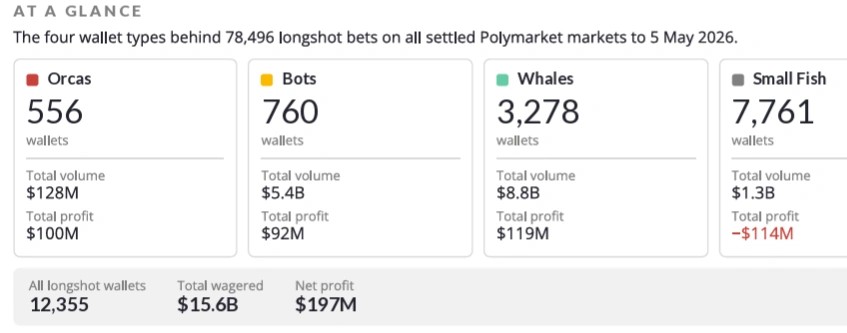
A new report from the Anti-Corruption Data Collective (ACDC) has identified 556 Polymarket wallets, labeled "Orcas," suspected of insider trading. These accounts allegedly place small, targeted bets on low-probability outcomes yet win over 75% of the time. Analyzing 78,496 high-risk bets (over $2,500 on odds of 35 cents or less), ACDC categorized bettors into Orcas, whales, bots, and small fish. While only 14% of high-odds bets win platform-wide, rates rise to 25% on political markets and 52% on military/defense markets. The report highlights that Orcas often place bets first on major military events, with whales and bots quickly copying, potentially broadcasting sensitive signals. Researchers estimate insider profits from military markets alone reached $9.3 million. ACDC argues this poses a national security risk, as blockchain transparency could allow foreign intelligence to act on these market movements. The organization concludes that banning the highest-risk market categories may be the only solution, citing recent insider trading cases involving a U.S. soldier and a Google engineer on Polymarket.

In a new report, the Anti-Corruption Data Collective (ACDC) identified 556 Polymarket accounts, which the organization refers to as "Orcas."

Reportedly, these accounts place small, targeted bets on low-probability outcomes and win more than 75% of the time.

What did ACDC discover about Polymarket?

The Anti-Corruption Data Collective (ACDC) published a report titled "Insider Trading Risk Classification," analyzing 78,496 high-risk bets placed from 12,355 wallets on Polymarket. ACDC defines a high-risk bet as one exceeding $2,500 placed on an outcome priced at 35 cents or less, meaning the perceived probability of the outcome is 35% or lower.

From this sample, researchers identified four groups: orcas, whales, bots, and "small fish." They recorded 556 wallets belonging to orcas, which placed bets on only a few markets and topics but won with an exceptionally high success rate of over 75%.
Win rate for high-odds bets across different player categories. Source: ACDC.

Large players, controlling 3,278 wallets, trade large volumes across many markets. Bots, with 760 wallets, appear to be partly automated, while the remaining 7,761 accounts are small players.

In its previous April report, ACDC found that across the entire Polymarket platform, only 14% of high-odds bets win, but this rate increases to 25% on political markets and to 52% on military and defense-related markets.

Michelle Kessler-Kret and David Szakonyi, authors of the report, estimated that on military markets alone, winning outsider bets have generated $9.3 million.

Why is insider trading on Polymarket a national security concern?

ACDC found that when betting on major military events, orcas place their bets first, followed by whales and bots, mimicking how experienced traders observe the public blockchain and copy insider actions in real time.

Such "copycat" trading is legal, but it can broadcast information about insider activity to the world.

For example, when an orca placed a bet on U.S. military action in Iran hours before the strikes in June 2025, a bot and a whale placed similar bets worth $200,000 and $100,000, respectively.

The same blockchain transparency that enables copycat trading also allows foreign military and intelligence services to act based on market signals.

Tracing a specific Orca account to a specific person is difficult, as the monetary trail is anonymous, and obtaining any information would require requesting data from exchanges holding funds for thousands of clients.

ACDC concluded that the only solution is a complete ban on the most risky market categories.

There have been several other incidents of insider trading on prediction platforms. In April, the Department of Justice charged a U.S. Army soldier named Gannon Ken Van Dike, accusing him of betting approximately $33,034 using secret information about a raid that captured Nicolás Maduro, and subsequently earning about $409,881.

In May, the U.S. Attorney's Office for the Southern District of New York charged Google engineer Michelle Spagnolo with using internal company data to earn $1.2 million on Polymarket.

Bubblemaps also recently claimed on CBS's "60 Minutes" program that it traced linked accounts that collectively won over $2.4 million in more than 80 bets on the Iran war with a 98% win probability.

"These numbers cannot be explained by luck alone," said Bubblemaps CEO Nicolas Vaiman.

end-content
Criptos en tendencia

Preguntas relacionadas

QAccording to the ACDC report, how many wallets did they identify as 'Orcas', and what is their reported win rate on high-risk bets?

AACDC identified 556 wallets as 'Orcas'. These wallets reportedly have a win rate of over 75% on their high-risk bets.

QHow does ACDC define a 'high-risk' bet on Polymarket?

AACDC defines a 'high-risk' bet as a bet of more than $2,500 on an outcome priced at 35 cents or less, implying a perceived probability of 35% or lower.

QWhy does the ACDC consider insider trading on Polymarket's military/defense markets a national security concern?

AIt is a national security concern because the transparency of the blockchain allows 'copycat' trading by whales and bots, which can broadcast signals about insider activity in real-time. Foreign military and intelligence services could then act on these market signals.

QWhat specific example of potential insider trading on a military event is given in the article?

AThe article states that an Orca placed a bet on US military action in Iran just hours before the June 2025 strikes. A bot and a whale then placed similar bets of $200,000 and $100,000, respectively.

QWhat does ACDC conclude is the only solution to the problem of insider trading on these markets?

AACDC concludes that the only solution is to completely ban the most risky market categories, such as those related to military and defense events.

Lecturas Relacionadas

Analysts: MiCA Has Not Caused Significant Global Outflow from USDT

Analysts from Artemis Analytics and independent research from LUISS University and the University of Surrey indicate that the European Union's Markets in Crypto-Assets (MiCA) regulation has not caused a significant global outflow from Tether (USDT), despite its restriction on regulated European platforms. Data shows no notable change in the overall supply or demand for USDT directly linked to MiCA's implementation, nor a large-scale migration of liquidity between exchanges or blockchains. Within Europe, the regulation has shifted trading patterns, with platforms moving toward USD Coin (USDC) instead of USDT. However, this change is localized. On a global scale, the aggregate market shares and trading volumes of major stablecoins have remained largely stable. USDT has retained its position as the leading stablecoin by market capitalization, which stood at approximately $183.27 billion in late July. Activity involving USDT continues to grow primarily outside the EU, particularly in global and emerging markets, as seen in increased user numbers on networks like BNB Chain and Tron. The resilience of dollar-pegged tokens is attributed to their expanding use beyond trading, such as for payments and remittances in regions like Argentina. While MiCA has reshaped the European market structure, it has not yet triggered a comparable shift in the global stablecoin landscape.

cryptonews.ruHace 2 hora(s)

Analysts: MiCA Has Not Caused Significant Global Outflow from USDT

cryptonews.ruHace 2 hora(s)

Trading

Spot

Artículos destacados

Cómo comprar DATA

¡Bienvenido a HTX.com! Hemos hecho que comprar DATA Network (DATA) sea simple y conveniente. Sigue nuestra guía paso a paso para iniciar tu viaje de criptos.Paso 1: crea tu cuenta HTXUtiliza tu correo electrónico o número de teléfono para registrarte y obtener una cuenta gratuita en HTX. Experimenta un proceso de registro sin complicaciones y desbloquea todas las funciones.Obtener mi cuentaPaso 2: ve a Comprar cripto y elige tu método de pagoTarjeta de crédito/débito: usa tu Visa o Mastercard para comprar DATA Network (DATA) al instante.Saldo: utiliza fondos del saldo de tu cuenta HTX para tradear sin problemas.Terceros: hemos agregado métodos de pago populares como Google Pay y Apple Pay para mejorar la comodidad.P2P: tradear directamente con otros usuarios en HTX.Over-the-Counter (OTC): ofrecemos servicios personalizados y tipos de cambio competitivos para los traders.Paso 3: guarda tu DATA Network (DATA)Después de comprar tu DATA Network (DATA), guárdalo en tu cuenta HTX. Alternativamente, puedes enviarlo a otro lugar mediante transferencia blockchain o utilizarlo para tradear otras criptomonedas.Paso 4: tradear DATA Network (DATA)Tradear fácilmente con DATA Network (DATA) en HTX's mercado spot. Simplemente accede a tu cuenta, selecciona tu par de trading, ejecuta tus trades y monitorea en tiempo real. Ofrecemos una experiencia fácil de usar tanto para principiantes como para traders experimentados.

527 Vistas totalesPublicado en 2026.07.01Actualizado en 2026.07.01

Cómo comprar DATA

Discusiones

Bienvenido a la comunidad de HTX. Aquí puedes mantenerte informado sobre los últimos desarrollos de la plataforma y acceder a análisis profesionales del mercado. A continuación se presentan las opiniones de los usuarios sobre el precio de DATA (DATA).

活动图片