If the AI Bubble Is Already Bursting, Who Will Truly Survive?

marsbitPublicado a 2026-06-15Actualizado a 2026-06-15

Resumen

If the AI Bubble is Bursting, Who Will Remain? The debate over an AI bubble is intensifying, with figures like Ray Dalio warning of high levels and Jensen Huang seeing immense, early-stage opportunity. Both views hold truth: a speculative bubble in capital markets likely exists, mirroring the dot-com era, but the underlying technological shift is real and transformative. History shows that while bubbles burst—wiping out overvalued companies and speculative capital—they often leave behind critical physical and digital infrastructure. The dot-com bust, for instance, eliminated many firms but left the global fiber optic networks and data centers that enabled the rise of Amazon, Netflix, and cloud computing. Today's massive AI infrastructure investments (projected at trillions by 2030) in data centers, power, cooling, and GPUs may follow a similar path, creating the foundation for future applications. A key divergence from past bubbles is the "Jevons Paradox" effect in AI. As the cost of AI inference has plummeted by over 99.7% since 2023, enterprise spending on AI has skyrocketed. Cheap "tokens" have unlocked vast, previously uneconomical use cases, moving AI from simple chatbots into core business workflows—code generation, legal document review, scientific simulation, and financial analysis. The market is now in a phase of self-correction, weeding out superficial "API-wrapper" startups, but this cleansing process strengthens the ecosystem. The long-term trajectory is clear...

Source: Gelong, North City's Mr. Xu

Data support: GogoBigData

The AI bubble is becoming the most divisive consensus in the global market. Dalio says the bubble is already high, while Huang Renxun says the opportunity is just beginning; one sees overheating in the capital market, the other sees the dawn of a productivity revolution.

The real issue is not whether there is an AI bubble, but what will be left behind after it bursts. The dot-com bubble of 2000 caused the Nasdaq to plummet, companies to collapse, and wealth to evaporate, but it also left behind the infrastructure of submarine cables, broadband networks, and cloud computing, which ultimately supported Amazon, Netflix, YouTube, and the mobile internet.

Today, AI stands at a similar juncture. On one side, hundreds of billions of dollars are pouring into data centers, electricity, liquid cooling, optical modules, and GPUs; on the other side, there is a huge gap yet to be filled by application revenues. A bubble clearly exists, but the underlying productive forces are not inflated. When token costs plummet and intelligence begins to be called upon like water and electricity, AI will no longer be just a chatting tool, but will enter real workflows in code, healthcare, finance, law, manufacturing, and scientific research. The market will wash away shell companies and PPT entrepreneurs, but it will not reverse the direction of AI+. The bubble will burst, but the industry will remain. Enjoy:

Recently, the market has experienced sharp fluctuations, and theories of an "AI bubble" are rampant.

  • Ray Dalio, founder of Bridgewater Associates, says: There is a bubble in the AI market, and it is "relatively high."

  • NVIDIA CEO Jensen Huang says: There is a huge opportunity in AI, and the demand for computing power is just beginning to explode.

Who should we believe?

They are both correct.

Is there a bubble in the AI industry? Absolutely.

However, bubbles in the tech sector are often the only tribute society can pay to disruptive advanced productive forces. They are not merely a derogatory term.

In the long run, this is an inevitable phenomenon at the dawn of advanced productive forces.

Many liken the current situation to the dot-com bubble of 2000, feeling deeply concerned. The dot-com bubble indeed caused the Nasdaq to plummet nearly 78%, evaporating over 5 trillion dollars in wealth.

But twenty years later, what industry can operate without the internet? Today, the value of the internet industry far exceeds that of the bubble era.

At least superficially, the AI bubble resembles that. The bubble in the capital market cannot stop nearly every sector in society from actively being empowered by AI.

AI+ is the inevitable trend. Just as all industries today cannot do without the internet, all industries in the future will not be able to do without AI.

01 The "IQ Tax" That Innovation Must Pay

In that era when companies could go public and raise money just by having .com in their name, the Nasdaq surged nearly 600% between 1995 and 2000. Then followed a two-and-a-half-year financial storm.

Iconic names of that time, like the software company MicroStrategy, plunged 62% in a single day due to accounting scandals and exaggerated claims; Pets.com (online dog food seller), Webvan (the pioneer of fresh food e-commerce) simply went bust... In the panic, almost everyone blamed the internet as a scam.

However, the physical infrastructure precipitated by the over-expenditure of speculative capital often nourishes the super giants of the next era at extremely low costs. The bubble burst not because of the internet technology itself, but because the physical construction speed of infrastructure could not keep pace with the market's rhythm.

For example, the global undersea cables and dense wavelength division multiplexing networks laid by those once-prominent telecom companies (like WorldCom, Global Crossing), which bankrupted them with heavy investment, became the perfect breeding ground for the later rise of Netflix, Zoom, and the mobile internet.

Without the frenzied and premature global investment in telecom infrastructure around 2000, the later video streaming explosion of YouTube and the cloud computing infrastructure would not have happened.

Amazon is the most typical example. Its stock price plummeted from a high of $107 in 1999 to $7 in 2001, a drop of over 90%. But it survived because its underlying business logic, "reconstructing retail with the network," aligned with the direction of advanced productive forces.

This is a classic case of Amara's Law: we tend to overestimate the effect of a new technology in the short run and underestimate its effect in the long run. In the early stages of a technological revolution, the fervor of speculative capital inevitably leads to overinvestment, forming a bubble. It's the IQ tax that innovation must pay. But when the bubble recedes, what remains will be more indestructible advanced productive forces.

02 Why Are Corporate AI Expenditures Rising Instead of Falling?

Back in 2026, the AI industry bubble appears even larger.

Just five major cloud service providers—Amazon, Google, Meta, Microsoft, and Oracle—are expected to have capital expenditures reaching $690 billion in 2026, with total AI infrastructure investment projected at $5.3 trillion by 2030. Of this, only about 25% is for GPUs; the remaining 75% is all poured into physical infrastructure: liquid cooling systems, power transmission, network switches, optical modules, and land.

On the revenue side, the combined total revenue in 2026 for all leading pure AI companies like OpenAI, Anthropic, Cohere, Mistral, Perplexity is projected not to exceed $40 billion.

The foundational layer invests nearly $700 billion, while the application layer recovers tens of billions. This severe asymmetry—isn't that a bubble?

Such a conclusion cannot be drawn so simply and crudely. One critical point must not be overlooked:

  • In March 2023, when OpenAI released GPT-4, the mixed cost per million tokens of input was about $30.

  • By April 2025, with model architecture optimization and inference computing power improvements, the price per million tokens for models of comparable intelligence plummeted to $0.1–$0.15.

According to Stanford University's "AI Index Report" and TokenCost data: AI inference costs have fallen by over 99.7% in the past two years.

Following traditional linear thinking, if costs plummet, corporate AI spending should decrease. But the reality is that corporate AI cloud spending tripled between 2024 and 2025.

Why?

Because when the marginal cost of "intelligence" approaches zero, AI is no longer just a simple text summarizer or chatting companion; it has entered a new era of agents and multi-modal enhanced retrieval. Enterprises are starting to let AI agents automatically run thousands of cycles of tasks—writing code, scanning millions of legal contracts, simulating biological experiments.

Cheap tokens have unlocked a massive volume of long-tail demands that were previously not commercially viable due to cost constraints.

Comparing NVIDIA in 2026 to Cisco, the networking hardware titan of 2000, also reveals this trend. Their ecosystem positions are remarkably similar, but their underlying financial health is worlds apart.
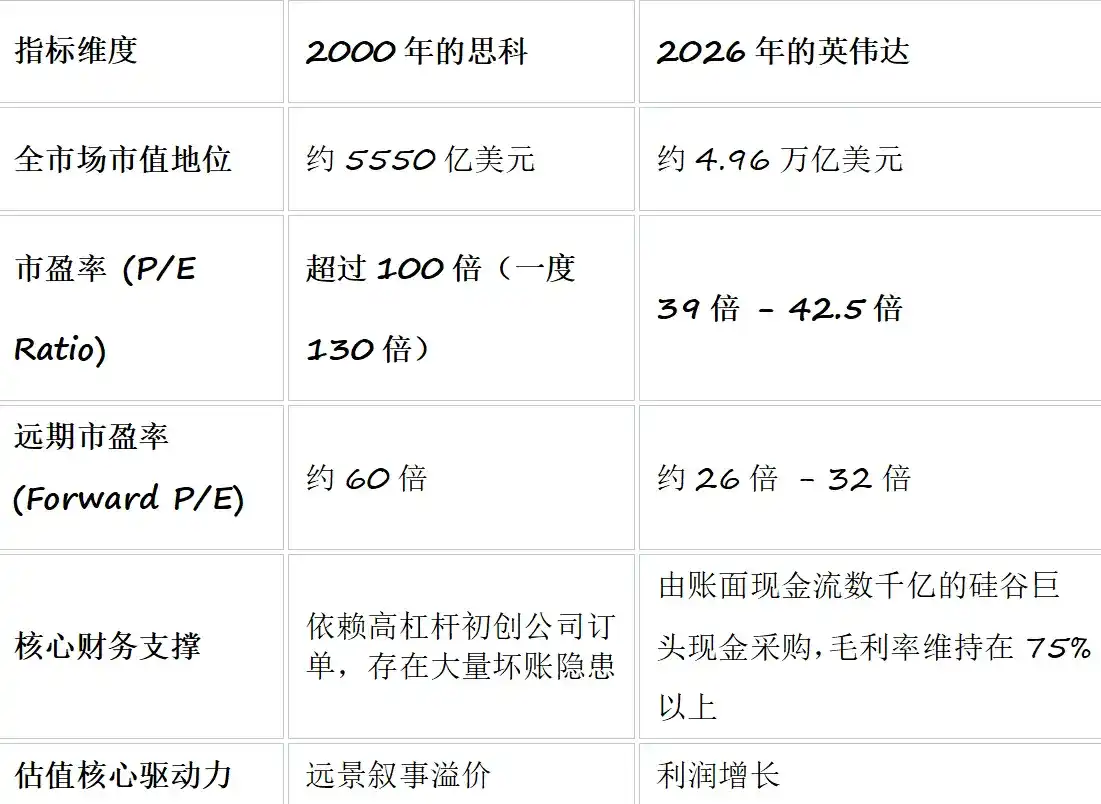
(Hardcore Financial Comparison of NVIDIA and Cisco)

This precisely confirms the economic principle of the "Jevons Paradox": technological progress improves energy use efficiency, but instead of reducing energy consumption, it leads to greater demand due to lower costs.

Even after last year's so-called "DeepSeek moment," the market quickly sobered up in the following months: the more optimized the algorithms, the lower the threshold for enterprises to adopt AI, and ultimately, the total computing power consumption rises exponentially instead.

It is precisely for this reason that AI has the potential to gradually embed itself into almost all old industries. Just as all industries embraced Internet+ over the past two decades. From SaaS software to biomedicine, to advanced manufacturing robots driven by embodied intelligence, by 2026, almost every industry is embracing AI+. No one discusses "whether we should use AI," but instead worries: "Is our data properly cleaned? Do we have enough API call quotas? Is the RAG architecture optimal?"

Currently, there is indeed a bubble in the AI industry. But for enterprises, if you don't embrace the bubble, you will be crushed by the times. This has been proven over the past two decades of the internet era.

03 The Market's Deep Evolution: From Infrastructure to Application

Currently, we are undoubtedly at a critical node in the technology life cycle: just before the "Trough of Disillusionment" on Gartner's Hype Cycle, or at the turning point described by the theory of "Technological Revolutions and Financial Capital."

The AI bubble is already bursting, though many haven't realized it. In the past, any upstart could write a few dozen pages of PPT, wrap a layer of OpenAI's API, and secure funding. Now, as the tide recedes, these companies with no moat and only concepts are dying en masse.

This is the market purifying itself, a manifestation of the bubble bursting. But this is only the surface. The deep logic of the market is undergoing three profound evolutions:

First, value transfer from CapEx to OpEx

Currently, money is being made by those selling shovels—NVIDIA, TSMC, and companies selling optical modules and server liquid cooling equipment are reaping most of the benefits. However, as computing power gradually becomes "infrastructure-ized," like water and electricity, the real excess profits will gradually shift to the application layer. These are the AI-native enterprises that can use extremely low-cost tokens to genuinely solve pain points in vertical industries and reshape business processes (OpEx optimization).

Second, valuation multiple compression and earnings digestion

The high valuations assigned to AI infrastructure do not necessarily imply an impending crash. In many cases, the rapid growth in corporate earnings can digest the high valuations over time, trading "time for space." As long as the revenue growth rate of cloud computing giants keeps pace with the depreciation rate of their capital expenditures, this game of hot potato can evolve into an unprecedented industrial upgrade.

  • For example, leading global automakers and chip giants, by introducing end-to-end AI twin technology, have shortened the cycle from R&D to mass production of new products by 35% and improved overall equipment effectiveness by 18%.

  • In the financial industry, by 2026, quantitative trading, risk control, and credit assessment are already fully dominated by multi-modal Agents. AI not only processes macro expectations at microsecond-level timestamps but is deeply involved in every micro-level asset pricing.

  • In industries highly reliant on senior professional knowledge, such as law, healthcare, and auditing, AI has already completed its transformation from a "junior assistant" to a "partner-level expert."

Among the over 1 billion active users of ChatGPT, Gemini, and Claude, a significant portion uses them as substitutes for daily high-intensity intellectual labor. This includes you and me. All of the above are real things happening, visible to everyone.

04 Conclusion

Looking back at the magnificent history of technology, the "creative destruction" proposed by Schumpeter is always at play.

The capital market is always impatient, hoping that $1 invested today will yield $10 tomorrow. When nearly $700 billion in infrastructure investment cannot be fully transformed into application-layer profits in the short term, the market is bound to face a brutal reshuffle. It will eliminate speculative shell companies that rely solely on flashy PPTs, leaving behind those with genuine technological depth and practical implementation scenarios.

After this reshuffle, those cheap yet vast computing centers and highly optimized model algorithms will serve thousands of industries at extremely low prices.

After 2000, humanity ushered in a digital era where no industry could do without the internet. Today, we are also irreversibly moving towards an intelligent golden age where all industries will be governed and empowered by AI.

Amidst the clamor of the bubble, the underlying productive potential carries not a single drop of moisture.

Preguntas relacionadas

QWhat is the core argument of the article regarding the AI bubble compared to the dot-com bubble?

AThe core argument is that the existence of an AI bubble is similar to the dot-com bubble, serving as a necessary 'tribute' to a disruptive new technology. While it leads to market overvaluation and will burst, the underlying physical infrastructure and technological progress (like plummeting token costs) built during the bubble will persist. This will enable AI to become ubiquitous across all industries, much like the internet did post-2000, leaving behind a transformative, durable foundation of productivity.

QWhy does the article claim that enterprise AI spending is rising even as AI inference costs fall dramatically?

AThe article cites the 'Jevons Paradox' from economics: a drastic reduction in the cost of a resource (in this case, AI 'intelligence' per token) does not reduce overall consumption but instead unlocks vast new, previously uncommercializable long-tail demands. With token costs nearing zero, companies are deploying AI for complex, iterative tasks like running thousands of automated code-writing, legal contract analysis, or scientific simulation jobs, leading to a massive increase in total AI cloud spending.

QAccording to the article, what is the primary difference between the financial health of Nvidia in 2026 and Cisco in 2000, despite their similar ecosystem positions?

AThe article implies that while both companies held dominant positions as hardware suppliers during their respective technological booms (networking for Cisco, AI compute for Nvidia), Nvidia's underlying financial health is portrayed as more robust. The article does not provide specific comparative financials but suggests the context is different because the AI infrastructure build-out is fueling tangible, widespread enterprise adoption and productivity gains across sectors, whereas the dot-com bubble involved more speculative investment without immediate, broad-based application revenue.

QWhat are the two key 'deep market evolutions' the article predicts will occur as the AI bubble matures?

AThe two key evolutions are: 1) A value shift from Capital Expenditure (CapEx) to Operational Expenditure (OpEx). Profit will migrate from infrastructure 'shovel sellers' (like GPU manufacturers) to AI-native application companies that use cheap tokens to solve vertical industry problems and optimize business processes. 2) Valuation compression and earnings digestion. High valuations for infrastructure will be gradually absorbed ('time for space') by the rapid growth of corporate profits as AI integration boosts efficiency and revenue in sectors like manufacturing, finance, and law.

QWhat does the article conclude will 'truly remain' after the AI bubble bursts?

AThe article concludes that after the bubble bursts and speculative, shell companies are washed away, what will truly remain is the massive, now-cheap computational infrastructure and highly optimized AI models. These will serve as a pervasive utility, enabling AI to be deeply integrated into and transform every industry—code, medicine, finance, law, manufacturing, and research—ushering in a 'smart era' where AI is as indispensable as the internet is today. The underlying productive potential is solid.

Lecturas Relacionadas

How Will the Price Move Before SpaceX's Next Share Unlock?

TL;DR Investors buying SPCX after SpaceX's IPO are not simply investing in a typical tech stock. It’s a high-valuation asset driven by Musk's narrative, Starlink, and space transport potential, but with a key twist: a very small initial float of ~4% has led to significant post-listing price appreciation. The current price action reflects a timing gap. Before the first lock-up expiration (estimated around August, subject to official confirmation), scarcity and high demand could continue to push prices up. Short-term bulls focus on low float, FOMO, and potential index inclusion. However, bears point to the supply dynamics that will change post-lockup. Existing shareholders still hold over 95% of shares, which will be released in stages starting from the first unlock window. This introduces future selling pressure from low-cost holders. The upcoming Q2 earnings report is a critical catalyst before the unlock. It will test whether the company's fundamentals can justify the current ~$2.1T valuation. Strong results could support the pre-unlock momentum, while weak figures could amplify concerns about future supply. The trading thesis is shifting from immediate scarcity ("can't buy enough") to evaluating future absorption capacity ("who will buy when more supply hits"). The path ahead hinges on the specifics of the unlock schedule, Q2 earnings performance, and whether anticipated passive index buying materializes.

marsbitHace 19 min(s)

How Will the Price Move Before SpaceX's Next Share Unlock?

marsbitHace 19 min(s)

Bitcoin Short-Term Bullish Structure Validated, HYPE Low-Entry Window Opens | Guest Analysis

**Market Analysis Summary (Week of June 2026)** **Overall Market Context:** The market environment is exceptionally complex, with the unexpected US-Iran agreement and the reopening of the Strait of Hormuz triggering a global asset repricing and significant volatility. This heightened noise underscores the importance of a structured analytical framework. **Bitcoin (BTC) Analysis & Strategy:** * **Current Status:** The price has climbed above $65,000, currently in a rebound phase (segment 38-39) following a complex 12-segment correction from the May high of $82,850. * **Key Levels:** * **Primary Resistance:** $69,500–$70,500. A successful breakout above $65,000 targets this zone. * **Primary Support:** $65,000 (immediate), followed by $59,000–$60,000 and $55,000. * **Weekly Outlook & Strategy:** The focus is on the confirmation of the $65,000 level. * **Bullish Scenario (Hold $65K):** A move toward the $69.5K–$70.5K resistance zone is anticipated, which is a potential area for initiating medium-term short positions. * **Bearish Scenario (Break below $65K):** A retest of the $60,000–$62,000 support range is likely. * **Medium-Term Strategy:** Currently neutral. Plan to establish short positions (up to 60% allocation) either in the $69.5K–$70.5K resistance zone upon signs of rejection, or on a confirmed breakdown below $65,000 and further below $59K–$60K. * **Short-Term Strategy:** Utilize 30% capital for scalping opportunities based on support/resistance levels, using 30/60-minute charts. **HYPE Analysis & Strategy:** * **Current Status:** The price has stabilized around $52 after a four-segment decline from the June high of $75.87 and is now in a rebound (segment 50-51). * **Key Levels:** * **Primary Resistance:** $62.50–$64.57. Watch for potential rejection here to form a lower high. * **Primary Support:** $52–$55.50, followed by $47–$49. * **Weekly Outlook & Strategy:** Adopt a "buy on dips, avoid chasing rallies" approach. * **Core View:** Monitor the price action and potential formation of a lower high ("endpoint 51") in the $62.50–$64.57 resistance zone. * **Short-Term Strategy:** Consider light long positions (max 30% allocation) if the price finds support and shows reversal signals in the $52–$54.50 or deeper $47–$49 support zones, confirmed by proprietary quantitative bottom signals. **Trade Review:** Last week's HYPE short-term long trade, executed based on proprietary "Price Difference" and "Momentum" model signals, yielded a profit of approximately 11.88%. The entry was near $54.39 and exit near $60.85. **Risk Management Reminder:** Always set an initial stop-loss upon entry. Move stop-loss to breakeven at +1% profit, then trail it upwards to lock in gains as the trade progresses. *Disclaimer: All analysis, models, and strategies are based on personal technical analysis for educational purposes only, not investment advice. The market carries inherent risk.*

Odaily星球日报Hace 24 min(s)

Bitcoin Short-Term Bullish Structure Validated, HYPE Low-Entry Window Opens | Guest Analysis

Odaily星球日报Hace 24 min(s)

Bitcoin Short-Term Bullish Structure Validated, HYPE Accumulation Window Opens | Guest Analysis

**Bitcoin and HYPE Market Analysis: Short-Term Outlook and Trading Strategies** This market analysis examines Bitcoin (BTC) and HYPE amid volatile conditions, providing short-term outlooks and specific trading strategies. **Key Outlooks:** * **Bitcoin (BTC):** Focus is on whether BTC's recent move above $65,000 holds. A successful breakout could lead to a test of the $69,500-$70,500 resistance zone, where medium-term short positions are considered. A failure, breaking below $65,000, may trigger a decline towards the $59,000-$60,000 support area. * **HYPE:** The token completed a four-wave correction and is now rebounding. The key resistance zone is $62.5-$64.57. The trading strategy is "buy on dips," looking for entry opportunities near the $52-$54.5 or deeper $47-$49 support zones, pending confirmation from proprietary models. **BTC Trading Strategy:** * **Medium-term:** Primarily looking to establish short positions (up to 60% allocated capital) if price rallies to the $69,500-$70,500 resistance area and shows signs of reversal. Alternative plans involve initiating shorts on a breakdown below $65,000. * **Short-term:** Allocate up to 30% capital for intraday "spread" trades based on support/resistance levels on 30/60-minute charts. **HYPE Trading Strategy:** * **Short-term:** Adopt a dip-buying approach. Consider light long positions (under 30% capital) when price tests key support levels ($52-$54.5 or $47-$49) and shows stabilization, confirmed by proprietary "Price Spread" and "Momentum Quant" models. **Trade Recap:** The analysis reviews a successful HYPE long trade from the previous week, executed at ~$54.39 and closed at ~$60.85 for an ~11.88% gain, based on signals from the aforementioned models. **Risk Management Emphasis:** The article stresses strict capital allocation (under 30-60%), immediate initial stop-loss placement, and a trailing stop-loss protocol to lock in profits as trades move favorably. ***Disclaimer:** All analysis, models, and strategies are for educational purposes based on technical analysis, not investment advice. Markets are volatile; trade with caution.*

marsbitHace 26 min(s)

Bitcoin Short-Term Bullish Structure Validated, HYPE Accumulation Window Opens | Guest Analysis

marsbitHace 26 min(s)

Trading

Spot
Futuros

Artículos destacados

Qué es GROK AI

Grok AI: Revolucionando la Tecnología Conversacional en la Era Web3 Introducción En el paisaje de rápida evolución de la inteligencia artificial, Grok AI se destaca como un proyecto notable que une los dominios de la tecnología avanzada y la interacción del usuario. Desarrollado por xAI, una empresa liderada por el renombrado empresario Elon Musk, Grok AI busca redefinir la forma en que interactuamos con la inteligencia artificial. A medida que el movimiento Web3 continúa floreciendo, Grok AI tiene como objetivo aprovechar el poder de la IA conversacional para responder consultas complejas, proporcionando a los usuarios una experiencia que no solo es informativa, sino también entretenida. ¿Qué es Grok AI? Grok AI es un sofisticado chatbot de IA conversacional diseñado para interactuar dinámicamente con los usuarios. A diferencia de muchos sistemas de IA tradicionales, Grok AI abraza una gama más amplia de consultas, incluyendo aquellas que normalmente se consideran inapropiadas o fuera de las respuestas estándar. Los objetivos centrales del proyecto incluyen: Razonamiento Confiable: Grok AI enfatiza el razonamiento de sentido común para proporcionar respuestas lógicas basadas en la comprensión contextual. Supervisión Escalable: La integración de asistencia de herramientas asegura que las interacciones de los usuarios sean monitoreadas y optimizadas para la calidad. Verificación Formal: La seguridad es primordial; Grok AI incorpora métodos de verificación formal para mejorar la confiabilidad de sus resultados. Comprensión de Largo Contexto: El modelo de IA sobresale en retener y recordar un extenso historial de conversaciones, facilitando discusiones significativas y contextualizadas. Robustez Adversarial: Al enfocarse en mejorar sus defensas contra entradas manipuladas o maliciosas, Grok AI busca mantener la integridad de las interacciones de los usuarios. En esencia, Grok AI no es solo un dispositivo de recuperación de información; es un compañero conversacional inmersivo que fomenta un diálogo dinámico. Creador de Grok AI La mente detrás de Grok AI no es otra que Elon Musk, una persona sinónimo de innovación en varios campos, incluyendo la automoción, los viajes espaciales y la tecnología. Bajo el paraguas de xAI, una empresa enfocada en avanzar la tecnología de IA de maneras beneficiosas, la visión de Musk busca remodelar la comprensión de las interacciones de IA. El liderazgo y la ética fundacional están profundamente influenciados por el compromiso de Musk de empujar los límites tecnológicos. Inversores de Grok AI Si bien los detalles específicos sobre los inversores que respaldan a Grok AI son limitados, se reconoce públicamente que xAI, el incubador del proyecto, está fundado y apoyado principalmente por el propio Elon Musk. Las empresas y participaciones anteriores de Musk proporcionan un respaldo robusto, fortaleciendo aún más la credibilidad y el potencial de crecimiento de Grok AI. Sin embargo, hasta ahora, la información sobre fundaciones de inversión adicionales u organizaciones que apoyan a Grok AI no está fácilmente accesible, marcando un área para una posible exploración futura. ¿Cómo Funciona Grok AI? La mecánica operativa de Grok AI es tan innovadora como su marco conceptual. El proyecto integra varias tecnologías de vanguardia que facilitan sus funcionalidades únicas: Infraestructura Robusta: Grok AI está construido utilizando Kubernetes para la orquestación de contenedores, Rust para rendimiento y seguridad, y JAX para computación numérica de alto rendimiento. Este trío asegura que el chatbot opere de manera eficiente, escale efectivamente y sirva a los usuarios de manera oportuna. Acceso a Conocimiento en Tiempo Real: Una de las características distintivas de Grok AI es su capacidad para acceder a datos en tiempo real a través de la plataforma X—anteriormente conocida como Twitter. Esta capacidad otorga a la IA acceso a la información más reciente, permitiéndole proporcionar respuestas y recomendaciones oportunas que otros modelos de IA podrían pasar por alto. Dos Modos de Interacción: Grok AI ofrece a los usuarios una elección entre “Modo Divertido” y “Modo Regular”. El Modo Divertido permite un estilo de interacción más lúdico y humorístico, mientras que el Modo Regular se centra en ofrecer respuestas precisas y exactas. Esta versatilidad asegura una experiencia personalizada que se adapta a diversas preferencias de los usuarios. En esencia, Grok AI une rendimiento con compromiso, creando una experiencia que es tanto enriquecedora como entretenida. Cronología de Grok AI El viaje de Grok AI está marcado por hitos cruciales que reflejan sus etapas de desarrollo y despliegue: Desarrollo Inicial: La fase fundamental de Grok AI tuvo lugar durante aproximadamente dos meses, durante los cuales se realizó el entrenamiento inicial y el ajuste del modelo. Lanzamiento Beta de Grok-2: En un avance significativo, se anunció la beta de Grok-2. Este lanzamiento introdujo dos versiones del chatbot—Grok-2 y Grok-2 mini—cada una equipada con capacidades para chatear, programar y razonar. Acceso Público: Tras su desarrollo beta, Grok AI se volvió disponible para los usuarios de la plataforma X. Aquellos con cuentas verificadas por un número de teléfono y activas durante al menos siete días pueden acceder a una versión limitada, haciendo que la tecnología esté disponible para un público más amplio. Esta cronología encapsula el crecimiento sistemático de Grok AI desde su inicio hasta el compromiso público, enfatizando su compromiso con la mejora continua y la interacción del usuario. Características Clave de Grok AI Grok AI abarca varias características clave que contribuyen a su identidad innovadora: Integración de Conocimiento en Tiempo Real: El acceso a información actual y relevante diferencia a Grok AI de muchos modelos estáticos, permitiendo una experiencia de usuario atractiva y precisa. Estilos de Interacción Versátiles: Al ofrecer modos de interacción distintos, Grok AI se adapta a diversas preferencias de los usuarios, invitando a la creatividad y la personalización en la conversación con la IA. Avanzada Infraestructura Tecnológica: La utilización de Kubernetes, Rust y JAX proporciona al proyecto un marco sólido para asegurar confiabilidad y rendimiento óptimo. Consideración de Discurso Ético: La inclusión de una función generadora de imágenes muestra el espíritu innovador del proyecto. Sin embargo, también plantea consideraciones éticas en torno a los derechos de autor y la representación respetuosa de figuras reconocibles—una discusión en curso dentro de la comunidad de IA. Conclusión Como una entidad pionera en el ámbito de la IA conversacional, Grok AI encapsula el potencial de experiencias transformadoras para los usuarios en la era digital. Desarrollado por xAI y guiado por el enfoque visionario de Elon Musk, Grok AI integra conocimiento en tiempo real con capacidades avanzadas de interacción. Busca empujar los límites de lo que la inteligencia artificial puede lograr mientras mantiene un enfoque en consideraciones éticas y la seguridad del usuario. Grok AI no solo encarna el avance tecnológico, sino que también representa un nuevo paradigma de conversación en el paisaje Web3, prometiendo involucrar a los usuarios con tanto conocimiento hábil como interacción lúdica. A medida que el proyecto continúa evolucionando, se erige como un testimonio de lo que la intersección de la tecnología, la creatividad y la interacción similar a la humana puede lograr.

404 Vistas totalesPublicado en 2024.12.26Actualizado en 2024.12.26

Qué es GROK AI

Qué es ERC AI

Euruka Tech: Una Visión General de $erc ai y sus Ambiciones en Web3 Introducción En el paisaje en rápida evolución de la tecnología blockchain y las aplicaciones descentralizadas, nuevos proyectos emergen con frecuencia, cada uno con objetivos y metodologías únicas. Uno de estos proyectos es Euruka Tech, que opera en el amplio dominio de las criptomonedas y Web3. El enfoque principal de Euruka Tech, particularmente su token $erc ai, es presentar soluciones innovadoras diseñadas para aprovechar las crecientes capacidades de la tecnología descentralizada. Este artículo tiene como objetivo proporcionar una visión general completa de Euruka Tech, una exploración de sus objetivos, funcionalidad, la identidad de su creador, posibles inversores y su importancia dentro del contexto más amplio de Web3. ¿Qué es Euruka Tech, $erc ai? Euruka Tech se caracteriza como un proyecto que aprovecha las herramientas y funcionalidades ofrecidas por el entorno Web3, centrándose en integrar inteligencia artificial dentro de sus operaciones. Aunque los detalles específicos sobre el marco del proyecto son algo elusivos, está diseñado para mejorar la participación del usuario y automatizar procesos en el espacio cripto. El proyecto tiene como objetivo crear un ecosistema descentralizado que no solo facilite transacciones, sino que también incorpore funcionalidades predictivas a través de inteligencia artificial, de ahí la designación de su token, $erc ai. El objetivo es proporcionar una plataforma intuitiva que facilite interacciones más inteligentes y un procesamiento eficiente de transacciones dentro de la creciente esfera de Web3. ¿Quién es el Creador de Euruka Tech, $erc ai? En la actualidad, la información sobre el creador o el equipo fundador detrás de Euruka Tech permanece no especificada y algo opaca. Esta ausencia de datos genera preocupaciones, ya que el conocimiento del trasfondo del equipo es a menudo esencial para establecer credibilidad dentro del sector blockchain. Por lo tanto, hemos categorizado esta información como desconocida hasta que se disponga de detalles concretos en el dominio público. ¿Quiénes son los Inversores de Euruka Tech, $erc ai? De manera similar, la identificación de inversores u organizaciones de respaldo para el proyecto Euruka Tech no se proporciona fácilmente a través de la investigación disponible. Un aspecto que es crucial para los posibles interesados o usuarios que consideren involucrarse con Euruka Tech es la garantía que proviene de asociaciones financieras establecidas o respaldo de firmas de inversión de renombre. Sin divulgaciones sobre afiliaciones de inversión, es difícil sacar conclusiones completas sobre la seguridad financiera o la longevidad del proyecto. De acuerdo con la información encontrada, esta sección también se encuentra en estado de desconocido. ¿Cómo Funciona Euruka Tech, $erc ai? A pesar de la falta de especificaciones técnicas detalladas para Euruka Tech, es esencial considerar sus ambiciones innovadoras. El proyecto busca aprovechar el poder computacional de la inteligencia artificial para automatizar y mejorar la experiencia del usuario dentro del entorno de las criptomonedas. Al integrar IA con tecnología blockchain, Euruka Tech tiene como objetivo proporcionar características como operaciones automatizadas, evaluaciones de riesgo e interfaces de usuario personalizadas. La esencia innovadora de Euruka Tech radica en su objetivo de crear una conexión fluida entre los usuarios y las vastas posibilidades que presentan las redes descentralizadas. A través de la utilización de algoritmos de aprendizaje automático e IA, busca minimizar los desafíos de los usuarios primerizos y optimizar las experiencias transaccionales dentro del marco de Web3. Esta simbiosis entre IA y blockchain subraya la importancia del token $erc ai, que actúa como un puente entre las interfaces de usuario tradicionales y las capacidades avanzadas de las tecnologías descentralizadas. Cronología de Euruka Tech, $erc ai Desafortunadamente, como resultado de la información limitada disponible sobre Euruka Tech, no podemos presentar una cronología detallada de los principales desarrollos o hitos en el viaje del proyecto. Esta cronología, típicamente invaluable para trazar la evolución de un proyecto y entender su trayectoria de crecimiento, no está actualmente disponible. A medida que la información sobre eventos notables, asociaciones o adiciones funcionales se haga evidente, las actualizaciones seguramente mejorarán la visibilidad de Euruka Tech en la esfera cripto. Aclaración sobre Otros Proyectos “Eureka” Es importante señalar que múltiples proyectos y empresas comparten una nomenclatura similar con “Eureka”. La investigación ha identificado iniciativas como un agente de IA de NVIDIA Research, que se centra en enseñar a los robots tareas complejas utilizando métodos generativos, así como Eureka Labs y Eureka AI, que mejoran la experiencia del usuario en educación y análisis de servicio al cliente, respectivamente. Sin embargo, estos proyectos son distintos de Euruka Tech y no deben confundirse con sus objetivos o funcionalidades. Conclusión Euruka Tech, junto con su token $erc ai, representa un jugador prometedor pero actualmente oscuro dentro del paisaje de Web3. Si bien los detalles sobre su creador e inversores permanecen no revelados, la ambición central de combinar inteligencia artificial con tecnología blockchain se presenta como un punto focal de interés. Los enfoques únicos del proyecto para fomentar la participación del usuario a través de la automatización avanzada podrían destacarlo a medida que el ecosistema Web3 progresa. A medida que el mercado cripto continúa evolucionando, los interesados deben mantener un ojo atento a los avances en torno a Euruka Tech, ya que el desarrollo de innovaciones documentadas, asociaciones o una hoja de ruta definida podría presentar oportunidades significativas en el futuro cercano. Tal como está, esperamos más información sustancial que podría revelar el potencial de Euruka Tech y su posición en el competitivo paisaje cripto.

383 Vistas totalesPublicado en 2025.01.02Actualizado en 2025.01.02

Qué es ERC AI

Qué es DUOLINGO AI

DUOLINGO AI: Integrando el Aprendizaje de Idiomas con Web3 e Innovación en IA En una era donde la tecnología redefine la educación, la integración de la inteligencia artificial (IA) y las redes blockchain anuncia una nueva frontera para el aprendizaje de idiomas. Entra DUOLINGO AI y su criptomoneda asociada, $DUOLINGO AI. Este proyecto aspira a fusionar la capacidad educativa de las principales plataformas de aprendizaje de idiomas con los beneficios de la tecnología descentralizada Web3. Este artículo profundiza en los aspectos clave de DUOLINGO AI, explorando sus objetivos, marco tecnológico, desarrollo histórico y potencial futuro, mientras mantiene claridad entre el recurso educativo original y esta iniciativa independiente de criptomoneda. Visión General de DUOLINGO AI En su esencia, DUOLINGO AI busca establecer un entorno descentralizado donde los aprendices puedan ganar recompensas criptográficas por alcanzar hitos educativos en la competencia lingüística. Al aplicar contratos inteligentes, el proyecto tiene como objetivo automatizar los procesos de verificación de habilidades y asignación de tokens, adhiriéndose a los principios de Web3 que enfatizan la transparencia y la propiedad del usuario. El modelo se aparta de los enfoques tradicionales para la adquisición de idiomas al apoyarse en gran medida en una estructura de gobernanza impulsada por la comunidad, permitiendo a los poseedores de tokens sugerir mejoras al contenido del curso y a las distribuciones de recompensas. Algunos de los objetivos notables de DUOLINGO AI incluyen: Aprendizaje Gamificado: El proyecto integra logros en blockchain y tokens no fungibles (NFTs) para representar niveles de competencia lingüística, fomentando la motivación a través de recompensas digitales atractivas. Creación de Contenido Descentralizada: Abre avenidas para que educadores y entusiastas de los idiomas contribuyan con sus cursos, facilitando un modelo de reparto de ingresos que beneficia a todos los contribuyentes. Personalización Impulsada por IA: Al emplear modelos avanzados de aprendizaje automático, DUOLINGO AI personaliza las lecciones para adaptarse al progreso de aprendizaje individual, similar a las características adaptativas que se encuentran en plataformas establecidas. Creadores del Proyecto y Gobernanza A partir de abril de 2025, el equipo detrás de $DUOLINGO AI permanece seudónimo, una práctica frecuente en el paisaje descentralizado de criptomonedas. Esta anonimidad está destinada a promover el crecimiento colectivo y la participación de los interesados en lugar de centrarse en desarrolladores individuales. El contrato inteligente desplegado en la blockchain de Solana anota la dirección de la billetera del desarrollador, lo que significa el compromiso con la transparencia en las transacciones a pesar de que la identidad de los creadores sea desconocida. Según su hoja de ruta, DUOLINGO AI aspira a evolucionar hacia una Organización Autónoma Descentralizada (DAO). Esta estructura de gobernanza permite a los poseedores de tokens votar sobre cuestiones críticas como implementaciones de características y asignaciones del tesoro. Este modelo se alinea con la ética del empoderamiento comunitario que se encuentra en diversas aplicaciones descentralizadas, enfatizando la importancia de la toma de decisiones colectiva. Inversores y Asociaciones Estratégicas Actualmente, no hay inversores institucionales o capitalistas de riesgo identificables públicamente vinculados a $DUOLINGO AI. En cambio, la liquidez del proyecto proviene principalmente de intercambios descentralizados (DEXs), marcando un contraste marcado con las estrategias de financiamiento de las empresas de tecnología educativa tradicionales. Este modelo de base indica un enfoque impulsado por la comunidad, reflejando el compromiso del proyecto con la descentralización. En su libro blanco, DUOLINGO AI menciona la formación de colaboraciones con “plataformas de educación blockchain” no especificadas, destinadas a enriquecer su oferta de cursos. Si bien aún no se han divulgado asociaciones específicas, estos esfuerzos colaborativos sugieren una estrategia para fusionar la innovación blockchain con iniciativas educativas, ampliando el acceso y la participación de los usuarios a través de diversas avenidas de aprendizaje. Arquitectura Tecnológica Integración de IA DUOLINGO AI incorpora dos componentes principales impulsados por IA para mejorar su oferta educativa: Motor de Aprendizaje Adaptativo: Este sofisticado motor aprende de las interacciones de los usuarios, similar a los modelos propietarios de las principales plataformas educativas. Ajusta dinámicamente la dificultad de las lecciones para abordar desafíos específicos de los aprendices, reforzando áreas débiles a través de ejercicios dirigidos. Agentes Conversacionales: Al emplear chatbots impulsados por GPT-4, DUOLINGO AI proporciona una plataforma para que los usuarios participen en conversaciones simuladas, fomentando una experiencia de aprendizaje de idiomas más interactiva y práctica. Infraestructura Blockchain Construido sobre la blockchain de Solana, $DUOLINGO AI utiliza un marco tecnológico integral que incluye: Contratos Inteligentes de Verificación de Habilidades: Esta característica otorga automáticamente tokens a los usuarios que superan con éxito las pruebas de competencia, reforzando la estructura de incentivos para resultados de aprendizaje genuinos. Insignias NFT: Estos tokens digitales significan varios hitos que los aprendices logran, como completar una sección de su curso o dominar habilidades específicas, permitiéndoles intercambiar o mostrar sus logros digitalmente. Gobernanza DAO: Los miembros de la comunidad con tokens pueden participar en la gobernanza votando sobre propuestas clave, facilitando una cultura participativa que fomenta la innovación en las ofertas de cursos y características de la plataforma. Línea de Tiempo Histórica 2022–2023: Conceptualización Los cimientos de DUOLINGO AI comienzan con la creación de un libro blanco, destacando la sinergia entre los avances en IA en el aprendizaje de idiomas y el potencial descentralizado de la tecnología blockchain. 2024: Lanzamiento Beta Un lanzamiento beta limitado introduce ofertas en idiomas populares, recompensando a los primeros usuarios con incentivos en tokens como parte de la estrategia de participación comunitaria del proyecto. 2025: Transición a DAO En abril, se produce un lanzamiento completo de la red principal con la circulación de tokens, lo que provoca discusiones comunitarias sobre posibles expansiones a idiomas asiáticos y otros desarrollos de cursos. Desafíos y Direcciones Futuras Obstáculos Técnicos A pesar de sus ambiciosos objetivos, DUOLINGO AI enfrenta desafíos significativos. La escalabilidad sigue siendo una preocupación constante, particularmente en equilibrar los costos asociados con el procesamiento de IA y mantener una red descentralizada y receptiva. Además, garantizar la creación y moderación de contenido de calidad en medio de una oferta descentralizada plantea complejidades en el mantenimiento de estándares educativos. Oportunidades Estratégicas Mirando hacia adelante, DUOLINGO AI tiene el potencial de aprovechar asociaciones de micro-certificación con instituciones académicas, proporcionando validaciones verificadas en blockchain de habilidades lingüísticas. Además, la expansión entre cadenas podría permitir que el proyecto acceda a bases de usuarios más amplias y a ecosistemas blockchain adicionales, mejorando su interoperabilidad y alcance. Conclusión DUOLINGO AI representa una fusión innovadora de inteligencia artificial y tecnología blockchain, presentando una alternativa centrada en la comunidad a los sistemas tradicionales de aprendizaje de idiomas. Si bien su desarrollo seudónimo y su modelo económico emergente traen ciertos riesgos, el compromiso del proyecto con el aprendizaje gamificado, la educación personalizada y la gobernanza descentralizada ilumina un camino hacia adelante para la tecnología educativa en el ámbito de Web3. A medida que la IA continúa avanzando y el ecosistema blockchain evoluciona, iniciativas como DUOLINGO AI podrían redefinir cómo los usuarios se involucran con la educación lingüística, empoderando comunidades y recompensando la participación a través de mecanismos de aprendizaje innovadores.

427 Vistas totalesPublicado en 2025.04.11Actualizado en 2025.04.11

Qué es DUOLINGO AI

Discusiones

Bienvenido a la comunidad de HTX. Aquí puedes mantenerte informado sobre los últimos desarrollos de la plataforma y acceder a análisis profesionales del mercado. A continuación se presentan las opiniones de los usuarios sobre el precio de AI (AI).

活动图片