Zhixiangxi, August 18th - Today, Xiaomi released its performance report for the second quarter (Q2) of 2026, showing a slight recovery in revenue and net profit. Lei Jun posted on Weibo to report the performance data to netizens. Lu Weibing, Partner and President of Xiaomi Group, revealed during the earnings call that the self-developed Xuanjie O1 chip launched last year has achieved cumulative shipments exceeding one million units across three device models, and a new generation of Xiaomi Xuanjie chip is about to be released.
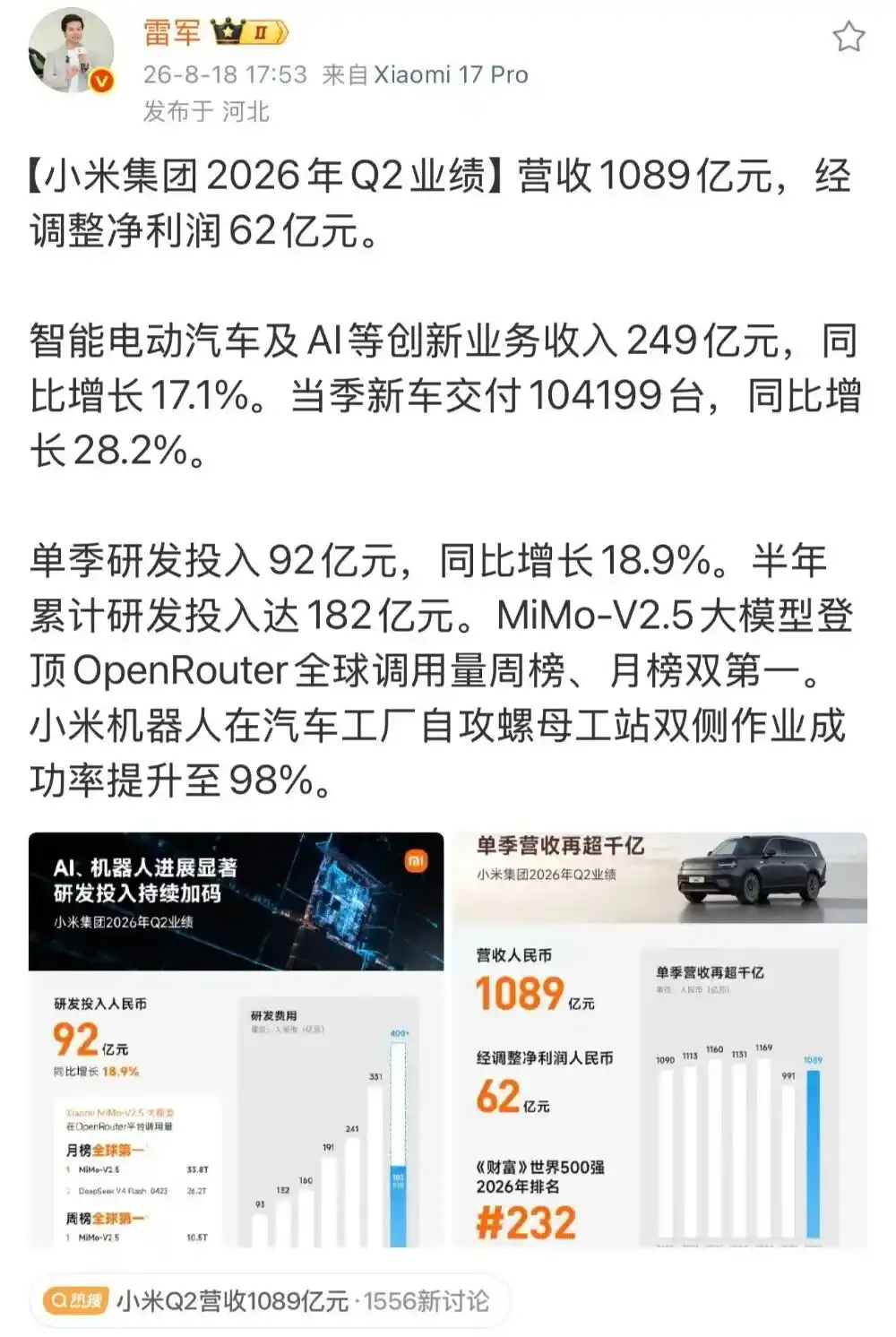
Lei Jun posted on Weibo to report performance (Source: Weibo)
The performance report shows that Xiaomi's Q2 revenue was approximately 108.9 billion yuan, a year-on-year decrease of 6.1%; adjusted net profit was about 6.2 billion yuan, a year-on-year decrease of 42.6%.
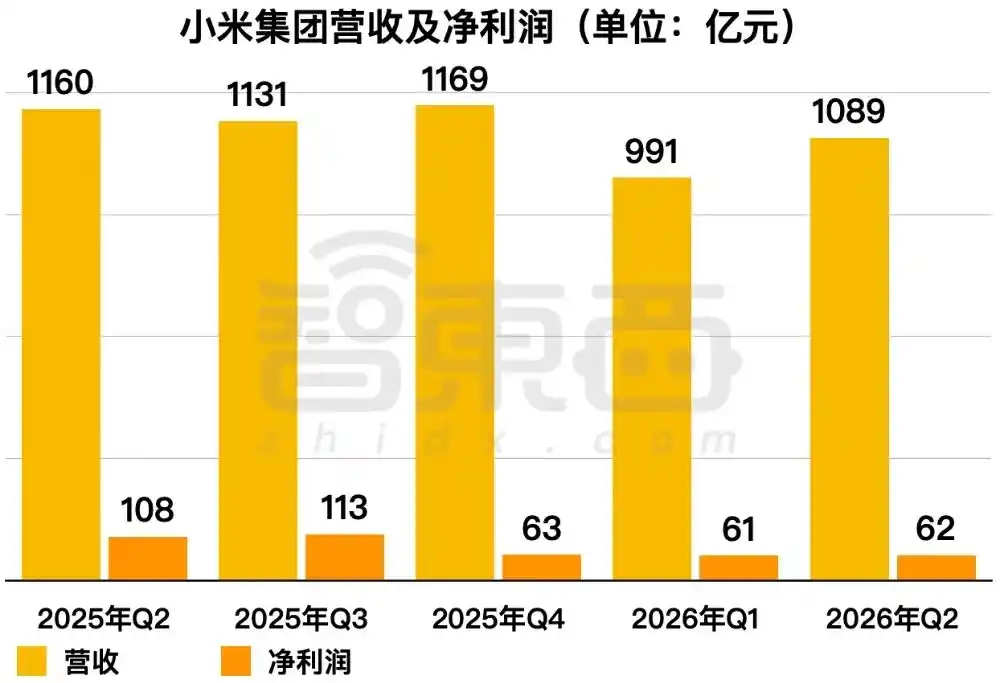
Xiaomi Group Revenue and Net Profit (Data Range: Q2 2025 - Q2 2026, Chart by Zhixiangxi)
In Q2, Xiaomi's capital expenditures were approximately 3.6 billion yuan, of which capital expenditures for the Smart Electric Vehicles and AI and other innovative businesses segment were 2.4 billion yuan, accounting for about 67% of total capital expenditures; R&D expenses were about 9.2 billion yuan, a year-on-year increase of nearly 19%, with cumulative R&D investment in the first half of the year reaching 18.2 billion yuan.
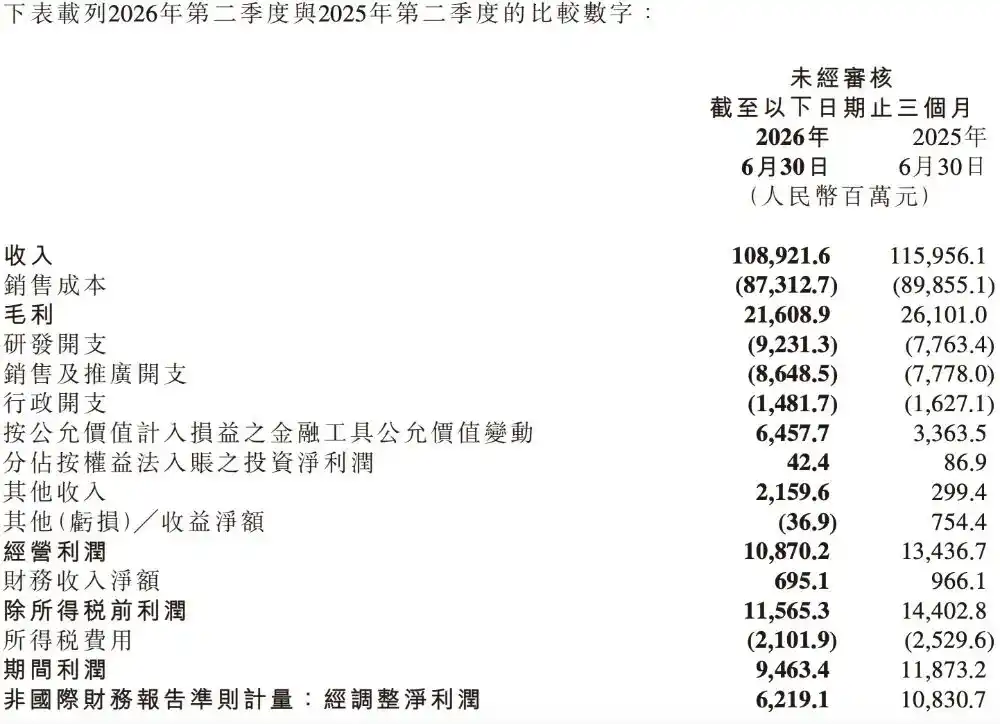
The financial report shows that in Q2, revenue from Xiaomi's "Smartphone × AIoT" business reached 84 billion yuan, with gross profit margin stable at 20%.
Lu Weibing disclosed during the earnings call that the increase in memory prices exceeded Xiaomi's expectations. From a sales perspective, rising memory prices had the most significant impact on low-end and entry-level models. Lu Weibing predicted that the upward trend in memory prices is expected to slow down in the middle of Q3, maintain a moderate increase in Q4, and overall will gradually become more controllable.
In terms of innovative businesses, overall revenue from the smart electric vehicles and AI segments increased by 17.1% year-on-year to 24.9 billion yuan. Among this, smart electric vehicles contributed 23.9 billion yuan in revenue, while AI and other emerging businesses contributed about 1 billion yuan in revenue, including income from the commercialization of the Xiaomi MiMo large model.
However, innovative businesses are still in a period of strategic investment. This quarter, the operating loss for this segment was 2.6 billion yuan.
Explaining this loss, Lin Shiwei, CFO of Xiaomi Group, stated that Xiaomi's AI is currently still in a phase of large-scale investment and will continue to promote the restructuring of business through AI. The previously launched Token Plan has already generated some revenue, but monetization is not the primary goal.
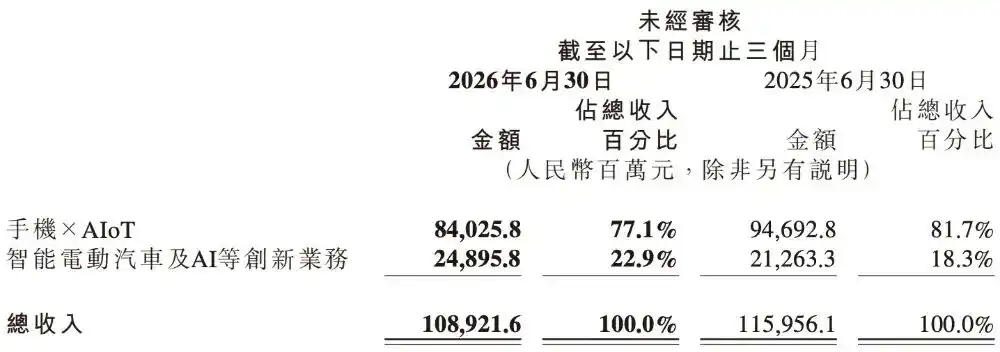
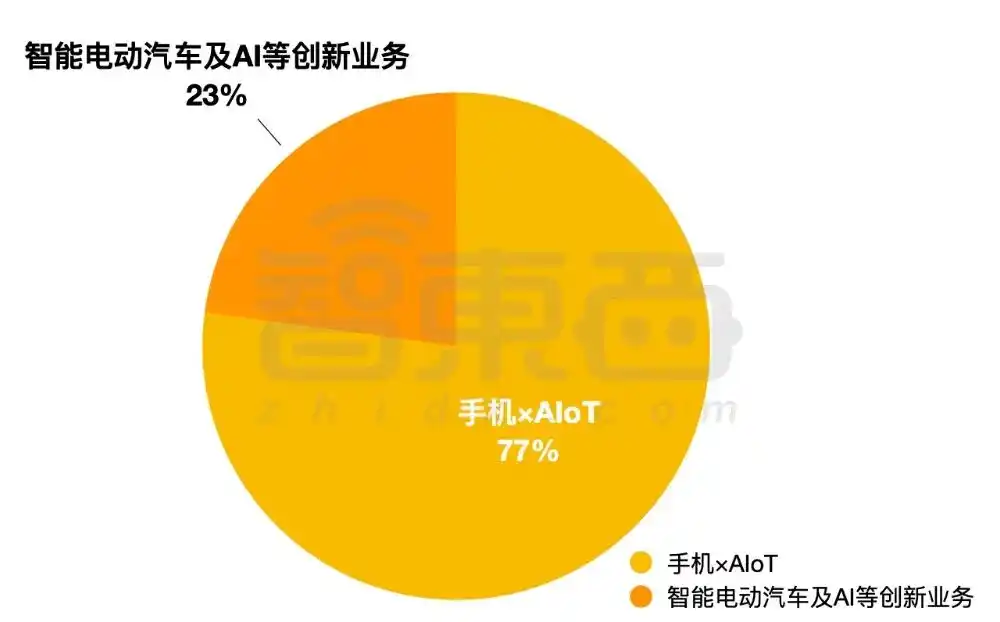
Revenue Proportion of Xiaomi Business Segments (Chart by Zhixiangxi)
01. Unveiling Multiple 'Tech Bombs': HyperOS 4, Super Little Love 2.0 Debut
Ever since recruiting former DeepSeek researcher Luo Fuli, hailed as a "genius girl" in the industry, Xiaomi's every move in AI has been placed under the spotlight.
On June 9th, the Xiaomi MiMo team and the inference systems team TileRT jointly announced that the UltraSpeed mode of the flagship large model Xiaomi MiMo-V2.5-Pro, released in April, has achieved a breakthrough, reaching over 1000 tokens/s output speed for the first time for a flagship trillion-parameter (1T) model.
In the same month, the Xiaomi MiMo team released and open-sourced the AI programming assistant MiMoCode V0.1.0. This product is based on secondary development of the open-source project OpenCode, with its core capability using "model-Agent collaboration + engineering memory" to solve issues like forgetfulness, deviation, and frequent rework in traditional Coding Agents.
The official version of Xiaomi MiMo Claw also launched in June. Positioned as a cloud-hosted, locally-deployment-free, out-of-the-box personal Agent, it is built on the MiMo-V2.5-Pro large model and integrates with the Kingsoft Office ecosystem.
On June 18th, Xiaomi also released and open-sourced the Whole-Home Smart AI Open Source Solution Xiaomi Miloco 2.0, currently the industry's first smart home solution capable of providing AI proactive services and possessing household memory.
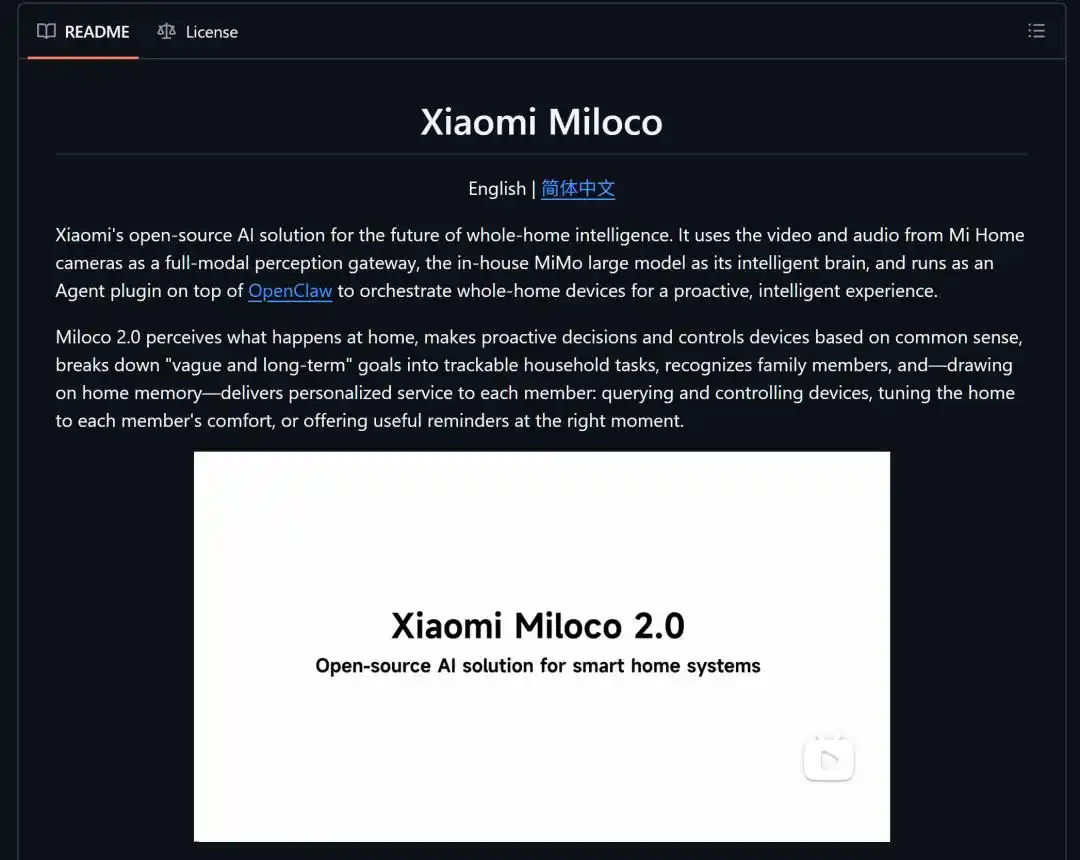
Xiaomi Miloco 2.0 GitHub Homepage (Source: GitHub)
In August, Xiaomi officially released the Beta version of the new-generation operating system Xiaomi HyperOS 4. It introduced workload precision calculation and memory preloading technologies to the Xiaomi HyperCore self-developed kernel and constructed the Xiaomi HyperOS application runtime environment.
Additionally, Xiaomi released "Super Little Love 2.0". Through improvements in AI architecture and integration with the Xiaomi MiMo large model, it now possesses better task orchestration and content generation capabilities, with specialized optimizations for cross-application and cross-device scenarios.
In terms of embodied intelligence, on July 15th, Xiaomi launched Xiaomi-Robotics-U0. This is a 38B-parameter autoregressive world foundation model and is also the first unified embodied generation model that combines an image generation foundation model with embodied world modeling.
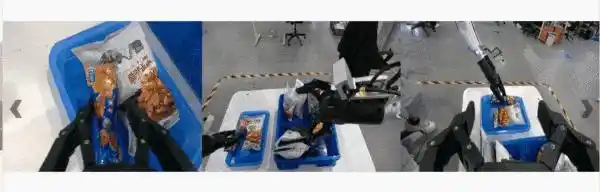
Multi-view prediction for robot interaction video generation (Source: Xiaomi Technology)
On July 14th, Xiaomi also revealed the latest progress on Xiaomi Robots. Earlier this year, Xiaomi Robots were deployed to perform tasks at the self-tapping nut feeding station in the Xiaomi car factory, where their success rate for bilateral operations at the self-tapping nut feeding station has increased to 98%. Meanwhile, the robots also achieved success rates of 90% in tasks like sorting center console side panels and folding/retrieving material boxes.
When asked about the positioning of the robot business within Xiaomi, Lu Weibing replied that humanoid robots still have a long cycle before large-scale commercialization. Xiaomi's first priority is to streamline its existing businesses, landing them in scenarios like smart factories and smart homes. In the future, many of Xiaomi's core capabilities will synergize with robots, and robot technology development will also feed back into existing businesses.
02. Smartphone ASP Hits Record High, AIoT Connected Devices Exceed 1.16 Billion
The financial report shows that in Q2, Xiaomi's smartphone revenue was 42.1 billion yuan, a year-on-year decrease of 7.5%, mainly due to a decrease in smartphone shipment volume, partially offset by an increase in average selling price (ASP).
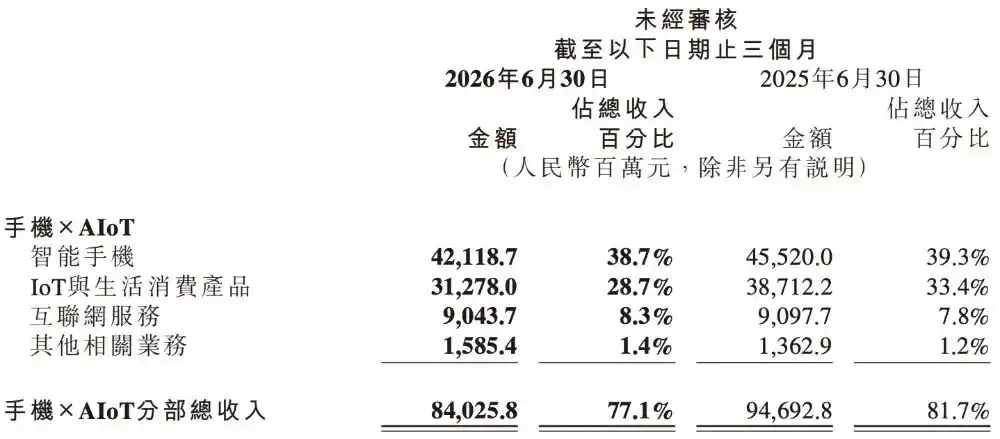
According to Omdia data, in Q2 2026, affected by memory prices, global smartphone shipment volume decreased by 6% year-on-year. During the same period, Xiaomi's global smartphone shipments were 31.2 million units, smartphone business revenue was 42.1 billion yuan, and gross profit margin was 8.5%.
Faced with rising memory prices, Xiaomi's smartphone division adopted a premiumization strategy, increasing product prices while continuing to optimize the product mix. In Q2 2026, Xiaomi's smartphone average selling price (ASP) increased by 25.9% year-on-year, reaching 1,351 yuan.
According to third-party data, in Q2 2026, in the Chinese mainland market, smartphones priced at 3000 yuan and above accounted for 32.1% of Xiaomi's total smartphone sales volume, hitting a record high, a year-on-year increase of 4.5 percentage points. Among them, Xiaomi's market share in the 3000–4000 yuan price segment for smartphones in the Chinese mainland reached 16.2%, a year-on-year increase of 3.3 percentage points.
According to Omdia data, in Q2 2026, Xiaomi's global smartphone shipment volume ranked third, maintaining its position in the global top three for 24 consecutive quarters.
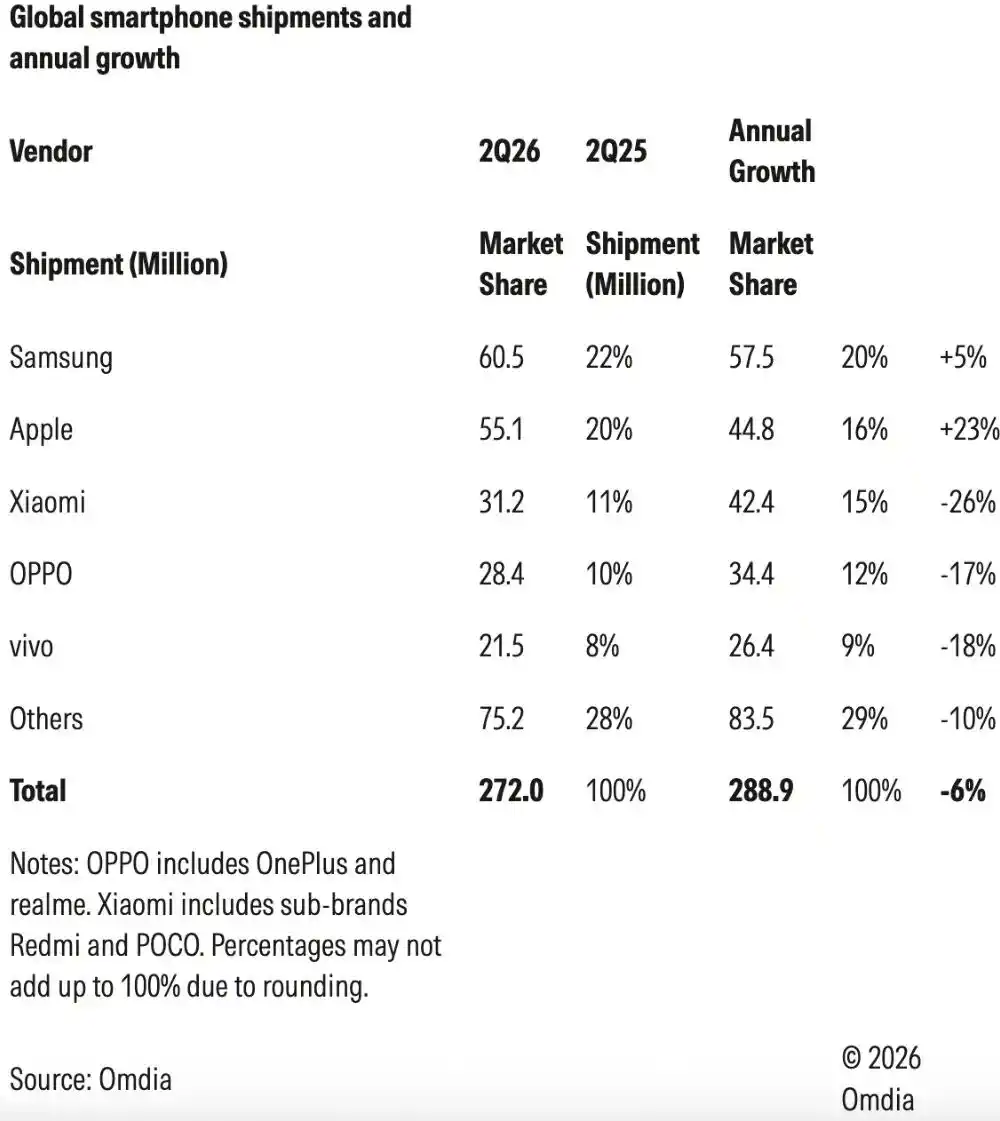
Global Smartphone Shipment Volume and Market Share (Source: Omdia)
Simultaneously, Xiaomi ranked among the top three in smartphone shipments in 53 countries and regions globally and among the top five in 67 countries and regions globally.
Specifically, Xiaomi's smartphone shipments ranked second in Southeast Asia, Latin America, and the Middle East, with market shares of 19.3%, 16.2%, and 13.5% respectively; it ranked third in Europe and Africa, with market shares of 16.5% and 10.9% respectively.
For other products, according to Omdia data, in Q2 2026, Xiaomi's global tablet shipments ranking rose to fourth, with its ranking in the Chinese mainland market also at fourth; global TWS headset shipments ranked second, with its ranking in the Chinese mainland market at second; global wearable band device shipments ranked second, with its ranking in the Chinese mainland market at second.
Regarding Xiaomi's ecosystem, the financial report shows that as of June 30, 2026, the number of IoT devices connected to the Xiaomi AIoT platform (excluding smartphones and tablets) reached 1.16 billion, a year-on-year increase of 17.4%; the number of users with five or more devices connected to the Xiaomi AIoT platform (excluding smartphones and tablets) reached 24.6 million, a year-on-year increase of 20.2%.
In June 2026, the monthly active users of the Mi Home app increased by 9.7% year-on-year to 124 million, and the monthly active users of Little Love Classmate increased by 14.2% year-on-year to 175 million.
In Q2 2026, overall revenue from Xiaomi's smart electric vehicles and AI segments increased by 17.1% year-on-year to 24.9 billion yuan. Among this, smart electric vehicles contributed 23.9 billion yuan in revenue.
The financial report shows that in Q2, Xiaomi delivered a total of 104,199 new vehicles, a year-on-year increase of 28.2%. In the first half of 2026, among pure electric sedans priced above 200,000 yuan in the Chinese mainland market, the Xiaomi SU7 series ranked first in sales volume. As of August 17, 2026, the cumulative deliveries of the Xiaomi SU7 series have exceeded 500,000 units.
03. Conclusion: Revenue and Profit Under Pressure, Xiaomi in Transition Pains
From this Q2 report, Xiaomi is in a period where new businesses are still growing while legacy businesses continue to face pressure.
On one hand, Xiaomi's core smartphone business maintained its market share amid an industry downturn. Premiumization is indeed taking effect, with ASP and high-end segment share showing tangible growth. On the other hand, its new businesses in automotive and AI are still "burning" significant cash, with a 2.6 billion yuan loss and 2.4 billion yuan in capital expenditures. It's difficult to see a profitability inflection point in the short term.
Regarding AI progress, products like agents, operating systems, and embodied intelligence models have been intensively released within half a year, indicating Xiaomi's desperate efforts to catch up in AI.
Market validation is just beginning for whether these technologies can ultimately translate into product competitiveness and truly help "connect Xiaomi's cars and IoT devices into a cohesive network."
This article is from the WeChat public account "Zhixiangxi" (ID: zhidxcom), Author: Wang Han, Editor: Bing Qian