Manufacturing's Share Drops Below 25%: Is Hangzhou Unconcerned?

marsbitPublicado a 2026-08-19Actualizado a 2026-08-19

Resumen

Hangzhou is entering a critical phase of industrial restructuring. While its manufacturing-to-GDP ratio has fallen below 25%, the city is not alarmed. Instead, it is strategically navigating a dual focus: advancing advanced manufacturing and expanding its service sector, particularly producer services. Recently, the city celebrated the IPO of a humanoid robotics company, seen as a milestone in moving beyond its e-commerce era. Simultaneously, it set an ambitious target for its service sector: to exceed 2 trillion yuan in value by 2030, with producer services making up over 60%. Data shows a clear trend: the service sector's share of GDP has risen to 75.3%, while manufacturing's share has declined to around 20.1%. This shift revives the debate on whether a strong service sector weakens a city's manufacturing "foundation." Hangzhou's approach challenges the notion of a fixed manufacturing "red line" near 25%. The city argues that the quality and integration of industries matter more than simple ratios. Its strategy is "using software to drive hardware," leveraging its core strengths in digital economy and producer services—like R&D, software, and supply chain management—to empower and add value to manufacturing. This is embodied by its emerging "AI era" companies, whose innovation in Hangzhou feeds into national industrial chains. The city believes that for a hub like Hangzhou, the key is not merely boosting visible manufacturing output, but strengthening the "invisible" co...

Hangzhou is entering a critical period of a new round of industrial adjustment.

On August 19, Unitree Robotics will list on the SSE Sci-Tech Innovation Board, becoming the "first humanoid robot stock" on the A-share market. The first of the "Six Little Dragons" to achieve an IPO is considered another milestone for Hangzhou in moving beyond the "e-commerce era."

Just a few days earlier, Hangzhou further deepened its commitment to its "traditional strength" in the services sector—setting a clear goal at a high-profile city-wide services industry conference: by 2030, the added value of the services industry will exceed 2 trillion yuan, with producer services accounting for over 60%.

On one side is manufacturing, on the other is services, bringing to light the long-discussed issue of Hangzhou's perceived "imbalance" in manufacturing.

In recent years, Hangzhou has continuously ramped up its emphasis on manufacturing, proposing to "rebuild a Hangzhou industry." However, from the data, the proportion of added value from large-scale industries in Hangzhou has been declining, accounting for only 20.1% of GDP last year.

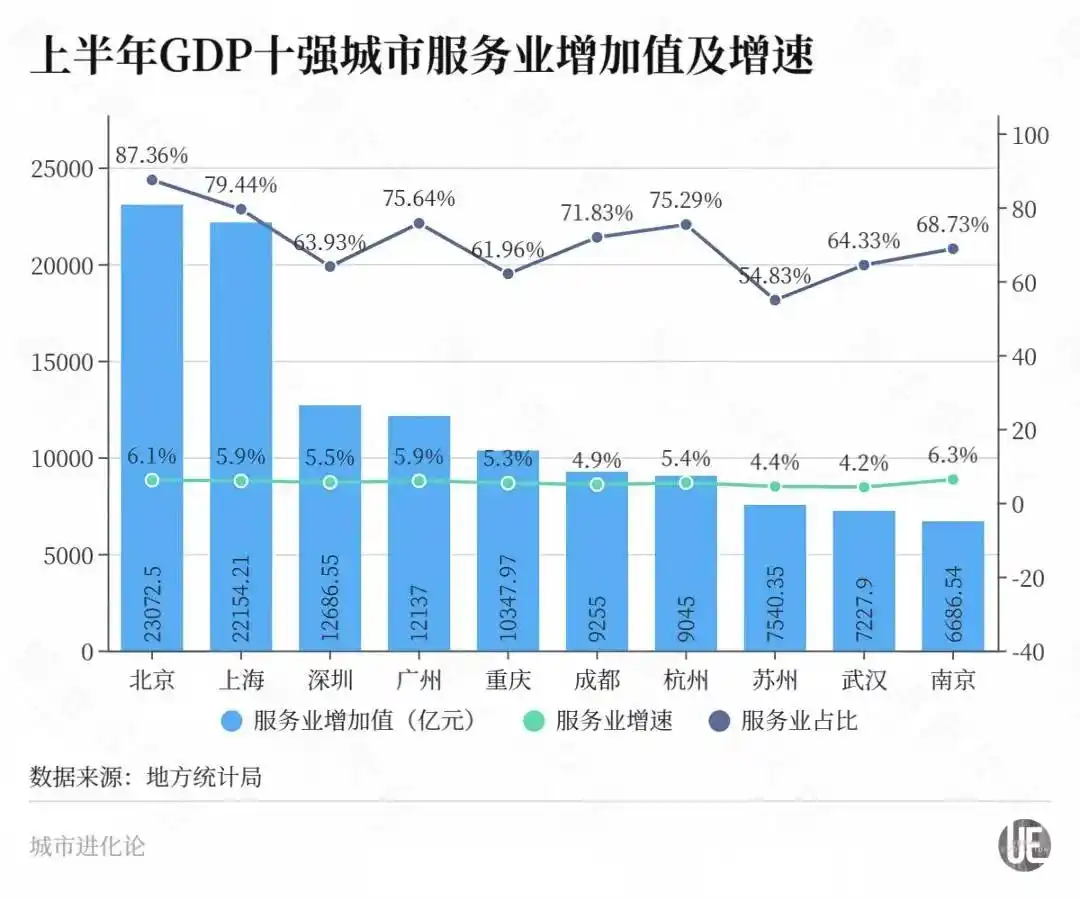
The other side of the coin is the continuous growth of the services sector. In the first half of this year, the added value of Hangzhou's services industry reached 904.5 billion yuan, a year-on-year increase of 5.4%, the highest growth rate in two years; the services sector's share of GDP exceeded 75% for the first time, reaching 75.3%, second only to Beijing, Shanghai, and Guangzhou.

This "rise and fall" has brought an old question back to the surface: as the services sector climbs higher, will the "foundation" of manufacturing become thinner? Under the requirement to maintain a reasonable proportion of manufacturing, what kind of reference can Hangzhou provide for cities hoping to bet on the next "little dragon"?

"25%"

25% was once considered a "red line" for the proportion of manufacturing in a city's economy.

The most representative example is Shanghai, which, in the "Shanghai Three-Year Action Plan for Promoting High-Quality Development of the Manufacturing Industry (2023-2025)" issued in 2023, explicitly drew a red line: by 2025, the proportion of industrial added value in Shanghai's regional GDP should reach over 25%. This was also the first time in seven years that Shanghai re-emphasized this goal.

Authoritative validation comes from a report by a World Bank research team: for megacities like Shanghai, the proportion of manufacturing should be between 25% and 30%. Consistent with this, many cities have also drawn their own "red lines." For example, Shenzhen, a major industrial city, although its manufacturing share is still significantly above 30%, still proactively set a red line for the city, mandating that the proportion of industrial land should not be less than 30%.

Although Hangzhou did not explicitly state such a red line at the time, under the national overall requirement to keep manufacturing's share "basically stable," Hangzhou also made similar arrangements in its 14th Five-Year Plan outline, proposing to deeply implement the "New Manufacturing Plan" and advance the "New Factory Plan."

However, this did not prevent the continuous rise in the services sector share in many cities. Several years later today, the manufacturing "red lines" in more and more cities are showing signs of loosening.

Looking at data from the first half of this year, as most cities have not released specific manufacturing data, if we only refer to the proportion of services sector added value in GDP, among the trillion-yuan GDP cities, there are four where this indicator exceeds 75%. Particularly Shanghai, where this indicator reached 79.4%, an increase of 4.2 percentage points compared to 2023, second only to Beijing.
Hangzhou is one of them.

A set of data repeatedly cited by local media is that in 2023, after Hangzhou's services sector added value share exceeded 70%, it continued to rise, increasing by 5 percentage points in three years, and further broke through 75% in the first half of this year, with the gap with Guangzhou narrowing to 0.3 percentage points.

In fact, Hangzhou has not relaxed its emphasis on manufacturing. In the past few years, under the goal of building a "global advanced manufacturing base," Hangzhou has, on one hand, reshaped its industrial geography, creating the East Hangzhou Intelligent Manufacturing Corridor to synergize with the West Hangzhou Science and Technology Innovation Corridor, forming a "two corridors" linkage. On the other hand, it has restructured its industrial framework, building the "296X" advanced manufacturing clusters, aiming to break the "significant deficiencies" in manufacturing in terms of total volume, growth rate, investment, industrial level, and enterprise attraction capacity.

But at the same time, the services sector remains a key development direction for Hangzhou. Just from a policy perspective, starting in 2022, Hangzhou has held high-level conferences on the high-quality development of the modern services industry for three consecutive years, hoping to further promote the upgrading of the services industry.

At this year's services industry conference, Hangzhou Municipal Party Committee Secretary Liu Fei further pointed out that the services industry is the "driving force industry" for Hangzhou to promote economic and social development, concerning industrial development, economic circulation, and people's livelihood and employment. It is necessary to "take promoting the expansion, quality improvement, and efficiency enhancement of the services industry as a major task, continuously achieve new results, and continue to lead the nation."

"Dual 70%"

Why does Hangzhou continue to push for an increase in the services sector share while under the requirement to stabilize the industrial proportion? One reason is that Hangzhou experienced the debate between manufacturing and services very early on.

One consensus is that the year 2000 was the starting point for Hangzhou's new-era promotion of the "industry revitalizing the city" strategy. Subsequently, Hangzhou's total industrial output value grew at a pace of crossing a 100-billion-yuan threshold almost every year, reaching 800 billion yuan by 2007.

The 2008 financial crisis became a turning point in Hangzhou's development. For many years thereafter, Hangzhou's GDP growth rate once fell to the bottom among sub-provincial cities. Issues such as a lack of land resources and high production factor prices made it difficult for manufacturing to maintain its inherent development model. Also in 2008, Hangzhou officially proposed the "services first" development strategy, achieving a landmark "tertiary-secondary-primary" industrial structure transformation the following year, marking a new starting point for Hangzhou's development of the services industry.

The lever for the shift towards services was precisely what later became Hangzhou's pride: the electronic information industry. As Liu Ting, former Deputy Director of the Zhejiang Provincial Development and Reform Commission, pointed out, from the "industry revitalizing the city" strategy to the information economy as the "No. 1 Project," Hangzhou's economy underwent a strategic leap from industrial-led to information-led, from industrial economy-dominated to information economy-dominated. This became the major background for Hangzhou's leading development in the new economy.

And now, more than a decade of accumulation in the services sector has, in turn, become the key to Hangzhou's advancement in manufacturing.

Last year, the emergence of Hangzhou's "Six Little Dragons" was seen as a milestone marking Hangzhou's transition from the "e-commerce era" to the "AI era." But if we look closely at the "Six Little Dragons," peeling back the shell of "hardcore manufacturing," it is precisely the core of Hangzhou's services industry, represented by the digital economy, that provides support.

Among them, Game Science and DeepSeek, which gained attention earlier, are backed by Hangzhou's advantage in software and information services—in 2025, the revenue of just large-scale information services exceeded 1.3 trillion yuan. Even Unitree Robotics, which focuses more on hardware development, has in the past year "conquered" many cities across the country, integrating into the industrial chains of major manufacturing cities like Chongqing. However, as a research and development center, Hangzhou's focus remains on its advantages in the digital economy, technological innovation, and the integration of the digital and real economies.

As pointed out in an article published on the official WeChat account of the Hangzhou Investment Promotion Bureau, this essentially injects Hangzhou's innovation genes into the national industrial and innovation chains. Such a city "truly deserves the term 'national strategic force.'" To achieve this goal, Hangzhou's services must not be just the "human touch" of consumer services; more importantly, they must be producer services that act as an "accelerator" for manufacturing.

Looking closely at the composition of "Hangzhou Services," the keyword also falls on "producer services"—a set of data repeatedly cited by local media in Hangzhou is that as early as 2024, the share of producer services in Hangzhou's services sector added value reached 63.2%, surpassing Shanghai and second only to Beijing.

In Hangzhou's 5.3% services sector growth last year, revenue from information transmission, software, and information technology services maintained double-digit growth for 11 consecutive months, with a full-year growth of 13.4%.

Comparing with the internationally commonly used "dual 70%" indicator for observing urban economic development levels, Hangzhou's services sector share has already "crossed the line." The next step is to fill the gap in producer services.

"Imbalance"?

In this sense, for Hangzhou, a more fundamental question is whether it actually needs to maintain an unchanged proportion of manufacturing.

Last year, at a Hangzhou conference on producer services, Huang Qifan, former Mayor of Chongqing, raised an "Apple question":

Apple doesn't build factories, has no production lines, and doesn't engage in manufacturing, so why does it take the vast majority of the product's profit? The reason is that it firmly controls every link of producer services, including research and development, logistics and distribution, market access, inspection and testing, digital empowerment, financial clearing, sales, and after-sales service. These are the foundation of the industrial chain and the bestowers of its core value.

In other words, to increase added value, manufacturing must extend into links such as R&D design, industrial software, supply chain management, brand services, and financial services. It is precisely these producer services that ultimately determine the profit and industrial added value of manufacturing, determining the gold content of modern manufacturing.

Going further, industry insiders have summarized the development path of Hangzhou's "Six Little Dragons" as a "soft driving hard" development model with Hangzhou characteristics. Compared to the longboards of Beijing, Shanghai, and Shenzhen in computing infrastructure and talent density, Hangzhou's artificial intelligence industry, based on the advantages of the digital economy and the services sector, has the potential to carve out a distinctive path of promoting innovation through application and gathering resources through ecology.

It is difficult to fully reflect the quality of a region's manufacturing development simply by looking at the increase or decrease in numbers.

Liu Ting once recalled in an interview that a few years ago, Hangzhou's economic growth rate was once at the bottom within the province. The local government became anxious, wondering whether to invite back heavy and chemical industries to boost the manufacturing proportion. After debate, a sober judgment emerged: the root of Hangzhou's problem was not insufficient industry, but insufficiently strong producer services. Sacrificing invisible competitiveness for visible numbers was not worthwhile.

One reason is that, unlike the "visible" manufacturing, the manufacturing growth driven by producer services is relatively "invisible." Many places have already realized this issue. According to media reports, in order to make this part of manufacturing data visible, Jiangsu changed its assessment method for manufacturing, no longer isolating and assessing the secondary industry share, but instead looking at the combined proportion of manufacturing and producer services in GDP. "The former is the 'skeleton,' the latter is the 'muscle'; looking at either one alone will be distorted."

From a national perspective, policies are also changing.

In the outline of the 15th Five-Year Plan, the phrasing of keeping manufacturing's share "basically stable" was replaced with a "reasonable proportion." Xiao Rongmei, Deputy Director of the Policy and Economics Research Institute of the China Academy of Information and Communications Technology, and others once wrote in an article that this means "after fully considering various internal and external risk impacts and balancing development stages and industrial structure issues, allowing the proportion of manufacturing to fluctuate within a certain reasonable range," "not only pursuing the scale expansion of manufacturing, but more importantly striving to achieve a systematic improvement in quality."

Under the new round of adjustment, how should we re-examine the judgment of Hangzhou's services sector "imbalance"? Where exactly is the "reasonable proportion" for Hangzhou's manufacturing? Hangzhou has already made its judgment. According to the "Hangzhou Three-Year Action Plan for Accelerating Manufacturing Development (2025-2027)," by 2027, the total added value of large-scale industries will reach 530 billion yuan, with an average annual growth of over 6%, and the proportion of industrial added value in GDP will be over 22%.

This article is from the WeChat public account "City Evolution Theory," author: Yang Qifei

Criptos en tendencia

Preguntas relacionadas

QWhy is the service industry considered the 'main driving force industry' for Hangzhou's economic and social development?

AThe service industry is considered the 'main driving force industry' for Hangzhou's economic and social development because it is crucial for industrial development, economic circulation, and people's livelihoods and employment. Hangzhou aims to continuously promote the expansion and quality improvement of the service industry to maintain its leading position nationally.

QWhat is the significance of the '25%' manufacturing share threshold mentioned for major cities?

AThe '25%' manufacturing share threshold is a benchmark often discussed for major cities. A World Bank research team report suggests that for megacities like Shanghai, the manufacturing share should be between 25% and 30%. Many cities, including Shanghai and Shenzhen, have used or referenced this threshold in their planning to ensure a stable industrial foundation. However, the article notes that this threshold is becoming more flexible in many cities.

QHow does Hangzhou's development of 'producer services' relate to its manufacturing sector?

AHangzhou's development of 'producer services' is closely tied to and supports its manufacturing sector. Producer services act as an 'accelerator' for manufacturing. The high value-added segments of manufacturing, such as R&D, industrial software, and supply chain management, are embedded within producer services. Hangzhou's strength in the digital economy and information services provides the core support for its advanced manufacturing clusters, enabling a 'soft drives hard' development model.

QWhat was the strategic shift in Hangzhou's industrial policy around 2008, and what triggered it?

AAround 2008, Hangzhou shifted its strategy from 'industrial revitalization' to prioritizing the service industry ('service industry first'). This strategic shift was triggered by the 2008 financial crisis, which exposed challenges for Hangzhou's traditional manufacturing model, including a lack of land resources and high production factor costs. This marked the beginning of Hangzhou's transition towards an economy led by information and services.

QAccording to the article, how has the national policy perspective on the manufacturing share in GDP changed recently?

AThe national policy perspective on the manufacturing share in GDP has shifted from emphasizing the need to keep its share 'basically stable' to maintaining a 'reasonable share' or 'reasonable proportion.' This change, noted in the context of the 15th Five-Year Plan, indicates a more flexible approach. It recognizes that the manufacturing share can fluctuate within a reasonable range based on various factors, with a greater focus on achieving systematic quality improvement rather than just scale expansion.

Lecturas Relacionadas

The Philadelphia Semiconductor Index Tumbles Nearly 5% in a Single Night, Optical and Memory Sectors 'Collapse' Together: Surging U.S. Bond Yields Shake AI Belief

On the evening of August 18th, the US stock market saw a sharp sell-off concentrated in the AI hardware sector, with the Philadelphia Semiconductor Index plummeting nearly 5%. Leading AI infrastructure and components companies in fields like optical communication and memory chips experienced some of the steepest declines, such as Fabrinet (-19.38%) and Kioxia ADR (-13%). The sell-off was not broad-based but rather targeted the long-duration, high-momentum stocks previously driven by AI narrative optimism. This market shift is primarily attributed to a significant surge in long-term US Treasury yields, with the 30-year yield hitting its highest level since 2007. Rising yields increase discount rates, disproportionately impacting the valuations of growth stocks whose profits are projected far into the future—a category that includes most AI hardware plays. Additional pressure came from climbing oil prices due to Middle East tensions, which fueled inflation concerns. The article identifies three structural reasons for the severity of the drop in these specific subsectors: excessive prior gains and crowded positioning, high sensitivity to the sustainability of AI capital expenditure narratives, and inherent high volatility within the supply chain. Importantly, the sell-off appears to be a valuation and positioning reset rather than a fundamental repudiation of AI, evidenced by the relatively modest decline in a bellwether like Nvidia (-2.34%). Looking ahead, the direction hinges on three key indicators: whether the 30-year Treasury yield stabilizes, the trajectory of oil prices and geopolitical risks, and the market's pricing of new AI-related corporate debt. For related Asian and A-share markets, short-term negative sentiment spillover is expected, but medium-term drivers like domestic cloud capex may provide divergence. The episode signifies a market transition from pricing AI's "story" to rigorously evaluating its returns against a backdrop of higher financing costs.

marsbitHace 33 min(s)

The Philadelphia Semiconductor Index Tumbles Nearly 5% in a Single Night, Optical and Memory Sectors 'Collapse' Together: Surging U.S. Bond Yields Shake AI Belief

marsbitHace 33 min(s)

Ten Years, Wang Xingxing's Comeback: Unitree Valued at 400 Billion

Over a decade ago, Wang Xingxing, a 29-year-old with a passion for robotics but little funding, demonstrated his struggling robot dog to investors in Hangzhou. In 2019, with his company Unitree nearly out of cash, he captured the attention of Sequoia Capital China's managing director Li Yannan. Despite initial skepticism about the niche market for robot dogs, Wang's vision and deep technical conviction led Sequoia to make an initial seed investment. This marked a turning point. Following Sequoia's lead, a wave of prominent investors including Meituan, Tencent, Alibaba, and various venture capital and state-backed funds joined subsequent funding rounds. Wang's relentless focus and Unitree's technological advancements propelled the company to become a global leader in humanoid robotics. On August 19th, 2027, Unitree Robotics debuted on Shanghai's STAR Market as the first listed humanoid robotics company in China. Its shares skyrocketed over 500% at opening, reaching a market valuation of approximately 400 billion yuan. Wang Xingxing became one of the wealthiest individuals of his generation on the exchange, while Sequoia China, having invested across multiple rounds, remained a major shareholder. The story is celebrated as a classic outlier's triumph—a founder without elite credentials achieving success through pure belief and perseverance. Unitree's IPO is seen as a major milestone for China's embodied AI industry, providing a valuation benchmark and accelerating the sector's maturation. As Wang once stated, he aims to be "a small boat riding the mighty torrent of technology." His journey symbolizes the beginning of a new narrative for Chinese robotics on the global stage.

marsbitHace 34 min(s)

Ten Years, Wang Xingxing's Comeback: Unitree Valued at 400 Billion

marsbitHace 34 min(s)

SEC Suddenly Proposes "Regulation Crypto": U.S. Token Fundraising May Become Legal Again

On August 18, the U.S. Securities and Exchange Commission (SEC) proposed a landmark set of permanent rules, "Regulation Crypto Assets," specifically designed for crypto asset investment contracts. The 402-page proposal introduces two registration exemption paths and a groundbreaking safe harbor mechanism, representing the SEC's first dedicated crypto-specific regulatory framework. Two exemption tiers are proposed: a "Startup Exemption" allowing a one-time raise of up to $5 million within four years with basic disclosure requirements, and a "Financing Exemption" permitting raises of up to $75 million every 12 months with stricter obligations, including financial statements and ongoing reporting. Both paths require "principles-based narrative disclosure," a flexible approach distinct from traditional IPO forms. The most transformative element is the investment contract safe harbor. It provides a legal path for tokens to "graduate" from being classified as securities. If an issuer completes or permanently ceases its "essential managerial efforts" as promised in the investment contract and meets specific conditions, it can file with the SEC to have the token exit the securities framework. This creates a novel legal lifecycle where a token can begin as a regulated security for fundraising and later become a non-security asset as the network decentralizes. This move is seen as the SEC pragmatically filling a legislative vacuum, as the stalled CLARITY Act in Congress faces significant delays. The proposal aims to offer a compliant pathway for token offerings within the U.S., countering the trend of projects moving overseas. While currently a proposal open for a 60-day public comment period, it signals a major potential shift from an enforcement-heavy approach toward establishing clearer rules for the crypto industry.

marsbitHace 1 hora(s)

SEC Suddenly Proposes "Regulation Crypto": U.S. Token Fundraising May Become Legal Again

marsbitHace 1 hora(s)

Late Qing County Magistrates' 'Official Debt' and the Crypto World's 'Exchange Listings': The Cross-Temporal Truth of Financializing Power

This article draws parallels between financialization of power in late Qing Dynasty China and the modern cryptocurrency industry. It opens with a staggering contemporary corruption case involving billions, illustrating how official positions control massive cash flows, akin to toll booths. The core analysis focuses on Du Fengzhi, a late Qing county magistrate. His 22-year journey from passing the provincial exam to finally obtaining a post highlights how bureaucratic "qualification" (like a VC investment) doesn't guarantee immediate benefit. Crucially, upon receiving his appointment, Du had to borrow heavily—"official debt"—to cover travel and networking costs to actually assume his position. Lenders, seeing his future post as a revenue-generating asset, offered loans with exorbitant effective interest rates (e.g., borrowing 4000 taels but receiving only 2000), effectively discounting and financializing his future power. Once in office, Du faced immense pressure from both public tax quotas and his crippling private debt. His diaries reveal aggressive, sometimes extreme, tax collection methods (sealing ancestral temples, pressuring local gentry) to meet these demands. The article argues this created a system where public duty and private financial survival became indistinguishable, with corruption evolving from operational necessity to normalized practice. The piece consistently analogizes this to crypto: VC funding as mere "qualification," the costly "listing" process on exchanges, the role of market makers and KOLs as intermediaries akin to local gentry, and the relentless pressure on funded projects to deliver returns—often leading to perpetual pivots, artificial metrics, and ultimately, the extraction of value from retail liquidity. Both systems, it concludes, are driven by the financialization of future potential, trapping individuals in cycles of debt and obligation with limited alternatives for upward mobility.

marsbitHace 1 hora(s)

Late Qing County Magistrates' 'Official Debt' and the Crypto World's 'Exchange Listings': The Cross-Temporal Truth of Financializing Power

marsbitHace 1 hora(s)

Trading

Spot

Artículos destacados

Qué es $S$

Entendiendo SPERO: Una Visión General Completa Introducción a SPERO A medida que el panorama de la innovación continúa evolucionando, la aparición de tecnologías web3 y proyectos de criptomonedas juega un papel fundamental en la configuración del futuro digital. Un proyecto que ha atraído la atención en este campo dinámico es SPERO, denotado como SPERO,$$s$. Este artículo tiene como objetivo reunir y presentar información detallada sobre SPERO, para ayudar a entusiastas e inversores a comprender sus fundamentos, objetivos e innovaciones dentro de los dominios web3 y cripto. ¿Qué es SPERO,$$s$? SPERO,$$s$ es un proyecto único dentro del espacio cripto que busca aprovechar los principios de descentralización y tecnología blockchain para crear un ecosistema que promueva la participación, la utilidad y la inclusión financiera. El proyecto está diseñado para facilitar interacciones de igual a igual de nuevas maneras, proporcionando a los usuarios soluciones y servicios financieros innovadores. En su esencia, SPERO,$$s$ tiene como objetivo empoderar a los individuos al proporcionar herramientas y plataformas que mejoren la experiencia del usuario en el espacio de las criptomonedas. Esto incluye habilitar métodos de transacción más flexibles, fomentar iniciativas impulsadas por la comunidad y crear caminos para oportunidades financieras a través de aplicaciones descentralizadas (dApps). La visión subyacente de SPERO,$$s$ gira en torno a la inclusividad, buscando cerrar brechas dentro de las finanzas tradicionales mientras aprovecha los beneficios de la tecnología blockchain. ¿Quién es el Creador de SPERO,$$s$? La identidad del creador de SPERO,$$s$ sigue siendo algo oscura, ya que hay recursos públicos limitados que proporcionan información de fondo detallada sobre su(s) fundador(es). Esta falta de transparencia puede derivarse del compromiso del proyecto con la descentralización, una ética que muchos proyectos web3 comparten, priorizando las contribuciones colectivas sobre el reconocimiento individual. Al centrar las discusiones en torno a la comunidad y sus objetivos colectivos, SPERO,$$s$ encarna la esencia del empoderamiento sin señalar a individuos específicos. Como tal, comprender la ética y la misión de SPERO sigue siendo más importante que identificar a un creador singular. ¿Quiénes son los Inversores de SPERO,$$s$? SPERO,$$s$ cuenta con el apoyo de una diversa gama de inversores que van desde capitalistas de riesgo hasta inversores ángeles dedicados a fomentar la innovación en el sector cripto. El enfoque de estos inversores generalmente se alinea con la misión de SPERO, priorizando proyectos que prometen avances tecnológicos sociales, inclusión financiera y gobernanza descentralizada. Estas fundaciones de inversores suelen estar interesadas en proyectos que no solo ofrecen productos innovadores, sino que también contribuyen positivamente a la comunidad blockchain y sus ecosistemas. El respaldo de estos inversores refuerza a SPERO,$$s$ como un contendiente notable en el dominio de proyectos cripto que evoluciona rápidamente. ¿Cómo Funciona SPERO,$$s$? SPERO,$$s$ emplea un marco multifacético que lo distingue de los proyectos de criptomonedas convencionales. Aquí hay algunas de las características clave que subrayan su singularidad e innovación: Gobernanza Descentralizada: SPERO,$$s$ integra modelos de gobernanza descentralizada, empoderando a los usuarios para participar activamente en los procesos de toma de decisiones sobre el futuro del proyecto. Este enfoque fomenta un sentido de propiedad y responsabilidad entre los miembros de la comunidad. Utilidad del Token: SPERO,$$s$ utiliza su propio token de criptomoneda, diseñado para servir diversas funciones dentro del ecosistema. Estos tokens permiten transacciones, recompensas y la facilitación de servicios ofrecidos en la plataforma, mejorando la participación y la utilidad general. Arquitectura en Capas: La arquitectura técnica de SPERO,$$s$ apoya la modularidad y escalabilidad, permitiendo la integración fluida de características y aplicaciones adicionales a medida que el proyecto evoluciona. Esta adaptabilidad es fundamental para mantener la relevancia en el cambiante paisaje cripto. Participación de la Comunidad: El proyecto enfatiza iniciativas impulsadas por la comunidad, empleando mecanismos que incentivan la colaboración y la retroalimentación. Al nutrir una comunidad sólida, SPERO,$$s$ puede abordar mejor las necesidades de los usuarios y adaptarse a las tendencias del mercado. Enfoque en la Inclusión: Al ofrecer tarifas de transacción bajas e interfaces amigables para el usuario, SPERO,$$s$ busca atraer a una base de usuarios diversa, incluyendo a individuos que anteriormente pueden no haber participado en el espacio cripto. Este compromiso con la inclusión se alinea con su misión general de empoderamiento a través de la accesibilidad. Cronología de SPERO,$$s$ Entender la historia de un proyecto proporciona información crucial sobre su trayectoria de desarrollo y hitos. A continuación se presenta una cronología sugerida que mapea eventos significativos en la evolución de SPERO,$$s$: Fase de Conceptualización e Ideación: Las ideas iniciales que forman la base de SPERO,$$s$ fueron concebidas, alineándose estrechamente con los principios de descentralización y enfoque comunitario dentro de la industria blockchain. Lanzamiento del Whitepaper del Proyecto: Tras la fase conceptual, se lanzó un whitepaper completo que detalla la visión, los objetivos y la infraestructura tecnológica de SPERO,$$s$ para generar interés y retroalimentación de la comunidad. Construcción de Comunidad y Primeras Interacciones: Se realizaron esfuerzos de divulgación activa para construir una comunidad de primeros adoptantes y posibles inversores, facilitando discusiones en torno a los objetivos del proyecto y obteniendo apoyo. Evento de Generación de Tokens: SPERO,$$s$ llevó a cabo un evento de generación de tokens (TGE) para distribuir sus tokens nativos a los primeros seguidores y establecer liquidez inicial dentro del ecosistema. Lanzamiento de la dApp Inicial: La primera aplicación descentralizada (dApp) asociada con SPERO,$$s$ se puso en marcha, permitiendo a los usuarios interactuar con las funcionalidades centrales de la plataforma. Desarrollo Continuo y Alianzas: Actualizaciones y mejoras continuas a las ofertas del proyecto, incluyendo alianzas estratégicas con otros actores en el espacio blockchain, han moldeado a SPERO,$$s$ en un jugador competitivo y en evolución en el mercado cripto. Conclusión SPERO,$$s$ se erige como un testimonio del potencial de web3 y las criptomonedas para revolucionar los sistemas financieros y empoderar a los individuos. Con un compromiso con la gobernanza descentralizada, la participación comunitaria y funcionalidades diseñadas de manera innovadora, allana el camino hacia un paisaje financiero más inclusivo. Como con cualquier inversión en el espacio cripto que evoluciona rápidamente, se anima a los posibles inversores y usuarios a investigar a fondo y participar de manera reflexiva con los desarrollos en curso dentro de SPERO,$$s$. El proyecto muestra el espíritu innovador de la industria cripto, invitando a una mayor exploración de sus innumerables posibilidades. Mientras el viaje de SPERO,$$s$ aún se desarrolla, sus principios fundamentales pueden, de hecho, influir en el futuro de cómo interactuamos con la tecnología, las finanzas y entre nosotros en ecosistemas digitales interconectados.

435 Vistas totalesPublicado en 2024.12.17Actualizado en 2024.12.17

Qué es $S$

Qué es AGENT S

Agent S: El Futuro de la Interacción Autónoma en Web3 Introducción En el paisaje en constante evolución de Web3 y las criptomonedas, las innovaciones están redefiniendo constantemente cómo los individuos interactúan con las plataformas digitales. Uno de estos proyectos pioneros, Agent S, promete revolucionar la interacción humano-computadora a través de su marco agente abierto. Al allanar el camino para interacciones autónomas, Agent S busca simplificar tareas complejas, ofreciendo aplicaciones transformadoras en inteligencia artificial (IA). Esta exploración detallada profundizará en las complejidades del proyecto, sus características únicas y las implicaciones para el dominio de las criptomonedas. ¿Qué es Agent S? Agent S se presenta como un marco agente abierto innovador, diseñado específicamente para abordar tres desafíos fundamentales en la automatización de tareas informáticas: Adquisición de Conocimiento Específico del Dominio: El marco aprende inteligentemente de diversas fuentes de conocimiento externas y experiencias internas. Este enfoque dual le permite construir un rico repositorio de conocimiento específico del dominio, mejorando su rendimiento en la ejecución de tareas. Planificación a Largo Plazo de Tareas: Agent S emplea planificación jerárquica aumentada por la experiencia, un enfoque estratégico que facilita la descomposición y ejecución eficiente de tareas complejas. Esta característica mejora significativamente su capacidad para gestionar múltiples subtareas de manera eficiente y efectiva. Manejo de Interfaces Dinámicas y No Uniformes: El proyecto introduce la Interfaz Agente-Computadora (ACI), una solución innovadora que mejora la interacción entre agentes y usuarios. Utilizando Modelos de Lenguaje Multimodal de Gran Escala (MLLMs), Agent S puede navegar y manipular diversas interfaces gráficas de usuario sin problemas. A través de estas características pioneras, Agent S proporciona un marco robusto que aborda las complejidades involucradas en la automatización de la interacción humana con las máquinas, preparando el terreno para una multitud de aplicaciones en IA y más allá. ¿Quién es el Creador de Agent S? Si bien el concepto de Agent S es fundamentalmente innovador, la información específica sobre su creador sigue siendo elusiva. El creador es actualmente desconocido, lo que resalta ya sea la etapa incipiente del proyecto o la elección estratégica de mantener a los miembros fundadores en el anonimato. Independientemente de la anonimidad, el enfoque sigue siendo en las capacidades y el potencial del marco. ¿Quiénes son los Inversores de Agent S? Dado que Agent S es relativamente nuevo en el ecosistema criptográfico, la información detallada sobre sus inversores y patrocinadores financieros no está documentada explícitamente. La falta de información disponible públicamente sobre las bases de inversión u organizaciones que apoyan el proyecto plantea preguntas sobre su estructura de financiamiento y hoja de ruta de desarrollo. Comprender el respaldo es crucial para evaluar la sostenibilidad del proyecto y su posible impacto en el mercado. ¿Cómo Funciona Agent S? En el núcleo de Agent S se encuentra una tecnología de vanguardia que le permite funcionar de manera efectiva en diversos entornos. Su modelo operativo se basa en varias características clave: Interacción Humano-Computadora Similar a la Humana: El marco ofrece planificación avanzada de IA, esforzándose por hacer que las interacciones con las computadoras sean más intuitivas. Al imitar el comportamiento humano en la ejecución de tareas, promete elevar las experiencias de los usuarios. Memoria Narrativa: Empleada para aprovechar experiencias de alto nivel, Agent S utiliza memoria narrativa para hacer un seguimiento de las historias de tareas, mejorando así sus procesos de toma de decisiones. Memoria Episódica: Esta característica proporciona a los usuarios una guía paso a paso, permitiendo que el marco ofrezca apoyo contextual a medida que se desarrollan las tareas. Soporte para OpenACI: Con la capacidad de ejecutarse localmente, Agent S permite a los usuarios mantener el control sobre sus interacciones y flujos de trabajo, alineándose con la ética descentralizada de Web3. Fácil Integración con APIs Externas: Su versatilidad y compatibilidad con varias plataformas de IA aseguran que Agent S pueda encajar sin problemas en ecosistemas tecnológicos existentes, convirtiéndolo en una opción atractiva para desarrolladores y organizaciones. Estas funcionalidades contribuyen colectivamente a la posición única de Agent S dentro del espacio cripto, ya que automatiza tareas complejas y de múltiples pasos con una intervención humana mínima. A medida que el proyecto evoluciona, sus posibles aplicaciones en Web3 podrían redefinir cómo se desarrollan las interacciones digitales. Cronología de Agent S El desarrollo y los hitos de Agent S pueden encapsularse en una cronología que resalta sus eventos significativos: 27 de septiembre de 2024: El concepto de Agent S fue lanzado en un documento de investigación integral titulado “Un Marco Agente Abierto que Usa Computadoras Como un Humano”, mostrando las bases del proyecto. 10 de octubre de 2024: El documento de investigación fue puesto a disposición del público en arXiv, ofreciendo una exploración profunda del marco y su evaluación de rendimiento basada en el benchmark OSWorld. 12 de octubre de 2024: Se lanzó una presentación en video, proporcionando una visión visual de las capacidades y características de Agent S, involucrando aún más a posibles usuarios e inversores. Estos marcadores en la cronología no solo ilustran el progreso de Agent S, sino que también indican su compromiso con la transparencia y la participación comunitaria. Puntos Clave Sobre Agent S A medida que el marco Agent S continúa evolucionando, varios atributos clave destacan, subrayando su naturaleza innovadora y potencial: Marco Innovador: Diseñado para proporcionar un uso intuitivo de las computadoras similar a la interacción humana, Agent S aporta un enfoque novedoso a la automatización de tareas. Interacción Autónoma: La capacidad de interactuar de manera autónoma con las computadoras a través de GUI significa un salto hacia soluciones informáticas más inteligentes y eficientes. Automatización de Tareas Complejas: Con su metodología robusta, puede automatizar tareas complejas y de múltiples pasos, haciendo que los procesos sean más rápidos y menos propensos a errores. Mejora Continua: Los mecanismos de aprendizaje permiten a Agent S mejorar a partir de experiencias pasadas, mejorando continuamente su rendimiento y eficacia. Versatilidad: Su adaptabilidad en diferentes entornos operativos como OSWorld y WindowsAgentArena asegura que pueda servir a una amplia gama de aplicaciones. A medida que Agent S se posiciona en el paisaje de Web3 y criptomonedas, su potencial para mejorar las capacidades de interacción y automatizar procesos significa un avance significativo en las tecnologías de IA. A través de su marco innovador, Agent S ejemplifica el futuro de las interacciones digitales, prometiendo una experiencia más fluida y eficiente para los usuarios en diversas industrias. Conclusión Agent S representa un audaz avance en la unión de la IA y Web3, con la capacidad de redefinir cómo interactuamos con la tecnología. Aunque aún se encuentra en sus primeras etapas, las posibilidades para su aplicación son vastas y atractivas. A través de su marco integral que aborda desafíos críticos, Agent S busca llevar las interacciones autónomas al primer plano de la experiencia digital. A medida que nos adentramos más en los reinos de las criptomonedas y la descentralización, proyectos como Agent S sin duda desempeñarán un papel crucial en la configuración del futuro de la tecnología y la colaboración humano-computadora.

819 Vistas totalesPublicado en 2025.01.14Actualizado en 2025.01.14

Qué es AGENT S

Cómo comprar S

¡Bienvenido a HTX.com! Hemos hecho que comprar Sonic (S) sea simple y conveniente. Sigue nuestra guía paso a paso para iniciar tu viaje de criptos.Paso 1: crea tu cuenta HTXUtiliza tu correo electrónico o número de teléfono para registrarte y obtener una cuenta gratuita en HTX. Experimenta un proceso de registro sin complicaciones y desbloquea todas las funciones.Obtener mi cuentaPaso 2: ve a Comprar cripto y elige tu método de pagoTarjeta de crédito/débito: usa tu Visa o Mastercard para comprar Sonic (S) al instante.Saldo: utiliza fondos del saldo de tu cuenta HTX para tradear sin problemas.Terceros: hemos agregado métodos de pago populares como Google Pay y Apple Pay para mejorar la comodidad.P2P: tradear directamente con otros usuarios en HTX.Over-the-Counter (OTC): ofrecemos servicios personalizados y tipos de cambio competitivos para los traders.Paso 3: guarda tu Sonic (S)Después de comprar tu Sonic (S), guárdalo en tu cuenta HTX. Alternativamente, puedes enviarlo a otro lugar mediante transferencia blockchain o utilizarlo para tradear otras criptomonedas.Paso 4: tradear Sonic (S)Tradear fácilmente con Sonic (S) en HTX's mercado spot. Simplemente accede a tu cuenta, selecciona tu par de trading, ejecuta tus trades y monitorea en tiempo real. Ofrecemos una experiencia fácil de usar tanto para principiantes como para traders experimentados.

1.6k Vistas totalesPublicado en 2025.01.15Actualizado en 2026.06.02

Cómo comprar S

Discusiones

Bienvenido a la comunidad de HTX. Aquí puedes mantenerte informado sobre los últimos desarrollos de la plataforma y acceder a análisis profesionales del mercado. A continuación se presentan las opiniones de los usuarios sobre el precio de S (S).

活动图片