Institutions and On-Chain Capital Are Bullish on CXMT's Continued Surge, Except for South Koreans

Odaily星球日报Publicado a 2026-07-27Actualizado a 2026-07-27

Resumen

Changxin Technology, China's leading memory chip manufacturer, made its debut on the STAR Market, closing up 465.8% with a market cap of 3.28 trillion yuan. Its record-breaking first day included over 140 billion yuan in turnover. Market opinions on its future trajectory diverge. Nomura issued a "buy" rating with a 116 yuan target (implying ~1239.5% upside), citing rapid growth projections, expansion into HBM, and the "crown jewel" status of its DRAM business. Northeast Securities offered a more conservative 10-15x PE valuation range, implying significant but lower upside. While the stock's surge reflects optimism, analysis suggests Changxin's current capacity remains below giants like Samsung and SK Hynix. U.S. equipment export restrictions may limit near-term expansion, and the company is not yet competitive in the high-margin HBM segment crucial for AI. On-chain data from Hyperliquid showed pre-listing positioning was net long by wallets tagged to the U.S., Hong Kong, and mainland China, while Korean-tagged wallets were heavily net short. Other bullish factors noted include a low initial float (6.63%), the ongoing memory "super cycle," and the stock's unique status as a domestic industry leader. Founder Zhu Yiming's plan to distribute 40% of his increased wealth to employees may also slow share sales. Multiple ETF issuers warned that fund net asset values might deviate from displayed reference values on the first day due to the large gap between Changxin's IPO price a...

Original|Odaily Planet Daily(@OdailyChina)

Author|Wenser(@wenser 2010 )
The esteemed "China's top storage stock," CXMT (ChangXin Memory Technologies), finally landed on the STAR Market today, closing up 465.8% on its debut, with a full-day turnover exceeding 140 billion yuan and a total market capitalization reaching 3.28 trillion yuan.

Simultaneously, it broke multiple thresholds on its first trading day, setting several A-share historical records including "first tech stock with an opening market cap exceeding 3 trillion yuan," "top market cap on the STAR Market," "first stock with a single-day turnover breaking 100 billion yuan," and "first IPO with over 100 billion turnover combined with a >50% turnover rate."

With the market performance on its debut day settled, the next question arises—can CXMT's stock price continue to rise? What is its target price? Currently, the market still holds some divergence on this matter.

Heated Debate on CXMT's Future Price Direction: Nomura Bullish to 116 Yuan, Northeast Securities Gives 10-15x PE Judgment

As the currently "world's fourth, China's first" storage giant, CXMT's market position is unquestionable.

According to data disclosed in CXMT's IPO press release, the company expects revenue of 110-120 billion yuan for the first half of 2026, a year-on-year increase of 612.53% to 677.31%; it expects net profit attributable to shareholders of 50-57 billion yuan, a year-on-year increase of 2244.03% to 2544.19%. In light of this, many institutions have given their own judgments on its future prospects.

Viewpoint One: Nomura Securities Gives a Buy Rating, Bullish to 116 Yuan, Market Cap Exceeds 7.7 Trillion RMB

This morning, international investment bank Nomura Securities issued a report, giving CXMT a "buy" rating with a target price of 116 yuan, corresponding to a 20x P/E ratio, implying an upside of 1239.5%. This valuation is double that of US storage giant Micron (MU), meaning CXMT's stock price would rise about 13.4 times from its IPO price, corresponding to a market cap of approximately 7.76 trillion yuan.

Notably, in the report title, Nomura likened the industrial value of CXMT's DRAM chips to "the jewel in the crown of China." According to its model projections, CXMT's revenue will rapidly increase from 61.8 billion yuan in 2025 to 290.7 billion yuan in 2026, 560.8 billion yuan in 2027, and 773.3 billion yuan in 2028; Nomura also expects CXMT's net profit attributable to shareholders to climb from less than 1.9 billion yuan to 130.3 billion yuan in 2026, 277.2 billion yuan in 2027, and 393.1 billion yuan in 2028. The compound annual growth rates for these two indicators are projected at 63% for revenue and 74% for net profit.
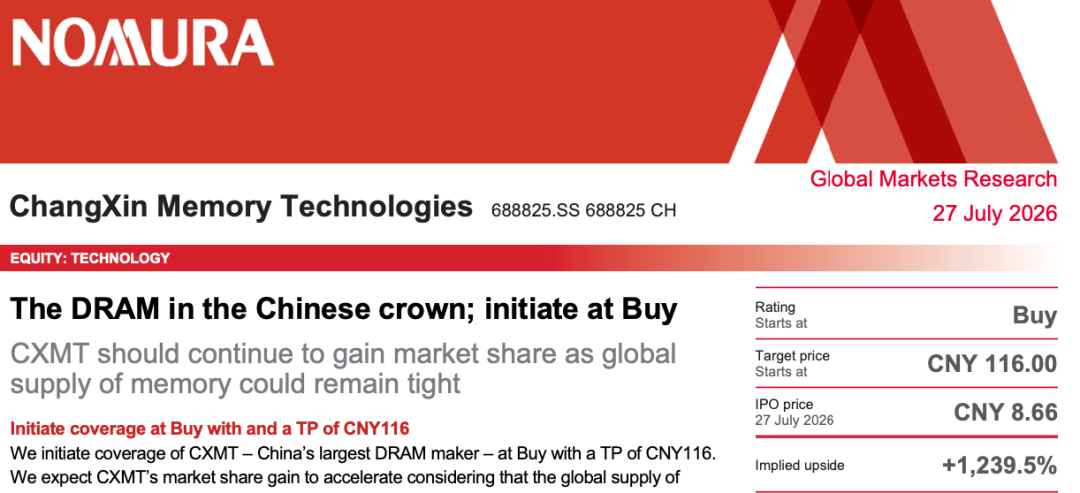
It is worth noting that Nomura's judgment, which is nearly 2.4 times the current market cap, is not unfounded. It is based on a comprehensive assessment of dimensions such as capacity expansion, technology upgrades, and price increases, and is also related to factors such as CXMT's current product mix, the storage super-cycle, and the subsequent use of IPO proceeds. For more on the underlying logic, recommended reading: "Thirteen Times Bullish on CXMT?"

According to information from CXMT's IPO prospectus, out of the 57.9 billion yuan raised, 7.5 billion yuan will be used for technology upgrade and transformation of the mass production line for memory wafer manufacturing, 13 billion yuan will be used for core DRAM memory process technology upgrades, and 9 billion yuan will be used for forward-looking technology research and development. The market generally believes the final 9 billion yuan will be allocated to HBM (High Bandwidth Memory) direction R&D, which is the core business of current memory giants like SK Hynix and Micron—AI chip high-bandwidth memory.

In other words, CXMT is not content with its current mainline DRAM business but is also striving to expand into high-profit, high-demand sectors like HBM.

Viewpoint Two: Northeast Securities Judges Valuation Range Converges to 3.2-5.7 Trillion RMB

Compared to the extremely optimistic Nomura, Northeast Securities offers a relatively conservative bullish range, but it still implies over 42% upside from the current market cap.

To provide a reasonable valuation for CXMT, Northeast Securities gives a market cap reference from the following three aspects:

  • Market Share Relative Valuation Perspective: Using US stocks as a valuation reference, by comparing and analyzing the market shares of Micron Technology, SK Hynix, Samsung Electronics, SanDisk, etc., in the DRAM and NAND markets, and splitting their market caps by different businesses, considering CXMT's future market share, the target market cap is 3.49 trillion yuan.
  • Profitability Breakdown Perspective: By decomposing CXMT's historical revenue and cost structure, using price and capacity as core variables to forecast profits for this year and next, with 2027 net profit attributable to shareholders at 284.8 billion yuan, a 10—15x P/E ratio corresponds to a target market cap of 2.85—4.27 trillion yuan.
  • Market Cap Per Unit Capacity Perspective: Calculating the market cap per unit capacity for overseas listed storage companies in the DRAM business and using this as a basis, a target market cap of 3.22—3.99 trillion yuan is calculated.

For detailed calculations and reasoning, recommended reading: "A-Share's New 'Stock King' is Born, How to Reasonably Value CXMT?"

Viewpoint Three: Multiple ETF Funds Warn ETF NAV May Deviate from IOPV on CXMT's Debut Day

This morning, prior to CXMT's listing, ETF fund managers such as ChinaAMC and Harvest Fund issued announcements warning that some of their ETFs participated in the IPO subscription for CXMT and valued it at the issue price. However, the ETF's Indicative Optimized Portfolio Value (IOPV) only includes CXMT's issue price and does not reflect its market price fluctuations. Therefore, on CXMT's debut day, the IOPV of these ETFs may differ from the actual net asset value per fund share, and investors are advised to pay attention to related investment risks.

In this regard, an ETF fund manager explained that currently, ETF participation in IPOs is generally done together with active equity funds. The IOPV for ETFs is strictly calculated based on the PCF (Portfolio Composition File) list, and restricted shares like new stocks not yet included as constituents are not counted. CXMT's sharp rise on its debut will cause the actual net asset value per share of ETFs that participated in the IPO to be slightly higher than the IOPV, creating a deviation. In such cases, potential arbitrage strategies could include buying the ETF while hedging with derivatives, retaining only the excess exposure from the deviation.

In simpler terms, the IOPV (reference net value) seen by investors is calculated based on CXMT's issue price of 8.66 yuan, but the fund's actual NAV is calculated based on the market price. Therefore, the IOPV severely "undervalues" the fund's true worth, appearing as a discount. Essentially, this is because CXMT's opening price surged, but there's a lag in the display on investment systems, aiming to prevent investors from buying ETF funds at inflated prices due to market volatility and incurring losses.

Viewpoint Four: Analyst Believes CXMT's Listing Surge Still Hard to Change Global DRAM Shortage Situation

Today, Milk Road AI analyst Melvin posted an analysis on CXMT's stock price surge.

He stated that in less than a year, CXMT's global DRAM market share increased from less than 4% to about 7.7%-8%, with Q1 revenue this year growing 719% year-on-year to 50.8 billion yuan. This growth primarily benefited from Samsung, SK Hynix, and Micron shifting more capacity to AI server storage (especially HBM), creating a supply gap in the traditional DDR5, LPDDR5 market, which CXMT filled by addressing mid-to-low-end DRAM demand.

However, CXMT's current capacity is far from sufficient to meet global demand. Its current monthly wafer capacity is about 290,000-320,000 pieces, lower than Samsung's approximately 630,000 pieces and SK Hynix's about 500,000 pieces. Furthermore, U.S. export restrictions on advanced lithography equipment are limiting the pace of CXMT's further expansion.

He believes that CXMT will find it difficult to enter the HBM market in the short term and therefore will not change the supply-demand dynamics of AI storage. Samsung, SK Hynix, and Micron will likely maintain their advantage in high-margin products like HBM, server DRAM, and LPDDR5X, and the global storage shortage cycle may persist.

In simpler terms, the analyst believes that CXMT's listing surge will not directly translate into a linear increase in market share or a massive surge in storage industry supply, offering a relatively neutral expectation for market cap and price performance from a rational perspective.

Viewpoint Five: On-Chain Sentiment Divided, US & China Addresses Bullish, South Korean Addresses Bearish

Apart from institutions and analysts, the pre-listing long-short divergence for CXMT on-chain is also quite distinct.

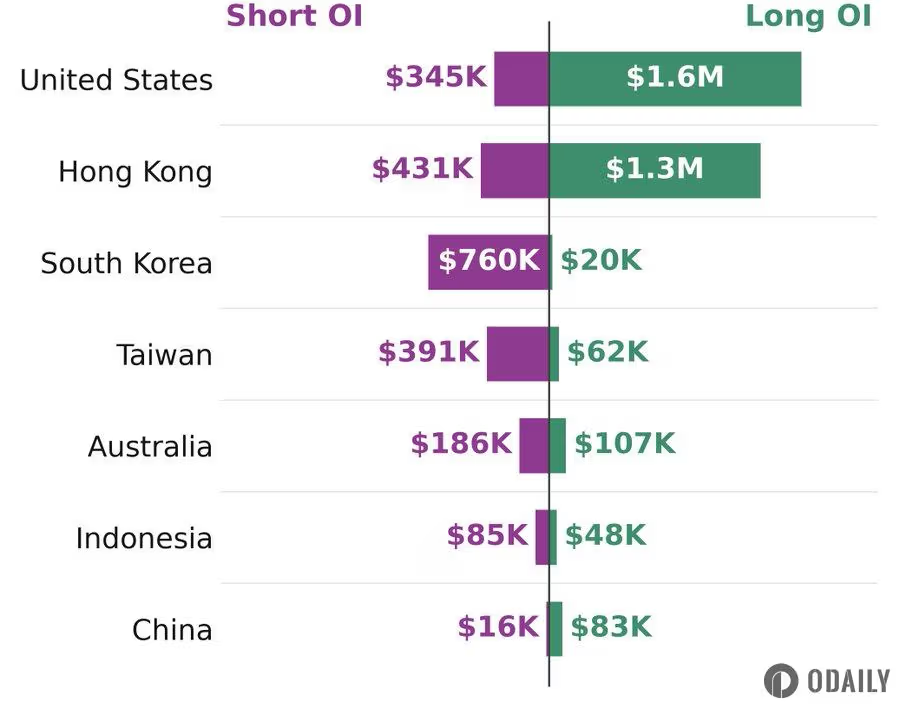
According to HyperInsight monitoring, on the eve of CXMT's listing, wallets attributable to CXMT on Hyperliquid showed: US, Hong Kong, and Mainland China wallets were overall bullish, while South Korean-labeled wallets became the main shorting force in this sample.

Among them, South Korean wallets held about $760,000 in short positions, a scale approximately 38 times that of their long positions; Taiwan-labeled wallets were also slightly bearish, with a net short of about $329,000.

On the long side:

  • US-labeled wallets held $1.6 million in long positions and $345,000 in short positions, net long about $1.255 million;
  • Hong Kong-labeled wallets held $1.3 million in long positions and $431,000 in short positions, net long about $869,000;
  • Mainland China-labeled wallets held only $83,000 in long positions and $16,000 in short positions, net long about $67,000.

Assuming the $760,000 in short positions from South Korean wallets were all opened before the opening bell at a unified price of $6.48 with no subsequent adjustments and all at 1x leverage, the theoretical floating loss on these short positions would be about $48,500, a loss rate of approximately 6.4%. Combined with today's closing data, the long side returned home with full pockets.
Viewpoint Six: CXMT's Upside Expected to Last Several Days, Low Float High Market Cap to Continue Fueling FOMO

Aside from the above information, mainstream views within the crypto market still maintain some confidence in CXMT's subsequent upward trend.

Their main points include:

First, the current freely tradable shares of CXMT account for only 6.63%, highly similar to the initial performance of SpaceX (SPCX) post-listing;

Second, the memory super-cycle remains the main theme in capital markets. Coupled with memory manufacturers like SK Hynix, Samsung Electronics, and Micron Technology continuing to expand production, advance chip partnerships, and build new factories, and with analysts expecting SK Hynix's Q2 earnings to far exceed market expectations, industry tailwinds directly fuel bullish sentiment for CXMT;

Third, CXMT's unique status as the "domestic storage industry leader" makes it a highly watched speculative target within the A-share market and even across multiple capital markets. Combined with the previous "A-share premium effect," a 15-20x P/E ratio expectation is not unrealistic;

Fourth, despite "rumored internal memos" claiming brokerages have banned hype around CXMT, market performance shows institutions maintain some restraint while still paying close attention. This suggests institutional buying interest for CXMT still exists, thereby storing some momentum for future gains.

Finally, as an aside, according to the Bloomberg Billionaires Index, since CXMT's listing, the wealth of its founder Zhu Yiming's family has surged nearly 300%, reaching $13.9 billion. Currently, he is reportedly preparing to distribute 40% of this as bonuses to employees. This move might emulate SK Hynix's practice of distributing 10% of its annual net profit to all employees and may also, to some extent, delay the pace of equity monetization.

Recommended Reading

More Accurate Than Brokers? TradeXYZ Pre-Priced CXMT

Criptos en tendencia

Preguntas relacionadas

QWhat were the key reasons for CXMT's strong debut and record-breaking performance on its first trading day?

AChangxin Memory Technologies (CXMT) had a strong debut due to its position as a leading domestic memory chip maker, significant year-on-year growth in projected revenue and net profit, and massive market interest. It set records including becoming the first tech stock to open with a market cap exceeding 3 trillion RMB, the highest market cap on the STAR Market, the first stock with single-day turnover exceeding 100 billion RMB, and the first new stock to combine 100 billion RMB turnover with over 50% turnover rate.

QWhat are the differing target price and valuation outlooks for CXMT from Nomura Securities and Northeast Securities?

ANomura Securities is extremely bullish, giving CXMT a 'Buy' rating with a target price of 116 RMB (implying a 1239.5% gain from the IPO price) and a market cap of approximately 7.76 trillion RMB, based on a 20x P/E ratio. In contrast, Northeast Securities provides a more conservative valuation range of 3.2 to 5.7 trillion RMB, using methods like relative market share valuation, profitability analysis (10-15x P/E on 2027 profits), and unit capacity valuation.

QAccording to the Milk Road AI analyst, why won't CXMT's listing immediately solve the global DRAM shortage?

AThe analyst states that while CXMT has grown its DRAM market share, its current monthly wafer capacity (290k-320k) is still much lower than competitors like Samsung (630k) and SK Hynix (500k). Furthermore, U.S. restrictions on advanced lithography equipment limit its expansion speed. Crucially, CXMT is not yet in the high-margin HBM (High Bandwidth Memory) market, which is dominated by Samsung, SK Hynix, and Micron for AI servers. Therefore, CXMT's growth primarily fills gaps in mid-to-low-end DRAM, not the high-end segments driving the shortage.

QHow did on-chain wallet activity on Hyperliquid show a geographical split in sentiment towards CXMT before its IPO?

AOn-chain data from Hyperliquid showed a clear geographical split in sentiment. Wallets tagged to the United States, Hong Kong (China), and mainland China were predominantly long (net buyers). In contrast, wallets tagged to South Korea were the main short-sellers in the sample, holding about $760k in short positions—38 times the size of their long positions. Wallets tagged to Taiwan (China) also showed a net short position.

QWhat are some of the arguments within the crypto market for why CXMT's price rise might continue?

ACrypto market participants are optimistic for several reasons: 1) Low free float (only 6.63% of shares), similar to SpaceX's (SPCX) early performance, which can amplify price moves. 2) The ongoing memory 'super cycle' and strong industry fundamentals, with peers like SK Hynix expecting strong earnings. 3) CXMT's unique status as the 'domestic memory leader' could command an 'A-share premium' with P/E ratios of 15-20x seen as realistic. 4) Despite rumors of broker restrictions on speculation, institutional interest remains high, suggesting potential for continued buying support.

Lecturas Relacionadas

US Calls for Restrictions on Sports Prediction Markets

The National Football League (NFL) has urged the U.S. Commodity Futures Trading Commission (CFTC) to tighten rules for prediction markets on sports events. In a July letter, the NFL argued that current proposals fail to adequately protect the integrity of games and market participants. Key demands include banning contracts on events easily manipulated by individuals (e.g., a kicker missing a field goal), clarifying definitions to prevent gambling-like contracts, and explicitly prohibiting trading based on non-public insider information. The league also called for restricted person lists, a ban on margin trading, advertising limits, stronger user protections, and a minimum age of 21. This push coincides with an ongoing jurisdictional dispute between the CFTC and several states. The CFTC claims exclusive federal oversight, classifying event contracts as swaps, while states argue these platforms violate local gambling laws. Recent legal actions in Michigan and Minnesota highlight the conflict, with a federal court temporarily blocking Minnesota from applying a new law to CFTC-registered platforms like Kalshi and Polymarket. Meanwhile, prediction markets are experiencing significant growth. In June, driven by events like the World Cup, Kalshi's trading volume exceeded $31 billion (85% from sports contracts), while Polymarket's global platform hit a monthly record of $10.8 billion. However, platforms face legal challenges, such as lawsuits from Kentucky accusing them of operating unlicensed sports betting disguised as prediction markets.

cryptonews.ruHace 10 min(s)

US Calls for Restrictions on Sports Prediction Markets

cryptonews.ruHace 10 min(s)

Peskov Says Russia Is Among Top Five Leaders in AI Race. What Do Global Rankings Say?

On July 27, 2026, Kremlin spokesman Dmitry Peskov stated that Russia remains among the top five countries in the global AI development race. He acknowledged Russian models still lag behind leading U.S. counterparts but claimed they have reached a "very high level," aiming to close the gap with "superhuman efforts." He highlighted the differing approaches of Russia's GigaChat, built from scratch, and Yandex, which initially used foreign technology. However, this claim is not supported by major international AI rankings. Stanford University's Global AI Vibrancy Tool (2024-25) ranks Russia 28th out of 36 countries. The top five are the U.S., China, India, South Korea, and the UK. The Stanford AI Index Report 2026 does not mention Russia's position, focusing instead on U.S. and Chinese leadership across various metrics like investments and model performance. In benchmarks, GigaChat ranks 25th on the Russian-language LM Arena. While it passed a financial analyst exam in December 2025, its business usage costs are reportedly tens to hundreds of times higher than China's DeepSeek. In related developments, President Putin signed a law on July 26, 2026, establishing a legal framework for sovereign AI models and granting developers access to state data. Previously, Russia joined 28 other nations, including China, to establish the World AI Cooperation Organization (WAICO) in Shanghai. The article notes that rankings vary due to different criteria, such as research, investment, infrastructure, or responsible AI governance. While Russian authorities are bolstering AI through legislation and international cooperation, independent analyses suggest the country faces significant challenges, including a hardware deficit for training models, which legal frameworks alone cannot resolve.

cryptonews.ruHace 10 min(s)

Peskov Says Russia Is Among Top Five Leaders in AI Race. What Do Global Rankings Say?

cryptonews.ruHace 10 min(s)

From Sand to Chips: Hefei's Semiconductor Alchemy

From Sand to Chips: Hefei's Semiconductor "Alchemy" On July 27, 2026, a memory chip maker from Hefei made history by surpassing the market capitalization of Industrial and Commercial Bank of China on its Shanghai Stock Exchange debut. This marks the culmination of Hefei's two-decade industrial transformation, often summarized in three strategic leaps: "Screen, Chip, Vehicle." The journey began in 2008 with a bold investment in BOE, establishing China's first 6th-generation LCD panel line. The second leap was the "Project 506" in 2016, which gave birth to ChangXin Memory Technologies (CXMT). With initial backing of 14.4 billion RMB from Hefei's state-owned investment platform, CXMT aimed to break into the global DRAM market, then over 95% controlled by three overseas giants. CXMT achieved a breakthrough in 2019 by producing China's first 8GB DDR4 DRAM chip, employing "generational leapfrog" R&D to catch up. After years of significant losses, the company turned profitable in 2025. A dramatic surge followed in 2026, driven by AI-driven demand and full capacity utilization, propelling CXMT to become the world's fourth-largest DRAM manufacturer. CXMT's success is not isolated. It anchors a dense, localized semiconductor ecosystem in Hefei. Within its vicinity are numerous supporting companies for equipment, materials, and packaging & testing. This cluster has fueled the regional economy, with Hefei's integrated circuit industry output growing over sevenfold between 2016 and 2025. The ripple effects extend beyond high-tech, revitalizing local communities with new businesses and services catering to the influx of workers. For individuals, Hefei offers competitive tech salaries at a significantly lower cost of living compared to major coastal cities, along with improved amenities and shorter commutes. Hefei's story demonstrates two decades of focused, long-term industrial policy, transforming the city from a provincial capital into a trillion-RMB GDP "Double Ten-Thousand" city (10 million people, 1 trillion RMB GDP). It shows how persistence in strategic sectors—turning sand into chips—can redefine a city's economic destiny.

marsbitHace 40 min(s)

From Sand to Chips: Hefei's Semiconductor Alchemy

marsbitHace 40 min(s)

Trading

Spot

Artículos destacados

Qué es $S$

Entendiendo SPERO: Una Visión General Completa Introducción a SPERO A medida que el panorama de la innovación continúa evolucionando, la aparición de tecnologías web3 y proyectos de criptomonedas juega un papel fundamental en la configuración del futuro digital. Un proyecto que ha atraído la atención en este campo dinámico es SPERO, denotado como SPERO,$$s$. Este artículo tiene como objetivo reunir y presentar información detallada sobre SPERO, para ayudar a entusiastas e inversores a comprender sus fundamentos, objetivos e innovaciones dentro de los dominios web3 y cripto. ¿Qué es SPERO,$$s$? SPERO,$$s$ es un proyecto único dentro del espacio cripto que busca aprovechar los principios de descentralización y tecnología blockchain para crear un ecosistema que promueva la participación, la utilidad y la inclusión financiera. El proyecto está diseñado para facilitar interacciones de igual a igual de nuevas maneras, proporcionando a los usuarios soluciones y servicios financieros innovadores. En su esencia, SPERO,$$s$ tiene como objetivo empoderar a los individuos al proporcionar herramientas y plataformas que mejoren la experiencia del usuario en el espacio de las criptomonedas. Esto incluye habilitar métodos de transacción más flexibles, fomentar iniciativas impulsadas por la comunidad y crear caminos para oportunidades financieras a través de aplicaciones descentralizadas (dApps). La visión subyacente de SPERO,$$s$ gira en torno a la inclusividad, buscando cerrar brechas dentro de las finanzas tradicionales mientras aprovecha los beneficios de la tecnología blockchain. ¿Quién es el Creador de SPERO,$$s$? La identidad del creador de SPERO,$$s$ sigue siendo algo oscura, ya que hay recursos públicos limitados que proporcionan información de fondo detallada sobre su(s) fundador(es). Esta falta de transparencia puede derivarse del compromiso del proyecto con la descentralización, una ética que muchos proyectos web3 comparten, priorizando las contribuciones colectivas sobre el reconocimiento individual. Al centrar las discusiones en torno a la comunidad y sus objetivos colectivos, SPERO,$$s$ encarna la esencia del empoderamiento sin señalar a individuos específicos. Como tal, comprender la ética y la misión de SPERO sigue siendo más importante que identificar a un creador singular. ¿Quiénes son los Inversores de SPERO,$$s$? SPERO,$$s$ cuenta con el apoyo de una diversa gama de inversores que van desde capitalistas de riesgo hasta inversores ángeles dedicados a fomentar la innovación en el sector cripto. El enfoque de estos inversores generalmente se alinea con la misión de SPERO, priorizando proyectos que prometen avances tecnológicos sociales, inclusión financiera y gobernanza descentralizada. Estas fundaciones de inversores suelen estar interesadas en proyectos que no solo ofrecen productos innovadores, sino que también contribuyen positivamente a la comunidad blockchain y sus ecosistemas. El respaldo de estos inversores refuerza a SPERO,$$s$ como un contendiente notable en el dominio de proyectos cripto que evoluciona rápidamente. ¿Cómo Funciona SPERO,$$s$? SPERO,$$s$ emplea un marco multifacético que lo distingue de los proyectos de criptomonedas convencionales. Aquí hay algunas de las características clave que subrayan su singularidad e innovación: Gobernanza Descentralizada: SPERO,$$s$ integra modelos de gobernanza descentralizada, empoderando a los usuarios para participar activamente en los procesos de toma de decisiones sobre el futuro del proyecto. Este enfoque fomenta un sentido de propiedad y responsabilidad entre los miembros de la comunidad. Utilidad del Token: SPERO,$$s$ utiliza su propio token de criptomoneda, diseñado para servir diversas funciones dentro del ecosistema. Estos tokens permiten transacciones, recompensas y la facilitación de servicios ofrecidos en la plataforma, mejorando la participación y la utilidad general. Arquitectura en Capas: La arquitectura técnica de SPERO,$$s$ apoya la modularidad y escalabilidad, permitiendo la integración fluida de características y aplicaciones adicionales a medida que el proyecto evoluciona. Esta adaptabilidad es fundamental para mantener la relevancia en el cambiante paisaje cripto. Participación de la Comunidad: El proyecto enfatiza iniciativas impulsadas por la comunidad, empleando mecanismos que incentivan la colaboración y la retroalimentación. Al nutrir una comunidad sólida, SPERO,$$s$ puede abordar mejor las necesidades de los usuarios y adaptarse a las tendencias del mercado. Enfoque en la Inclusión: Al ofrecer tarifas de transacción bajas e interfaces amigables para el usuario, SPERO,$$s$ busca atraer a una base de usuarios diversa, incluyendo a individuos que anteriormente pueden no haber participado en el espacio cripto. Este compromiso con la inclusión se alinea con su misión general de empoderamiento a través de la accesibilidad. Cronología de SPERO,$$s$ Entender la historia de un proyecto proporciona información crucial sobre su trayectoria de desarrollo y hitos. A continuación se presenta una cronología sugerida que mapea eventos significativos en la evolución de SPERO,$$s$: Fase de Conceptualización e Ideación: Las ideas iniciales que forman la base de SPERO,$$s$ fueron concebidas, alineándose estrechamente con los principios de descentralización y enfoque comunitario dentro de la industria blockchain. Lanzamiento del Whitepaper del Proyecto: Tras la fase conceptual, se lanzó un whitepaper completo que detalla la visión, los objetivos y la infraestructura tecnológica de SPERO,$$s$ para generar interés y retroalimentación de la comunidad. Construcción de Comunidad y Primeras Interacciones: Se realizaron esfuerzos de divulgación activa para construir una comunidad de primeros adoptantes y posibles inversores, facilitando discusiones en torno a los objetivos del proyecto y obteniendo apoyo. Evento de Generación de Tokens: SPERO,$$s$ llevó a cabo un evento de generación de tokens (TGE) para distribuir sus tokens nativos a los primeros seguidores y establecer liquidez inicial dentro del ecosistema. Lanzamiento de la dApp Inicial: La primera aplicación descentralizada (dApp) asociada con SPERO,$$s$ se puso en marcha, permitiendo a los usuarios interactuar con las funcionalidades centrales de la plataforma. Desarrollo Continuo y Alianzas: Actualizaciones y mejoras continuas a las ofertas del proyecto, incluyendo alianzas estratégicas con otros actores en el espacio blockchain, han moldeado a SPERO,$$s$ en un jugador competitivo y en evolución en el mercado cripto. Conclusión SPERO,$$s$ se erige como un testimonio del potencial de web3 y las criptomonedas para revolucionar los sistemas financieros y empoderar a los individuos. Con un compromiso con la gobernanza descentralizada, la participación comunitaria y funcionalidades diseñadas de manera innovadora, allana el camino hacia un paisaje financiero más inclusivo. Como con cualquier inversión en el espacio cripto que evoluciona rápidamente, se anima a los posibles inversores y usuarios a investigar a fondo y participar de manera reflexiva con los desarrollos en curso dentro de SPERO,$$s$. El proyecto muestra el espíritu innovador de la industria cripto, invitando a una mayor exploración de sus innumerables posibilidades. Mientras el viaje de SPERO,$$s$ aún se desarrolla, sus principios fundamentales pueden, de hecho, influir en el futuro de cómo interactuamos con la tecnología, las finanzas y entre nosotros en ecosistemas digitales interconectados.

157 Vistas totalesPublicado en 2024.12.17Actualizado en 2024.12.17

Qué es $S$

Qué es AGENT S

Agent S: El Futuro de la Interacción Autónoma en Web3 Introducción En el paisaje en constante evolución de Web3 y las criptomonedas, las innovaciones están redefiniendo constantemente cómo los individuos interactúan con las plataformas digitales. Uno de estos proyectos pioneros, Agent S, promete revolucionar la interacción humano-computadora a través de su marco agente abierto. Al allanar el camino para interacciones autónomas, Agent S busca simplificar tareas complejas, ofreciendo aplicaciones transformadoras en inteligencia artificial (IA). Esta exploración detallada profundizará en las complejidades del proyecto, sus características únicas y las implicaciones para el dominio de las criptomonedas. ¿Qué es Agent S? Agent S se presenta como un marco agente abierto innovador, diseñado específicamente para abordar tres desafíos fundamentales en la automatización de tareas informáticas: Adquisición de Conocimiento Específico del Dominio: El marco aprende inteligentemente de diversas fuentes de conocimiento externas y experiencias internas. Este enfoque dual le permite construir un rico repositorio de conocimiento específico del dominio, mejorando su rendimiento en la ejecución de tareas. Planificación a Largo Plazo de Tareas: Agent S emplea planificación jerárquica aumentada por la experiencia, un enfoque estratégico que facilita la descomposición y ejecución eficiente de tareas complejas. Esta característica mejora significativamente su capacidad para gestionar múltiples subtareas de manera eficiente y efectiva. Manejo de Interfaces Dinámicas y No Uniformes: El proyecto introduce la Interfaz Agente-Computadora (ACI), una solución innovadora que mejora la interacción entre agentes y usuarios. Utilizando Modelos de Lenguaje Multimodal de Gran Escala (MLLMs), Agent S puede navegar y manipular diversas interfaces gráficas de usuario sin problemas. A través de estas características pioneras, Agent S proporciona un marco robusto que aborda las complejidades involucradas en la automatización de la interacción humana con las máquinas, preparando el terreno para una multitud de aplicaciones en IA y más allá. ¿Quién es el Creador de Agent S? Si bien el concepto de Agent S es fundamentalmente innovador, la información específica sobre su creador sigue siendo elusiva. El creador es actualmente desconocido, lo que resalta ya sea la etapa incipiente del proyecto o la elección estratégica de mantener a los miembros fundadores en el anonimato. Independientemente de la anonimidad, el enfoque sigue siendo en las capacidades y el potencial del marco. ¿Quiénes son los Inversores de Agent S? Dado que Agent S es relativamente nuevo en el ecosistema criptográfico, la información detallada sobre sus inversores y patrocinadores financieros no está documentada explícitamente. La falta de información disponible públicamente sobre las bases de inversión u organizaciones que apoyan el proyecto plantea preguntas sobre su estructura de financiamiento y hoja de ruta de desarrollo. Comprender el respaldo es crucial para evaluar la sostenibilidad del proyecto y su posible impacto en el mercado. ¿Cómo Funciona Agent S? En el núcleo de Agent S se encuentra una tecnología de vanguardia que le permite funcionar de manera efectiva en diversos entornos. Su modelo operativo se basa en varias características clave: Interacción Humano-Computadora Similar a la Humana: El marco ofrece planificación avanzada de IA, esforzándose por hacer que las interacciones con las computadoras sean más intuitivas. Al imitar el comportamiento humano en la ejecución de tareas, promete elevar las experiencias de los usuarios. Memoria Narrativa: Empleada para aprovechar experiencias de alto nivel, Agent S utiliza memoria narrativa para hacer un seguimiento de las historias de tareas, mejorando así sus procesos de toma de decisiones. Memoria Episódica: Esta característica proporciona a los usuarios una guía paso a paso, permitiendo que el marco ofrezca apoyo contextual a medida que se desarrollan las tareas. Soporte para OpenACI: Con la capacidad de ejecutarse localmente, Agent S permite a los usuarios mantener el control sobre sus interacciones y flujos de trabajo, alineándose con la ética descentralizada de Web3. Fácil Integración con APIs Externas: Su versatilidad y compatibilidad con varias plataformas de IA aseguran que Agent S pueda encajar sin problemas en ecosistemas tecnológicos existentes, convirtiéndolo en una opción atractiva para desarrolladores y organizaciones. Estas funcionalidades contribuyen colectivamente a la posición única de Agent S dentro del espacio cripto, ya que automatiza tareas complejas y de múltiples pasos con una intervención humana mínima. A medida que el proyecto evoluciona, sus posibles aplicaciones en Web3 podrían redefinir cómo se desarrollan las interacciones digitales. Cronología de Agent S El desarrollo y los hitos de Agent S pueden encapsularse en una cronología que resalta sus eventos significativos: 27 de septiembre de 2024: El concepto de Agent S fue lanzado en un documento de investigación integral titulado “Un Marco Agente Abierto que Usa Computadoras Como un Humano”, mostrando las bases del proyecto. 10 de octubre de 2024: El documento de investigación fue puesto a disposición del público en arXiv, ofreciendo una exploración profunda del marco y su evaluación de rendimiento basada en el benchmark OSWorld. 12 de octubre de 2024: Se lanzó una presentación en video, proporcionando una visión visual de las capacidades y características de Agent S, involucrando aún más a posibles usuarios e inversores. Estos marcadores en la cronología no solo ilustran el progreso de Agent S, sino que también indican su compromiso con la transparencia y la participación comunitaria. Puntos Clave Sobre Agent S A medida que el marco Agent S continúa evolucionando, varios atributos clave destacan, subrayando su naturaleza innovadora y potencial: Marco Innovador: Diseñado para proporcionar un uso intuitivo de las computadoras similar a la interacción humana, Agent S aporta un enfoque novedoso a la automatización de tareas. Interacción Autónoma: La capacidad de interactuar de manera autónoma con las computadoras a través de GUI significa un salto hacia soluciones informáticas más inteligentes y eficientes. Automatización de Tareas Complejas: Con su metodología robusta, puede automatizar tareas complejas y de múltiples pasos, haciendo que los procesos sean más rápidos y menos propensos a errores. Mejora Continua: Los mecanismos de aprendizaje permiten a Agent S mejorar a partir de experiencias pasadas, mejorando continuamente su rendimiento y eficacia. Versatilidad: Su adaptabilidad en diferentes entornos operativos como OSWorld y WindowsAgentArena asegura que pueda servir a una amplia gama de aplicaciones. A medida que Agent S se posiciona en el paisaje de Web3 y criptomonedas, su potencial para mejorar las capacidades de interacción y automatizar procesos significa un avance significativo en las tecnologías de IA. A través de su marco innovador, Agent S ejemplifica el futuro de las interacciones digitales, prometiendo una experiencia más fluida y eficiente para los usuarios en diversas industrias. Conclusión Agent S representa un audaz avance en la unión de la IA y Web3, con la capacidad de redefinir cómo interactuamos con la tecnología. Aunque aún se encuentra en sus primeras etapas, las posibilidades para su aplicación son vastas y atractivas. A través de su marco integral que aborda desafíos críticos, Agent S busca llevar las interacciones autónomas al primer plano de la experiencia digital. A medida que nos adentramos más en los reinos de las criptomonedas y la descentralización, proyectos como Agent S sin duda desempeñarán un papel crucial en la configuración del futuro de la tecnología y la colaboración humano-computadora.

565 Vistas totalesPublicado en 2025.01.14Actualizado en 2025.01.14

Qué es AGENT S

Cómo comprar S

¡Bienvenido a HTX.com! Hemos hecho que comprar Sonic (S) sea simple y conveniente. Sigue nuestra guía paso a paso para iniciar tu viaje de criptos.Paso 1: crea tu cuenta HTXUtiliza tu correo electrónico o número de teléfono para registrarte y obtener una cuenta gratuita en HTX. Experimenta un proceso de registro sin complicaciones y desbloquea todas las funciones.Obtener mi cuentaPaso 2: ve a Comprar cripto y elige tu método de pagoTarjeta de crédito/débito: usa tu Visa o Mastercard para comprar Sonic (S) al instante.Saldo: utiliza fondos del saldo de tu cuenta HTX para tradear sin problemas.Terceros: hemos agregado métodos de pago populares como Google Pay y Apple Pay para mejorar la comodidad.P2P: tradear directamente con otros usuarios en HTX.Over-the-Counter (OTC): ofrecemos servicios personalizados y tipos de cambio competitivos para los traders.Paso 3: guarda tu Sonic (S)Después de comprar tu Sonic (S), guárdalo en tu cuenta HTX. Alternativamente, puedes enviarlo a otro lugar mediante transferencia blockchain o utilizarlo para tradear otras criptomonedas.Paso 4: tradear Sonic (S)Tradear fácilmente con Sonic (S) en HTX's mercado spot. Simplemente accede a tu cuenta, selecciona tu par de trading, ejecuta tus trades y monitorea en tiempo real. Ofrecemos una experiencia fácil de usar tanto para principiantes como para traders experimentados.

1.1k Vistas totalesPublicado en 2025.01.15Actualizado en 2026.06.02

Cómo comprar S

Discusiones

Bienvenido a la comunidad de HTX. Aquí puedes mantenerte informado sobre los últimos desarrollos de la plataforma y acceder a análisis profesionales del mercado. A continuación se presentan las opiniones de los usuarios sobre el precio de S (S).

活动图片