US Calls for Restrictions on Sports Prediction Markets

cryptonews.ruPublicado a 2026-07-28Actualizado a 2026-07-28

Resumen

The National Football League (NFL) has urged the U.S. Commodity Futures Trading Commission (CFTC) to tighten rules for prediction markets on sports events. In a July letter, the NFL argued that current proposals fail to adequately protect the integrity of games and market participants. Key demands include banning contracts on events easily manipulated by individuals (e.g., a kicker missing a field goal), clarifying definitions to prevent gambling-like contracts, and explicitly prohibiting trading based on non-public insider information. The league also called for restricted person lists, a ban on margin trading, advertising limits, stronger user protections, and a minimum age of 21. This push coincides with an ongoing jurisdictional dispute between the CFTC and several states. The CFTC claims exclusive federal oversight, classifying event contracts as swaps, while states argue these platforms violate local gambling laws. Recent legal actions in Michigan and Minnesota highlight the conflict, with a federal court temporarily blocking Minnesota from applying a new law to CFTC-registered platforms like Kalshi and Polymarket. Meanwhile, prediction markets are experiencing significant growth. In June, driven by events like the World Cup, Kalshi's trading volume exceeded $31 billion (85% from sports contracts), while Polymarket's global platform hit a monthly record of $10.8 billion. However, platforms face legal challenges, such as lawsuits from Kentucky accusing them of operatin...

The National Football League (NFL) has called on the U.S. Commodity Futures Trading Commission (CFTC) to tighten regulations for prediction markets on sporting events. This was stated in a letter dated July 27.

The NFL noted that maintaining the integrity of the games is its top priority. In the league's opinion, the rules proposed by the regulator do not provide sufficient protection for competitions and market participants.

Manipulation

The NFL proposed restricting contracts on events that could be manipulated by one person or a small group of individuals. Examples cited included bets on a kicker missing a field goal or a quarterback throwing an inaccurate first pass.

Separately, the league asked the CFTC to clarify the definition of contracts that cannot be meaningfully distinguished from gambling.

NFL representatives also criticized the possibility of an exemption for markets on awards and voting. They believe this could allow platforms to circumvent restrictions by adding a formal voting or award-granting element to sports contracts.

As a controversial example, The Block cited a market on the winner of the Offensive Player of the Year award. The outcome of such a contract depends on a voting panel, but the subject itself is related to player performance.

Insider Information

Another set of proposals concerns material non-public information. The NFL urged the CFTC to explicitly state that trading sports contracts based on confidential league, team, or related-party information should be considered a manipulative or deceptive practice.

The letter's authors also proposed introducing mandatory lists of individuals prohibited from trading contracts for specific competitions. The NFL believes platforms should not rely solely on their own controls.

Furthermore, the league reiterated previous demands: a ban on margin trading, advertising restrictions, additional user protection measures, and an age threshold of 21.

The CFTC and States Dispute Continues

Meanwhile, questions remain regarding the regulation of prediction markets at the federal and local levels. CFTC Chairman Michael Selig insists that the agency has "exclusive jurisdiction" over the sector, as event contracts fall under the category of swaps. States object, arguing that platforms violate local gambling laws.

In July, this dispute put Kalshi in a difficult position. The CFTC demanded that the platform settle transactions for Michigan residents normally, even though a state court ordered it to annul the same operations in late June.

At the end of the month, a U.S. Federal Court temporarily prohibited Minnesota from applying a new law to platforms registered with the Commodity Futures Trading Commission. Kalshi and Polymarket US will continue operating in the state until the dispute is resolved. The judge considered that some contracts on event outcomes might fall under the exclusive jurisdiction of the CFTC.

Industry organizations are also dissatisfied. For example, American gambling associations have called on the U.S. Senate to ban prediction markets related to sports and gambling.

Premudrye Kity

Amid the FIFA World Cup, Kalshi and Polymarket surpassed traditional U.S. bookmakers. In June, Kalshi's trading volume exceeded $31 billion — 70% higher than May's figure. According to Dune, sports contracts accounted for 85% of the platform's turnover.

The international platform Polymarket updated its monthly record to $10.8 billion. Its regulated U.S. version collected $3.5 billion.
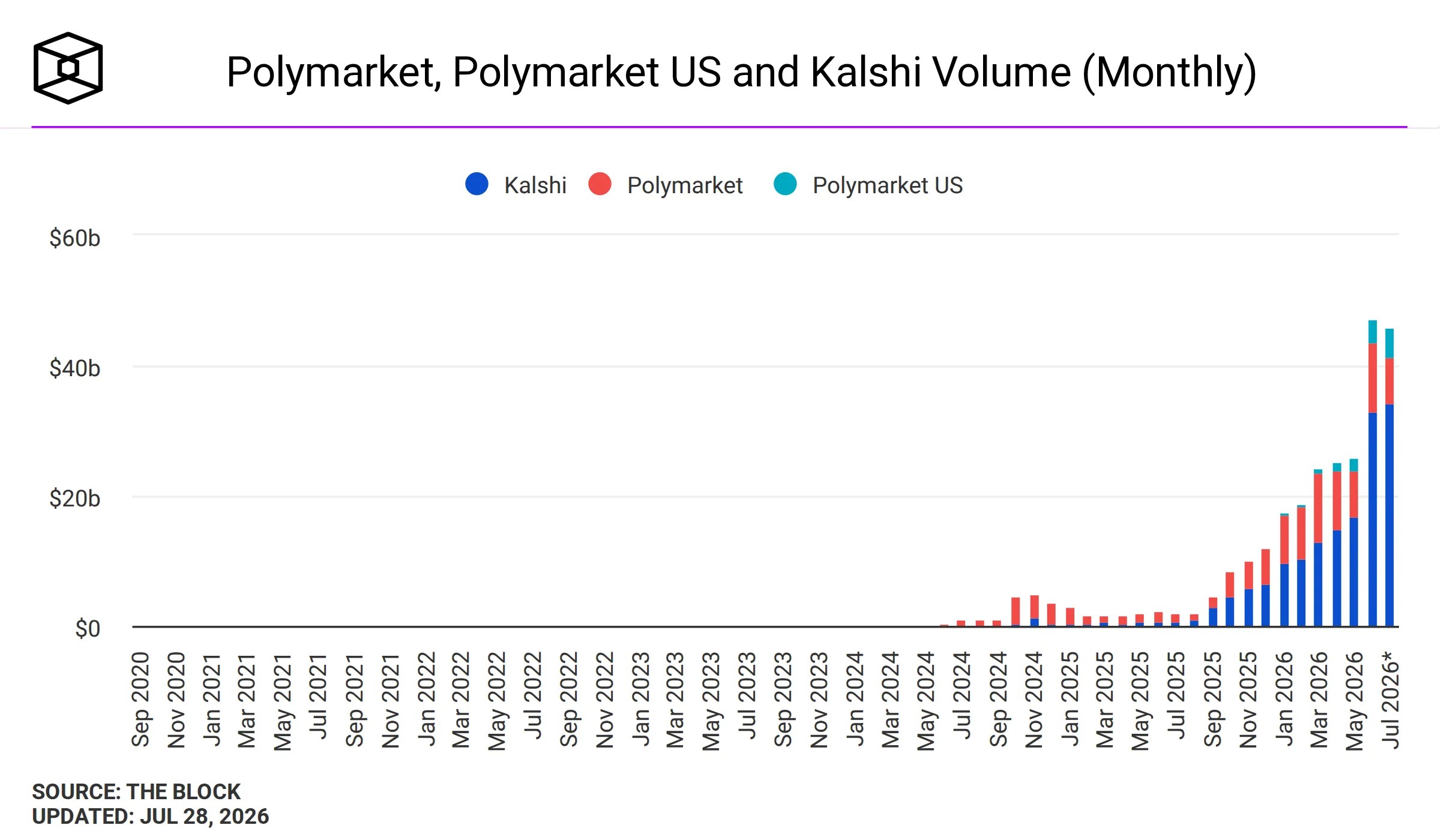
Source: The Block.

Recall that in June, Kentucky authorities filed lawsuits against Kalshi and Polymarket. The state accused the platforms of operating unlicensed sports betting under the guise of prediction markets.


Preguntas relacionadas

QWhich U.S. sports league has called on the CFTC to tighten rules for sports prediction markets, and what is their main stated priority?

AThe National Football League (NFL) has called on the U.S. Commodity Futures Trading Commission (CFTC) to tighten the rules. Their main stated priority is the preservation of game integrity.

QWhat specific examples did the NFL provide of event contracts that could be manipulated by a small group of people?

AThe NFL provided examples such as contracts based on whether a kicker misses a field goal or whether a quarterback's first pass is incomplete.

QAccording to the article, what is the core of the jurisdictional dispute between the CFTC and U.S. states regarding prediction markets?

AThe CFTC chairman insists the agency has 'exclusive jurisdiction' over the sector because event contracts fall under the category of swaps, while states argue that the platforms violate local gambling laws.

QWhat recent legal action caused difficulty for the prediction market platform Kalshi in July?

AIn July, Kalshi was put in a difficult position when the CFTC demanded it settle trades for Michigan residents as usual, while a Michigan state court had ordered it to cancel those same operations in late June.

QWhich two prediction market platforms reportedly surpassed traditional U.S. sportsbooks in trading volume during the World Cup, and what were their approximate June trading volumes?

AKalshi and Polymarket reportedly surpassed traditional sportsbooks. In June, Kalshi's trading volume exceeded $31 billion, and Polymarket's international platform set a monthly record of $10.8 billion, with its regulated U.S. version at $3.5 billion.

Lecturas Relacionadas

Within Strategy's Framework, STRC's Dividend Yield Remains at 12% as Share Price Stays Below Par Value

Michael Saylor, Executive Chairman of Strategy (MSTR), confirmed that the dividend rate for its STRC perpetual preferred shares will remain at 12.00% through August 2026. The rate has increased from 9% at its July 2025 launch to the current high via a "ratchet" mechanism, which permanently raises the rate by 0.5% whenever the share price falls below $95. This mechanism is intended to push the price back toward its $100 par value and support Strategy's "at-the-market" (ATM) program for issuing new shares to fund Bitcoin purchases. However, the mechanism has not worked as intended. STRC shares closed at $89.46 on July 31, remaining about 10-11% below par value despite the record-high dividend. Competition from rival Strive's higher-yielding SATA securities has pressured demand. The persistent discount has forced Strategy to suspend new STRC issuances via its ATM program, limiting this funding channel for Bitcoin acquisitions. STRC's struggles reflect Bitcoin's own volatility, as the preferred shares historically move in tandem. Analysts have warned the ratchet structure carries long-term, one-way risk. A law firm is investigating Strategy's ability to maintain dividend payments if Bitcoin's price stays low. Retail investors own roughly 83% of outstanding STRC shares, a group seen as prone to panic selling during downturns. In response, Strategy has established financial reserves, including a liquidity cushion covering about 26 months of dividend/interest obligations, and a $2 billion share buyback program alongside a Bitcoin monetization framework, though the company emphasized it is not obligated to sell any Bitcoin.

cryptonews.ruHace 14 min(s)

Within Strategy's Framework, STRC's Dividend Yield Remains at 12% as Share Price Stays Below Par Value

cryptonews.ruHace 14 min(s)

Analyst: Bitcoin's Price Will Drop to $60k in August, Then Rebound to $70k

Financial analyst Andrey Poroshin has provided a new forecast for Bitcoin's price dynamics in August. Poroshin, an analyst at the Bitbanker exchange, expects the cryptocurrency market to experience a downturn this month, with prices retesting the $60,000 level due to a lack of supportive macroeconomic catalysts. He noted that the recent US Federal Reserve decision to hold interest rates did not significantly impact the market, while inflation remains above the 2% target. Poroshin stated that Bitcoin is ending July under pressure from moderate volatility and a lack of new macroeconomic stimuli, leading to continued market caution. According to his base scenario, Bitcoin will drop to a range of $60,000 to $62,000 before recovering to $70,000. He pointed out that even $70,000 remains below the cost of mining in the US, which has prompted some miners to shift towards AI data center operations. Poroshin cited the winding down of BitMEX's operations as a potential catalyst for a price rebound, suggesting the exit of weaker players often coincides with market reversals and reduced short-term selling pressure. He believes Bitcoin is currently less susceptible to geopolitical shocks, such as the Iran-US conflict, and does not expect significant market changes in August related to the pending CLARITY Act. Looking ahead, Poroshin forecasts that September will bring more active price fluctuations driven by potential Fed rate decisions and possible discussions or approval of the CLARITY Act.

cryptonews.ruHace 14 min(s)

Analyst: Bitcoin's Price Will Drop to $60k in August, Then Rebound to $70k

cryptonews.ruHace 14 min(s)

Trading

Spot
活动图片




