From OpenSea to OpenRouter: Is Alex Atallah Repeating His 'Exit at the Peak' Playbook?

链捕手Publicado a 2026-07-24Actualizado a 2026-07-24

Resumen

From OpenSea to OpenRouter: Is Alex Atallah Repeating His "Exit at the Peak" Playbook? According to the Wall Street Journal, payments giant Stripe is in talks to acquire the AI model aggregation platform OpenRouter in a potential deal valuing the company near $100 billion. This would mark founder Alex Atallah's second creation of a company reaching a $100 billion valuation, following his co-founding of NFT marketplace OpenSea. OpenRouter, founded just over three years ago, has grown rapidly by acting as a unified gateway for developers to access over 400 AI models. It currently has about 10 million users and processes over 200 trillion tokens monthly. While the platform's annualized revenue is around $50 million, its valuation has skyrocketed from $1.3 billion in March 2026. The potential acquisition by Stripe, a company OpenRouter's founder once likened it to, represents a major expansion into AI infrastructure for the payments leader. This move echoes Atallah's previous timing with OpenSea, where he departed before the NFT market's significant downturn. For OpenRouter, selling now may be strategic. Despite its scale, its business model—charging a 5-5.5% fee on AI inference calls—faces pressure from competition, open-source models, and potential price wars among model providers, limiting its profitability narrative for an IPO. A key asset for potential acquirers like Stripe is OpenRouter's vast repository of real-world AI usage data, which offers unique insights into mod...

Author:Nancy,PANews

Over four years ago, Alex Atallah exited before the peak of the NFT bubble; now, he is in the spotlight again amid the AI boom and is preparing to sell his AI model aggregation platform OpenRouter at a high price.

On July 23, according to the Wall Street Journal, payment giant Stripe is in talks to acquire OpenRouter, with a potential transaction valuation nearing $10 billion. If the deal goes through, this would be another successful creation of a company worth tens of billions of dollars by Alex Atallah, following the NFT platform OpenSea.

Stripe Plans to Acquire OpenRouter, Valuation Could Reach $10 Billion

Rumors of OpenRouter's "sell-out" have been brewing for some time.

Last week, multiple foreign media outlets including The Information and Jawl reported that OpenRouter has received acquisition interest from several large technology companies and has initiated discussions regarding a sale, with a potential deal size reaching several billion dollars.
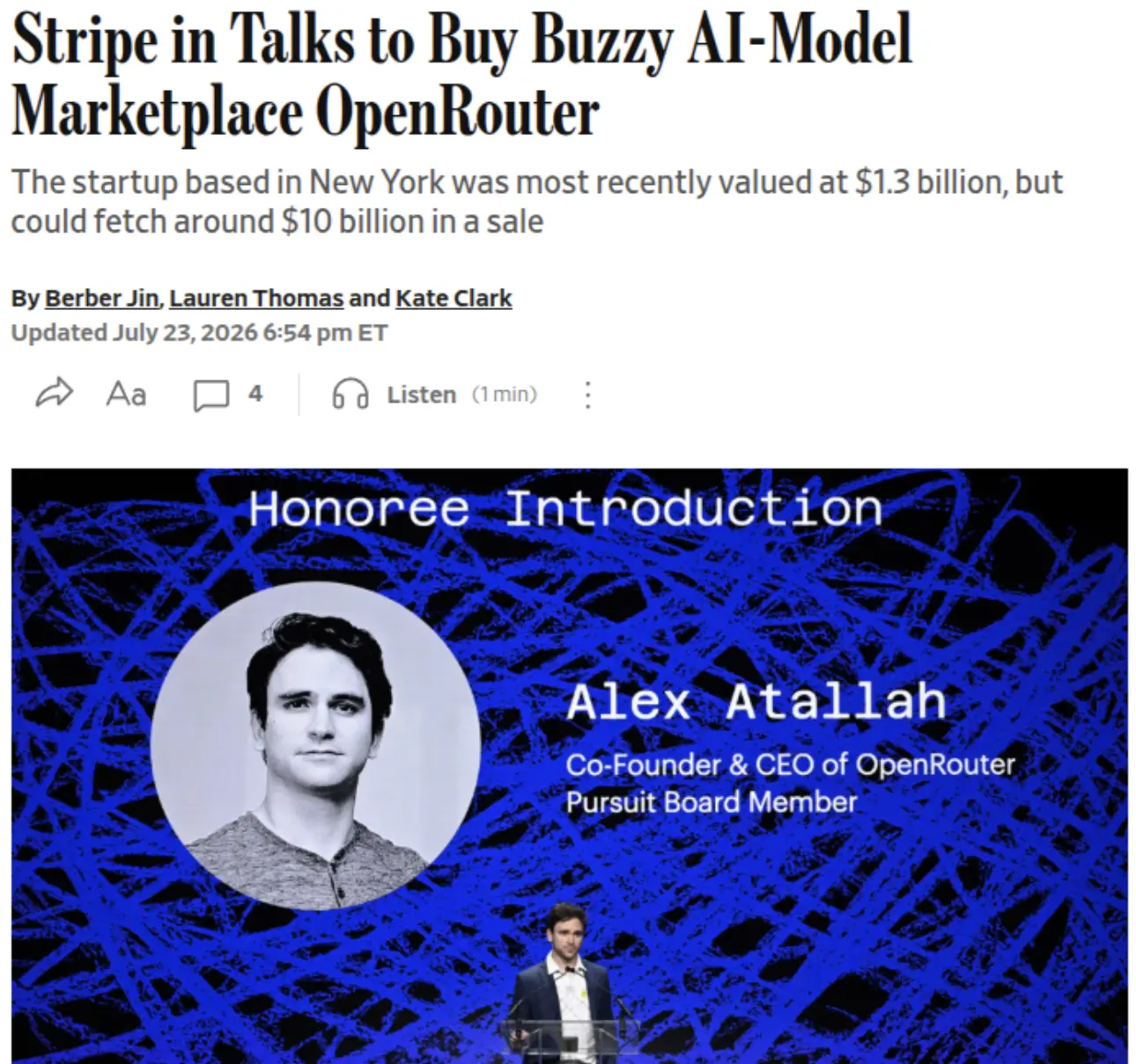
According to the latest report from the Wall Street Journal, Stripe is considering acquiring this global largest AI model aggregation platform. Informed sources reveal that transaction talks between the two parties may be announced soon, but uncertainties remain, and the possibility of negotiation breakdown or other potential buyers joining the bid cannot be ruled out.

Interestingly, Alex Atallah once described OpenRouter as "the Stripe of the AI field." In his view, just as Stripe helps clients handle various payments through a unified entry point, OpenRouter aims to become a unified entry point for enterprises to access different AI models, reducing the cost of switching between multiple AI suppliers while avoiding being "locked in" by a single model supplier.

In fact, OpenRouter and Stripe have already established a cooperative relationship. This potential transaction between the two parties is also seen as an important strategic move by the payment infrastructure giant to further extend into the AI infrastructure sector. It's worth noting that this could be another major acquisition move by Stripe, following recent market rumors of its plan to acquire PayPal.

Currently, neither party has disclosed specific transaction amounts. However, according to informed sources, if the deal is finalized, OpenRouter's valuation at the time of sale could be close to $10 billion.

This figure far exceeds OpenRouter's valuation during its previous financing rounds. In just over three years since its founding, this AI infrastructure company has achieved rapid growth driven by the wave of large models.
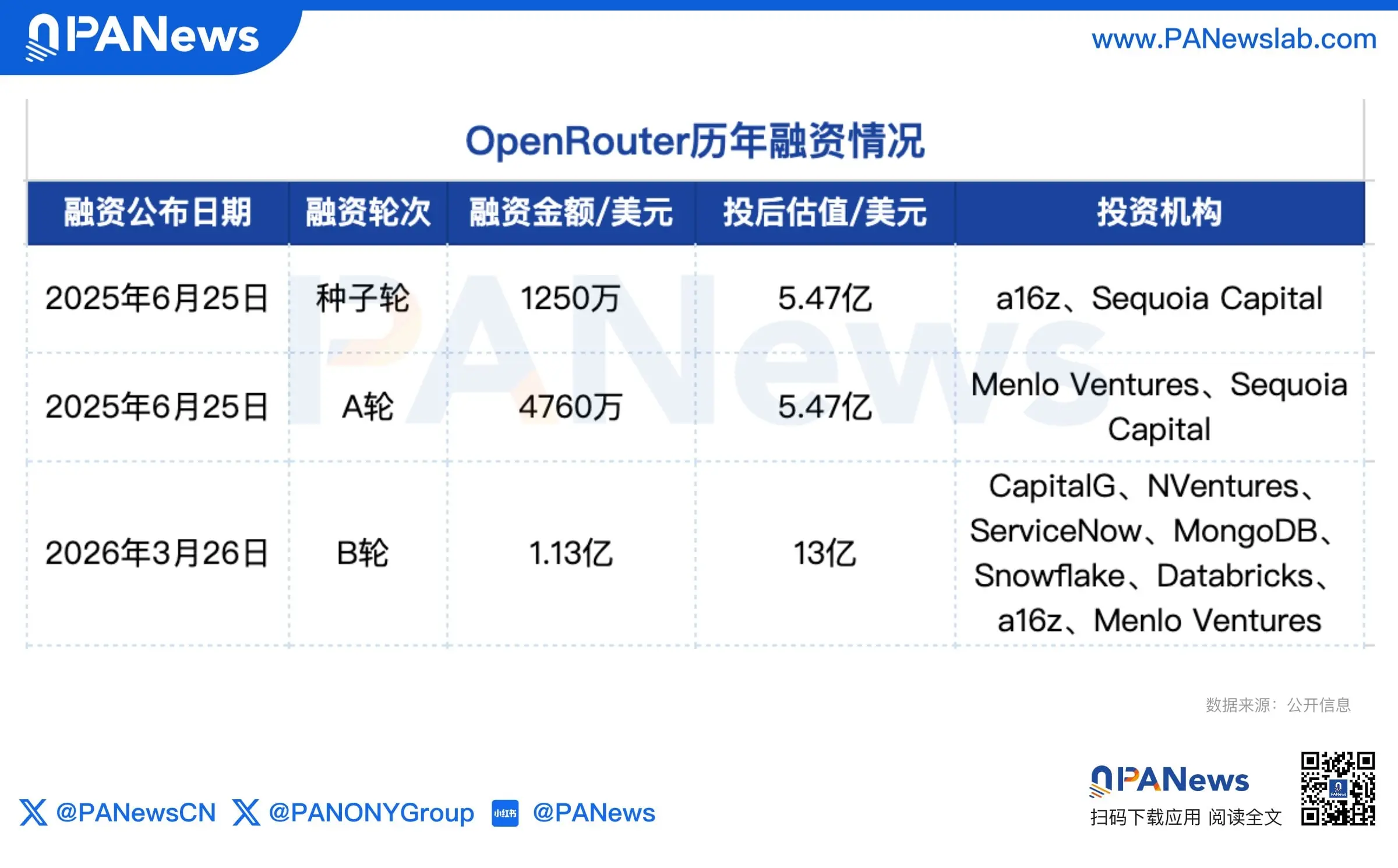
Public data shows that OpenRouter has completed three rounds of financing, raising over $150 million cumulatively. In June 2025, OpenRouter announced the completion of $40 million in seed and Series A funding, with a post-money valuation of approximately $547 million at the time; on March 26, 2026, OpenRouter announced the completion of a $113 million Series B funding round, with a post-money valuation of about $1.3 billion.

If this transaction materializes, it would mean OpenRouter's valuation could increase nearly tenfold within months, joining the ranks of decacorns (companies valued over $10 billion).

Behind OpenRouter's rising value lies not only the explosive demand brought about by the rapid expansion of large models but also increased attention from the capital market towards the AI infrastructure sector.

Repeating the OpenSea Exit Playbook? Why is OpenRouter Choosing to 'Sell Out'?

This is not the first time Alex Atallah has built a company worth tens of billions of dollars.

Prior to this, the serial entrepreneur co-founded OpenSea, bringing NFTs from a niche circle into the mainstream spotlight. During the peak of NFT frenzy, OpenSea grew from a little-known platform into the world's largest NFT marketplace, with its valuation once exceeding $13 billion, and the net worth of its two founders reaching approximately $2.2 billion each.

However, before the comprehensive downturn of the NFT market in 2022, Alex Atallah chose to leave OpenSea. Subsequently, as the industry bubble burst, OpenSea's valuation shrank significantly, and the former NFT leader gradually faded from its peak glory. Alex Atallah's early exit was also seen by the market as a significant signal of the peak.

Afterwards, Alex Atallah turned his focus to AI infrastructure, and the OpenRouter he founded became the largest transit hub in the AI era.
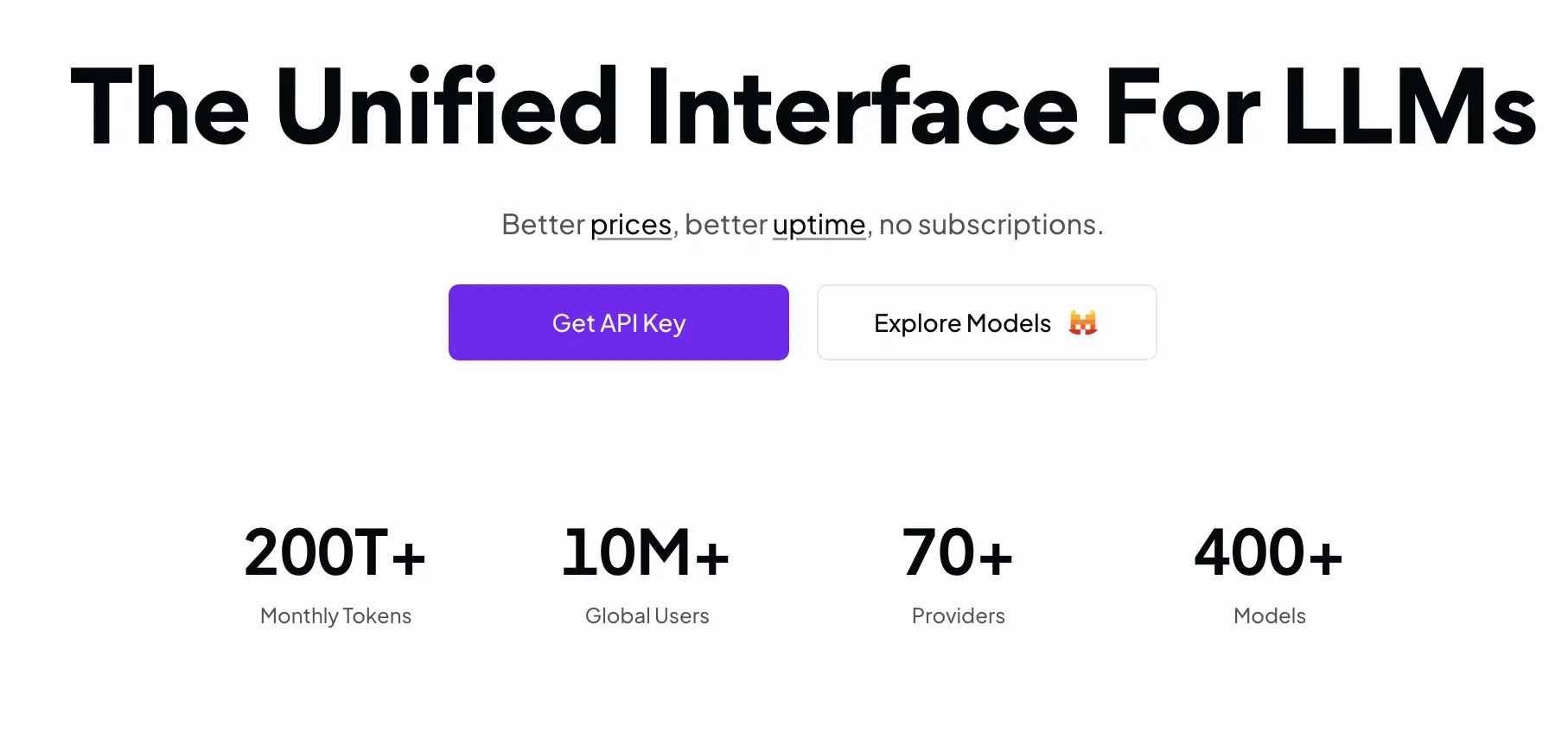
Currently, OpenRouter has integrated over 400 AI models, boasts approximately 10 million users, and processes over 200 trillion tokens per month. This year, the number of tokens processed through its API has increased roughly tenfold.

But it is worth noting that despite rapid business growth, OpenRouter has not chosen an IPO but is heading down the path of a potential sale. The reason lies in it being a large-scale but low-margin gateway business.

Currently, OpenRouter primarily profits by charging a platform service fee when developers call AI models, with a commission rate of about 5%-5.5%. Although its annualized AI inference consumption scale has reached several hundred million dollars, as of April 2026, the company's annualized revenue was approximately $50 million.

In other words, OpenRouter connects to a massive AI demand market but does not fully control the upstream value chain. As model capabilities gradually standardize, the platform is susceptible to factors such as the rise of open-source models, ecosystem lock-in by cloud providers, and direct price reductions by model suppliers, which could continuously pressure profit margins. OpenRouter finds it difficult to tell a story of exponential growth and ultra-high profits in the capital market.

Meanwhile, competition in the AI model aggregation track is intensifying. For example, Meta's internal AI incubator is developing a dispatch service similar to OpenRouter to reduce code development and compute costs; domestically in China, large model aggregation platforms have also emerged, including Cheetah Mobile's EasyRouter and NetEase Youdao's ThinkFlow.

Therefore, the high valuation currently given to OpenRouter by the market is more about pricing its future potential rather than its current profitability.

However, for potential buyers, the truly attractive asset of OpenRouter may not be its current revenue scale but rather the real AI usage data it has accumulated over the long term.

By connecting hundreds of models and tens of millions of users, OpenRouter has amassed a large amount of invocation data from real production environments, including performance differences of various models in actual tasks, developer preferences, price sensitivity, and substitution relationships between open-source and closed-source models. Compared to lab test data, this real-world AI usage data is closer to market demand and harder to replicate quickly through short-term investment. This is perhaps a key reason why large technology companies are willing to pay a high premium for OpenRouter.

From NFTs to AI, Alex Atallah has twice caught the wave of the times. If OpenRouter is ultimately sold at a $10 billion valuation, will it signify a repricing of AI infrastructure value or be another signal of a cyclical peak? The answer may still require time to verify.

Criptos en tendencia

Preguntas relacionadas

QWho is the founder of OpenRouter, and what other notable company did he co-found before?

AThe founder of OpenRouter is Alex Atallah. He previously co-founded the NFT marketplace OpenSea.

QWhat is the reported potential valuation of OpenRouter in the acquisition talks with Stripe?

AThe reported potential valuation of OpenRouter in the acquisition talks with Stripe is close to 100 billion US dollars.

QHow does OpenRouter generate its revenue according to the article?

AOpenRouter generates revenue primarily by charging a platform service fee, approximately 5%-5.5%, when developers use its API to call AI models.

QWhat are some competitive challenges OpenRouter faces in the AI model aggregation space?

AOpenRouter faces competitive challenges such as the rise of open-source models, potential bundling by cloud service providers, price reductions by model suppliers, and new entrants like Meta's internal AI incubator service and similar platforms in China.

QWhat unique asset of OpenRouter is highlighted as a key attraction for potential acquirers like Stripe?

AA key asset of OpenRouter is its extensive collection of real-world AI usage data, including performance differences of models in production tasks, developer preferences, and substitution relationships between open-source and closed-source models, which is difficult to replicate quickly.

Lecturas Relacionadas

The Verdict in Choi Tae-won's Divorce Case: Revealing the Inheritance Undercurrent Behind SK Hynix's Trillion-Won Empire

SK Group Chairman Chey Tae-won's high-profile divorce case, involving a record 1.38 trillion won settlement, has drawn attention to the succession plans for Korea's second-largest conglomerate, especially its crown jewel, SK hynix. Unlike traditional chaebol scripts centered on the eldest son, Chey's three children from his marriage to former President Roh Tae-woo's daughter, Roh Soh-yeong, are carving distinct, non-traditional paths. Eldest daughter Chey Yun-jung (b. 1989) is seen as the most evident successor. With a scientific and consulting background, she holds executive roles at SK bioscience and SK Inc.'s growth support department, focusing on future strategy and biopharma. Her marriage is to an AI infrastructure entrepreneur, not a traditional business alliance. Second daughter Chey Min-jung (b. 1991) took a unique route, voluntarily serving as a South Korean naval officer, including an anti-piracy deployment. She later worked on policy and strategy for SK hynix in Washington D.C. before co-founding an AI-driven healthcare startup. She married a former U.S. Marine Corps officer, connecting her to U.S. defense and policy circles—networks crucial for a global semiconductor giant. The only son, Chey In-geun (b. 1995), who studied physics like his father, worked briefly at SK E&S before joining McKinsey. Despite fitting the traditional "heir" profile as the eldest son, he remains silent and holds no public position or shares in SK, suggesting the old succession playbook is obsolete. As SK hynix's valuation soars, becoming a geopolitical asset in the AI era, the heirs' legitimacy is no longer automatic. They must prove themselves in fields like AI biotech, global policy, and strategic consulting. Their marriages also reflect new elite networks in tech and defense, not old political alliances. Their inheritance is the complex challenge of navigating a globalized, tech-driven world, not just a corporate throne.

marsbitHace 13 hora(s)

The Verdict in Choi Tae-won's Divorce Case: Revealing the Inheritance Undercurrent Behind SK Hynix's Trillion-Won Empire

marsbitHace 13 hora(s)

Trading

Spot

Artículos destacados

Qué es ₿O₿

Bitcoin Bob ($₿o₿): Pionero en DeFi Centrado en Bitcoin a Través de la Innovación Híbrida de Capa 2 En una era donde la economía digital está evolucionando rápidamente, Bitcoin Bob ($₿o₿) surge como un proyecto revolucionario que busca mejorar la utilidad de Bitcoin en el sector de las finanzas descentralizadas (DeFi). Lanzado oficialmente en mayo de 2024, Bitcoin Bob, también conocido como Build on Bitcoin (BOB), representa una solución híbrida de blockchain de Capa 2 que combina la reconocida seguridad e inmutabilidad de Bitcoin con la programabilidad de Ethereum. Esta iniciativa busca llenar un vacío crucial en el ecosistema de Bitcoin al facilitar la integración de contratos inteligentes y aplicaciones descentralizadas, manteniendo al mismo tiempo los principios fundamentales de confianza y seguridad inherentes a Bitcoin. Con un respaldo significativo de destacados capitalistas de riesgo, Bitcoin Bob está posicionado para redefinir el papel de Bitcoin en el paisaje DeFi, convirtiéndolo en una piedra angular de las operaciones financieras descentralizadas a nivel global. ¿Qué es Bitcoin Bob, $₿o₿? En su esencia, Bitcoin Bob es una solución de blockchain híbrida diseñada para mejorar la funcionalidad de Bitcoin. El objetivo principal del proyecto es habilitar las finanzas descentralizadas en Bitcoin, facilitando transacciones rápidas y sin problemas mientras se asegura altos niveles de seguridad. Bitcoin Bob emplea tecnología avanzada, específicamente una arquitectura híbrida de capa 2 que combina los atributos de seguridad de Bitcoin con la programabilidad y flexibilidad de la Máquina Virtual de Ethereum (EVM). Este enfoque pragmático permite que el proyecto opere de manera efectiva sin comprometer los valores fundamentales de Bitcoin, convirtiéndolo en un paso monumental para cerrar la brecha entre los tenedores tradicionales de Bitcoin y el emergente ecosistema DeFi. Una de las características destacadas de Bitcoin Bob es su papel en proporcionar un entorno minimizado en confianza a través de mecanismos innovadores, como los rollups optimistas que inicialmente dependen de Ethereum, y que eventualmente transicionan a una integración completa con Bitcoin. Este sistema híbrido está diseñado para asegurar que la vasta liquidez presente en Bitcoin no solo se preserve, sino que también se utilice de manera efectiva en varios protocolos DeFi. ¿Quién es el Creador de Bitcoin Bob, $₿o₿? La fuerza creativa detrás de Bitcoin Bob es el cofundador y CEO Alexei Zamyatin, quien aporta una gran experiencia y conocimiento de su extensa trayectoria en el espacio de las criptomonedas. Zamyatin tiene un doctorado en Ciencias de la Computación y ha estado involucrado activamente en el desarrollo de Bitcoin desde 2015. Su profundo entendimiento de los ecosistemas de Bitcoin y Ethereum juega un papel crucial en la formación de la visión y los fundamentos tecnológicos de Bitcoin Bob. Junto a Zamyatin está el cofundador Dominik Harz, quien se desempeña como Director de Tecnología (CTO). Juntos, el dúo ha cultivado un equipo de individuos talentosos con una pasión compartida por empujar los límites de la tecnología blockchain, asegurando el estatus innovador de Bitcoin Bob en el mercado. ¿Quiénes son los Inversores de Bitcoin Bob, $₿o₿? Bitcoin Bob ha logrado obtener apoyo de una variedad de inversores prominentes y firmas de capital de riesgo que reconocen su potencial para transformar el paisaje de Bitcoin. En marzo de 2024, el proyecto completó una robusta ronda de financiamiento inicial de $10 millones, liderada por Castle Island Ventures, con la notable participación de firmas como Coinbase Ventures y Bankless Ventures. Poco después, en julio de 2024, Bitcoin Bob aseguró un adicional de $1.6 millones en financiamiento estratégico. Esta ronda fue co-liderada por Ledger Ventures y contó con ángeles de varias firmas prominentes como BlackRock, Aave y Curve. El fuerte respaldo financiero refleja un reconocimiento en toda la industria del enfoque innovador de Bitcoin Bob para desbloquear el potencial de Bitcoin en el espacio DeFi. Este financiamiento es crucial no solo para el desarrollo continuo del proyecto, sino también para establecer un incubador que fomente aplicaciones descentralizadas (dApps) nativas de Bitcoin, dirigidas específicamente a satisfacer las necesidades de una base de usuarios en crecimiento. ¿Cómo Funciona Bitcoin Bob, $₿o₿? La mecánica operativa de Bitcoin Bob se basa en su arquitectura de rollup híbrido, que está diseñada para combinar los beneficios de la seguridad de Bitcoin con la versatilidad de la EVM de Ethereum. El proyecto emplea un modelo de seguridad por fases que describe su interacción con usuarios y desarrolladores de la siguiente manera: Fase 1 – La fase inicial opera como un rollup optimista en Ethereum, donde las transacciones se procesan con una expectativa prometedora de validez, allanando el camino para futuros desarrollos en Bitcoin. Fase 2 – A medida que el proyecto transiciona, integrará la finalización de Bitcoin a través de Staking de Bitcoin, aprovechando la Red Babylon para mejorar la seguridad. Este mecanismo requiere que los validadores bloqueen Bitcoin, verificando así las transacciones de BOB, lo que no solo mejora la seguridad, sino que también crea perspectivas de rendimiento para los participantes. Fase 3 – La visión a futuro para Bitcoin Bob es integrarse completamente con Bitcoin, utilizando tecnologías innovadoras como BitVM y pruebas de conocimiento cero para facilitar la computación fuera de la cadena mientras se mantiene la integridad de seguridad de Bitcoin. Innovaciones clave como BitVM2, un protocolo de puente minimizado en confianza co-autorado por Zamyatin, son críticas para la funcionalidad del proyecto, permitiendo depósitos y retiros de Bitcoin sin necesidad de una extensa dependencia de la red. Esto permite que el ecosistema se conecte de manera eficiente con Ethereum y otras cadenas compatibles, creando un modelo de interacción fluido y efectivo para usuarios y desarrolladores. Cronología de Bitcoin Bob, $₿o₿ Entender la evolución de Bitcoin Bob implica rastrear sus hitos importantes: 2019: Alexei Zamyatin y Dominik Harz establecen una firma de investigación enfocada en soluciones blockchain, sentando las bases para futuros proyectos. Marzo 2024: Bitcoin Bob recauda exitosamente $10 millones en una ronda de financiamiento inicial, marcando su entrada en el competitivo paisaje de blockchain. 1 de mayo de 2024: Ocurre el lanzamiento oficial de la mainnet, mostrando las capacidades del proyecto con una adopción significativa de usuarios y valor total bloqueado (TVL). Julio 2024: El proyecto atrae un adicional de $1.6 millones en financiamiento estratégico para establecer su incubadora, destinada a fomentar innovaciones impulsadas por Bitcoin. Octubre 2024: Bitcoin Bob publica un “Documento de Visión”, detallando su diseño de capa 2 híbrida y estrategias a futuro. 2025: Se espera el lanzamiento de las características de la Fase 2, enfocándose en la finalización de Bitcoin y puentes BitVM destinados a mejorar la funcionalidad general. Conclusión: Redefiniendo el Papel de Bitcoin en las Finanzas Descentralizadas Bitcoin Bob ($₿o₿) no es solo otro proyecto de blockchain; representa un cambio de paradigma en la forma en que Bitcoin puede interactuar con aplicaciones financieras más amplias. Al combinar meticulosamente la seguridad de Bitcoin con la flexibilidad de Ethereum, Bitcoin Bob busca remodelar el paisaje DeFi, cerrando la brecha entre la moneda digital y las aplicaciones descentralizadas. Con un robusto marco tecnológico, un liderazgo fuerte y financiamiento estratégico, Bitcoin Bob está bien posicionado para establecerse como un jugador fundamental en el ecosistema de criptomonedas, desbloqueando nuevas dimensiones de liquidez y utilidad para Bitcoin. A medida que el proyecto continúa evolucionando y expandiéndose, promete inaugurar una nueva era de innovación, demostrando que el potencial de Bitcoin se extiende mucho más allá de ser un mero almacén de valor, sino más bien como una piedra angular del futuro paisaje financiero. A medida que el proyecto avanza a través de sus fases anticipadas, todas las miradas estarán puestas en Bitcoin Bob, particularmente en lo que respecta a su compromiso de incorporar principios descentralizados y asegurar que los usuarios puedan disfrutar de todos los beneficios de DeFi anclados en Bitcoin.

57 Vistas totalesPublicado en 2025.06.30Actualizado en 2025.06.30

Qué es ₿O₿

Cómo comprar O

¡Bienvenido a HTX.com! Hemos hecho que comprar O1 exchange (O) sea simple y conveniente. Sigue nuestra guía paso a paso para iniciar tu viaje de criptos.Paso 1: crea tu cuenta HTXUtiliza tu correo electrónico o número de teléfono para registrarte y obtener una cuenta gratuita en HTX. Experimenta un proceso de registro sin complicaciones y desbloquea todas las funciones.Obtener mi cuentaPaso 2: ve a Comprar cripto y elige tu método de pagoTarjeta de crédito/débito: usa tu Visa o Mastercard para comprar O1 exchange (O) al instante.Saldo: utiliza fondos del saldo de tu cuenta HTX para tradear sin problemas.Terceros: hemos agregado métodos de pago populares como Google Pay y Apple Pay para mejorar la comodidad.P2P: tradear directamente con otros usuarios en HTX.Over-the-Counter (OTC): ofrecemos servicios personalizados y tipos de cambio competitivos para los traders.Paso 3: guarda tu O1 exchange (O)Después de comprar tu O1 exchange (O), guárdalo en tu cuenta HTX. Alternativamente, puedes enviarlo a otro lugar mediante transferencia blockchain o utilizarlo para tradear otras criptomonedas.Paso 4: tradear O1 exchange (O)Tradear fácilmente con O1 exchange (O) en HTX's mercado spot. Simplemente accede a tu cuenta, selecciona tu par de trading, ejecuta tus trades y monitorea en tiempo real. Ofrecemos una experiencia fácil de usar tanto para principiantes como para traders experimentados.

131 Vistas totalesPublicado en 2026.06.19Actualizado en 2026.06.29

Cómo comprar O

Discusiones

Bienvenido a la comunidad de HTX. Aquí puedes mantenerte informado sobre los últimos desarrollos de la plataforma y acceder a análisis profesionales del mercado. A continuación se presentan las opiniones de los usuarios sobre el precio de O (O).

活动图片