Three 'Reflexivity' Shadows Hang Over the Market

链捕手Publicado a 2026-07-27Actualizado a 2026-07-27

Resumen

Global markets are currently enveloped by three mutually reinforcing "reflexive" loops: oil price politics, outsized capital expenditure by hyperscale cloud providers, and AI debt risks. According to Goldman Sachs, the combined negative feedback from these factors places the market in a fragile and precarious state. The first loop involves the two-way feedback between surging oil prices and rising interest rates. Brent crude's brief breach of $100 per barrel tests expectations of a U.S. policy response to curb prices and inflation. However, the delay in such intervention forces markets to increasingly price in the risks themselves. Higher energy costs are already impacting corporate earnings, as seen with an airline's profit warning, and threaten to fuel broader inflation. The second loop concerns the massive, escalating capital expenditure (capex) by major tech firms like Google, which recently raised its 2026 capex forecast significantly. The market's tolerance for viewing such spending as a cost-free growth signal is waning, shifting focus to investment returns. This competitive capex spiral pressures the entire cloud and semiconductor sector. Furthermore, the competitive gap in AI between leading closed-source and Chinese open-source models is narrowing rapidly, threatening the economic rationale behind massive investments. The third reflexive danger lies in the financing structures supporting this expansion. Bond prices for entities funding AI infrastructure, such as ...

Author: Wall Street Insights

Global markets are currently facing three mutually reinforcing reflexivity loops: oil price politics, massive capex from hyperscale cloud providers, and AI debt risks. Goldman Sachs warns that the combined negative feedback mechanism formed by these three factors leaves the current market in a fragile and precarious balance.

This week, Rich Privorotsky, head of 1-Delta Trading at Goldman Sachs, pointed out in his latest client report that the dual pressures of soaring oil prices and rising interest rates are making the market increasingly difficult to digest, and the negative shock on the bond side has deteriorated sharply.

He stated that without substantive easing at the political level, the market will have to absorb the risks on its own, pushing the situation towards a worse direction.

At the same time, the uncontrolled expansion of capital expenditures by tech giants and the price collapse of AI infrastructure-related bonds are shaking investor confidence in the hyperscale cloud provider narrative.

Privorotsky warns that betting on these companies is essentially evolving into a high-stakes gamble on "the revenue inflection point arriving before the peak in expenditures."

The two-way feedback mechanism between oil prices and politics is the first reflexivity chain Privorotsky is most concerned about.

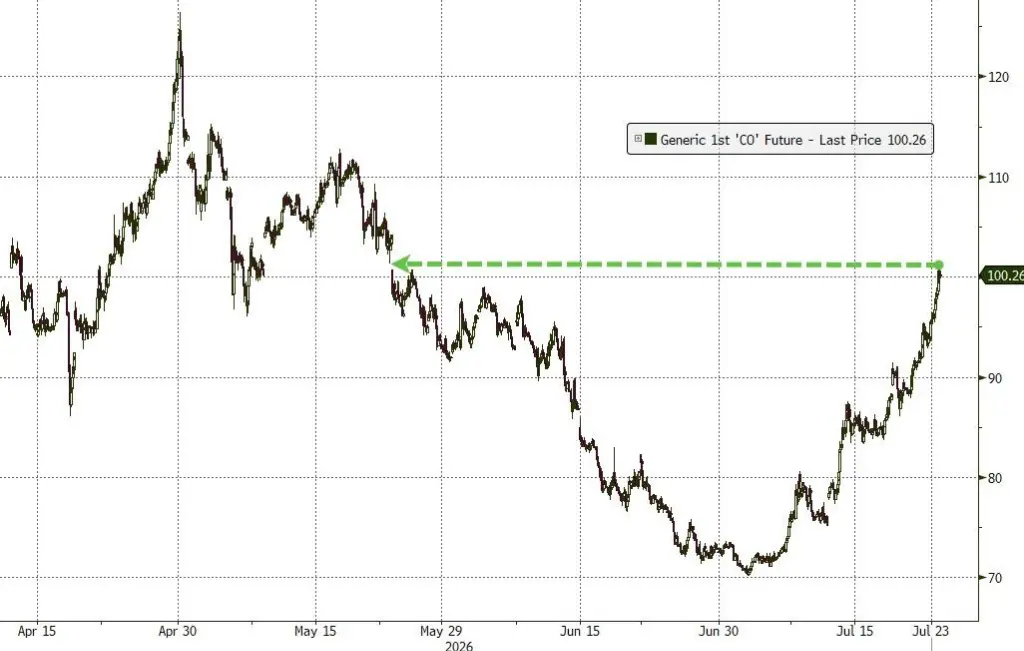
Brent crude oil prices briefly broke through $100 per barrel this week, testing market expectations regarding Trump's policy responses.
Previously, the market generally expected that once oil prices breached a certain threshold, pushing up retail gasoline prices and dragging down presidential approval ratings, the Trump administration would intervene to curb oil prices.
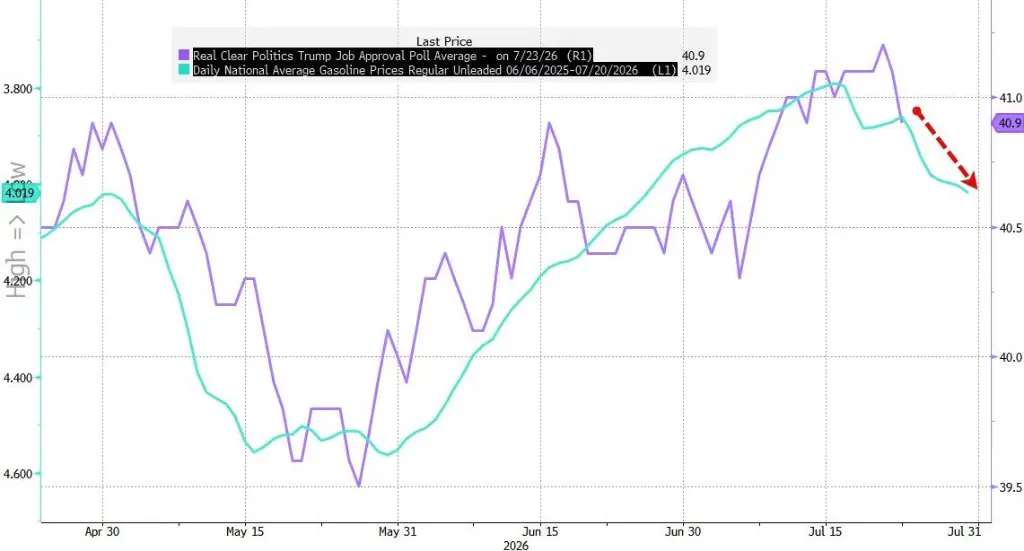
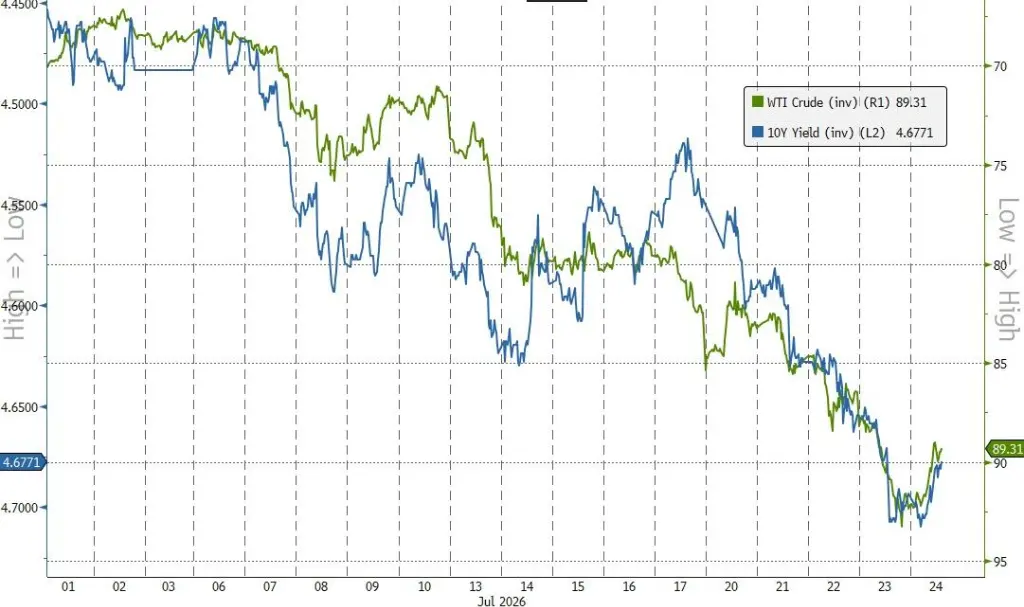
This expectation has supported stock market resilience to some extent, but Privorotsky pointed out that each day that passes without a policy response at the same price level forces the market to drive the outcome itself.

The interest rate shock is becoming the most difficult variable to ignore in this loop.
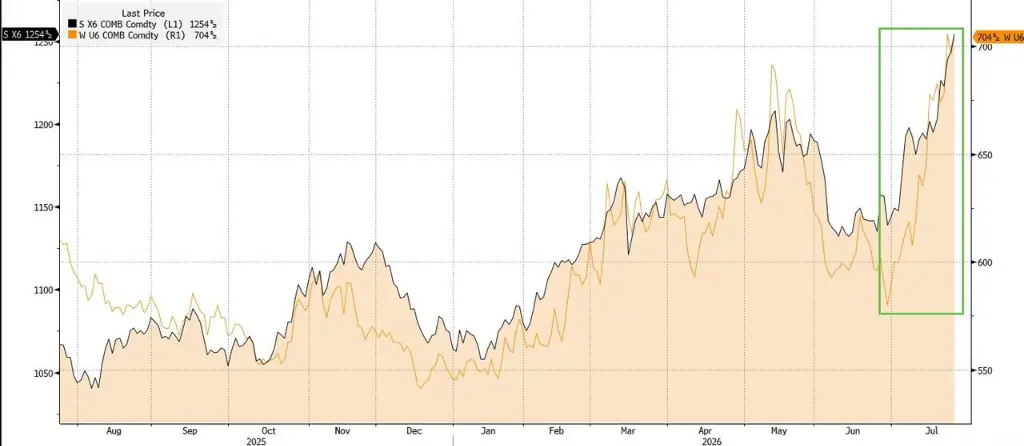
Meanwhile, the transmission of energy costs into food inflation is also about to become a reality.
Warning signals have already appeared at the real economy level—despite record-high revenues, rising ticket prices, and relatively robust demand, American Airlines still lowered its 2026 performance guidance, citing that its fuel costs have increased by about $1.6 billion since early July.

Geopolitical tensions continue to heat up.

According to CCTV News, on July 24 local time, when discussing the "exit strategy" for the war with Iran at the White House, President Trump stated that the US has two choices: first, continue current military operations, possibly intensifying strikes, and gradually destroy Iran's military capabilities; second, reach an agreement through negotiations.

Wall Street Insights mentioned that earlier that day, Reuters cited sources reporting that Pakistan is exploring ways to push for the resumption of stalled US-Iran negotiations.

Israeli Prime Minister Netanyahu will visit the White House to meet with Trump next Tuesday. Privorotsky suggests this timing may be brewing a "TACO moment" for the market—a sudden negotiation or compromise-driven market movement.

The second reflexivity loop revolves around the capital expenditures of hyperscale tech companies, with its core contradiction being: is the market still willing to view massive investments as growth signals with no cost?

Google became the negative symbol of this earnings season for tech. The company announced an increase in its 2026 capital expenditure guidance to $195-205 billion, with free cash flow for the quarter at negative $5.9 billion, and its stock price subsequently fell by 6.9%.

While operational data such as 82% growth in cloud business was impressive, the market is no longer willing to view expenditures as cost-free strategic investments, and questions about cutting-edge product roadmaps and return on investment received almost no positive response.

The deeper impact lies in competitive transmission. If Google increases spending, it will force peers to follow suit, putting pressure on the entire hyperscale cloud computing sector. The hardware side is also sounding alarms:

  • STMicroelectronics' core profits missed expectations, and Q3 revenue guidance appeared slightly weak, with the stock falling about 14%;
  • Texas Instruments (TXN) performed relatively solidly but still closed down 3%.

Regarding the competitive landscape in artificial intelligence, Privorotsky pointed out that the gap between leading closed-source models and Chinese open-source models has narrowed significantly.
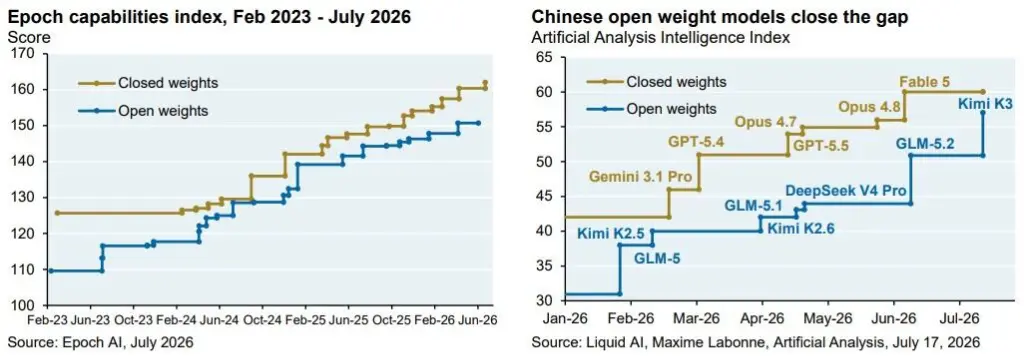
He stated that the gap, previously measured in nine to twelve months, has now compressed to weeks on some benchmarks. The cost-to-marginal-benefit ratio of pre-training versus reinforcement learning and post-training is creating vastly different economic models; the intensity of competition at the application layer and the flatness of the competitive landscape are historically rare.

He believes that the risks from small models and efficiency improvements are a "story for later," but should not be underestimated.

The third reflexivity loop is hidden within the bond and financing structures of hyperscale tech companies.

Privorotsky views the bond market as the most noteworthy risk signal at present.

Taking Meta's "Hyperion" financing of $27.3 billion completed through the Beignet SPV as an example, this bond issuance was priced at par and later traded above 109, but has now fallen back to around 95.
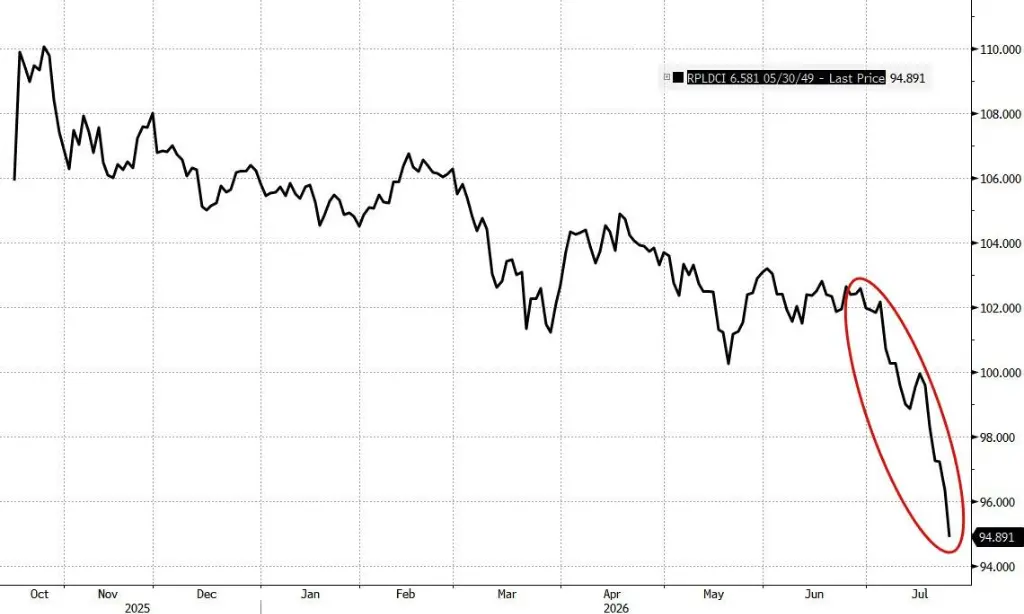
Although the overall financial health of hyperscale cloud providers remains robust, with balance sheet leverage not high, the impact of valuation repricing on stock multiples has been quite significant.
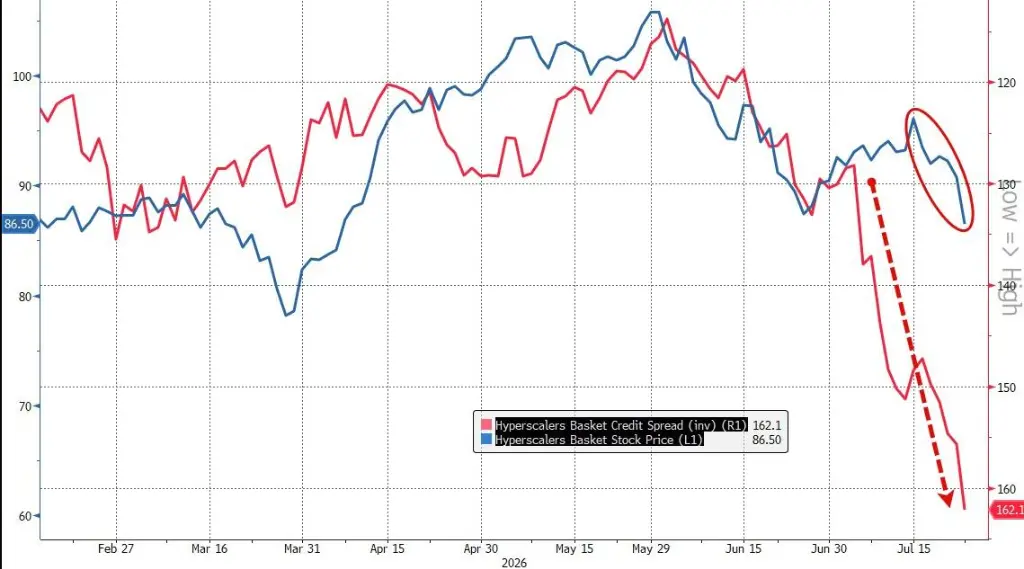
The more severe problem is that as capital expenditures accelerate, free cash flow conversion continues to deteriorate, and the impact on leveraged entities providing financing for infrastructure construction will be even more drastic.

Privorotsky warns that today's capacity expansion could evolve into tomorrow's computing power oversupply, and at that time, larger-scale depreciation expenses will begin to wash over the income statement.
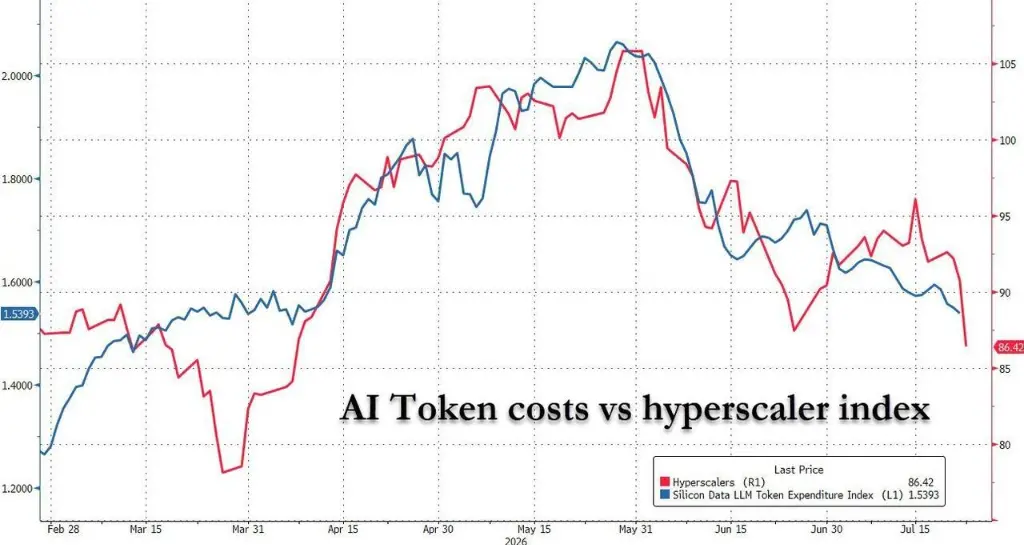
Looking ahead to the near term, Privorotsky named two events that will serve as crucial tests for the aforementioned reflexivity themes.

The first is Microsoft's earnings conference call this Wednesday. He believes, "If the reflexivity theme is to play out, this might be the most crucial call."

The market will closely scrutinize Microsoft's balance between capital expenditures, cloud growth, and free cash flow to judge whether the hyperscale tech narrative can stabilize.

The second is the IPO of Chinese memory chipmaker ChangXin Memory on the STAR Market. ChangXin Memory is currently the world's fourth-largest DRAM producer, and this fundraising round amounts to approximately $8.6 billion.

Privorotsky emphasized, "This is by no means an insignificant new competitor." If its post-IPO stock price trades close to the valuation levels implied by the OTC perpetual market, it will have a significant impact on the entire memory chip sector.

Privorotsky concluded with a sentence summarizing the current situation:

It feels a bit like circular referencing on the oil price issue.

In a market dominated by reflexivity, every variable is both cause and effect.

Preguntas relacionadas

QWhat are the three self-reinforcing reflexive loops mentioned by Goldman Sachs's Rich Privorotsky that are putting the global market in a fragile and dangerous balance?

AThe three self-reinforcing reflexive loops are: 1) The two-way feedback mechanism between oil prices and politics. 2) The capital expenditure explosion by hyperscale technology (cloud) companies. 3) The debt and financing risks embedded in the bonds and funding structures of these same hyperscale companies.

QWhy did Google's stock fall despite strong cloud growth in its recent earnings report, according to the article?

AGoogle's stock fell because the market is no longer willing to view massive capital expenditures as cost-free strategic investments. The company raised its 2026 capital expenditure guidance significantly to $195-205 billion and reported negative free cash flow of $5.9 billion for the quarter, raising investor concerns about investment returns and future profitability.

QWhat is the 'TACO moment' that Privorotsky suggests might be brewing around the meeting between Israeli PM Netanyahu and President Trump?

AA 'TACO moment' refers to an unexpected negotiation or compromise that triggers sudden market movements. Privorotsky suggests the upcoming meeting between Netanyahu and Trump could be a catalyst for such a moment, potentially impacting oil prices and geopolitical tensions.

QWhat specific warning does Privorotsky give regarding the bond market, using Meta's 'Hyperion' financing as an example?

APrivorotsky warns that the bond market is a key risk signal. He cites Meta's 'Hyperion' bond issuance of $27.3 billion, which was priced at par (100) and traded above 109, but has since fallen to around 95. This price drop indicates growing market concern about the debt used to finance AI infrastructure, suggesting a repricing of risk for hyperscale companies.

QWhich two upcoming events does Privorotsky identify as critical tests for the 'reflexivity thesis' presented in the article?

AThe two critical upcoming events are: 1) Microsoft's earnings call, where the market will scrutinize its balance between capital expenditure, cloud growth, and free cash flow. 2) The IPO of Chinese memory chip maker CXMT (ChangXin Memory Technologies) on the STAR Market, as its post-listing valuation could significantly impact the global memory chip sector.

Lecturas Relacionadas

US Calls for Restrictions on Sports Prediction Markets

The National Football League (NFL) has urged the U.S. Commodity Futures Trading Commission (CFTC) to tighten rules for prediction markets on sports events. In a July letter, the NFL argued that current proposals fail to adequately protect the integrity of games and market participants. Key demands include banning contracts on events easily manipulated by individuals (e.g., a kicker missing a field goal), clarifying definitions to prevent gambling-like contracts, and explicitly prohibiting trading based on non-public insider information. The league also called for restricted person lists, a ban on margin trading, advertising limits, stronger user protections, and a minimum age of 21. This push coincides with an ongoing jurisdictional dispute between the CFTC and several states. The CFTC claims exclusive federal oversight, classifying event contracts as swaps, while states argue these platforms violate local gambling laws. Recent legal actions in Michigan and Minnesota highlight the conflict, with a federal court temporarily blocking Minnesota from applying a new law to CFTC-registered platforms like Kalshi and Polymarket. Meanwhile, prediction markets are experiencing significant growth. In June, driven by events like the World Cup, Kalshi's trading volume exceeded $31 billion (85% from sports contracts), while Polymarket's global platform hit a monthly record of $10.8 billion. However, platforms face legal challenges, such as lawsuits from Kentucky accusing them of operating unlicensed sports betting disguised as prediction markets.

cryptonews.ruHace 7 min(s)

US Calls for Restrictions on Sports Prediction Markets

cryptonews.ruHace 7 min(s)

Peskov Says Russia Is Among Top Five Leaders in AI Race. What Do Global Rankings Say?

On July 27, 2026, Kremlin spokesman Dmitry Peskov stated that Russia remains among the top five countries in the global AI development race. He acknowledged Russian models still lag behind leading U.S. counterparts but claimed they have reached a "very high level," aiming to close the gap with "superhuman efforts." He highlighted the differing approaches of Russia's GigaChat, built from scratch, and Yandex, which initially used foreign technology. However, this claim is not supported by major international AI rankings. Stanford University's Global AI Vibrancy Tool (2024-25) ranks Russia 28th out of 36 countries. The top five are the U.S., China, India, South Korea, and the UK. The Stanford AI Index Report 2026 does not mention Russia's position, focusing instead on U.S. and Chinese leadership across various metrics like investments and model performance. In benchmarks, GigaChat ranks 25th on the Russian-language LM Arena. While it passed a financial analyst exam in December 2025, its business usage costs are reportedly tens to hundreds of times higher than China's DeepSeek. In related developments, President Putin signed a law on July 26, 2026, establishing a legal framework for sovereign AI models and granting developers access to state data. Previously, Russia joined 28 other nations, including China, to establish the World AI Cooperation Organization (WAICO) in Shanghai. The article notes that rankings vary due to different criteria, such as research, investment, infrastructure, or responsible AI governance. While Russian authorities are bolstering AI through legislation and international cooperation, independent analyses suggest the country faces significant challenges, including a hardware deficit for training models, which legal frameworks alone cannot resolve.

cryptonews.ruHace 7 min(s)

Peskov Says Russia Is Among Top Five Leaders in AI Race. What Do Global Rankings Say?

cryptonews.ruHace 7 min(s)

From Sand to Chips: Hefei's Semiconductor Alchemy

From Sand to Chips: Hefei's Semiconductor "Alchemy" On July 27, 2026, a memory chip maker from Hefei made history by surpassing the market capitalization of Industrial and Commercial Bank of China on its Shanghai Stock Exchange debut. This marks the culmination of Hefei's two-decade industrial transformation, often summarized in three strategic leaps: "Screen, Chip, Vehicle." The journey began in 2008 with a bold investment in BOE, establishing China's first 6th-generation LCD panel line. The second leap was the "Project 506" in 2016, which gave birth to ChangXin Memory Technologies (CXMT). With initial backing of 14.4 billion RMB from Hefei's state-owned investment platform, CXMT aimed to break into the global DRAM market, then over 95% controlled by three overseas giants. CXMT achieved a breakthrough in 2019 by producing China's first 8GB DDR4 DRAM chip, employing "generational leapfrog" R&D to catch up. After years of significant losses, the company turned profitable in 2025. A dramatic surge followed in 2026, driven by AI-driven demand and full capacity utilization, propelling CXMT to become the world's fourth-largest DRAM manufacturer. CXMT's success is not isolated. It anchors a dense, localized semiconductor ecosystem in Hefei. Within its vicinity are numerous supporting companies for equipment, materials, and packaging & testing. This cluster has fueled the regional economy, with Hefei's integrated circuit industry output growing over sevenfold between 2016 and 2025. The ripple effects extend beyond high-tech, revitalizing local communities with new businesses and services catering to the influx of workers. For individuals, Hefei offers competitive tech salaries at a significantly lower cost of living compared to major coastal cities, along with improved amenities and shorter commutes. Hefei's story demonstrates two decades of focused, long-term industrial policy, transforming the city from a provincial capital into a trillion-RMB GDP "Double Ten-Thousand" city (10 million people, 1 trillion RMB GDP). It shows how persistence in strategic sectors—turning sand into chips—can redefine a city's economic destiny.

marsbitHace 37 min(s)

From Sand to Chips: Hefei's Semiconductor Alchemy

marsbitHace 37 min(s)

Trading

Spot
活动图片