Authors: Ryan Weeks, Spe Chen, Muyao Shen, Bloomberg News
Compiled by: Jiahuan, ChainCatcher
On the last Saturday of February this year, when the US and Israel launched airstrikes on Iran, the world's major oil markets were closed, but crude oil prices did not stop fluctuating.
On Trade.xyz, built on the crypto exchange Hyperliquid, traders were buying and selling a chain-based oil derivative throughout the weekend. By the time traditional futures markets reopened, on-chain traders had already spent hours pricing in the potential impact of the conflict.
For decades, modern financial markets have operated around a common architecture: recognized trading venues, fixed trading hours, and benchmark prices that serve as references for other markets. Crypto markets have shattered this convention. They operate 24/7, easily cross borders, and are increasingly filling the gaps left when traditional exchanges are closed.
Trade.xyz is a prime example of testing how far this change can go.
With a team of only about a dozen people, this startup has launched perpetual contracts linked to crude oil, precious metals, stock indices, and pre-IPO companies like SpaceX in less than a year. Since its launch last October, these markets have generated approximately $500 billion in trading volume, accounting for over 99% of the total trading activity in Hyperliquid's third-party market system, HIP-3.
This achievement has led Trade.xyz and Hyperliquid to pursue a bigger goal. They are lobbying US regulators to allow pre-listing perpetual contracts into the US market, arguing that such products can lead to more adequate price discovery before a company officially goes public, thereby modernizing the traditional IPO process.
Currently, Hyperliquid operates outside the US and is not formally open to US traders, a restriction that also applies to Trade.xyz.
However, Hyperliquid seems to have won over an important ally. Crypto-friendly President Trump, whose family is also widely involved in related businesses, said last week that regulators were studying how to bring Hyperliquid into the US market.
Unlike traditional futures contracts that settle on a fixed date, perpetual contracts have no expiration. Investors can hold positions long-term without repeatedly rolling expiring contracts into new ones. These products may also offer extremely high leverage, with some platforms allowing investors to borrow $100 for every $1 invested.
Walter Li, a former ETF trader at RBC who now manages a personal trading portfolio primarily through Trade.xyz, said, "There's always going to be a bull market somewhere."
He added that if a popular asset class hasn't yet been brought onto the blockchain, Trade.xyz can build a market for it.
Bloomberg's analysis of Trade.xyz contracts during the US-Iran conflict shows that during relatively calm periods, these contracts largely tracked traditional oil prices; when traditional markets were closed, they could also reflect trader sentiment in real-time.
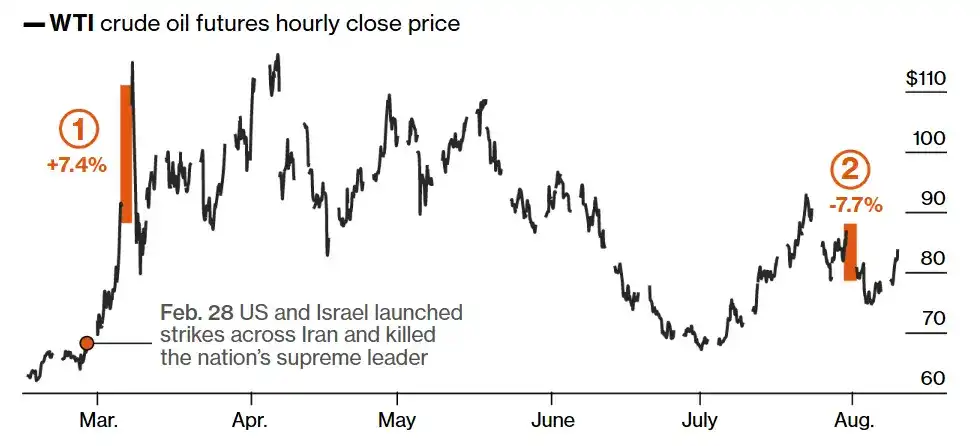
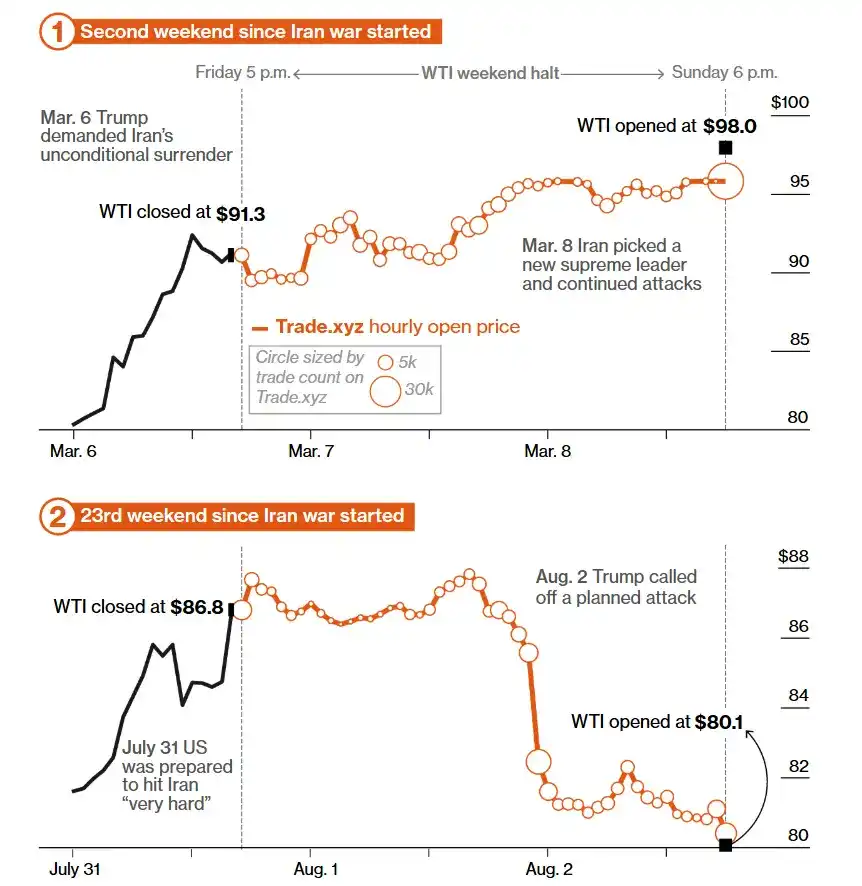
However, during some of the most turbulent periods of the conflict, the price changes in Trade.xyz contracts were smaller than the fluctuations that occurred after traditional markets reopened.
Trade.xyz uses a mechanism called "price discovery boundaries" to limit extreme price changes during periods of high volatility. As the market matures, the platform has gradually relaxed these limits.
A Trade.xyz spokesperson said the purpose of this mechanism is to allow market price discovery while preventing weekend markets from being manipulated.
The participants and sources of liquidity in these weekend contracts differ from the traditional crude oil futures markets used for comparison. Several professional oil traders said they view these contracts as indicators of market sentiment, but not necessarily as predictive tools for the reopening price of Brent or West Texas Intermediate crude.
Trade.xyz was developed by Unit Labs, whose team members mostly use pseudonyms. People familiar with the matter revealed that Unit Labs received investment from venture capital firm Paradigm over a year ago. Spokespersons for both Unit Labs and Paradigm declined to comment on the deal.
Today, Trade.xyz's business has deeply penetrated traditional financial markets.
In March of this year, Trade.xyz and S&P Global launched what they called the first formally authorized perpetual contract linked to the S&P 500 index. The open interest for this product is currently around $450 million. Trade.xyz also offers perpetual contracts tracking the Nasdaq 100 index.
The largest markets on HIP-3 were all developed by Trade.xyz, linked to the S&P 500 index, SK Hynix stock, and gold, with a combined open interest value of approximately $1.2 billion.
The Regulatory Challenge of 24/7 Trading
Before Hyperliquid launched the HIP-3 system, perpetual contracts linked to assets like stocks already existed, but HIP-3 has significantly accelerated the shift towards globally distributed, 24/7 trading.
Yesha Yadav, a professor at Vanderbilt University Law School specializing in digital asset research, said that Wall Street regulators, once accustomed to markets trading only on weekdays, must now "confront the possibility of liquidity migrating to other markets and price discovery occurring in offshore markets, especially during traditional market closures."
Collins Belton, COO and General Counsel of Unit Labs, said at an industry conference in July that this emerging field is dealing with an administration that is "very willing to be supportive." He originally expected more concerns from institutions and regulators.
This has also put regulators in conflict with CME Group, the world's largest derivatives exchange.
In June, CME sued the US Commodity Futures Trading Commission and its Chairman, Michael Selig, because a guidance issued by the commission was seen as paving the way for US platforms to launch crypto perpetual contracts.
The CFTC issued a statement at the time calling the lawsuit "baseless."
SpaceX's Pre-Listing Pricing Experiment
Compared to oil contracts, pre-IPO company contracts fill a different kind of market gap.
Companies like SpaceX do not have continuously traded public share prices before listing. Their valuations are typically only gauged by different rounds of financing and secondary market trades, which can be months apart.
The perpetual contracts launched by Trade.xyz and its competitors do not grant traders ownership of the underlying company's stock. Since these companies are not yet public, there are no publicly traded securities that can provide an anchor for contract prices through direct arbitrage.
The function of these contracts is to publicly reflect traders' judgment of a company's value before it goes public.
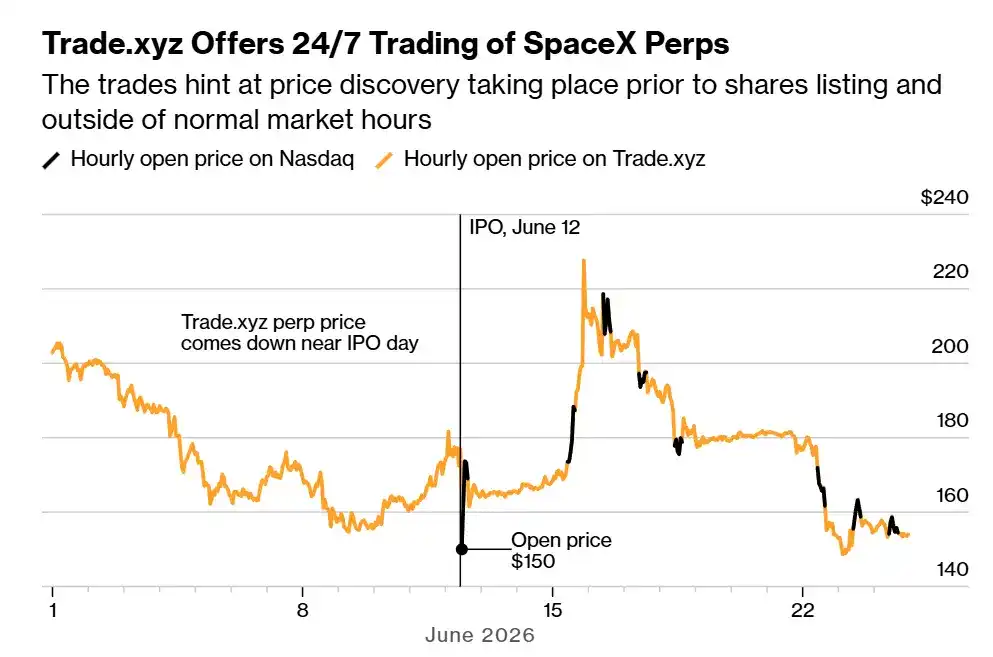
So far, Trade.xyz's pre-listing perpetual contracts have largely accurately predicted the opening performance of the related stocks. In several major listings this year, including SpaceX and SK Hynix, these contracts indicated in advance that the stock price at the start of trading would be higher than the offering price set by the underwriting banks.
David Schamis, CEO of Hyperliquid Strategies, which focuses on accumulating Hyperliquid's native token, said:
"A group of market participants who have never actually seen the stock of this company had a judgment on the opening price that was closer to the actual result than the underwriting syndicate that spent two weeks promoting the deal."
In a letter dated August 18 to US Securities and Exchange Commission Secretary Vanessa Countryman, Trade.xyz and a lobbying group associated with Hyperliquid cited the previous performance of pre-listing perpetual contracts, arguing that such products could provide public market signals before a company goes public, thereby improving the IPO pricing process.
High Leverage Amplifies Abnormal Volatility
Extremely high leverage has also quickly exposed problems in this emerging market.
In mid-June, a few days after SpaceX stock began trading, a short squeeze occurred in the Trade.xyz perpetual contract linked to this Musk-owned rocket and satellite company, momentarily pushing its implied valuation to $3 trillion, surpassing Amazon or Microsoft at the time.
As a result, over $50 million in short positions were automatically liquidated.
About a month later, the same market mechanism caused an abnormally large reverse fluctuation in the Trade.xyz perpetual contract linked to SK Hynix.
After the contract fell 20%, holders were forced to close nearly $60 million in long positions. Previously, SK Hynix stock had fallen up to 30% in pre-market trading. This drop was triggered by a single-share trade on the Nextrade market that executed at a price suspected to be anomalous.
Trade.xyz stated it would compensate for losses caused by the abnormal price fluctuation portion of the SK Hynix incident.
The platform said: "In the future, we will further refine our pricing system to handle extreme events."
Liquidity as a Competitive Moat
To open a perpetual contract market on Hyperliquid, the operator must stake 500,000 HYPE tokens, currently worth about $39 million.
Some early entrants have shut down. Meanwhile, new competitors backed by institutions like Multicoin Capital and Hyperion DeFi are targeting markets where Trade.xyz does not yet dominate.
Skew, backed by Hyperion, plans to focus on developing pricing data that is "not easily replicable." Hyunsu Jung, CEO of Hyperion, said this will be the platform's point of differentiation.
However, Trade.xyz's liquidity remains a difficult barrier to cross. This advantage stems from launching new markets earlier and having lower fee levels than competitors.
Although Trade.xyz perpetual contracts' total trading volume reached $107 billion in July this year, data aggregated by DefiLlama shows that, at current levels, their annualized revenue is only about $27 million.
Pratik Kala, Portfolio Manager at digital asset hedge fund Apollo Crypto, said:
"I don't even look at other markets. The most important thing is liquidity, and liquidity in other markets is very poor. If I wanted to place an order for even $500,000, the bid-ask spread would widen immediately."
Yadav said that a potential risk brought by Trade.xyz's rapid development is that large-scale liquidations like those seen in the SpaceX and SK Hynix perpetual contracts could, in the future, transmit to traditional markets.
In the worst-case scenario, a market crash occurring over the weekend could plunge institutions also holding traditional financial assets into a "balance sheet crisis."
She said: "Come Monday morning, will they still have sufficient funds to continue trading in the traditional markets? That's the potential danger that may emerge in the future."
In contrast, former ETF trader Walter Li is more worried about missing trading opportunities while he sleeps.
He said he used ChatGPT to design a monitoring system to scan market activity on Trade.xyz. When activity in any 24/7 traded perpetual contract picks up, the system sends him an alert.
"If you set up the right monitoring system and truly know what you're looking for, you don't need to be at your trading desk all the time."