US Senators Press Bank Regulators For ‘Fair’ Crypto Capital Rules

bitcoinistPublicado a 2026-06-05Actualizado a 2026-06-05

Resumen

A group of U.S. Senate Republicans, led by Senator Cynthia Lummis, is urging federal bank regulators to establish clear and fair capital rules for banks involved with crypto assets. In a letter to the Federal Reserve, FDIC, and OCC, the lawmakers criticized the international Basel Committee's standards, which impose a punitive 1,250% risk weight on crypto assets, calling it a de facto ban not based on actual risk. They applauded recent interagency guidance that granted tokenized securities the same capital treatment as traditional ones, arguing this risk-based principle should apply consistently to all digital assets. The senators called on the agencies to develop a new capital framework, aligning with recent legislative progress on crypto market structure. Their push coincides with testimonies from top regulators, who emphasized a shift toward more risk-based supervision and responsible innovation, while also addressing stablecoin oversight under new proposals.

A group of Senate Republicans is pressing bank regulators to build on recent regulatory progress by creating a clearer capital framework for crypto activities and asset treatment.

US Senators Call For Clear Crypto Capital Rules

On Thursday, Senate Banking Subcommittee on Digital Assets Chair Cynthia Lummis and Senators Dan Sullivan, Bill Hagerty, Bernie Moreno, Ted Budd, and Jon Husted shared a recent letter urging key financial agencies to move toward “clear and fair” capital rules for banks engaged in crypto asset activities.

The letter, addressed to Federal Reserve Vice Chair for Supervision Miki Bowman, Federal Deposit Insurance Corporation (FDIC) Chairman Travis Hill, and Comptroller of the Currency Jonathan Gould, criticized the international Basel Committee on Bank Supervision’s capital standards, which gave “the most punitive classification in the capital framework” to crypto assets.

Notably, the standard assigned a 1,250% risk weight, used to determine how much a bank must hold against a certain asset, on crypto assets. To the senators, “This classification was not derived from a calibrated assessment of the actual risk profile of digital assets.

Instead, it “appears to be a blanket penalty assigned by asset category as a de facto ban on banks holding this asset class, in direct tension with a technology-neutral approach” that agencies like the Office of the Comptroller of the Currency (OCC) and the FDIC have disclosed over the past year.

The lawmakers applauded the regulatory agencies for their recent interagency guidance on tokenized securities, which clarified the capital treatment of these assets. In March, the FDIC, the OCC, and the Federal Reserve jointly said that tokenized securities should generally receive the same capital treatment as their non-tokenized counterparts, affirming that capital treatment should reflect the risk characteristics of the underlying asset, not the technology used to record ownership.

“That principle should apply consistently—including to other digital assets,” the letter stated. Citing this position and recent progress on the crypto market structure bill, which would expand banks’ ability to engage in balance-sheet crypto asset activities, the senators urged the FDIC, OCC, and Federal Reserve to begin developing a new capital framework for such activities.

Top Regulators Shift To ‘Risk-Based’ Supervision

The senators’ call for new crypto capital rules came as the three regulators testified before the House Financial Services Committee on Thursday morning, updating lawmakers on their broader effort to revisit and ease several bank rules implemented after the 2008 financial crisis.

In prepared remarks, the FDIC chair noted that the agency is implementing several changes to reform its approach to a more “effective and efficient” supervisory framework that continues to support the safety of individual institutions and the broader system.

Hill stated that strong capital standards play a critical role in ensuring a resilient banking system, while driving economic growth and supporting their customers. Regarding crypto assets, he stated that the agency has issued several proposed rules to regulate and oversee subsidiaries of FDIC-supervised Insured depository institutions (IDIs) approved to issue payment stablecoins under the GENIUS Act.

Similarly, the OCC Chief affirmed that it is “returning to risk-based supervision rooted in law and emphasizing examiner judgment, not arbitrary checklists,” and reviewing past supervisory criticisms and enforcement actions.

“Our job is to facilitate, not stymie, responsible innovation,” Gould said, adding that “Our banking system will only remain relevant and trusted if it resists pressures to deny access based on political or religious beliefs or lawful business activity. We have made considerable progress in reviewing the activities of the largest national banks and are investigating complaints of alleged debanking, consistent with the President’s executive order.”
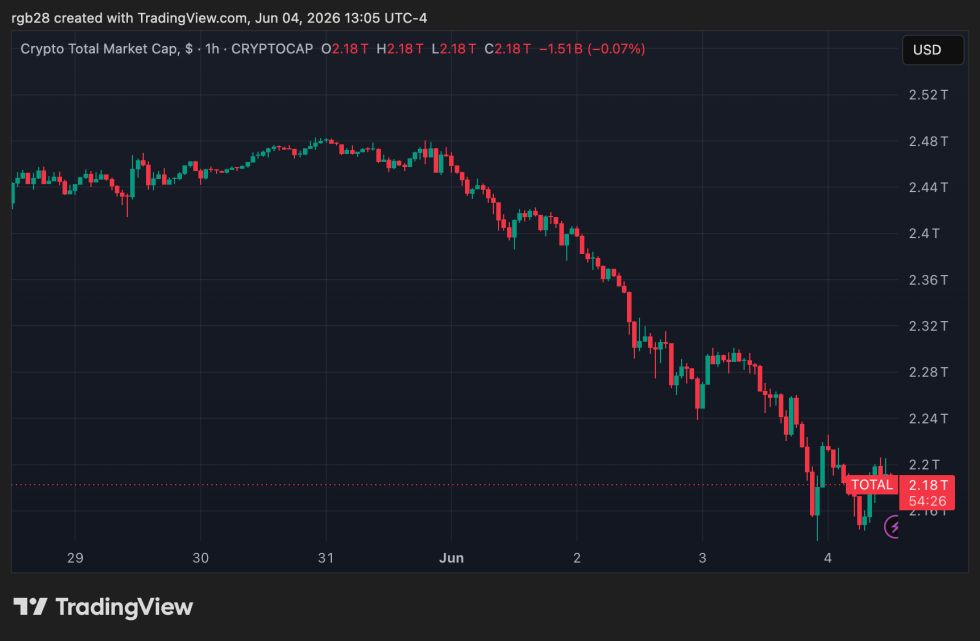
The total crypto market capitalization is at $2.18 trillion in the one-week chart. Source: TOTAL on TradingView


Criptos en tendencia

Preguntas relacionadas

QWhat are the main concerns of the US Senators regarding the current capital rules for crypto assets?

AThe Senators criticize the Basel Committee's standards for assigning a punitive 1,250% risk weight to crypto assets, arguing it appears to be a blanket penalty and a de facto ban rather than a calibrated assessment of actual risk.

QWhich regulatory agencies did the senators' letter address, and what recent guidance did they praise?

AThe letter was addressed to Federal Reserve Vice Chair Miki Bowman, FDIC Chairman Travis Hill, and Comptroller of the Currency Jonathan Gould. They praised the agencies' recent interagency guidance on tokenized securities, which clarified that tokenized securities should receive the same capital treatment as their non-tokenized counterparts.

QAccording to the letter, what principle should apply to the capital treatment of digital assets?

AThe principle that capital treatment should reflect the risk characteristics of the underlying asset, not the technology used to record ownership, should apply consistently to digital assets.

QWhat broader regulatory shift was mentioned in the testimony of the FDIC and OCC heads?

AThe FDIC and OCC heads indicated a shift towards more 'risk-based' supervision. The FDIC is moving to a more 'effective and efficient' framework, and the OCC is 'returning to risk-based supervision rooted in law and emphasizing examiner judgment, not arbitrary checklists.'

QWhat did OCC Comptroller Jonathan Gould state about the role of regulators regarding innovation and access?

AGould stated that the regulator's job is 'to facilitate, not stymie, responsible innovation,' and that the banking system must resist denying access based on political or religious beliefs or lawful business activity to remain relevant and trusted.

Lecturas Relacionadas

The Verdict in Choi Tae-won's Divorce Case: Revealing the Inheritance Undercurrent Behind SK Hynix's Trillion-Won Empire

SK Group Chairman Chey Tae-won's high-profile divorce case, involving a record 1.38 trillion won settlement, has drawn attention to the succession plans for Korea's second-largest conglomerate, especially its crown jewel, SK hynix. Unlike traditional chaebol scripts centered on the eldest son, Chey's three children from his marriage to former President Roh Tae-woo's daughter, Roh Soh-yeong, are carving distinct, non-traditional paths. Eldest daughter Chey Yun-jung (b. 1989) is seen as the most evident successor. With a scientific and consulting background, she holds executive roles at SK bioscience and SK Inc.'s growth support department, focusing on future strategy and biopharma. Her marriage is to an AI infrastructure entrepreneur, not a traditional business alliance. Second daughter Chey Min-jung (b. 1991) took a unique route, voluntarily serving as a South Korean naval officer, including an anti-piracy deployment. She later worked on policy and strategy for SK hynix in Washington D.C. before co-founding an AI-driven healthcare startup. She married a former U.S. Marine Corps officer, connecting her to U.S. defense and policy circles—networks crucial for a global semiconductor giant. The only son, Chey In-geun (b. 1995), who studied physics like his father, worked briefly at SK E&S before joining McKinsey. Despite fitting the traditional "heir" profile as the eldest son, he remains silent and holds no public position or shares in SK, suggesting the old succession playbook is obsolete. As SK hynix's valuation soars, becoming a geopolitical asset in the AI era, the heirs' legitimacy is no longer automatic. They must prove themselves in fields like AI biotech, global policy, and strategic consulting. Their marriages also reflect new elite networks in tech and defense, not old political alliances. Their inheritance is the complex challenge of navigating a globalized, tech-driven world, not just a corporate throne.

marsbitHace 2 días 09:06

The Verdict in Choi Tae-won's Divorce Case: Revealing the Inheritance Undercurrent Behind SK Hynix's Trillion-Won Empire

marsbitHace 2 días 09:06

From OpenSea to OpenRouter: Is Alex Atallah Repeating His 'Exit at the Peak' Playbook?

From OpenSea to OpenRouter: Is Alex Atallah Repeating His "Exit at the Peak" Playbook? According to the Wall Street Journal, payments giant Stripe is in talks to acquire the AI model aggregation platform OpenRouter in a potential deal valuing the company near $100 billion. This would mark founder Alex Atallah's second creation of a company reaching a $100 billion valuation, following his co-founding of NFT marketplace OpenSea. OpenRouter, founded just over three years ago, has grown rapidly by acting as a unified gateway for developers to access over 400 AI models. It currently has about 10 million users and processes over 200 trillion tokens monthly. While the platform's annualized revenue is around $50 million, its valuation has skyrocketed from $1.3 billion in March 2026. The potential acquisition by Stripe, a company OpenRouter's founder once likened it to, represents a major expansion into AI infrastructure for the payments leader. This move echoes Atallah's previous timing with OpenSea, where he departed before the NFT market's significant downturn. For OpenRouter, selling now may be strategic. Despite its scale, its business model—charging a 5-5.5% fee on AI inference calls—faces pressure from competition, open-source models, and potential price wars among model providers, limiting its profitability narrative for an IPO. A key asset for potential acquirers like Stripe is OpenRouter's vast repository of real-world AI usage data, which offers unique insights into model performance and developer preferences that are difficult to replicate. Whether this potential deal signifies a new valuation benchmark for AI infrastructure or another market peak signal remains to be seen.

链捕手Hace 2 días 08:42

From OpenSea to OpenRouter: Is Alex Atallah Repeating His 'Exit at the Peak' Playbook?

链捕手Hace 2 días 08:42

Trading

Spot

Artículos destacados

Qué es $BANK

Banco AI: Un Paso Revolucionario en el Futuro de la Banca Introducción En una era marcada por avances rápidos en tecnología, Banco AI se sitúa en la intersección de la inteligencia artificial (IA) y los servicios bancarios. Este proyecto innovador busca redefinir el panorama financiero, mejorando la eficiencia operativa, las medidas de seguridad y las experiencias del cliente a través del poder de la IA. Al embarcarnos en esta exploración de Banco AI, profundizaremos en lo que implica el proyecto, sus dinámicas operativas, su contexto histórico y hitos significativos. ¿Qué es Banco AI? En su esencia, Banco AI representa una iniciativa transformadora destinada a integrar la inteligencia artificial en varias operaciones bancarias. Este proyecto aprovecha las capacidades de la IA para automatizar procesos, mejorar los protocolos de gestión de riesgos y mejorar la interacción con los clientes a través de servicios personalizados. Los objetivos principales de Banco AI incluyen: Automatización de Funciones Bancarias: Al aprovechar las tecnologías de IA, Banco AI tiene como objetivo automatizar tareas rutinarias, reduciendo la carga sobre los recursos humanos y mejorando la eficiencia. Mejora en la Gestión de Riesgos: El proyecto utiliza algoritmos de IA para predecir e identificar riesgos, fortaleciendo así las medidas de seguridad contra fraudes y otras amenazas. Personalización de Servicios Bancarios: Banco AI se centra en ofrecer productos y servicios financieros a medida al analizar datos y comportamientos de los clientes. Mejoramiento de la Experiencia del Cliente: La implementación de soluciones impulsadas por IA, como chatbots y asistentes virtuales, tiene como objetivo proporcionar a los usuarios interacciones más humanas, revolucionando la forma en que los clientes se relacionan con los bancos. Con estos objetivos, Banco AI se posiciona como un jugador crucial para hacer que la banca sea más eficiente, segura y centrada en el usuario. ¿Quién es el Creador de Banco AI? Los detalles sobre el creador de Banco AI siguen siendo desconocidos. Como tal, no se ha identificado a ninguna persona u organización específica en la información disponible. El anonimato que rodea el inicio del proyecto plantea preguntas, pero no resta valor a su ambiciosa visión y objetivos. ¿Quiénes Son los Inversores de Banco AI? Al igual que con el creador del proyecto, no se ha divulgado información específica sobre los inversores u organizaciones que apoyan a Banco AI. Sin esta información, es un desafío delinear el respaldo financiero y el apoyo institucional que podrían estar impulsando el proyecto hacia adelante. No obstante, la importancia de contar con una sólida base de inversión es fundamental para sostener el desarrollo en un campo tan innovador. ¿Cómo Funciona Banco AI? Banco AI opera en múltiples frentes innovadores, centrándose en factores únicos que lo diferencian de los marcos bancarios tradicionales. A continuación, se presentan las características operativas clave: Automatización: Al aplicar algoritmos de aprendizaje automático, Banco AI automatiza varios procesos manuales dentro de los bancos. Esto resulta en la reducción de costos operativos y permite que los trabajadores humanos redirijan sus esfuerzos hacia actividades más estratégicas. Gestión Avanzada de Riesgos: La integración de la IA en las prácticas de gestión de riesgos equipa a los bancos con herramientas para predecir con precisión amenazas potenciales como el fraude, garantizando que la información y los activos de los clientes permanezcan seguros. Recomendaciones Financieras Personalizadas: A través del aprendizaje continuo a partir de las interacciones con los clientes, los sistemas de IA desarrollan una comprensión matizada de las necesidades del usuario, lo que les permite ofrecer consejos adaptados sobre decisiones financieras. Interacciones Mejoradas con los Clientes: Al utilizar chatbots y asistentes virtuales impulsados por IA, Banco AI permite una experiencia más atractiva para el cliente, permitiendo a los usuarios resolver sus consultas rápidamente, reduciendo así los tiempos de espera y mejorando los niveles de satisfacción. En conjunto, estas características operativas posicionan a Banco AI como un pionero en el sector bancario, estableciendo nuevos parámetros para la entrega de servicios y la excelencia operativa. Línea de Tiempo de Banco AI Entender la trayectoria de Banco AI requiere mirar su contexto histórico. A continuación, se presenta una línea de tiempo que destaca hitos y desarrollos importantes: Inicios de 2010: La conceptualización de la integración de la IA en los servicios bancarios comenzó a ganar atención a medida que las instituciones bancarias reconocieron los posibles beneficios. 2018: Se produjo un aumento notable en la implementación de tecnologías de IA cuando los bancos comenzaron a utilizar herramientas de IA como chatbots para el servicio al cliente básico y sistemas de gestión de riesgos para mejorar la seguridad. 2023: La sofisticación de la IA continuó avanzando, con la introducción de IA generativa para tareas más complejas como el procesamiento de documentos y análisis de inversiones en tiempo real. Este año marcó un salto significativo en las capacidades que la tecnología de IA otorgó a los bancos. 2024-Estatus Actual: A partir de este año, Banco AI se encuentra en una trayectoria ascendente, con investigaciones y desarrollos en curso que pronto mejorarán las capacidades en las operaciones bancarias. La continua exploración de las aplicaciones de IA sugiere emocionantes desarrollos aún por venir. Puntos Clave Sobre Banco AI Integración de la IA en la Banca: Banco AI se centra en adoptar inteligencia artificial para optimizar los procesos bancarios y mejorar la experiencia del usuario. Enfoque en Automatización y Gestión de Riesgos: El proyecto enfatiza fuertemente estas áreas, con el objetivo de desplazar la carga de tareas rutinarias mientras mejora los marcos de seguridad a través de análisis predictivos. Soluciones Bancarias Personalizadas: Al aprovechar los datos de los clientes, Banco AI permite servicios bancarios adaptados a las necesidades individuales de los usuarios. Compromiso con el Desarrollo: Banco AI se mantiene comprometido con esfuerzos de investigación y desarrollo continuos, asegurando su adaptabilidad y relevancia continua a medida que la tecnología sigue evolucionando. Conclusión En resumen, Banco AI ejemplifica un paso crucial hacia adelante en la industria bancaria, aprovechando la inteligencia artificial para redefinir los paradigmas operativos, mejorar la seguridad y promover la satisfacción del cliente. A pesar de las lagunas en la información sobre el creador y los inversores, los objetivos claros y los mecanismos funcionales de Banco AI proporcionan una sólida base para su evolución continua. A medida que la tecnología de IA sigue avanzando y fusionándose con el sector bancario, Banco AI está bien posicionado para impactar significativamente el futuro de los servicios financieros, mejorando la forma en que entendemos e interactuamos con la banca.

188 Vistas totalesPublicado en 2024.04.06Actualizado en 2024.12.03

Qué es $BANK

Cómo comprar BANK

¡Bienvenido a HTX.com! Hemos hecho que comprar Lorenzo Protocol (BANK) sea simple y conveniente. Sigue nuestra guía paso a paso para iniciar tu viaje de criptos.Paso 1: crea tu cuenta HTXUtiliza tu correo electrónico o número de teléfono para registrarte y obtener una cuenta gratuita en HTX. Experimenta un proceso de registro sin complicaciones y desbloquea todas las funciones.Obtener mi cuentaPaso 2: ve a Comprar cripto y elige tu método de pagoTarjeta de crédito/débito: usa tu Visa o Mastercard para comprar Lorenzo Protocol (BANK) al instante.Saldo: utiliza fondos del saldo de tu cuenta HTX para tradear sin problemas.Terceros: hemos agregado métodos de pago populares como Google Pay y Apple Pay para mejorar la comodidad.P2P: tradear directamente con otros usuarios en HTX.Over-the-Counter (OTC): ofrecemos servicios personalizados y tipos de cambio competitivos para los traders.Paso 3: guarda tu Lorenzo Protocol (BANK)Después de comprar tu Lorenzo Protocol (BANK), guárdalo en tu cuenta HTX. Alternativamente, puedes enviarlo a otro lugar mediante transferencia blockchain o utilizarlo para tradear otras criptomonedas.Paso 4: tradear Lorenzo Protocol (BANK)Tradear fácilmente con Lorenzo Protocol (BANK) en HTX's mercado spot. Simplemente accede a tu cuenta, selecciona tu par de trading, ejecuta tus trades y monitorea en tiempo real. Ofrecemos una experiencia fácil de usar tanto para principiantes como para traders experimentados.

819 Vistas totalesPublicado en 2025.05.09Actualizado en 2026.06.02

Cómo comprar BANK

Discusiones

Bienvenido a la comunidad de HTX. Aquí puedes mantenerte informado sobre los últimos desarrollos de la plataforma y acceder a análisis profesionales del mercado. A continuación se presentan las opiniones de los usuarios sobre el precio de BANK (BANK).

活动图片