What would you do if you had an idle NFT in your wallet? List it on a marketplace and wait? Or just let it gather dust?
Recently, a new project called Fake World Assets (FWA for short) has emerged on the Ethereum mainnet. Developed by the TokenWorks team with the official website at fwa.fun, this project essentially creates an "NFT Gachapon Machine" that runs entirely on-chain. Anyone can put their NFT into the machine as a prize, and others can pay a unified price to take a chance.
It cleverly blends concepts like providing liquidity on Uniswap, the thrill of blind box draws, and tokenomics. Today, let's break down this project in simple terms and see how it actually works.
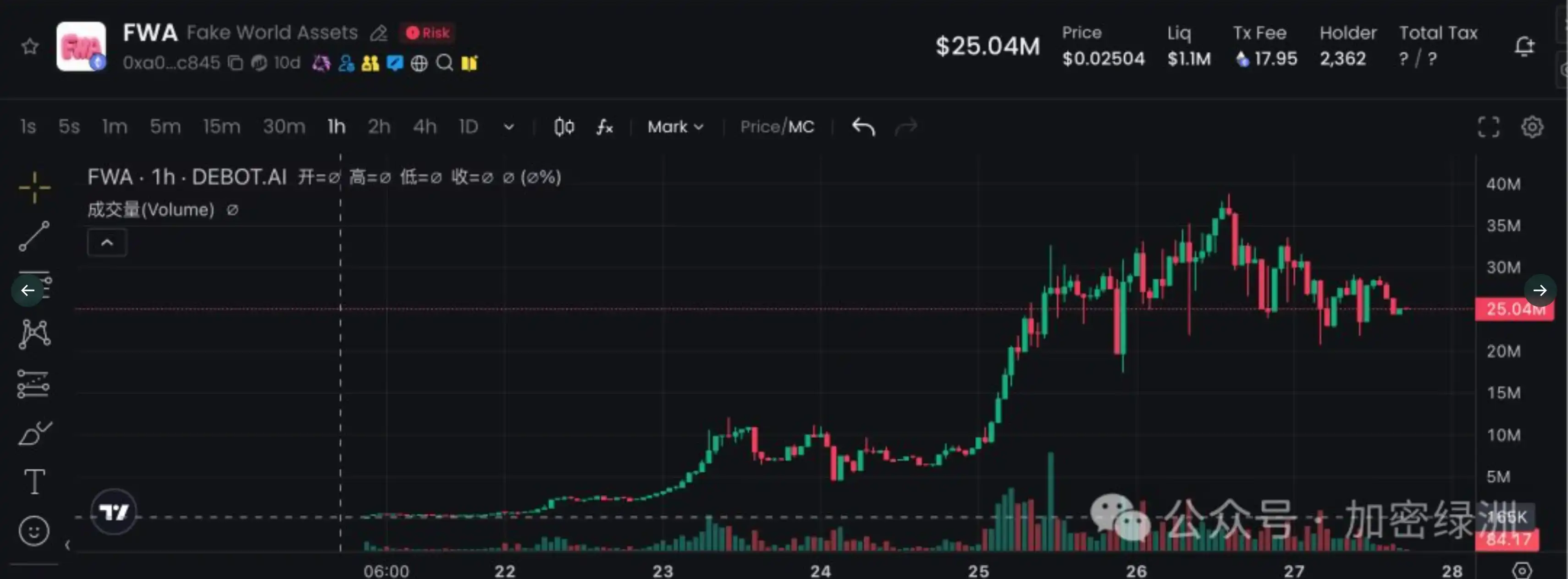
I. Key Terms Explained
Before diving into the mechanics, let's align on some key terms for clarity.
Position: In FWA, you can't just put an NFT into the gachapon. You must pair an NFT with a sum of ETH. This combination, locked together, constitutes a complete "Position".
Backing: This is the ETH you pair with your NFT. It serves as your capital and also determines the probability of your NFT being drawn.
Standing Bid: The Backing you deposit essentially becomes a "standing buy-back offer" for that NFT. If someone draws your NFT but doesn't want it, they can directly sell it back to you and receive a large portion of your Backing.
Acquisition Price: The unified price a participant pays for each draw from the gachapon. This price is calculated in real-time by the system based on all positions in the pool.
Crown: The position with the highest Backing in the pool wears a "Crown" and receives an additional share of the draw fees.
II. Core Mechanism: How the Gachapon Machine Operates
A Depositor locks their NFT along with a self-selected amount of ETH into the protocol, forming a Position. This ETH, called Backing, fulfills three key roles:
1. Determining Selection Probability (Selection Weight): Weight is inversely proportional to Backing. Higher Backing means lower probability of being drawn, making the position safer and longer-lasting. Lower Backing means a higher chance of being drawn.
2. Serving as the Standing Bid: The full Backing is locked to support the depositor's standing buy-back offer to the drawer.
3. Acting as the Depositor's Capital. Standing Bid and Backing are closely related but distinct concepts: Backing is the actual locked ETH capital, while Standing Bid is the "always-available buy-back" price offered using this capital. By default, when a drawer accepts the Standing Bid, they can take 85% of the Backing (choose to receive it as ETH or swap it directly for $FWA). The remaining ~15% is a settlement discount, which by default goes to the protocol. Randomness is provided by Chainlink VRF, with requests settled strictly in submission order to prevent front-running or manipulation.
Positions in the pool are roughly categorized by rarity: Common, Uncommon, Rare, Epic, Legendary, mainly corresponding to different Backing levels.
III. Two Core Roles and Gameplay
1. Depositor – The Liquidity Provider "House"
Deposit a whitelisted NFT (currently supporting dozens of collections including CryptoPunks, BAYC, Azuki, Milady, Pudgy Penguins, Ten Thousand Tokens, and continuously adding more) + any amount of ETH as Backing (with a minimum threshold). Revenue sources: · Each time someone draws, after deducting the protocol fee and the Crown's share, the acquisition fee is evenly distributed among all active positions (each position receives the same amount, regardless of Backing size).
· The "Crown" holder with the current highest Backing receives an additional small portion of each fee.
·$FWA token rewards (early allocation weighted by √Backing).
· Can voluntarily withdraw at any time (as long as the position hasn't been drawn and pending requests are settled or expired).
If drawn: Drawer keeps NFT → Depositor recovers almost all Backing (minus ~1% protocol settlement fee), loses NFT. Drawer sells back → Depositor recovers NFT, but loses most of the Backing.
2. Purchaser/Drawer – The "Player" Seeking Random Acquisition
Pays the unified acquisition price calculated in real-time by the system (pool Expected Value, i.e., the harmonic mean of all Backings + ~10% premium fee + a small VRF service fee). Same price for everyone at the same moment, with slippage protection available. Upon successful payment, guaranteed to receive a random position (probability is much higher for low Backing than high Backing). After drawing, must choose one option (within a time-limited window): - Keep the NFT. - Accept the Standing Bid, receive 85% of that position's Backing (in ETH or $FWA), and return the NFT to the original owner. Also receives $FWA rewards (early distribution evenly split among successful draws each day).
This design makes low-Backing positions the "common loot," keeping draw prices cheap and participation accessible. High-Backing positions become the rare "jackpots," attracting players seeking high odds.
IV. $FWA Token Economic Model
$FWA is a fixed-supply incentive token. Its core purpose is to bootstrap the two-sided market and convert protocol activity into token value.
Initial Distribution: 50%: Injected into the Uniswap v4 FWA/ETH liquidity pool. 30%: 15-day early emission (2% of total supply daily, 1% each for Depositors and Purchasers). 20%: v1 snapshot airdrop (claimable via Merkle proof based on a specific block snapshot).
External purchases are disabled early on; tokens can only be earned by participating in the protocol. Selling is always open. This reduces early sell pressure. Value support and appreciation logic:
When a drawer chooses "sell back and settle in $FWA", the system uses 85% of the Backing ETH to buy $FWA directly from the market and sends it to the user, creating real, sustained buy pressure (especially stronger when high-Backing positions are drawn).
Protocol fees can be configured for $FWA buybacks (currently disabled by default). If enabled, default allocation after buyback is 40% to Depositors, 40% to Purchasers, 20% burned.
The higher the protocol activity, the stronger the fee and settlement buybacks, leading to more pronounced deflation and demand. Token transfers are restricted; trading mainly occurs through official pools with a 1% transaction fee.
V. Revenue Sources
1. Commission on each draw fee (1% of pool acquisition fee): Deducted from the premium fee portion of the user's acquisition price. The user's actual paid price remains unchanged; this 1% is taken from the premium.
2. Settlement commission when drawer keeps NFT (1% of Backing): Only incurred when the drawer "keeps the NFT", deducted from the Backing returned to the depositor. Not charged when selling back.
3. Settlement discount when selling back (15% of Backing): By default, entirely goes to the protocol. Can be switched in the future to be distributed among all Depositors.
4.$FWA token transaction fee (1% buy/sell): Goes independently into a dedicated fee wallet, not through the Splitter distribution mentioned above.
VI. Important Notes:
User's acquisition price = Pool Expected Value (EV, harmonic mean) + 10% premium fee + VRF service fee.
Using a user payment of 0.1 ETH pool acquisition fee as an example (ignoring VRF service fee for simplicity):
1. Break down structure: EV (Expected Value) ≈ 0.0909 ETH; 10% premium fee ≈ 0.0091 ETH; Total 0.1 ETH
2. Protocol first takes 1% fee = 0.1 × 1% = 0.001 ETH (deducted from premium fee)
Now: EV portion remains ~0.0909 ETH; Remaining premium ~0.0081 ETH; Total distributable amount ≈ 0.099 ETH
3. Then take Crown's 5% from distributable amount: Crown reward ≈ 0.099 × 5% ≈ 0.00495 ETH (goes to highest Backing holder). The Crown's cut is taken from the entire distributable amount, affecting both EV and premium portions.
Distribution of final remaining portion (key point): After deducting protocol and Crown shares, the remaining funds are processed separately based on source: The portion belonging to EV (main body, approx. 0.09): Fixed, evenly distributed to all active Depositors, unaffected by hot/cold pool state.
The portion belonging to the premium fee (approx. 0.008): Has hot/cold distinction: Hot Pool → More/all goes to Depositors (further split evenly). Cold Pool → More/all is converted into $FWA purchase quota for successful drawers. Smooth transition in intermediate states.
Current Splitter Allocation
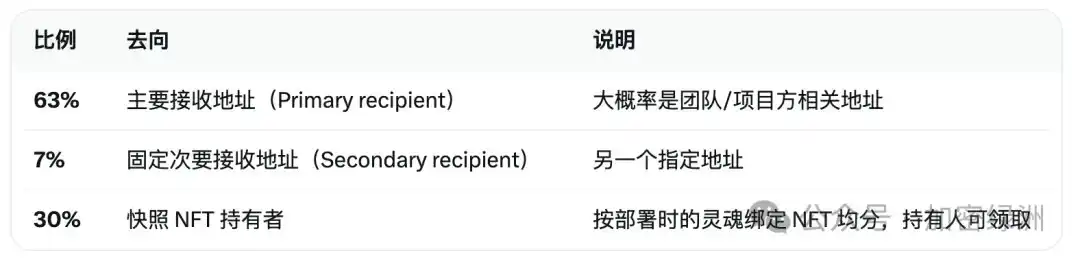
VII. Key Design Features
1. Clever Combination of Inverse Weighting + Even Fee Distribution Higher Backing → Lower draw probability → Longer survival → Can collect fees more times. But each fee distribution is evenly split by number of positions, unrelated to Backing size. Result: Small depositors are incentivized to consistently provide "cheap loot," while large depositors achieve higher total returns by "living longer." Both sides have reasons to participate.
2. Harmonic Mean Pricing
The draw price is determined by the harmonic mean of all position Backings. The harmonic mean is strongly pulled down by the lowest Backings. So, even with super high-value jackpots in the pool, the overall draw price remains cheap. This allows "low-cost, high-frequency draws" and "high-value, rare jackpots" to coexist without conflict.
3. Dynamic Hot/Cold Allocation of Remaining Premium Fee
The remaining premium fee isn't fixed for one party; it slides based on pool activity: Hot Pool → More to Depositors (encouraging sustained liquidity provision). Cold Pool → More to Drawers for buying $FWA (stimulating demand, bootstrapping). This allows the protocol to auto-adjust supply/demand without manual intervention.
4. Standing Bid Mechanism
The Backing locked by the Depositor simultaneously becomes an irrevocable buy-back offer. The drawer, upon winning, has a binary choice: keep the NFT, or directly take 85% of the Backing (can also opt to receive it as $FWA). This protects the Depositor's asset safety (Backing is always fully covered), provides the drawer with a "stop-loss/cash-out" option, and creates real buy pressure for $FWA. This design significantly lowers the psychological barrier to user participation.
5. Forced Buy Pressure from Settlement in $FWA
When a drawer chooses to sell back and settle in $FWA, the system uses 85% of the Backing ETH to buy $FWA directly from the market. This converts part of the Depositor's capital into real token demand, directly linking protocol activity with token price.
6. Asymmetrical Buying/Selling (referred to as anti-pixiu by the community)
Early on, you can only sell, not buy. Therefore, only two groups initially obtain $FWA: airdrop recipients from the old user snapshot, and real protocol participants – NFT Depositors and successful drawers. The benefit of this design is that it directs early token circulation primarily to genuine participants, not external speculative capital, giving the protocol ample time to bootstrap. A very interesting project.