Wow, Generalist's funding progress bar seems to be running on a 2x speed hack, their development is moving so fast!

I'm not exaggerating. According to an Axios report, after Generalist completed a $400 million (¥2.87 billion) Series B funding round in June this year, propelling it to unicorn status, just under three months later, Generalist has quietly completed another $200 million (approx. ¥1.44 billion) funding round, with its latest valuation surpassing the $2 billion mark (approx. ¥14.36 billion).
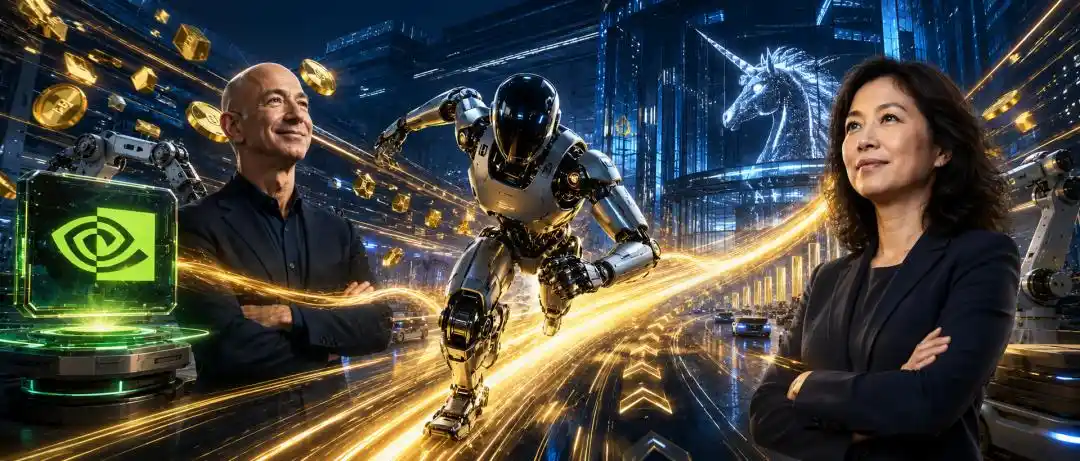
Prominent names like Nvidia, Jeff Bezos's Bezos Expeditions, and 'AI Godmother' Fei-Fei Li are all listed among its shareholders.
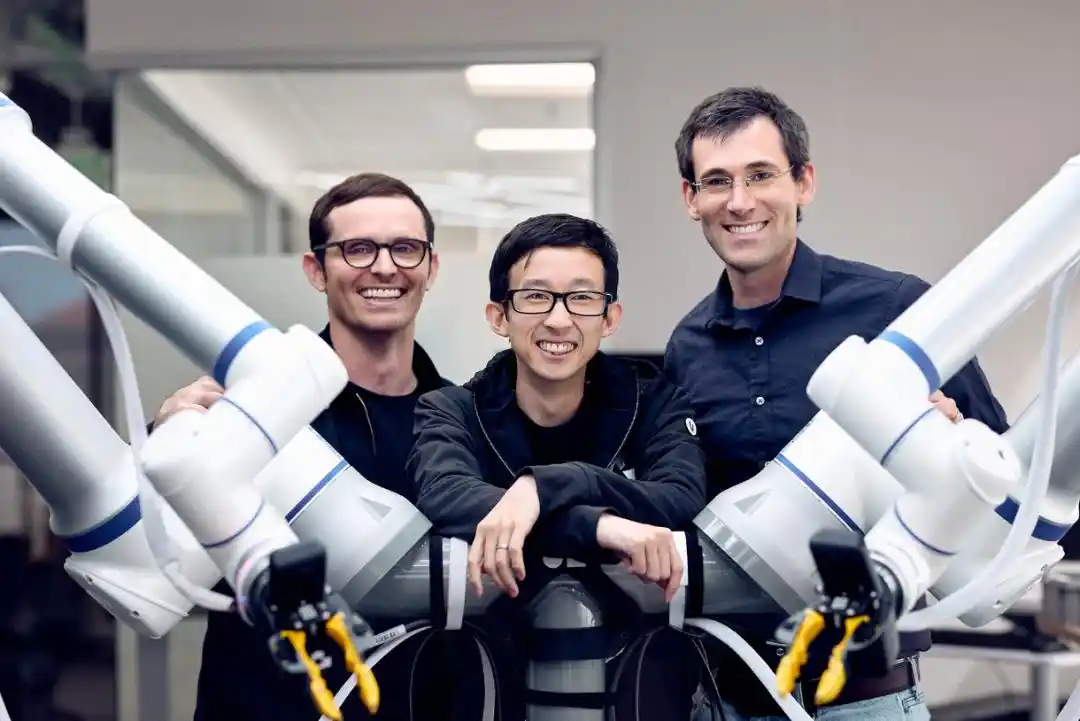
Generalist is an AI company focused on 'building a general brain for robots'. Founded in 2024 in the San Francisco Bay Area, USA, the company was co-founded by former Google DeepMind researchers Pete Florence and Andy Zeng, along with former Boston Dynamics engineer Andrew Barry.
△
According to Forge, as of publication, Generalist has completed 4 rounds of financing, with total funding reaching approximately $750 million (approx. ¥5.39 billion). Investors include Nvidia, Boldstart Ventures, Xiaomi co-founder Bin Lin, Fei-Fei Li, Naval Ravikant, and Zoom founder Eric Yuan, among others.
Generalist doesn't release flashy humanoid robot bodies, nor does it rely on robotic arm orders for its narrative. They rapidly gained prominence solely through their team background from Google DeepMind, OpenAI, and Boston Dynamics, and the powerful generalization capability demonstrated by GEN-1.5—'learning new tasks from a single demonstration without requiring retraining'. This propelled them to become a rising star in the embodied AI field, securing approximately $600 million (approx. ¥4.308 billion) in funding within just two months.
So, what's the story behind this company? What exactly makes GEN-1.5's generalization so strong? And what aspect of Generalist are investors betting on?
You'll find out after reading this:
No Retraining Needed, Learning from a Single Demonstration
If traditional industrial robots are chefs who can only cook from a fixed recipe, then Generalist's newly released GEN-1.5 is more like a new apprentice who can take over immediately after watching the master operate once.
In the past, robots had to undergo a lengthy 'pre-job development' phase before starting work. Their problem-solving approach largely followed the pattern of 'one scenario, one policy'—tightening screws on a production line required one program, while sorting parts required another;
Even if the task remained the same, any change in object position, shape, or tools might require engineers to re-collect data, adjust parameters, and retrain the model.
GEN-1.5 aims to lower the barrier for deploying robots from 'hiring engineers for redevelopment' to 'on-site personnel demonstrating once.'
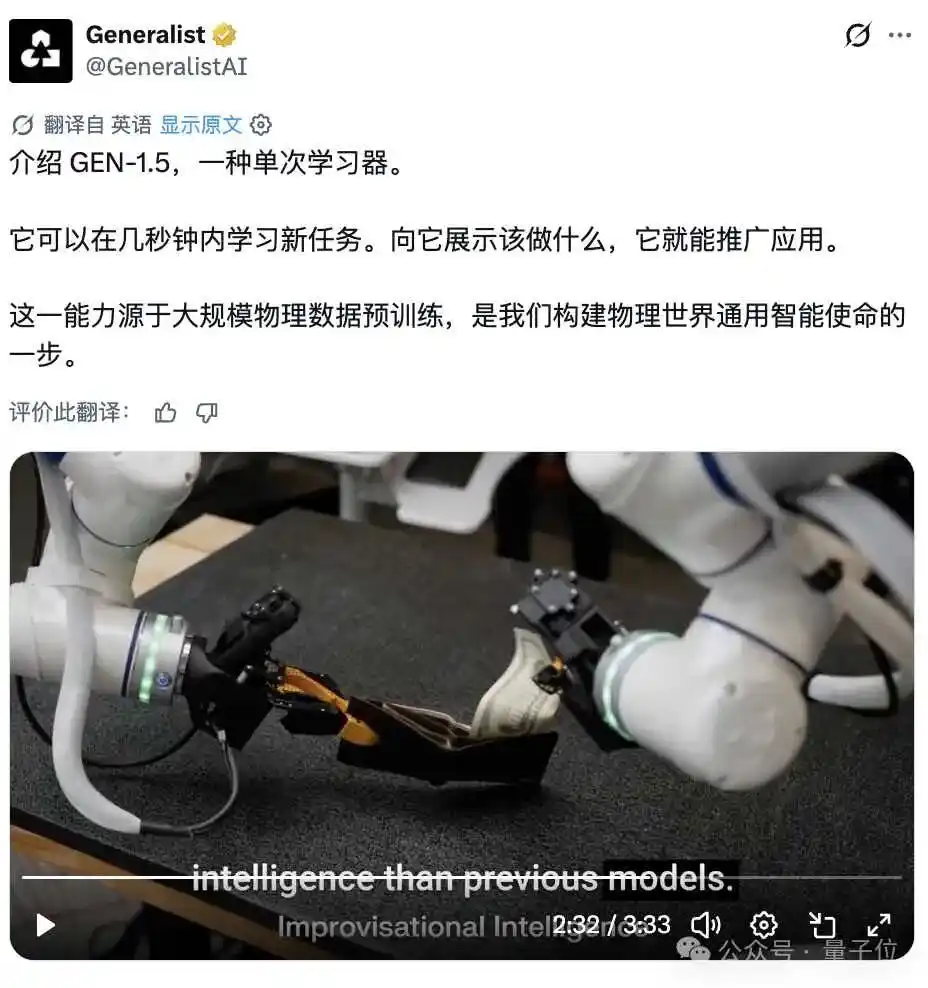
In Generalist's demo video, a worker only needs to demonstrate once using a handheld gripper or the robot itself. The model can then use the 3 to 12 seconds of sensor and motion data as 'physical prompts' to directly understand the task and begin operation, all without requiring gradient updates or fine-tuning.
For instance, unscrewing a glass jar, unzipping a pencil case, sweeping blocks into a bowl, or even using previously unseen brushes and dustpans—it can organize actions based on the demonstration.

Of course, GEN-1.5 isn't so magical that it succeeds every time at first glance.
Official tests show its average single-demonstration success rate across 10 simple, short-duration tasks is 59%; if fine-tuned with about 5 minutes of data over 10 gradient update steps, the success rate can rise to 83%.
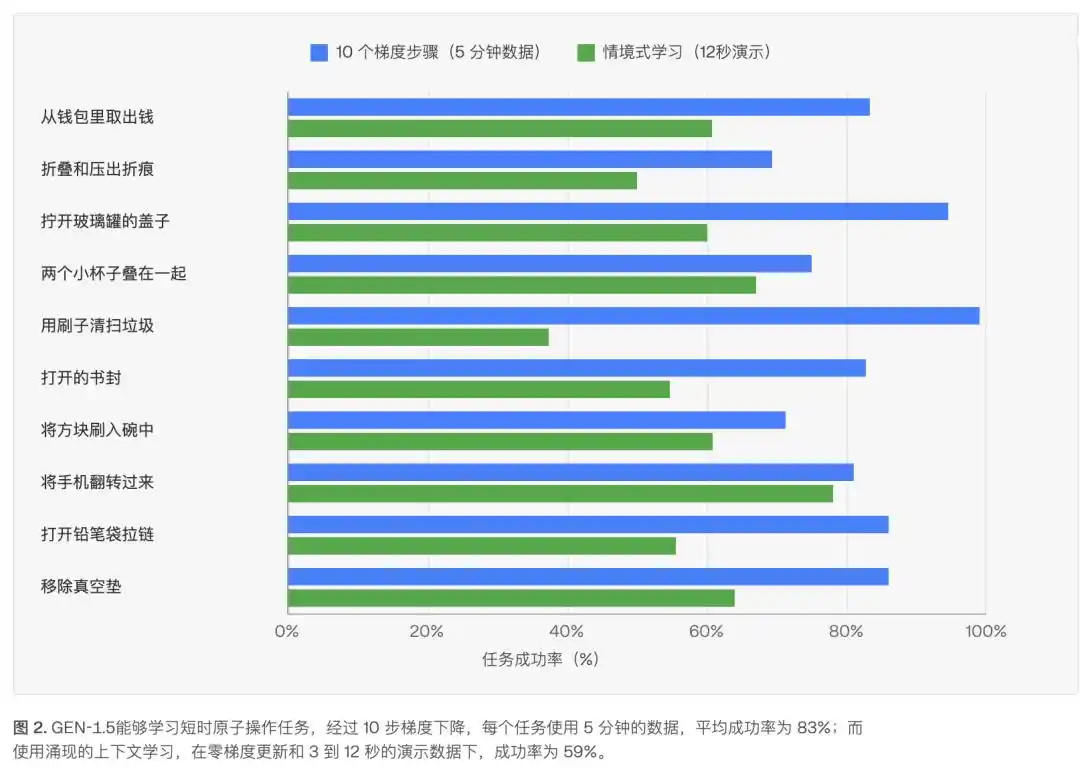
This result isn't perfect, but it proves something more important: adapting robots to tasks has the potential to be compressed from months to seconds.
This potential to become a universal foundation for robots is likely what capital is eyeing.

For clients, the same model can be deployed faster across different factories, warehouses, and labs, reducing costs associated with engineering deployment, data collection, and downtime for debugging.
For investors, Generalist isn't selling a specific robot; they're selling the intelligence layer that runs on various hardware, naturally expanding the market boundaries.
And for Generalist itself, this general capability can also set a data flywheel in motion:
The stronger the model, the more real-world tasks it can handle; the more deployments, the richer the physical interaction data collected; new data, in turn, trains the next generation of models. Ultimately, GEN-1.5 aims to give robots the ability to continuously learn and work.
This ability to 'replace month-long development with second-long adaptation' doesn't come out of thin air. It stems precisely from the founding team's decade-long firsthand experience with the pain points in the robotics industry.
A Group of DeepMind and Boston Dynamics Veterans Building a 'Robot Brain'
Generalist's founding team essentially combines the two most crucial capabilities for the robotics industry.
CEO Pete Florence holds a Ph.D. in Computer Science from MIT, studied under roboticist Russ Tedrake, was a Senior Research Scientist at Google DeepMind, helped pioneer vision-language-action models, and trained DeepMind's first multimodal large model.

△
Chief Scientist Andy Zeng earned his bachelor's degree from UC Berkeley, majoring in Computer Science and Mathematics, and later obtained his Ph.D. in Computer Science from Princeton University.
He served as a Research Scientist at Google DeepMind, researching robots that can write their own code and inventing methods for large-scale robot data collection using handheld grippers.

△
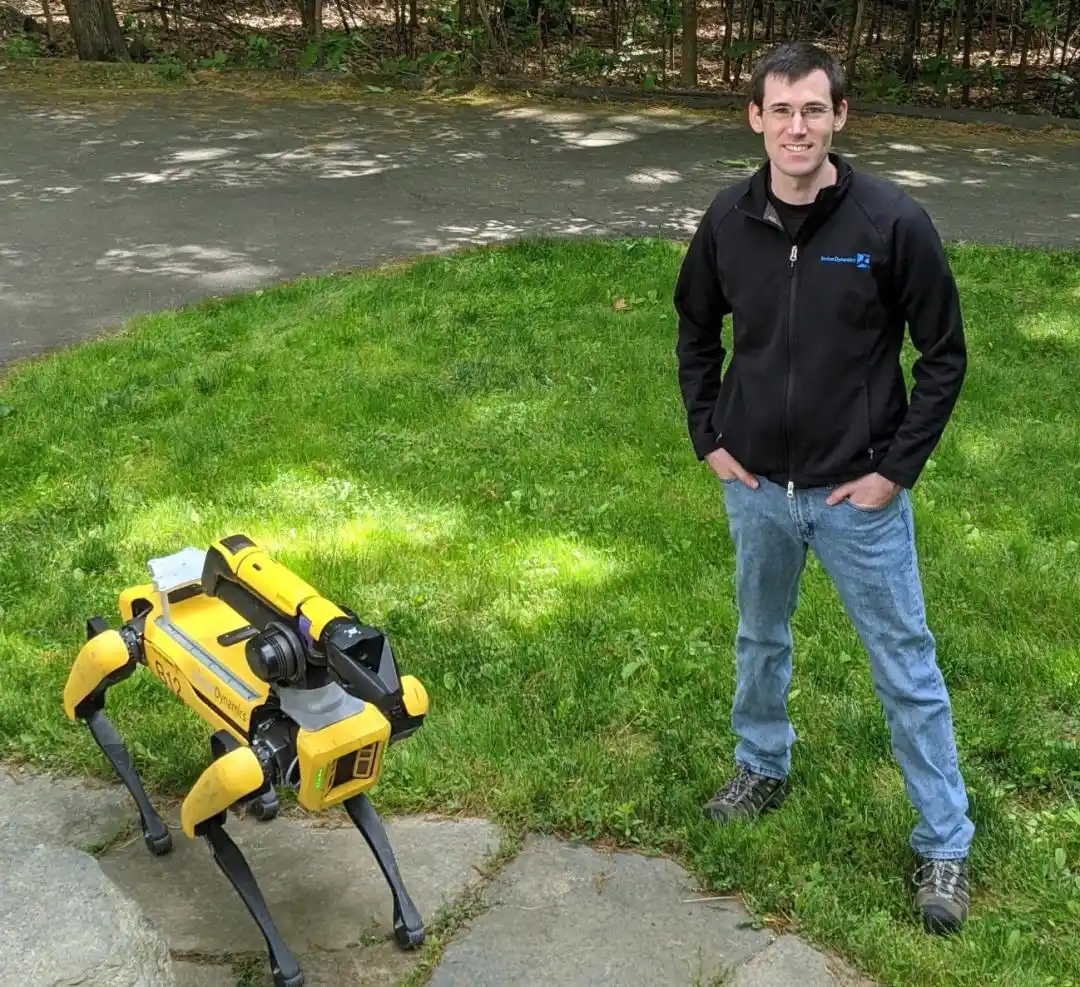
Responsible for actually embedding ideas into robotic bodies is CTO Andrew Barry.
He earned his bachelor's from Olin College of Engineering and his Ph.D. from MIT, focusing on robot control and high-speed autonomous obstacle avoidance;
Before joining Generalist, he worked at Boston Dynamics for about 5 years as a Senior Robotics Specialist, contributing to the development of the robotic arm for the Spot robot dog.
In other words, he not only knows what the model should output but also understands how a robot should move in the real world to avoid falling, shaking, or jamming.
△
These three individuals didn't just form a team chasing a trend because AI became hot; their work over the past decade-plus has coincidentally pointed to the same bottleneck in the robotics industry:
Hardware can already run, jump, and grasp; what truly limits real-world deployment is that the robot's 'brain' can't keep up with its 'body.'
What DeepMind brings is the model's generalization capability across different tasks, objects, and scenes;
What Boston Dynamics brings is the 'physical sense' for mechanical structures, control systems, and real environments.
This is also why Generalist chose to train a general robot brain instead of betting on a specific robot body. They understand that only when both the model and the hardware are proficient can robots move from lab demos to factories and warehouses.
Otherwise, no matter how elegant the model, it might just result in publishing more papers; no matter how flashy the robot's movements, it might still only perform pre-programmed routines.
However, GEN-1.5 still has significant room for improvement.
Learning at First Glance Doesn't Mean Ready for the Job
However, learning from a single glance doesn't mean GEN-1.5 is ready to start working in a factory.
Generalist has proactively tempered expectations for this capability. The official technical blog states that the team's current testing mostly involves simple, short-duration tasks like unscrewing jar lids, zipping zippers, and grasping objects.
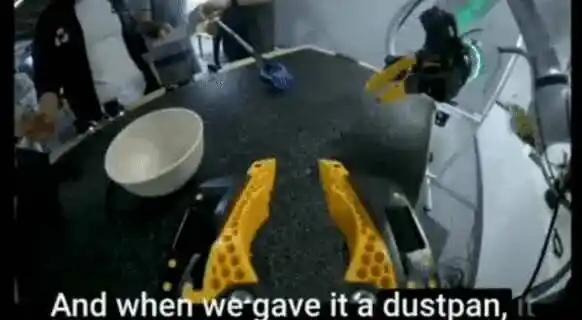
GEN-1.5's average single-demonstration success rate across 10 task categories is 59%, still far from the long-duration, low-failure stable operation required on production lines.
In a real factory setting, robots must also handle variations in materials, equipment wear, human interference, and sudden malfunctions, which pose far greater challenges than lab demonstrations.
More importantly, 'learning from a single demo' primarily addresses task adaptation and doesn't automatically equate to low-cost commercialization.
Large-scale robot deployment also depends on hardware cost, operational speed, maintenance cost, safety, and system integration capabilities. Even if the model learns quickly, if the robotic arm is expensive, prone to frequent failures, or still requires extensive engineering debugging for each deployment, the business case may still not work out.

But the value of GEN-1.5 shouldn't be measured solely by its current success rate.
The emergence of GEN-1.5 demonstrates that robots have the potential to rapidly understand new tasks through a few seconds of 'physical prompts,' similar to how large models understand text prompts.
Although it hasn't yet placed robots on production lines for long-term operation, it has already made progress in reducing the time for robots to learn new tasks from months to seconds.
Moving from 'developing one program per task' to 'the same model learning different tasks'—this is the more noteworthy aspect of GEN-1.5.
It might not be a qualified worker yet, but at least it shows the potential learning method for future general robot brains.
In this sense, GEN-1.5 currently resembles a roadmap towards general-purpose robots more than a fully mature product manual.
What truly excites the market isn't just what it can do today, but the possibility it demonstrates for robots to continuously learn to do more things.
General-Purpose Robots Are Hitting the Road
If past robotics companies were vying to be 'champions in specific skills,' the story Generalist tells investors is one about a 'robot generalist.'
When robotic arms being able to grasp, place, and twist is no longer novel, the standards for capturing capital attention shift accordingly.
Rather than how many pre-programmed actions a robot knows, the market cares more about how quickly it can learn new actions, how much data it requires, and how high the deployment cost is.

Although GEN-1.5 still has a long way to go in completing its transformation from 'learning at first glance' to 'working stably for eight hours a day,' Generalist has at least validated a possibility: robots don't have to be forever confined to 'one scenario, one policy'; they too can rely on general models to quickly adapt to unfamiliar tasks, just like humans.
And when the time for robots to learn new skills shrinks from months to seconds, with marginal costs gradually approaching zero, what truly needs redefinition might not be just the robotics industry.
At that point, where will the core value of human labor lie?
This question might be even more worthy of discussion than GEN-1.5 itself.
Reference Links:
[1]https://www.axios.com/2026/08/24/robotics-ai-generalist-200m
[2]https://forgeglobal.com/generalist_stock/
[3]https://generalistai.com/blog/gen-1.5
[4]https://generalistai.com/about
[5]https://www.peteflorence.com/
[6]https://andyzeng.github.io/[7]https://abarry.org/
This article is from the WeChat public account 'QbitAI', author: Wenting