By:Theodore Schleifer, The New York Times
Compiled by:Luffy, Forsight News
The biggest donor in this round of US midterm elections is not Elon Musk, George Soros, nor any other billionaire with the deepest pockets in politics.
The actual top donor is a venture capital firm: Andreessen Horowitz (a16z).

Top donors in the current midterm election cycle, data source: Federal Election Commission, The New York Times
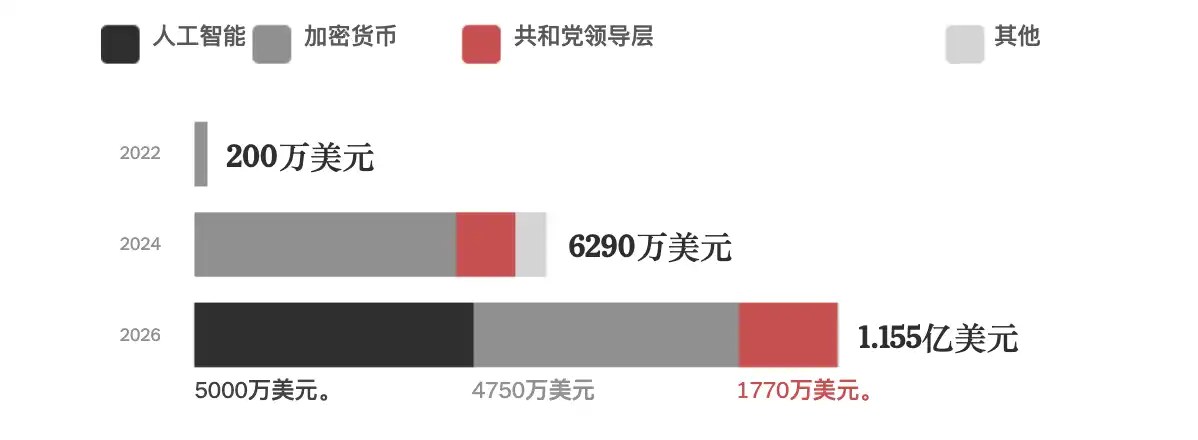
Analysis by The New York Times shows that this Silicon Valley venture capital firm, together with its founding partners Marc Andreessen and Ben Horowitz, has already donated over $115 million in political contributions for midterm election-related activities, making it the single largest known donor in this election cycle.
a16z's involvement in politics is not new; the two founders themselves are seasoned political donors worth tens of billions. However, the scale of donations this cycle far exceeds the approximately $63 million spent during the 2024 election cycle. This top-tier investment firm is now investing in politics with unprecedented intensity, attempting to leverage policy directions to align with its commercial interests.
Following the last presidential election, a16z established a posture of long-term political engagement. Conventionally, the day after a major election ends (with two years left until the next significant election) is not the time for massive donations. But on November 6, 2024, a16z injected over $23 million in a single day into two key crypto industry Super PACs (Political Action Committees), sending a clear signal: its political strategy is a long-term plan, not a fleeting trend.
a16z declined to comment on media interview requests and did not arrange for interviews with the two founders.
A few days later, Andreessen stated bluntly in an election recap podcast, "My conclusion is that we have to treat political participation as a permanent mission." "Sometimes circumstances allow us to go with the flow, other times we must fight with all our might. But regardless of whether it's smooth sailing or an uphill battle, we need to be deeply involved throughout the entire process."
The massive political contributions from venture capital firms also reflect a significant shift in the US political landscape. In this midterm election, the top donor force has shifted from individual billionaires to corporate entities like a16z. Critics argue that large-scale institutional money entering the fray could hijack the electoral process, solely for their own commercial gain.
Since the 2024 presidential election, a16z has contributed $47.5 million to the crypto industry Super PAC network Fairshake. Its strategy has also extended beyond the crypto sector: following the Fairshake model, it took the lead in establishing the Super PAC Leading the Future, focused on supporting pro-artificial intelligence (AI) candidates, and invested $50 million. Both Fairshake and Leading the Future adopt a bipartisan strategy, funding both Republican and Democratic candidates.
Additionally, a16z and its two founders collectively donated $12 million to the Trump-aligned Super PAC MAGA Inc., including a single $6 million donation in March. In the same month, a trust fund linked to Andreessen also donated nearly $900,000 to the Republican National Committee.
This series of political investments has also helped Marc Andreessen build close connections with the Trump administration.
A chart showing the dramatic surge in public political contributions from Andreessen and Horowitz this cycle: a16z and its founders' political donations skyrocketed from $2 million in 2022 to $115.5 million in 2026; funds primarily flowed to AI-related issues, the Republican camp, and the crypto industry.
Source: Federal Election Commission, The New York Times
Before Trump began his second term last year, Andreessen revealed that he spent half his time at Mar-a-Lago, assisting the Trump team with the transition. The venture capital titan also served as an informal advisor to the government efficiency department led by Musk. Two former a16z partners have taken up senior government positions, with one handling AI regulatory matters.
In March of this year, 54-year-old Andreessen was appointed to a top White House science and technology advisory committee; recently, he was also invited to attend the state dinner for King Charles III's visit to the US and a private club dinner hosted by Trump in the White House Rose Garden.
Regulatory filings show that the large donations from Andreessen and Horowitz mostly come from the wholly-owned a16z entity. The $115.5 million for this election cycle does not yet include the tens of millions of dollars the firm recently invested in the emerging AI non-profit advocacy organization American Innovators Network, which is not required to disclose donation details.
Founded in 2009, a16z is one of the most prestigious investment firms in Silicon Valley. It incubates startups by borrowing from the Hollywood talent agency model, recruiting aggressively and excelling at self-promotion. Early bets on crypto exchange Coinbase and social platform Instagram cemented its industry reputation.
The political stances of the two founders are quite storied. In the 1990s, Andreessen gained early fame and fortune with the pioneering web browser Mosaic, was a core member of former Vice President Al Gore's tech brain trust, and a major Democratic fundraiser.
Years later, his political leanings gradually shifted rightward. He himself revealed that after Trump's victory in 2016, he deliberately withdrew from political fundraising activities, embarking on a journey of political "self-reflection," re-examining various ideological extremes.
According to people familiar with his private social circles, Andreessen is now active in various private communities, often discussing current events with conservative activists.
Ben Horowitz, 59, is the son of the prominent conservative agitator David Horowitz. However, insiders say Horowitz himself is less vocal in public about politics and has relatively limited involvement in the firm's Super PAC affairs. a16z publicly endorsed Trump in the summer of 2024; in October of the same year, Horowitz also provided financial support to Democratic presidential candidate Harris due to personal connections.
Andreessen and Horowitz describe themselves as "single-issue voters": their voting and donations are based solely on what benefits tech startups. Insiders say the two became determined to engage deeply in politics after repeated clashes with the media and the Biden administration over tech policy in earlier years.
Andreessen once told a friend an anecdote. About a decade ago, at the headquarters of Condé Nast, parent company of The New Yorker, he had a heated argument with the magazine's editor, David Remnick. Remnick's team accused tech elites of being out of touch with the masses, but after Andreessen toured their luxurious offices and bathrooms, he concluded that it was the media elites who were truly out of touch with reality.
Before the 2024 election, Chris Lehane, a seasoned Silicon Valley political operative and Coinbase board member, spearheaded the formation of Fairshake. Andreessen and Horowitz believed the Biden administration was too harsh on the crypto industry, where a16z had heavily invested. Coupled with the fraud conviction of crypto political figure SBF, the industry urgently needed a new political path.
Thus, a16z joined forces with crypto giants like Coinbase and Ripple to become core funders of Fairshake, with the firm donating $47 million to the organization during the 2024 election cycle. Although most pro-crypto policies in Washington now originate from Trump (Fairshake did not endorse Trump), this political move is still seen within the industry as a successful experiment.
In the spring of 2025, Lehane, who had joined OpenAI, again took the lead. Together with a16z, tech donors, and political operatives, they planned to replicate the crypto industry's political fundraising strategy for the AI field, starting early and investing more heavily.
a16z, which has heavily invested in numerous AI projects, fully committed. In August 2025, it donated $25 million to the AI-focused PAC Leading the Future, and added another $25 million in February 2026. Insiders reveal the firm has not yet decided whether to make further contributions.
Compared to a16z's trillion-dollar assets under management, a $115.5 million political investment is not particularly high. However, other top Silicon Valley venture capital firms, such as Sequoia Capital and Founders Fund, have not undertaken similar large-scale political initiatives.
According to The New York Times' tally, since the 2024 election, the next largest publicly disclosed federal donors after a16z are Soros-linked entities (approximately $103 million) and Musk ($85 million).
The large-scale political involvement has also drawn a16z into controversy and backlash from multiple sides.
Internally, early partner John O'Farrell resigned from his part-time advisory role in May last year due to political differences. He publicly criticized the two PACs, Fairshake and Leading the Future, as well as what he called "tech figures actively cozying up to this administration, including many former venture capital peers and partners." He declined to comment further.
Externally, the progressive camp strongly criticizes a16z. Last year, several Democratic lawmakers publicly criticized Arizona Democratic Senator Ruben Gallego for co-hosting a fundraiser with Andreessen.
a16z's support for the AI PAC Leading the Future has even prompted industry countermeasures. The opposing Super PAC Public First, espousing AI safety principles, emerged with the express purpose of counterbalancing the political financial influence of a16z and its allies. Insiders even jokingly named the organization "z16a," deliberately inverting a16z's common abbreviation.
New York State Democratic Assemblyman Alex Bores, who is running for Congress with Public First's endorsement, stated bluntly that he is not afraid of attacks from Leading the Future: "The venture capital logic is about rapid scaling, but that logic shouldn't be applied to buying democracy."
Some Republicans are also unimpressed with a16z's political bets. They privately complain that Fairshake and Leading the Future's insistence on a bipartisan, neutral strategy is misguided, arguing that AI and crypto policies are inherently more Republican-friendly, and the related PACs should fully align with the Republican Party.
Andreessen and Horowitz have told allies that their decision-making power within the two PACs is limited and they rarely directly interact with the PAC leadership.
a16z's political strategy and Washington lobbying efforts are coordinated by former congressional aide and Republican Collin McCune. He keeps track of the two PACs' movements and updates Andreessen on the latest policies and political developments.
But this doesn't mean Andreessen is unaware of political rules. In 2000, at just 29 years old, he asserted, "If you think the scale of political donations is big now, you haven't seen anything yet."