A Hair Dryer Blows Open the World's Largest Nvidia Chip Smuggling Case

比推Publicado a 2026-03-20Actualizado a 2026-03-20

Resumen

A co-founder and senior executive of Supermicro, Wally Liaw, has been arrested in California for orchestrating the largest AI chip smuggling case in history, involving $2.5 billion worth of Nvidia GPUs destined for China. The scheme involved using a Southeast Asian shell company to purchase servers under the guise of legitimate use, then repackaging them for illegal shipment to China. To deceive auditors, the group created counterfeit servers with real serial numbers transferred using a hairdryer. Liaw, who faces up to 20 years in prison, accelerated operations ahead of new U.S. export restrictions in May 2025. The case highlights the persistent demand for Nvidia chips in China, where black market prices are 50% higher, and the evolving sophistication of smuggling networks, from individual couriers to corporate insiders.

Author: David, Shenchao TechFlow

Original Title: A Hair Dryer Blows Open the World's Largest Nvidia Chip Smuggling Case


Early this morning, Wally Liaw, co-founder of Supermicro, was arrested in California.

Supermicro is one of the world's largest AI server manufacturers and a core supply chain partner of Nvidia, having received $13 billion in orders for Nvidia Blackwell chips in just one quarter last year.

Liaw has been with the company since its founding in 1993 and currently serves as senior vice president and board member.

The charges against him are:

Smuggling $2.5 billion worth of Nvidia AI chip servers to China through shell companies in Southeast Asia. The maximum sentence is 20 years.

The U.S. Department of Justice has characterized this case as the largest AI chip smuggling case in history.

However, the details of this case are very much like a movie plot.

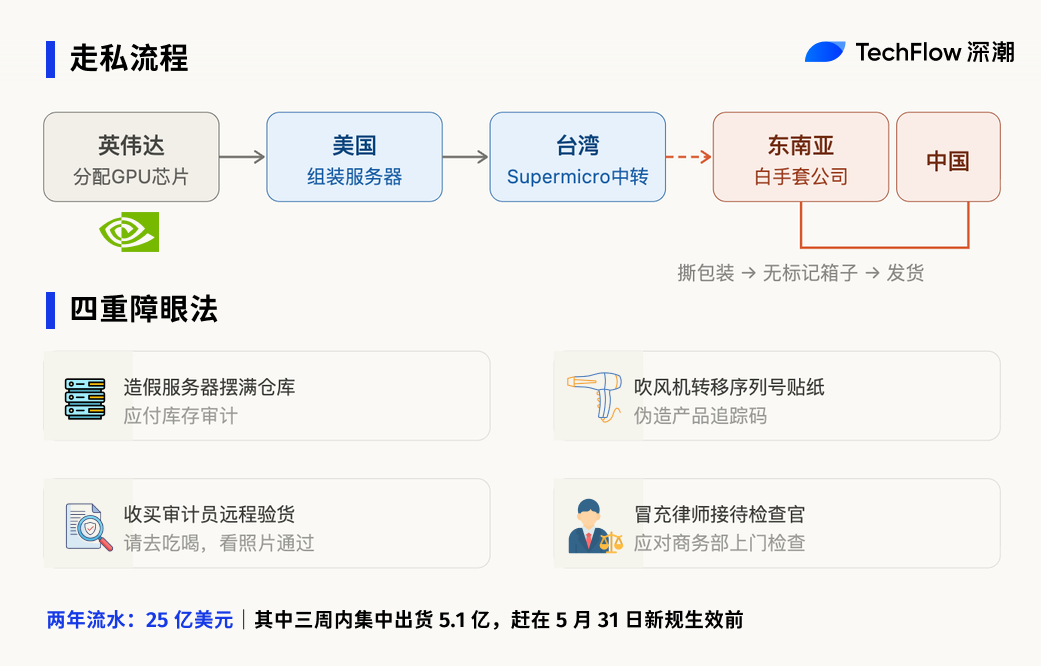
According to the indictment, Liaw and his accomplices arranged for a Southeast Asian company to act as a "white glove," purchasing large quantities of servers equipped with Nvidia GPUs from Supermicro under the guise of "self-use." Once the servers arrived in Southeast Asia, workers tore off the original packaging, placed them into unmarked boxes, and shipped them to China.

The real goods were shipped away, but Supermicro's compliance team and the U.S. Department of Commerce would regularly inspect the inventory and scan serial numbers at the warehouse. The warehouse couldn't be empty, could it?

So they built tens of thousands of fake servers.

The shells looked identical to the real ones, but they contained no chips and could not be powered on. They were specifically placed in the warehouse for auditors to see.

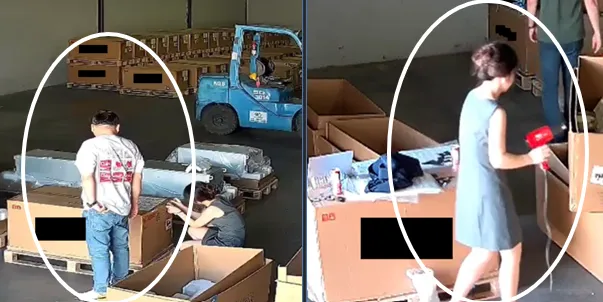
Having fake servers wasn't enough; the serial numbers on the packaging also had to match. Workers used a hair dryer to heat the serial number stickers on the real packaging, peeled them off completely, and then stuck them onto the boxes of the fake servers...
The auditors scanned the codes, and the system showed everything was normal.

Surveillance footage in the factory captured the hair dryer moment. But the real goods were already on their way to China.

Even more outrageous, on one occasion when Supermicro's own compliance team sent someone to inspect, accomplice Sun took photos and videos of the fake servers and sent them to the auditor as "proof" that the "goods were all there."

Another time, U.S. Department of Commerce export control officials came for an inspection. Someone on site directly impersonated a lawyer to receive them...

The main culprit, Liaw, is 71 years old and holds Supermicro stock worth $430 million. In theory, he doesn't need the money.

There's another detail in the indictment. A broker once forwarded a news link to Liaw about several Chinese nationals being arrested in the U.S. for smuggling AI chips.

Liaw's reply was a string of crying face emojis, and then he continued with the operation.

After the news was announced, Supermicro's stock fell 13% in after-hours trading. The company stated that Liaw has been suspended, the involved party Sun has been terminated, and sales manager Steven Chang from the Taiwan office is currently at large.

Supermicro was not named as a defendant. The company stated it has a "robust compliance system."

But this isn't the first time this company's compliance system has had problems.

$2.5 Billion Chip Smuggling Pipeline

This smuggling chain wasn't built overnight.

The indictment shows that Liaw was very proactive in managing the operation. He directly asked the person in charge of the Southeast Asian company via encrypted communication: How many can you take in January? February? March? April? Just give a rough estimate, and then we'll use this number to apply for a chip quota from Nvidia.

So the process was:

First, confirm the demand from Chinese buyers, then use that volume to negotiate a quota from Nvidia, citing "self-use" by the Southeast Asian company. Once Nvidia approved the quota, the servers were assembled in the U.S., shipped to Taiwan, then transferred to the Southeast Asian company, which removed the packaging and shipped them to China.
From clients to supply sources to logistics, Liaw single-handedly managed the entire chain. He wasn't a middleman; he was the co-founder and head of business development at Supermicro.

Using his own company's supply chain to smuggle his own company's products.

Between 2024 and 2025, servers worth $2.5 billion flowed out through this pipeline. The indictment says this scale gradually expanded, using the phrase:

Growing increasingly bold.

The boldest single transaction occurred from late April to mid-May 2025. In three weeks, $510 million worth of servers were transferred from the U.S. to China via Southeast Asia.

Why the sudden acceleration? Possibly because Liaw saw a White House statement.

In early 2025, the U.S. government announced a new set of export control rules for AI products, scheduled to take effect in mid-May, further tightening chip export reviews to regions like Southeast Asia. Liaw forwarded this news to the head of the Southeast Asian company, adding a note:

"We need to speed these up before May 13!"

May 13th was the effective date of the new rules. Before that, the existing loopholes could still be used. So the final three weeks became a race against time. The volume that usually took months to move was compressed into twenty days.

Meanwhile, Steven Chang from the Taiwan office was responsible for another task: ensuring no one conducted a real inspection.

The indictment says he prevented auditors from checking the actual areas where servers were stored in the Southeast Asian data center and specifically arranged for an auditor he called "friendly" to conduct this review.

All the forged documents, fake servers, and hair dryer label switching were meant to keep this pipeline running uninterrupted. And the speed of the pipeline peaked in the final three weeks.

But Supermicro isn't the only one in the chip smuggling business.

Over the past two years, the U.S. Department of Justice has dismantled several chip smuggling networks. The scale ranged from tens of millions to hundreds of millions of dollars, with methods becoming increasingly outrageous. And the profiles of the participants have also been escalating.

Stricter the Chip Ban, More Respectable the Smugglers

Supermicro isn't the first to be caught.

Looking back two years, the chip smuggling business has evolved through three generations. The identities of the participants have escalated, their methods have become more like legitimate business, and the scale has grown larger.

The first generation was "ant moving."

When the chip ban first came out in 2022, smuggling was still manual labor. International students, tourists, personal shoppers would carry one or two Nvidia GPUs at a time, hiding them in personal luggage to get through customs. If stopped, they would claim it was for personal use.

Some hid chips in boxes of live lobsters, some strapped them to their bodies and covered them with fake pregnant bellies.

In Shenzhen's Huaqiangbei, these chips had a complete after-sales industry chain. Specialized shops repaired broken cards and disassembled chips, handling over 500 per month, charging $1,400 to $2,800 per chip. After repair, they were sold to data centers and AI startups.

Smugglers at this stage had no companies, no documents; they relied on human effort and courage. The amount per transaction was small, but every little helps.
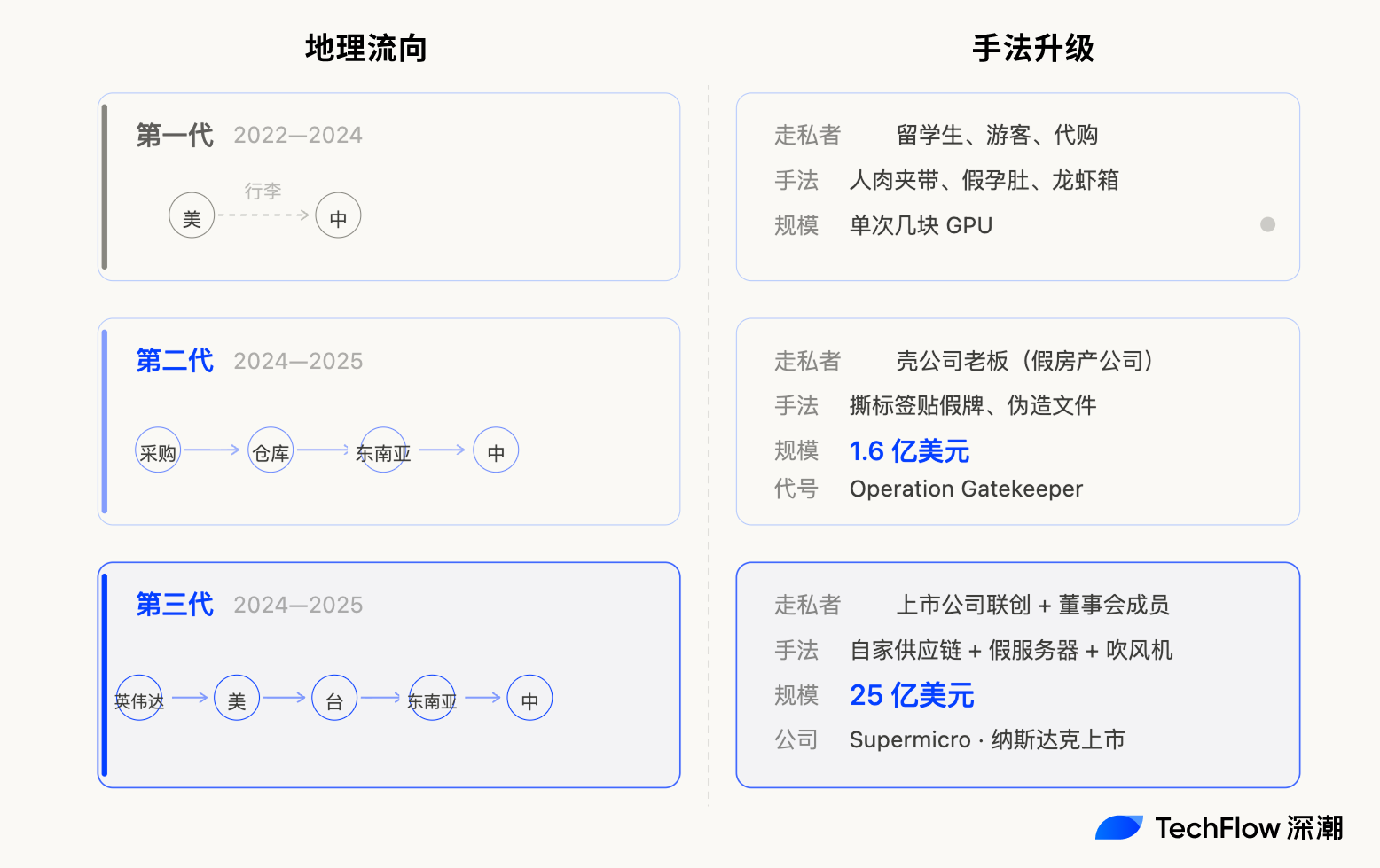
The second generation began using companies, "hanging sheep's head but selling dog meat."

In late 2025, the U.S. Department of Justice dismantled a smuggling network codenamed "Operation Gatekeeper." The main culprit was a man living in Houston named Alan Hsu, 43 years old. He used a company to purchase Nvidia chips in bulk from Lenovo and ship them to a warehouse in New Jersey.

This company was called Janford Realtor, registered as a real estate company.

It never conducted a single real estate transaction.

After the chips arrived at the warehouse, workers tore off Nvidia's original labels and stuck on the name of a fictional company—"SANDKYAN." They were then transshipped via Malaysia and Thailand, eventually entering China. The entire network moved over $160 million in goods in eight months.

The most dramatic moment in this case occurred during the takedown. FBI agents secretly infiltrated the New Jersey warehouse beforehand and quietly removed all the GPUs inside. The smugglers discovered the goods were missing, thought they had been stolen, and sent people to the warehouse to "redeem" them.

The ransom was negotiated to $1 million, and the person who came to make the exchange was caught red-handed by the FBI.

The third generation is the professionally involved, like Supermicro.

No longer fake companies, no longer middlemen, but the co-founder of a listed company personally managing the operation.

No need to buy chips from others; their own company is a core supplier to Nvidia. No need to forge buyer identities; using the company's own supply chain, its own customer relationships, its own quotas to apply for chips, and then internally bypassing its own company's compliance team.

From ant moving to fake real estate companies, to Silicon Valley listed company executives. The three generations of smugglers have only one thing in common:

The end buyers are all in China, and the chips are all Nvidia's.

The difference is, the person carrying a backpack through customs in 2022 was gambling with their freedom. The person sitting in a Silicon Valley office managing the operation in 2026 is gambling with a company worth tens of billions of dollars.

Every time the ban is upgraded, the profit from smuggling jumps a step, and the status of those willing to enter the game also jumps a step.

So how profitable is this business really?

The Black Market Price of a Chip

Why can't chip smuggling be stopped? The answer lies in the price.

According to multiple overseas media reports, the price of Nvidia's high-end GPUs on the Chinese black market is generally about 50% higher than the official channels in the U.S. The ban created a price difference, the price difference created profit, and the profit created smugglers.

Demand is rigid. Ray Wang, an analyst at semiconductor analysis firm SemiAnalysis, said in an interview with CNBC:

Over 60% of China's leading AI models currently still run on Nvidia hardware. Training a large model requires thousands of high-end GPUs; you can't start work even one short.

This means Chinese AI companies don't "want to buy" Nvidia chips; they "must buy" them.
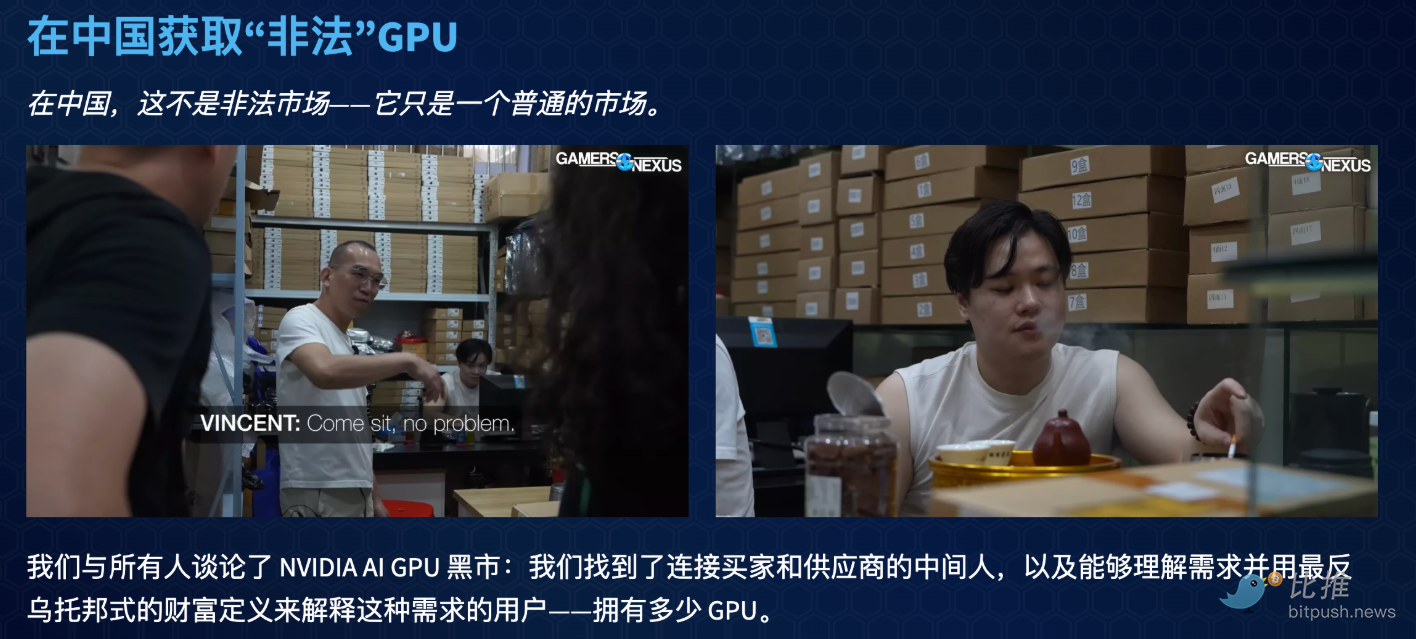
Image source: GamersNexus in-depth investigation of the Huaqiangbei chip market

What about the supply side?

After chips leave Nvidia's factory, they pass through distributors, system integrators, server manufacturers—every link is a potential entry point for smuggling. U.S. export controls mainly focus on the sales and shipping step, relying on buyers to self-declare the end user.

Once the chips leave the U.S., the subsequent steps basically rely on honesty.

A Financial Times report last year estimated that in just the three months after April 2025, over $1 billion worth of embargoed chips flowed into China through various channels. Industry insiders estimate the entire black market's monthly turnover could be on the order of $1 billion...

And ironically, the U.S. government's own policies have been wavering.

Last December, the Department of Justice high-profile announced the dismantling of the Operation Gatekeeper smuggling network, arresting several suspects. But on the same day, Trump announced on Truth Social: Allowing Nvidia to sell H200 chips to China.

Later, the U.S. government opened another loophole, allowing Nvidia to sell the less powerful H20 chips to China, on the condition that Nvidia pay 15% of the sales revenue to the U.S. government.

Cracking down on smuggling on one hand, selling themselves on the other, and even taking a cut. This makes the entire ban system very difficult to explain.

If you tell a chip broker that smuggling is illegal, he might reply: The government is selling them too, they just call it "conditional export."

The deeper paradox is that Nvidia is now the world's highest-valued company, with a market cap of $4.3 trillion. The more advanced its chips, the greater the demand, the higher the black market premium, and the more lucrative the smuggling.

A Hair Dryer Can't Blow Away Demand

What signal do people inside chip companies see when the government itself is both cracking down on smuggling and approving exports?

The protagonist of this article, Supermicro, also helped Musk build the Colossus AI computing cluster in 122 days and received $13 billion in Nvidia Blackwell orders last quarter.

The people who build the servers and the people who smuggle the servers are the same group.

A $2.5 billion smuggling case was finally brought down by a hair dryer. Surveillance footage captured workers using a hair dryer to peel off labels; it's now posted on the U.S. Department of Justice website for anyone to see.

The same week Liaw was arrested, Nvidia CEO Jensen Huang publicly stated that the company is facing a backlog of $1 trillion in chip orders.

A trillion dollars in demand is sitting there, and the black market premium is sitting there.

Perhaps the next person willing to pick up a hair dryer won't have to wait long.


Twitter:https://twitter.com/BitpushNewsCN

Bitpush TG Discussion Group:https://t.me/BitPushCommunity

Bitpush TG Subscription: https://t.me/bitpush

Original link:https://www.bitpush.news/articles/7621608

Preguntas relacionadas

QWhat was the role of Wally Liaw at Supermicro and what crime was he charged with?

AWally Liaw was a co-founder and senior vice president of Supermicro. He was charged with smuggling $2.5 billion worth of Nvidia AI chip servers to China through shell companies in Southeast Asia.

QWhat was the method used to deceive auditors and export control officials in the smuggling operation?

AThey created thousands of fake servers with identical exteriors but no chips inside. They used a hairdryer to heat and remove the serial number stickers from the real packaging and then applied them to the boxes of the fake servers to pass audits.

QWhy did the smuggling operation accelerate significantly in April and May 2025?

AThe operation accelerated because the U.S. government announced new AI product export control rules set to take effect in mid-May 2025. Liaw wanted to move as much inventory as possible before the stricter rules closed the existing loopholes.

QWhat is the estimated price premium for Nvidia's high-end GPUs on the Chinese black market according to the article?

ANvidia's high-end GPUs sell for approximately a 50% premium on the Chinese black market compared to official U.S. channels.

QWhat paradox does the article highlight regarding the U.S. government's policy on chip exports to China?

AThe article points out the paradox of the U.S. government cracking down on chip smuggling while simultaneously allowing Nvidia to sell certain chips to China under specific conditions, such as taking a 15% cut of the sales, which complicates the enforcement of the ban.

Lecturas Relacionadas

The Migration of Settlement Power: B18 and the Institutional Starting Point of On-Chain Banking

The article "The Migration of Settlement Power: B18 and the Institutional Starting Point of On-Chain Banking" discusses how traditional finance relies on settlement—not just transactions—to determine ownership of funds. While transactions are instantaneous, settlement requires time, counterparties, and system confirmation, during which users do not fully control their funds. In contrast, early DeFi (decentralized finance) focused on trading and liquidity while avoiding the fundamental question of who defines settlement in the absence of banks. B18, built on Coinbase’s on-chain infrastructure and operating on Base, aims to address this gap by transforming blockchain into a system that handles time, accounting, clearing order, and finality—functions traditionally managed by banks. B18 is not a typical DeFi protocol but an attempt to decouple banking from institutions and encode it into executable rules. Its capital structure reflects this ambition, with support from Paradigm and Wintermute Ventures at the protocol level, GSR Capital for market liquidity, FuturePay for real-world payment integration, and Base Ecosystem Fund builders who design the rules for fund recording, profit recognition, and liquidation conditions. Together, these layers form a new on-chain financial order where code, not institutions, governs settlement—shifting the power dynamics of finance. B18 represents the starting point of this migration. (Note: This is a submitted article and does not represent the views of ChainCatcher or constitute investment advice.)

marsbitHace 2 hora(s)

The Migration of Settlement Power: B18 and the Institutional Starting Point of On-Chain Banking

marsbitHace 2 hora(s)

From Tencent and Circle: Looking at the Easy and Hard Questions of Investment

The article contrasts the investment prospects of Tencent and Circle in the AI era, framing the decision as a choice between "easy" and "hard" problems, inspired by Charlie Munger's philosophy. Tencent's stock has declined despite strong earnings, as the market shifted from fearing insufficient AI investment to worrying about excessive spending. The author argues this pessimism is overdone. WeChat's nascent AI agent, Yuanbao, is seen as a prototype for a future, more powerful system-native agent. Crucially, this agent would have system-level permissions to seamlessly interact with the massive Mini Program ecosystem (housing apps like Meituan, Didi, etc.), making it a practical, usable product for billions. The author believes the high-probability success of this inevitable development makes investing in Tencent an "easy" decision that the market is currently overlooking. Conversely, Circle's recent rise is fueled by the AI narrative, specifically the belief that AI agents will require blockchain-based stablecoins for settlement, with USDC as the leading compliant option. The author deconstructs this bullish thesis, identifying high uncertainties in its core assumptions: whether AI transactions will *necessarily* use stablecoins (vs. other protocols like Google's UCP), USDC's ability to maintain its lead against competitors like Tether or PayPal, and whether stablecoins even possess strong network effects in an agent-dominated world where cost and friction are paramount. The compounding uncertainty makes investing in Circle a "hard" problem, riskier than market sentiment suggests. In summary, the author posits that Tencent presents a clear, high-probability opportunity (easy), while Circle's future is built on a chain of speculative assumptions (hard).

marsbitHace 2 hora(s)

From Tencent and Circle: Looking at the Easy and Hard Questions of Investment

marsbitHace 2 hora(s)

Trading

Spot
Futuros

Artículos destacados

Qué es $S$

Entendiendo SPERO: Una Visión General Completa Introducción a SPERO A medida que el panorama de la innovación continúa evolucionando, la aparición de tecnologías web3 y proyectos de criptomonedas juega un papel fundamental en la configuración del futuro digital. Un proyecto que ha atraído la atención en este campo dinámico es SPERO, denotado como SPERO,$$s$. Este artículo tiene como objetivo reunir y presentar información detallada sobre SPERO, para ayudar a entusiastas e inversores a comprender sus fundamentos, objetivos e innovaciones dentro de los dominios web3 y cripto. ¿Qué es SPERO,$$s$? SPERO,$$s$ es un proyecto único dentro del espacio cripto que busca aprovechar los principios de descentralización y tecnología blockchain para crear un ecosistema que promueva la participación, la utilidad y la inclusión financiera. El proyecto está diseñado para facilitar interacciones de igual a igual de nuevas maneras, proporcionando a los usuarios soluciones y servicios financieros innovadores. En su esencia, SPERO,$$s$ tiene como objetivo empoderar a los individuos al proporcionar herramientas y plataformas que mejoren la experiencia del usuario en el espacio de las criptomonedas. Esto incluye habilitar métodos de transacción más flexibles, fomentar iniciativas impulsadas por la comunidad y crear caminos para oportunidades financieras a través de aplicaciones descentralizadas (dApps). La visión subyacente de SPERO,$$s$ gira en torno a la inclusividad, buscando cerrar brechas dentro de las finanzas tradicionales mientras aprovecha los beneficios de la tecnología blockchain. ¿Quién es el Creador de SPERO,$$s$? La identidad del creador de SPERO,$$s$ sigue siendo algo oscura, ya que hay recursos públicos limitados que proporcionan información de fondo detallada sobre su(s) fundador(es). Esta falta de transparencia puede derivarse del compromiso del proyecto con la descentralización, una ética que muchos proyectos web3 comparten, priorizando las contribuciones colectivas sobre el reconocimiento individual. Al centrar las discusiones en torno a la comunidad y sus objetivos colectivos, SPERO,$$s$ encarna la esencia del empoderamiento sin señalar a individuos específicos. Como tal, comprender la ética y la misión de SPERO sigue siendo más importante que identificar a un creador singular. ¿Quiénes son los Inversores de SPERO,$$s$? SPERO,$$s$ cuenta con el apoyo de una diversa gama de inversores que van desde capitalistas de riesgo hasta inversores ángeles dedicados a fomentar la innovación en el sector cripto. El enfoque de estos inversores generalmente se alinea con la misión de SPERO, priorizando proyectos que prometen avances tecnológicos sociales, inclusión financiera y gobernanza descentralizada. Estas fundaciones de inversores suelen estar interesadas en proyectos que no solo ofrecen productos innovadores, sino que también contribuyen positivamente a la comunidad blockchain y sus ecosistemas. El respaldo de estos inversores refuerza a SPERO,$$s$ como un contendiente notable en el dominio de proyectos cripto que evoluciona rápidamente. ¿Cómo Funciona SPERO,$$s$? SPERO,$$s$ emplea un marco multifacético que lo distingue de los proyectos de criptomonedas convencionales. Aquí hay algunas de las características clave que subrayan su singularidad e innovación: Gobernanza Descentralizada: SPERO,$$s$ integra modelos de gobernanza descentralizada, empoderando a los usuarios para participar activamente en los procesos de toma de decisiones sobre el futuro del proyecto. Este enfoque fomenta un sentido de propiedad y responsabilidad entre los miembros de la comunidad. Utilidad del Token: SPERO,$$s$ utiliza su propio token de criptomoneda, diseñado para servir diversas funciones dentro del ecosistema. Estos tokens permiten transacciones, recompensas y la facilitación de servicios ofrecidos en la plataforma, mejorando la participación y la utilidad general. Arquitectura en Capas: La arquitectura técnica de SPERO,$$s$ apoya la modularidad y escalabilidad, permitiendo la integración fluida de características y aplicaciones adicionales a medida que el proyecto evoluciona. Esta adaptabilidad es fundamental para mantener la relevancia en el cambiante paisaje cripto. Participación de la Comunidad: El proyecto enfatiza iniciativas impulsadas por la comunidad, empleando mecanismos que incentivan la colaboración y la retroalimentación. Al nutrir una comunidad sólida, SPERO,$$s$ puede abordar mejor las necesidades de los usuarios y adaptarse a las tendencias del mercado. Enfoque en la Inclusión: Al ofrecer tarifas de transacción bajas e interfaces amigables para el usuario, SPERO,$$s$ busca atraer a una base de usuarios diversa, incluyendo a individuos que anteriormente pueden no haber participado en el espacio cripto. Este compromiso con la inclusión se alinea con su misión general de empoderamiento a través de la accesibilidad. Cronología de SPERO,$$s$ Entender la historia de un proyecto proporciona información crucial sobre su trayectoria de desarrollo y hitos. A continuación se presenta una cronología sugerida que mapea eventos significativos en la evolución de SPERO,$$s$: Fase de Conceptualización e Ideación: Las ideas iniciales que forman la base de SPERO,$$s$ fueron concebidas, alineándose estrechamente con los principios de descentralización y enfoque comunitario dentro de la industria blockchain. Lanzamiento del Whitepaper del Proyecto: Tras la fase conceptual, se lanzó un whitepaper completo que detalla la visión, los objetivos y la infraestructura tecnológica de SPERO,$$s$ para generar interés y retroalimentación de la comunidad. Construcción de Comunidad y Primeras Interacciones: Se realizaron esfuerzos de divulgación activa para construir una comunidad de primeros adoptantes y posibles inversores, facilitando discusiones en torno a los objetivos del proyecto y obteniendo apoyo. Evento de Generación de Tokens: SPERO,$$s$ llevó a cabo un evento de generación de tokens (TGE) para distribuir sus tokens nativos a los primeros seguidores y establecer liquidez inicial dentro del ecosistema. Lanzamiento de la dApp Inicial: La primera aplicación descentralizada (dApp) asociada con SPERO,$$s$ se puso en marcha, permitiendo a los usuarios interactuar con las funcionalidades centrales de la plataforma. Desarrollo Continuo y Alianzas: Actualizaciones y mejoras continuas a las ofertas del proyecto, incluyendo alianzas estratégicas con otros actores en el espacio blockchain, han moldeado a SPERO,$$s$ en un jugador competitivo y en evolución en el mercado cripto. Conclusión SPERO,$$s$ se erige como un testimonio del potencial de web3 y las criptomonedas para revolucionar los sistemas financieros y empoderar a los individuos. Con un compromiso con la gobernanza descentralizada, la participación comunitaria y funcionalidades diseñadas de manera innovadora, allana el camino hacia un paisaje financiero más inclusivo. Como con cualquier inversión en el espacio cripto que evoluciona rápidamente, se anima a los posibles inversores y usuarios a investigar a fondo y participar de manera reflexiva con los desarrollos en curso dentro de SPERO,$$s$. El proyecto muestra el espíritu innovador de la industria cripto, invitando a una mayor exploración de sus innumerables posibilidades. Mientras el viaje de SPERO,$$s$ aún se desarrolla, sus principios fundamentales pueden, de hecho, influir en el futuro de cómo interactuamos con la tecnología, las finanzas y entre nosotros en ecosistemas digitales interconectados.

72 Vistas totalesPublicado en 2024.12.17Actualizado en 2024.12.17

Qué es $S$

Qué es AGENT S

Agent S: El Futuro de la Interacción Autónoma en Web3 Introducción En el paisaje en constante evolución de Web3 y las criptomonedas, las innovaciones están redefiniendo constantemente cómo los individuos interactúan con las plataformas digitales. Uno de estos proyectos pioneros, Agent S, promete revolucionar la interacción humano-computadora a través de su marco agente abierto. Al allanar el camino para interacciones autónomas, Agent S busca simplificar tareas complejas, ofreciendo aplicaciones transformadoras en inteligencia artificial (IA). Esta exploración detallada profundizará en las complejidades del proyecto, sus características únicas y las implicaciones para el dominio de las criptomonedas. ¿Qué es Agent S? Agent S se presenta como un marco agente abierto innovador, diseñado específicamente para abordar tres desafíos fundamentales en la automatización de tareas informáticas: Adquisición de Conocimiento Específico del Dominio: El marco aprende inteligentemente de diversas fuentes de conocimiento externas y experiencias internas. Este enfoque dual le permite construir un rico repositorio de conocimiento específico del dominio, mejorando su rendimiento en la ejecución de tareas. Planificación a Largo Plazo de Tareas: Agent S emplea planificación jerárquica aumentada por la experiencia, un enfoque estratégico que facilita la descomposición y ejecución eficiente de tareas complejas. Esta característica mejora significativamente su capacidad para gestionar múltiples subtareas de manera eficiente y efectiva. Manejo de Interfaces Dinámicas y No Uniformes: El proyecto introduce la Interfaz Agente-Computadora (ACI), una solución innovadora que mejora la interacción entre agentes y usuarios. Utilizando Modelos de Lenguaje Multimodal de Gran Escala (MLLMs), Agent S puede navegar y manipular diversas interfaces gráficas de usuario sin problemas. A través de estas características pioneras, Agent S proporciona un marco robusto que aborda las complejidades involucradas en la automatización de la interacción humana con las máquinas, preparando el terreno para una multitud de aplicaciones en IA y más allá. ¿Quién es el Creador de Agent S? Si bien el concepto de Agent S es fundamentalmente innovador, la información específica sobre su creador sigue siendo elusiva. El creador es actualmente desconocido, lo que resalta ya sea la etapa incipiente del proyecto o la elección estratégica de mantener a los miembros fundadores en el anonimato. Independientemente de la anonimidad, el enfoque sigue siendo en las capacidades y el potencial del marco. ¿Quiénes son los Inversores de Agent S? Dado que Agent S es relativamente nuevo en el ecosistema criptográfico, la información detallada sobre sus inversores y patrocinadores financieros no está documentada explícitamente. La falta de información disponible públicamente sobre las bases de inversión u organizaciones que apoyan el proyecto plantea preguntas sobre su estructura de financiamiento y hoja de ruta de desarrollo. Comprender el respaldo es crucial para evaluar la sostenibilidad del proyecto y su posible impacto en el mercado. ¿Cómo Funciona Agent S? En el núcleo de Agent S se encuentra una tecnología de vanguardia que le permite funcionar de manera efectiva en diversos entornos. Su modelo operativo se basa en varias características clave: Interacción Humano-Computadora Similar a la Humana: El marco ofrece planificación avanzada de IA, esforzándose por hacer que las interacciones con las computadoras sean más intuitivas. Al imitar el comportamiento humano en la ejecución de tareas, promete elevar las experiencias de los usuarios. Memoria Narrativa: Empleada para aprovechar experiencias de alto nivel, Agent S utiliza memoria narrativa para hacer un seguimiento de las historias de tareas, mejorando así sus procesos de toma de decisiones. Memoria Episódica: Esta característica proporciona a los usuarios una guía paso a paso, permitiendo que el marco ofrezca apoyo contextual a medida que se desarrollan las tareas. Soporte para OpenACI: Con la capacidad de ejecutarse localmente, Agent S permite a los usuarios mantener el control sobre sus interacciones y flujos de trabajo, alineándose con la ética descentralizada de Web3. Fácil Integración con APIs Externas: Su versatilidad y compatibilidad con varias plataformas de IA aseguran que Agent S pueda encajar sin problemas en ecosistemas tecnológicos existentes, convirtiéndolo en una opción atractiva para desarrolladores y organizaciones. Estas funcionalidades contribuyen colectivamente a la posición única de Agent S dentro del espacio cripto, ya que automatiza tareas complejas y de múltiples pasos con una intervención humana mínima. A medida que el proyecto evoluciona, sus posibles aplicaciones en Web3 podrían redefinir cómo se desarrollan las interacciones digitales. Cronología de Agent S El desarrollo y los hitos de Agent S pueden encapsularse en una cronología que resalta sus eventos significativos: 27 de septiembre de 2024: El concepto de Agent S fue lanzado en un documento de investigación integral titulado “Un Marco Agente Abierto que Usa Computadoras Como un Humano”, mostrando las bases del proyecto. 10 de octubre de 2024: El documento de investigación fue puesto a disposición del público en arXiv, ofreciendo una exploración profunda del marco y su evaluación de rendimiento basada en el benchmark OSWorld. 12 de octubre de 2024: Se lanzó una presentación en video, proporcionando una visión visual de las capacidades y características de Agent S, involucrando aún más a posibles usuarios e inversores. Estos marcadores en la cronología no solo ilustran el progreso de Agent S, sino que también indican su compromiso con la transparencia y la participación comunitaria. Puntos Clave Sobre Agent S A medida que el marco Agent S continúa evolucionando, varios atributos clave destacan, subrayando su naturaleza innovadora y potencial: Marco Innovador: Diseñado para proporcionar un uso intuitivo de las computadoras similar a la interacción humana, Agent S aporta un enfoque novedoso a la automatización de tareas. Interacción Autónoma: La capacidad de interactuar de manera autónoma con las computadoras a través de GUI significa un salto hacia soluciones informáticas más inteligentes y eficientes. Automatización de Tareas Complejas: Con su metodología robusta, puede automatizar tareas complejas y de múltiples pasos, haciendo que los procesos sean más rápidos y menos propensos a errores. Mejora Continua: Los mecanismos de aprendizaje permiten a Agent S mejorar a partir de experiencias pasadas, mejorando continuamente su rendimiento y eficacia. Versatilidad: Su adaptabilidad en diferentes entornos operativos como OSWorld y WindowsAgentArena asegura que pueda servir a una amplia gama de aplicaciones. A medida que Agent S se posiciona en el paisaje de Web3 y criptomonedas, su potencial para mejorar las capacidades de interacción y automatizar procesos significa un avance significativo en las tecnologías de IA. A través de su marco innovador, Agent S ejemplifica el futuro de las interacciones digitales, prometiendo una experiencia más fluida y eficiente para los usuarios en diversas industrias. Conclusión Agent S representa un audaz avance en la unión de la IA y Web3, con la capacidad de redefinir cómo interactuamos con la tecnología. Aunque aún se encuentra en sus primeras etapas, las posibilidades para su aplicación son vastas y atractivas. A través de su marco integral que aborda desafíos críticos, Agent S busca llevar las interacciones autónomas al primer plano de la experiencia digital. A medida que nos adentramos más en los reinos de las criptomonedas y la descentralización, proyectos como Agent S sin duda desempeñarán un papel crucial en la configuración del futuro de la tecnología y la colaboración humano-computadora.

264 Vistas totalesPublicado en 2025.01.14Actualizado en 2025.01.14

Qué es AGENT S

Cómo comprar S

¡Bienvenido a HTX.com! Hemos hecho que comprar Sonic (S) sea simple y conveniente. Sigue nuestra guía paso a paso para iniciar tu viaje de criptos.Paso 1: crea tu cuenta HTXUtiliza tu correo electrónico o número de teléfono para registrarte y obtener una cuenta gratuita en HTX. Experimenta un proceso de registro sin complicaciones y desbloquea todas las funciones.Obtener mi cuentaPaso 2: ve a Comprar cripto y elige tu método de pagoTarjeta de crédito/débito: usa tu Visa o Mastercard para comprar Sonic (S) al instante.Saldo: utiliza fondos del saldo de tu cuenta HTX para tradear sin problemas.Terceros: hemos agregado métodos de pago populares como Google Pay y Apple Pay para mejorar la comodidad.P2P: tradear directamente con otros usuarios en HTX.Over-the-Counter (OTC): ofrecemos servicios personalizados y tipos de cambio competitivos para los traders.Paso 3: guarda tu Sonic (S)Después de comprar tu Sonic (S), guárdalo en tu cuenta HTX. Alternativamente, puedes enviarlo a otro lugar mediante transferencia blockchain o utilizarlo para tradear otras criptomonedas.Paso 4: tradear Sonic (S)Tradear fácilmente con Sonic (S) en HTX's mercado spot. Simplemente accede a tu cuenta, selecciona tu par de trading, ejecuta tus trades y monitorea en tiempo real. Ofrecemos una experiencia fácil de usar tanto para principiantes como para traders experimentados.

304 Vistas totalesPublicado en 2025.01.15Actualizado en 2025.03.21

Cómo comprar S

Discusiones

Bienvenido a la comunidad de HTX. Aquí puedes mantenerte informado sobre los últimos desarrollos de la plataforma y acceder a análisis profesionales del mercado. A continuación se presentan las opiniones de los usuarios sobre el precio de S (S).

活动图片