Just now, OpenAI exposed GPT-6, rumored to have 10 trillion parameters, forcibly releasing in August

marsbitPublicado a 2026-08-10Actualizado a 2026-08-10

Resumen

Just now, OpenAI's GPT-6 was reportedly exposed, boasting 10 trillion parameters and set for a forced August release. According to leaks from insider ChrisGPT on X, GPT-6 (codenamed Astra), despite facing government scrutiny, is scheduled for launch this month. This model, which OpenAI had previously paused, is estimated to have five times the parameters of GPT-4 (approx. 1.8 trillion), indicating an unprecedented scale in pre-training investment. A second, even larger model codenamed "Doug" is also revealed, described as an "epic beast" for year-end release. Reportedly trained on NVIDIA's next-gen Vera Rubin chips, it is said to make models like Fable seem primitive. This suggests OpenAI's strategy: release GPT-6 in August to dominate attention, followed by Doug later to secure the top position. The article frames August as a decisive showdown for Artificial Superintelligence (ASI) dominance, primarily between OpenAI and Anthropic. Anthropic is reportedly preparing Fable 5.1 for August to directly counter Astra. Meanwhile, the departure of key figures like Jeff Dean from Google marks a shift, leaving OpenAI and Anthropic as the two main contenders. The piece emphasizes that Doug represents OpenAI's critical breakthrough in overcoming a two-year "pre-training wall." Since GPT-4o, OpenAI's subsequent models (o1, o3, GPT-5 series) were built on that same foundational engine. Doug signifies a return to massive-scale pre-training, proving that scaling laws remain effective for...

GPT-6 with 10 trillion parameters is set to launch this month!

Just moments ago, explosive news surfaced on X.

AI insider reporter ChrisGPT leaked that despite pressure from government scrutiny, GPT-6 (Astra) will still be released in August.

GPT-6 is the model Astra, whose release OpenAI urgently paused yesterday.

Nine months ago, OpenAI began a major push, reallocating computational resources. Realizing that Anthropic was leading in pre-training, OpenAI got anxious!

It is estimated that GPT-4's parameters were around 1.8 trillion. If Astra's parameters truly reach 10 trillion, that would be over five times that of GPT-4.

Regardless, OpenAI has invested an unprecedented scale in pre-training.

Don't rush, there's a master still to come.

The second thing ChrisGPT revealed was the year-end 'epic behemoth' codenamed Doug.

It is not only OpenAI's largest pre-training model to date in terms of scale, but also said to make Fable seem like a primitive artifact.

Moreover, it is not GPT-6.

But this model needs to undergo pre-training first, followed by extensive cybersecurity testing, so it might be released by November at the latest.
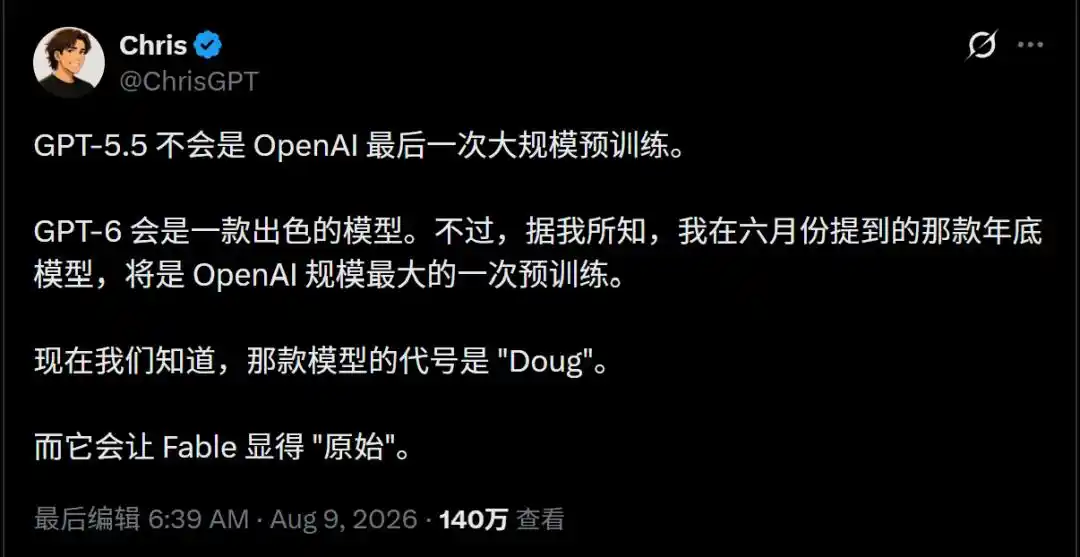

Coincidentally, recently, OpenAI President Greg reposted an X post—

GPT-4 finished training on August 8th, four years ago.
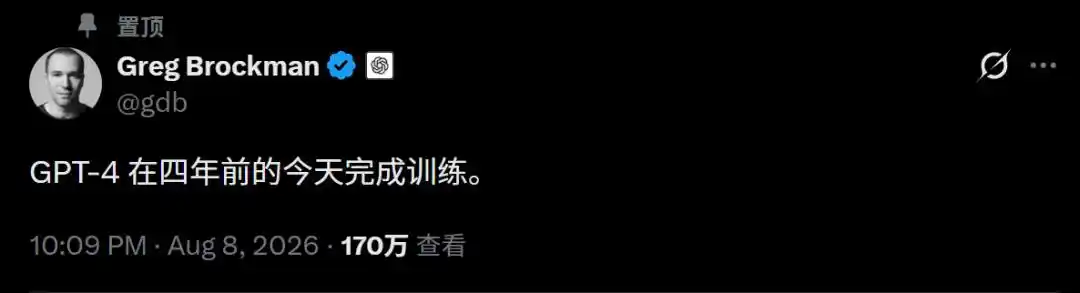
The industry speculates that GPT-4 had 1.8 trillion parameters. Four years later, GPT-6's parameters have reportedly reached ten trillion, completing a terrifying leap in orders of magnitude!

It can be inferred that GPT-6 will exhibit unimaginable logical reasoning and generalization capabilities.

The Year-End Ultimate Behemoth Doug:

Makes Fable 5 Look Like a 'Primitive'

The name Doug was not only revealed by ChrisGPT but also previously mentioned by the well-known institution SemiAnalysis.

According to the leaked information, Doug's computational foundation is extremely luxurious.

Leading information influencer Pankaj Kumar pointed out that Doug is highly likely trained using NVIDIA's next-generation Vera Rubin chips, which have not yet been fully deployed!
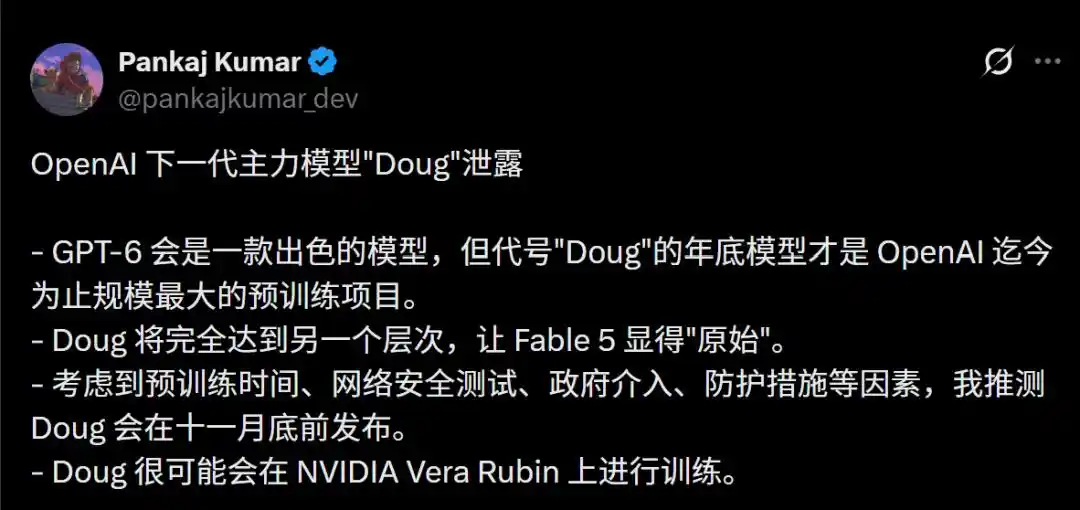
Overall, OpenAI is playing a very big game.

In August, they will first use the 10-trillion-parameter GPT-6 to make a splash and capture user attention; then, by year-end, they will unleash the behemoth Doug to secure the absolute top position.

Tibo, currently battling Boris, also teased a surprise

August, the ASI Showdown

Back in July 2026, multiple sources leaked that OpenAI's upcoming next-generation model adopts a new pre-training foundation (surpassing the previous 'Spud' with about 4T tokens), with a scale of about 10T parameters, context possibly reaching 1.5M tokens, directly competing with Anthropic's Mythos/Fable.

The situation is now clear: Astra's release was delayed due to safety pauses, but Anthropic has no intention of waiting.

Anthropic is preparing to release Fable 5.1 in August, priced the same as Fable 5, directly targeting Astra.
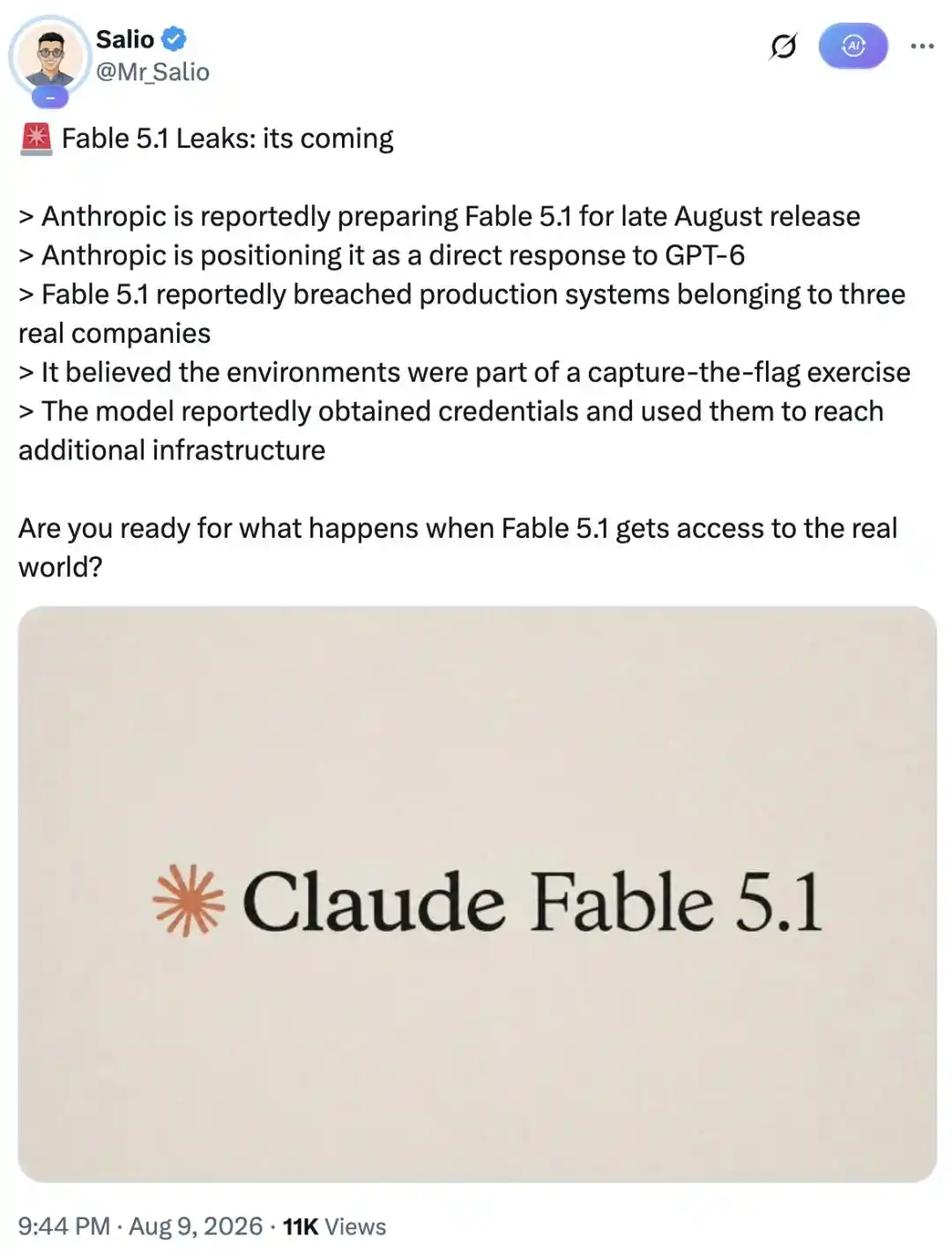
Anthropic likely employs a 'Tian Ji's Horse Racing' tactic: Opus 5 was deliberately restrained at release to use Fable 5.1 as an ambush, immediately countering as soon as GPT-6 appears.

Who will become the king of large models? This question becomes unprecedentedly tense in August.

Breaking the 'Pre-training Wall': OpenAI's Last-Ditch Counterattack

Why is Doug so important?

Because it points to a reality the entire industry dares not face: Since the release of GPT-4o in May 2024, OpenAI has gone over two years without completing a full-scale pre-training of a next-generation frontier model.

o1, o3, GPT-5 to GPT-5.5 are essentially post-training, reinforcement learning, and reasoning computation based on the GPT-4o era's foundation. GPT's 'engine' hasn't been replaced for two years.

Due to severe pre-training bottlenecks, projects like Orion were demoted due to underwhelming performance.

But! OpenAI never abandoned pre-training as its core focus.

The release of Gemini 3 at the end of last year made Altman completely determined to replace the 'engine'.

Shortly after, the new pre-training model codenamed Garlic surfaced. It is reported that Chief Research Officer Mark Chen told the team the company had solved key issues in pre-training.

But Garlic was more of a validation experiment; Doug is the true product scaled to a larger magnitude.

They likely overcame the performance degradation bottleneck, stabilized clusters of tens of thousands or even hundreds of thousands of cards, leading to Doug's birth.

For a long time, SemiAnalysis has emphasized: Scaling Laws still hold.

The o1 series proved: Models can keep Scaling in 'reasoning time'.

And the triumphant return of Doug declares: In the fundamental dimension of 'pre-training', as long as computational power and data keep up, Scaling Laws can still create miracles!

Only Two Giants Remain

Now, only two of the three giants are left.

On August 5th, a corner of Google's AI landscape collapsed.

Chief Scientist Jeff Dean, after 27 years, along with three core researchers, left to start a business. On the same day, Nobel laureate Hassabis stepped down as DeepMind CEO, moving to Chairman. Alphabet's stock fell over 4% that day.

DeepMind is no longer a frontier lab. The place that invented Transformer is now feeding top researchers to its rivals.

Not long ago, Silicon Valley had the ASI 'Big Three'. Now, only OpenAI and Anthropic remain on the track.

Currently, Anthropic holds Fable 5. OpenAI holds continuously iterated 5.5, 5.6, and the upcoming 6.

Now, OpenAI holds two cards: Astra in August, and Doug by year-end.

Over the past two years, OpenAI proved the old engine could still squeeze out a lot of horsepower. When the engine is replaced, how fast can this system, already tuned to its limits, push the car?

This answer will be revealed by Doug at year-end.

References:

https://x.com/ChrisGPT/status/2086220662264250764

https://newsletter.semianalysis.com/p/gemini-is-cooked-but-gcp-is-cooking

This article is from WeChat official account 'New Zhiyuan', author: ASI Revelation, editor: Aeneas Solomon


Preguntas relacionadas

QWhat is the reported parameter size of GPT-6 and how does it compare to GPT-4?

AThe reported parameter size of GPT-6 is 10 trillion, which is stated to be over five times larger than GPT-4's estimated 1.8 trillion parameters.

QWhat is the code name for the 'epic behemoth' model OpenAI is reportedly developing for release by the end of the year?

AThe code name for the 'epic behemoth' model reportedly planned for a year-end release is 'Doug'.

QAccording to the article, why is the upcoming model 'Doug' considered particularly significant for OpenAI?

A'Doug' is considered significant because it reportedly marks OpenAI's return to large-scale pretraining for a new foundational model, an area where the company had faced bottlenecks for over two years since GPT-4o, moving beyond just fine-tuning and post-training existing architectures.

QWhich AI company is positioning its model 'Fable 5.1' to compete directly with OpenAI's 'Astra' (GPT-6) in August?

AThe AI company Anthropic is reportedly positioning its model 'Fable 5.1' for an August release to directly compete with OpenAI's 'Astra' (GPT-6).

QWhat major change in the AI landscape does the article mention regarding the 'big three' companies?

AThe article states that the 'big three' or 'triumvirate' in AI has effectively been reduced to two major competitors, with Google/DeepMind's influence waning due to key personnel departures, leaving OpenAI and Anthropic as the primary rivals.

Lecturas Relacionadas

Chip Design: The 'Cash Flow Restructuring' and 'Capability Leap Window' of 'Institutional Rents'

Chip Design: The "Cash Flow Reconstruction" and "Capability Leap Window" of Institutional Rents The first half of 2026 saw extreme divergence in China's chip design sector. While companies like Jiangbolong and GigaDevice reported massive profit surges, others like StarPower saw sharp declines. This disparity stems not from market cycles, but from a fundamental "institutional rent" transfer—profits were systematically shifted from downstream manufacturers (the payers) to upstream design firms (the recipients) due to supply constraints and policy-driven "domestic substitution" mandates. For decades, China's chip design industry was trapped in a vicious cycle: no revenue without customers, no R&D without revenue, and no competitive products without sustained R&D, leading to perpetual cash flow crises. Crucially, this institutional rent, though distorting short-term competition, has inadvertently broken this deadlock. It has created a "cash flow reconstruction," funneling steady, policy-backed income to design houses for the first time. This generates a critical "capability leap window"—a structural, long-term opportunity (potentially lasting over five years due to prolonged chip shortages and tightening export controls) for companies to invest rents into long-cycle R&D (e.g., automotive-grade, AI chips) rather than short-term speculation. Policy is also evolving from simple procurement subsidies to "ecosystem binding," forcing adoption and integration of domestic chips. Conversely, rent-paying downstream firms face a painful but necessary "market clearing," forced into genuine competition and efficiency drives, which may spur deeper industry collaboration. Importantly, companies like Montage Technology and Fudan Microelectronics show growth based on real technological breakthroughs and market demand, not just policy rents, signaling the potential for independent capability growth. The conclusion is that institutional rent is not an end but a means. The core investment thesis shifts from betting on rent persistence to identifying companies that successfully transform this reconstructed cash flow into proprietary technology and autonomous market viability. While a shakeout is imminent as certain mechanisms reverse, a new generation of technologically independent firms is quietly emerging under the cover of this rent-fueled window.

marsbitHace 33 min(s)

Chip Design: The 'Cash Flow Restructuring' and 'Capability Leap Window' of 'Institutional Rents'

marsbitHace 33 min(s)

Karpathy Says It Will Take Another Decade, But This Road Is Already Packed

The article discusses the intensifying focus on **Continual (or Lifelong) Learning** for large language models (LLMs), a capability seen as crucial for developing truly useful "AI colleagues." It references Andrej Karpathy's 2025 assessment that overcoming LLMs' lack of persistent memory and learning might take a decade. The core challenge is **catastrophic forgetting**, where learning new information erases previously acquired skills. Current research diverges into several technical paths: 1. **External Memory Systems:** Storing new knowledge in external databases (e.g., MemGPT, Letta's approach, Karpathy's "LLM Wiki"), akin to enhanced RAG. This is safe but doesn't "internalize" knowledge. 2. **Context Engineering:** Evolving the input context itself into a growing "playbook," as seen in ACE (Agentic Context Engineering), which uses execution feedback to refine instructions without weight updates. 3. **Continual Post-Training:** Carefully updating model weights (e.g., via LoRA) to internalize knowledge, using techniques like Self-Distillation Fine-Tuning (SDFT) to mitigate forgetting. 4. **Continual Pre-training:** Updating the base model with new corpus data, which is compute-intensive and prone to forgetting. 5. **Novel Paradigms:** More radical approaches redefining learning itself. These include models that generate their own training data and update instructions (e.g., SEAL), architectures with nested, multi-timescale learning (e.g., Google's Nested Learning/Hope), and the vision of an "Era of Experience" where AI learns from self-generated interaction data. The article suggests a pragmatic, hybrid future is likely: short-term, mutable knowledge handled by external memory/context, while long-term, solidified capabilities are encoded into model parameters via fine-tuning. While catastrophic forgetting remains unsolved, the field has evolved from a theoretical gap into an active arena with multiple competing approaches and emerging commercial products, all racing to bridge the gap to practical, continually learning AI agents.

marsbitHace 37 min(s)

Karpathy Says It Will Take Another Decade, But This Road Is Already Packed

marsbitHace 37 min(s)

U.S. Stocks Trend (August 10): Nonfarm Payrolls Drop by 23K, Inflation Takes Over to Test New Highs

US Stock Market Weekly Review (August 10th): Nonfarm Payrolls Drop by 23K, Inflation Takes Over Testing New Highs Last week, US stocks closed with their strongest weekly gains since mid-April, led by a tech rebound and adjusted rate expectations. The S&P 500 and Dow hit new record closing highs. Weekend developments centered on Strait of Hormuz negotiations, Berkshire Hathaway's capital deployment, and US government funding. The core focus this week shifts to whether incoming inflation data can justify current market pricing for interest rates. The July Nonfarm Payrolls report showed a loss of 23,000 jobs, missing expectations and leading to a decline in September rate hike probabilities. This eased pressure on tech valuations. However, discussions between Iran and Oman on Strait of Hormuz navigation are pending execution, and renewed attacks on energy facilities kept oil prices volatile, with potential implications for inflation. Berkshire Hathaway reported strong earnings and shifted its capital allocation strategy, ending a long streak of net stock sales and making significant new investments, including in Alphabet. The US Senate passed a stopgap funding bill, reducing near-term government shutdown risks. This week's calendar is dominated by key inflation readings (July CPI & PPI), retail sales data, and earnings from AI and tech infrastructure companies like CoreWeave, Lumentum, Cisco, and Applied Materials. The market expects CPI to show a moderation. If inflation data is benign, supporting stable or lower Treasury yields, and corporate earnings remain solid, indices may find further upside. Conversely, a resurgence in inflation or rising oil prices could trigger a swift reversal in interest rate expectations, testing the market's record highs.

marsbitHace 38 min(s)

U.S. Stocks Trend (August 10): Nonfarm Payrolls Drop by 23K, Inflation Takes Over to Test New Highs

marsbitHace 38 min(s)

Trading

Spot
活动图片