After Three Years of Reducing Stock Holdings, Warren Buffett Finally Makes a Move

Odaily星球日报Publicado a 2026-08-10Actualizado a 2026-08-10

Resumen

After three consecutive years of net stock sales, Berkshire Hathaway, under the leadership of CEO Greg Abel, has returned to net buying. According to its Q2 2026 earnings report, the conglomerate made net stock purchases of approximately $19.8 billion, including a significant $10 billion private investment in Alphabet (Google's parent company), making it a top-five holding. This marks a strategic shift under Abel's tenure, suggesting increased comfort with major tech investments. The quarter also saw Berkshire resume share buybacks, spending about $4.5 billion. Consequently, its massive cash and Treasury holdings decreased from a peak near $400 billion to about $364.7 billion. The report contrasts Berkshire's recent patience—criticized during the AI/semiconductor market frenzy—with its disciplined approach of waiting for reasonable prices. The move underscores the firm's long-term value investing philosophy, using its cash reserves to act decisively when market conditions align.

Original | Odaily Planet Daily(@OdailyChina)

Author | Azuma(@azuma_eth)

After the US stock market closed on August 9, Beijing time, Berkshire Hathaway announced its financial report for the second quarter of 2026.

The financial report data shows that Berkshire's total revenue for the second quarter of 2026 reached $101.808 billion, an increase of about 10% year-on-year. The net profit attributable to shareholders was $25.667 billion, doubling compared to the same period last year (an increase of about 107%). Both operating profit and net profit significantly exceeded market expectations.

However, the more significant signal in the financial report is that Berkshire Hathaway finally ended a streak of net stock sales lasting over three years (14 quarters) and shifted to net purchases.

With $400 Billion in Cash on Hand, Berkshire Finally Takes Action

Financial report data shows that in the second quarter, Berkshire Hathaway purchased approximately $23.47 billion worth of stocks while selling only $3.69 billion, resulting in net purchases of nearly $19.8 billion, ending the long-standing net selling trend that began in 2023.

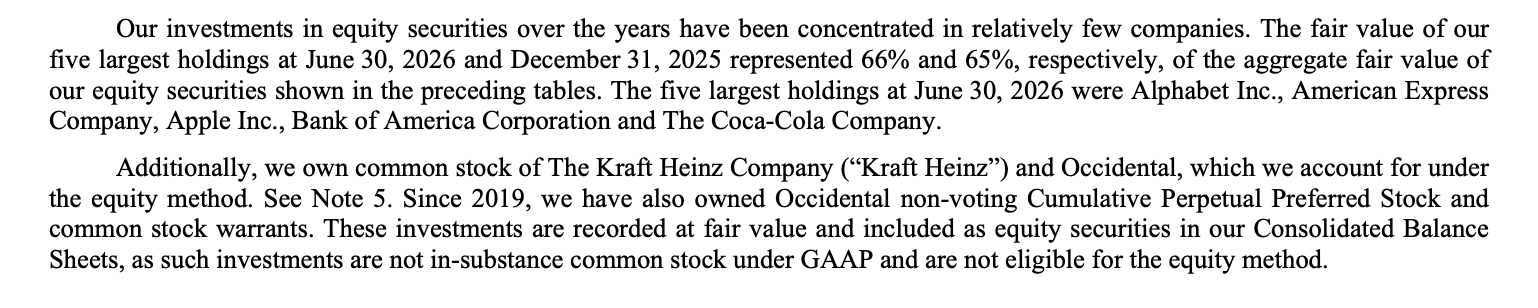
Of greater interest to investors is the allocation of these funds. The financial report disclosed that Berkshire Hathaway's largest single move last quarter was an additional investment of approximately $10 billion in Alphabet (Google's parent company) through a private placement. This officially places Google among Berkshire Hathaway's top five largest holdings by market value – alongside American Express, Apple, Bank of America, and Coca-Cola. As of the end of June, these five holdings collectively accounted for 66% of the stock investment portfolio, indicating that portfolio concentration remains extremely high.
Although Warren Buffett himself has long maintained a cautious stance toward technology stocks, he previously revealed when first building a position in Google that the investment was a joint decision made after consulting with Greg Abel (the current CEO of Berkshire Hathaway, who officially succeeded Buffett on January 1 of this year). Buffett also admitted that missing out on Google early on was a "historic mistake." This later investment, essentially a "make-up purchase," was based on value investment logic, focusing on its search monopoly moat and stable cash flow.

This latest $10 billion increase is an investment decision made under the leadership of the new CEO, Greg Abel – this perhaps indicates that under the new regime with Buffett stepping back and Abel in charge, Berkshire Hathaway's tolerance for and participation in the technological frontier is increasing.

In addition to resuming net purchases in the market, Berkshire Hathaway also conducted its first stock buyback in two years during the second quarter. The financial report disclosed that the company spent a total of approximately $4.527 billion on buybacks last quarter, reaching a single-quarter high not seen since 2021; it added over $3.3 billion more for buybacks in July.

In March of this year, Berkshire Hathaway announced the restart of its stock repurchase program. Abel stated at the time that the buybacks were because management believed the company's stock's "intrinsic value" exceeded its market price.

With the shift in investment and buyback pace, the massive cash reserves that Berkshire Hathaway had accumulated over the long term also began to change. In recent years, one of the company's biggest labels has been a "cash machine." Due to a lack of large-scale opportunities meeting Buffett's investment criteria, the company's cash and short-term U.S. Treasury holdings continued to climb, reaching a historical high of nearly $400 billion by the end of the first quarter of this year.

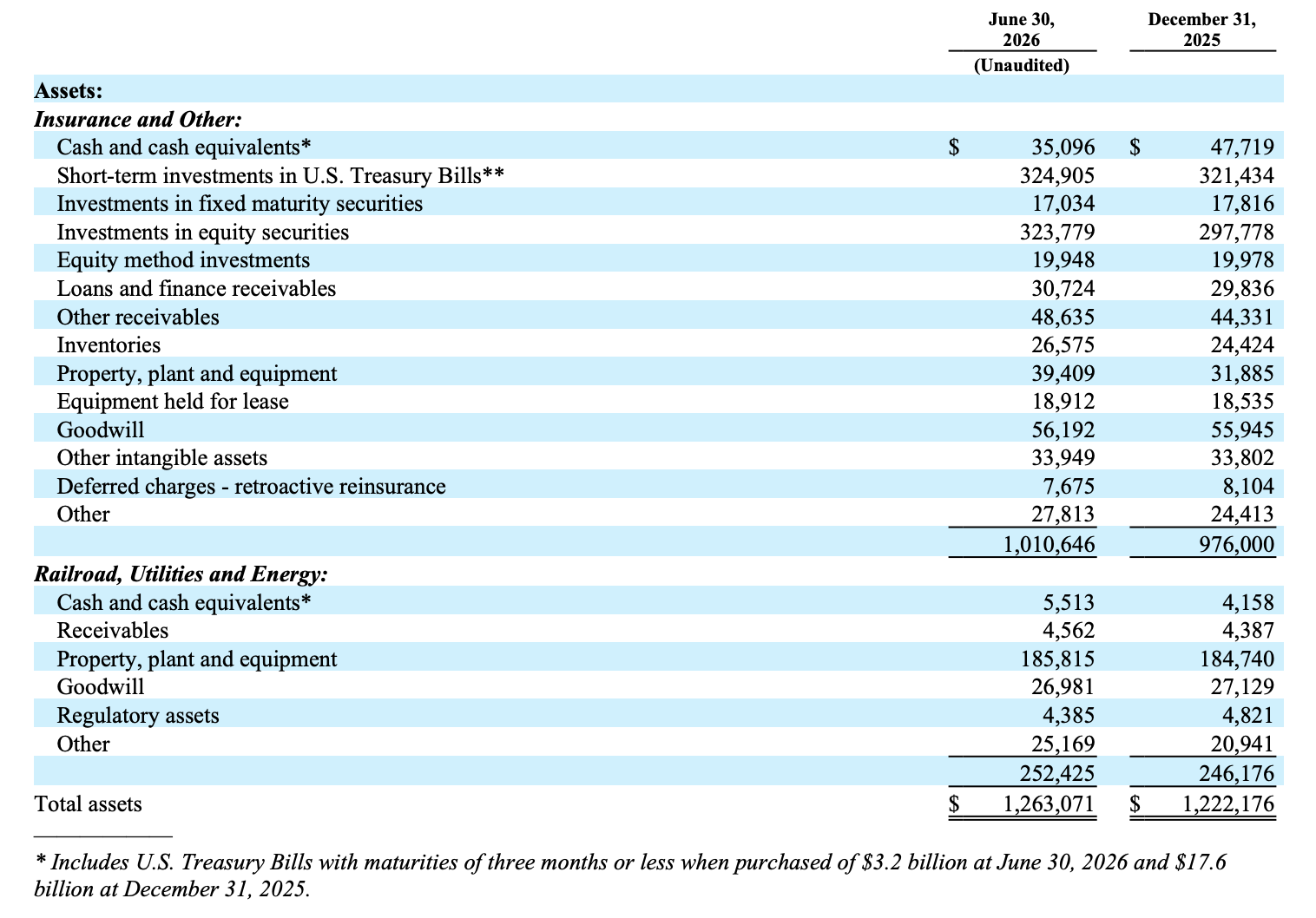
However, as stock purchases, stock buybacks, and industrial acquisitions (primarily for the acquisition of petrochemical company OxyChem and homebuilder Taylor Morrison) unfolded successively, Berkshire Hathaway's cash reserves began to enter a downward trend. As of June 30, Berkshire held approximately $35.1 billion in cash and cash equivalents and about $324.9 billion in short-term U.S. Treasury securities, totaling roughly $364.7 billion. This represents a noticeable decline from the $397.38 billion at the end of the first quarter.
Once Mocked as "Out of Touch," Actually Just Watching Quietly from "the Shore of the Era's Turbulence"

Rewind to the period from 2023 to early 2026.

Over the past few years, the wave of AI technology completely ignited the global capital markets. The chip and semiconductor industry chain, represented by companies like NVIDIA, SK Hynix, Samsung, and Micron, became the most crowded trading sector.

The market was filled with "All in AI" frenzy. Any fund manager not heavily invested in semiconductors was seen as outdated. Meanwhile, Warren Buffett and his Berkshire Hathaway, despite sitting on hundreds of billions of dollars in cash, chose to observe with an almost cold detachment.

Mockery ensued. "Buffett is out of touch with the times," "Value investing is dead," "In the face of the AI revolution, the moat theory is obsolete," "The old man isn't even as good as me"... Doubts like these were endless. People eagerly discussed the semiconductor stocks' surges, often multiplying several or even dozens of times over, and compared them to Berkshire Hathaway's seemingly sluggish stock performance, hastily concluding that this 90-year-old veteran investment master and his designated successor, Abel, had lost their judgment regarding the technological revolution.

But Berkshire Hathaway's choices clearly had their own logic. In the financial report for the second quarter of 2026, Berkshire Hathaway reiterated its iconic warning: "The amount of investment gains/losses in any given quarter is usually meaningless and offers virtually no analytical or predictive value."

This statement, while ostensibly referring to GAAP accounting standards, is actually a reflection of their consistent attitude toward short-term market hype. In the eyes of Buffett and Abel, doubts likely still existed about whether the semiconductor industry could escape its cyclical nature, and uncertainty remained about when the explosive demand for AI hardware would translate into sustainable cash flow.

When the market entered a狂欢 stage and semiconductor company stock prices were elevated, the market environment at that time no longer conformed to Berkshire Hathaway's discipline of "buying wonderful companies at fair prices." Thus, while the market was immersed in FOMO sentiment, Berkshire Hathaway chose the most boring but most DNA-aligned strategy – waiting.

It wasn't until recent months, as semiconductor狂热 suddenly subsided and the previously overhyped targets experienced significant corrections, that investors who had once mocked Buffett for "missing out" suddenly realized their paper gains from chasing semiconductors rapidly evaporated during the pullback. Meanwhile, Berkshire Hathaway's hundreds of billions of dollars in cash not only provided it with unparalleled safety margins but also gave it the confidence to be greedy when others were fearful.

The $19.8 billion in net purchases in the second quarter is a validation of this discipline. It is worth noting that Berkshire Hathaway did not chase the market at its peak; instead, it made large-scale moves only after market volatility and the return of quality asset prices to reasonable ranges.

This is precisely the truth Buffett has practiced for decades – investing is not about who runs the fastest, but about who lives the longest and has the last laugh.


Criptos en tendencia

Preguntas relacionadas

QWhat significant change did Berkshire Hathaway make in its stock trading activity in Q2 2026 according to the article?

AAccording to the article, Berkshire Hathaway ended over three years (14 quarters) of net stock selling and shifted to net buying, with a net purchase of approximately $19.8 billion in Q2 2026.

QWhat was the largest single investment Berkshire Hathaway made in Q2 2026, and what was its significance?

AThe largest single investment was a roughly $10 billion private placement to add to its holdings in Alphabet (Google's parent company). This move made Google officially one of Berkshire Hathaway's top five largest equity holdings by market value.

QHow did Berkshire Hathaway's cash and Treasury holdings change from Q1 to the end of Q2 2026, and what contributed to this change?

AThe combined cash and short-term U.S. Treasury holdings decreased from about $397.38 billion at the end of Q1 to approximately $364.7 billion by June 30, 2026. This decline was attributed to increased stock purchases, share buybacks (including a significant $4.527 billion in Q2), and industrial acquisitions.

QWhat criticism did Berkshire Hathaway face in the years leading up to 2026, and how does the article suggest its recent actions respond to that criticism?

ABerkshire Hathaway was criticized for being 'out of touch with the times' and missing the AI/semiconductor investment frenzy from 2023-early 2026, with critics suggesting value investing was outdated. The article suggests its recent large-scale net buying and disciplined capital deployment after the market cooled demonstrates the long-term wisdom of its 'wait for the right price' strategy, using its massive cash reserves to act when others are fearful.

QWhat does the article imply about Berkshire Hathaway's investment approach towards technology under its new CEO, Greg Abel?

AThe article implies that under new CEO Greg Abel, Berkshire Hathaway's tolerance for and engagement with cutting-edge technology is increasing. The decision for the massive $10 billion additional investment in Alphabet was made under Abel's leadership, marking a potential strategic shift.

Lecturas Relacionadas

Wall Street 'Conspiracy Theory': Did Powell Deliberately Push Up Long-Term U.S. Treasury Yields?

Bank of America refutes market speculation that Federal Reserve Chair Warsh deliberately pushed up long-term U.S. Treasury yields via press conferences to tighten financial conditions. Their report argues such action contradicts the Fed's established policy framework and would lack FOMC support. According to the report, some market participants interpreted the post-July FOMC meeting rise in long-end yields and inflation breakevens as a deliberate strategy by Warsh to combat inflation by tightening financial conditions. Analysts Mark Cabana and Aditya Bhave directly reject this, stating the FOMC's core policy tool remains the federal funds rate, as outlined in its long-term strategy statements. They emphasize Warsh cannot unilaterally alter the Fed's operational approach, which would require full FOMC consensus—a high bar. The analysis highlights the Fed's precise control over overnight rates versus its limited, indirect influence on long-term yields, which operate through policy expectations and the hard-to-manage term premium channel. The recent sharp move in long-end rates serves as a reminder of the risks of operating outside the Fed's direct control. The report concludes the FOMC is unlikely to abandon its proven, controllable tools for unverified methods, dismissing the "four-dimensional chess" theory of long-rate manipulation as market overinterpretation.

marsbitHace 2 min(s)

Wall Street 'Conspiracy Theory': Did Powell Deliberately Push Up Long-Term U.S. Treasury Yields?

marsbitHace 2 min(s)

Third Quarter Beijing Office Market: Investment and Owner-occupier Acquisition Demand to Recover in Parallel

Third Quarter Beijing Office Market: Investment and Owner-Occupier Acquisition Demand to Recover in Parallel Structural shifts in the domestic economy are reshaping office leasing demand. While expansion in high-tech sectors like AI, semiconductors, and new energy will drive demand, traditional industries may downsize to cut costs. Rents are expected to continue declining due to new supply and landlords' concessions, but prime submarkets attracting high-tech tenants will see slower rental declines and faster absorption. Tenants increasingly favor submarkets with strong industry clusters and supportive policies. The adoption of AI may also lead some firms to reduce their office footprint as they optimize workforce efficiency. The investment sales market is showing signs of recovery. Investor-buyers are becoming more active, targeting properties with stable rental income in key tech hubs. Simultaneously, owner-occupier demand is emerging from high-tech firms seeking headquarters. They prefer buildings in relevant industry locations with good renovation potential. Market Strategy for Q3 2026: * For Tenants: Those for whom office image is critical should consider prime buildings in the CBD. Leverage strong brand positions to negotiate favorable terms, including landlord contributions to fit-out costs. * For Landlords: Transition to service providers by offering industry-specific support like financing connections. Proactively engage expiring tenants with renewal incentives and dedicated account management. * For Buyers: Investor-buyers should target stable, well-occupied assets in submarkets like Zhongguancun. Owner-occupiers from high-tech sectors can seek value in properties with good locational fit but financially pressured sellers, carefully assessing renovation costs. Q2 2026 Market Snapshot: The average effective rent for Beijing Grade A offices fell 2.7% QoQ to RMB 197/sqm/month, with vacancy at a high 16.3%. High-tech sectors drove major leases in submarkets like Zhongguancun and Wangjing-Jiuxianqiao. Total investment sales volume reached RMB 14.2 billion, boosted by investor interest in tech areas and owner-occupier acquisitions by high-tech firms. The average sales price rose 24% QoQ to RMB 38,312/sqm, partly due to premium prices paid for owner-occupier purchases in key financial submarkets.

marsbitHace 2 min(s)

Third Quarter Beijing Office Market: Investment and Owner-occupier Acquisition Demand to Recover in Parallel

marsbitHace 2 min(s)

BofA Research Report Insights: Bull & Bear Indicator Rises to 9.7, Liquidity Backstop and Midterm Elections Form Market's Core Contradiction

Bank of America's Bull & Bear indicator rose to 9.7 in early August, its highest since 2021 and nearing a "sell" signal. Weekly flows showed $52.9B into cash, $32.9B into equities, and $23.1B into bonds. The report highlights a core market contradiction: clear policy intent to backstop financial conditions (evidenced by recent coordinated FX intervention, termed a "poor man's LTCM event") versus extreme bullish sentiment, widening credit spreads for AI mega-cap firms, and rising political uncertainty ahead of the midterm elections. Fund flows were mixed: while equity inflows are on a record annualized pace, the tech sector saw its first outflow in six weeks. Bank of America's strategy advises a "summer retreat or rotation"—exiting risk assets or rotating into defensive sectors (consumer staples), duration assets (REITs, small caps, biotech), and the USD to hedge against potential financial tightening. The midterm election is identified as the key macro variable for H2 2026, acting as a referendum on populist fiscal policies. A Republican-held Senate is viewed as market-positive. The report also notes that AI capital expenditure momentum requires the Mag 7 index to recover above 50 to counter threats from cheap Chinese computing. Near-term market direction may hinge on July payroll data, influencing the Fed's Jackson Hole stance. Overall, while liquidity backstops provide downside protection, the extreme Bull & Bear reading suggests limited upside.

marsbitHace 6 min(s)

BofA Research Report Insights: Bull & Bear Indicator Rises to 9.7, Liquidity Backstop and Midterm Elections Form Market's Core Contradiction

marsbitHace 6 min(s)

Trading

Spot

Artículos destacados

Cómo comprar MOVE

¡Bienvenido a HTX.com! Hemos hecho que comprar Movement (MOVE) sea simple y conveniente. Sigue nuestra guía paso a paso para iniciar tu viaje de criptos.Paso 1: crea tu cuenta HTXUtiliza tu correo electrónico o número de teléfono para registrarte y obtener una cuenta gratuita en HTX. Experimenta un proceso de registro sin complicaciones y desbloquea todas las funciones.Obtener mi cuentaPaso 2: ve a Comprar cripto y elige tu método de pagoTarjeta de crédito/débito: usa tu Visa o Mastercard para comprar Movement (MOVE) al instante.Saldo: utiliza fondos del saldo de tu cuenta HTX para tradear sin problemas.Terceros: hemos agregado métodos de pago populares como Google Pay y Apple Pay para mejorar la comodidad.P2P: tradear directamente con otros usuarios en HTX.Over-the-Counter (OTC): ofrecemos servicios personalizados y tipos de cambio competitivos para los traders.Paso 3: guarda tu Movement (MOVE)Después de comprar tu Movement (MOVE), guárdalo en tu cuenta HTX. Alternativamente, puedes enviarlo a otro lugar mediante transferencia blockchain o utilizarlo para tradear otras criptomonedas.Paso 4: tradear Movement (MOVE)Tradear fácilmente con Movement (MOVE) en HTX's mercado spot. Simplemente accede a tu cuenta, selecciona tu par de trading, ejecuta tus trades y monitorea en tiempo real. Ofrecemos una experiencia fácil de usar tanto para principiantes como para traders experimentados.

361 Vistas totalesPublicado en 2024.12.13Actualizado en 2026.06.02

Cómo comprar MOVE

Discusiones

Bienvenido a la comunidad de HTX. Aquí puedes mantenerte informado sobre los últimos desarrollos de la plataforma y acceder a análisis profesionales del mercado. A continuación se presentan las opiniones de los usuarios sobre el precio de MOVE (MOVE).

活动图片