He Xiaopeng Breaks Unitree's Record

marsbitPublicado a 2026-08-25Actualizado a 2026-08-25

Resumen

He Xiaopeng Breaks Unitree's Record: Xiaopeng Group's Humanoid Robot Arm Valued at $6.3 Billion In a landmark deal mirroring Unitree's recent listing, Xiaopeng Group has announced the completion of the first private equity financing round for its humanoid robotics business, led by IDG Capital. The funding round raised over $900 million (approximately 6.5 billion RMB), resulting in a post-investment valuation exceeding $6.3 billion (approximately 43 billion RMB). This surpasses the total funds raised by Unitree Technology in its recent IPO. He Xiaopeng, founder of XPeng Motors, is personally leading the robotics venture as its CEO. Established in 2020, the company has quickly become a super unicorn. Its latest robot model, IRON, debuted in late 2025 with a highly realistic, human-proportioned design and the ability to perform complex movements like a "catwalk," sparking significant online attention. The round saw participation from IDG Capital, Gaorong Capital, and strategic investors Tencent and Alibaba. He Xiaopeng stated that Xiaopeng IRON is on the cusp of mass production, with plans for commercial deployment starting from XPeng's own stores and campuses by the end of 2026, followed by official market launch in 2027. He believes each IRON robot's lifetime revenue and profit contribution will significantly exceed that of the current automotive business per vehicle. This development comes amidst a heated race in China's embodied AI sector, following Unitree's recent list...

This scene rivals Unitree's listing—

It has been learned by Investing Frontier that XPeng Group has officially announced that its humanoid robotics business has signed equity financing agreements with multiple investors. The round is led by IDG Capital, with participation from Gaorong Capital, and also secured support from strategic investors Tencent and Alibaba.

It is worth mentioning that this round marks the first financing for XPeng's robotics business. The financing amount exceeds $9 billion (approximately ¥65 billion), with a post-investment valuation exceeding $63 billion (approximately ¥430 billion). This single-handedly sets a new record for the largest single round of private equity financing in China's embodied AI industry. In comparison, Unitree Technology's final IPO fundraising total was approximately ¥60.99 billion.

This time, He Xiaopeng is personally taking the helm—he is not only the founder of XPeng Motors but is also currently the CEO of XPeng's robotics business. Under his leadership, XPeng's humanoid robotics started in 2020 and has already become a super unicorn with its first financing round.

The timing is quite delicate—just days ago, Unitree Technology debuted on the STAR Market as the "first humanoid robotics stock." A major battle in China's embodied AI sector is unfolding.

¥430 Billion Valuation, Breaking the Record

Alibaba and Tencent Have Arrived

More investment details have emerged.

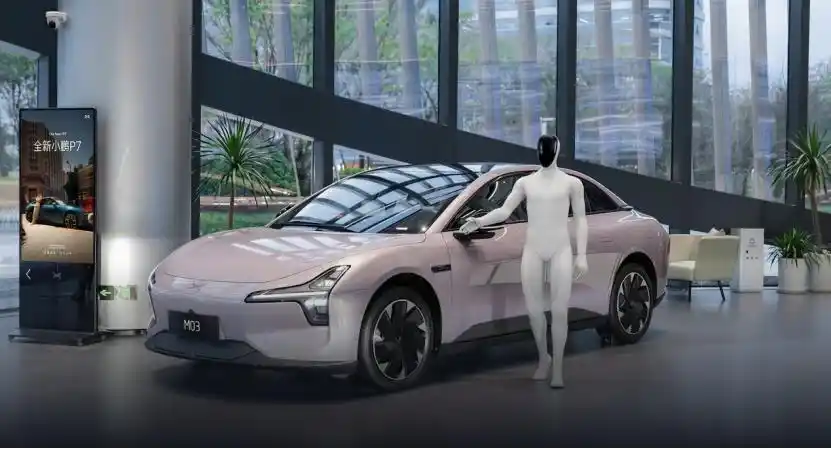
XPeng Group's announcement shows that the transaction entity, Pxing, has a pre-money valuation of $50 billion and a post-money valuation of $63 billion. Among them, a wholly-owned subsidiary of XPeng Group intends to invest $200 million to subscribe for 98.6752 million Series A preferred shares; investors including IDG Capital, Gaorong Capital, Alibaba, and Tencent intend to invest a total of $600 million to subscribe for 296 million Series A preferred shares; the management subscription party, an affiliated entity wholly controlled by He Xiaopeng and Gu Hongdi, intends to invest a total of $100 million to subscribe for 49.3376 million ordinary shares.

For the four external investors, this investment in XPeng Robotics represents one of the largest single disclosed investments each has made in the embodied AI field: IDG Capital invested ¥2.1 billion, while Gaorong Capital, Alibaba, and Tencent each invested ¥720 million.
The announcement also indicates that Pxing can issue additional Series A preferred shares to extra investors within four months of signing the share purchase agreement, raising up to $15 million.

According to the announcement, while introducing this round of financing, XPeng Group and Pxing will implement and complete the Pxing spin-off plan within an agreed period. This involves transferring certain business assets, intellectual property, and personnel related to the robotics business, which are not yet held by Pxing, to Pxing.

Furthermore, the timeline for the capitalization of XPeng's robotics business is becoming clearer. The announcement discloses that if Pxing fails to complete a qualified IPO within seven years after the initial investment closing, investors have the right, under certain conditions, to require Pxing, its significant subsidiaries, or XPeng Group to redeem the relevant shares.

XPeng Group stated in the announcement that this round of financing allows the value of Pxing and the robotics business to be better reflected, attracts robotics-specialized capital distinct from automotive business investors, alleviates the financial burden on XPeng Group with substantial funds, and the participation of renowned international institutional investors will enhance Pxing's image among potential customers, suppliers, and strategic partners.

From IDG Capital's perspective, XPeng's humanoid robot represents the leading level of China's humanoid robotics industry and possesses the capability to compete globally with leading overseas enterprises. XPeng has achieved a full-stack proprietary layout covering edge AI chips, physical AI large models, and complete hardware, boasting industry-leading edge computing power, training computing power, and a high-quality data closed-loop system. Additionally, the robotics business can generate significant strategic synergies with the smart car and autonomous driving businesses. "We believe that with its advantages across the entire chain from core technology R&D and mass production to globalization, XPeng will become a leading enterprise driving the industry towards the large-scale application stage."

Gaorong Capital similarly stated that humanoid robots are transitioning from demonstrating mobility capabilities to achieving stable mass production and creating value in real-world scenarios. XPeng IRON, with its highly anthropomorphic product form and automotive-grade safety standards, enters real commercial scenarios, serving both as an interactive medium close to humans and a crucial entry point for acquiring real-world data. It holds the potential to drive the continuous operation of the 'mass production—data—model—application' flywheel. "XPeng is systematically transferring the full-stack R&D capabilities, supply chain, and manufacturing system accumulated over more than a decade in smart electric vehicles to robotics, laying a solid foundation for the industrialization of humanoid robots."

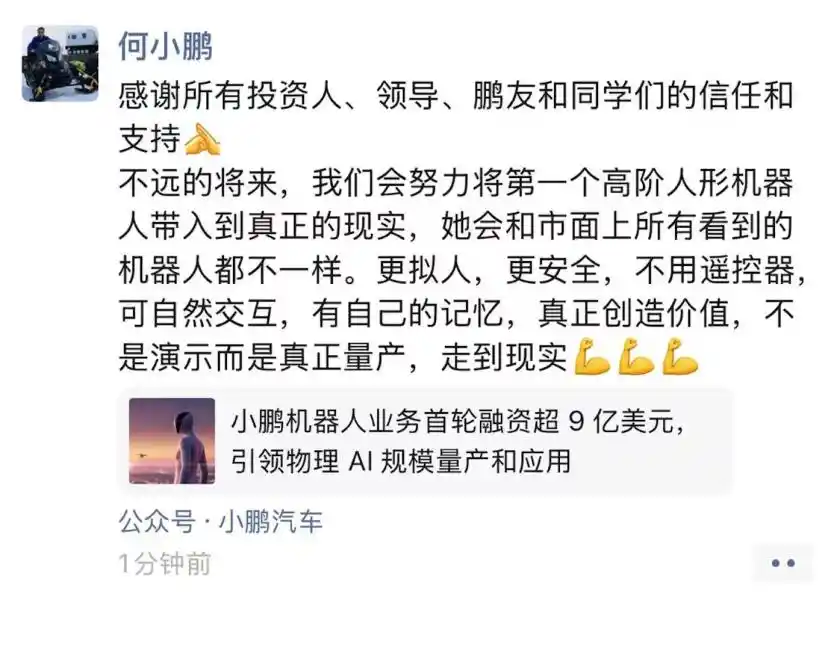
After leading XPeng's humanoid robotics to this milestone, He Xiaopeng expressed profound emotions. He wrote on his WeChat Moments, "In the not-too-distant future, we will strive to bring the first advanced humanoid robot into reality. She will be different from all the robots currently seen on the market."
He Xiaopeng Personally Takes Charge

Robot Capable of Catwalk to be Mass-Produced This Year

XPeng's foray into robotics started much earlier than the public imagined.

It is reported that He Xiaopeng's interest in robotics began as early as 2016. He conducted serious annual research into the robotics direction and once had a long conversation with Wang Xingxing, founder of Unitree.

It wasn't until 2020 that He Xiaopeng decided to act. Introduced by Xiaomi founder Lei Jun, he acquired "Dogotix" founded by Zhao Tongyang and established "Pxing Intelligence" to explore XPeng's robotics business. Later, in September 2023, XPeng Motors acquired the remaining 74.82% stake in Pxing Intelligence for $98.96 million, making Pxing an official robotics division of XPeng Motors. In October of the same year, XPeng's first bipedal humanoid robot, the PX5, was unveiled.

Why such dedication to robotics development? He Xiaopeng has repeatedly emphasized publicly that the greatest value of AI lies in "changing the physical world." In his view, smart electric vehicles are the precursor to robots. Autonomous driving technology solves "minor brain problems" like "movement and balance," accumulating crucial experience for humanoid robots.

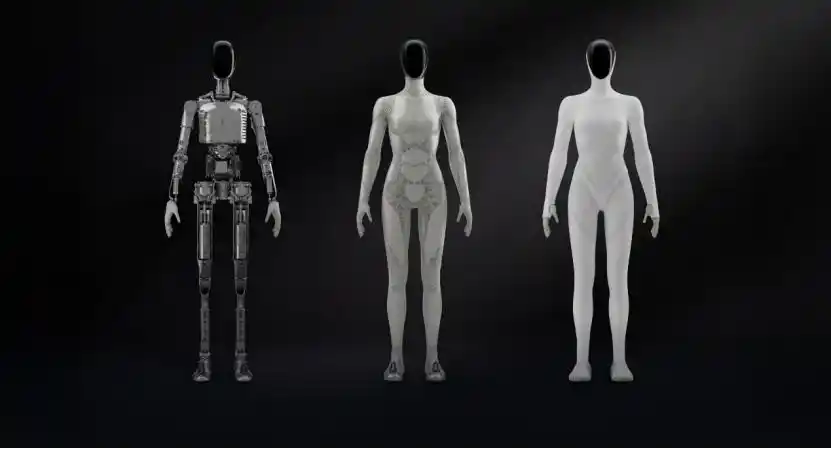
The moment that truly captivated the entire internet occurred at the XPeng Tech Day in November 2025, where the new generation humanoid robot IRON was officially unveiled. Designed with a 1:1 human proportion, it was capable of a catwalk-style walking posture, sparking widespread online discussion. Some netizens even suspected "a real person was hidden inside."

In terms of hardware, the XPeng IRON boasts industry-leading anthropomorphic posture and design, featuring the first full-coverage flexible lattice structure that balances aesthetics and safety. It has 76 degrees of freedom overall, with 21 degrees of freedom in a single hand. Furthermore, XPeng Robotics has independently designed and developed an AI-native hardware platform and all core components for embodied intelligence, including chips, controllers, motion modules, and dexterous hands. Leveraging its established smart electric vehicle R&D and manufacturing system, it aims to achieve automotive-grade quality and large-scale mass production and delivery capabilities.

In terms of intelligence, the XPeng IRON is equipped with three Turing AI chips, delivering an effective computing power of up to 2250 TOPS. The XPeng Physical AI large model is successfully deployed on the edge, enabling it to autonomously complete complex work tasks without remote operation, while ensuring low-latency inference and data security.
Entering 2026, XPeng Robotics accelerated its industrialization pace. In February, the company began constructing the industry's first full-chain mass production base for humanoid robots. In June, He Xiaopeng announced that in addition to serving as Group CEO, he would personally take on the role of CEO for the robotics business. He stated candidly that the XPeng humanoid robot IRON is standing on the threshold of mass production and delivery, comparable to the stage XPeng Motors was at eight years ago, just before completing the launch of its first car, the G3.

According to plan, the XPeng IRON will enter the mass production phase by the end of 2026, starting its commercial application in XPeng's stores and campuses, and will be officially launched and delivered to markets in China and overseas in 2027.

It is worth noting that Pxing remains in a phase of continuous investment, reporting net losses of ¥87 million in 2024 and ¥369 million in 2025. As of the end of March 2026, its net liabilities were approximately ¥447 million, and it has yet to disclose scaled product revenue or external orders.

However, He Xiaopeng remains confident. He stated during the earnings call that the technological barriers for high-level general-purpose robots are extremely high, and high-quality supply is scarce. Therefore, the revenue and gross profit contribution throughout the lifecycle of each IRON unit, including hardware sales and sustained revenue from software AI model capability upgrades, will be significantly higher than the current average selling price and gross profit per vehicle in the automotive business.

Interestingly, He Xiaopeng holds another super unicorn—XPeng AeroHT. Also founded in 2020, XPeng AeroHT focuses on the R&D of intelligent electric flying cars. According to He Xiaopeng, XPeng AeroHT's global orders for the Land Aircraft Carrier have reached 7,000 units, and it has the potential to set a world record for annual sales of manned flying vehicles.

In March this year, XPeng AeroHT completed a new round of equity financing of nearly $200 million, with investors including Hillhouse Ventures, Sequoia Capital China, Gaorong Capital, and Fortune Capital. This brings XPeng AeroHT's total historical equity financing to approximately $1 billion.

During this period, Bloomberg reported that XPeng AeroHT was working with J.P. Morgan and Morgan Stanley on its IPO preparations. XPeng AeroHT responded at the time, emphasizing its current focus on product R&D and mass production delivery, with no other information to share.

It seems likely that He Xiaopeng will once again stand on the stage for an IPO bell-ringing ceremony.

Automakers Jumping In Collectively

Life-and-Death Battle for Chinese Robots Begins

The real elimination race has begun.

Last week, Unitree Technology officially listed on the Shanghai Stock Exchange's STAR Market, becoming the "first humanoid robotics stock" on the A-share market, with its market capitalization briefly reaching nearly ¥450 billion on the first day.

However, Unitree's stock price began to decline the next trading day, and its latest market cap has fallen below ¥250 billion. This "rollercoaster" performance completely shattered the last layer of window dressing in the embodied AI track: before this, startups could rely on technical demonstrations and conceptual proposals to secure financing; after this, the capital market wants to see revenue, mass production, and a commercialization path.

This means the window of opportunity for humanoid robotics startups is rapidly narrowing. For automotive giants, however, this has become the best time to collectively enter the field.

Among them, Tesla is undoubtedly the most aggressive player. Tesla Vice President Tao Lin publicly stated that the Optimus humanoid robot will officially commence large-scale mass production by the end of 2026, with the Fremont factory's long-term annual capacity target set at 1 million units. To this end, the former Model S/X production line at the factory has been converted into an exclusive Optimus production line, scheduled to officially start production in July-August.

Turning our perspective back to China—in February this year, GAC Group officially incubated the humanoid robotics company Huilun Technology and unveiled its fourth-generation robot, the GoMate Mini. Then, in mid-August, Huilun Technology announced the completion of over ¥100 million in financing, jointly invested by CRRC Guochuang Fund, CMB International, Sichuan Science and Technology Innovation, and other institutions.

Such cases are emerging: at the end of March, Changan established Tianshu Intelligent Robotics Company, launching the humanoid robot prototype "Xiao'an"; Li Auto revealed during its Q1 earnings call that its humanoid robot product has been approved for R&D; BYD's commercial service humanoid robot "Xiao Di" was announced in August at the "Di Space" in Zhengzhou; at the same time, news emerged that Chery Automobile's Mojia Robot had started IPO preparations; and at the recently concluded 2026 World Robot Conference, FAW Group, Dongfeng Motor, and Xiaomi Group all showcased their new generation humanoid robots......

Li Xiang, founder of Li Auto, once judged, "In the next 3-5 years, competition in the mid-to-high-end smart car sector will essentially be competition in embodied intelligence. From a market structure perspective, whether it's automakers with initial revenues reaching the hundred-billion-yuan level or larger-scale auto manufacturers, they will all enter the embodied intelligent robotics track."

Previously, a founder of an embodied AI unicorn candidly stated in a conversation with Investing Frontier, "Embodied companies are worried about automakers entering the field because they have ready-made technology and production lines. It's essentially a dimensional reduction strike."

The reason for this concern is self-evident. For startups, the current market landscape seems somewhat suffocating. The competitors they face are no longer peers on the same starting line but automotive giants with cash reserves of tens of billions, complete supply chain systems, large-scale manufacturing capabilities, and global sales networks.

After all, there is significant overlap in the technological systems of automobiles and robots, and this technological homology provides an inherent advantage for automakers. The proprietary chips, large models, perception systems, control systems, and operating systems required for smart cars also form the core technological foundation for general-purpose humanoid robots. Technological capabilities validated in mass-produced vehicles can be directly advanced to humanoid robots.

More importantly, the industrialization capabilities of the automotive industry provide crucial support for robot mass production. The large-scale manufacturing experience, supply chain management systems, and quality control standards from smart cars can be directly applied to robot production.

Thus, automakers don't need to start from scratch when making robots, and car factories themselves are ideal testing and deployment scenarios for humanoid robots.

At present, the final outcome of this elimination race remains unpredictable, but one thing is certain: every player on the track has no way back.

This article is from the WeChat public account "Investing Frontier" (ID: pedaily2012), author: Liu Bo.


Criptos en tendencia

Preguntas relacionadas

QWhat record did Xiaopeng Group's humanoid robot business break in the first round of financing?

AXiaopeng's robot business broke the single-round private equity financing record in China's embodied AI industry, raising over $9 billion with a post-investment valuation exceeding $6.3 billion, surpassing Unitree's total IPO fundraising amount.

QWhich major investors participated in Xiaopeng's robot business financing round led by IDG Capital?

AIDG Capital led the round, with GSR Ventures participating and Tencent and Alibaba providing strategic investment.

QWhat is the name of Xiaopeng's next-generation humanoid robot, and what was a notable feature that sparked online discussion?

AXiaopeng's robot is named IRON. Its debut in November 2025, featuring a cat-walk gait so lifelike it led some netizens to suspect a human was inside the suit, sparked widespread online discussion.

QAccording to the article, why are major automakers like Tesla, Xiaopeng, and others entering the humanoid robot field?

AAutomakers are entering the field because technologies for smart cars (like self-driving chips, AI models, and control systems) overlap significantly with those needed for humanoid robots. They also possess massive manufacturing, supply chain, and industrialization capabilities that can be directly applied to robot production, giving them a potential advantage over startups.

QWhat is the capital market's changing demand for humanoid robot companies, as indicated by Unitree's post-IPO stock performance?

AUnitree's volatile stock performance after its IPO indicates the capital market is shifting its focus from technical demonstrations and concepts to demanding tangible results like revenue, mass production plans, and clear commercialization paths.

Lecturas Relacionadas

Franklin Templeton to Include Tokenized Assets BENJI in ETF and Mutual Fund Lineups

Franklin Templeton is preparing to incorporate tokenized assets into its traditional investment funds, marking a deeper integration of blockchain into mainstream asset management. According to reports, the firm plans to use its Franklin Onchain U.S. Government Money Fund (BENJI) as an asset or collateral within its exchange-traded funds (ETFs) and mutual funds, pending board approvals. The SEC has cleared this structure, permitting the use of this natively digital money market product for cash management and collateral purposes—a first-of-its-kind approval. This move goes beyond simply issuing blockchain versions of existing securities. Franklin already distributes tokenized funds via digital wallets but now aims to use these assets within conventional portfolios to enhance liquidity management and improve the efficiency of idle cash. The firm manages over 130 ETFs globally with around $82 billion in assets and approximately $790 billion in mutual fund assets. Its tokenized money market funds currently manage about $2.6 billion. This step occurs as tokenized real-world assets gain traction on Wall Street, with the total market value exceeding $38 billion. Other major firms like Blackrock and BNY are also expanding blockchain-based fund and settlement initiatives. Tokenization offers benefits like faster settlements, 24/7 transfers, and more efficient collateral use. Franklin's approach integrates these assets seamlessly into traditional fund operations, signaling an evolution where blockchain transitions from an external "wrapper" to a core operational mechanism. The company also plans to launch additional tokenized products for broader use across its fund lineup.

cryptonews.ruHace 2 min(s)

Franklin Templeton to Include Tokenized Assets BENJI in ETF and Mutual Fund Lineups

cryptonews.ruHace 2 min(s)

Liquidity Improvement Upgraded Again: Bonds, Gold, and Bitcoin Rise Simultaneously. Why Do Tech Stocks Continue to Fall?

On August 25th, US financial markets exhibited an unusual pattern: US Treasury bonds, gold, and Bitcoin rose simultaneously, the dollar remained strong, crude oil prices declined, and tech stocks continued to fall. The core drivers were two policy signals from US Treasury Secretary Scott Bessent. First, reports suggested the Treasury might use cash from its General Account (TGA) at the Fed to fund an expansion of long-term bond buybacks. Second, the US policy focus on Iran appeared to shift toward economic sanctions rather than further military escalation. These developments collectively lowered long-term Treasury yields and oil prices, while supporting gold and crypto assets. However, US equities did not broadly rally, with AI and semiconductor stocks continuing to weigh on the Nasdaq. The potential use of TGA cash, estimated at $80-$200 billion, was seen as a stronger tool to stabilize the long-end of the bond market by improving liquidity and altering the supply structure of tradable bonds. This led to a flatter yield curve. However, analysts from Goldman Sachs and others argue such buybacks may not address the fundamental pressures on long-term yields stemming from fiscal deficits, debt supply, sticky inflation, and term premiums. Regarding Iran, the US emphasis on "economic D-Day" sanctions against entities facilitating Iranian oil trade was interpreted as a de-escalation of immediate military risks, leading to a pullback in oil's geopolitical risk premium. However, risks remain for refined products due to transport bottlenecks and global refining capacity constraints. Despite the decline in interest rates, tech stocks, led by semiconductors and AI-related names like Nvidia, extended their losses. This suggests the AI trade is transitioning from a liquidity-driven phase to one focused on validating earnings, valuations, and returns on capital expenditure. Market volatility increased at the index level but decreased for individual stocks, indicating concerns are centered on systemic macro and sector risks rather than company-specific events. In summary, the day's moves reflected a complex mix of factors: improved bond market liquidity expectations, a temporary downgrade of Iran-related oil risks, and support for alternative assets from lower real rates. Tech stocks' divergence highlights a shift toward fundamental scrutiny amid ongoing macro policy uncertainty.

marsbitHace 9 min(s)

Liquidity Improvement Upgraded Again: Bonds, Gold, and Bitcoin Rise Simultaneously. Why Do Tech Stocks Continue to Fall?

marsbitHace 9 min(s)

Goldman Sachs Research Report Analysis: Cryptocurrency Trading Declines for Ten Consecutive Months, Turning Point May Be Approaching

Gold Sachs Research Note: Crypto Trading Declines for Ten Months, Inflection Point May Be Near Crypto trading volumes fell 30% in July and 21% in August, marking ten consecutive months of decline—a duration now exceeding the median of past five cycles. However, in a report dated August 24, Goldman Sachs expresses "cautious optimism" for the second half, suggesting a market recovery could provide significant upside potential. The current crypto trading volume downturn has seen a 75% drop from its peak over ten months. While a brief rebound in April-May failed to sustain, a recent 21% market cap increase, if maintained, could signal a volume inflection point. Goldman notes sector valuations are near the 30th percentile of the past five years, presenting a favorable risk-reward profile. Key catalysts include regulatory progress, such as the SEC's innovation exemption proposal and over 15 crypto firms receiving federal banking charters by 2026, which could bolster institutional adoption. Furthermore, crypto companies have cut costs by ~5% on average in 2026, improving operating margins and preserving cash flow. The report highlights four Buy-rated stocks: HOOD ($124 target), IBKR ($114 target, on Conviction List), FIGR ($43 target), and COIN ($196 target), each benefiting from distinct growth drivers like structural account growth, international expansion, or regulatory tailwinds. Overall, Goldman argues the sector has priced in significant pessimism, with a potential reversal supported by seasonal trends, election cycles, and a combination of market cap recovery, cost-cutting, and regulatory reforms.

marsbitHace 12 min(s)

Goldman Sachs Research Report Analysis: Cryptocurrency Trading Declines for Ten Consecutive Months, Turning Point May Be Approaching

marsbitHace 12 min(s)

Stanford Business School Internal Guide: Look Beyond the Reputation, How to Accurately Identify the 5% of Truly 'Top VCs'

"Stanford Business School Internal Guide: Beyond Reputation, How to Precisely Identify the Top 5% of 'Elite VCs'" Professor Ilya Strebulaev of Stanford Graduate School of Business, using data from 230,000 investments, reveals that the top 5% of venture capital firms generate approximately 90% of the industry's profits. For founders, choosing the wrong investor can mean a tenfold difference in returns. The article introduces the data-driven 2026 Strebulaev-Jackson VC Ranking, an alternative to lists like Forbes Midas. It scores nearly 13,000 investors across 30 years based on six factors: dilution-adjusted ownership, net profit (investment cost subtracted), value-add (e.g., lead investor/board role), and attribution of credit between firms and individual partners. Key findings from the top 100 firms: - Sequoia Capital leads with 10,158 points. - Performance follows a power law: the #1 firm scores ~41x more than #100. - Unicorn count is a poor performance proxy (e.g., SV Angel with 139 unicorns ranks #31). - 21 of the top 100 were founded in 2015 or later. - 23 firms have their top-scoring investment in frontier AI/AI infrastructure. - Geography remains concentrated: 62 in California, 19 in New York. The author cautions against using the rank order blindly. Founders must prioritize: 1. Strategic fit (stage, sector, involvement model) over raw rank. 2. Due diligence on the specific partner, not just the firm brand. 3. Recognizing that VC partnerships are long-term commitments akin to marriages. The ranking is a tool to identify the elite 5%, but the final choice requires deeper research into partner dynamics and how investors behave during a company's difficult times.

marsbitHace 12 min(s)

Stanford Business School Internal Guide: Look Beyond the Reputation, How to Accurately Identify the 5% of Truly 'Top VCs'

marsbitHace 12 min(s)

Trading

Spot

Artículos destacados

Qué es $S$

Entendiendo SPERO: Una Visión General Completa Introducción a SPERO A medida que el panorama de la innovación continúa evolucionando, la aparición de tecnologías web3 y proyectos de criptomonedas juega un papel fundamental en la configuración del futuro digital. Un proyecto que ha atraído la atención en este campo dinámico es SPERO, denotado como SPERO,$$s$. Este artículo tiene como objetivo reunir y presentar información detallada sobre SPERO, para ayudar a entusiastas e inversores a comprender sus fundamentos, objetivos e innovaciones dentro de los dominios web3 y cripto. ¿Qué es SPERO,$$s$? SPERO,$$s$ es un proyecto único dentro del espacio cripto que busca aprovechar los principios de descentralización y tecnología blockchain para crear un ecosistema que promueva la participación, la utilidad y la inclusión financiera. El proyecto está diseñado para facilitar interacciones de igual a igual de nuevas maneras, proporcionando a los usuarios soluciones y servicios financieros innovadores. En su esencia, SPERO,$$s$ tiene como objetivo empoderar a los individuos al proporcionar herramientas y plataformas que mejoren la experiencia del usuario en el espacio de las criptomonedas. Esto incluye habilitar métodos de transacción más flexibles, fomentar iniciativas impulsadas por la comunidad y crear caminos para oportunidades financieras a través de aplicaciones descentralizadas (dApps). La visión subyacente de SPERO,$$s$ gira en torno a la inclusividad, buscando cerrar brechas dentro de las finanzas tradicionales mientras aprovecha los beneficios de la tecnología blockchain. ¿Quién es el Creador de SPERO,$$s$? La identidad del creador de SPERO,$$s$ sigue siendo algo oscura, ya que hay recursos públicos limitados que proporcionan información de fondo detallada sobre su(s) fundador(es). Esta falta de transparencia puede derivarse del compromiso del proyecto con la descentralización, una ética que muchos proyectos web3 comparten, priorizando las contribuciones colectivas sobre el reconocimiento individual. Al centrar las discusiones en torno a la comunidad y sus objetivos colectivos, SPERO,$$s$ encarna la esencia del empoderamiento sin señalar a individuos específicos. Como tal, comprender la ética y la misión de SPERO sigue siendo más importante que identificar a un creador singular. ¿Quiénes son los Inversores de SPERO,$$s$? SPERO,$$s$ cuenta con el apoyo de una diversa gama de inversores que van desde capitalistas de riesgo hasta inversores ángeles dedicados a fomentar la innovación en el sector cripto. El enfoque de estos inversores generalmente se alinea con la misión de SPERO, priorizando proyectos que prometen avances tecnológicos sociales, inclusión financiera y gobernanza descentralizada. Estas fundaciones de inversores suelen estar interesadas en proyectos que no solo ofrecen productos innovadores, sino que también contribuyen positivamente a la comunidad blockchain y sus ecosistemas. El respaldo de estos inversores refuerza a SPERO,$$s$ como un contendiente notable en el dominio de proyectos cripto que evoluciona rápidamente. ¿Cómo Funciona SPERO,$$s$? SPERO,$$s$ emplea un marco multifacético que lo distingue de los proyectos de criptomonedas convencionales. Aquí hay algunas de las características clave que subrayan su singularidad e innovación: Gobernanza Descentralizada: SPERO,$$s$ integra modelos de gobernanza descentralizada, empoderando a los usuarios para participar activamente en los procesos de toma de decisiones sobre el futuro del proyecto. Este enfoque fomenta un sentido de propiedad y responsabilidad entre los miembros de la comunidad. Utilidad del Token: SPERO,$$s$ utiliza su propio token de criptomoneda, diseñado para servir diversas funciones dentro del ecosistema. Estos tokens permiten transacciones, recompensas y la facilitación de servicios ofrecidos en la plataforma, mejorando la participación y la utilidad general. Arquitectura en Capas: La arquitectura técnica de SPERO,$$s$ apoya la modularidad y escalabilidad, permitiendo la integración fluida de características y aplicaciones adicionales a medida que el proyecto evoluciona. Esta adaptabilidad es fundamental para mantener la relevancia en el cambiante paisaje cripto. Participación de la Comunidad: El proyecto enfatiza iniciativas impulsadas por la comunidad, empleando mecanismos que incentivan la colaboración y la retroalimentación. Al nutrir una comunidad sólida, SPERO,$$s$ puede abordar mejor las necesidades de los usuarios y adaptarse a las tendencias del mercado. Enfoque en la Inclusión: Al ofrecer tarifas de transacción bajas e interfaces amigables para el usuario, SPERO,$$s$ busca atraer a una base de usuarios diversa, incluyendo a individuos que anteriormente pueden no haber participado en el espacio cripto. Este compromiso con la inclusión se alinea con su misión general de empoderamiento a través de la accesibilidad. Cronología de SPERO,$$s$ Entender la historia de un proyecto proporciona información crucial sobre su trayectoria de desarrollo y hitos. A continuación se presenta una cronología sugerida que mapea eventos significativos en la evolución de SPERO,$$s$: Fase de Conceptualización e Ideación: Las ideas iniciales que forman la base de SPERO,$$s$ fueron concebidas, alineándose estrechamente con los principios de descentralización y enfoque comunitario dentro de la industria blockchain. Lanzamiento del Whitepaper del Proyecto: Tras la fase conceptual, se lanzó un whitepaper completo que detalla la visión, los objetivos y la infraestructura tecnológica de SPERO,$$s$ para generar interés y retroalimentación de la comunidad. Construcción de Comunidad y Primeras Interacciones: Se realizaron esfuerzos de divulgación activa para construir una comunidad de primeros adoptantes y posibles inversores, facilitando discusiones en torno a los objetivos del proyecto y obteniendo apoyo. Evento de Generación de Tokens: SPERO,$$s$ llevó a cabo un evento de generación de tokens (TGE) para distribuir sus tokens nativos a los primeros seguidores y establecer liquidez inicial dentro del ecosistema. Lanzamiento de la dApp Inicial: La primera aplicación descentralizada (dApp) asociada con SPERO,$$s$ se puso en marcha, permitiendo a los usuarios interactuar con las funcionalidades centrales de la plataforma. Desarrollo Continuo y Alianzas: Actualizaciones y mejoras continuas a las ofertas del proyecto, incluyendo alianzas estratégicas con otros actores en el espacio blockchain, han moldeado a SPERO,$$s$ en un jugador competitivo y en evolución en el mercado cripto. Conclusión SPERO,$$s$ se erige como un testimonio del potencial de web3 y las criptomonedas para revolucionar los sistemas financieros y empoderar a los individuos. Con un compromiso con la gobernanza descentralizada, la participación comunitaria y funcionalidades diseñadas de manera innovadora, allana el camino hacia un paisaje financiero más inclusivo. Como con cualquier inversión en el espacio cripto que evoluciona rápidamente, se anima a los posibles inversores y usuarios a investigar a fondo y participar de manera reflexiva con los desarrollos en curso dentro de SPERO,$$s$. El proyecto muestra el espíritu innovador de la industria cripto, invitando a una mayor exploración de sus innumerables posibilidades. Mientras el viaje de SPERO,$$s$ aún se desarrolla, sus principios fundamentales pueden, de hecho, influir en el futuro de cómo interactuamos con la tecnología, las finanzas y entre nosotros en ecosistemas digitales interconectados.

452 Vistas totalesPublicado en 2024.12.17Actualizado en 2024.12.17

Qué es $S$

Qué es AGENT S

Agent S: El Futuro de la Interacción Autónoma en Web3 Introducción En el paisaje en constante evolución de Web3 y las criptomonedas, las innovaciones están redefiniendo constantemente cómo los individuos interactúan con las plataformas digitales. Uno de estos proyectos pioneros, Agent S, promete revolucionar la interacción humano-computadora a través de su marco agente abierto. Al allanar el camino para interacciones autónomas, Agent S busca simplificar tareas complejas, ofreciendo aplicaciones transformadoras en inteligencia artificial (IA). Esta exploración detallada profundizará en las complejidades del proyecto, sus características únicas y las implicaciones para el dominio de las criptomonedas. ¿Qué es Agent S? Agent S se presenta como un marco agente abierto innovador, diseñado específicamente para abordar tres desafíos fundamentales en la automatización de tareas informáticas: Adquisición de Conocimiento Específico del Dominio: El marco aprende inteligentemente de diversas fuentes de conocimiento externas y experiencias internas. Este enfoque dual le permite construir un rico repositorio de conocimiento específico del dominio, mejorando su rendimiento en la ejecución de tareas. Planificación a Largo Plazo de Tareas: Agent S emplea planificación jerárquica aumentada por la experiencia, un enfoque estratégico que facilita la descomposición y ejecución eficiente de tareas complejas. Esta característica mejora significativamente su capacidad para gestionar múltiples subtareas de manera eficiente y efectiva. Manejo de Interfaces Dinámicas y No Uniformes: El proyecto introduce la Interfaz Agente-Computadora (ACI), una solución innovadora que mejora la interacción entre agentes y usuarios. Utilizando Modelos de Lenguaje Multimodal de Gran Escala (MLLMs), Agent S puede navegar y manipular diversas interfaces gráficas de usuario sin problemas. A través de estas características pioneras, Agent S proporciona un marco robusto que aborda las complejidades involucradas en la automatización de la interacción humana con las máquinas, preparando el terreno para una multitud de aplicaciones en IA y más allá. ¿Quién es el Creador de Agent S? Si bien el concepto de Agent S es fundamentalmente innovador, la información específica sobre su creador sigue siendo elusiva. El creador es actualmente desconocido, lo que resalta ya sea la etapa incipiente del proyecto o la elección estratégica de mantener a los miembros fundadores en el anonimato. Independientemente de la anonimidad, el enfoque sigue siendo en las capacidades y el potencial del marco. ¿Quiénes son los Inversores de Agent S? Dado que Agent S es relativamente nuevo en el ecosistema criptográfico, la información detallada sobre sus inversores y patrocinadores financieros no está documentada explícitamente. La falta de información disponible públicamente sobre las bases de inversión u organizaciones que apoyan el proyecto plantea preguntas sobre su estructura de financiamiento y hoja de ruta de desarrollo. Comprender el respaldo es crucial para evaluar la sostenibilidad del proyecto y su posible impacto en el mercado. ¿Cómo Funciona Agent S? En el núcleo de Agent S se encuentra una tecnología de vanguardia que le permite funcionar de manera efectiva en diversos entornos. Su modelo operativo se basa en varias características clave: Interacción Humano-Computadora Similar a la Humana: El marco ofrece planificación avanzada de IA, esforzándose por hacer que las interacciones con las computadoras sean más intuitivas. Al imitar el comportamiento humano en la ejecución de tareas, promete elevar las experiencias de los usuarios. Memoria Narrativa: Empleada para aprovechar experiencias de alto nivel, Agent S utiliza memoria narrativa para hacer un seguimiento de las historias de tareas, mejorando así sus procesos de toma de decisiones. Memoria Episódica: Esta característica proporciona a los usuarios una guía paso a paso, permitiendo que el marco ofrezca apoyo contextual a medida que se desarrollan las tareas. Soporte para OpenACI: Con la capacidad de ejecutarse localmente, Agent S permite a los usuarios mantener el control sobre sus interacciones y flujos de trabajo, alineándose con la ética descentralizada de Web3. Fácil Integración con APIs Externas: Su versatilidad y compatibilidad con varias plataformas de IA aseguran que Agent S pueda encajar sin problemas en ecosistemas tecnológicos existentes, convirtiéndolo en una opción atractiva para desarrolladores y organizaciones. Estas funcionalidades contribuyen colectivamente a la posición única de Agent S dentro del espacio cripto, ya que automatiza tareas complejas y de múltiples pasos con una intervención humana mínima. A medida que el proyecto evoluciona, sus posibles aplicaciones en Web3 podrían redefinir cómo se desarrollan las interacciones digitales. Cronología de Agent S El desarrollo y los hitos de Agent S pueden encapsularse en una cronología que resalta sus eventos significativos: 27 de septiembre de 2024: El concepto de Agent S fue lanzado en un documento de investigación integral titulado “Un Marco Agente Abierto que Usa Computadoras Como un Humano”, mostrando las bases del proyecto. 10 de octubre de 2024: El documento de investigación fue puesto a disposición del público en arXiv, ofreciendo una exploración profunda del marco y su evaluación de rendimiento basada en el benchmark OSWorld. 12 de octubre de 2024: Se lanzó una presentación en video, proporcionando una visión visual de las capacidades y características de Agent S, involucrando aún más a posibles usuarios e inversores. Estos marcadores en la cronología no solo ilustran el progreso de Agent S, sino que también indican su compromiso con la transparencia y la participación comunitaria. Puntos Clave Sobre Agent S A medida que el marco Agent S continúa evolucionando, varios atributos clave destacan, subrayando su naturaleza innovadora y potencial: Marco Innovador: Diseñado para proporcionar un uso intuitivo de las computadoras similar a la interacción humana, Agent S aporta un enfoque novedoso a la automatización de tareas. Interacción Autónoma: La capacidad de interactuar de manera autónoma con las computadoras a través de GUI significa un salto hacia soluciones informáticas más inteligentes y eficientes. Automatización de Tareas Complejas: Con su metodología robusta, puede automatizar tareas complejas y de múltiples pasos, haciendo que los procesos sean más rápidos y menos propensos a errores. Mejora Continua: Los mecanismos de aprendizaje permiten a Agent S mejorar a partir de experiencias pasadas, mejorando continuamente su rendimiento y eficacia. Versatilidad: Su adaptabilidad en diferentes entornos operativos como OSWorld y WindowsAgentArena asegura que pueda servir a una amplia gama de aplicaciones. A medida que Agent S se posiciona en el paisaje de Web3 y criptomonedas, su potencial para mejorar las capacidades de interacción y automatizar procesos significa un avance significativo en las tecnologías de IA. A través de su marco innovador, Agent S ejemplifica el futuro de las interacciones digitales, prometiendo una experiencia más fluida y eficiente para los usuarios en diversas industrias. Conclusión Agent S representa un audaz avance en la unión de la IA y Web3, con la capacidad de redefinir cómo interactuamos con la tecnología. Aunque aún se encuentra en sus primeras etapas, las posibilidades para su aplicación son vastas y atractivas. A través de su marco integral que aborda desafíos críticos, Agent S busca llevar las interacciones autónomas al primer plano de la experiencia digital. A medida que nos adentramos más en los reinos de las criptomonedas y la descentralización, proyectos como Agent S sin duda desempeñarán un papel crucial en la configuración del futuro de la tecnología y la colaboración humano-computadora.

839 Vistas totalesPublicado en 2025.01.14Actualizado en 2025.01.14

Qué es AGENT S

Cómo comprar S

¡Bienvenido a HTX.com! Hemos hecho que comprar Sonic (S) sea simple y conveniente. Sigue nuestra guía paso a paso para iniciar tu viaje de criptos.Paso 1: crea tu cuenta HTXUtiliza tu correo electrónico o número de teléfono para registrarte y obtener una cuenta gratuita en HTX. Experimenta un proceso de registro sin complicaciones y desbloquea todas las funciones.Obtener mi cuentaPaso 2: ve a Comprar cripto y elige tu método de pagoTarjeta de crédito/débito: usa tu Visa o Mastercard para comprar Sonic (S) al instante.Saldo: utiliza fondos del saldo de tu cuenta HTX para tradear sin problemas.Terceros: hemos agregado métodos de pago populares como Google Pay y Apple Pay para mejorar la comodidad.P2P: tradear directamente con otros usuarios en HTX.Over-the-Counter (OTC): ofrecemos servicios personalizados y tipos de cambio competitivos para los traders.Paso 3: guarda tu Sonic (S)Después de comprar tu Sonic (S), guárdalo en tu cuenta HTX. Alternativamente, puedes enviarlo a otro lugar mediante transferencia blockchain o utilizarlo para tradear otras criptomonedas.Paso 4: tradear Sonic (S)Tradear fácilmente con Sonic (S) en HTX's mercado spot. Simplemente accede a tu cuenta, selecciona tu par de trading, ejecuta tus trades y monitorea en tiempo real. Ofrecemos una experiencia fácil de usar tanto para principiantes como para traders experimentados.

1.6k Vistas totalesPublicado en 2025.01.15Actualizado en 2026.06.02

Cómo comprar S

Discusiones

Bienvenido a la comunidad de HTX. Aquí puedes mantenerte informado sobre los últimos desarrollos de la plataforma y acceder a análisis profesionales del mercado. A continuación se presentan las opiniones de los usuarios sobre el precio de S (S).

活动图片